At its core, Holotropic Breathwork is a surprisingly simple yet profound technique for self-exploration and healing. It uses nothing more than your own breath, accelerated and deepened, combined with powerful music to guide you into non-ordinary states of consciousness. It’s a way to tap into your own innate healing wisdom.
Think of it as a form of deep psychological exploration, where your breath acts as the catalyst to journey into your inner landscape, uncovering and resolving old emotional patterns.
A Journey Into Your Inner World

Imagine your mind is a vast ocean. Your day-to-day awareness—the to-do lists, worries, and surface-level thoughts—is just the choppy surface. The holotropic breathwork technique gives you the scuba gear to dive deep below, exploring the hidden currents, forgotten treasures, and rich ecosystems of your subconscious.
This powerful method was developed by psychiatrists Stanislav and Christina Grof as a drug-free alternative to psychedelic therapy. They found that specific breathing patterns, when done in a supportive environment, could reliably trigger profound experiences that lead to incredible personal growth and emotional release. It’s not just about breathing fast; it’s about creating the right conditions for your inner healer to wake up and get to work.
The Three Pillars of the Technique
The whole practice rests on three core elements that work together seamlessly. Understanding how they function demystifies the process and helps you feel more prepared for the experience.
- Accelerated Breathing: The engine of the practice is conscious connected breathing. This means you breathe deeper and faster than you normally would, without any pause between your inhales and exhales. Actionable Tip: To get a feel for this, try it for just 30 seconds. Lie down, close your eyes, and breathe in fully through your mouth, letting your belly expand, then exhale through your mouth without pausing. Notice the immediate shift in your body’s energy.
- Evocative Music: A carefully chosen soundtrack is your guide on the journey. The music isn’t just background noise; it’s an active component. It often starts with driving, rhythmic beats to build energy, flows into more dramatic and emotional pieces to help unearth buried feelings, and finally settles into gentle, heart-centered melodies to help you integrate the experience.
- A Safe and Supportive Setting: This is crucial. Holotropic Breathwork is almost always done with others, either in pairs or groups. One person is the “breather,” and their partner is the “sitter.” The sitter’s only job is to be a quiet, reassuring presence—to make sure the breather feels completely safe and to offer simple support (like a glass of water or a hand on the shoulder) without ever interrupting or directing the breather’s process.
“By combining breathing, evocative music, and a safe setting, Holotropic Breathwork creates an opportunity for individuals to access their own inner healing wisdom.”
What This Means for You
This isn’t a passive relaxation exercise. It’s an active, dynamic process of self-discovery. By engaging with this technique, you give yourself a chance to release tension you’ve been holding onto for years, process unresolved emotions, and uncover insights that are normally out of reach.
The benefits aren’t just anecdotal. A study published in the Journal of Psychoactive Drugs found that participants in a Holotropic Breathwork workshop reported significant reductions in death anxiety and an increase in self-esteem. Another peer-reviewed study in the Journal of Alternative and Complementary Medicine showed it was highly effective in reducing symptoms of PTSD and depression. Similarly, research in the International Journal of Transpersonal Studies confirms that participants frequently report a decrease in neuroticism and a noticeable increase in self-awareness after sessions.
While Holotropic Breathwork is a complete practice in itself, many people find that combining it with other tools can help deepen your meditation practice and integrate the insights gained. Ultimately, it’s one powerful approach in a wide world of healing. To see where it fits in the bigger picture, it can be helpful to learn more about what breathwork therapy is and how it helps.
The Origins of Holotropic Breathwork
To really get what holotropic breathwork is all about, you have to look at where it came from. This isn’t some fly-by-night wellness trend; it’s a practice born from decades of serious, and often controversial, psychological research into the depths of human consciousness.
The story starts not with breathing, but with psychedelics.
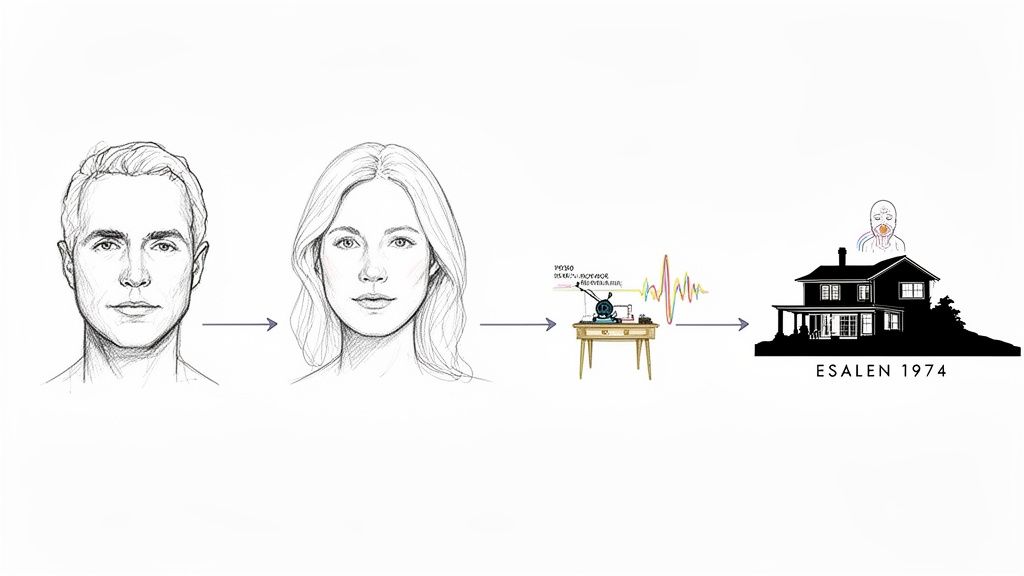
The method was developed by two pioneers: psychiatrist Stanislav Grof and his late wife, Christina Grof. Back in the 1950s and 60s, Stanislav was at the center of clinical research exploring the therapeutic potential of substances like LSD. His work involved thousands of sessions where patients navigated the deepest parts of their minds to work through trauma and other deep-seated psychological issues.
From Psychedelics to Breath
During these intense therapeutic sessions, Grof noticed something fascinating. As the effects of the psychedelic substance started to fade, his patients would often start breathing faster and deeper. They did this completely on their own, without any instruction. It was as if their own bodies knew this was the way to prolong the profound healing state they were in.
That was the lightbulb moment. Grof began to wonder if the breath itself could be the key to unlocking these non-ordinary states of consciousness, without any substance at all. It was a radical idea suggesting that our own bodies hold the tools for profound psychological exploration. Think about that for a second: your breath is a built-in mechanism for shifting your entire state of being.
“The breath is the bridge which connects life to consciousness, which unites your body to your thoughts.” – Thich Nhat Hanh
This insight kicked off a period of focused experimentation. The Grofs set out to design a complete system—using only accelerated breathing, evocative music, and a safe, supportive environment—that could reliably guide people into similar healing experiences. Their mission was to create a drug-free path for deep self-exploration that anyone could access.
The Birth of a New Technique
The result of all this work was the formal creation of Holotropic Breathwork. In 1974, at the famous Esalen Institute in Big Sur, California, Stanislav and Christina Grof officially introduced their method for accessing altered states for deep psychological healing. You can learn more about the history of this unique approach to healing and its journey from clinical research to global practice.
Knowing this history is key. It shows that Holotropic Breathwork isn’t just a random set of breathing exercises. It’s a carefully constructed modality with a rich scientific and therapeutic foundation, designed with one clear purpose: to tap into the mind’s incredible, innate capacity to heal itself.
What Science Says About the Benefits
While the experience of Holotropic Breathwork can feel mystical and deeply personal, its effects aren’t just in your head. They are real, measurable changes backed by a growing body of scientific research. It’s not just about the journey you take during a session; it’s about the tangible, positive shifts that stick with you long after.
The benefits tend to fall into three main categories: serious stress reduction, a huge boost in self-awareness, and the potential to finally work through old emotional baggage.
So, how does it work? The fast, deep breathing temporarily changes your body’s chemistry—specifically, the balance of oxygen and carbon dioxide. This little trick helps quiet down the overthinking, analytical part of your brain. Once the “inner critic” is on a coffee break, deeper parts of your psyche can come forward to be seen, processed, and released. The result is often profound psychological and emotional relief.
Dials Down Stress and Anxiety
One of the first things people notice is how powerfully this practice calms the nervous system. Most of us live in a low-grade state of “fight-or-flight,” and this breathwork helps shift you back into “rest and digest” mode, where true recovery happens. This isn’t just a feeling; you can see it in your body’s chemistry.
Regular practice can lead to a noticeable drop in cortisol, the main stress hormone. It also helps rebalance your autonomic nervous system, something you can track with a metric called Heart Rate Variability (HRV). A higher, more adaptable HRV is a clear sign of a resilient system that can handle stress better. If you want to dive deeper into this, you can learn more about how to improve heart rate variability and why it’s so important for your overall health.
A 2013 study published in the Journal of Alternative and Complementary Medicine really put this to the test. Participants in a breathwork program reported a significant decrease in anxiety symptoms and a corresponding drop in feelings of depression after just one month. That’s a powerful testament to its impact on mental well-being.
A Shortcut to Self-Awareness and Growth
Beyond just chilling you out, this technique is an incredible tool for self-discovery. By stepping into a non-ordinary state of consciousness, you get to look at your life, your habits, and your challenges from a completely new vantage point—without the usual ego filters getting in the way. People often have “aha!” moments that bring a ton of clarity about who they are and what they really want.
This isn’t just some fluffy, subjective claim. Research has shown that the practice can actually shift personality traits, helping people become more flexible and less rigid in their thinking. For professionals feeling stuck in a rut or burned out, this can be a game-changer.
A detailed 2015 study, for example, found statistically significant improvements in temperament. Participants became less rigid and persistent in unhelpful ways, and they also showed a big drop in people-pleasing tendencies—a major source of workplace dissatisfaction for many. You can actually look at the complete study findings on temperament changes and see the data for yourself.
Healing Old Emotional Wounds
This might be the most profound benefit of all: the ability to help heal deep emotional wounds and trauma. Trauma isn’t just a bad memory; it’s energy and emotion that get stuck in the body. Holotropic Breathwork creates a safe space for that stored energy to finally be released somatically—through physical sensations, spontaneous movements, or a good cry.
The process cleverly bypasses the conscious mind, which often wants to suppress or explain away painful feelings. Instead, it trusts the body’s innate intelligence—the “inner healer”—to bring up whatever is ready to be processed and integrated.
This is backed by clinical research. One study published in the International Journal of Transpersonal Studies with individuals who had experienced significant trauma found that a group breathwork program led to a significant decrease in symptoms of Post-Traumatic Stress Disorder (PTSD) and depression. It gave them a way to safely revisit and release the imprints of their experiences, leading to a real sense of lasting freedom.
What To Expect During Your First Session
Walking into your first Holotropic Breathwork session can feel a lot like preparing for a deep-sea dive—there’s a mix of excitement and maybe a little nervousness about what you’ll discover in the depths. Knowing the lay of the land (or, in this case, the water) can help you relax and get the most out of the experience.
A well-run session isn’t just a free-for-all; it’s carefully structured to create a safe and supportive space for profound inner work. The entire process is broken down into three key phases, each one building on the last. This thoughtful structure is what makes the holotropic breathwork technique so powerful.
The Preparation Phase: Setting The Stage
Before you take a single deep breath, the facilitator lays the groundwork. Think of this as creating a secure “container” for the journey ahead. They’ll walk everyone through the process, answer any lingering questions, and establish clear guidelines so the whole group feels safe and respected.
This is also when you’ll get paired up. In a group setting, you’ll alternate between two essential roles:
- The Breather: The person actively doing the breathwork and exploring their inner world.
- The Sitter: The sitter is a quiet, supportive presence. Their job isn’t to guide or interfere but simply to be there, offering a reassuring hand or a tissue if needed, ensuring the breather feels completely safe.
Finally, you’ll be gently guided to set an intention. This isn’t about chasing a specific outcome. It’s more like pointing your inner compass in a general direction. Actionable Tip: Before your first session, spend 5 minutes journaling on the question, “What am I ready to release or understand?” This can help you arrive with a clear, gentle intention like, “I am open to what needs to be seen,” or “I want to connect with my inner strength.”
The Breathwork Journey: The Inner Voyage
Once you’re settled and lying down comfortably, the music starts. This is your cue to begin the breathing—a little deeper and faster than normal, with no pauses between the inhale and exhale. The music is far more than just background ambiance; it’s a powerful co-pilot on your journey. The soundtrack is meticulously designed to help you navigate different layers of consciousness, starting with intense, rhythmic beats before softening into more emotional or tranquil melodies.
What you experience is completely unique to you. Some people see vivid imagery or revisit memories, while others feel intense physical sensations or a powerful emotional release. There’s no right or wrong way for it to unfold. The real work is to trust your body’s intelligence and allow whatever surfaces to move through you without judgment.
One peer-reviewed study highlighted that this process can lead to significant psychological growth, including an increased sense of purpose and a deeper connection to oneself and others. The journey isn’t just about release; it’s about profound self-discovery.
This process helps people move from a state of anxiety toward greater self-awareness and even trauma resolution.
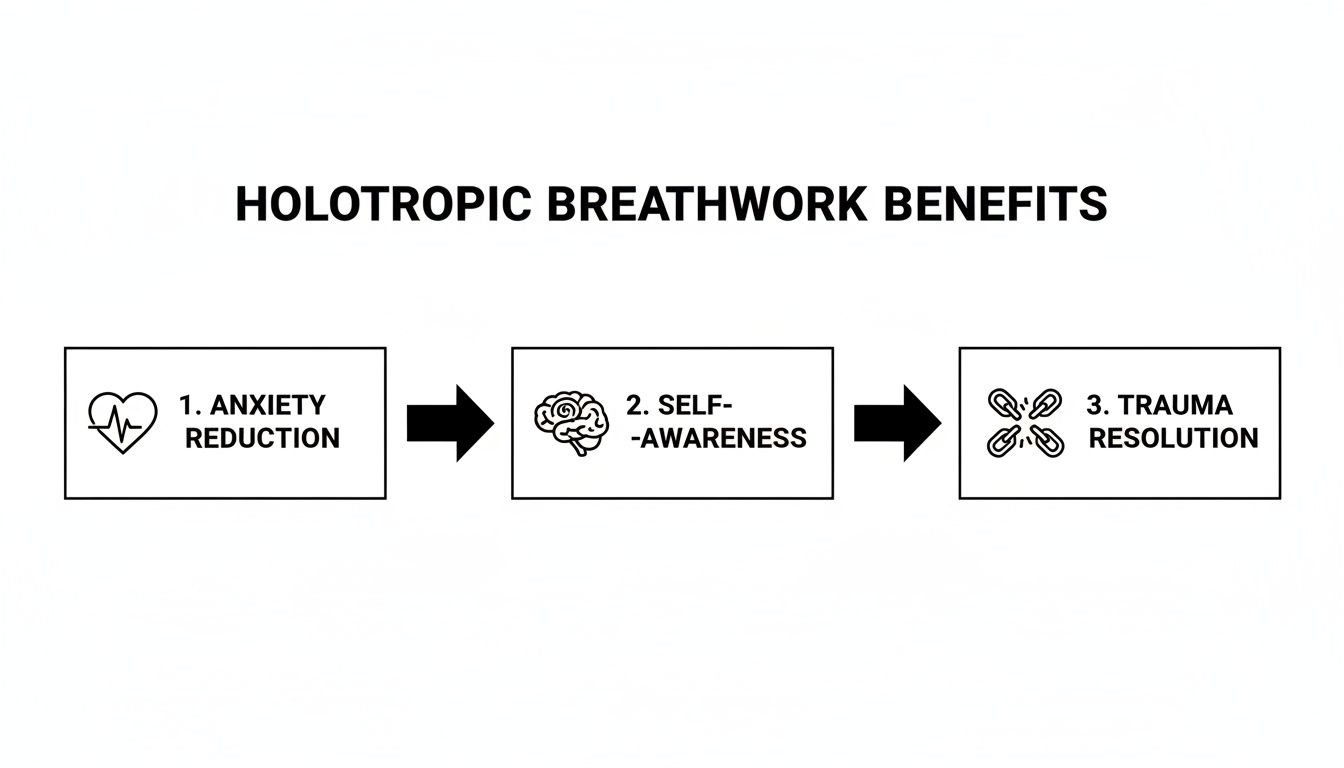
The practice provides a path to manage stress, build a stronger connection with yourself, and begin working through deep-seated emotional patterns.
The Integration Phase: Making Sense Of It All
As the music fades and the intense breathing subsides, you’re given quiet time just to be. This is a critical moment for the insights from your journey to settle in. Once you feel ready, you’ll be offered art supplies to create a mandala, which is simply a drawing within a circle. You don’t need any artistic skill—the goal is to express your inner experience visually, without words.
The session usually wraps up with an optional sharing circle. It’s a space to put words to your experience, if you feel called to, and to listen as others share theirs. This simple act of speaking and listening helps ground the experience in reality and reinforces the feeling of a shared human journey. This integration work is what turns a powerful experience into lasting change. Scientific research supports this, showing that integrating non-ordinary states is key to long-term positive outcomes in well-being.
To give you a clearer picture, here’s how a typical session breaks down:
The Three Phases of a Holotropic Breathwork Session
| Phase | Primary Goal | Key Activities |
|---|---|---|
| Preparation | To create a safe and supportive environment for deep inner exploration. | Introduction, Q&A, pairing up into “breathers” and “sitters,” and setting a personal intention. |
| The Journey | To access non-ordinary states of consciousness for healing and self-discovery. | Lying down comfortably, continuous deep breathing, and listening to evocative music. |
| Integration | To ground the experience and begin processing insights in a meaningful way. | Quiet rest period, optional mandala drawing, and a voluntary group sharing circle. |
Each phase is designed to support you from start to finish, ensuring the journey inward is as safe as it is profound.
Finding a Qualified Facilitator and Practicing Safely
Diving into Holotropic Breathwork is a serious commitment to your inner work, and that means one thing comes before anything else: safety. While the practice is generally very safe, it’s not for everyone. The first and most important step you can take is to understand the risks and learn how to find a guide you can trust.
This isn’t a casual breathing exercise; it’s designed to bring intense emotional and physical experiences to the surface. Because of that, there are some clear contraindications. If you are pregnant or have serious cardiovascular issues, severe hypertension, glaucoma, or a personal history of psychosis, this practice is not recommended.
Being honest with yourself about your health history is key. A good facilitator will help you assess if this is the right path for you, not just try to sign you up.
Vetting Your Guide: Questions to Ask
Choosing your facilitator is hands-down the most critical decision you’ll make on this journey. You’re not just looking for someone who can explain a breathing pattern. You’re looking for someone who can create and hold a secure “container”—a space where you feel safe enough to let go and navigate deep emotional and psychological territory.
Think of your facilitator as an anchor. Their job is to make the environment feel supportive and completely free from judgment, which is what allows you to fully surrender to your own healing process. To find that person, you have to ask the right questions.
Here’s an actionable checklist to use when researching facilitators:
- “Where did you get your certification?” Look for someone certified through Grof® Legacy Training or a similar, well-respected organization. This tells you they’ve gone through rigorous, supervised training directly from the source.
- “How do you create a safe container for deep emotional release?” A skilled guide should be able to walk you through their exact process for managing intense experiences. They should have a clear plan for ensuring everyone feels physically and emotionally secure.
- “What does your post-session integration support look like?” The real work often begins after the breathing stops. Ask them how they help you make sense of it all. Do they use mandala drawing, group sharing, or offer follow-up support?
The Importance of a Controlled Environment
Holotropic Breathwork is so powerful because it happens in a controlled, supportive setting. It’s the combination of the breath, the music, and the safe environment that makes deep healing possible. This is absolutely not something to try on your own or with an untrained friend.
A key study from the Multidisciplinary Association for Psychedelic Studies (MAPS) found that participants felt a significant drop in anxiety and a boost in self-esteem. They pointed directly to the structured, group-supported setting as the reason for these positive changes. Having a trained guide and supportive peers was critical.
This emphasis on a structured, safe container has been validated time and again, even in demanding clinical environments. A groundbreaking 12-year program used this technique with 11,000 psychiatric inpatients. The result? Nursing staff reported zero complications or complaints—a perfect safety record when managed by professionals. This proves that while the experience is profound, the method itself is incredibly low-risk inside the right container. You can read the full clinical report on Holotropic Breathwork’s safety for a deeper look.
The process of releasing stored emotions is often physical, a core principle in somatic healing. A good facilitator knows how to guide this physical release safely and effectively. If you’re curious about this connection, you might want to learn more about what somatic therapy is and how it works.
At the end of the day, a peer-reviewed article in the Journal of Alternative and Complementary Medicine put it best: the safety and success of practices like this are directly tied to the facilitator’s skill and the structure of the session. When you prioritize finding a great guide, you give yourself the best chance to experience the incredible rewards of Holotropic Breathwork responsibly.
Frequently Asked Questions About Holotropic Breathwork
Diving into a practice as deep as Holotropic Breathwork naturally brings up some questions. Let’s walk through some of the most common ones so you can feel clear and confident about what to expect.
How Is This Different From Meditation?
This is a great question. While both paths lead toward greater self-awareness, the journey itself is completely different.
Think of meditation as sitting quietly on a riverbank, watching the water of your thoughts flow by without getting swept away. It’s often about cultivating stillness and detached observation.
Holotropic Breathwork, on the other hand, is about jumping right into that river. It’s an active, energetic practice designed to stir things up, bringing what’s hidden in the subconscious to the surface so it can be processed and released. The aim isn’t quiet observation; it’s deep, active engagement. Practical Example: In meditation, you might notice an anxious thought and let it float past. In Holotropic Breathwork, that same anxiety might manifest as a tingling sensation in your chest or a sudden urge to cry, allowing you to physically release the emotion rather than just observe it.
Can I Practice Holotropic Breathwork Alone?
In its traditional form, the Holotropic Breathwork technique is absolutely not a solo practice. It’s designed to be done with a trained facilitator and a sitter, and for good reason.
The experience can bring up intense physical sensations and powerful emotional releases. Having a professional there to hold a safe space is non-negotiable. They ensure you’re supported and guided, no matter what comes up.
If you’re looking for something to do on your own, stick to guided audio journeys created specifically for individual use. And if you ever find yourself in an unexpectedly intense state during any kind of breathwork, it’s smart to have tools ready. Learning a few grounding techniques for dissociation is a fantastic way to prepare.
A study on the therapeutic effects of breathwork noted that the supportive group setting was a key factor in participants’ positive outcomes, highlighting the importance of a guided environment.
How Many Sessions Are Needed to See Benefits?
There’s no magic number, as everyone’s journey is their own. Many people walk away from their very first session with a profound insight or a significant emotional shift. It can be that powerful.
But it’s more helpful to think of it as an ongoing practice rather than a one-and-done fix.
The real, lasting changes come with consistency. Just like going to the gym, the benefits build over time. Regular sessions can lead to sustained improvements in stress levels, emotional regulation, and a much deeper connection to yourself. Actionable step: Instead of aiming for a specific number of sessions, commit to a consistent practice for three months. Track your progress in a journal, noting changes in your mood, sleep, and overall sense of well-being to see the cumulative benefits for yourself.
At 9D Breathwork, we honor these foundational principles while weaving in modern sound technology and expert guidance. We’ve designed a powerful experience that meets the unique challenges of today. Discover our approach and see how it can support your own journey at https://9dbreathwork.com.