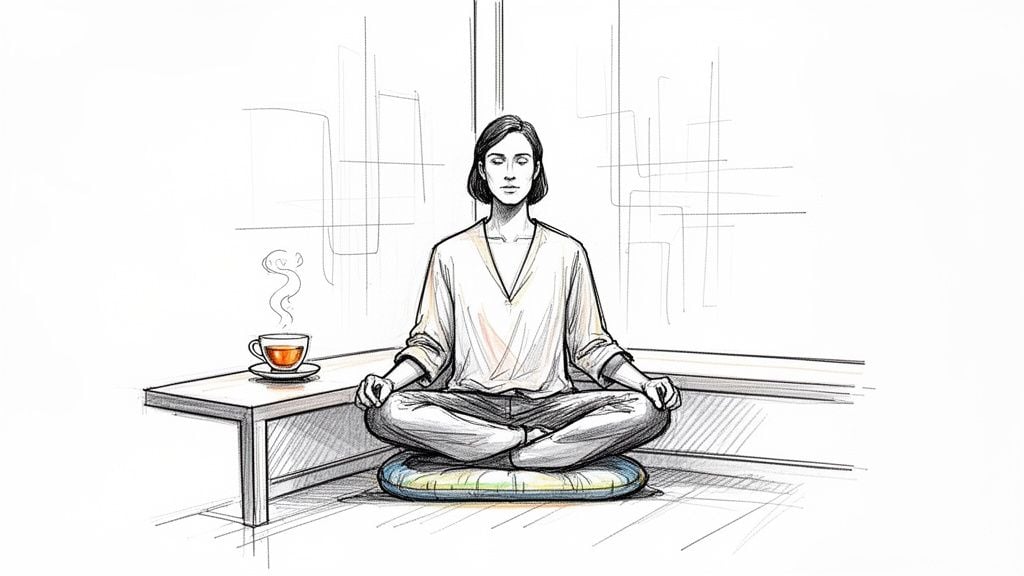
Grounding techniques are less about complicated mental gymnastics and more about simple, sensory-based actions that bring you back to the present moment. Think of them as a way to interrupt that feeling of floating away by intentionally engaging your senses—touch, sight, sound—to re-anchor yourself in the here and now.
Understanding Dissociation and Why Grounding Works

First things first: dissociation isn’t a flaw or a weakness. It’s an incredibly smart, protective response your brain uses when things get overwhelming. Faced with intense stress, anxiety, or trauma, your mind creates distance to cope.
This can manifest in subtle ways, like feeling a bit detached during a high-pressure meeting, or in more profound ways, where the world feels unreal, almost like you’re just watching a movie of your life.
The Brain’s Protective Disconnect
You can think of dissociation as your nervous system hitting the emergency exit. When the sensory information coming in is just too much to process, the brain dials down its connection to the present to shield you.
This survival mechanism is wired deep into our biology. A study published in the European Journal of Psychotraumatology highlights that dissociation is a common peritraumatic response, essentially the brain’s attempt to survive an experience it deems intolerable. This protective disconnect, while useful in the moment, can interfere with daily life when it becomes a go-to coping strategy.
While this protective disconnect is a natural response, it can interfere with daily life when it becomes a go-to coping strategy. Dissociative disorders are a serious mental health challenge, with international prevalence rates sitting between 1% and 5%. What’s truly startling is that many people spend 5 to 12.5 years in the mental health system before getting a correct diagnosis, largely because the symptoms are so often misunderstood.
How Grounding Acts as a Circuit Breaker
This is exactly where grounding techniques show their power. They act like a circuit breaker, deliberately pulling your focus away from those overwhelming internal feelings and directing it toward concrete, neutral details in the world around you.
Grounding is the practice of anchoring your awareness in the present moment. By tuning into your senses, you send a clear signal to your brain: “I am right here, right now, and I am safe.” This simple act interrupts the dissociative loop and re-establishes a connection between your mind and body.
By consciously noticing the solid feel of your feet on the floor, the rough texture of your jeans, or the smell of coffee brewing nearby, you actively pull your awareness back into your physical self. It’s not magic; it’s a practical skill that can give you an immediate sense of control and stability. This ability to help regulate the nervous system is why grounding is now a cornerstone of modern, trauma-informed care.
The Science Behind Sensory Anchoring
So, what’s happening in the brain when you focus on a simple sensation? Research into sensory processing has shown that engaging our senses can powerfully shift our mental state. For instance, a 2019 study in Frontiers in Psychology revealed that tactile stimulation, like holding a textured object, lights up brain regions linked to self-awareness and attention. This neural shift directly counters the “out-of-body” sensation of dissociation by reinforcing your sense of your physical self.
In the same vein, a 2021 study published in Chemical Senses showed how olfaction (your sense of smell) has a potent link to memory and emotion. A familiar scent can instantly snap you back to the present, bypassing the tangled thought patterns that often fuel dissociation. Your senses are a direct line to the parts of your brain that register safety and presence. For those interested in how creativity can help, exploring the broader art therapy benefits for mental health can provide some fascinating insights.
The table below breaks down the core ideas behind grounding and how they work in practice.
Core Principles of Grounding
| Principle | How It Counters Dissociation | A Practical Example |
|---|---|---|
| Sensory Engagement | Pulls focus from internal distress to external, neutral stimuli. | Action: Hold an ice cube. Don’t just hold it—describe the feeling to yourself. “It’s freezing, wet, smooth on one side, and sharp on the edge.” |
| Present-Moment Focus | Interrupts thoughts about the past (trauma) or future (anxiety). | Action: Name 5 things you can see in the room right now. Be specific: “the blue pen,” “the dusty laptop screen,” “the chipped mug handle.” |
| Mind-Body Reconnection | Reinforces the brain’s awareness of the physical body. | Action: Stomp your feet on the ground. Feel the vibration travel up your legs. Do it three times and focus only on that physical shock. |
| Nervous System Regulation | Activates the parasympathetic nervous system, promoting a state of calm. | Action: Take a slow, deep breath and try to identify one specific scent in the air. Is it coffee? Rain? The paper in a book? |
Ultimately, grounding is about empowerment. It gives you a tangible, actionable method you can use anywhere, anytime, to reclaim your presence and find your footing—one breath and one sensation at a time.
Sensory Grounding Tools for Immediate Relief
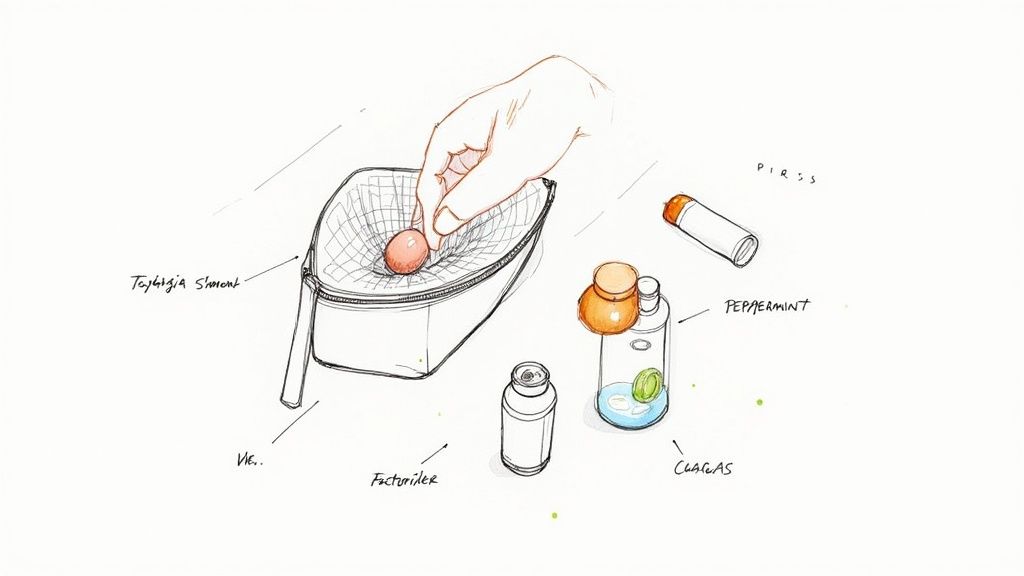
When you feel that familiar sensation of drifting away—the world turning fuzzy or your own thoughts feeling distant—you need something that works right now. This isn’t about theory; it’s about having practical, real-world tools in your back pocket to pull you back to the present moment.
Think of these sensory grounding techniques as your emergency toolkit. They’re designed to interrupt a dissociative state by giving your brain something tangible and immediate to latch onto. Best of all, they’re discreet and accessible enough to use anywhere, from a hectic meeting to a quiet walk home.
And this isn’t just wishful thinking; the science is solid. Grounding techniques are evidence-based interventions that help anchor you in the present. Research has shown they can effectively reduce symptoms of PTSD, anxiety, and dissociation by re-establishing your connection to reality when you feel yourself slipping. You can dive deeper into the clinical findings on grounding techniques to see just how powerful they are.
The 5-4-3-2-1 Lifeline
One of the most trusted and effective methods out there is the 5-4-3-2-1 technique. It’s more than just a simple exercise; it’s a lifeline that systematically brings your attention back to your immediate environment, one sense at a time.
Imagine you’re in a busy cafe, and the noise starts to feel overwhelming, the lights too bright. You feel that disconnect starting. Instead of letting panic set in, you can quietly start the sequence:
- See 5 things: Look around and mentally name five objects. The grain of the wooden table, a crack in the floor tile, the barista’s blue apron, the swirl of foam on a latte, the reflection in the window. Action: Say them silently to yourself.
- Touch 4 things: Shift your focus to physical sensations. Feel the smooth, cool surface of your phone, the texture of the fabric on your jeans, the warmth of your mug, the solid pressure of your feet inside your shoes. Action: Physically touch each item and describe its texture in your mind. “Smooth,” “rough,” “warm,” “solid.”
- Hear 3 things: Tune your ears to the sounds around you. Can you isolate three distinct noises? Maybe it’s the clink of a spoon against ceramic, the low hum of the espresso machine, and the murmur of a conversation at the next table. Action: Close your eyes for just a second to help you isolate each sound.
- Smell 2 things: This one can be subtle, which is part of the point. Can you catch the scent of roasted coffee beans in the air? Or the faint, clean smell of your own hand soap? Action: Take a deliberate sniff of the air. If you can’t smell anything, sniff your own sleeve or hair.
- Taste 1 thing: Now, focus on one thing you can taste. It could be the lingering sweetness of the sugar in your drink, the mint from your gum, or simply the neutral taste inside your mouth. Action: Take a sip of your drink or pop a mint if you have one. If not, simply notice the sensation inside your mouth.
The real power of the 5-4-3-2-1 method is its structure. It gives your mind a specific, sequential job to do, which diverts your focus away from the internal chaos of dissociation and plants you firmly back in the external, observable world.
Physical Anchors You Can Use Anywhere
Sometimes, a single, strong sensory input is all it takes to jolt your awareness back to the present. These are tangible, physical anchors you can count on for immediate, discreet relief when you need it most.
Temperature Shock
A sudden shift in temperature is incredibly effective at cutting through the mental fog. That sharp, undeniable sensation demands your brain’s immediate attention.
- Try this when: You feel a wave of derealization coming on during a conversation.
- Actionable example: Quietly pick up a cold can of seltzer or a glass of ice water. Press it against the inside of your wrist or the back of your neck. Focus entirely on that intense cold as it spreads across your skin. Close your eyes for a second and just feel the cold.
Textural Focus
Engaging your sense of touch with a unique or complex texture can pull your focus outward. Your brain has to process the new information, which is a great way to interrupt a dissociative loop.
- Try this when: You’re in a meeting and can feel yourself starting to zone out.
- Actionable example: Run your thumb over the textured surface of a credit card, the raised stitching on your notebook, or the specific grooves of a key on your keychain. Describe the texture to yourself in one word: “bumpy,” “ridged,” “sharp.”
Aromatic Anchors
Scent is directly wired to memory and emotion, making it an exceptionally powerful grounding tool. A strong, familiar smell can instantly slice through mental static.
- Try this when: You’re in a crowded public space and start to feel overwhelmed or detached.
- Actionable example: Keep a small vial of peppermint or citrus essential oil in your bag. When you feel that disconnect, you can discreetly bring it to your nose and take a deep, intentional inhale. Focus on following the scent all the way in and all the way out.
Building Your Proactive Grounding Practice
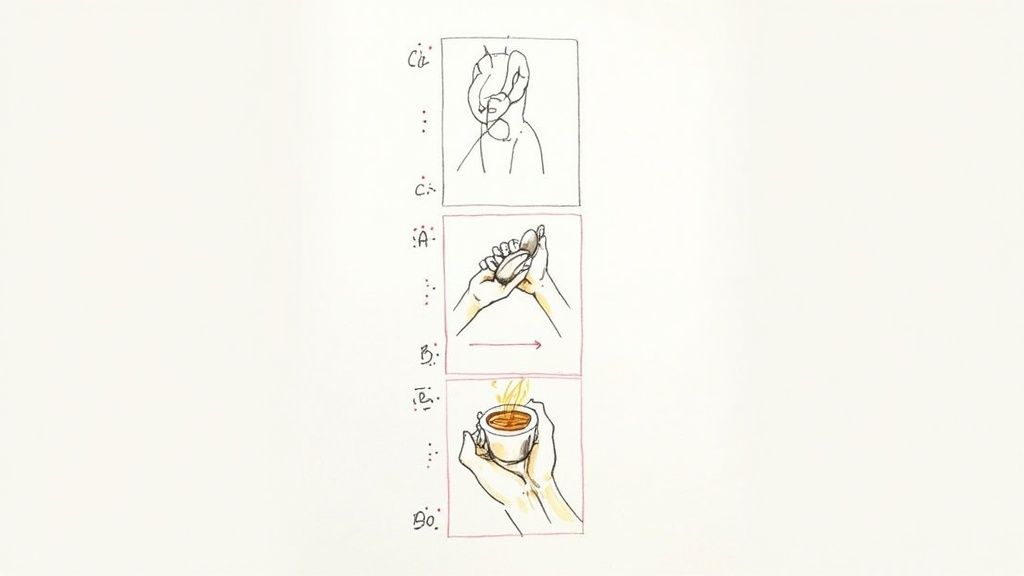
While having in-the-moment grounding techniques is crucial for pulling yourself back, the real game-changer is shifting from reactive rescue to proactive resilience. It’s about weaving grounding into the fabric of your daily life, making it a habit rather than an emergency-only tool.
Think of it like this: you’re training your nervous system to prefer being present. Every time you proactively ground yourself, you’re carving out new, healthier neural pathways. Research into neuroplasticity backs this up completely. A landmark 2018 study in Nature Reviews Neuroscience showed how repeated behaviors physically strengthen the brain circuits tied to them. So, when you practice grounding regularly, you’re building a well-worn path back to the present moment, making it much easier to find when you start to drift.
Create a Personalized Grounding Kit
One of the most concrete ways to get started is by putting together your own grounding kit. This isn’t some fancy or complicated setup—it’s just a small, portable collection of things you’ve chosen to engage your senses and pull you back into your body.
The magic word here is personalization. Your kit has to work for you, filled with items that bring a sense of comfort and safety. Keep them in a little pouch, a dedicated pocket in your bag, or a desk drawer so they’re always within reach.
Action: Spend 15 minutes this week gathering items for your kit. Here are ideas to get you started:
- Touch: A smooth, cool stone you found on a walk, a small square of soft velvet, a squishy stress ball, or even a coin with a unique texture.
- Smell: A tiny vial of essential oil like lavender or cedarwood, a sachet of dried herbs, or a travel-sized hand lotion with a scent you love.
- Sight: A small photo of a person, pet, or place that makes you feel genuinely happy and safe.
- Taste: A few strong mints, sour candies, or a piece of dark chocolate. The intense flavor can cut through the fog.
- Sound: A tiny bell, or just a specific playlist on your phone with music that instantly calms you.
Having these tools on hand takes the pressure off. When you feel yourself disconnecting, you don’t have to scramble to think of a technique; you can just reach for your kit and connect with an object that’s already a trusted anchor.
The Power of Grounding Rituals
Beyond the kit, the most profound shift happens when you build grounding rituals into your schedule. We’re not talking about long, elaborate ceremonies. These are short, intentional, 5-minute practices that can bookend your day with a sense of presence.
Consistency trumps intensity every time. A simple 5-minute daily practice is far more powerful than a one-hour session you only do once a month. You’re creating predictable anchors of safety in your own routine.
Treat these rituals like preventative maintenance for your nervous system. Research confirms this works; a 2020 study in the Journal of Affective Disorders found that people who practiced daily mindfulness had significantly lower levels of dissociation over time. This shows that small, consistent doses of present-moment awareness really can dial down the frequency and severity of episodes.
Weaving Grounding into Your Daily Flow
The key is to make these rituals feel natural, not like another task on your to-do list. Just find small pockets of time where you can insert a moment of intentional awareness.
Morning Grounding Ritual (5 minutes)
- The Goal: Start the day feeling connected to your body and the world around you.
- Action: Before you even get out of bed, take three slow, deep breaths. Then, as you stretch your arms and legs, really feel it. Pay attention to the sensation of your muscles waking up, the texture of the sheets on your skin, and the solid weight of your body on the mattress.
Evening Grounding Ritual (5 minutes)
- The Goal: Let go of the day’s stress and signal to your body that it’s time to rest.
- Action: Make a cup of caffeine-free tea and focus only on that experience. Notice the warmth of the mug in your hands, the steam rising, the aroma, and the taste of each sip. If your mind wanders off to worry or plan, gently bring it back to the tea.
By dedicating just a few minutes each day, you’re actively building a stronger foundation of safety within yourself. This proactive work helps to calm your nervous system over the long haul, making it less vulnerable to the triggers that cause you to disconnect. You’re building a home within yourself, one small, consistent moment at a time.
Grounding in the Real World: Adapting for Work and Trauma
Grounding techniques aren’t a one-size-fits-all prescription. Their power lies in how well they fit your life, and that means adapting them for the situation at hand. A high-stakes work meeting and the quiet space of trauma recovery are two very different worlds, and your grounding tools need to reflect that.
This is where we move beyond the basics. For a busy professional, the key is discretion—finding ways to stay present without drawing unwanted attention. For a trauma survivor, the focus shifts to safety and choice, carefully selecting techniques that feel empowering, not overwhelming.
Subtle Grounding for the Office
Let’s be real: you can’t exactly start a deep breathing exercise in the middle of a tense board meeting. The professional world demands a certain level of composure, which can feel like an impossible standard when you’re starting to feel disconnected or floaty.
The trick is to have a few go-to techniques that are completely invisible to everyone else. These are small, physical anchors that can pull you back into the room without anyone knowing.
Action Plan for Your Next Stressful Meeting:
- The Desk Anchor: Press your feet flat on the floor. Really feel them. Notice the solid ground beneath you. Wiggle your toes inside your shoes. The simple act of noticing that sensation is a powerful anchor.
- Hidden Pressure: Press your thumb firmly into the palm of your other hand under the table. Or, press your fingertips, one by one, into your thigh. This creates a focused, physical sensation that cuts through the mental noise.
- Tune In: Pick one neutral sound in the room and focus on it. It could be the low hum of a server, the ticking of a clock, or the gentle whoosh of the HVAC system. Let it be the one thing you listen to.
The point isn’t to magically erase stress at work; it’s to stay present with it. Think of these as your secret weapons for keeping your feet on the ground when the pressure mounts.
A Trauma-Informed Approach to Grounding
If you have a history of trauma, your relationship with your body can be incredibly complex. Sensations that others find calming might feel threatening or triggering for you. This is why a trauma-informed approach to grounding is not just helpful—it’s essential.
It all comes down to creating safety and choice. A 2022 study in the Journal of Traumatic Stress emphasized that agency—the feeling of being in control—is absolutely crucial for healing. What does this mean for grounding? It means you are always the one in charge. If a technique feels wrong, scary, or just “off,” you have 100% permission to stop. No questions asked.
The Gentle Art of Titration
One of the most important concepts from trauma therapy we can apply here is titration. It’s a fancy word for a simple idea: introducing something in small, manageable doses. Instead of flooding your system with intense sensations, you dip a toe in, see how it feels, and proceed slowly.
Forcing yourself into a full-body scan when you’re already feeling unsafe can be a recipe for disaster, potentially making the dissociation worse. Titration offers a gentler path.
Action: Try this micro-practice right now. Just notice the feeling of your sleeve on your wrist for three seconds. That’s it. Or maybe you focus on the temperature of the air on your cheeks for one full breath. The goal is to slowly re-acquaint your nervous system with physical sensations in a way that feels safe. Research on somatic therapies confirms that this gradual process helps the brain relearn that the body isn’t a dangerous place to be.
This is where working with a trauma-informed therapist can be a game-changer. A good therapist can help you build a personalized grounding toolkit that respects your history and empowers you. It’s a collaborative process of gently and intentionally reconnecting with your body, one safe step at a time.
Pairing Mindful Breathing with Grounding
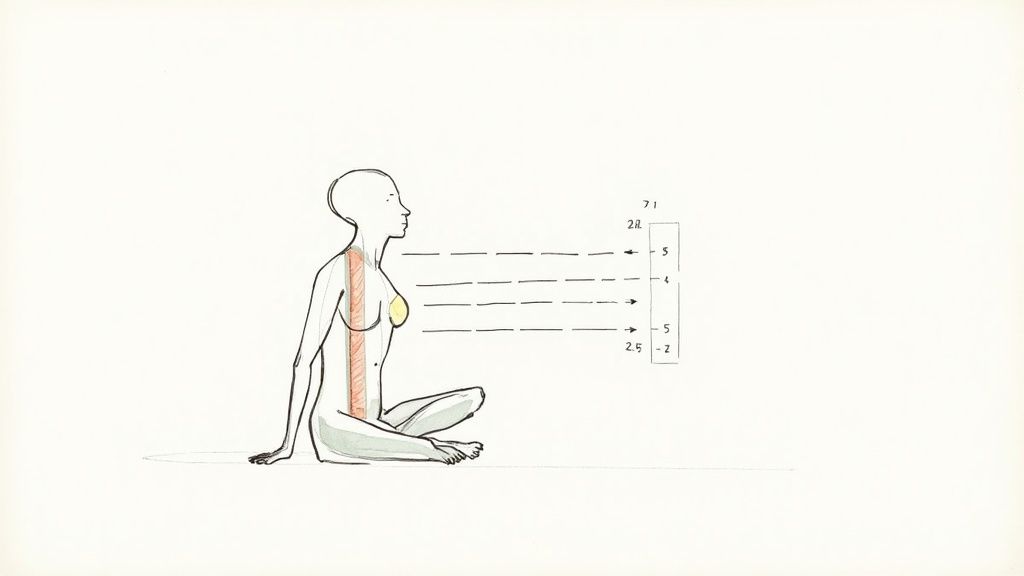
Of all the grounding tools you have, your breath is the most powerful and portable. It’s always with you. Learning to use it with intention can be a complete game-changer when you’re trying to manage dissociation. When you pair mindful breathing with physical grounding techniques, you create a powerful synergy that calms your nervous system from the inside out.
Intentional breathing sends a direct signal to your brain that you’re safe. Think about it: when you feel disconnected, your breath often becomes shallow and quick, which just feeds the body’s stress response. By consciously slowing everything down, you activate your parasympathetic nervous system—the body’s “rest and digest” mode—which is the natural antidote to the “fight or flight” state that fuels dissociation.
A Safe and Simple Breathing Anchor: Box Breathing
One of the most effective and discreet breathing exercises out there is box breathing. It’s incredibly simple to remember, and you can do it anywhere without anyone noticing. It’s perfect for a stressful meeting at work, on a crowded train, or any time you need a subtle way to come back to yourself.
Action: Try one round right now.
- Inhale slowly through your nose for a count of four.
- Gently hold your breath for a count of four.
- Exhale slowly through your mouth for a count of four.
- Gently hold the empty breath for a count of four.
Just repeat that cycle for a few minutes. The predictable, rhythmic pattern gives your mind something simple to focus on, which can interrupt anxious thought loops and pull you back into your body.
A Quick Note on Safety: It’s really important to approach breathwork gently, especially if you have a history of trauma. Simple exercises like box breathing are generally very safe, but more intense styles of breathwork can sometimes feel overwhelming. The goal is always to feel more present and calm, not to force a particular feeling.
Combining Breath with Physical Sensations
This is where the real magic happens. The power of using your breath for grounding is magnified when you consciously combine it with physical sensations. This practice deepens your connection to the present moment by linking your internal world (your breath) with your external reality (your body in this space).
This isn’t just a nice idea; it’s backed by evidence. A 2020 study in Mindfulness found that mind-body practices that integrate breath with bodily awareness are highly effective at reducing dissociative symptoms. Syncing your breath with a physical sensation actively strengthens the mind-body connection that dissociation tries to break.
Actionable Ways to Merge Breath and Body
Ready to give it a try? Here are a couple of practical ways you can merge your breathing with physical grounding.
Sync Your Exhale with Gravity
- When to Use It: You’re sitting in a chair and start to feel floaty or a bit “unreal.”
- How to Do It: As you exhale slowly, pour all your attention into the feeling of your body sinking into the chair. Feel the weight of your legs on the seat, the pressure of your back against the chair, and your feet pressing into the floor. Try to match the entire length of your exhale with this feeling of becoming heavier and more solid.
Breathe into Your Hands
- When to Use It: Your thoughts are racing and you need a single, strong point of focus.
- How to Do It: Press your palms together firmly in front of your chest. Take a deep breath in. As you exhale, press your hands together even harder. Really notice the tension and warmth in your hands, wrists, and arms. Feel that physical effort as you breathe out.
Exploring different approaches, like the ones in our guide on meditation and guided breathing, can give you even more tools. The goal with any of these grounding techniques is simple: use your breath as an anchor to tether your awareness firmly to your body, right here in the present moment.
When It’s Time to Seek Professional Support
Grounding techniques are fantastic tools. Think of them as first aid for your mind—powerful, in-the-moment skills designed to pull you back to the present when you feel yourself drifting away. They absolutely belong in your mental health toolkit.
But it’s important to be honest about what they are: they are coping mechanisms, not a cure. They manage the symptoms, but they don’t resolve the deep-seated reasons why severe or persistent dissociation is happening in the first place.
Choosing to see a professional isn’t a sign that you’ve failed. It’s a sign of profound strength and a courageous step toward lasting healing. These self-help strategies work best when they’re part of a bigger plan, guided by someone who truly gets it.
Red Flags: When Self-Help Isn’t Enough
So, how do you know when it’s time to make that call? There are some clear signals that self-management is no longer enough and you need the support of a qualified therapist to stay safe and get well.
It’s probably time to reach out if you’re noticing:
- Your Life is Shrinking: Dissociation is consistently getting in the way of your job, your relationships, or just handling day-to-day tasks. It’s not just a momentary thing; it’s actively holding you back.
- Big Gaps in Your Memory: You’re losing chunks of time—hours or even days—and have no idea what happened.
- Feeling Like You’re Not Just “One” Person: You have a sense that there are separate, distinct identities or “parts” inside you, each with their own ways of thinking, feeling, and remembering.
- A Constant Feeling of Unreality: That sense of being detached from yourself (depersonalization) or the world around you (derealization) has become your baseline reality, not just a fleeting feeling.
Finding a Therapist Who Understands
When you’re ready to take this step, finding the right kind of help is everything. You’ll want to look specifically for a trauma-informed therapist, particularly one who specializes in dissociative disorders. These professionals have the specific training needed to help you navigate these experiences safely and compassionately.
Don’t be afraid to interview potential therapists to find a good fit. It’s your healing journey, and you deserve to feel comfortable and confident in your choice.
Action: If you decide to seek help, prepare for your first call. Write down a few direct questions to ask:
- “What’s your experience working with clients who struggle with dissociation?”
- “Are you trained in specific therapies for trauma, like EMDR, Somatic Experiencing, or Internal Family Systems (IFS)?”
- “How do you help clients feel safe in your sessions?”
A clinician might use certain tools to get a clearer picture of what you’re going through. One common one is the Dissociative Experiences Scale (DES). This is just a standardized questionnaire that helps them understand the frequency and type of your dissociative symptoms. A score above 30%, for example, usually suggests that a closer clinical look is needed.
You can learn more about how professionals assess dissociation here. This process isn’t meant to be scary or intimidating; it’s simply about getting the right information so your treatment can be truly effective for you.
Answering Your Questions About Grounding
It’s completely normal to have questions as you begin to explore new ways of managing dissociation. Grounding is deeply personal—what feels like a lifeline to one person might not resonate with another. Let’s walk through some of the most common concerns I hear.
What if a Grounding Technique Makes Me Feel Worse?
This happens, and it’s okay. It’s actually a very common experience, especially if a certain sight, sound, or texture is unexpectedly linked to a difficult memory.
If a technique increases your anxiety, don’t push through it. The best thing you can do is gently stop and shift to a different sense. For example, if holding an ice cube feels too intense, try switching to an auditory technique. Action: Immediately name three distinct sounds in the room right now. “The hum of the fridge.” “The distant traffic.” “My own breathing.”
This isn’t about mastering every single technique in the book. It’s about finding what feels genuinely safe and helpful for your nervous system. Honoring what your body is telling you is a crucial part of the process.
The point isn’t to execute a technique perfectly. The goal is simply to find something that helps you feel even 1% more present than you did a moment ago. That’s a win.
How Fast Should Grounding Work?
The honest answer? It varies.
Sometimes, the shift back to the present can feel almost instant, like flipping a light switch. Other times, it might take a few minutes of consistent effort before you notice a real change. The aim isn’t a magical, immediate fix, but a gentle, gradual return to your body and your surroundings.
Here’s a tip from my experience: Practice these techniques when you’re already feeling calm. Action: Set a timer for two minutes today while you feel relaxed. Practice the 5-4-3-2-1 technique. Building that muscle memory makes them far more effective and faster-acting when you actually need them in a moment of distress.
Is it Better to Keep My Eyes Open or Closed?
For grounding, I almost always recommend keeping your eyes open. The whole point is to connect with your current physical environment, and your sight is a powerful anchor for that.
For many people, particularly those with a history of trauma, closing the eyes can heighten a sense of vulnerability or feeling unsafe. A 2021 study on mindfulness and safety actually confirmed that having external visual cues helps reinforce your awareness of the present moment.
Start with your eyes open, or maybe with a soft, unfocused gaze if that feels more comfortable. Above all, do what makes you feel the most secure.
At 9D Breathwork, we’re focused on giving you tools that build strength from the inside out. We combine specific breath patterns with sensory engagement to help you create a solid foundation of presence. If you’re curious about how our guided journeys can support you, learn more about our approach at https://9dbreathwork.com.