When you’re navigating the heavy fog of depression, any tool that offers a sliver of light without demanding a huge effort can feel like a godsend. The world can feel loud and overwhelming, both inside and out. That’s where something as simple as sound therapy, specifically binaural beats, can make a surprising difference.
This guide is designed to be your starting point. We’ll cut through the jargon and get straight to what matters: how this auditory technique actually works, the science behind it, and how you can start using it today to find a bit more calm and balance in your life.
How Sound Can Influence Your State of Mind
At its heart, using binaural beats for depression is about gently influencing your brain’s own electrical rhythms. Your brain is constantly humming with activity, producing waves of energy at different frequencies. These are your brainwaves, and each one is tied to a different state of mind.
- Delta (0.5–4 Hz): The slow, deep waves of restorative, dreamless sleep.
- Theta (4–8 Hz): Found in deep meditation, light sleep, and states of high creativity.
- Alpha (8–13 Hz): The frequency of relaxed awareness. Think of it as a calm, present state of mind, perfect for reducing stress.
- Beta (13–30 Hz): Your “on” switch. This is the state of active thinking, problem-solving, and focused attention.
- Gamma (30–100 Hz): Associated with intense focus, peak cognitive function, and “aha!” moments.
Depression often brings a sense of being “stuck” in low-energy, anxious, or chaotic mental states. The goal of binaural beats is to gently nudge your brainwaves toward more beneficial patterns. For instance, a 2018 study published in PLoS One found that listening to theta (6 Hz) binaural beats for just 10 minutes could reduce the stress hormone cortisol and lower anxiety levels. By encouraging your brain to produce more of a certain brainwave—like the calming alpha waves—you can gently guide your mind away from states of stress and overthinking.
This is supported by more recent findings. A 2023 meta-analysis in the journal Psychological Research confirmed that binaural beats are an effective tool for reducing anxiety, a common companion to depression. Another 2024 study found that this kind of sound stimulation can help regulate the autonomic nervous system, which is the system that controls your body’s fight-or-flight response. In other words, it helps your body relax on a physiological level.
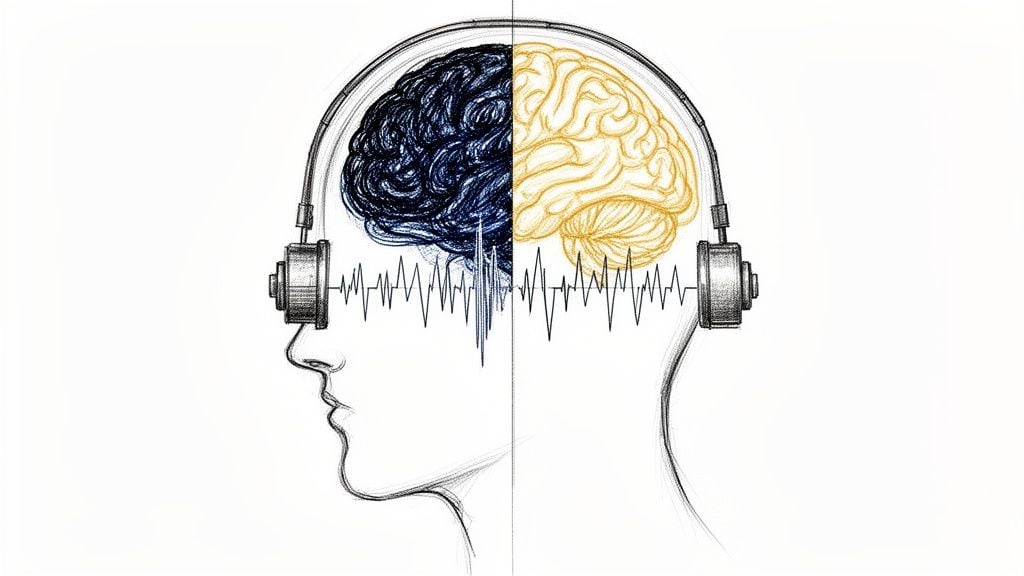
This image gives a great overview of how different brainwaves support essential functions like calm, focus, and rest.

It’s all about nudging your brain toward the states that counter that feeling of being stuck, tired, and mentally foggy. If you’re curious about the specifics of this process, you can dive deeper into how binaural beats for stress relief work in our dedicated article.
To see how different frequencies can directly support your mood, the table below breaks down their potential roles in managing symptoms of depression.
Binaural Beat Frequencies and Their Mood-Supporting Roles
| Brainwave State | Frequency Range (Hz) | Associated Mental State | Potential Benefit for Depression |
|---|---|---|---|
| Delta | 0.5–4 Hz | Deep, restorative sleep | May improve sleep quality, which is often disrupted by depression. |
| Theta | 4–8 Hz | Deep relaxation, meditation | Can help quiet racing thoughts and promote a sense of inner peace. |
| Alpha | 8–13 Hz | Calm awareness, reduced stress | Excellent for reducing anxiety and creating a baseline of relaxed focus. |
| Beta | 13–30 Hz | Active thinking, focus | Low-beta frequencies may help with focus and motivation when feeling lethargic. |
This table isn’t about finding a “magic” frequency, but rather about understanding how different sounds can be used to support different needs, whether it’s calming down, getting better sleep, or finding a little more mental clarity.
The research backs this up. A 2023 study demonstrated that older adults who listened to music embedded with 10 Hz alpha binaural beats showed a significant drop in their depression scores. This isn’t just theory; it’s a practical, measurable effect. You’re using targeted sound to help your brain find its way back to a more balanced and resilient rhythm.
How Sound Can Retune Your Brain’s Frequency
Think of your brain’s neurons firing together in a complex, rhythmic dance. When the rhythm is right, you feel focused, calm, and in sync with the world. But depression can throw that rhythm off completely, leaving you with a sense of static, sadness, and mental fog. This is where a surprisingly simple tool—binaural beats—can help.
Binaural beats use a clever auditory illusion to gently guide your brain back toward a more balanced, harmonious state. It’s not magic; it’s a well-documented process called brainwave entrainment, and it’s like using sound to retune your mind’s internal frequency.

The Science of the Phantom Beat
So, how does it actually work? The mechanism is beautifully simple. You’ll need a pair of stereo headphones to listen to two slightly different frequencies, one played in each ear.
Let’s say your left ear hears a pure tone at 200 Hz, while your right ear hears one at 210 Hz. Your brain, trying to make sense of the two signals, perceives a third, pulsating “phantom” beat. The frequency of this beat is the exact difference between the two tones—in this case, 10 Hz.
This 10 Hz frequency isn’t random. It falls right in the middle of the alpha brainwave range, a state of mind associated with relaxed awareness and calm focus.
This process encourages your brain’s own electrical patterns to sync up with this new, calming rhythm. It’s a lot like a musician using a tuning fork. The fork provides a perfect reference pitch, and the musician adjusts the instrument’s string until it vibrates in perfect harmony with it.
This is precisely how using binaural beats for depression can be so helpful. It gives your brain a steady, therapeutic rhythm to follow, helping to guide it away from the sluggish or chaotic patterns that often come with depressive states.
From Auditory Illusion to Tangible Change
This isn’t just about feeling calmer; research points to real, measurable shifts in brain activity and emotional state. The brain’s natural tendency to sync with external rhythms is a well-known phenomenon that can influence everything from mood and focus to sleep quality.
Different frequencies can nudge your brain into different states, giving you a powerful toolkit for supporting your mental well-being.
- Alpha Waves (8–13 Hz): This is often the starting point for managing depressive symptoms. Alpha states promote calm alertness, which can be a huge relief from the anxious, looping thoughts that frequently tag along with depression.
- Theta Waves (4–8 Hz): Linked to deep meditation and creativity, listening to theta beats can help quiet the mind and foster a sense of inner peace that feels incredibly restorative.
- Delta Waves (0.5–4 Hz): These are the brainwaves of deep, restorative sleep. Since depression so often disrupts sleep, delta wave entrainment can be a game-changer for improving sleep quality and aiding overall recovery.
The scientific backing for this is growing stronger. A fascinating 2023 study in Taiwanese retirement homes, for example, looked at the effects of familiar music embedded with 10 Hz alpha binaural beats. The results were impressive: the average depression score dropped from 10.97 to 7.61—a nearly 30% improvement.
Practical Steps to Start Retuning Your Brain
Getting started is refreshingly simple. You don’t need any fancy equipment, just a good pair of stereo headphones and a quiet spot where you won’t be disturbed for about 15-20 minutes.
Your Action Step:
- Find a Track: Search on YouTube or a music streaming service for “10 Hz alpha binaural beats.”
- Get Comfortable: Put on your headphones and find a quiet place to sit or lie down.
- Listen & Breathe: Close your eyes, press play, and for the next 15 minutes, focus on the pulsating sound. Take a few slow, deep breaths.
- Notice: When the track ends, just sit for a moment. Notice any small shifts in your body or mind.
This simple act of focused listening is a potent first step in learning how to rewire your brain. The real key here is consistency. By making this a regular practice, you’re actively training your brain to access and maintain more balanced, resourceful states. If you’re curious to learn more about the underlying mechanics, exploring what brainwave state is used during sound healing can offer even deeper insights.
Building Your Personal Sound Therapy Routine
Getting started with binaural beats to help manage depression is a lot more straightforward than you might think. The real magic isn’t in finding one “perfect” session. It’s about building a consistent, personal routine that actually fits into your daily life. Let’s walk through how to do just that, from picking the right tools to designing a schedule that supports what you need most.
First things first: you absolutely need a good pair of stereo headphones. This is non-negotiable. The whole principle of binaural beats relies on sending slightly different frequencies to each ear, and you simply can’t achieve that with standard speakers or mono earbuds. You don’t need to break the bank on a high-end audiophile set; a comfortable pair of over-ear headphones or in-ear buds that deliver clear stereo sound is all it takes to create the auditory illusion.
Selecting The Right Frequencies For Your Goals
With your headphones ready, it’s time to choose which frequencies to listen to. Think of it like picking the right tool for the job at hand. How you feel in the morning might be a world away from how you feel at night, and your audio track should match that reality.
Here’s a practical way to think about matching frequencies to your needs:
- Morning Anxiety or Overwhelm: Kickstart your day with Alpha waves (8-13 Hz). These frequencies are known to foster a state of calm awareness, helping to gently quiet anxious thoughts without leaving you feeling groggy. Actionable Tip: Find a 15-minute alpha track and listen while you have your morning coffee, before you even check your phone.
- Midday Sluggishness or Brain Fog: Feeling that all-too-familiar lethargy or lack of motivation? A track featuring low Beta waves (13-16 Hz) can be a huge help. Actionable Tip: Set a timer for a 10-minute “sound break” in the afternoon instead of reaching for a third cup of coffee.
- Evening Wind-Down and Restless Sleep: To prep your mind for rest, turn to Theta waves (4-8 Hz). These are closely linked to deep relaxation and the very first stages of sleep. Actionable Tip: Make listening to a 20-minute theta track the last thing you do before turning out the lights.
- Deep Restorative Sleep: If poor sleep is a major part of your struggle, a session with Delta waves (0.5-4 Hz) can make a difference. These are the brainwaves of deep, dreamless sleep. Actionable Tip: Find a delta wave track that is at least 30 minutes long and let it play as you fall asleep.
This targeted approach helps you build a smarter, more intentional routine. You’re not just passively listening; you’re actively choosing the right sound for the right moment.
Creating Your Ideal Listening Environment
Where you listen is just as important as what you listen to. To really get the therapeutic benefit of binaural beats, you need to create a space that signals safety and relaxation to your brain and body.
Find a quiet, comfortable spot where you know you won’t be interrupted for at least 15-20 minutes. This could be a favorite chair, your bed, or even a quiet corner of the office during your lunch break. Dim the lights, put your phone on silent, and take a few deep, centering breaths before you hit play. This simple ritual helps prepare your mind to fully receive the benefits of the session. A calm environment is foundational for mental wellness, and for a deeper dive, you can learn more about how to calm your nervous system in our detailed guide.
Emerging science is starting to confirm this, showing how specific frequencies can create a physiological calming effect. For example, a 2024 randomized study with college students showed that beta binaural beats could promote physiological calm. Since anxiety and depression overlap in up to 60% of cases, this is a big deal. The research suggests that beta waves may help stabilize the unstable brainwave patterns seen in 30-40% of people with depression, reducing negative emotions. You can explore the full research on beta wave effects to understand these findings better.
Remember, consistency will always beat duration. A daily 15-minute session is far more effective than a single, hour-long session once a week. To help you build that consistency, here is a sample schedule you can tweak to fit your own life.
Sample Weekly Binaural Beats Listening Schedule
This table offers a starting point for integrating binaural beats into your week. Think of it as a template—your real-life schedule will depend on your unique energy levels and challenges each day.
| Day | Time of Day | Frequency Focus | Duration | Session Goal |
|---|---|---|---|---|
| Mon | Morning | Alpha (10 Hz) | 15 min | Reduce morning anxiety and set a calm tone for the week. |
| Tue | Evening | Theta (6 Hz) | 20 min | Wind down from the day and quiet racing thoughts before sleep. |
| Wed | Midday | Low Beta (14 Hz) | 15 min | Combat midday fatigue and improve mental clarity. |
| Thu | Evening | Theta (6 Hz) | 20 min | Reinforce relaxation and promote restful sleep. |
| Fri | Morning | Alpha (10 Hz) | 15 min | Ease into the end of the week with a sense of calm focus. |
| Sat | Afternoon | Alpha (12 Hz) | 20 min | A longer session for deeper relaxation and mental reset. |
| Sun | Evening | Delta (2 Hz) | 20 min | Prepare for the week ahead with a deep, restorative session. |
This schedule provides a balanced approach by targeting different needs throughout the week. Don’t be afraid to adjust the times, durations, and frequencies based on how you feel. The ultimate goal is to create a sustainable practice that becomes a reliable and supportive part of your mental health toolkit.
Amplifying Results with a Multisensory Approach
While binaural beats are powerful on their own, you can unlock their true potential by combining them with other sensory inputs. It’s like the difference between hearing a single guitar and experiencing a full band. Each new element adds depth and richness, creating a much more profound experience.
When you engage multiple senses and systems at once, you can create a more holistic and lasting shift in your mental state. This isn’t just a theory; it’s a principle backed by emerging research.

Layering Sound with Other Practices
The core idea here is simple: pair your binaural beats sessions with other mindful activities. This synergy can deepen the brainwave entrainment process and magnify the therapeutic benefits, moving you beyond just managing symptoms and toward fundamental change.
Here are a few practical ways to create your own multisensory sessions:
- Mindful Breathing: This is probably the most accessible and effective combination. As the binaural beats track plays, bring your full attention to the sensation of your breath. Actionable Tip: Try “box breathing” with your audio—inhale for 4 counts, hold for 4, exhale for 4, and hold for 4.
- Guided Meditation or Visualization: Layering a guided meditation over your binaural beats can be incredibly potent. Actionable Tip: Find a guided meditation on self-compassion and play it at a low volume over an alpha wave track to deepen its impact.
- Gentle Movement or Yoga: For those who find it hard to sit still, pairing sound with gentle, restorative yoga is a perfect match. Actionable Tip: Put on a theta wave track while you do a few simple stretching poses before bed to release physical tension.
The goal is to create an immersive experience that fully occupies your mind and body. When multiple senses are engaged in a calming, coherent way, there’s less room for intrusive thoughts or depressive rumination to take hold.
The Power of Integrated Modalities
This concept of sensory layering is the very foundation for more structured, holistic practices. For instance, modalities like 9D Breathwork are built on this principle, intentionally fusing sound therapy with guided breathwork, hypnotic language, and other sensory inputs. By creating such a rich and immersive environment, these experiences can help disrupt deep-seated patterns at their root. To get a better feel for how these elements work together, you can learn more about the 9D Breathwork experience and its unique approach.
This integrated method is supported by a growing body of evidence. A 2024 trial involving older residents in long-term care facilities combined binaural beat music (BBM) with rhythmic light flashes. The results were compelling: the group receiving the combined therapy showed robust gains in vitality and a significant reduction in depression severity. This shows that when you stack sensory inputs, you can create a much more powerful effect. You can read the full research about these multisensory findings to see exactly how this combination works.
Your Actionable First Step
You don’t need a complicated setup to start. Here’s a simple, 15-minute protocol you can try today to combine sound with mindful breathing:
- Choose Your Track: Select an alpha wave (8-13 Hz) binaural beats track.
- Find Your Space: Put on your stereo headphones and sit or lie down comfortably.
- Start with Sound: Play the track and take a minute just to listen and feel the pulsating rhythm.
- Add Your Breath: Close your eyes and begin a simple box breathing pattern: inhale for a count of four, hold for four, exhale for four, and hold for four.
- Sync and Focus: Let the rhythm of your breath and the rhythm of the beats be your only focus. If your mind wanders, just gently guide it back to the dual sensations of sound and breath.
By consistently practicing this simple layering technique, you’re actively training your brain to enter a state of calm coherence more easily. It’s a practical step toward building a richer, more effective routine for managing binaural beats for depression.
Listening Safely and Setting the Right Expectations
When you’re exploring binaural beats for depression, it’s best to think of them as a supportive tool in your mental health toolkit, not a magic bullet. Getting the most out of them means being smart about how you listen and realistic about what to expect.
First things first: volume matters. You don’t need to blast the sound to get the effect. In fact, listening too loudly can be counterproductive and even harmful to your hearing over time. The goal is gentle brainwave entrainment, so find a comfortable, moderate volume.
Also, the entire experience hinges on stereo sound. You’ll need a good pair of high-quality stereo headphones to make sure each ear is getting its own distinct frequency. Without them, you’re just listening to a regular tone, not a binaural beat.
How Long Until I Notice a Difference?
It’s a fair question. While you might feel calmer after your very first session, the real, lasting shifts in your mood and mindset come from consistency. Think of it like learning a new skill or starting a workout routine.
You wouldn’t go to the gym once and expect to be in perfect shape. Binaural beats work the same way—the benefits build up over time with regular, daily practice. You’re gently encouraging your brain to form new, healthier neural pathways, and that takes patience.
The research backs this up. A 2023 study published in Complementary Therapies in Clinical Practice showed that combining binaural beats with lavender scents improved sleep quality cumulatively over four weeks. Similarly, a 2024 systematic review found that these beats are consistently better than a placebo for reducing anxiety, which often goes hand-in-hand with depression. Another 2024 study even pointed out that when and how often you listen are crucial for getting results.
A Quick Word of Caution
Binaural beats are generally very safe, but they aren’t for everyone. It’s always a good idea to chat with your doctor before diving in, especially if any of the following apply to you.
It’s best to consult a professional first if you:
- Have a history of seizures or epilepsy.
- Use a pacemaker or have a heart condition.
- Are pregnant.
- Are under care for a serious mental health condition.
Taking this simple precaution ensures you’re looking after your whole self. By approaching this practice with awareness and patience, you set yourself up to get the most sustainable support for your mood.
Your Next Steps Toward Mental Wellness
You now have the map. We’ve walked through the science of brainwave entrainment, looked at the research on its potential for depression, and laid out a practical plan for getting started. The most important thing to remember is that you have an accessible, powerful tool at your fingertips to support your mental health.
But knowing is one thing; doing is another. The journey forward is all about putting this knowledge into action.
Begin With a Single, Simple Action
Your first step doesn’t need to be some grand gesture. In fact, it’s better if it isn’t. Just commit to one small, achievable action today. That’s how real momentum starts.
- Action Step: Find a quiet 15 minutes today for a session with alpha waves (10 Hz). Grab your headphones, find a comfortable spot, and just notice how you feel before and after. That’s it.
This simple experiment gives you a personal baseline. It takes the idea of using binaural beats for depression out of the abstract and makes it a real, tangible experience.
It’s worth noting that a 2024 systematic review confirmed that binaural beats consistently outperform placebos in reducing anxiety—a common companion to depression. This shows the real, measurable potential for even a single session to create a noticeable shift.
Broaden Your Wellness Toolkit
Once you get a feel for it, start thinking about where sound therapy fits into your bigger picture. Binaural beats aren’t a magic bullet; they work best when they’re part of a supportive ecosystem you build for yourself. As you consider adding them to your routine, it can also be helpful to explore the top therapies for depression to see the full spectrum of support available.
Bringing these practices together helps you move beyond just managing symptoms. The real goal is to actively rewire your inner world for lasting resilience and well-being. Your path forward is about small, consistent actions that add up over time, helping you build a stronger foundation and regain a sense of control over your mental wellness.
Frequently Asked Questions
It’s natural to have questions when you’re exploring something new. Let’s walk through some of the most common ones about using binaural beats for depression so you can feel clear and confident as you get started.
How Long Until I Feel a Difference?
This is probably the most common question, and the honest answer is: it varies, but consistency is everything. Many people feel calmer and more relaxed after their very first session, which is a great sign.
But for deeper, more lasting changes in mood, think of this as a form of brain training. The real benefits build up over time. Most studies suggest that listening daily for at least two to four weeks is the sweet spot for noticing a real shift in depressive symptoms. It’s all about gently encouraging your brain to adopt healthier patterns, so patience is key. A 2023 study really brought this home, showing how binaural beats paired with lavender gradually improved sleep quality—a huge piece of the puzzle for managing depression.
Can I Listen While I Work?
For the specific goal of easing depression, it’s best to give the session your full attention. The magic happens when you can relax without distractions, letting your brain fully tune into the frequencies. This is when you’ll get the most therapeutic benefit.
That said, you can use certain frequencies while you work, but the goal is different. Beta waves (13-30 Hz) or Gamma waves (30-100 Hz) are great for boosting focus and concentration. Think of them as productivity tools rather than mood support. A 2024 systematic review confirmed this, highlighting that the context of how and when you listen is crucial for getting the results you want.
Is This a Replacement For Therapy?
Let me be crystal clear: absolutely not. Think of binaural beats as a powerful complementary tool in your mental health toolkit, not a replacement for professional medical advice, therapy, or medication.
A helpful way to look at it is like building a house. Therapy and medication are the strong foundation and framework—they provide the essential structure. Binaural beats are like the high-quality wiring and insulation that make the house more comfortable and functional.
Always talk to your doctor or therapist before adding anything new to your routine. Research continues to support this approach; a 2024 review found that binaural beats are consistently better than a placebo for anxiety (which often goes hand-in-hand with depression), highlighting their value as a supportive practice. Integrating them into your existing care plan is the safest and most effective way forward.
At 9D Breathwork, we weave binaural beats into a much larger tapestry of sound, breath, and guidance to create a truly profound experience. To see how this fusion can support your own path to wellness, you can explore our 9D Breathwork experiences.