Within every adult lives the echo of the child they once were. This “inner child” is a wellspring of creativity, joy, and spontaneity, but it also holds the memories of unmet needs and unhealed emotional wounds from our formative years. These early experiences subconsciously script our adult behaviors, dictating how we respond to professional pressure, relationship conflicts, and personal setbacks. Left unaddressed, these old patterns can manifest as persistent anxiety, crippling perfectionism, corporate burnout, and a general sense of unfulfillment.
Engaging in specific, evidence-based inner child healing exercises offers a direct path to addressing these root causes. This is not about dwelling on the past; it is about actively rewiring your nervous system for greater resilience and emotional freedom in the present. A study in the Journal of Counseling & Development highlights how unresolved childhood issues significantly impact adult psychological well-being, reinforcing the need for targeted healing work. Another study in the Journal of Traumatic Stress underscores the importance of creating a sense of internal safety—a core goal of these exercises—for regulating the nervous system and reducing threat perception.
This article provides a curated roundup of eight powerful, actionable exercises designed for deep and lasting change. We will move beyond abstract concepts to offer step-by-step instructions for modalities like somatic movement, guided visualization, and targeted breathwork. You will learn practical techniques to reparent yourself, release stored trauma, and unlock your authentic potential. For those just starting, it can be helpful to begin with foundational approaches. To begin your journey with foundational approaches, explore these 5 Inner Child Healing Practices. The exercises that follow build upon these core ideas, offering a practical roadmap to integrating your past and creating a more empowered, successful, and joyful present.
1. Inner Child Dialogue & Guided Visualization (Reparenting + Hypnotic Journeys)
Inner Child Dialogue is a profound exercise that involves consciously connecting and communicating with your younger self. This technique is often paired with guided visualization, where you create a safe, internal space to meet, listen to, and nurture the part of you that holds onto childhood emotions, beliefs, and memories. The core principle is “reparenting”: providing the validation, safety, and love your inner child may not have received, directly from your present-day adult self. This process helps reframe limiting beliefs formed in childhood, such as “I am not good enough” or “I must be perfect to be loved.”

This method goes beyond simple conversation. It often uses hypnotic language and sensory-rich imagery to access subconscious patterns. By creating a vivid internal sanctuary, you can revisit specific memories not to relive trauma, but to offer a new outcome where your adult self steps in to protect and comfort your younger self. Research in The American Journal of Clinical Hypnosis highlights that such guided imagery can significantly influence emotional regulation and self-perception by creating new neural associations.
How It Works in Practice
- An executive struggling with perfectionism might visualize their younger self being criticized for a B+ on a report card. Their adult self can then step into the scene, praise the child for their hard work, and explain that their worth isn’t tied to performance. This rewires the original emotional imprint.
- A professional facing imposter syndrome could use this dialogue to ask their inner child what they are afraid of. The child might express a fear of being “found out” or abandoned. The adult can then provide reassurance and evidence of their current competence and security.
Actionable Steps for Implementation
- Create a Safe State: Begin with 5-10 minutes of grounding breathwork. To deepen this state, consider using binaural beats in the Theta wave range (4-8Hz), which is associated with deep relaxation and memory access.
- Initiate the Visualization: Close your eyes and imagine a beautiful, safe place. This could be a forest, a beach, or a cozy room. Invite your younger self to meet you there.
- Engage in Dialogue: Ask your inner child questions like, “What do you need to hear right now?” or “What are you feeling?” Listen without judgment. Offer words of comfort, validation, and love. Practical example: If your child feels scared, you might say, “I am here with you now. I am bigger and stronger, and I will keep you safe.”
- Anchor the Feeling: Once you feel a positive shift, create a physical anchor, like gently pressing your thumb and forefinger together. This helps you recall the feeling of safety and connection later.
- Journal for Integration: After the session, write down the conversation and any insights you gained. This reinforces the experience and helps you track patterns over time.
This approach is one of the most direct inner child healing exercises because it actively builds a new, supportive internal relationship. By combining dialogue with specific visualization techniques, you can effectively update old emotional programming. Learn more about the different types of guided meditation techniques to find what works best for you.
2. Somatic Play and Movement Re-enactment (Embodied Release + Joyful Expression)
Somatic Play and Movement Re-enactment is a body-based approach that uses intentional movement, play, and physical expression to access and release stored trauma from the nervous system. While verbal dialogue connects with the cognitive mind, this technique acknowledges that our bodies hold memories and emotions that words cannot reach. Practitioners often recreate playful childhood movements or explore free-form expression, allowing the body to complete stress responses and re-engage natural spontaneity. The focus is on letting the body’s wisdom lead, unlocking joy and releasing tension without needing a narrative.

This method, rooted in the principles of Somatic Experiencing and Dance/Movement Therapy, helps bridge the gap between mind and body. When a child experiences overwhelm, their natural impulse to fight, flee, or play might be suppressed, trapping that energy in their physiology. A 2021 study in Frontiers in Psychology confirmed that movement-based therapies are effective in reducing symptoms of anxiety and depression by regulating the autonomic nervous system. By consciously engaging in playful movement as an adult, you create a safe container to finally release that stored energy.
How It Works in Practice
- A corporate attorney holding years of tension might find that during a breathwork session, their body spontaneously begins to shake or wants to curl up. Allowing this movement, rather than suppressing it, can release deep-seated muscular armoring tied to childhood pressures.
- An overwhelmed project manager who feels disconnected from joy could use guided dance to a favorite childhood song. This act can reconnect them to a time of carefree expression, reawakening feelings of spontaneity and happiness in their adult life.
Actionable Steps for Implementation
- Create a Safe and Private Space: Find a room where you won’t be interrupted or feel self-conscious. This containment is crucial for allowing uninhibited expression.
- Prime the Nervous System: Start with a grounding breathwork pattern, like the 4-7-8 technique, to signal safety to your body. Consider playing music that resonates with feelings of joy or freedom from your childhood.
- Initiate Guided Movement: Begin with simple, guided movements. Gently shake your hands, roll your shoulders, or sway from side to side. Notice any sensations that arise without judgment.
- Allow for Free-Form Expression: As you feel more comfortable, let your body move however it wants. This could be dancing, stretching, stomping, or even just lying on the floor and wiggling. Trust the impulse. Practical example: If you feel anger, allow yourself to stomp your feet or punch a pillow. If you feel joy, let yourself jump and dance wildly.
- Integrate and Ground: After 15-20 minutes of movement, slowly come to a rest. Place a hand on your heart and one on your belly, return to slow breathing, and notice the shifts in your body and emotional state.
This is one of the most powerful inner child healing exercises for those who feel stuck in their heads. It bypasses the analytical mind to work directly with the body’s stored experiences. To go deeper, you can discover more about how to release stored trauma from the body.
3. Bilateral Stimulation with Inner Child Dialogue (EMDR-Inspired Breathwork)
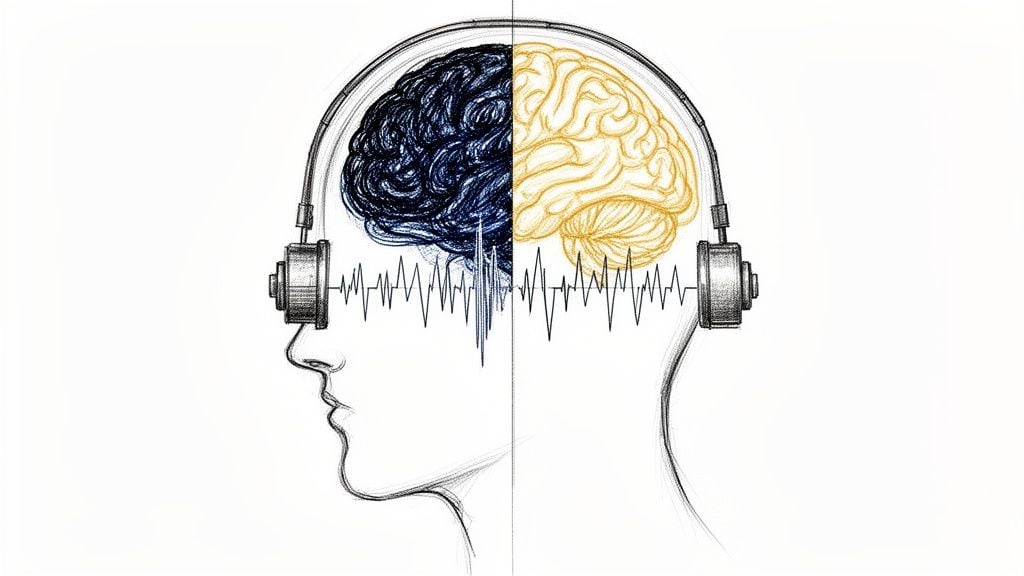
This advanced exercise integrates bilateral stimulation, a core component of EMDR, with conscious breathwork and inner child dialogue. Bilateral stimulation involves engaging both hemispheres of the brain through alternating sensory input, such as sound, sight, or touch. When combined with focused breathing and communication with your younger self, it creates a powerful environment for processing deeply stored emotions and traumatic memories that are often stuck in one hemisphere. The rhythmic, cross-body sensory information helps the brain reintegrate these memories, reducing their emotional charge.
The method is inspired by Eye Movement Desensitization and Reprocessing (EMDR), a therapy developed by Francine Shapiro. By activating the brain’s natural information processing system, you can re-access and neutralize distressing memories. A study published in the Journal of EMDR Practice and Research found that bilateral stimulation facilitates the communication between brain hemispheres, which is crucial for integrating traumatic experiences. Our approach integrates EMDR-inspired breathwork, and for a comprehensive understanding of the foundational therapy, you can learn more about how EMDR Therapy helps heal trauma.
How It Works in Practice
- A corporate professional releasing a childhood fear of failure might use alternating binaural beats while breathing and visualizing their younger self being scolded for a mistake. The bilateral input helps their nervous system stay regulated, allowing them to comfort the child without becoming emotionally overwhelmed.
- An anxious executive processing perfectionism could combine gentle, alternating knee taps with a dialogue, asking their inner child what they believed would happen if they weren’t perfect. The rhythmic tapping can help process the underlying fear of abandonment or criticism.
Actionable Steps for Implementation
- Establish Safety and Grounding: Begin with 5 minutes of diaphragmatic breathing to calm your nervous system. This ensures you are in a regulated state before introducing more intense processing.
- Introduce Bilateral Stimulation: Choose one method: listen to alternating binaural beats with headphones, or gently tap your knees or shoulders, alternating left and right in a steady rhythm.
- Synchronize Breath: Layer in a simple breath pattern, like a 4-count inhale and a 4-count exhale. As you breathe, let your attention gently follow the left-right stimulation.
- Connect with the Inner Child: Once you feel settled in the rhythm, invite your inner child into your awareness. Ask what they are feeling or what memory is present. Maintain the bilateral stimulation and breathing as you listen.
- Process and Integrate: If the emotional intensity increases, slow down the tapping or breathing. Offer your inner child comfort while the bilateral input helps your brain process the feelings. Afterwards, use an NLP anchor, like squeezing your wrist, to associate the new feeling of calm with the memory. Practical example: While tapping your knees, visualize your adult self stepping in front of your younger self to shield them from a harsh word, saying, “I will protect you.”
This is one of the more potent inner child healing exercises as it directly engages the brain’s processing mechanisms. It’s especially useful for addressing memories that feel “stuck.” Understanding how this regulates your nervous system is key; you can explore related concepts in these Polyvagal Theory exercises.
4. Journaling with Inner Child Voice (Somatic Writing)
Inner Child Journaling is a powerful expressive writing practice that connects you directly to the voice and needs of your younger self. This technique involves writing from your inner child’s perspective or creating a written dialogue between your adult self and younger self. When practiced after breathwork or meditation, this form of somatic writing helps bypass the adult mind’s intellectual filters, allowing raw, subconscious emotions, needs, and memories to surface onto the page. This creates a tangible record of your internal world and your healing journey.

This method’s power lies in its ability to translate internal states into concrete language, a process validated by extensive research. Studies by James Pennebaker, published in journals like JAMA, show that expressive writing about emotional upheavals can improve physical and psychological health by helping individuals organize thoughts and find meaning in their experiences. The physical act of writing engages the body, making it a somatic practice that helps release stored emotional energy. By giving your inner child a voice on paper, you validate its existence and begin to understand its unmet needs.
How It Works in Practice
- An executive journaling to understand career fears might write from their younger self’s perspective and discover a deep-seated fear of failure rooted in a childhood incident. This awareness allows them to address the core emotion rather than just the surface-level career anxiety.
- A professional writing letters to their inner child after breathwork can foster profound self-compassion. They might write, “Dear Little Me, I see how hard you tried. It wasn’t your fault,” providing the reassurance they never received.
- A team member in a corporate wellness program could track their inner child’s voice over 12 weeks, noticing a shift from expressions of fear and sadness to those of joy and safety, marking clear progress.
Actionable Steps for Implementation
- Prime Your State: Engage in a grounding activity like breathwork or meditation for 5-15 minutes to quiet your analytical mind and improve access to your subconscious.
- Use Your Non-Dominant Hand: To further bypass the critical, logical brain, try writing with your non-dominant hand. This often accesses a more childlike, emotionally raw part of yourself.
- Set a Timer & Use Prompts: Set a timer for 10-20 minutes and begin with a prompt like, “What does my inner child need to say right now?” or “Dear Younger Me…” Write continuously without stopping to edit or judge.
- Practice Non-Judgmental Flow: The goal is pure expression, not perfect prose. Allow whatever comes up to flow onto the page, whether it’s words, scribbles, or drawings. Practical example: Start a dialogue. As ‘Adult You’, write: “What are you feeling right now?” Then switch to your non-dominant hand as ‘Inner Child’ and write the first thing that comes to mind, such as “I’m scared I’ll get it wrong.”
- Review and Release: Re-read your entries weekly to identify recurring themes or patterns. For a symbolic release of heavy emotions, you can choose to safely burn or shred the pages after you have processed their contents.
This is one of the most effective inner child healing exercises for creating a tangible, ongoing conversation with your younger self. It provides a private, safe container to explore deep-seated feelings and track your healing evolution over time.
5. Inner Child Safety Contract and Boundary Setting
The Inner Child Safety Contract is a cognitive-emotional technique where your adult self makes a conscious, binding agreement with your younger self. This process involves establishing clear promises about safety, boundaries, and emotional needs. The core principle is to create a formal, internal commitment that directly addresses the survival beliefs that often drive anxiety, hypervigilance, and overwhelm. By explicitly stating how you will protect and care for your inner child, you build a foundation of trust that may have been missing.
This method often integrates principles from Transactional Analysis and Internal Family Systems (IFS), which emphasize the importance of internal relationships. The act of writing and verbalizing the contract reinforces the new neural pathways you are building, moving from a reactive state to a consciously protective one. Research published by the American Psychological Association has shown that setting clear, self-directed goals and commitments can significantly improve self-regulation and reduce anxiety by providing a predictable framework for behavior. This contract serves as a tangible anchor for that internal safety.
How It Works in Practice
- An anxious professional might create a contract that says, “When you feel overwhelmed in meetings, I will take three deep breaths and remind you that we are safe and competent.” This replaces the old pattern of spiraling into self-doubt.
- An executive struggling with burnout could establish a boundary by stating, “I promise to stop working by 7 PM each night to give you time to rest and play. Your well-being is my priority.” This directly counters the belief that worth comes from constant productivity.
Actionable Steps for Implementation
- Enter a Receptive State: Perform a short breathwork session to calm your nervous system. This heightened state of suggestibility makes the subconscious mind more receptive to the new agreement.
- Draft the Contract: On a piece of paper, write a letter to your inner child. Use strong, present-tense, and active language. Start with a clear commitment like, “I, your adult self, hereby promise to…”
- Include Specific Commitments: Make your promises concrete. Instead of “I will take care of you,” write “When you feel scared, I will place a hand on my heart and remind you I am here.” Practical Example: “I promise that I will no longer allow Uncle John to make critical jokes at your expense. I will speak up or we will leave.”
- Sign and Display: Sign the contract and place it somewhere visible, like on your bathroom mirror, desk, or as your phone’s lock screen. This regular exposure reinforces the commitment.
- Reinforce Daily: Dedicate 5 minutes each morning to a brief breathwork exercise while reading the contract aloud. This daily ritual strengthens the neural pathways associated with safety and trust.
This technique is one of the most structured inner child healing exercises because it provides a clear, actionable framework for building internal security. By formalizing your promises, you give your inner child the tangible proof of safety it has always needed.
6. Emotion-Specific Breathwork Patterns for Inner Child States
Emotion-specific breathwork involves tailoring your breathing rhythm to directly address particular inner child emotions like fear, sadness, or anger. This approach uses the breath as a tool to regulate the nervous system, combining specific patterns with focused intention to calm or release stored emotional energy. The core idea is that different breathing patterns create distinct physiological responses, allowing you to soothe or activate your system in a controlled way, directly supporting your inner child’s needs.
This method draws from ancient Pranayama traditions and modern neuroscience, particularly Stephen Porges’ Polyvagal Theory, which explains how breathing influences the vagus nerve to shift between states of calm, stress, and shutdown. Slower rhythms with extended exhales activate the parasympathetic “rest and digest” system, signaling safety to the inner child. In contrast, faster, more forceful patterns can engage the sympathetic system to release pent-up energy like frustration. Research in Frontiers in Psychology shows that slow-breathing techniques can effectively reduce anxiety and depressive symptoms by increasing vagal tone.
How It Works in Practice
- An executive feeling anxious before a presentation might recognize this as their inner child’s fear of being judged. They could use a 4-7-8 breathing pattern (inhale for 4, hold for 7, exhale for 8) for two minutes to activate their vagal brake, calming the physiological fear response.
- A team member feeling stuck and resentful after receiving unfair feedback could use a short burst of “Breath of Fire” to physically process and release the inner child’s stored anger and frustration, preventing it from turning into prolonged bitterness.
Actionable Steps for Implementation
- Identify the Emotion: First, check in with yourself and name the dominant emotion your inner child is experiencing. Is it fear, sadness, anger, or shame?
- Match the Pattern: Select a breathwork pattern that corresponds to the emotional need. Practical Example: For fear or anxiety, try Box Breathing (inhale for 4, hold for 4, exhale for 4, hold for 4). For overwhelming sadness, use 4-7-8 Breathing. For anger, try Breath of Fire (short, forceful exhales through the nose).
- Start Small: Begin with just 2-3 minutes of the chosen pattern. Focus on the physical sensation of the breath. Practice during calm moments first to build familiarity before using it during emotional dysregulation.
- Visualize and Comfort: While breathing, visualize your adult self holding or comforting your inner child. You can internally whisper phrases like, “You are safe now” or “It’s okay to feel this.”
- Track the Shift: After the exercise, notice the change in your emotional state. You can use a simple 1-10 scale or an HRV-tracking app to measure the physiological shift over time.
This approach is one of the most direct physiological inner child healing exercises because it uses the body’s own regulatory system to create a felt sense of safety. By consciously pairing breath with intention, you provide your inner child with the immediate somatic co-regulation they need.
7. Reparenting Affirmations with Subliminal Integration
This technique delivers positive, corrective messages to both your conscious and subconscious mind. It combines audible affirmations with subliminal audio, hypnotic language, and often binaural beats to bypass the critical, defensive parts of the psyche. The goal is to directly reprogram the deep-seated negative beliefs your inner child absorbed from critical or neglectful environments, such as “I am a burden” or “My needs don’t matter.”
This method works on the principle of neuroplasticity, where repeated exposure to new messages can create and strengthen new neural pathways. By layering audible affirmations with subliminal messages (recorded just below the threshold of normal hearing), you address the inner child’s wounds on multiple levels. A study in the Journal of Cognitive Enhancement found that auditory beat stimulation, like binaural beats, can effectively entrain brainwaves to states more receptive to suggestion, such as Theta (4-8Hz), which is linked to memory and emotional processing. This makes the mind fertile ground for planting new, empowering beliefs.
How It Works in Practice
- A professional struggling with perfectionism might listen nightly to an audio track with affirmations like “My best is enough” and “I am loved for who I am, not what I achieve,” layered with subliminal versions of the same messages to reinforce them during sleep.
- An executive with imposter syndrome could use a 15-minute break to listen to a guided track with affirmations of self-worth and competence, using headphones to get the full effect of the binaural beats designed to quiet the inner critic.
Actionable Steps for Implementation
- Identify Unmet Needs: First, journal about specific childhood memories. What did you need to hear in that moment? “You are safe,” “It’s okay to make mistakes,” or “I am here for you.” Turn these into “I am” or “It is safe for me to” affirmations.
- Prime Your Mind: Before listening, perform 5-10 minutes of box breathing or another calming breathwork pattern. This lowers cognitive defenses and prepares your nervous system to receive new information.
- Use High-Suggestibility Times: Listen to your affirmation tracks immediately upon waking, just before falling asleep, or after a breathwork session when your mind is most open to suggestion.
- Layer with Technology: Find or create audio tracks that layer your chosen affirmations with Theta wave binaural beats for subconscious access or 40Hz Gamma waves for conscious focus during the day.
- Commit to Repetition: For neural consolidation, listen to the same set of affirmations daily for at least 30 consecutive days. Consistency is more important than duration. Practical example: Set a recurring daily alarm labeled “My Affirmations” to create an unbreakable habit.
- Track the Shifts: Keep a journal to note subtle changes in your thoughts, feelings, and behaviors. This provides conscious evidence that the reprogramming is working.
This is one of the most efficient inner child healing exercises because it directly targets the subconscious programming where childhood wounds are stored. You can explore a variety of subconscious mind healing techniques to see how this fits into a broader healing strategy.
8. Parts Work and Multi-Voice Integration (IFS-Inspired Breathwork)
Parts Work is an approach that views the psyche not as a single entity, but as a system of distinct “parts,” each with its own beliefs, feelings, and memories. Inspired by the Internal Family Systems (IFS) model, this exercise uses breathwork to access and communicate with these parts, such as the inner critic, the perfectionist, or the people-pleaser. The goal is not to eliminate these parts, but to understand their protective origins and negotiate new, healthier roles for them. This process honors that every part has a positive intention, even if its expression has become problematic.
This method facilitates a direct dialogue between your core adult self and these internal sub-personalities. Breathwork helps lower the defenses of protective parts, making them more accessible for curious, non-judgmental conversation. Studies in Trauma and Dissociation have shown that IFS-based approaches improve psychological well-being by fostering internal harmony rather than internal conflict. By understanding a part’s original function, you can use techniques like NLP reframing to help it adopt a new role that serves your present-day life, moving from protection to collaboration.
How It Works in Practice
- An executive with an overactive inner critic might discover this part originated as a protective response to a critical parent, believing it had to find flaws first to prevent external shame. Through dialogue, the executive can thank the part for its protection and repurpose its keen sense of discernment for constructive feedback instead of self-attack.
- A professional struggling with perfectionism could identify how this part protected them from the shame of failure in a high-stakes environment. By negotiating, they can help the part relax its standards, allowing for creativity and growth from mistakes.
Actionable Steps for Implementation
- Establish a Safe Internal State: Start with 10 minutes of grounding breathwork to signal safety to your nervous system. Focus on slow, deep diaphragmatic breaths to activate the parasympathetic response.
- Identify and Greet a Part: Gently bring to mind a challenging pattern (e.g., procrastination). Ask yourself, “What part of me is responsible for this?” Notice any feelings, images, or thoughts that arise. Greet this part with curiosity, not judgment.
- Understand Its Positive Intention: Ask the part questions like, “What are you trying to protect me from?” or “What are you afraid would happen if you stopped doing your job?” Listen for its story and its original purpose.
- Facilitate Dialogue and Negotiation: Let the part know you (the adult self) are here now and can handle things differently. Ask it what it would prefer to do if it didn’t have to work so hard at its current job. Propose a new, updated role and create a new “agreement.” Practical example: You might say to your Inner Critic, “Thank you for trying to keep me safe. I’d like to give you a new job as my ‘Director of Excellence.’ Your role is to spot areas for improvement after the first draft is done, not before it starts.”
- Journal the Agreement: After the session, write down the new agreement between you and the part. For example: “My Perfectionist part agrees to allow for a ‘B+’ effort on internal drafts, freeing up energy for final-stage refinement.”
This is one of the most sophisticated inner child healing exercises because it resolves internal conflicts at their source. By building a collaborative internal team, you create lasting changes in behavior and self-perception. You can learn more about the IFS model from its founder, Richard Schwartz.
8-Point Comparison: Inner Child Healing Exercises
| Technique | Implementation complexity | Resource requirements | Expected outcomes | Ideal use cases | Key advantages |
|---|---|---|---|---|---|
| Inner Child Dialogue & Guided Visualization (Reparenting + Hypnotic Journeys) | Moderate–High — requires altered states and skilled facilitation | Quiet time, breathwork, binaural tones, facilitator, recording capability | Reframed core beliefs, increased self‑compassion, durable neural change | Professionals addressing perfectionism, imposter syndrome, childhood-rooted patterns | Immersive multisensory processing; customizable; repeatable via recordings |
| Somatic Play and Movement Re‑enactment | Moderate — needs containment and movement facilitation | Safe physical space, music/rhythm, facilitator, privacy | Rapid nervous system regulation, release of trapped energy, restored spontaneity | Stress‑carrying professionals, group release sessions, joy activation | Bypasses intellectual defenses; immediate, experiential regulation |
| Bilateral Stimulation with Inner Child Dialogue (EMDR‑Inspired Breathwork) | High — requires EMDR knowledge and careful pacing | Alternating binaural frequencies, tapping/tactile tools, trained facilitator | Faster processing of deep trauma; neural integration and symptom reduction | Deep trauma, persistent anxiety, high‑performers with stuck patterns | Research‑backed EMDR principles combined with breathwork for efficient change |
| Journaling with Inner Child Voice (Somatic Writing) | Low — simple to implement independently | Journal/materials, prompts, brief post‑breathwork window | Clarified subconscious content, tangible progress record, enhanced insight | Busy professionals seeking asynchronous integration between sessions | Highly accessible, low cost, activates cognitive and motor pathways |
| Inner Child Safety Contract and Boundary Setting | Low–Moderate — simple but requires authenticity and follow‑through | Breathwork for suggestibility, writing materials, daily reinforcement | Increased internal safety, reduced hypervigilance, clearer boundaries | Chronic anxiety, hypervigilant professionals, those needing structure | Simple, fast intervention that links conscious commitment to subconscious encoding |
| Emotion‑Specific Breathwork Patterns for Inner Child States | Low–Moderate — requires pattern training and safety guidance | No equipment required (optional binaural beats, HRV tracking), instruction | Immediate vagal modulation, emotion‑specific relief, measurable physiological change | On‑the‑spot regulation for busy professionals, quick interventions | Portable, evidence‑informed, rapid and practical for varied emotions |
| Reparenting Affirmations with Subliminal Integration | Moderate — audio design and ethical use needed | High‑quality audio production, binaural/subliminal layering, scripted affirmations | Gradual belief change, scalable subconscious encoding, passive reinforcement | Long‑term reprogramming, sleep or passive listening for professionals | Multi‑modal efficiency; scalable and usable during low‑effort periods |
| Parts Work and Multi‑Voice Integration (IFS‑Inspired Breathwork) | High — complex, time‑intensive, needs advanced facilitation | Experienced IFS/parts facilitator, extended sessions, breathwork, integration tools | Comprehensive internal cooperation, reduced internal conflict, deep integration | Complex, interrelated patterns in high‑functioning professionals | Systemic, respectful approach that repurposes protective parts for healthy functioning |
Putting It All Together: Your Path to Lasting Inner Child Integration
You have now explored a detailed collection of inner child healing exercises, from the quiet introspection of somatic journaling to the dynamic energy of somatic play and the deep processing of EMDR-inspired breathwork. Each method offers a unique entry point into the landscape of your past, providing a specific tool to connect with, understand, and nurture the younger parts of yourself that still carry unresolved pain or unmet needs. The journey is not about finding a single magic bullet, but about building a versatile and personal toolkit.
The true power of this work emerges not from a single session but from consistent, gentle application. Think of it as building a new relationship. You wouldn’t expect to build deep trust with a person after one conversation; likewise, your inner child needs to see that you will show up repeatedly with compassion, safety, and a willingness to listen. This consistency is what rewires the brain. A 2018 study in NeuroImage confirmed that consistent mindfulness practices, similar to the focused attention in these exercises, can produce measurable changes in brain regions associated with emotional regulation, such as the prefrontal cortex and amygdala.
Key Takeaways for Your Continuing Journey
As you move forward, hold these core principles at the forefront of your practice. They are the guardrails that ensure your inner child healing exercises are not just actions, but acts of profound self-love.
- Patience Over Perfection: Some days, connecting will feel easy; on others, your inner child may seem distant or silent. This is normal. The goal is not a perfect outcome but a consistent effort.
- Safety First, Always: Before any exercise, establish a sense of present-moment safety. Use grounding techniques or the “Safety Contract” exercise to create a secure container for emotional exploration. This is especially crucial for those with a history of trauma.
- Integration is the Goal, Not Eradication: The objective is not to get rid of your inner child or erase painful memories. It’s about integrating these parts into your whole self, allowing the wisdom of your adult self to soothe and guide the vulnerable child within.
- Listen to Your Body’s Wisdom: Somatic exercises are powerful because your body holds memories that your conscious mind may not. Pay attention to physical sensations, tension, or releases during your practice. These are important messages from your nervous system.
Creating a Sustainable Practice
The most effective approach is one that fits your life. You don’t need to dedicate hours every day. Instead, start small and build momentum.
- Start with One: Choose the single exercise from this list that resonates most with you right now. Commit to practicing it for just five minutes, three times a week.
- Create a Ritual: Pair your exercise with an existing habit. For example, practice your “Reparenting Affirmations” while you brush your teeth or do a brief “Inner Child Dialogue” before you start your workday.
- Track Your Progress: Keep a simple log of which exercises you did and how you felt afterward. This creates a feedback loop of positive reinforcement and helps you identify which tools are most effective for different situations.
Ultimately, these inner child healing exercises are about reclaiming your wholeness. By tending to the wounds of the past, you free up immense energy that was previously locked in patterns of anxiety, self-doubt, and reaction. This allows your authentic adult self to lead with more clarity, creativity, and emotional freedom. Research from the Journal of Personality and Social Psychology has consistently shown that individuals with higher levels of self-compassion, a core component of this work, exhibit greater emotional resilience and psychological well-being. By engaging in these practices, you are not just healing; you are building a scientifically-backed foundation for a more integrated and fulfilling life.
Ready to accelerate your journey and experience deep subconscious rewiring in a structured, immersive environment? The 9D Breathwork program integrates many of the principles discussed here, using neuro-acoustic soundscapes and guided somatic breathwork to create a powerful container for profound and lasting change. Explore a guided path to inner child integration by visiting 9D Breathwork.