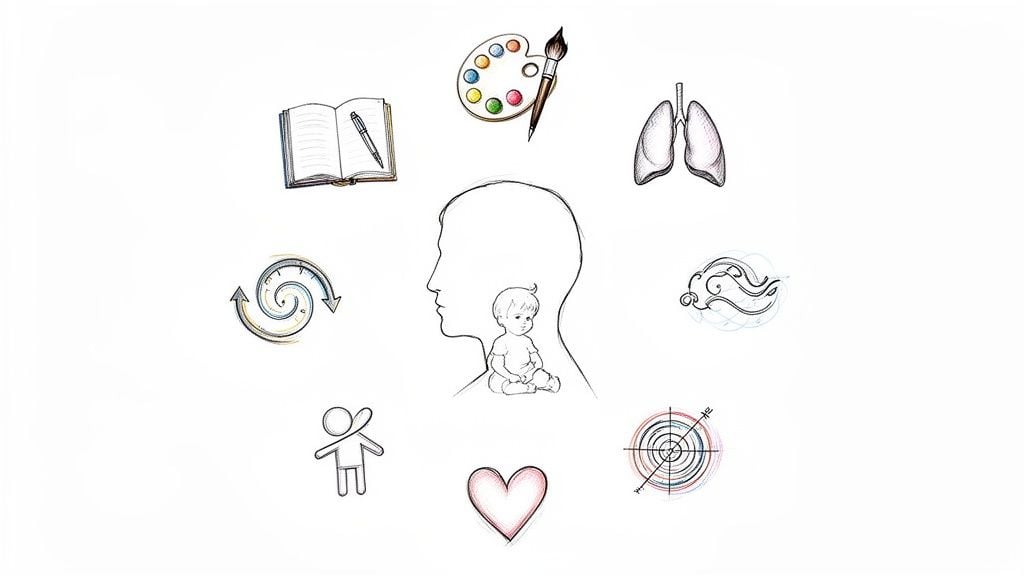
The subconscious mind is the powerful, silent architect of our lives, shaping over 95% of our behaviors, beliefs, and emotional responses. While your conscious mind sets goals and makes plans, it’s the deeply embedded programming in the subconscious that dictates your day-to-day reality. When this internal programming is rooted in past trauma, limiting beliefs, or the patterns of chronic stress so common in professional life, we find ourselves stuck in cycles of anxiety, burnout, and stagnation. It’s the invisible force behind self-sabotage and feeling unfulfilled despite outward success.
This article is a practical, actionable guide to the most effective subconscious mind healing techniques available today. It’s designed to move you beyond simple awareness and into direct application. We will explore a curated list of evidence-informed modalities, providing not just the ‘what’ and ‘why,’ but the crucial ‘how’ for each one. From breathwork and neuro-linguistic programming to somatic healing and guided visualization, you will find step-by-step instructions to begin implementing these powerful tools immediately.
Each technique is presented as a distinct yet complementary approach to accessing and rewiring your internal operating system. The goal is to provide a comprehensive toolkit for anyone seeking to break free from old patterns and cultivate lasting change. For those passionate about understanding the complexities of the human mind and the scientific basis of healing, you can pursue an online psychology degree to build a deeper professional foundation. This guide, however, focuses on direct experience and personal transformation, empowering you to start your healing journey right now.
1. Breathwork and Conscious Breathing Techniques
Breathwork is a powerful modality that uses intentional breathing patterns to influence your mental, emotional, and physical states. It serves as a direct bridge to the subconscious mind by shifting the autonomic nervous system from a state of stress (sympathetic) to one of rest and healing (parasympathetic). By consciously controlling the breath, you can access and release stored trauma, limiting beliefs, and suppressed emotions that unconsciously drive your behavior.
This process works by altering brainwave activity and physiological responses. Intense patterns like Holotropic or circular breathing can induce non-ordinary states of consciousness, allowing subconscious material to surface. Slower, rhythmic patterns calm the nervous system, creating a safe internal environment for processing difficult emotions. Research confirms its efficacy; a 2017 study in Frontiers in Psychology found that diaphragmatic breathing reduces negative affect and cortisol levels, directly impacting the stress response rooted in the subconscious. Further research in PLOS ONE demonstrated that just five minutes of cyclic sighing significantly improved mood and reduced respiratory rate, showing its immediate physiological benefits. A study in the Journal of Affective Disorders also found that breathwork was effective in reducing symptoms of depression and anxiety.
When to Use This Technique
Consider using breathwork when you feel stuck in patterns of anxiety, burnout, or emotional reactivity. Practical Example: A sales professional feeling anxious before a major client call can use three minutes of Box Breathing to calm their nervous system and enter the meeting with a clear, focused mind. It’s particularly effective for professionals dealing with high-stress environments, such as first responders using tactical breathing to maintain calm under pressure. For a deeper dive into its mechanisms, you can explore the healing power of breathwork.
How to Get Started
- Actionable Step: Start Small with Box Breathing. Inhale for a count of four, hold for four, exhale for four, and hold for four. Do this right now for one minute. Repeat for 5 minutes daily to build a foundation of nervous system regulation.
- Find a Quiet Space. Ensure you won’t be disturbed. Lie down comfortably with a pillow under your knees to support your lower back.
- Use a Facilitator for Deeper Work. For intense modalities like Holotropic or Transformational Breath, work with a certified practitioner to ensure a safe and supportive experience.
- Pair with Journaling. After each session, spend 10 minutes writing down any thoughts, feelings, or memories that emerged. This helps integrate the subconscious insights into your conscious awareness.
2. Binaural Beats and Brainwave Entrainment
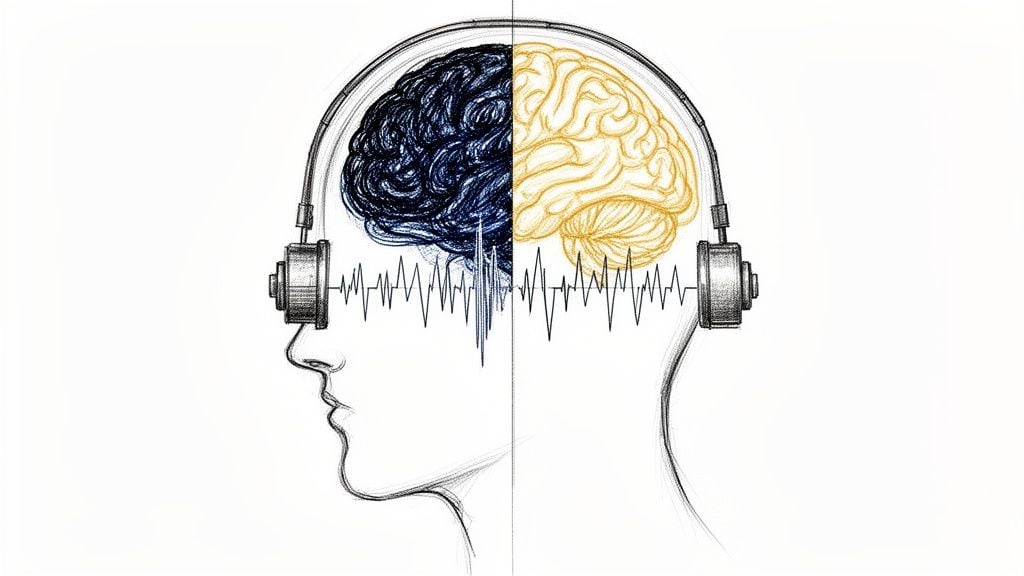
Binaural beats use a specific auditory illusion to guide your brain into desired states of consciousness, making it one of the most accessible subconscious mind healing techniques. The process, known as brainwave entrainment, occurs when you listen to two slightly different sound frequencies in each ear through headphones. Your brain perceives the difference between these two tones as a third, rhythmic pulse, or “beat,” and begins to synchronize its own electrical cycles to this frequency.
This allows you to gently coax your mind into states that are otherwise difficult to achieve on demand, such as the deep relaxation of alpha waves (8-12Hz) or the profound meditative states of theta waves (4-8Hz). A study published in Frontiers in Psychiatry found that listening to theta-wave binaural beats significantly reduced anxiety scores in participants. Another study in Psychological Research showed that binaural beats could enhance long-term memory, while research in Brain Topography indicated that they can modulate functional connectivity in the brain, validating their influence on cognitive states.
When to Use This Technique
Binaural beats are ideal for managing stress, enhancing focus, or improving sleep quality without extensive training. Practical Example: A student struggling with focus can listen to an alpha-wave track (8-12Hz) while studying to promote a state of calm concentration and improve information retention. It’s an excellent tool if you find traditional meditation challenging, as the audio provides a focal point that can prevent a wandering mind. To explore this topic further, you can read more about how binaural beats for anxiety can be applied.
How to Get Started
- Actionable Step: Use Quality Stereo Headphones. This is non-negotiable, as the technique relies on delivering a different frequency to each ear.
- Choose the Right Frequency. Select a frequency that matches your goal. Use alpha waves for calm focus, theta waves for deep meditation or creative problem-solving, and delta waves for sleep.
- Create a Quiet Environment. Minimize external distractions to allow your brain to fully entrain with the audio. Lie down or sit comfortably.
- Start with Short Sessions. Begin with 15-20 minute sessions 3-5 times per week to allow your brain to adapt.
- Combine with Other Modalities. Enhance the experience by pairing binaural beats with guided visualization or journaling to consciously process the subconscious material that arises.
3. Neuro-Linguistic Programming (NLP)
Neuro-Linguistic Programming (NLP) is a psychological approach that models how we structure our subjective experiences. It examines the powerful connection between our neurological processes (neuro), the language we use (linguistic), and the behavioral patterns we’ve learned through experience (programming). NLP serves as one of the most direct subconscious mind healing techniques by providing tools to identify and “reprogram” the limiting beliefs and automatic responses that dictate our actions.
This process works by deconstructing how our brain has coded past experiences and then installing more resourceful alternatives. Techniques like “reframing” help change the emotional meaning associated with a memory, while “anchoring” allows you to consciously trigger a desired state like confidence. NLP’s efficacy in changing behavioral patterns is supported by research; a 2013 study in the Journal of Experiential Psychotherapy highlighted its effectiveness in reducing public speaking anxiety. Another study in Cureus noted its positive impact on psychological well-being and stress reduction in students. Furthermore, research in Perspectives in Psychiatric Care found NLP significantly reduced symptoms of PTSD, demonstrating its power to re-wire deep-seated subconscious responses.
When to Use This Technique
Use NLP when you notice specific, recurring patterns you want to change, such as imposter syndrome or a persistent phobia. Practical Example: An entrepreneur who freezes up during networking events due to a subconscious fear of rejection can use the “anchoring” technique. By repeatedly associating a physical cue (like pressing their thumb and forefinger together) with a memory of peak confidence, they can trigger that confident state on demand before approaching a new contact.
How to Get Started
- Actionable Step: Identify a Limiting Belief. Pinpoint one specific subconscious belief that holds you back, such as “I’m not good enough to lead this project.” Write it down.
- Practice Reframing. Consciously challenge that belief. Ask yourself: “What would be a more empowering belief to hold instead?” For example, reframe “I’m not good enough” to “I have the skills and support needed to succeed in this role.” Say the new belief aloud five times.
- Create a Resource Anchor. Think of a time you felt supremely confident. As you vividly recall that feeling, press your thumb and forefinger together firmly. Repeat this several times. Now, when you need a confidence boost, press your fingers together to activate that state.
- Work with a Certified Practitioner. For deeper issues like trauma, seek a practitioner certified by a reputable body. They can guide you through advanced techniques for resolving past programming.
4. Hypnotherapy and Hypnotic Suggestion
Hypnotherapy is a therapeutic technique that uses guided relaxation and intense, focused concentration to achieve a heightened state of awareness, often called a trance. This state allows you to bypass the critical, analytical conscious mind and gain direct access to the subconscious. Here, the mind is highly receptive to positive suggestions for changing beliefs, habits, and behaviors that are deeply rooted in your subconscious programming.
This powerful method works by guiding the brain into a theta brainwave state (4-8Hz), similar to deep meditation. In this receptive state, a therapist can introduce suggestions that help reframe limiting beliefs or build new neural pathways. It’s a highly effective tool for targeted change, moving beyond conscious resistance. Clinical research validates its effectiveness; a comprehensive meta-analysis in the International Journal of Clinical and Experimental Hypnosis confirmed its significant impact on treating anxiety, obesity, and insomnia. A 2018 study in Scientific Reports demonstrated that hypnosis can alter brain connectivity, providing a neurological basis for its therapeutic effects. Additionally, a study from Stanford University found that hypnosis altered activity in brain regions associated with focused attention and emotional control.
When to Use This Technique
Consider hypnotherapy when you struggle with specific, persistent issues like phobias, smoking cessation, or performance anxiety that conscious effort alone hasn’t resolved. Practical Example: An athlete struggling with a mental block after an injury can use hypnotherapy to visualize a successful, pain-free performance. The hypnotic suggestions help rebuild subconscious confidence in their body’s ability, overcoming the fear that holds them back during competition.
How to Get Started
- Actionable Step: Seek a Certified Professional. Find a qualified clinical hypnotherapist certified by a reputable organization. Ask about their experience with your specific goals, whether it’s anxiety reduction or habit change.
- Define Clear Goals. Before your first session, clearly identify what you want to achieve. A specific goal like “I want to feel calm and confident during presentations” is more effective than “I want to be less anxious.”
- Use Reinforcement Recordings. Many therapists provide recordings of your sessions. Listen to these daily for 21 days to reinforce the hypnotic suggestions and accelerate the reprogramming of your subconscious mind.
- Practice Self-Hypnosis. Learn basic self-hypnosis techniques from your therapist to practice between sessions. This empowers you to access a calm, receptive state on your own.
5. Subliminal Programming and Affirmations
Subliminal programming is a technique designed to bypass the conscious, critical mind and deliver new suggestions directly to the subconscious. It involves using auditory or visual stimuli presented just below the threshold of conscious perception. These messages, often in the form of affirmations, are embedded in music or flashed quickly on a screen, allowing them to be absorbed without the conscious mind’s analytical filtering.
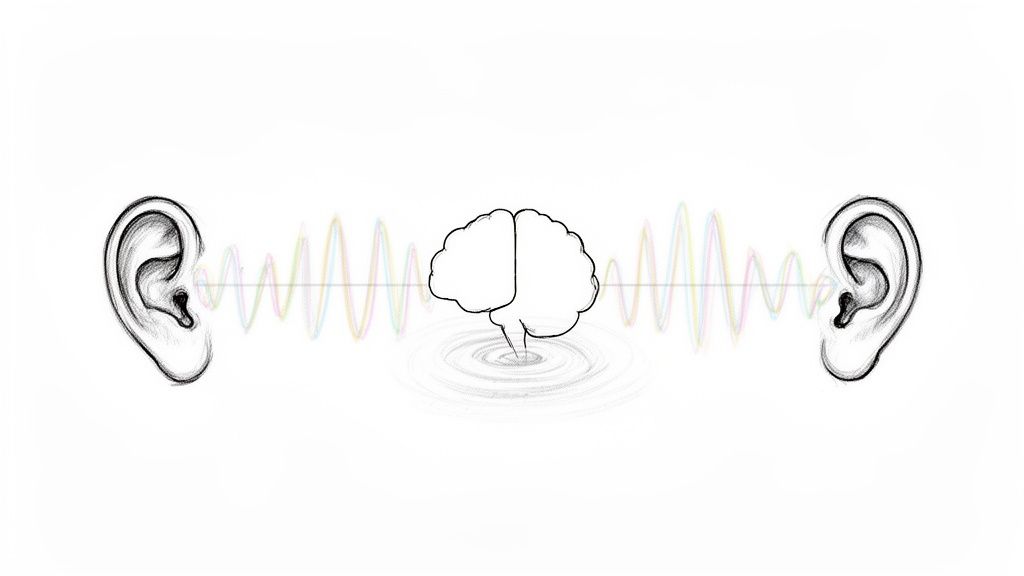
The efficacy of this method is based on the principle of neuroplasticity and repetition. By consistently exposing the subconscious to positive statements, new neural pathways are formed. Research supports this concept; a study in the Journal of Experimental Social Psychology found that subliminal priming could influence judgments and behavior. Another study in Neuroscience of Consciousness confirmed that subliminal information can be processed and affect decision-making. A Dutch study published in Social Cognitive and Affective Neuroscience found that subliminal cues for drinking water increased actual water consumption, showing a direct link between subliminal messages and behavior.
When to Use This Technique
This technique is ideal for changing deeply ingrained habits, beliefs, or self-perceptions, such as low self-worth or fear of failure. Practical Example: Someone with a deep-seated “scarcity mindset” can listen to subliminal audio tracks with affirmations like “Abundance flows to me easily” while working or sleeping. Over time, this consistent input helps shift their subconscious filter from seeking lack to recognizing opportunity. For more on this, explore how to reprogram your subconscious mind.
How to Get Started
- Actionable Step: Define Your Goal and Create an Affirmation. Be specific about the new belief you want to install (e.g., “I am capable and deserving of success”). Write it in the present tense, as if it’s already true.
- Choose High-Quality Programs. Select subliminal audio tracks from reputable creators. Look for programs that disclose the affirmations used and combine them with sound frequencies like binaural beats.
- Listen Consistently. Commit to listening to your chosen audio daily for at least 30 minutes for a minimum of 40-60 days. The best times are during relaxed states, such as before sleep or upon waking.
- Combine with Conscious Practice. Reinforce the subliminal messages by consciously repeating your affirmations throughout the day and journaling about any shifts you notice in your thoughts and behaviors.
6. Emotional Release and Somatic Healing
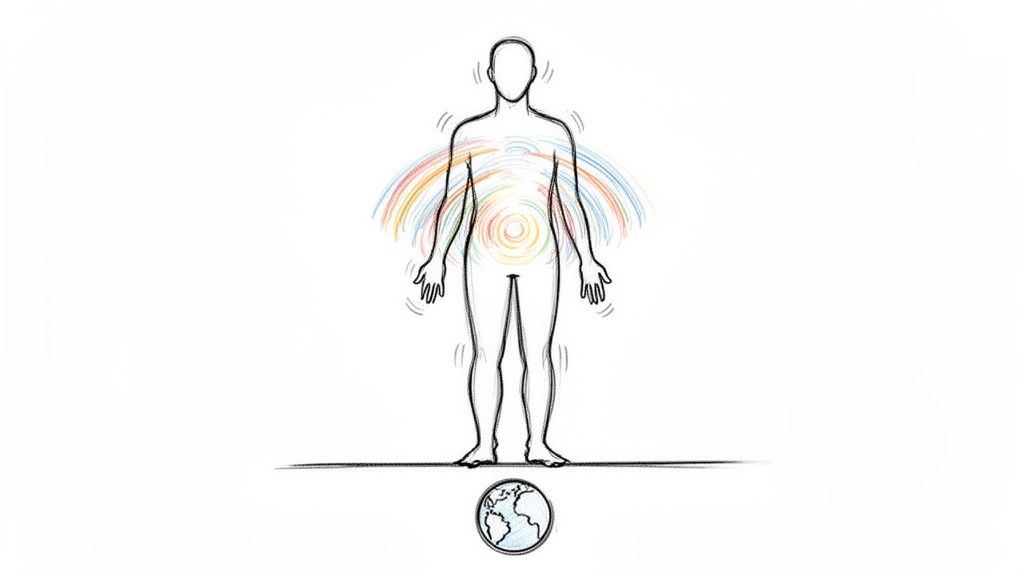
Somatic healing is a therapeutic approach recognizing that trauma, stress, and limiting beliefs are stored physiologically in the body’s nervous system. Pioneered by figures like Peter Levine, this modality uses body-awareness techniques, movement, and intentional breath to access and discharge suppressed emotions and frozen trauma responses. It operates on the principle that to truly heal the mind, we must address the “score” the body keeps.
These techniques work by helping the autonomic nervous system complete self-protective motor responses that were “frozen” during an overwhelming event. By mindfully engaging with physical sensations, you can facilitate a natural discharge of stored survival energy. A 2017 study published in the European Journal of Psychotraumatology highlighted the effectiveness of somatic-based interventions like TRE (Trauma Release Exercises) in reducing anxiety and PTSD symptoms. A study in the Journal of Traumatic Stress found that sensorimotor psychotherapy improved emotional regulation in trauma survivors. Another review in Global Advances in Health and Medicine concluded that mind-body practices are effective for treating trauma-related disorders.
When to Use This Technique
Use somatic healing when you experience chronic physical tension, unexplained anxiety, or feel disconnected from your body. Practical Example: An individual who feels constantly on edge and has chronic shoulder tension (a common manifestation of stored stress) can practice a “body scan.” By lying down and methodically bringing gentle, non-judgmental awareness to the sensation of tension in their shoulders, they allow the nervous system to process and release that stored energy, which may manifest as warmth, tingling, or subtle shaking.
How to Get Started
- Actionable Step: Cultivate Body Awareness. Right now, close your eyes and take 60 seconds to scan your body from head to toe. Notice areas of tension, warmth, or tingling without judgment. This is the first step.
- Create a Safe Space. Ensure you have a private, comfortable area where you feel safe to allow physical release without interruption.
- Explore Gentle Movement. Try gentle, intuitive movements like stretching, rocking, or shaking your arms and legs to start releasing physical tension.
- Work with a Professional. For deep trauma work, it is crucial to work with a certified somatic therapist. To find out more, you can learn about somatic therapy and its applications.
- Practice Grounding. After each session, use grounding techniques like feeling your feet on the floor or holding a cool object to help your nervous system return to a calm state.
7. Guided Visualization and Imagery Work
Guided visualization is a therapeutic technique that uses the power of the mind to create detailed sensory experiences. This is a powerful tool among subconscious mind healing techniques because the brain often doesn’t distinguish between a vividly imagined event and a real one. Both activate similar neural pathways, allowing you to reprogram limiting beliefs, rehearse desired outcomes, and soothe the nervous system from a place of safety.
This technique works by guiding you into a relaxed state where the subconscious is highly receptive. In this state, you construct internal scenarios that build new neural connections for confidence, calmness, or success. Research supports its effectiveness. A study in the Journal of Consulting and Clinical Psychology found that guided imagery significantly reduced anxiety and depression. A 2018 study in Frontiers in Human Neuroscience showed that motor imagery (visualizing movement) activated the same brain regions as actual physical execution. Furthermore, a meta-analysis in Pain Research and Management confirmed its efficacy in reducing pain perception.
When to Use This Technique
Use guided visualization to prepare for a high-stakes event, change a deep-seated habit, or manage anxiety. Practical Example: A manager about to have a difficult conversation with an employee can spend 10 minutes visualizing the entire interaction going smoothly. They imagine their own calm demeanor, the employee’s receptive attitude, and a mutually positive outcome. This mental rehearsal programs the subconscious for success and reduces anticipatory anxiety.
How to Get Started
- Actionable Step: Establish a Calm State. Begin with several minutes of slow, deep breathing to relax your body and quiet your conscious mind.
- Engage All Senses. As you visualize your goal, don’t just “see” it. Actively imagine the sounds, smells, and physical sensations. For the manager’s visualization, what does the coffee in the room smell like? What is the temperature of the chair? The more multi-sensory, the more real it feels to your brain.
- Start with a Script or Recording. Use a pre-recorded guided visualization track when you’re new to the practice. This helps you stay focused.
- Practice Consistently. Dedicate 10-20 minutes, 3-4 times a week, to reinforce the new neural pathways you are building.
8. Energy Work and Chakra Balancing
Energy work refers to a family of healing practices, including Reiki, that operate on the principle that the body has a subtle energy system. This system, including energy centers known as chakras, influences physical and emotional well-being. When chakras become blocked due to stress or trauma, it can manifest as emotional disturbances. These techniques aim to clear energetic blockages and restore balance, facilitating healing at a root, subconscious level.
This modality works by channeling life force energy to dissolve energetic congestion. While mechanisms are still being explored by Western science, the practice is gaining recognition for its therapeutic effects. A 2017 systematic review in the Journal of Alternative and Complementary Medicine concluded that Reiki activates the parasympathetic nervous system to heal the body and mind. Another study published in Cancer Prevention and Control found that energy healing significantly reduced fatigue in cancer patients. Research in the Journal of Holistic Nursing found that Reiki was effective in reducing pain and anxiety during post-operative recovery.
When to Use This Technique
Consider energy work when you experience persistent emotional blocks, chronic fatigue, or discomfort that doesn’t respond to conventional methods. Practical Example: Someone with a deep-seated fear of public speaking might have a blocked throat chakra (related to communication). An energy healer might work on this area to clear the blockage, which the person might experience as a release of tension, allowing them to feel more open and confident in expressing themselves.
How to Get Started
- Actionable Step: Seek a Certified Practitioner. Find a reputable and certified practitioner in a modality like Reiki or Healing Touch to ensure a safe and professional experience.
- Practice Self-Energy Clearing. Start your day by visualizing a protective white light surrounding your body. As you breathe deeply, imagine this light clearing away any stagnant or negative energy from your system.
- Use Sound for Chakra Activation. Incorporate sound baths using singing bowls or listen to specific chakra-balancing frequencies (binaural beats) to help align your energy centers.
- Integrate with Other Modalities. Combine energy work with journaling or breathwork. This synergy can amplify the release of subconscious material and help you consciously process the energetic shifts.
Subconscious Healing: 8-Method Comparison
| Technique | Implementation complexity | Resource requirements | Expected outcomes | Ideal use cases | Key advantages |
|---|---|---|---|---|---|
| Breathwork and Conscious Breathing Techniques | Low to medium — learnable practice, some facilitation for intense work | None to minimal; instructor for advanced sessions; time commitment | Rapid autonomic regulation, reduced anxiety, improved interoception | Stress relief, immediate anxiety management, prep for deeper modalities | Immediate physiological effects, accessible anywhere |
| Binaural Beats and Brainwave Entrainment | Low — simple to implement but requires correct parameters | Quality headphones, audio tracks, quiet environment, 20–45 min sessions | Entrainment to target brainwaves (theta/alpha/delta), relaxation, enhanced absorption | Meditation, sleep support, scalable digital programs | Passive, scalable, measurable via EEG/HRV |
| Neuro-Linguistic Programming (NLP) | Medium to high — requires practitioner skill for best results | Certified practitioner or training, client engagement, multiple sessions | Rapid behavioral shifts, reframed beliefs, improved performance | Overcoming limiting beliefs, performance coaching, anxiety patterns | Targets root beliefs, provides portable self-tools |
| Hypnotherapy and Hypnotic Suggestion | Medium — requires trained clinician, therapeutic framework | Certified hypnotherapist, safe setting, recordings for reinforcement | Deep subconscious access, habit change, symptom reduction | Smoking cessation, habit change, trauma-informed suggestion work | Direct subconscious suggestion, often fast therapeutic change |
| Subliminal Programming and Affirmations | Low — easy to distribute, longer consolidation time | Quality audio/video production, consistent daily exposure over weeks | Gradual belief rewiring, cumulative behavior change | Busy professionals, passive reinforcement during sleep/meditation | Works without active effort, scalable digitally |
| Emotional Release and Somatic Healing | High — needs trauma-informed facilitation and containment | Skilled somatic therapist, safe space, repeated sessions | Nervous system recalibration, discharge of stored trauma, lasting relief | Chronic stress, trauma recovery, burnout, body-based symptoms | Addresses physiological roots, tangible body-based shifts |
| Guided Visualization and Imagery Work | Low to medium — accessible but benefits from skilled guidance | Guided scripts or recordings, quiet space, 10–20+ minute sessions | New neural pathways via vivid imagery, reduced anxiety, performance gains | Performance visualization, trauma-safe reprocessing, meditation enhancement | Safe, multi-sensory, immediately experiential |
| Energy Work and Chakra Balancing | Low to medium — variable methods, practitioner-dependent | Trained energy practitioner or self-practice tools (sound, visualization) | Perceived energetic balance, relaxation, symptom relief (anecdotal/evolving evidence) | Holistic wellness, persistent “stuck” patterns, complementary therapy | Holistic, complements other modalities, often immediate subjective relief |
Integrating Your Toolkit: The Path to Lasting Change
You’ve just explored a powerful and diverse collection of subconscious mind healing techniques, each one a unique key capable of unlocking profound personal transformation. From the foundational power of Breathwork and the precise reframing of Neuro-Linguistic Programming (NLP) to the deep states induced by Hypnotherapy and Binaural Beats, the path to reprogramming your inner world is multifaceted. We’ve seen how Guided Visualization builds new neural pathways for success, while Subliminal Programming and Affirmations gently rewrite limiting beliefs operating just below the surface of your awareness.
The true breakthrough, however, lies not in choosing one “perfect” technique, but in understanding their synergy. These modalities are not isolated tools; they are interconnected elements of a holistic healing system. Think of your subconscious as a deeply rooted tree. Somatic Healing and Emotional Release address the physical tension stored in the trunk and branches, while Energy Work clears blockages in the subtle energy field that nourishes the entire system. Each technique addresses a different layer of your being.
The Power of Integration and Consistent Action
The most significant takeaway is that lasting change requires an integrated approach. While practicing one technique consistently is valuable, combining them amplifies their effects exponentially. Breathwork, for instance, is the master key. It quiets the analytical conscious mind and regulates the nervous system, creating the ideal state for other modalities like hypnotic suggestion or NLP to be received and integrated more deeply.
A 2018 study in Frontiers in Psychology highlighted how practices that combine focused attention and physiological regulation (like many forms of breathwork and meditation) can significantly enhance emotional regulation and cognitive flexibility. This underscores the principle of synergy: calming the body first makes the mind more receptive to new programming. Your journey forward is about creating your own unique healing sequence.
Key Insight: True transformation isn’t about finding a single magic bullet. It’s about intelligently layering complementary subconscious mind healing techniques to create a holistic and personalized system for change that addresses mind, body, and energy.
Your Actionable Path Forward
To avoid overwhelm, the goal is not to master all eight techniques at once. The path to subconscious healing is a marathon, not a sprint. Your immediate next step is to choose one or two modalities that resonated most strongly with you and commit to consistent, intentional practice.
Here is a simple framework to begin:
- Choose Your Foundation (The “State-Changer”): Select a practice that helps you access a receptive subconscious state. This is often Breathwork or Binaural Beats. Commit to a short, 5-10 minute daily practice to build consistency.
- Select Your “Reprogramming” Tool: Pick a technique focused on actively rewriting old patterns. This could be creating a set of powerful Affirmations, practicing a 10-minute Guided Visualization, or using an NLP technique like anchoring.
- Schedule and Track: Treat this like any other important commitment. Schedule it in your calendar and perhaps keep a brief journal to note any shifts in your thoughts, feelings, or behaviors. This reinforces your commitment and provides valuable feedback on what’s working.
Remember, the subconscious mind learns through repetition and emotion. Brief, consistent, and emotionally resonant practices will always be more effective than infrequent, long sessions. By taking these small, actionable steps, you are not just learning about healing; you are actively participating in the creation of a new reality for yourself, one built on a foundation of empowerment, resilience, and conscious design. The power to change is already within you; these tools simply help you access it.
Ready to experience the synergistic power of multiple modalities in one seamless journey? 9D Breathwork integrates guided breathwork, hypnotic suggestion, NLP, binaural beats, and somatic release into a single, transformative experience designed to accelerate subconscious healing. Explore the future of personal transformation by visiting 9D Breathwork to learn more.