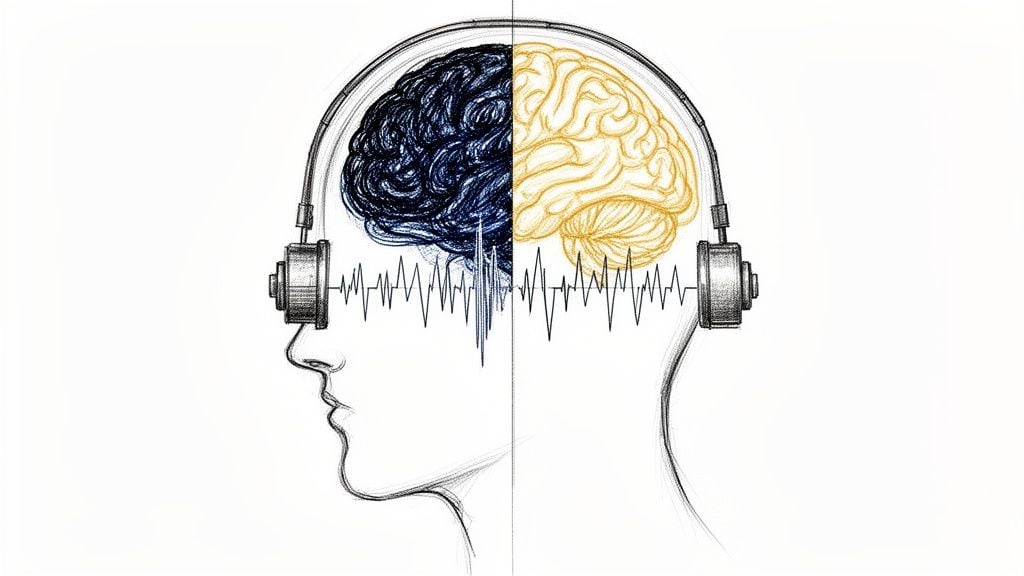
Binaural beats offer a surprisingly simple, science-backed way to calm your mind using nothing more than sound. By listening to two slightly different frequencies—one in each ear—your brain perceives a third, phantom tone. This tone can gently guide you into a state of deep relaxation, helping to dial down those feelings of stress and overwhelm.
Your Quick Start Guide to Using Binaural Beats
Ever heard two guitar strings that are almost, but not quite, in tune? You get that distinct, vibrating hum in the air. That’s the core idea behind binaural beats, but it happens inside your head, not out in the room. This phenomenon is called brainwave entrainment.
Your brain is a symphony of electrical activity, producing waves that mirror your mental state. When you’re anxious, your brain is often buzzing with high-frequency Beta waves—think of it as being stuck in high gear. Binaural beats introduce a calmer, more coherent rhythm, and your brain has a natural tendency to sync up with it.
Finding Your Path to Calm
The goal here isn’t to force relaxation but to gently guide your brain from a state of high alert into one of deep rest. We do this by working with specific frequency ranges that are known to promote calm.
- Alpha Waves (8-13 Hz): This is your brain’s “calm but alert” mode. It’s the feeling you get when you’re lightly meditating, daydreaming, or just lost in a creative flow. Alpha frequencies are fantastic for taking the edge off stress while keeping your mind clear. Actionable Tip: Use an Alpha wave track during your work break to reset your focus without feeling drowsy.
- Theta Waves (4-8 Hz): This is a much deeper state, the kind you experience during profound meditation or right before you fall asleep. Theta frequencies are perfect for quieting those persistent, looping anxious thoughts and achieving a serious sense of tranquility. Actionable Tip: Listen to a Theta wave track at the end of a stressful day to help your mind and body fully unwind.
By listening, you’re essentially giving your nervous system a steady, external rhythm to follow, leading it away from the chaotic patterns of anxiety. A study in Psychological Research found that listening to binaural beats, especially in the Theta range, significantly reduced anxiety symptoms in participants.
And the best part? All you need to get started is a pair of stereo headphones and a quiet spot to sit or lie down. While powerful on its own, this practice becomes even more effective when layered with other techniques. You can learn more about combining sound with guided breathing practices to get even deeper results.
A 2019 study published in PLoS One found that even a brief 5-minute exposure to theta-frequency binaural beats induced a meditative-like state in the brain, showcasing their potential for quick anxiety reduction.
To help you jump right in, I’ve put together a simple reference guide.
Quick-Start Guide to Binaural Beats for Anxiety Relief
Use this table as a quick reference to choose the right frequency and session length for your needs.
| Frequency Range | Associated Brainwave State | Primary Benefit for Anxiety | Recommended Session Length |
|---|---|---|---|
| 8-13 Hz | Alpha | Reduces mild stress, promotes calm focus, and quiets racing thoughts. | 15-20 minutes |
| 4-8 Hz | Theta | Eases deep-seated anxiety, supports emotional processing, and encourages profound calm. | 20-30 minutes |
Start with a shorter session and see how you feel. Consistency is far more important than duration, especially when you’re just beginning.
How Sound Can Calm an Anxious Mind
Let’s start with a simple way to picture what’s happening in your brain when you’re anxious. Imagine a huge, scattered crowd where everyone is clapping to their own beat. The result? A chaotic, unfocused jumble of noise. Now, picture a single, powerful drum starting a steady rhythm. Little by little, the people in the crowd begin to clap along, until the entire group is locked into one single, coherent beat.
That’s essentially what brainwave entrainment does for your mind. Your brain isn’t just a passive listener; it actively synchronizes its own internal rhythms—its brainwaves—to an external rhythm, like the one created by binaural beats. This gives you a direct way to guide your mental state from feeling anxious and scattered to calm and focused.
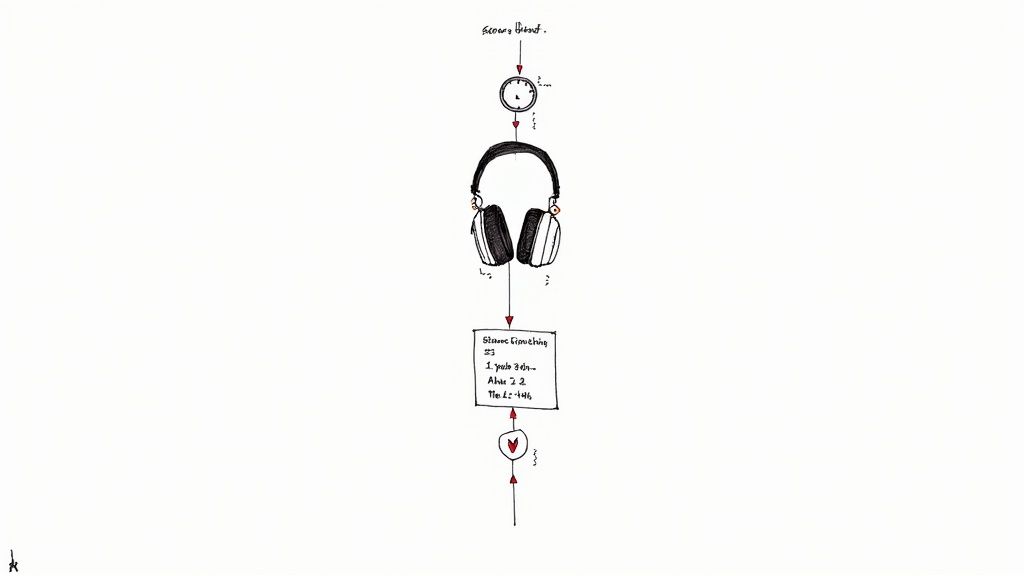
This infographic gives you a clear visual of this simple yet powerful process, showing how audio waves can influence your brain to create a state of calm.
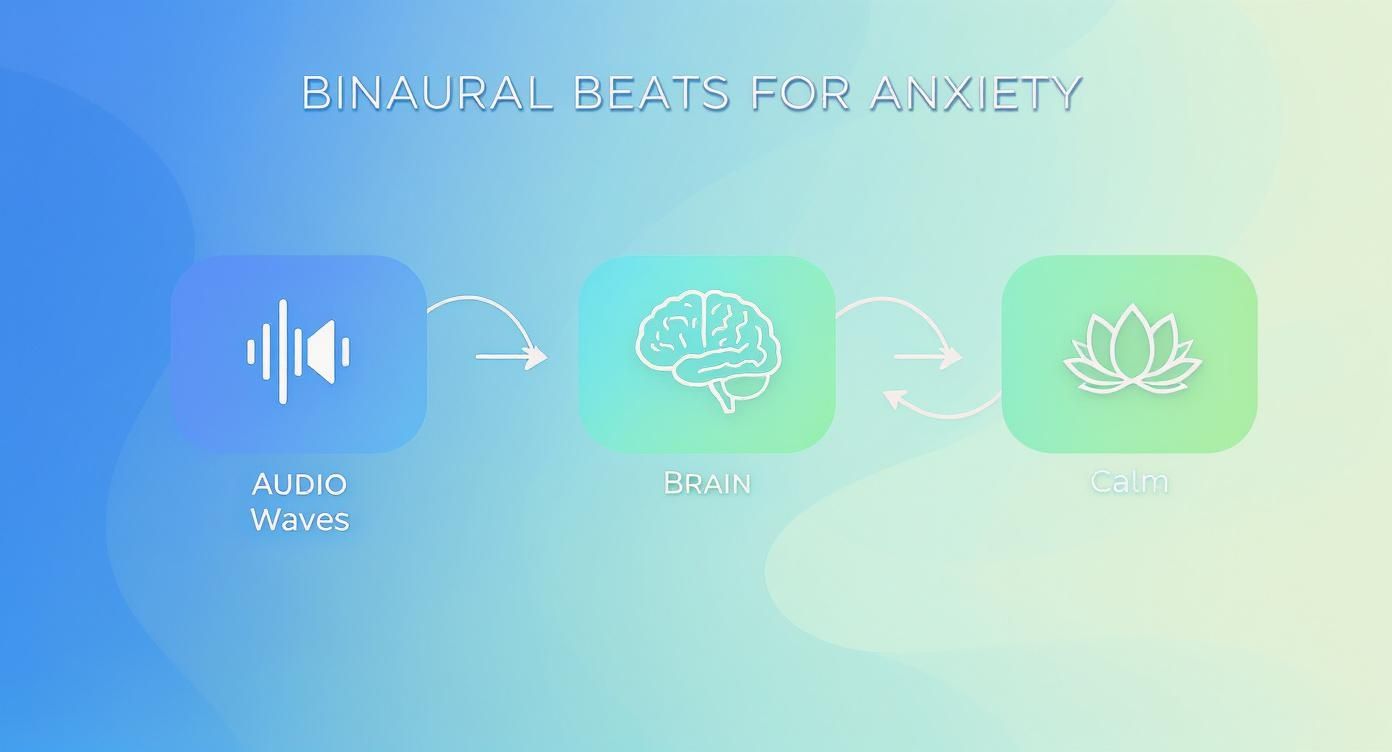
As you can see, the journey from an external sound to a feeling of inner peace is a direct one. The right auditory input can be a powerful tool for self-regulation.
Understanding Your Brain’s Rhythms
Your brain operates on a whole spectrum of electrical frequencies, or brainwaves, and each one corresponds to a different state of mind. Getting familiar with these is the first step toward learning how to shift between them intentionally. A 2024 systematic review in Applied Sciences confirmed that binaural beats are a consistently effective tool for reducing anxiety precisely because they guide the brain toward calmer wave patterns.
Here are the five main types of brainwaves:
- Gamma (30-100 Hz): This is your brain in high gear—think peak focus, complex problem-solving, and intense concentration.
- Beta (14-30 Hz): Your everyday, waking state. You’re alert, engaged, and focused on what’s happening around you. The catch? High-range Beta is also the signature of stress, anxiety, and that “on-edge” feeling.
- Alpha (8-14 Hz): This is the sweet spot of relaxed wakefulness. It’s a calm, focused flow state, perfect for light meditation or creative brainstorming.
- Theta (4-8 Hz): Linked to deep relaxation, meditation, and that twilight state just before you fall asleep. This is where truly profound stress relief happens.
- Delta (1-4 Hz): The slowest brainwaves, associated with deep, restorative, dreamless sleep and physical healing.
When anxiety takes over, your brain is usually stuck in high-frequency Beta waves. It’s on high alert, constantly scanning for threats. The whole point of using binaural beats for anxiety is to gently coax your brain out of that overactive state and down into the more peaceful, restorative Alpha or Theta states.
Shifting from Chaos to Calm
So, how does this actually work in practice? When you put on headphones and listen to a binaural beat track designed for anxiety, you’re essentially feeding your brain a steady frequency that falls within that target Alpha or Theta range. Research published in the journal Physiology & Behavior has shown that this process can significantly shift both mood and alertness.
Your brain has a natural tendency to sync up with external rhythms, a phenomenon known as the frequency-following response. It just takes over.
Practical Example: Let’s say you have an important presentation coming up and feel your heart racing. Instead of just pushing through the anxiety, take 15 minutes. Put on your headphones, find a 10 Hz Alpha wave track, and close your eyes. This actively nudges your brain away from the high-stress Beta state and towards a state of calm focus, making it easier to think clearly without the anxious mental chatter.
This isn’t about fighting your anxiety head-on. It’s about giving your brain a new, calmer rhythm to follow. By practicing with these sounds consistently, you’re doing more than just finding a temporary fix—you’re actually training your brain to access these peaceful states more easily on its own. It’s an active process of mental conditioning that puts you back in the driver’s seat.
What the Science Says About Binaural Beats
The idea that specific sounds can soothe an anxious mind might sound a bit like science fiction, but a growing body of research is starting to back it up. While personal stories are great, it’s worth digging into the actual peer-reviewed studies to see what they’ve found.
So, let’s look at the evidence. We’ll explore some key studies that show both the promise and the nuances of using binaural beats, giving you a clear, balanced picture of what’s really going on.
Evidence from High-Stress Scenarios
Some of the most powerful research comes from high-stress medical environments—places where anxiety is practically a given. A foundational study in the journal Anaesthesia looked at patients waiting for surgery, a situation anyone would find stressful. The results were pretty eye-opening.
The study found that patients who listened to binaural beats experienced a 26.3% reduction in pre-operative anxiety. This was a significantly greater reduction than that seen in the group that listened to regular, non-therapeutic music. You can learn more about the science behind binaural beats and anxiety reduction.
This wasn’t just a placebo effect; it was a measurable physiological and psychological shift toward calm in a clinical setting. It was a green light for researchers to explore how this simple, non-invasive tool could be used more widely.
This effect isn’t a one-off, either. A more recent clinical trial published in Frontiers in Psychiatry involving patients undergoing endoscopic procedures found similar results. A short session with binaural beats made a significant difference in their comfort and lowered anxiety scores right before the procedure.
It’s Not Always That Simple
Of course, science rarely gives us a neat, one-size-fits-all answer. The brain is an incredibly complex machine, and how it responds to sound isn’t always predictable. The effectiveness of binaural beats can really depend on the person, the setting, and the specific kind of anxiety being measured.
This is actually a crucial point. It’s not just about hitting “play” and expecting magic. It’s about creating the right conditions, both inside and out, for your brain to settle down and respond.
A 2023 study in the Journal of Affective Disorders Reports really drove this point home. Researchers looked at binaural beats during a different type of medical procedure and, in this particular case, they didn’t find a statistically significant drop in anxiety compared to other groups.
So what does that tell us? It means that while binaural beats are a potent tool for many people, they aren’t a guaranteed fix. Their effectiveness seems to be influenced by a few key factors:
- Your Environment: Listening in a quiet, comfortable space where you won’t be disturbed is essential.
- Your Mindset: Going into a session with an open, receptive attitude can make a huge difference.
- Consistency: Just like exercising a muscle, regular practice builds strength and delivers better results.
This doesn’t cancel out the positive findings. It just adds an important layer of understanding. It suggests that binaural beats work best when they’re part of an intentional, mindful practice, not just something you have on in the background. You’re not just listening—you’re actively guiding your brain toward a state of calm.
This is a core idea in most mind-body practices. When you consistently expose your brain to calming signals, you’re essentially teaching it new habits. You can dive deeper into this fascinating process of neuroplasticity in our guide on how to rewire your brain.
What This Means for You
So, what’s the bottom line? The scientific evidence gives a strong thumbs-up to binaural beats as a legitimate, drug-free way to manage anxiety, especially in those high-stress, in-the-moment situations. The research provides a solid foundation for their use.
At the same time, the science is clear that context matters. The surest path to getting results is to be an active participant. That means setting aside dedicated time for your practice, paying attention to how different frequencies affect you, and being patient with the process.
Your Action Plan: Try it for yourself. Commit to a 15-minute session every day for one week. Use an Alpha wave track. At the end of the week, check in with yourself. Notice how you feel. The science validates the tool, but it’s your consistent action that truly unlocks its power.
Creating Your Own Anxiety Relief Protocol
Alright, let’s move from theory to action. This is where the real magic happens, because understanding what binaural beats are is one thing, but using them effectively is another. Building a personal routine isn’t complex, but it does require being intentional. Think of this as your practical roadmap to creating a protocol that actually fits into your life and helps you feel better, right from the start.
First things first, and this is non-negotiable: you must use stereo headphones. Seriously. This isn’t just a friendly tip—it’s a requirement for the whole process to work. The entire effect hinges on delivering a different frequency to each ear at the same time, and that’s something speakers or mono earbuds simply can’t do.
Choosing the Right Frequencies for Your Goal
The frequency you choose directly steers your mental state. It’s a bit like shifting gears on a bike—some are for climbing hills (intense focus), and others are for cruising downhill (deep relaxation). Your goal is to match the “gear” to the outcome you want.
For anxiety relief, you’ll mainly be working with two key ranges:
- Alpha Waves (8-13 Hz): This is your sweet spot for quieting those racing thoughts while staying alert and present. It’s perfect for dialling down stress before a big presentation or taking the edge off during a demanding workday when you can’t afford to get drowsy.
- Theta Waves (4-8 Hz): Think of this as your deep-dive into restorative calm. You’ll want to reach for Theta frequencies when you feel totally overwhelmed and just need to disconnect—like after a particularly brutal day or during a dedicated meditation practice.
Don’t be afraid to experiment within these ranges. You might find a 10 Hz Alpha beat is perfect for clear-headed focus, while a 6 Hz Theta beat delivers the most profound sense of peace you’ve felt all week.
Session Length and Optimal Volume
When you’re just starting out, consistency beats duration every single time. Aim for a session that’s at least 15-20 minutes long. This gives your brain enough time to tune into the rhythm and actually start the entrainment process. Trying to rush it is like trying to meditate in a hurry—it just defeats the entire purpose.
This isn’t just a random number, either. A recent randomized controlled trial with patients about to undergo a stressful medical procedure showed that a single 15-minute session of binaural beats led to a significant drop in their anxiety scores. The group that didn’t listen? No change. You can dive into the details and read the full study on binaural beats and anxiety reduction for yourself.
Actionable Tip: Schedule 20 minutes in your calendar for your first few sessions. Treat it like an important appointment you wouldn’t cancel. This helps build the habit and gives the practice a real shot at working for you.
Volume is the other piece of the puzzle, and louder is definitely not better. The goal here is subtle guidance, not an auditory assault. Set the volume to a comfortable, low-to-moderate level. It should be just loud enough to hear clearly, but soft enough that it could easily fade into the background if you weren’t paying attention. This is better for your ears and creates a much more relaxing experience.
Important Considerations for a Safe Experience
For the vast majority of people, listening to binaural beats is completely safe. That said, there are a few important exceptions to keep in mind to ensure you have a positive and secure experience, especially if you have certain pre-existing health conditions.
It’s crucial to know about these before you hit play:
- Seizure Disorders and Epilepsy: The rhythmic stimulation from binaural beats could, in rare instances, be a potential trigger for someone with epilepsy or a history of seizures. If this is you, it’s absolutely essential to talk with your doctor before trying any form of brainwave entrainment.
- Pacemakers or Heart Conditions: While the risk is considered extremely low, anyone with a pacemaker should also have a quick chat with their healthcare provider before making binaural beats a regular practice.
- Driving or Operating Machinery: This one is critical. Never, ever listen to binaural beats—especially the relaxing Theta or Delta frequencies—while driving a car or operating any kind of heavy machinery. They are designed to put you in a deeply relaxed or even drowsy state, which is incredibly dangerous when you need to be fully alert.
By picking the right frequency for your needs, committing to a consistent session length, keeping the volume comfortable, and being mindful of these safety guidelines, you’re all set to build a powerful and personalized protocol for managing anxiety.
How to Amplify Your Results with Other Techniques
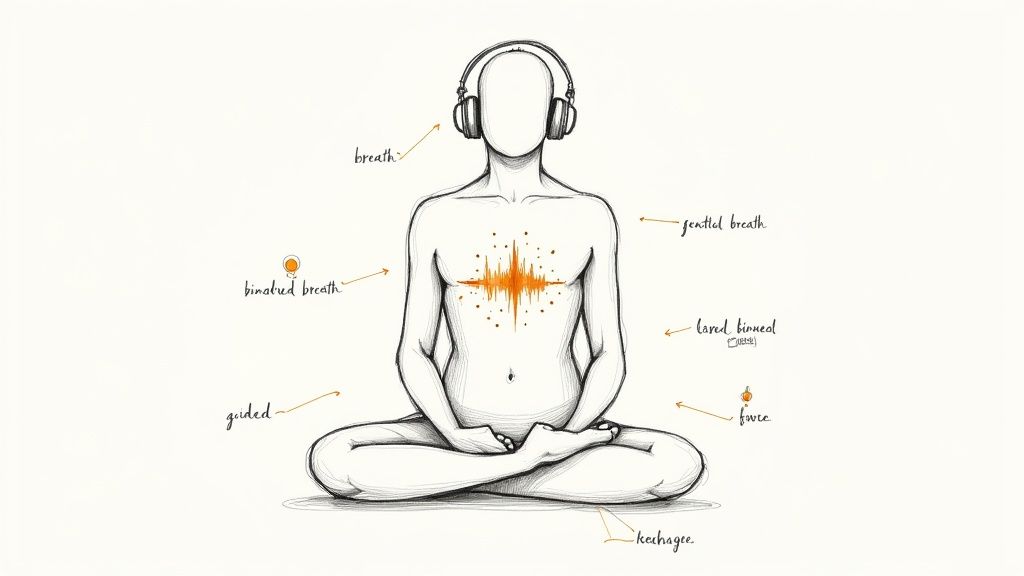
While binaural beats are powerful on their own, you can take their calming effects to a whole new level by layering them with other proven mind-body practices. Think of the binaural beat as the foundational rhythm for your session. By adding intentional techniques on top, you create a rich, multi-sensory experience that can quiet an anxious mind far more quickly and effectively.
This combined approach works by engaging different parts of your nervous system at the same time. While the auditory input from the beats gently nudges your brainwaves toward calm, a practice like controlled breathing sends a direct signal to your body that it’s safe to relax. It’s this synergy that creates a powerful feedback loop, making it much easier to shift out of a state of high alert.
Combining Binaural Beats with Breathwork
One of the most immediate and profound ways to amplify your results is by synchronizing your breath with your listening session. Conscious breathing is your direct line of communication with the autonomic nervous system—the very system that controls your fight-or-flight response. When you deliberately slow down your breath, you’re essentially telling your body to stand down.
A simple yet incredibly effective technique to start with is box breathing. It’s so reliable that everyone from Navy SEALs to surgeons uses it to manage stress in high-pressure moments, and it’s remarkably easy to learn.
Here’s the pattern:
- Inhale Slowly: As your binaural beat session begins, breathe in gently through your nose for a count of four.
- Hold Your Breath: Pause and hold your breath at the top for a count of four.
- Exhale Slowly: Release the breath completely through your mouth for a count of four.
- Hold Again: Pause at the bottom of the exhale for a final count of four.
Repeat this cycle for the first few minutes of your session. This combination does a fantastic job of anchoring your mind in the present, which makes it much harder for anxious thoughts to take over. Focusing on the rhythm also stimulates the vagus nerve, a key player in your body’s relaxation response. To dig deeper into this, you can explore these https://9dbreathwork.com/polyvagal-theory-exercises/ and better understand how to work with your nervous system.
Using Affirmations and Self-Hypnosis
Another fantastic addition is weaving in positive affirmations or simple self-hypnosis scripts during your session. As the binaural beats guide your brain into a relaxed and receptive Theta state, your mind becomes more open to suggestion. This is the perfect window of opportunity to introduce new, calming thought patterns.
This technique isn’t about forceful positive thinking. It’s about gently offering your mind an alternative to the looping, negative thoughts that often fuel anxiety.
Instead of trying to fight off anxious thoughts, you simply introduce a new narrative. You can silently repeat a simple phrase that feels right for you, such as:
- “I am safe and in control.”
- “I release what I cannot change.”
- “With every breath, I feel more at peace.”
Say these phrases to yourself as you listen. The combination of a deeply relaxed brain state and the repetition of these statements can help disrupt old, anxious mental habits and start building new, more resilient ones.
Practical Session Templates to Try Today
To bring this all together, here are two actionable session templates you can use right away—one for a quick reset during a hectic day and another for deep relaxation in the evening.
Template 1: The 15-Minute Workday Reset
- Goal: Quickly reduce stress and get your focus back.
- Binaural Beat: A 10 Hz Alpha Wave track for calm alertness.
- Technique: Start with 5 minutes of box breathing to ground yourself. For the remaining 10 minutes, silently repeat the affirmation, “My mind is calm and clear.”
- When to Use: Perfect for a lunch break, before a big meeting, or anytime you feel that midday overwhelm creeping in.
Template 2: The 25-Minute Deep Relaxation Session
- Goal: Unwind completely and prepare for restorative sleep.
- Binaural Beat: A 6 Hz Theta Wave track for profound calm.
- Technique: Lie down comfortably. For the first 10 minutes, just focus on the sensation of your body relaxing into the surface beneath you. For the final 15 minutes, visualize a peaceful, safe place while the beats play.
- When to Use: At the end of the day or right before bed to disconnect from the day’s stress.
Remember, layering these simple techniques transforms your binaural beats practice from a passive listening experience into an active, intentional tool for managing anxiety. And don’t forget that optimizing your sleep hygiene is another cornerstone of well-being. Exploring other natural habits for improving sleep quality can create an even more comprehensive and effective approach.
Common Questions About Binaural Beats
Stepping into the world of sound-based wellness is exciting, but it often brings up a few questions. It’s smart to get a clear picture before you commit time and energy to something new. This section is here to answer the most common things people ask about using binaural beats for anxiety, giving you straightforward, practical answers to feel confident.
We want to clear up any confusion so you can get started safely and make the most of this powerful tool. Let’s get into it.
How Quickly Can I Expect to Feel a Difference?
Most people feel a tangible shift—a sense of calm washing over them—within the first 15-20 minutes of listening. This isn’t just a feeling; clinical studies back this up, showing rapid decreases in what’s known as “state anxiety” (how you feel in the moment). But for real, lasting change, consistency is everything.
Think of it like going to the gym for your brain. The first session feels good, but it’s the regular practice that builds true mental resilience. Committing to a daily 20-minute session for even a couple of weeks can train your brain to access that relaxed state much more easily and quickly on its own.
A 2024 systematic review of existing research published in Applied Sciences found that binaural beats consistently reduced anxiety more effectively than control conditions, confirming they are a reliable tool for immediate relief.
Can I Use Binaural Beats While I’m Working or Sleeping?
Yes, you absolutely can! The trick is to match the frequency to what you’re doing. Using the wrong brainwave frequency can be like trying to sprint during a yoga class—it just doesn’t work.
- For Work or Study: Stick with Alpha waves (8-13 Hz). These promote a state of “calm alertness,” which is the sweet spot for focus, creativity, and getting into a productive flow state without feeling sleepy.
- For Sleep: Delta waves (0.5-4 Hz) are your best friend here. These are the slowest brainwaves, directly linked to deep, restorative sleep. Listening as you wind down can help you drift off faster and improve the overall quality of your rest.
A word of caution: never listen to relaxing Theta or Delta frequencies while driving or operating machinery. Your full, sharp attention is non-negotiable in those situations.
Are There Any Dangers or Side Effects I Should Know About?
For the overwhelming majority of people, binaural beats are incredibly safe. The only real things to watch out for are the volume and a few pre-existing health conditions. Always keep the sound at a comfortable, moderate level—think background music, not a rock concert—to protect your hearing.
There are a few specific cases where it’s best to be cautious. A recent review in the journal Applied Sciences confirmed the general safety of binaural beats but also highlighted the need for awareness. If you have epilepsy or a history of seizures, please talk to your doctor first, as rhythmic stimulation can be a potential trigger in very rare cases. The same advice goes for anyone with a pacemaker or who is under treatment for a serious psychological condition.
What’s the Difference Between Binaural, Monaural, and Isochronic Tones?
All three are methods of brainwave entrainment using sound, but they work in slightly different ways. Knowing the difference can help you figure out what you might prefer.
- Binaural Beats: These require stereo headphones because they send a slightly different frequency to each ear. Your brain then creates the therapeutic “beat” by perceiving the difference between the two. This feels very immersive, smooth, and is often the most relaxing for people.
- Monaural Beats: Here, the two tones are mixed together before they get to your ears. This means you can listen through speakers without headphones, which some people prefer.
- Isochronic Tones: These are simply single tones that pulse on and off very quickly, creating a sharp, rhythmic beat. Some people find this method more potent, while others feel it’s a bit too jarring compared to the gentle phasing of binaural beats.
Ultimately, it comes down to personal preference. For a soothing and effective entry point, most people find the immersive nature of binaural beats for anxiety is the perfect place to start.
At 9D Breathwork, we integrate the power of binaural beats with guided breathwork and hypnotic suggestion to create deep, lasting change from the inside out. Discover how our full-spectrum experiences can help you rewire your response to stress and anxiety.