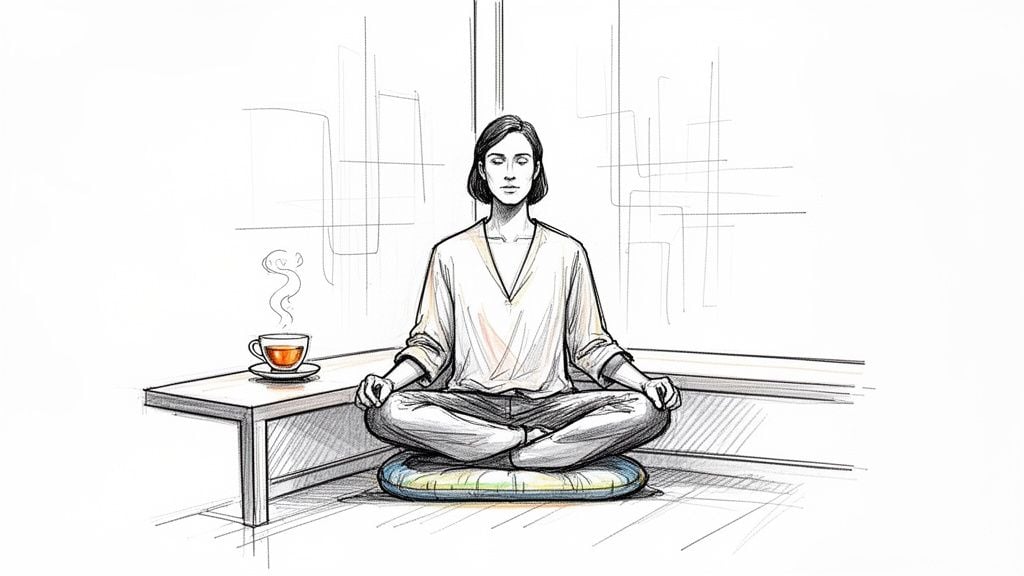
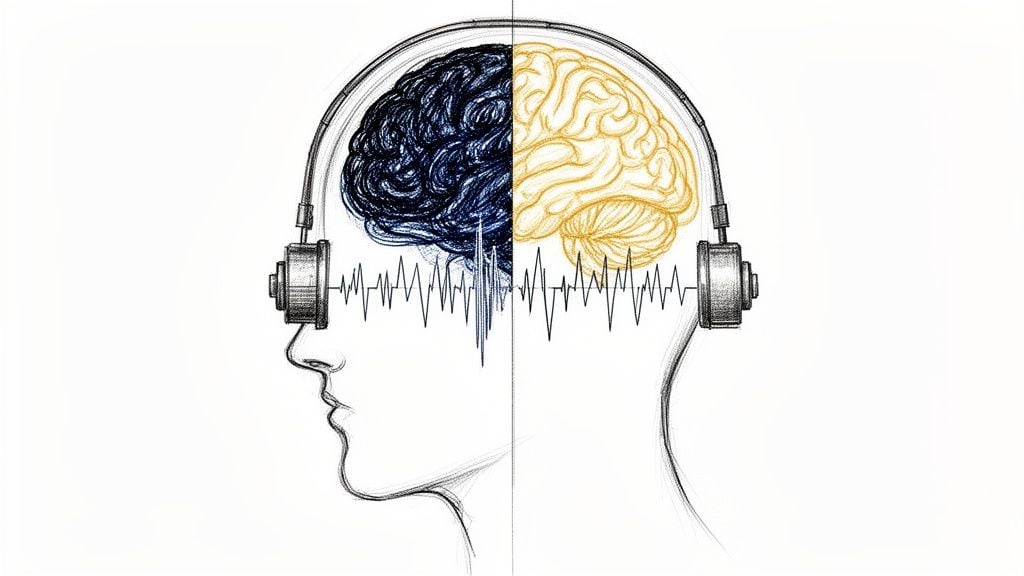
If you want to truly rewire your brain, it comes down to one thing: consistent, targeted daily practice. It’s not about one massive effort but about the small, deliberate actions you take every single day. The most effective approach combines focused mindfulness to quiet those overactive stress circuits, intentional breathwork to literally help your brain grow, and cognitive reframing to carve out new, more positive thought patterns. These small inputs add up to create real, measurable changes in your brain’s architecture and how it operates over time.
Your Quick Guide to Neural Rewiring
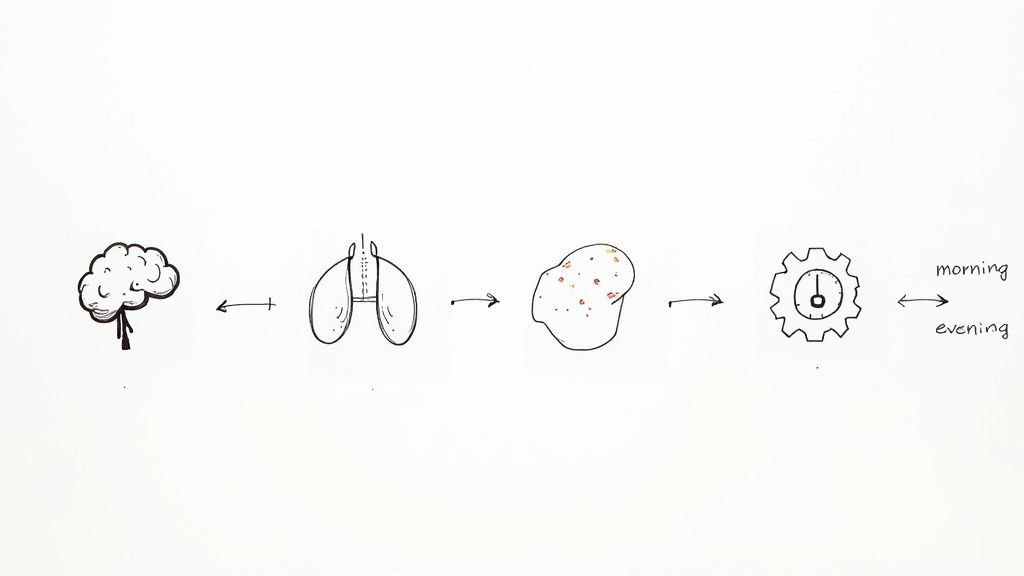
The idea of changing your brain can feel daunting, but it’s built on a surprisingly simple concept: neuroplasticity. This is your brain’s incredible, natural ability to reorganize itself by creating new connections between neurons. Don’t think of your brain as a fixed circuit board; see it as a dynamic, living network that constantly adapts to your thoughts, actions, and experiences.
The proof is everywhere. A study in Psychological Science found that just labeling your emotions—the simple act of putting feelings into words in a journal—actually calms the response in the amygdala, your brain’s fear and threat detector. This is a perfect example of how a small, consistent habit can directly influence your neural wiring. Actionable step: Tonight, before bed, take three minutes to write down one challenging emotion you felt today (e.g., “frustration,” “anxiety”) and one sentence about what triggered it. This simple act begins the rewiring process.
Four Core Actions for Daily Practice
To make this tangible, let’s break it down into four key areas you can weave into your daily life without causing a major disruption. Each one works on a different piece of the neural puzzle, giving you a powerful, holistic approach to rewiring your brain.
- Focused Mindfulness: This is your workout for the prefrontal cortex, the part of your brain that handles self-control and rational thinking. Actionable step: For the next three days, set a timer for five minutes when you wake up. Close your eyes and focus only on the sensation of your breath moving in and out. When your mind wanders, gently guide it back. This simple drill strengthens your ability to stay centered.
- Targeted Breathwork: It’s more than just relaxing. Specific breathing patterns can trigger the production of Brain-Derived Neurotrophic Factor (BDNF). A 2023 study in Scientific Reports confirmed that slow, deep breathing exercises significantly increase BDNF levels. Actionable step: During your lunch break, try the “Box Breathing” technique for three minutes: inhale for four seconds, hold for four, exhale for four, and hold for four.
- Cognitive Reframing: Your automatic thoughts are just well-worn neural habits. By consciously catching, questioning, and challenging negative or limiting beliefs, you start to weaken those old pathways and build new, more empowering ones. Actionable step: The next time you think, “I can’t do this,” pause and write it down. Then, write two alternative thoughts: “This is challenging, but I can try,” and “I will break this down into smaller steps.” If you’re looking for a deeper dive, you can learn more about overcoming limiting beliefs in our detailed guide.
- Habit Architecture: You can make change easier by tweaking your environment. Actionable step: If you want to start a daily meditation practice, place a cushion in a specific corner of your room. This visual cue makes the new habit automatic and removes the friction of deciding where to sit each day.
A landmark Harvard study showed that just eight weeks of mindfulness practice created measurable changes in brain regions tied to memory, empathy, and stress. This is solid proof that consistent, short-term effort delivers tangible, physical results in the brain.
These actions don’t need to consume your day. A 5-minute breathing session between meetings or a 3-minute journaling entry before sleep is more than enough to get the ball rolling. It’s not about intensity; it’s all about consistency. By layering these small practices into your daily life, you’re building a powerful system for intentional and lasting brain change.
Key Steps to Rewire Your Brain at a Glance
To make this even simpler, here’s a quick-reference table summarizing the core practices. Think of it as your daily cheat sheet for building a better brain.
| Step | Focus | Duration | Expected Benefit |
|---|---|---|---|
| Mindfulness | Breath Awareness | 5-10 mins/day | Strengthens prefrontal cortex, calms amygdala |
| Breathwork | Rhythmic Breathing | 5 mins/day | Stimulates BDNF production for neuron growth |
| Reframing | Thought Journaling | 3-5 mins/day | Weakens old neural habits, builds new beliefs |
| Habit Stacking | Environmental Cues | N/A | Automates new behaviors for consistency |
Each of these steps works on a different mechanism of neuroplasticity. When you combine them, you create a synergistic effect that accelerates the rewiring process far more effectively than doing any single one alone.
Understanding The Science Of Neuroplasticity
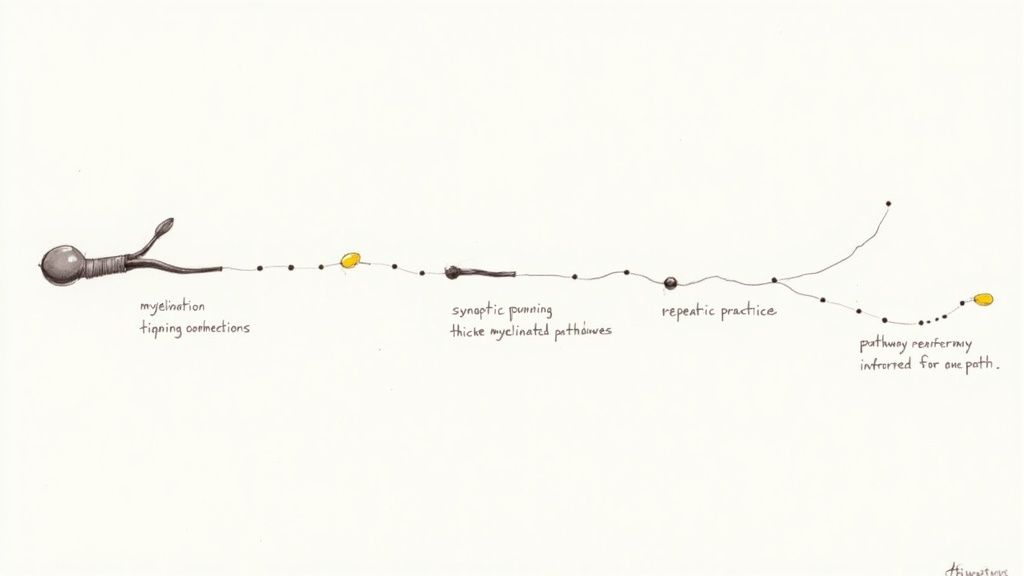
Rewiring your brain doesn’t happen overnight. It’s about sticking with consistent, focused practices—and that’s where neuroplasticity comes in. Picture your brain not as fixed hardware but as a system constantly updating itself based on what you do.
Every habit you repeat carves a clearer path. Whether you’re learning French or ditching a long-standing routine, you’re essentially strengthening the neural connections involved. Over time, these pathways become more efficient—like paving a dirt road into a highway.
The Mechanics Of Brain Change
Here’s what goes on under the hood when you practice a skill or thought pattern:
- Myelination: Neurons get a fatty coating called myelin that speeds up signal transmission. More practice = thicker insulation = faster responses.
- Synaptic Pruning: Your brain trims away less-used synapses and reinforces the active ones. It’s a classic “use it or lose it” approach.
- Pathway Reinforcement: Repetition amplifies certain circuits until they become the brain’s default route, making new habits stick.
A foundational study published in Social Cognitive and Affective Neuroscience discovered that simply putting feelings into words—a practice known as affect labeling—reduces activity in the amygdala, your brain’s emotional alarm system. This shows how a small, repeated action like journaling can physically alter how your brain processes stress.
Real-World Brain Rewiring In Action
- Practical example for musicians: A musician drilling scales isn’t just training their fingers; they’re insulating the exact neural paths that control hand movements. Day by day, signals travel faster, and what felt clumsy turns into fluid muscle memory. You can apply this by practicing one difficult passage for just 10 minutes every day, rather than an hour once a week.
- Practical example for language learners: A language learner using spaced repetition taps into the brain’s timing mechanism. Actionable step: Use an app like Anki or Memrise. When you learn a new word, review it again just before you’re about to forget it. This sends a clear message: this info matters. The result? Stronger connections and words that stick in long-term memory.
Understanding these principles lets you craft strategies that work with your brain’s wiring rather than against it. Many practical guides explore techniques on how to focus with ADHD built on these same foundations.
Neuroplasticity isn’t about growing brand-new brain regions. It’s about strengthening the ones you already have. A landmark 2014 meta-analysis in Frontiers in Human Neuroscience found that functional recovery after brain injury depends on boosting these existing pathways through targeted rehabilitation.
Setting realistic, science-based expectations keeps you motivated. Those small, daily rituals—breathwork, mindful journaling, or targeted drills—gradually reshape your grey and white matter. And that’s where lasting change really takes hold.
Designing Daily Protocols For Neural Change
Knowing the science is one thing, but transformation happens when you put it into practice. A structured daily routine can rewire your brain without feeling like a bootcamp. Think of it as crafting a personal workout plan for your mind.
A sustainable protocol focuses on small, consistent actions that fit into your day. A few minutes before breakfast, a midday pause, and an evening reflection can compound into lasting neural shifts.
Crafting Your Morning Neural Kickstart
How you begin your morning shapes your brain’s performance all day. Instead of grabbing your phone, spend 10–15 minutes on intentional breathwork. This simple shift primes your nervous system for calm focus.
Actionable Step: Use the 4-4-6-2 Breathing Pattern:
- Inhale through your nose for 4 counts
- Hold at the top for 4 counts
- Exhale through your mouth for 6 counts
- Hold at the bottom for 2 counts
Repeat this cycle for 5–10 minutes. You’ll ramp up oxygen flow and stimulate BDNF—often called the “Miracle-Gro” for your brain.
A 2021 study published in NeuroImage highlighted that just ten minutes of daily mindfulness and breathwork can significantly reduce mind-wandering and improve cognitive performance. This demonstrates how a short morning practice directly strengthens your brain’s attention networks.
After breathwork, take two minutes for an intention-setting exercise. Actionable Step: Ask yourself, “What emotional state do I want to embody today?” Write down one word (e.g., calm, focus, creativity) on a sticky note and place it where you’ll see it all day.
The Midday Mindfulness Reset
That afternoon slump isn’t a dead end—it’s a cue. Skip the extra coffee and try a 3–5-minute body scan instead. Actionable Step: Close your eyes at your desk. Starting with your toes, mentally scan up through your body, simply noticing any sensations without judgment. When you reach your head, take one deep breath and open your eyes.
Building this interoceptive awareness helps you regulate emotions on the fly. To deepen this skill, see our guide on how to increase self-awareness.
Shifting Negative Loops With NLP
We all slip into self-critical spirals. A swift Pattern Interrupt breaks that loop and lays down a new neural path. Actionable Step: The next time a negative thought strikes, immediately get up and do five jumping jacks or splash cold water on your face.
Right after the interrupt, replace the thought with something empowering. Swap “I can’t handle this” for “I’ll tackle this one step at a time.” With repetition, you build a stronger, more positive neural highway.
Evening Consolidation And Reframing
Your brain cements memories and habits while you sleep. A brief five-minute journaling ritual can steer that process. Actionable Step: Keep a notebook by your bed and write down three things:
- One challenge you faced today.
- The automatic negative thought it triggered.
- Two more balanced, constructive perspectives on the situation.
For example, critical feedback on a project might feel like failure. A reframe such as “This feedback gives me a clear path to improve” turns it into an opportunity.
Neuroimaging shows that training boosts grey matter, with myelination accounting for 40–50% of observed white matter changes. Synaptic pruning then fine-tunes connections over days. For a deeper look, explore the full research on how training affects brain matter.
If you’re tackling specific challenges, insights on how to manage ADHD and Autism without medication can provide practical, science-backed strategies. Consistency is your greatest ally—small, powerful exercises woven into your day truly rewire your mind.
How to Measure Your Progress
So, you’ve committed to rewiring your brain. That’s the first, most important step. But how do you actually know if it’s working?
Without some way to measure your progress, it’s easy to feel like you’re just going through the motions. Tracking what you do isn’t just about seeing what’s effective; it’s about staying motivated and knowing when to adjust your approach. It’s what turns wishful thinking into a real, data-driven strategy.
The idea is to get beyond a vague sense of “feeling better” and start looking at tangible changes. When you pair your daily reflections with some simple, objective numbers, you create a powerful feedback loop. This shows you exactly how those small, daily actions—the breathwork, the mindfulness exercises—are adding up to real improvements in your focus, mood, and ability to learn.
From Subjective Feelings to Objective Data
Journaling about how you feel is fantastic, but when you combine it with quantifiable data, you get the full picture. The trick is to find simple tools that won’t add another layer of stress to your day.
A fascinating 2007 study in Psychological Science showed that the simple act of writing down and labeling our emotions actually calms down the amygdala—the brain’s alarm system. So, when you track your emotional state, you’re not just recording it; you’re actively helping to regulate it.
Here are a few practical ways to start tracking today:
- Memory Quizzes: Actionable Step: Download a free app like Lumosity or Elevate and do a 5-minute memory game each day. Jot your score in a notebook. Watch the trend over a month.
- Attention Tasks: Actionable Step: Set a timer for two minutes and count backward from 100 by sevens (100, 93, 86…). Note how far you got and how many times you had to restart. Try to beat your score each week.
- Emotional Regulation Prompts: Actionable Step: At the end of each day, ask yourself: “When I felt triggered today, how quickly was I able to return to a calm state?” Rate your answer from 1 (instantly reactive) to 10 (calm and centered quickly).
A key study by psychologist James Pennebaker, published in the Journal of Abnormal Psychology, found that expressive writing—journaling about tough experiences—led to improved immune function and lower stress. Tracking your emotional journey isn’t just in your head; it creates measurable physical changes.
Progress Metrics Overview
A good tracking system uses a mix of metrics. Cognitive scores show you how your performance is changing, while emotional check-ins reveal shifts in your inner world. Think of it as building a dashboard for your own brain.
Here’s a quick overview of some key indicators you can use to track your neuroplastic progress over time.
| Metric | What It Measures | Recommended Frequency |
|---|---|---|
| Working Memory Score | Your brain’s ability to hold and manipulate information. | Daily (5 mins) |
| Sustained Attention Task | Your capacity to maintain focus on a single task. | 3 times per week |
| Emotional Reactivity Score | How quickly you recover from emotional triggers. | Daily (2 mins) |
| Sleep Quality Rating (1-10) | The restorative effectiveness of your sleep. | Daily (upon waking) |
When you consistently log these numbers, you’ll quickly start to spot patterns. You might see that a solid week of breathwork makes your attention scores jump, or that a good night’s sleep almost always leads to lower emotional reactivity the next day. This is the real secret. You’re not just following a plan; you’re using your own data to learn how to rewire your brain in the way that works best for you.
Ensuring Safety in Brain Rewiring Practices
Rewiring your brain can feel exhilarating, but pushing your limits too fast often backfires. Like sprinting through weights, you risk mental exhaustion instead of growth. The trick is balancing challenge with recovery—finding that sweet spot where progress happens without burnout.
Practical example: A breathwork enthusiast who doubled his daily holds from one to two minutes ended up foggy and unfocused at work—his nervous system waving the white flag. Instead of pushing harder, he should have scaled back to 90 seconds and focused on consistency.
Recognizing Signs Of Mental Overload
Your brain drops hints when it’s overtaxed. Ignoring these warnings turns a growth practice into a stress generator, defeating the goal of building resilience and calm.
Watch for these red flags:
- Increased Irritability: Minor setbacks feel like major crises.
- Persistent Brain Fog: You can’t think clearly, even after sleeping well.
- Emotional Numbness: You’re disconnected from your own feelings.
- Physical Exhaustion: You’re wiped out without any added workouts.
“While meditation offers profound benefits, a 2017 study from PLOS ONE found that a notable percentage of practitioners reported challenging experiences like anxiety and social withdrawal, especially when practicing without proper guidance or pacing.”
Actionable Step: If you notice two or more of these signs for more than three days in a row, take a mandatory rest day. Do something completely different and restorative, like taking a walk in nature or listening to music.
Safe Practices For Breathwork And Meditation
Deep breathwork demands respect. The aim is to invite challenge, not shock your system into panic. Hyperventilation—rapid, shallow breathing—can spark dizziness, tingling, and anxiety by upsetting your oxygen–carbon dioxide balance.
Keep these tips in mind:
- Always sit or lie down in a safe spot.
- Never practice intense breathing while driving or in water.
- Actionable Step: If dizziness or overwhelm hits, immediately switch to gentle, natural breathing. Place a hand on your belly and focus on making your exhales slightly longer than your inhales until you feel grounded.
When To Seek Professional Guidance
DIY approaches can take you far, but certain situations call for expert eyes. If you’re using breathwork or hypnosis to process serious trauma or a diagnosed mental health condition, partnering with a qualified therapist or coach is non-negotiable.
Likewise, persistent fatigue or feeling worse after sessions—especially beyond a week—signals it’s time to consult a professional. They’ll help fine-tune your routine, ensuring your journey to rewire your brain stays both effective and safe.
Weaving 9D Breathwork into Your Daily Life
Standard breathwork is a fantastic foundation, but if you’re looking to truly accelerate neural change, integrating a multi-layered approach like 9D Breathwork can be a game-changer. This isn’t just about inhaling and exhaling; it’s a sophisticated method that layers specific breathing patterns with sound, vocal guidance, and focused intention. The goal is to stimulate different neural circuits and essentially rewire your brain from the inside out.
Think of it like upgrading from a basic jog to a comprehensive cross-training program for your mind. Each phase of a 9D session is intentionally designed to target a specific physiological and emotional state, creating a dynamic journey that helps disrupt old, stubborn patterns and forge new, more resilient pathways.
What Does a 9D Breathwork Session Actually Feel Like?
Unlike a monotonous breathing exercise, a typical 9D session is a journey. It guides you through several distinct phases, each with its own rhythm and purpose. One moment, you might be doing rapid, energizing breaths to activate the sympathetic nervous system and release pent-up emotional energy. The next, you could be shifting into slow, deep, rhythmic breathing to engage the parasympathetic system for profound rest and integration.
Practical example: Imagine a busy professional who carves out just 20 minutes during their lunch break. They start with dynamic breathing to shake off morning stress, move into a phase with brief breath holds to sharpen focus, and finish with gentle breathing set to calming binaural beats. Instead of reaching for another coffee, they return to their desk feeling clear, centered, and genuinely energized.
As you start to explore deeper practices, it’s vital to listen to your body. This infographic outlines a simple, but crucial, safety progression to follow.
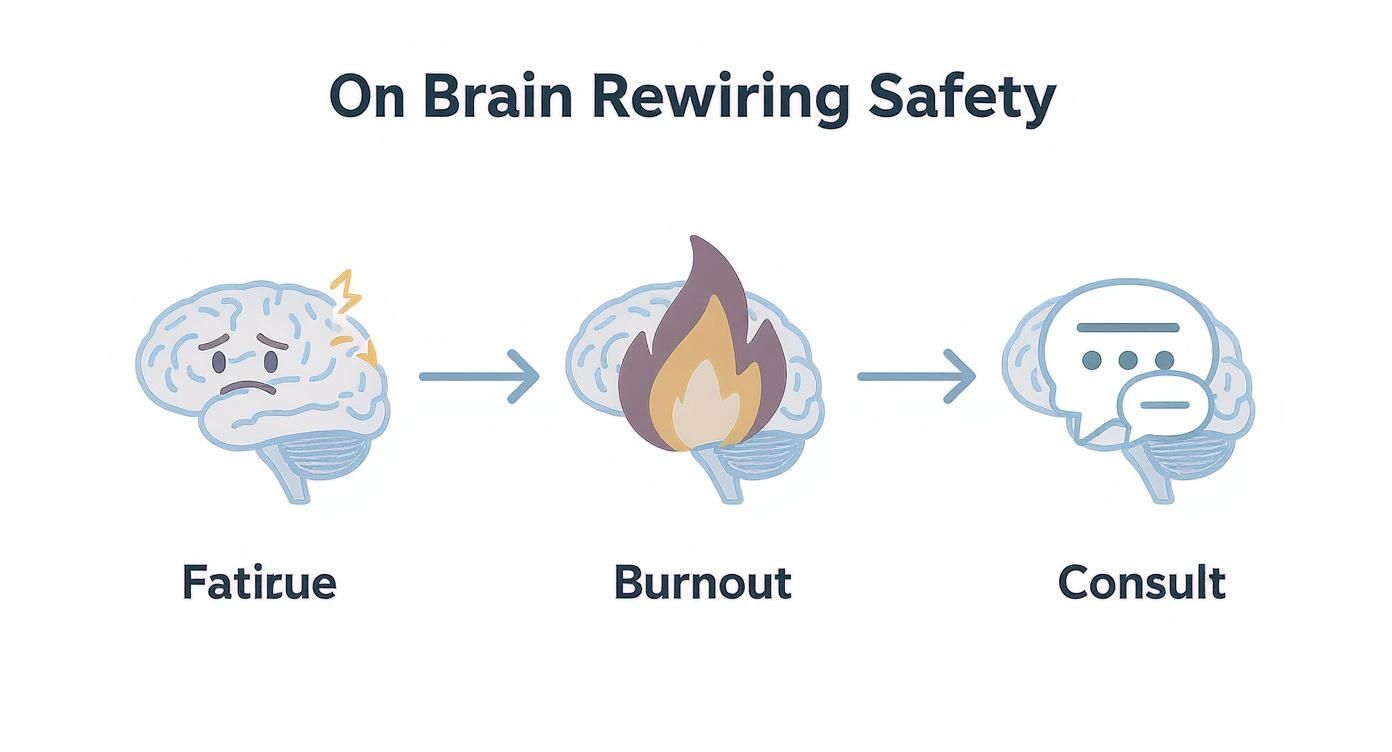
The key takeaway here is to recognize when you’re feeling fatigued and understand that seeking guidance isn’t a sign of weakness—it’s a smart step to prevent burnout on your rewiring journey.
A Practical Plan for Your First Week
To build consistency without shocking your system, I recommend alternating the intensity of your sessions. This gives your nervous system time to adapt and recover, which is absolutely essential for creating lasting change.
Here’s a sample schedule you can adapt:
- Monday: High-Intensity Session (25 mins) – Focus on emotional release and pushing past limiting beliefs.
- Tuesday: Light Session (15 mins) – Gentle, rhythmic breathing designed for stress reduction and a sense of calm.
- Wednesday: Active Recovery – Skip the formal session. Take a mindful walk or do some light stretching instead.
- Thursday: High-Intensity Session (25 mins) – Use dynamic patterns to target mental clarity and focus.
- Friday: Light Session (15 mins) – A perfect way to unwind from the week and prime your body for restful sleep.
- Saturday: Moderate Session (20 mins) – A balanced practice combining both energizing and calming phases.
- Sunday: Rest Day – Let your body and brain integrate the work you’ve done.
Don’t underestimate the power of sleep in this process. Research from UC Berkeley published in Nature Human Behaviour revealed that just one night of poor sleep can send anxiety levels soaring by up to 30%. Weaving a short, light breathwork session into your evening routine can dramatically improve sleep quality—the critical time when your brain consolidates new learning and cements those new neural pathways.
How to Safely Deepen Your Practice Over Time
As you get more comfortable, you can begin to scale your practice. This doesn’t have to be complicated. Actionable step: Try adding one more round to your breathing cycle or extending your session by two minutes. For an evening routine, try a five-minute breathwork session followed by a few gentle retentions and five minutes of journaling about your experience. This is a powerful combination for priming the brain for overnight consolidation.
The potential here is incredible. A recent Stanford Medicine study in Cell Stem Cell identified biological pathways that could boost the creation of new adult neurons. This suggests that practices like intentional breathwork, which can influence metabolic states, may powerfully enhance the activity of our neural stem cells.
If you’re new to this style of practice, taking some time to understand the essentials of guided breathwork and its benefits is a fantastic next step. By thoughtfully and consistently integrating these powerful techniques, you can safely and effectively take control of how to rewire your brain.
Common Questions Answered
When you start a journey to rewire your brain, a few key questions always pop up. Let’s tackle them head-on with some practical, science-backed advice to keep you moving forward and set realistic expectations.
I’ve pulled these answers from years of experience and solid research to help you build a routine that actually sticks.
How Long Does This Realistically Take?
You’ll probably start feeling a shift in your focus, mood, and how you handle stress within the first 3–4 weeks of consistent daily practice. These early wins are usually about getting the hang of the techniques and applying them effectively.
But the real, deep-level changes—the kind that physically alter your brain’s structure, like building more grey matter in the prefrontal cortex—that takes a bit longer. We’re talking 8–12 weeks of steady effort. In fact, the well-known Harvard study showed that just eight weeks of mindfulness practice led to measurable growth in brain regions tied to memory and emotional control.
Can Breathwork Alone Create Lasting Change?
Breathwork is an incredible tool for kickstarting change. It gets your nervous system in a calm, receptive state and can even boost brain-derived neurotrophic factor (BDNF), which helps new neurons grow. But on its own, it’s not the whole picture.
Practical analogy: Think of breathwork as tilling the soil. It prepares your brain for new growth. But to make sure those new pathways stick, you have to plant seeds with actions like mindfulness (watering) and cognitive reframing (weeding). It’s the combination that creates a solid, well-rounded approach to rewiring your brain.
As neuroscientist Dr. Rick Hanson puts it, “what flows through your mind sculpts your brain.” This really drives home why pairing an active practice like breathwork with intentional thought work is so essential for building new, lasting neural architecture.
How Do I Combine All This Without Burning Out?
This is a big one. The secret is to tune into your body and mix up the intensity. Going full-throttle every single day is a surefire recipe for burnout.
A smarter way to approach it is by rotating your sessions. Here’s a simple schedule that works for most people:
- Plan for 2-3 high-intensity breathwork sessions a week.
- On the other days, stick to lighter practices, like a 10-minute mindfulness meditation.
- Weave in super-short daily habits, like two minutes of journaling or a quick cognitive reframing exercise.
This strategy keeps you consistently engaged without ever overwhelming your system.
When Is It Time to Adjust the Intensity?
Keep a close eye on your progress metrics. If you notice your memory scores, attention span, or emotional regulation ratings have flatlined for more than two weeks, that’s a clear sign your brain has adapted.
That’s your cue to introduce a new challenge. Actionable step: The next week, add 1–2 minutes to your main session, try a new cognitive drill from an app, or experiment with a more complex breathing pattern (e.g., extend your exhale by one second). This is the principle of progressive overload, and it’s absolutely critical for continuing to drive neuroplasticity and see results over the long haul.
Ready to create profound, lasting change from the inside out? 9D Breathwork takes you on a powerful, multi-sensory journey, blending breathwork with sound, hypnotic guidance, and NLP to get to the root of old patterns. See how our proven methods can help you rewire your mind for more resilience, clarity, and fulfillment.
Explore the 9D Breathwork journey and get started.