Overcoming limiting beliefs isn’t about chanting positive affirmations in the mirror. It’s about getting your hands dirty—systematically digging up, challenging, and replacing the subconscious rules that have been holding you back.
Think of it as rewriting your internal programming. We’re going to swap out the old, buggy code with evidence-based truths that let you finally tap into your full potential, both personally and professionally. This is a practical skill, and it creates real, lasting change.
The Hidden Scripts That Run Your Life

Ever feel like you’re fighting an invisible force? You’ve got the drive and the talent, but when a big opportunity comes along, you hesitate. That internal friction, that resistance, is almost always a limiting belief at work—a hidden script you learned years ago that’s now quietly capping your potential.
These beliefs are the automatic thoughts that hum along in the background, shaping your reality without you even noticing. They feel like facts: “I’m just not a creative person,” “It’s too late for me to switch careers,” or “You have to be lucky to get ahead.”
Research shows these ideas often get wired into our subconscious during childhood, usually from a moment of failure or criticism. Now, they run on autopilot, influencing your choices without ever asking for your conscious permission.
The Science Behind Subconscious Sabotage
Your brain is a master of efficiency. To navigate the world without getting overwhelmed, it creates mental shortcuts based on everything you’ve ever experienced. A limiting belief is simply one of those shortcuts that’s turned into a dead end. It’s a conclusion your mind jumped to—maybe to protect you from failure or rejection—that’s now completely outdated.
A 2018 study in Frontiers in Psychology drew a clear line connecting self-limiting beliefs to lower well-being and higher psychological distress. So, these internal narratives aren’t just holding back your career; they’re genuinely affecting your quality of life. They are more than just thoughts; they are deeply ingrained patterns. To really get to the bottom of these “hidden scripts,” it helps to remember that most “bad habits” are just automatic systems your brain built, which is why understanding and breaking automatic negative habits is so crucial.
A fascinating study in the Journal of Experimental Social Psychology found that when people simply identified and reframed their limiting beliefs about their own abilities, their performance on difficult tasks improved significantly.
From Autopilot to Active Control
The journey to overcoming limiting beliefs begins with a simple but powerful realization: these scripts are not facts. They are interpretations. Failing at a spelling bee in third grade doesn’t mean you’re a bad public speaker; it just means you were a kid who got nervous.
Grasping that distinction is the first real step toward taking back the controls. This guide will walk you through a science-backed process to do just that.
- Identify: First, we’ll pinpoint the exact beliefs that are sabotaging your success.
- Challenge: Then, we’ll use cold, hard evidence from your own life to dismantle their faulty logic.
- Rewire: Finally, we’ll create new, empowering neural pathways to make the change stick.
How to Uncover Your Core Limiting Beliefs
Before you can dismantle a limiting belief, you have to drag it out of the shadows. These beliefs are masters of disguise, often masquerading as practicality, caution, or even wisdom. To get started, you need a clear, diagnostic process to find the specific scripts holding you hostage.
This isn’t about guesswork; it’s more like an archaeological dig into your own mind. The goal is to build a precise inventory of the mental barriers causing self-sabotage and keeping you stuck.
Actionable Step: Catch Negative Self-Talk in Action
Your first tool is mindful observation. The most practical way to do this is through targeted journaling. Don’t just write about your day; become a detective of your own thought patterns.
Your task: For the next three days, keep a “Thought Log” in a notebook or phone app. Whenever you feel resistance, anxiety, or the urge to procrastinate, pause and write down the exact thought that just occurred.
- Practical Example: You see a job posting you’re excited about, but you immediately close the tab. Pause. What was the thought? You might write down: “I’m not qualified enough to even apply.”
- Practical Example: You’re in a team meeting and have an idea, but you stay silent. Pause. What was the thought? You might write down: “They’ll think my idea is stupid.”
- Practical Example: You look at your to-do list and feel overwhelmed. Pause. What’s the thought? “I’ll never get all this done, so why bother starting?”
These phrases are the breadcrumbs that lead back to your core limiting beliefs. This practice requires conscious effort at first, but it quickly becomes a powerful habit. This kind of focused observation is a foundational step, and you can explore more ways to increase self-awareness in our detailed guide.
Actionable Step: The Five Whys Technique
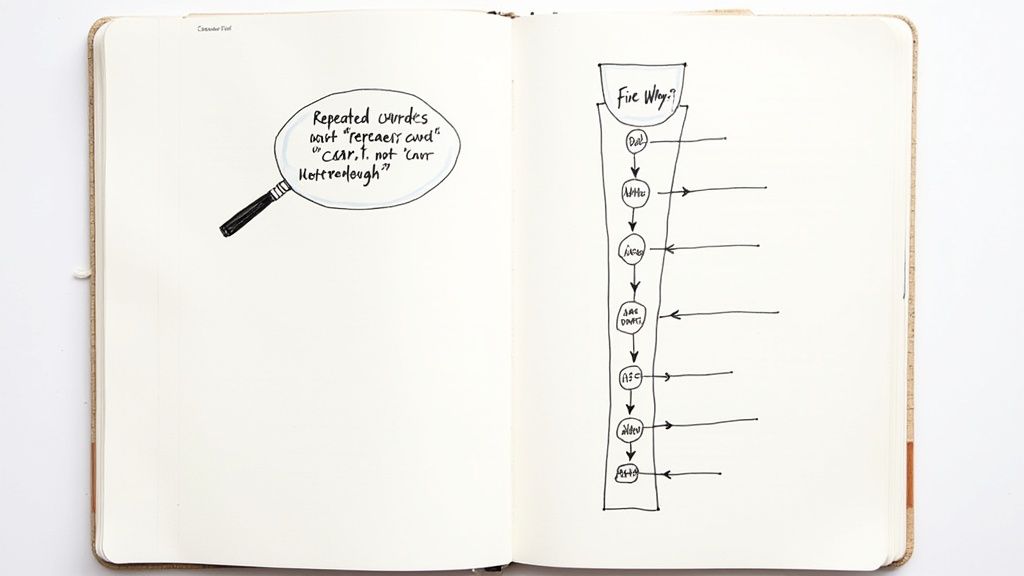
Once you’ve captured a negative thought, the next step is to dig deeper to find its root. The “Five Whys” is a simple but remarkably effective technique for getting past surface-level anxieties. It works by repeatedly asking “Why?” to peel back the layers of a problem.
Let’s use a practical example with the thought, “I can’t ask for a raise.”
- Belief: “I can’t ask for a raise.”
- 1. Why? “Because I might get rejected, and it would be awkward.”
- 2. Why would that be awkward? “Because my boss would think I’m greedy or ungrateful.”
- 3. Why would they think that? “Because I feel I haven’t done enough to truly deserve it.”
- 4. Why don’t you feel you deserve it? “Because I still struggle with certain tasks and don’t feel like a top performer.”
- 5. Why does struggling with tasks mean you’re not a top performer? “Because I believe you have to be perfect and never show weakness to be considered valuable.”
See how that worked? A simple fear of rejection quickly unmasked a deep-seated belief about perfectionism and worthiness. That’s the core belief you need to address, not just the surface-level fear.
It’s important to remember that many of these underlying fears are not based in reality. A study by Penn State researchers, published in Behavior Therapy, found that over 91% of participants’ worries did not come true. This highlights how often our limiting beliefs are built on exaggerated fears rather than facts.
Categorizing Your Beliefs for Clarity
As you start uncovering these beliefs, organizing them can bring immense clarity. Most limiting beliefs fall into a few key categories. Pinpointing which category a belief belongs to helps you see the broader patterns at play in your life.
This simple framework can help you classify what you find.
Identifying Your Limiting Belief Category
| Belief Category | Core Idea | Example in the Workplace |
|---|---|---|
| Abilities & Competence | “I am not skilled/smart enough.” | “I can’t lead this project because I’m not a natural leader.” |
| Worthiness & Deserving | “I am not good enough to have…” | “I don’t deserve a high-paying job because it should go to someone more qualified.” |
| Possibility & Opportunity | “It’s not possible for me to…” | “People from my background don’t get executive roles in this industry.” |
| Safety & Risk | “I must avoid X to be safe.” | “I can’t leave my stable but unfulfilling job; it’s too risky to try something new.” |
By using these tools—journaling to capture thoughts, the Five Whys to find the root, and categorization to see the patterns—you create a detailed map of your internal landscape. This map is your guide for the next, crucial step: challenging these beliefs head-on.
Challenging Beliefs with Facts, Not Feelings
Once you drag a limiting belief out into the open, its power already starts to fade. But to really dismantle it for good, you need to come armed with logic and evidence. This is where we stop wishful thinking and start using a practical framework inspired by a powerhouse of psychology: cognitive-behavioral therapy (CBT).
Here’s the thing: feelings are notoriously unreliable narrators. A limiting belief feels completely true, which is exactly why just chanting positive affirmations in the mirror often falls flat. You need to become a detective in your own mind, hunting for the cold, hard proof that directly contradicts the belief’s bogus claims.
Actionable Step: Build Your Case with a Success Ledger
One of the most effective ways to get started is by creating a Success Ledger. Think of it as your personal logbook of evidence, a running list that proves your limiting belief is a liar. This isn’t just for the big, flashy wins—it’s about documenting every single piece of data that goes against the grain, no matter how small it seems.
Your task: Choose one core limiting belief you’ve identified (e.g., “I’m incompetent at my job.”). For the next week, your only mission is to write down every action that challenges this narrative in your ledger.
- Monday: “Got an email from a colleague thanking me for my input on the Q3 report.”
- Tuesday: “Figured out that tricky spreadsheet formula all on my own.”
- Wednesday: “Handled a tough client call and found a solution they were really happy with.”
- Thursday: “My boss approved my project proposal with only a couple of minor tweaks.”
- Friday: “A junior team member told me they learned a lot from how I ran the team meeting.”
By the end of the week, you don’t just have a vague feeling of being capable—you have a documented list of facts. This ledger becomes an undeniable repository of your competence, making it incredibly difficult for that old, worn-out belief to keep its grip on you.
Actionable Step: The Power of Socratic Questioning
Once you have some evidence in hand, the next move is to actively pick apart the flawed logic holding the belief together. Socratic questioning is a brilliant technique where you use a series of sharp, targeted questions to expose all the inconsistencies and false assumptions.
Essentially, you’re putting your own negative thought on the witness stand and cross-examining it.
A 2021 study in the International Journal of Cognitive Therapy confirmed what therapists have known for years: Socratic questioning is a core driver of change in CBT. It’s so effective because it guides you to your own conclusions instead of just having someone tell you what to think.
Let’s put this into practice with the belief, “I’m not creative enough to contribute valuable ideas.”
Your task: Grab a pen and paper and answer these questions for your belief.
- What’s the hard evidence for this belief? “Well, there was that one time in a meeting two years ago when my idea got shot down.”
- Is there any evidence that contradicts it? “Actually, yes. Last month, the team implemented my suggestion for a new workflow, and it’s been a huge help. Plus, I got great feedback on my creative approach to the last marketing campaign.”
- Are there any other ways to look at the ‘evidence’? “Maybe that idea from two years ago wasn’t fully baked, or it just wasn’t the right time. It doesn’t automatically mean all my ideas are bad.”
- Realistically, what’s the worst that could happen if I challenge this? “I might share an idea that doesn’t get used. It could feel a bit embarrassing for a minute, I guess.”
- And what’s the absolute best that could happen? “My idea could solve a huge problem, get me noticed by leadership, or help the whole team succeed.”
As you go through this, the belief starts to crumble under the weight of its own shoddy logic. You begin to see it for what it truly is: a weak argument based on cherry-picked data. This kind of logical takedown is a crucial step for anyone serious about learning how to break negative thought patterns for good.
This one-two punch of documenting proof and interrogating the faulty logic behind a belief completely shatters its foundation. It forces you to trade emotional reasoning for factual reality, empowering you to see yourself and what you’re capable of in a much clearer, more accurate light.
Rewiring Your Brain for New Beliefs
Challenging a limiting belief with hard evidence is a great start, but the real magic happens when you physically rewire your brain to accept a new, empowering one. This isn’t just positive thinking; it’s the hands-on application of neuroplasticity—your brain’s incredible capacity to forge new connections and let old ones fade away. And the best part? You’re in the driver’s seat.
By combining a few powerful mind-body techniques, you can speed up this rewiring process and install new beliefs where they matter most: your subconscious. The idea is to go from intellectually knowing a belief is false to feeling a new truth in your very core.
This simple infographic breaks down the fundamental process, from spotting the belief to pulling it apart with evidence.
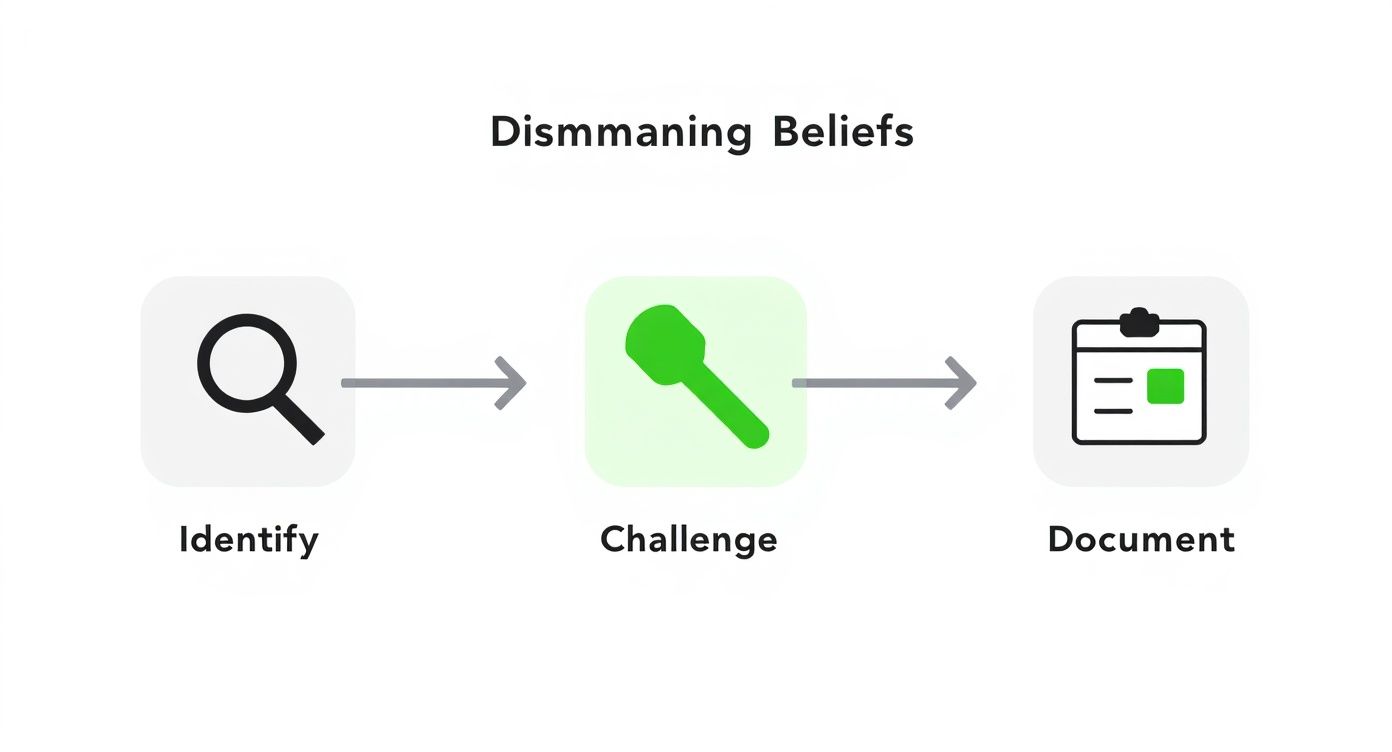
As you can see, overcoming these beliefs is a structured journey, not a fluke. It moves from awareness to active dismantling.
Actionable Step: Shift Your State with 9D Breathwork
Before you can program new beliefs, you have to get your mind into a receptive state. When you’re stressed or anxious, your nervous system is stuck in “fight-or-flight,” making it almost impossible to absorb new, positive information. A simplified 9D Breathwork protocol can quickly shift you out of that defensive posture and into a more relaxed, open, and suggestible state.
Your task: Try this quick protocol right now or schedule 10 minutes today to do it.
- Preparation (2 minutes): Find a quiet spot to sit or lie down. Put on headphones with calming music. Close your eyes and take a few deep, slow breaths to settle in.
- Activating Breath (3 minutes): Begin a rhythmic, circular breathing pattern. Inhale deeply through your nose, filling your belly first, then your chest. Without pausing, exhale fully through your mouth. Keep it flowing continuously.
- The Breath Hold (30-60 seconds): After three minutes, take one final, massive inhale. Then, let all the air out and hold your breath on the exhale. Stay here for as long as it feels comfortable, relaxing into the stillness.
- Integration (4 minutes): When you’re ready, take a deep recovery breath and let your breathing return to a slow, gentle rhythm. Your mind is now receptive. This is the perfect time to introduce your new, empowering belief. Repeat it to yourself (e.g., “I am a calm and capable leader”), feeling the truth in the words.
This whole process quiets the noisy, analytical part of your mind and opens a direct line to your subconscious. It prepares the fertile ground where new beliefs can take root.
Actionable Step: Install New Beliefs with NLP Anchoring
Once your mind is in that receptive state, you can use a powerful Neuro-Linguistic Programming (NLP) technique called Anchoring to lock in your new belief. An anchor is just a sensory trigger—a touch, a word, an image—that you deliberately link to a specific emotional state.
Think of it as creating a mental shortcut. With an anchor, you give yourself an instant way to tap into a powerful, positive feeling whenever you need it most.
Your task: Let’s create an anchor for the belief “I am a calm, capable, and decisive leader.”
- First, Access a Peak State. Close your eyes and vividly remember a time you felt incredibly confident or in control. It doesn’t have to be a work thing—it could be solving a tough puzzle, learning a new skill, or even helping a friend.
- Next, Amplify the Feeling. As you replay that memory, turn up the volume. Make the colors brighter, the sounds sharper. Most importantly, dial up the feeling. Let that wave of confidence wash over you completely.
- Then, Set the Anchor. Right at the peak of that feeling, create a physical anchor. A simple and discreet one is to press your thumb and index finger together firmly. Hold it for about 5-10 seconds while you’re fully immersed in that peak emotion.
- Finally, Release and Test. Let go of the anchor, shake out your hands, and think about something totally random, like what you ate for breakfast. Now, press your thumb and index finger together again. You should feel a rush of that confident feeling come back.
To help you put this all together, here is a simple template for a self-guided breathwork session focused on belief change.
9D Breathwork Session Template for Belief Change
This table outlines a structured session you can follow at home. It combines the breathwork protocol with the NLP anchoring technique to create a powerful belief-rewiring experience.
| Phase | Duration | Technique/Focus | Supporting Tool |
|---|---|---|---|
| Preparation | 2 mins | Settle into a comfortable position. Set your intention. | Calming music or binaural beats |
| Activation | 3 mins | Continuous, circular breathing (in nose, out mouth). | Rhythmic music to guide the pace |
| Breath Hold | 30-60 secs | Exhale fully and hold on empty. Focus on stillness. | Silence or a soft drone sound |
| Integration | 4 mins | Slow, gentle breathing. State your new belief as an “I am” statement. | Affirmation or subliminal track |
| Anchoring | 2-3 mins | Access a peak state feeling, then set your physical anchor. | Vivid mental imagery |
| Closing | 1 min | Take a few final deep breaths. Feel gratitude for the shift. | Journal for post-session notes |
By following this template, you create a dedicated space and time to consciously work on your internal programming.
The science behind this is pretty solid. Research from places like Mind Lab Neuroscience highlights how cognitive restructuring is a proven method for overcoming limiting beliefs. This entire process is a direct result of neuroplasticity, and a 2009 study published in the European Journal of Social Psychology found it takes, on average, about 66 days to form a new automatic habit.
When you practice anchoring daily, especially right after a breathwork session, you are literally carving out a new neural pathway. You’re teaching your brain to link a simple touch with a profound sense of capability. Over time, that new connection becomes stronger and more automatic than the old, limiting script. This is how you go from just challenging a belief to truly embodying its powerful opposite.
Making Your New Mindset Stick
Breaking free from a limiting belief isn’t a one-and-done event. It’s more like starting a new relationship with yourself. You have to keep showing up. Think of it like tending a garden—you can’t just plant the seeds and walk away. You have to consistently nurture your new mindset and be ready to pull out the old weeds that will inevitably try to creep back in.
This ongoing effort is what turns a powerful insight from a breathwork session into a real, lasting change in how you operate every day. The goal is to build a supportive ecosystem where your new beliefs can actually take root and thrive. Let’s get into the practical, sustainable habits that make this happen.
Actionable Step: The Power of Behavioral Activation
One of the most effective strategies for making change stick is called behavioral activation. It’s a clinical term for a simple but profound idea: action changes thought.
Most of us wait to feel confident before we act. Behavioral activation flips that script. You take small, confident actions first, which in turn generates the feeling of confidence you were waiting for.
Every time you take action that aligns with your new belief, you’re giving your brain a piece of real-world evidence. You’re physically strengthening the new neural pathway you’ve created. It’s no surprise that a 2017 meta-analysis in the Journal of Affective Disorders found this approach highly effective for reducing depressive symptoms—it shows just how much our actions can shape our mental state.
Your task: Choose one small action to take today that aligns with your new belief.
- Old Belief: “I’m not a good networker; I’m just too awkward.”
- New Belief: “I am capable of making valuable connections.”
- Behavioral Activation: You don’t wait to feel like a charismatic social butterfly. Your action for today is to send a single thoughtful connection request on LinkedIn with a personalized note. Or maybe you decide to speak to just one new person at your next event.
Once you do it, you collect proof. You have a lived experience that shows you can connect with others. Suddenly, the new belief isn’t just an abstract idea anymore; it’s real.
Actionable Step: Daily Reinforcement and Weekly Reviews
Consistency is everything when you’re rewiring your brain. You don’t need to dedicate hours to this; two simple routines can make all the difference.
First, I recommend a five-minute daily Belief Reinforcement Journal. This isn’t deep, soul-searching journaling. It’s a quick, focused exercise to prime your brain for success each morning.
Your 5-Minute Daily Journal Template
- New Belief: Write down the new, empowering belief you’re installing. (e.g., “I am a decisive and effective leader.”)
- One Action Today: What’s one small, specific thing you will do today that lines up with this? (e.g., “I will make a final decision on the project timeline in under 10 minutes.”)
- Anticipated Feeling: How will taking that action make you feel? (e.g., “Capable and in control.”)
Second, put a simple Weekly Review on your calendar. Every Friday afternoon, take ten minutes to look back. Just ask yourself two questions: “When did I successfully act on my new belief this week?” and “Did any old patterns show up?” This isn’t about judging yourself. It’s about awareness and making small course corrections.
A study in PLOS ONE found that people who consistently monitored and reviewed their goals were significantly more successful at behavioral change. This regular check-in keeps your new mindset front and center.
Handling Setbacks Gracefully
Look, you’re going to have moments where the old belief pops up. It will happen. That’s not a failure—it’s just part of the process.
The key is how you respond when it does.
When you catch yourself slipping into an old thought pattern, don’t beat yourself up. Just pause and get curious. Acknowledge the old thought without judgment, almost like you’re observing a cloud passing by.
Then, use a grounding technique to pull yourself back to the present. Simple breathing exercises to lower your heart rate are incredibly powerful here. They calm your nervous system on a physiological level, creating the mental space you need to consciously choose your new belief over the old one.
Remember, every setback is just another chance to practice.
It’s Time to Raise Your Ceiling
We’ve walked through the entire process—from identifying and questioning those old, limiting stories to completely rewiring them. Think of this not as a one-time fix, but as a new skill you’re building. With every practice, it becomes more natural, more a part of who you are.
This isn’t about becoming someone new. It’s about chipping away at the self-imposed barriers that have been hiding the real you all along.
The journey forward is really about reclaiming self-worth, which is the bedrock of any meaningful change. The tools are in your hands now. All it takes is that first small step.
Your potential doesn’t have a ceiling; only your beliefs do. Every time you challenge a limiting thought, you’re not just changing your mind—you’re raising that ceiling a little higher.
And this isn’t just theory. The science backs it up. The very act of cognitive restructuring—challenging and replacing those negative thoughts—is proven to boost well-being and performance. We know for a fact that focused mental exercises create real, measurable changes in the brain.
So start today. A new level of achievement, both in your work and your life, is right there, waiting for you to unlock it.
Common Questions About Limiting Beliefs
When you start digging into the work of rewriting old beliefs, a few practical questions almost always pop up. Getting them answered upfront gives you the clarity to stick with it when things get tough.
Let’s get into the most common ones I hear.
How Long Does This Actually Take?
This is usually the first question people ask, and the most honest answer is: it really depends. There isn’t a magic number, but you can absolutely expect to feel small, tangible shifts within a few weeks of doing the work consistently. Major, lasting change that feels like second nature? That often takes a few months.
A 2021 study in the European Journal of Social Psychology found that building a new habit can take anywhere from 18 to 254 days. That’s a huge range, right? Tackling limiting beliefs is a lot like that—you’re replacing an old, worn-out mental habit with a fresh, empowering one. The real key here is consistency, not intensity.
I always tell my clients to think of it like learning to play the guitar. You won’t be a rockstar in a week, but after a month of daily practice, you’ll definitely be able to strum a few songs. The goal isn’t some finish line; it’s about building a lifelong skill of self-awareness and mental flexibility.
What If I Feel Completely Stuck?
First off, feeling stuck is a totally normal part of this process. It’s not a sign you’re failing. It usually just means you’ve bumped up against a really deep-rooted belief, one that’s been on repeat for years. When that happens, the worst thing you can do is try to muscle through it.
Instead, shift your focus. It’s time to go back to the fundamentals:
- Gather more evidence: For one full week, dedicate your “Success Ledger” to hunting for proof that directly contradicts this one stubborn belief. Be a detective.
- Change your state: Before you even try to reframe the thought, use a 9D Breathwork session. It’s designed to help you bypass that critical, analytical part of your brain and soothe your nervous system first.
- Shrink the action: What’s the smallest possible step you can take that aligns with your new belief? If the goal feels overwhelming, break it down again and again until it feels almost laughably easy.
More often than not, “feeling stuck” is just your brain’s natural resistance to change. Research in Psychological Science actually showed our brains are wired to prefer familiar negative situations over uncertain positive ones. Just knowing that can help you look at that stuck feeling with a bit of curiosity instead of a ton of frustration.
Isn’t This Just Positive Thinking?
I get this one a lot, and it’s a great question. While both involve consciously directing your thoughts, this evidence-based process is a world away from simple positive thinking. “Positive thinking” often feels like just plastering a happy affirmation over a deep, unexamined negative belief. It can feel fake because, on some level, it is.
Our approach is about deconstruction, not decoration. We don’t just tell you to chant, “I am confident.” We help you dig down to the very root of “I am not confident,” put that belief on trial, and then systematically dismantle it with cold, hard evidence from your own life. It’s a methodical process of proving the old story wrong so the new, empowering one has solid ground to stand on.
At 9D Breathwork, we specialize in giving you the tools to deconstruct these old stories at the subconscious level, where they really live. Our unique fusion of breathwork, hypnotic guidance, and sound technology helps you access and rewire the core programming that’s been running your life.
Ready to go deeper than surface-level affirmations? Explore the 9D Breathwork experience and find out how real, lasting change is truly possible.