The first step in breaking free from negative thought patterns is a simple but powerful one: awareness. It’s about learning to catch those automatic, critical thoughts as they pop up and understanding why they have such a hold on you. This act of noticing is the bedrock for everything that follows; it’s how you begin to interrupt the cycle and make real, lasting change.
Why Negative Thoughts Stick and How to Spot Them
Ever feel like your mind is stuck in a loop, replaying a mistake from last week or forecasting a disaster that hasn’t happened yet? It’s a common experience. This isn’t a personal flaw—it’s just a quirk in our brain’s wiring, a survival mechanism that’s gone a little overboard in the modern world.
Our brains come with a built-in negativity bias. This just means we’re naturally wired to give more attention and weight to negative experiences than positive ones. For our ancestors, this was incredibly useful. Remembering which berries were poisonous was far more crucial for survival than recalling a pretty sunset. A 2017 study in Psychological Bulletin confirmed this, showing that the brain responds more intensely to negative stimuli than to equally potent positive ones, making negative thoughts inherently “stickier.”
The problem is, today, that same bias can keep us trapped in cycles of anxiety, self-doubt, and worry.
These patterns are often learned and reinforced over years, many times starting in childhood. A single critical comment can plant a seed that grows into a core belief like, “I’m not good enough.” Before you know it, that belief becomes an automatic filter, coloring how you see the world and fueling even more negative thoughts.
The Science Behind Stuck Thoughts
The stickiness of these thoughts isn’t just in your head; it’s rooted in your physiology. A 2019 study revealed a sobering statistic: a staggering 90% of people in the U.S. have experienced some form of psychological trauma, which can literally hardwire the brain to expect the worst.
These persistent negative expectations have real, measurable effects. They prime the brain to be on high alert for threats, which helps explain why shaking off a bad mood can feel like such an uphill battle. You can learn more by reading the full research on how trauma shapes our worldview.
This mental churn is often tied to overthinking and anxiety, creating a state where clarity feels impossible. For more on this, check out our guide on how to stop overthinking and find calm.
The key is to start by simply recognizing these thoughts as they happen, without judging them. This practice creates a bit of space between you and the thought, allowing you to see it for what it is—a fleeting mental event, not an undeniable truth.
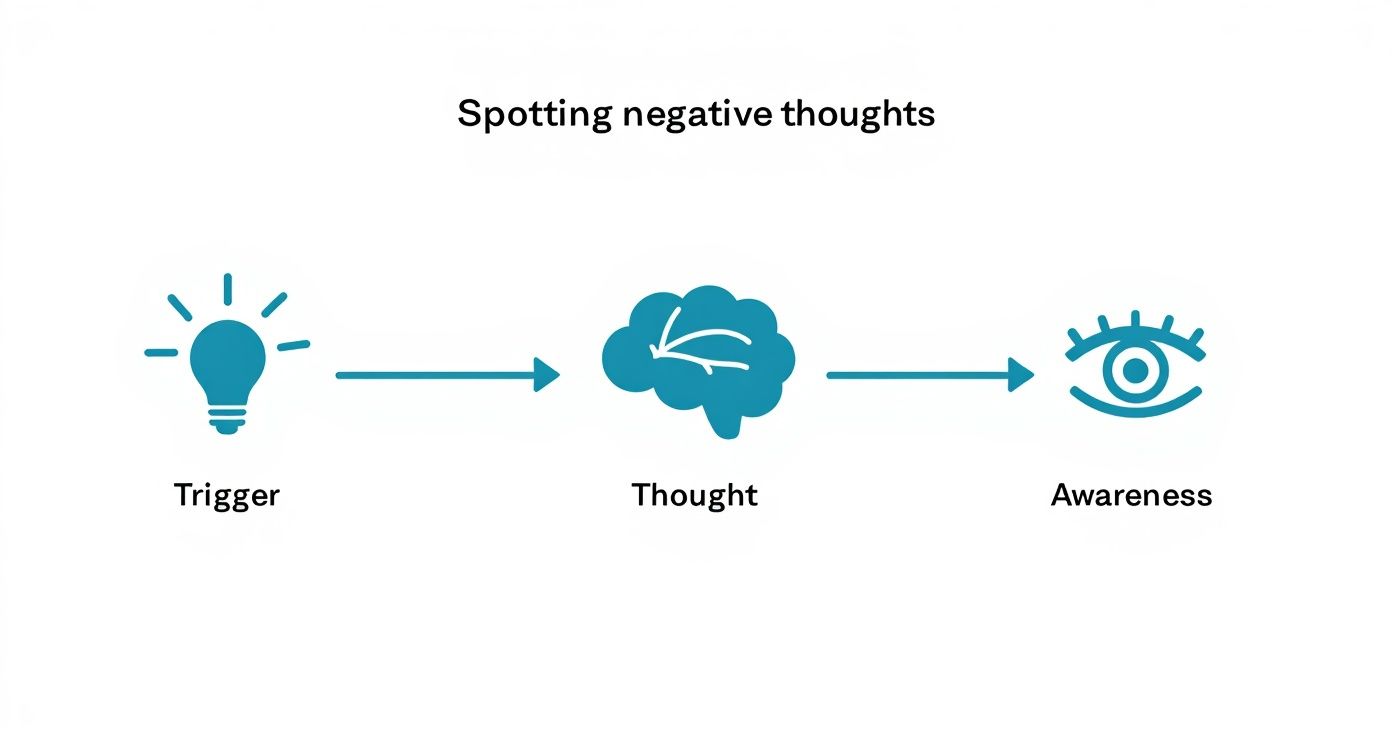
The real insight here is that awareness is your interception point. It gives you the power to choose your response instead of just reacting on autopilot.
Common Thought Traps in Professional Life
These negative thought patterns, often called cognitive distortions, are predictable tricks our minds play on us. They’re especially common in high-pressure professional environments where the stakes feel high.
Recognizing these patterns is the first step toward dismantling them. Here’s a quick guide to some of the most common ones you might see at work.
Common Negative Thought Patterns and How They Show Up
| Thought Pattern (Cognitive Distortion) | What It Means in Plain English | A Real-World Example |
|---|---|---|
| All-or-Nothing Thinking | You see things in black and white. If it’s not perfect, it’s a complete failure. | You get great feedback on a presentation but fixate on one minor suggestion, thinking, “I completely bombed that.” |
| Catastrophizing | You automatically jump to the worst-case scenario. A small setback feels like a sign of impending doom. | Your manager sends a short email: “Let’s chat tomorrow.” You immediately assume you’re getting fired and worry all night. |
| Personalization | You blame yourself for things that are completely out of your control or assume others’ actions are about you. | A team project is delayed by outside factors, but you tell yourself, “If I had just worked harder, we would’ve hit the deadline.” |
Getting familiar with your go-to distortions makes them easier to spot in the wild. Once you can name it (“Oh, there’s that all-or-nothing thinking again”), you’ve already taken away some of its power.
The goal isn’t to eliminate negative thoughts entirely—that’s impossible. The real power comes from recognizing them for what they are: distorted, automatic patterns that don’t reflect reality.
Using CBT to Actively Challenge Your Thoughts
Alright, so you’ve gotten good at spotting those negative thoughts when they pop up. That’s a huge first step. But just noticing them isn’t quite enough—the next move is to actively challenge them. This is where we get practical and borrow some powerful, evidence-based tools from Cognitive Behavioral Therapy (CBT).
CBT works on a simple but profound idea: your thoughts, feelings, and actions are all linked. If you can change a distorted thought, you can fundamentally shift how you feel and what you do. It’s not just theory; a meta-analysis in Cognitive Therapy and Research found CBT to be a highly effective treatment for anxiety disorders, with a success rate of up to 75% for certain conditions.
It’s about learning to treat your automatic negative thoughts not as gospel truth, but as a hypothesis—something you can actually investigate. This simple shift in perspective moves you from being a passenger on your own mental roller coaster to being the one operating the controls.
Create a Simple Thought Record
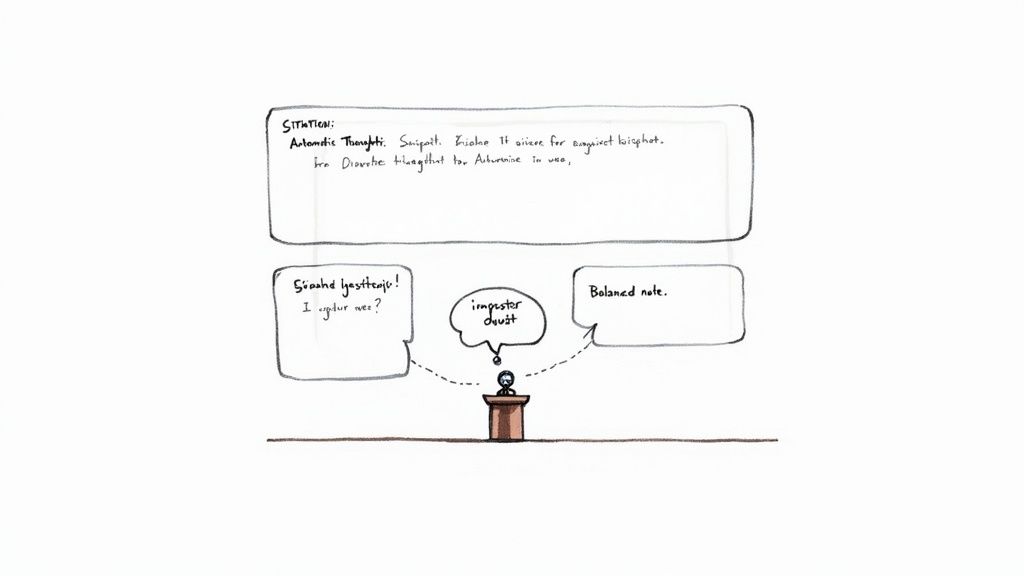
One of the most effective and straightforward tools in the CBT toolkit is the Thought Record. Don’t let the name intimidate you. Think of it as a mental courtroom where you get to put your negative thoughts on the stand. It’s essentially a log that helps you slow down, pull apart your thinking, and build a solid case against that inner critic.
Action Step: Tonight, take 10 minutes to set up a thought record. Open a notes app on your phone or use a physical notebook. Create five columns: 1. Situation, 2. Automatic Negative Thought (ANT), 3. Feelings, 4. Evidence For, 5. Evidence Against.
The real goal here is to build the habit of examining your thoughts instead of letting them run wild.
Let’s walk through a classic scenario for anyone in the corporate world: that all-too-familiar feeling of imposter syndrome before a big presentation.
Real-World Scenario: The Imposter Syndrome Spiral
- The Situation: You’re about to present a massive project update to the senior leadership team. The meeting is in an hour.
- The Automatic Negative Thought (ANT): “I’m going to completely bomb this. They’ll see right through me and realize I have no idea what I’m doing. I’m a total fraud.”
- The Feelings: Overwhelming anxiety (a solid 9/10), dread (8/10), and a powerful urge to call in sick.
This is the make-or-break moment. Left unchecked, this thought will trigger a full-blown stress response, tanking your confidence right when you need it the most. A thought record is your circuit breaker.
Look for the Evidence
Now you get to play detective. The next step is to objectively look at the evidence for and against that automatic thought. This is where the magic happens, because it forces you out of an emotional spiral and into logical analysis.
Let’s stick with our presentation example and gather the facts:
Evidence Supporting the Negative Thought:
- “My stomach is in knots; I feel incredibly nervous.”
- “I feel like one of the slides in the middle is a bit weak.”
- “I know Sarah from Finance is in the room, and she always asks tough questions.”
Evidence Against the Negative Thought:
- “I’ve spent the last three weeks completely immersed in this project data.”
- “My boss reviewed the entire deck and told me it was ‘strong and compelling’.”
- “I’ve successfully presented to my own team dozens of times.”
- “Even if Sarah asks a tough question, it doesn’t mean I’m a fraud. It means she’s paying attention and doing her job.”
When you actually write it all down, the evidence against the negative thought is almost always stronger and more rooted in fact. The evidence for it? That usually leans heavily on feelings, not facts.
Practice Cognitive Reframing
The final piece of the puzzle is to craft a new, more balanced thought based on all the evidence you just gathered. This isn’t about slapping on a coat of fake positivity; it’s about finding what’s actually true. This process is called cognitive reframing, and it’s a core skill for rewiring your brain.
So, for our pre-presentation jitters, a more balanced and accurate thought would sound something like this:
“Okay, I’m feeling nervous, and that’s a totally normal reaction before a big presentation. I’ve prepared for weeks, my manager signed off on the content, and I know this project inside and out. I’m capable of handling questions, even the challenging ones. This is an opportunity to showcase my work.”
See the difference? The new thought doesn’t pretend the anxiety doesn’t exist. It acknowledges the feeling but anchors you in the reality of your competence and preparation. It’s a subtle shift, but it’s incredibly powerful.
This is how you quiet the alarm bells in your brain and walk into that meeting from a place of centered confidence, not spiraling fear. Research published in Social Cognitive and Affective Neuroscience backs this up, confirming that this kind of mental reappraisal leads to better emotional regulation. Every time you do this, you’re not just getting through the moment—you’re actively building healthier, more realistic pathways in your brain.
How to Use Mindfulness to Break the Negative Cycle
Actively challenging your thoughts with CBT is a powerful mental workout, but what about when your mind is racing too fast to even grab onto a single thought? In those moments, trying to think your way out of the storm is like trying to reason with a hurricane.
The real leverage you have is in the deep connection between your thoughts and your physical body. A frantic mind almost always goes hand-in-hand with a tense body, shallow breathing, and a nervous system on high alert.
The good news? This is a two-way street. You can intentionally calm your body to create the mental space you need to quiet your mind. It’s a brilliant way to interrupt the loop of Repetitive Negative Thinking (RNT) without getting into a wrestling match with your thoughts. You simply change the physiological environment where those thoughts thrive. A study in the Journal of Behavioral Medicine found that regular mindfulness practice was directly linked to lower levels of RNT, showing that physiological calming has a direct impact on mental loops.
Ground Yourself with the 3-Minute Breathing Space
As a busy professional, the idea of a 30-minute meditation session can feel laughable. That’s exactly why the 3-Minute Breathing Space is so effective. It’s a bite-sized, structured mindfulness practice you can do anywhere—at your desk between calls, in your car before a big meeting, or even in a bathroom stall.
Action Step: Set a recurring alarm on your phone for midday, labeled “3-Minute Reset.” When it goes off, commit to doing this practice.
- Minute 1: Check In. Close your eyes if you feel comfortable. Ask yourself, “What’s going on for me right now?” Notice thoughts, feelings, and body sensations without judging them. Is there a knot in your stomach? Are your shoulders up by your ears? Just acknowledge it.
- Minute 2: Focus on the Breath. Gently shift all of your attention to the physical sensation of your breath. Feel the air moving in and out. Your mind will wander—that’s what minds do. When it does, just patiently guide your focus back to the breath.
- Minute 3: Expand Your Awareness. Now, broaden your attention to include your entire body as a whole. Feel the ground beneath your feet, the posture of your spine, the air on your skin. Carry this grounded awareness with you as you open your eyes and move back into your day.
This practice is a potent circuit breaker. It pulls you out of the autopilot of anxious thinking and anchors you firmly in the present moment.
Shifting Your Brainwaves with Sound and Breath
If you want to get more direct, there are tools that can influence your brain’s activity and pull you out of a ruminating, anxious state. Two of the most effective methods I’ve seen are binaural beats and specific breathwork protocols.
Binaural beats are a fascinating auditory illusion. You listen to two slightly different sound frequencies, one in each ear, and your brain perceives a third tone—the difference between the two. This “phantom” beat can gently guide your brainwaves into a different state. For instance, listening to frequencies that promote alpha waves (8-12 Hz) is linked to relaxed awareness, making it a fantastic tool for quieting mental noise.
Similarly, structured breathwork patterns can dramatically shift your physical state. Techniques that emphasize a longer exhale than inhale activate the parasympathetic nervous system—your body’s “rest and digest” mode. This process slows your heart rate, can lower blood pressure, and sends a clear signal to your brain that it’s safe to power down the alarm bells. If you’re looking for specifics, there are powerful breathing exercises designed to lower your heart rate that are perfect for moments of high stress.
You don’t always have to think your way out of a negative thought pattern. Sometimes, the most direct path is to breathe your way out of it by intentionally changing your physiological state.
This isn’t just theory; the data backs it up. Globally, nearly 1 in 7 people live with a mental disorder, with anxiety and depression being pervasive issues often fueled by repetitive negative thinking. Crucially, studies show that mindfulness-based interventions can slash this pattern by 30-40% and cut the risk of relapse for those with recurrent depression by 31%. You can explore these global mental health statistics from WHO to see the full picture.
Testing Your Beliefs with Behavioral Experiments
Challenging your thoughts with a thought record is a fantastic mental workout. But what if you could do more than just challenge a belief in your head? What if you could gather cold, hard evidence from the real world that proves your most stubborn negative thoughts wrong?
That’s exactly what behavioral experiments are for.
We’re not talking about taking terrifying leaps of faith. These are small, deliberate, and safe actions designed to put a negative assumption to the test. Thinking differently is the first step, but it’s acting differently that provides the undeniable proof your brain needs to truly unwire a deep-seated belief.
From Anxious Guess to Actionable Data
The whole process is surprisingly scientific. You start treating your negative thought not as a fact, but as a hypothesis—an educated guess that needs to be tested. This simple reframe is powerful. It moves you from being a passive victim of your thoughts to an active researcher of your own mind.
Think about it: you stop arguing with the thought and start collecting data.
This isn’t just theory. A 2021 study in Cognitive Therapy and Research found that people who regularly used behavioral experiments saw significant drops in social anxiety. By actively testing their fears, they gathered direct evidence that the catastrophes they predicted almost never happened.
How to Design Your First Experiment
Let’s walk through a simple framework you can use right away. It’s all about identifying the belief, designing a small test, predicting what will happen, and then seeing what actually happens.
- Pinpoint the Belief: What’s the specific thought that’s tripping you up? What are you afraid is going to happen?
- Design a Small Test: What’s a low-stakes action you could take to test this? The key is to make it manageable, not overwhelming.
- State Your Hypothesis: Write down exactly what you expect to happen. Be specific.
- Run the Experiment: Just do it. Carry out the small action and pay close attention to the results.
- Analyze the Data: Compare the actual outcome to your prediction. What did you learn? How does this new evidence shake up the original belief?
Let’s see how this plays out with a classic professional fear.
Real-World Example: “My Team Will Think I’m Incompetent”
Imagine you’re managing a project and you’ve hit a wall. You can’t figure out the next step, and that old automatic negative thought pops up.
- The Belief: “If I ask for help, my team will lose respect for me and think I’m incompetent.”
- The Experiment: Asking the whole team feels like too much, so you scale it down. Your experiment is: “I will go to one trusted colleague, Sarah, and ask for her perspective on this specific problem for 15 minutes.” It’s a safe, controlled test.
- The Hypothesis (Your Prediction): “Sarah will look annoyed that I’m bothering her. She’ll give a short, unhelpful answer and probably tell others later that I don’t know what I’m doing.”
- The Actual Outcome: You approach Sarah. She actually seems glad to help, mentioning she got stuck on a similar issue last quarter. She spends 20 minutes brainstorming with you, and you come up with a great solution together. She ends the chat with, “Hey, good catch. Glad you brought this up.”
- The Analysis: Your prediction was completely off. Sarah was collaborative, not critical. This outcome is a powerful piece of evidence against your belief. The new, more balanced thought could be: “When I ask a trusted colleague for help, they see it as a sign of collaboration, not incompetence.”
Behavioral experiments are so effective because they bypass the intellectual argument. You’re not just thinking your way to a new belief; you’re creating real-life experiences that make the old belief impossible to hold onto.
Journaling Prompts to Make It Stick
After each experiment, taking a few minutes to journal can help cement the new insight. It connects the action to a more empowered way of thinking. Try these prompts:
- What was the single biggest difference between my prediction and reality?
- Looking at this new evidence, is my original belief 100% true?
- How did it actually feel to prove that fear wrong, even in this small way?
- Based on this success, what’s a slightly bigger experiment I could try next?
Every experiment, no matter how small, chips away at the foundation of your negative thought patterns. You’re not just hoping to feel different; you’re actively building a new mindset, one piece of real-world proof at a time. Research from the Journal of Anxiety Disorders backs this up, showing that direct experience is a far more powerful way to change fear-based beliefs than simply trying to talk yourself out of them.
Building Lasting Mental Resilience
Think of this whole process less like a quick fix and more like building muscle at the gym. You wouldn’t expect to be a powerlifter after one session, right? Changing your deep-seated thought patterns works the same way—it’s all about consistency, not perfection. The tools we’ve covered are fantastic for tackling negative thoughts as they pop up, but the real, lasting change happens when you create a mental environment where resilience is your new normal.
This isn’t about trying to banish every negative thought for the rest of your life. That’s an impossible goal. Instead, it’s about building such a solid foundation that those thoughts lose their power to derail your day. True resilience is having your toolkit ready before the storm hits, so you can navigate life’s challenges with a clear head instead of getting pulled back into old, unhelpful habits.
Creating Your Personal Wellness Plan
A Mental Wellness Plan is your personal roadmap for keeping this momentum going long-term. Think of it as a proactive strategy you design for yourself, by yourself. This shouldn’t feel like another item on your to-do list. It’s about weaving a few small, sustainable micro-habits into the fabric of your daily life.
Action Step: Choose one of the following micro-habits to commit to for the next seven days. Don’t try to do them all; pick the one that feels most achievable.
- A Daily Gratitude Check-In: Every morning, before checking your phone, write down three specific things you’re grateful for. Example: “The quiet of the house before anyone else wakes up.”
- A Weekly Self-Reflection: Block out 15 minutes on a Sunday evening to just check in. How did I handle that tough conversation this week? Where did I successfully reframe a thought? What can I learn?
- Your Go-To Stress Protocol: Decide now what you will do the next time you feel stress spike. Maybe your plan is to immediately step outside for a ten-minute walk with a specific playlist. Having a pre-decided action short-circuits the stress response before it spirals. We have a whole guide on this, by the way, if you want more ideas on how to reduce cortisol levels naturally.
The goal here is to make these actions non-negotiable. They are the daily maintenance that keeps your mind running smoothly and strongly.
Identifying Your Triggers and Warning Signs
To keep from sliding back into old patterns, you have to become a detective of your own mind. What pushes your buttons? Triggers are those specific events or internal feelings that kickstart your negative thought loops.
For many people, common triggers are things like:
- Getting an ambiguous email from their boss.
- The physical feeling of being tired or hungry.
- Mindlessly scrolling Instagram and falling into the comparison trap.
Just as important are the early warning signs—the subtle clues that you’re starting to slip. Maybe it’s that familiar knot in your stomach, a sudden urge to procrastinate on important work, or finding yourself being a bit short with the people you love. When you can spot these signs early, you can jump in with your tools before a small thought turns into an emotional avalanche.
Lasting change isn’t about a dramatic, one-time fix. It’s the sum of small, conscious choices you make every single day to nurture a healthier mindset and reinforce new, more empowering thought patterns.
This internal work is more critical now than ever. A 2025 study in Communications Psychology found something startling: linguistic markers of rigid, negative thought patterns have skyrocketed by about 200% in public discourse since the year 2000. This trend shows how our individual thinking can ripple outward, making this work not just personal, but vital. Discover more insights about these psychological trends.
On a more practical level, building tangible, real-world skills can be a huge boost. For example, learning how to start conversations with confidence directly combats the kind of negative self-talk that often holds us back in social settings. By strengthening both your internal mindset and your external skills, you’re creating a powerful, two-front defense against negativity.
Common Questions Answered
As you begin to put these techniques into practice, you’re bound to have some questions. It’s totally normal to wonder about timelines, what to do when you get stuck, and when it might be time to bring in extra support. Let’s get straight to the practical answers for the most common hurdles people face.
How Long Does This Actually Take?
Honestly, there’s no one-size-fits-all answer. The timeline really depends on how deeply ingrained your patterns are and how consistently you’re able to practice the new techniques.
Many people start to feel small but significant shifts within just a few weeks of consistently using tools like thought records. But for deep, lasting change? Think in terms of several months. It’s a lot like building muscle at the gym—real strength comes from showing up and doing the work over time.
A key study on neuroplasticity in the Journal of Neuroscience backs this up, showing that consistent mental practice can create measurable changes in the brain’s structure and function. The takeaway is powerful: your brain isn’t fixed; it changes based on your habits.
Don’t forget to celebrate the small wins. Every single time you catch and reframe a thought is a victory that builds momentum.
What if I Can’t Find Any Evidence Against My Negative Thought?
This is a classic roadblock, and it can be incredibly frustrating when a belief feels 100% true. When you hit this wall, it’s time to change your angle of attack.
Instead of trying to prove the thought wrong, ask a different set of questions:
- Is this thought actually helping me in any way right now?
- Is there a more compassionate or constructive way to view this?
- What would I say to a close friend who was thinking this exact same thing?
The goal isn’t always to find hard proof that the thought is false. Sometimes, it’s about simply loosening its grip and finding a more balanced perspective. If you’re looking for more ways to tackle stubborn thoughts, exploring these additional strategies to stop negative thoughts can offer some fresh ideas.
If you find you’re consistently getting stuck on the same belief, that could be a sign of a deeper issue that would be worth exploring with a professional.
When Is It Time to Get Professional Help?
Self-help tools are fantastic, but knowing when to call in a professional is a sign of strength, not failure. It’s probably time to reach out to a therapist or counselor if your negative thoughts are:
- Seriously getting in the way of your daily life, your job, or your relationships.
- Leaving you feeling constantly overwhelmed, hopeless, or anxious.
- Leading to behaviors you want to stop but can’t seem to control on your own.
Research from the American Psychological Association has shown that therapies like CBT are incredibly effective, with many people seeing major improvements. A therapist doesn’t just listen; they give you a personalized roadmap, hold you accountable, and guide you through the process. Think of it less as a last resort and more like hiring an expert coach to help you get where you want to go, faster and more effectively.
At 9D Breathwork, we’re all about getting to the root of the issue. Our approach combines somatic breathwork, immersive audio, and subconscious reprogramming to help you disrupt those deep-seated patterns for good. It’s about creating profound, lasting change from the inside out. Explore the 9D Breathwork experience.