Polyvagal theory exercises are powerful, practical ways to intentionally guide your nervous system from a place of stress or shutdown back to a state of calm and connection. They’re not just abstract concepts; they are real, body-based techniques that use your breath, your senses, and your awareness to regulate how you feel.
Think of it as learning the language of your own body. The goal isn’t to eliminate stress—it’s to build your capacity to navigate it with more ease and control.
Understanding Your Nervous System Through a Polyvagal Lens
Before you can use these exercises effectively, you need a basic map of your internal landscape. Imagine your nervous system operates like a traffic light, signaling when it’s safe to proceed, when to be cautious, or when to stop completely. Learning to recognize which light is on at any given moment is the first, most crucial step in self-regulation.
This entire framework comes from the work of neuroscientist Dr. Stephen Porges, who first published his Polyvagal Theory back in 1995. His work gave us a new, more nuanced way to understand our autonomic nervous system by highlighting the central role of the vagus nerve. It’s not just a niche idea anymore; with over 20,000 peer-reviewed articles citing the theory, it’s a well-established cornerstone of modern neuroscience and trauma therapy.
The Three Core States of Your Nervous System
Your nervous system is always on the lookout, scanning the environment for cues of safety or danger. Based on what it detects—a process called neuroception—it shifts you into one of three primary states. Getting to know these states in yourself is like getting a user manual for your own mind and body.
- Ventral Vagal (The “Green Light”): This is your sweet spot. It’s the state of safety, connection, and social engagement. When you’re here, you feel present, calm, curious, and open to the world. Think of the warm, easy feeling of laughing with a good friend or the peacefulness of a quiet morning.
- Sympathetic (The “Yellow Light”): This is your mobilization state, the classic “fight-or-flight” response. When your nervous system detects a threat, it floods your body with adrenaline and cortisol to prepare you for action. Your heart pounds, your muscles tighten, and you might feel anxious, angry, or overwhelmed. It’s that jolt you feel when you narrowly miss a car accident.
- Dorsal Vagal (The “Red Light”): This is the oldest, most primitive part of our response system—a state of shutdown or collapse. When a threat feels too big to fight or flee, the system hits the emergency brake. You might feel numb, disconnected, foggy, or completely drained of energy. This is immobilization.
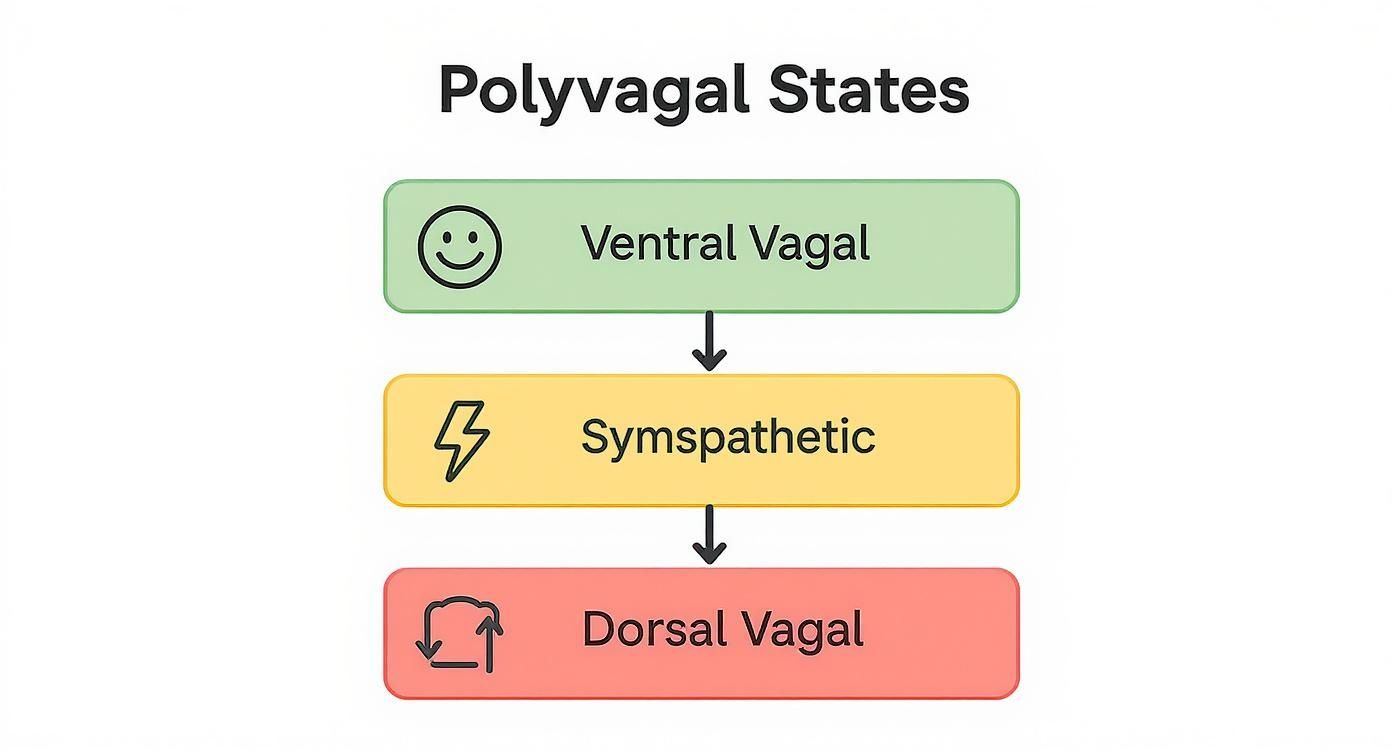
This diagram shows how we move between states. Ideally, we live in the green Ventral Vagal state. But when we sense danger, we first move into the yellow Sympathetic state to try and deal with it. If that doesn’t work or the threat is overwhelming, we can drop down into the red Dorsal Vagal collapse.
Key takeaway: Feeling safe isn’t just a mental exercise. It is a physiological reality. Your body has to register safety before your mind can genuinely relax and connect.
Your Autonomic States At a Glance
Use this quick reference guide to identify the three primary polyvagal states and their common characteristics in your daily life.
| Autonomic State | Feeling/Experience | Physical Sensations | Behavioral Response |
|---|---|---|---|
| Ventral Vagal | Safe, connected, calm, curious, engaged | Full breaths, relaxed muscles, warm feeling | Open to connection, playful, present |
| Sympathetic | Anxious, angry, overwhelmed, panicked | Rapid heart rate, shallow breathing, tense muscles | Fight, flee, argue, avoid, fidget |
| Dorsal Vagal | Numb, hopeless, disconnected, frozen, foggy | Low energy, coldness, feeling heavy, digestive issues | Withdraw, dissociate, shut down, isolate |
This table is a starting point. As you begin paying closer attention, you’ll discover your own unique patterns and signals for each state.
Learning to identify where you are on this map is the first step toward consciously guiding yourself back to that green zone of safety. If you’re looking for more ways to do this, check out our in-depth guide on how to calm your nervous system. The exercises that follow will give you concrete tools to build this life-changing skill.
Simple Exercises to Find Calm and Safety
Understanding the theory is a great start, but putting it into practice is where the magic really happens. Polyvagal exercises aren’t complicated or demanding; they’re simple, intentional actions that send powerful signals of safety straight to your nervous system.
Think of these techniques as a way to consciously guide yourself out of a state of high alert (sympathetic) or shutdown (dorsal vagal) and back into your calm, connected, and resourceful self (ventral vagal).
Let’s walk through two foundational exercises you can start using today. The goal here isn’t perfection—it’s curiosity. Just notice what happens in your body without any judgment.
The Orienting Exercise: Your First Step to Safety
When we feel threatened, our focus narrows down to a pinpoint. It’s a primal survival instinct designed to scan for danger. The Orienting Exercise gently flips that script by intentionally widening your awareness to take in the safety of your current environment. It’s a direct message to your nervous system: “Hey, look around. We’re actually okay right now.”
Here’s how to do it:
- Go Slow: From wherever you are, just let your eyes slowly drift around the room. Don’t whip your head around. Let the movement be easy and unhurried.
- Scan and Notice: Allow your gaze to land on different objects. The key is to notice things that feel neutral or even a little bit pleasant. Maybe it’s the color of a book on your shelf, the texture of the wall, or the way the light hits a plant.
- Name It: As your eyes rest on something, silently name it to yourself. “Blue lamp.” “Wooden table.” “Green plant.” This simple act of labeling helps bring the thinking part of your brain—the prefrontal cortex—back online and out of alarm mode.
- Check In: After a minute or so, bring your attention back inside. Do you notice any subtle shifts? A slight deepening of your breath? A feeling of more weight in your chair?
This exercise works so well because it directly counters the brain’s threat-detection system. A 2018 study in Frontiers in Psychology showed how deliberately directing your attention to environmental cues can change your emotional state—and that’s exactly what orienting does.
Real-World Scenario: Imagine you’re in a tense meeting, and you feel your heart rate climb and your shoulders tighten. Instead of spiraling into anxiety, you can discreetly practice orienting. Let your eyes slowly scan the room, noticing the frame of the whiteboard, the pattern on a colleague’s tie, or the plant in the corner. This tiny internal shift can be enough to keep you grounded and stop a full-blown stress response in its tracks.
The Vagal Sigh: A Quick and Powerful Reset
Have you ever let out a long, audible sigh after a stressful moment? That wasn’t just you being dramatic; it was your body’s intuitive attempt to regulate itself. The “Vagal Sigh” takes that instinct and turns it into a purposeful practice.
A long, slow exhale is one of the fastest ways to stimulate the vagus nerve, which in turn activates your parasympathetic “rest and digest” system.
In fact, a notable 2023 study from Stanford University published in Cell Reports Medicine found that this “cyclic sighing” was more effective at improving mood and calming physiological arousal than other breathing techniques, including mindfulness meditation.
Here’s how to do the Vagal Sigh:
- Take a normal breath in through your nose.
- Without fully exhaling, take a second, shorter sip of air to completely fill your lungs.
- Now, exhale slowly and audibly through your mouth for as long as you comfortably can. The key is making the exhale significantly longer than the inhales combined.
- Repeat this just 2-3 times and notice the feeling of release that follows.
It isn’t about forcing a massive deep breath; it’s all about that long, slow, complete exhale.
Alongside these direct exercises, remember that other practices can create a similar sense of physiological calm. For instance, things like Swedish massage therapy have been shown to significantly reduce anxiety and stress. Ultimately, all these methods work by sending the same core message to your body: you are safe.
Using Your Breath and Voice to Regulate Your State
When it comes to influencing your nervous system, you have two incredibly powerful tools at your disposal 24/7: your breath and your voice. They aren’t just for survival or communication; they are direct lines to your vagus nerve, allowing you to intentionally shift your physiological state.
Think of it this way: by consciously changing how you breathe or using your voice, you can send signals of safety straight to your nervous system. This helps you move out of an anxious (sympathetic) or shutdown (dorsal vagal) state and back into a place of calm and connection. This whole process is about improving your vagal tone—a key measure of your vagus nerve’s health and your body’s ability to bounce back from stress.

Harness the Power of Vibration and Sound
Making sounds is one of the most effective polyvagal exercises out there. Why? Because it directly engages the muscles in your face, throat, and even your middle ear—all of which are wired into the social engagement system. A 2017 study in Frontiers in Psychology found that activities like singing and chanting can increase heart rate variability (HRV), a gold-standard indicator of good vagal tone and parasympathetic activity.
Here are a few simple ways to put this into practice:
- Humming: This is my go-to because it’s so discreet. You can hum a simple tune at your desk, in the car, or while walking down the street. The magic is in the vibration. Pay attention to how it feels in your throat, chest, and lips. That physical sensation is a powerful calming signal for your nervous system.
- Chanting or Singing: Go for it! Whether it’s a simple “om” during a quiet moment or belting out your favorite song in the car, the combination of prolonged vocalization and controlled breath is fantastic for vagal stimulation.
- Gargling: It might feel a little strange, but gargling with water for 30 seconds activates muscles in the back of your throat that directly stimulate the vagus nerve. A 2021 paper in Current Opinion in Neurology even touched on the potential of exercises like this to improve vagal function.
Real-World Scenario: You’re stuck in soul-crushing traffic. You can feel your jaw clench and your heart rate climb—a classic sympathetic fight-or-flight response. Instead of gripping the wheel tighter, try humming a low, steady note. Focus on the physical vibration. You might be surprised to feel your shoulders drop and your breath deepen in under a minute.
Master the Extended Exhale
If you need a quick reset, this is it: make your exhale longer than your inhale. This simple breathing tweak is a cornerstone of relaxation practices for a reason—it works, and it works fast. A long, slow exhale tells your parasympathetic “rest and digest” system that the coast is clear and it’s safe to relax.
Here’s a simple exercise to try right now:
- Find a comfortable position and gently inhale through your nose for a count of four.
- Now, exhale slowly and completely through your mouth for a count of six or even eight.
- Really focus on the feeling of letting go with each exhale.
- Repeat this for just 5-10 breaths anytime you feel that familiar wave of stress.
This isn’t just theory. A 2017 study in the journal Breathe found that slow, paced breathing with a longer exhale significantly boosts heart rate variability, offering clear proof of its positive impact on vagal tone.
You can find a ton of great resources on meditation and guided breathing to build this into a regular practice. And if you want to dig deeper into how to use your breath to either energize or calm yourself, you can learn more by mastering breathing techniques for energy and stress relief.
Finding Your Calm Through Connection
We’re social beings, right down to our biology. It’s not just a nice idea; our nervous systems are literally wired to sync up with each other. Polyvagal Theory calls this co-regulation. We’re constantly, subconsciously scanning the faces, voices, and body language of people around us for signs of safety or danger.
The great news is we can use this built-in feature to our advantage. By intentionally using social connection, you can send powerful signals of safety to your nervous system, creating a profound sense of calm. This isn’t just about feeling better in the moment; it’s about actively building more resilient and trusting relationships.
Practice the Safe Gaze
Think about what your eyes do when you’re stressed. They might dart around the room, or you might avoid eye contact altogether. This is your nervous system on high alert. The Safe Gaze exercise is a simple way to reverse that signal.
It’s all about practicing soft, gentle eye contact to tell your brain, “Hey, we’re safe right now.”
- With a partner or friend: Sit across from someone you trust. Let your eyes meet softly—no staring contests here. Just hold a gentle gaze for a few seconds, notice their expression, and then look away. Repeat as it feels comfortable. The goal is connection, not intensity.
- With a pet: There’s a reason we feel so good around our animals. Their calm presence is incredibly co-regulating. Try gently gazing into your pet’s eyes while you stroke them. It’s a pure, simple exchange of safety cues.
- With yourself: This one can feel a little strange at first, but it’s powerful. Look at yourself in the mirror and try to offer a kind, compassionate expression. Maybe a soft smile. You’re sending those signals of safety directly inward.
The Soothing Power of Your Voice
Ever notice how a calm, gentle voice can instantly defuse a tense situation? That’s your nervous system responding to what it hears. Our middle ear muscles are directly connected to our social engagement system and are fine-tuned to pick up on the specific frequencies of the human voice. A melodic, rhythmic voice—a quality known as prosody—is like a direct message of safety to the brain.
When your voice is calm and rhythmic, you’re not just soothing the other person; you are simultaneously sending calming signals back to your own nervous system. It’s a two-way street.
This wiring starts from day one. In fact, research shows that healthy full-term infants have nearly double the capacity for autonomic stability compared to preterm infants, showing just how early our social engagement system is primed for connection through cues like a caregiver’s soothing voice. You can learn more about how these neurological foundations are applied in therapy.
To put this into practice, pay attention to your vocal tone, especially when you feel stressed. You don’t have to put on a fake “calm voice.” Simply try slowing your speech down and lowering your pitch just a bit. You’ll be surprised at how this small adjustment can bring a wave of calm over a conversation, for both you and the other person. When you pair these social practices with focused breathing, you really start to unlock the healing power of breathwork.
Weaving Polyvagal Exercises into Your Daily Routine
The magic of these exercises isn’t in some grand, one-time effort. It’s found in the small, consistent things you do every single day. Think of it less like an emergency brake for when you’re spiraling and more like regular maintenance for your nervous system.
By weaving these practices into your daily life, you’re constantly sending little signals of safety to your body. Over time, this helps a calm, grounded state become your new normal, not something you have to fight to find. You start building resilience from the ground up.
While Dr. Porges first introduced Polyvagal Theory in 1995, the idea of using the body to calm the mind is ancient. We’ve known since at least the 1970s that simple things like deep breathing could directly influence our nervous system. Fast forward to today, and we see the powerful results of combining this knowledge with modern therapy—a 2014 meta-analysis in the Journal of Traumatic Stress showed that mind-body therapies, including somatic approaches, lead to significant reductions in PTSD symptoms. If you’re curious, you can discover more insights about the evolution of somatic therapy and its impact.
Building Your Daily Practice
You don’t need to carve out an hour of your day for this. The real trick is to find those little pockets of time that already exist and attach a new, simple practice to them. It’s all about linking these exercises to habits you already have.
Here are a couple of incredibly simple ways to get started:
- The 3-Minute Morning Anchor: Before you even think about grabbing your phone, just sit on the edge of your bed. Put one hand on your heart and the other on your belly. Take five slow, deep breaths. Try to make your exhale just a little bit longer than your inhale. That’s it. You’ve just started your day from a place of groundedness instead of immediate reactivity.
- The 1-Minute Meeting Reset: Got a minute or two between Zoom calls? Resist the reflex to check your inbox. Instead, try the Orienting exercise. Let your eyes slowly wander around the room and softly land on three things that seem pleasant or even just neutral. This tiny pause helps you shake off the energy from the last meeting and walk into the next one feeling more present.
A Note on Self-Compassion: For anyone with a history of trauma, starting these practices can feel… complicated. Sometimes, trying to feel “safe” can bring up the opposite. Please be incredibly gentle with yourself. If an exercise feels wrong or brings up too much, it is perfectly okay to stop. This is a journey of self-compassion, and working with a trauma-informed therapist can make all the difference.
Sample Daily Polyvagal Practice Plan
Here’s a simple template to give you an idea of what this could look like. The goal is to build nervous system resilience by sprinkling in small, impactful exercises that feel right for you.
| Time of Day | Suggested Exercise | Duration | Goal |
|---|---|---|---|
| Morning | 3-Minute Anchor Breathing | 3 minutes | Start the day grounded and centered. |
| Mid-Morning | Vagal Sigh before opening email | 30 seconds | Release anticipatory stress before diving into work. |
| Lunch Break | Mindful walk, noticing your surroundings | 10 minutes | Reset your nervous system and get out of your head. |
| Afternoon | Hum a tune at your desk | 1-2 minutes | Stimulate the vagus nerve to combat afternoon fatigue. |
| Evening | Gentle neck stretches | 5 minutes | Release physical tension from the day. |
Use this as a starting point. Feel free to swap exercises, change the timing, and find what genuinely works for your life. The best plan is the one you’ll actually stick with.
Common Questions About Polyvagal Exercises
Whenever you start something new, questions are bound to pop up. As you dip your toes into these polyvagal exercises, it’s completely normal to wonder what you should be feeling, how to stay safe, and what the whole process looks like. Let’s tackle some of the most common questions to help you feel more confident.
How Do I Know If It Is Working?
This isn’t about looking for a lightning-bolt moment. The real magic is in the small, subtle shifts you’ll start to notice in your body and your mind. These are the quiet signs that your nervous system is starting to respond.
What should you look for? It might be something as simple as:
- Taking a deeper, fuller breath without even trying.
- Feeling your shoulders drop or your jaw unclench, even just a little.
- The chatter in your head becoming a bit quieter or kinder.
- A sense of being more present in your own skin, right here, right now.
Don’t get caught up in chasing some perfect state of bliss. In this work, just noticing these small, gentle shifts is a huge win. That’s how you know it’s working.
Can I Do These Exercises If I Have Trauma?
Yes, absolutely. But the key here is to move with incredible care and self-compassion. If you have a history of trauma, your nervous system is likely on high alert, so the golden rule is to go slowly. Prioritize feeling safe over pushing through an exercise.
A 2019 study in the European Journal of Psychotraumatology confirmed that mind-body practices can be incredibly helpful for trauma, but it also stressed that pacing is everything. If any exercise starts to feel like too much, it’s not a failure to stop. In fact, it’s a sign you’re listening to your body.
Working alongside a trauma-informed therapist can be a game-changer. They can help you adapt these exercises in a way that feels secure and truly supports your healing journey.
How Long Until I See Results?
There’s no magic number here. This is a practice, not a quick fix, and everyone’s nervous system is different. Some people feel a wave of relief after their very first try. For others, the changes are more like a slow sunrise, gradually appearing over weeks or even months.
The real goal is consistency, not intensity. Think of it like watering a plant—a little bit regularly is what helps it grow strong. Research in Frontiers in Human Neuroscience backs this up, showing that regular mind-body practices actually create lasting changes in the brain’s structure and function.
Every time you practice—even for a minute—you’re laying down a new neural pathway. Each conscious breath and gentle stretch is another step toward building a more resilient nervous system.
At 9D Breathwork, we blend these kinds of somatic practices with immersive sound technology to help you build nervous system resilience from the ground up. Our approach is designed to guide you toward a deeper sense of calm and unlock powerful personal insights. Find out more and start your journey with us.