So, what does it actually mean to “reprogram your subconscious mind”?
At its core, it’s the process of deliberately and consistently swapping out old, unhelpful beliefs for new, empowering ones. Think of it like updating the deeply ingrained software that runs your life—your automatic responses, your gut feelings, your default reactions. You’re consciously choosing to align those automatic programs with what you actually want to achieve.
Your Brain’s Hidden Operating System
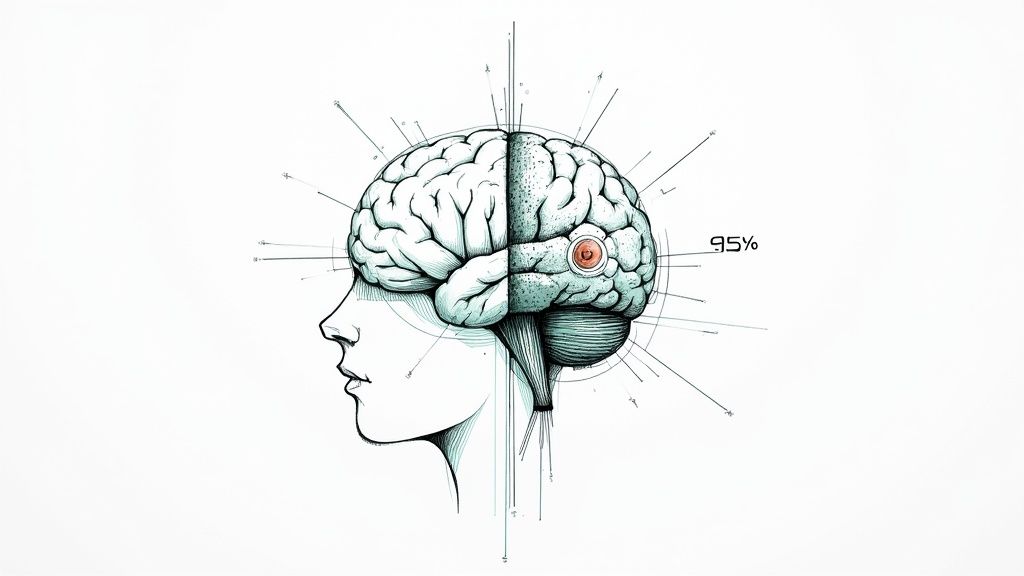
The best way I’ve found to explain the subconscious is to think of it as your brain’s powerful, hidden operating system. It’s always running in the background, quietly steering your habits, shaping your emotional reactions, and nudging your decisions, all without you having to think about it.
This whole idea really took off with the rise of neuroplasticity—the game-changing discovery that our brains can physically reorganize themselves by creating new neural pathways, no matter our age.
Now, you’ve probably heard the statistic that the subconscious controls 95% of our behavior. While that number isn’t a hard scientific fact, it’s a fantastic metaphor for just how much of our daily life is driven by these automatic processes. Grasping this is the first real step toward making lasting changes.
Why Your Willpower Keeps Failing
Ever decided to start a new habit—say, hitting the gym before work or finally tackling that big project—only to find yourself back on the couch, scrolling through your phone a week later? That’s your subconscious mind pulling you back to what’s familiar and safe.
Your conscious mind is hitting the accelerator, but your subconscious has the emergency brake on. It’s a classic conflict. Your conscious brain wants growth and change, but your subconscious is programmed for survival, and it defaults to the well-worn paths it already knows.
This guide is designed to cut through the fluff and give you practical, science-backed methods to get your conscious goals and subconscious programming on the same team. We’re going to dive into actionable strategies that will help you:
- Dig Up and Replace Limiting Beliefs: Learn to spot the hidden “rules” that are sabotaging your success and keeping you stuck.
- Dial Down Stress and Anxiety: Master techniques to calm your nervous system and break free from the chronic fight-or-flight mode that so many of us in the corporate world live in.
- Build Unshakeable Confidence: Start forging new neural pathways that support peak performance, whether you’re leading a critical meeting or aiming for that next promotion.
To bring this all together, I’ve broken the process down into four core pillars. This framework is your roadmap for making these changes stick.
The Four Pillars of Subconscious Reprogramming
| Pillar | Description | Practical Example |
|---|---|---|
| 1. Identify | Pinpointing the specific limiting belief or negative pattern you want to change. You can’t change what you don’t acknowledge. | You realize the thought “I’m not good enough for a promotion” pops up whenever you see a senior role open up. |
| 2. Interrupt | Consciously stopping the old pattern in its tracks the moment it appears. This breaks the automatic loop. | When the thought arises, you say “Stop” out loud and take three deep breaths to break the mental spiral. |
| 3. Install | Replacing the old belief with a new, empowering one through repetition, visualization, or affirmations. | You repeat a new belief: “I have the skills and experience to excel in a senior role.” You visualize yourself succeeding in the interview. |
| 4. Integrate | Taking small, real-world actions that align with your new belief, reinforcing the change through experience. | You update your resume, talk to a mentor about the role, and apply for the position, proving your new belief to yourself. |
By consistently moving through these four pillars, you’re not just thinking differently—you’re actively building a new reality for yourself.
Neuroplasticity Isn’t Just a Buzzword
The beautiful thing is, this entire process is backed by solid science. The key is neuroplasticity. Research in neuroscience has shown again and again that the brain is far from fixed. For example, a well-known study on London taxi drivers published in Current Biology found they had significantly larger posterior hippocampi—the brain region associated with spatial memory—than control subjects. Their brains physically changed to meet the demands of their job.
It’s not just physical skills, either. Mental practices like mindfulness and visualization have been shown to physically alter brain structure. A 2011 study in Psychiatry Research: Neuroimaging found that an eight-week mindfulness meditation program led to measurable increases in gray matter density in the hippocampus, which is important for learning and memory.
By repeatedly introducing new thoughts, feelings, and behaviors, you are physically rewiring your brain’s circuitry. Over time, those new patterns become the default. This isn’t just wishful thinking—it’s applied neuroscience. To delve deeper into understanding how your brain operates and how to enhance its capabilities, you might find valuable resources in Shortgenius’s insights on cognitive potential.
The Science of Rewiring Your Brain
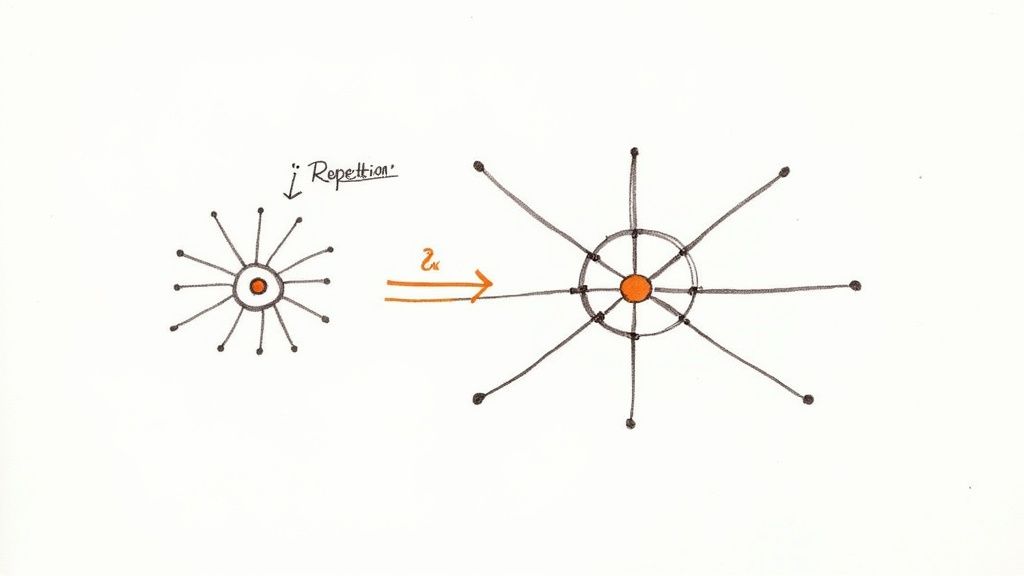
Let’s get one thing straight: reprogramming your subconscious mind isn’t some new-age “wishful thinking.” It’s applied neuroscience. The entire process hangs on a biological principle called neuroplasticity—your brain’s incredible capacity to rewire itself by forging new connections, something it can do your entire life.
Think of your brain’s pathways like trails in a dense forest. The thoughts you have over and over are the well-trodden highways—they’re wide, clear, and almost effortless to travel. A new thought? That’s like trying to hack a new path through thick underbrush with a machete.
It’s tough going at first. But the more you walk that new path—through sheer repetition—the more defined it becomes. Before you know it, that new trail is your go-to route, and the old one is completely overgrown from neglect. This is the nuts-and-bolts framework for how you change your mind, literally.
The Power of Repetition and Mental Rehearsal
When you consistently rehearse a new way of thinking or vividly imagine a different outcome, you are physically building and strengthening those new neural pathways. The fascinating part is that your brain often can’t tell the difference between a real memory and a richly imagined one.
We see this play out all the time in sports psychology. A study in the Journal of Neurophysiology found that when participants simply imagined flexing a muscle, it led to a 22% increase in muscle strength—nearly as much as the group who physically performed the exercises. This mental work led to real, measurable physical improvements.
The same exact mechanism works for our beliefs. When you repeatedly tell yourself, “I am calm and in control during high-stakes presentations,” you are firing and wiring new circuits for that state of being.
- Actionable Step: For the next week, pick one upcoming task that makes you nervous. Spend three minutes each morning vividly imagining yourself completing it successfully. Notice the feeling of accomplishment. This is a practical way to start building the “success” pathway.
How Beliefs Become Your Biology
Your thoughts aren’t just abstract ideas; they trigger very real physiological changes. A thought based on the fear of failure dumps cortisol—the stress hormone—into your system, putting your body on high alert. On the flip side, a thought of success or gratitude can release dopamine and serotonin, the neurotransmitters that make you feel motivated and great.
This biochemical feedback loop is what makes the new pathways stick. When you feel good after thinking a positive thought, your brain essentially says, “Hey, I liked that. Let’s do it again,” reinforcing the new belief.
This isn’t a new concept. The use of affirmations and autosuggestion goes back to the early 20th century. What’s changed is that modern science has caught up, validating these old techniques. A 2021 study in Behavioral Sciences found that self-affirmation practices can buffer the negative effects of stress and improve problem-solving performance under pressure.
Putting Science Into Action
Understanding this science should give you the confidence to stick with the practices we’re about to cover. It’s not magic. It’s a methodical process of working with your brain’s natural ability to change.
This is also where specific tools like Neuro-Linguistic Programming (NLP) come in handy. NLP gives you a structured way to identify and recode old, unhelpful thought patterns right at the subconscious level. Understanding what Neuro-Linguistic Programming is hands you a powerful toolkit to make this whole rewiring process happen much faster.
If you really want to embed these new patterns for good, it helps to know how to learn effectively. You can explore some powerful accelerated learning techniques that mesh perfectly with the principles of neuroplasticity.
Knowing the ‘why’ behind all this is your biggest advantage. Every time you practice a new thought, you’re not just hoping for change—you are an active participant in the biological process of building a new you.
Your Daily Reprogramming Toolkit
Knowing the science is one thing, but actually putting it into practice is where you’ll see the real change. This is your hands-on guide to the daily tools you’ll use to actively rewire your subconscious mind.
Think of these techniques less like chores and more like mental hygiene. They are small, consistent practices that clear out old junk and install new, more powerful software. We’ll focus on three methods: Targeted Affirmations, State-Shifting Breathwork, and Visualization. These aren’t just vague ideas; they are specific exercises designed to create real shifts in how you think and feel.
Crafting Affirmations That Actually Work
Forget those generic “I am wealthy” statements that your logical mind immediately shuts down. For an affirmation to sneak past your internal critic and really land with your subconscious, it has to feel personal, believable, and emotionally charged. The goal is to create statements that feel less like a lie and more like an emerging truth.
A truly effective affirmation has a few key ingredients:
- It’s positive and happening now. Your subconscious lives in the present. Instead of “I will be confident,” a much better version is, “I am becoming more confident with every presentation I deliver.”
- It carries an emotional charge. You need to feel it. “I feel a sense of calm and control when I lead team meetings” is worlds away from a flat, sterile declaration.
- It’s specific to your goal. Vague statements get vague results. If procrastination is your enemy, try something targeted like, “I find it easy and rewarding to tackle my most important task first thing in the morning.”
Actionable Example: A Stressed Project Manager’s Affirmation
Imagine you’re constantly overwhelmed, always feeling behind, and terrified of missing a deadline.
- Old Limiting Belief: “I’m always behind and can’t handle this pressure.”
- New Targeted Affirmation: “I am capable and resourceful, and I handle challenges with a calm and focused mind. I trust my ability to prioritize effectively and meet my deadlines with ease.”
- Practical Application: Write this affirmation on a sticky note and place it on your computer monitor. Read it aloud three times before you check your first email. This anchors the new belief to the start of your workday.
Shift Your State with Simple Breathwork
Before you can plant new beliefs in your subconscious, you need to prepare the soil. A stressed-out, anxious mind is like hard, dry ground—nothing new can take root. State-shifting breathwork is your go-to tool for instantly calming your nervous system, making your mind much more receptive to new programming.
This doesn’t mean you need to set aside an hour for a complex meditation session. A simple, five-minute exercise can create a dramatic shift in your physical and mental state.
One of the most powerful techniques is Box Breathing. It’s a go-to for everyone from Navy SEALs to surgeons who need to stay laser-focused under intense pressure.
Actionable Step: The Box Breathing Method
- Inhale slowly through your nose for a count of four. Feel the air fill your lungs.
- Hold your breath at the top for a count of four.
- Exhale slowly through your mouth for a count of four. Imagine releasing tension.
- Hold your breath at the bottom for a count of four.
- Repeat this cycle for 3-5 minutes before your next important meeting or when you feel overwhelmed.
When you regulate your breath, you send a direct signal to your brain that you are safe. This simple act shifts you out of the “fight-or-flight” sympathetic state and into the “rest-and-digest” parasympathetic state—the ideal condition for influencing the subconscious. As you practice this, you’re not just calming down; you’re also building a deeper connection with your internal state, a cornerstone of learning how to increase self-awareness.
Using Visualization for Mental Rehearsal
Here’s a fascinating quirk of the human mind: it often can’t tell the difference between a vividly imagined experience and a real one. Visualization, or what I call mental rehearsal, takes advantage of this to build the neural pathways for success before you even step into the ring. You’re essentially creating a detailed, multi-sensory movie of your desired outcome.
The evidence for this stuff is compelling. One 2023 study looked at a 21-day affirmation intervention. After just three weeks of daily practice, 65% of participants showed a significant jump in rational decision-making, while their impulsive choices dropped by 40%. It’s a powerful reminder of how consistent mental input can create measurable changes in how our brains work. You can read more about these subconscious mind findings on ijip.in.
Actionable Example: Acing a High-Stakes Presentation
Let’s say you have a career-defining presentation on the horizon. Instead of just stewing in anxiety, you can use visualization to program a successful outcome.
- Find a quiet spot, set a timer for five minutes, and close your eyes.
- Step 1 (See): Picture yourself walking into the room, feeling grounded and confident. See the faces in the audience—they look engaged and receptive.
- Step 2 (Hear): Mentally rehearse your opening lines. Hear your own voice, sounding clear, steady, and authoritative.
- Step 3 (Feel): Feel the presentation flowing smoothly. Imagine yourself fielding questions with ease and expertise. Feel the confidence in your chest.
- Step 4 (Outcome): Visualize the successful conclusion: the applause, the handshakes, that incredible feeling of accomplishment.
Spend 5-10 minutes on this each day leading up to the event. You’re not just hoping for the best; you’re actively training your brain and body for success. By the time the big day arrives, the whole experience will feel familiar and way less intimidating.
To make this even more practical, here’s a quick-reference guide to help you pick the right tool for the job.
Daily Practice Selector
This table helps you choose the right technique based on your immediate need, making the toolkit practical and personalized for your goals.
| If Your Goal Is… | Recommended Technique | Actionable Step |
|---|---|---|
| To build a new core belief (e.g., confidence) | Targeted Affirmations | Write one on a sticky note for your desk. Read it 3x daily. |
| To calm down before a stressful meeting or call | Box Breathing | Set a 3-minute timer and do the exercise before the event. |
| To prepare for a specific high-stakes event | Visualization / Mental Rehearsal | Schedule 5 minutes in your calendar daily to mentally rehearse. |
| To start the day with a positive mindset | Targeted Affirmations | Repeat your affirmation while your morning coffee brews. |
| To stop a negative thought spiral in its tracks | Box Breathing | Step away from your desk and do 5 rounds of the breath cycle. |
Think of these tools as your personal support system. The more you use them, the more intuitive they become, and the more control you gain over your internal state.
Your 90-Day Transformation Plan
Knowing the tools is one thing, but real, lasting change comes from putting them to work consistently. If you try to bulldoze your entire belief system overnight, you’re just setting yourself up for burnout. A much smarter approach is to treat this as a manageable, 90-day project.
This phased approach keeps you from getting overwhelmed. It lets you focus your energy, build momentum, and actually give new habits the time they need to stick. Think of it like building a house—you pour the foundation long before you start hanging drywall.
Phase 1: Build Your Foundation (Days 1–30)
The first 30 days are all about consistency over intensity. The goal here is simple: lock in one core practice and zero in on one specific limiting belief. Trying to do too much at once will dilute your focus and sabotage the whole effort before it even gets going.
Your mission for this month is to make one practice a non-negotiable part of your day. Pick one technique from the toolkit—Targeted Affirmations are a fantastic starting point—and commit to just five minutes every single day.
- Actionable Step 1 (Pick Your Target): Open a notebook. Write down the one belief that trips you up the most. Is it “I’m not qualified for that promotion,” or “I’m just not disciplined enough?”
- Actionable Step 2 (Craft Your Affirmation): On the same page, write a single, powerful statement that directly counters that belief. Example: “I have all the skills and drive I need to excel in my career.”
- Actionable Step 3 (Schedule Your Practice): Set a recurring daily reminder on your phone for a time you know you’ll be free, like during your morning coffee. The goal is to make it automatic.
Journaling during this phase is your secret weapon. Research published in the Journal of Experimental Psychology shows that expressive writing can reduce intrusive thoughts and improve working memory, making it easier to install new beliefs.
Actionable Journal Prompt for Phase 1: “Today, when my old belief showed up, how did I respond? What one small piece of evidence did I notice that supports my new, empowering belief?”
Phase 2: Integrate and Amplify (Days 31–60)
Alright, you’ve laid the groundwork and built a solid habit. Now it’s time to add another layer. In this phase, you’ll bring a second technique into the mix and start consciously looking for proof that it’s working.
This is where you can start “stacking” techniques for a more powerful effect. For example, right after your morning affirmation session, you could add a five-minute visualization exercise. This one-two punch sends a clear, unified message to your subconscious.
This simple flow chart shows how you can combine these practices.
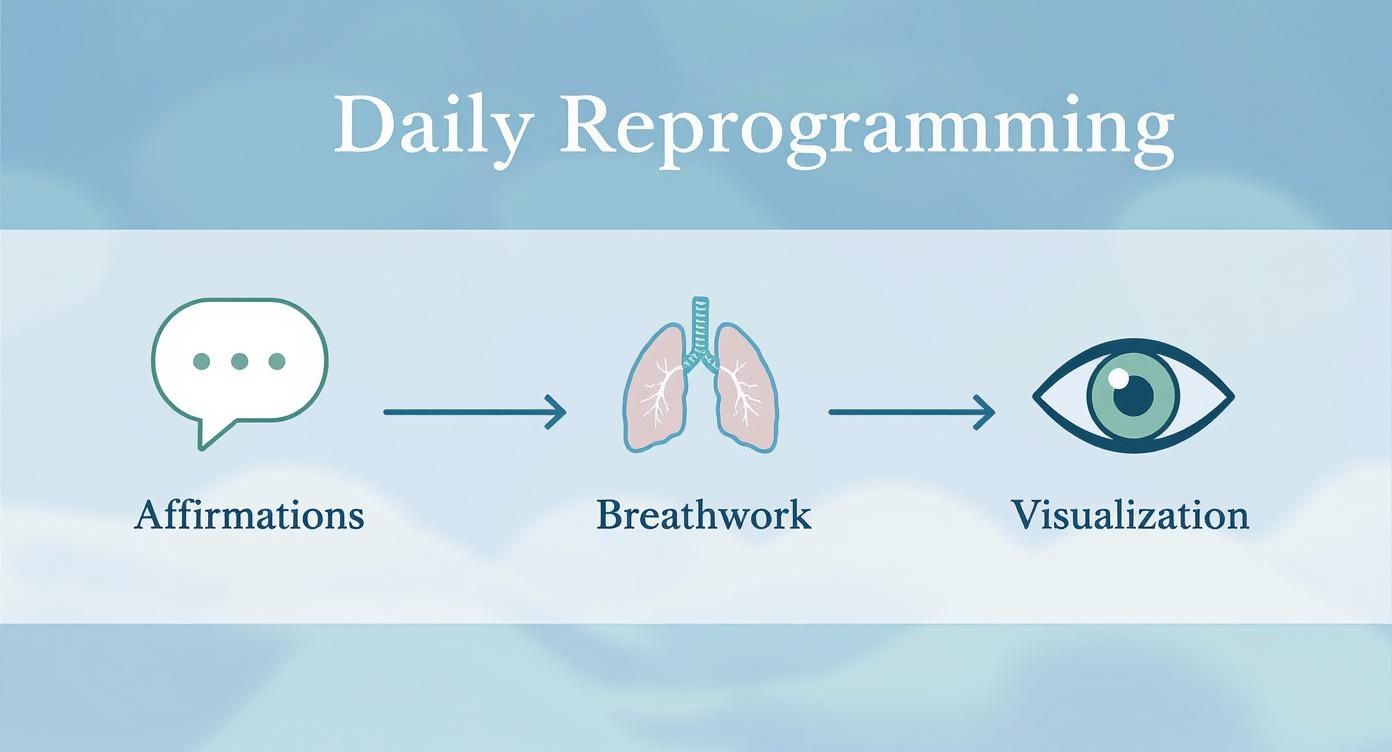
As you can see, each practice builds on the last, creating a powerful loop that reinforces your new programming.
During this month, your actionable task is to become a “small wins hunter.” At the end of each day, write down one time you acted in line with your new belief, no matter how insignificant it seems. Did you speak up in a meeting? Did you tackle a tough project without procrastinating?
This practice is backed by science; studies on self-efficacy show that recognizing small achievements builds the confidence and motivation needed to keep going. It creates a positive feedback loop that speeds everything up.
Actionable Journal Prompt for Phase 2: “What was one small win I had today that aligned with my new belief? How did it feel to act from this new place of empowerment?”
Phase 3: Solidify and Automate (Days 61–90)
The final 30 days are all about making your new mindset the default. The goal is for your new, empowering belief to feel less like a conscious effort and more like… well, you. By now, your daily practices should be second nature.
This is where the real magic happens. The new neural pathways you’ve been building are now so strong that they fire automatically. You’ll start to notice that your gut reactions and spontaneous thoughts are more aligned with your goals. This isn’t wishful thinking; it’s a direct result of neuroplasticity in action.
Your focus in this final stretch is on maintenance and observation. Keep up with your daily practices, but also pay close attention to how your external world is starting to reflect your internal shifts.
- Are new opportunities popping up?
- Are your conversations with colleagues different?
- Do you just feel a general sense of confidence and ease that wasn’t there before?
This is also the perfect time to bring in breathwork as an in-the-moment tool. If you feel an old pattern of stress or self-doubt creeping back in, use a few rounds of Box Breathing to hit the brakes on that thought loop and return to your new, empowered state. A study in the Journal of Affective Disorders found that even brief breathwork sessions can significantly reduce anxiety symptoms, showing just how powerful it is for regulating your nervous system on the fly.
Actionable Journal Prompt for Phase 3: “In what specific ways has my external world started to reflect my internal changes? How does my ‘new normal’ feel compared to 90 days ago?”
Overcoming Common Roadblocks on Your Journey
Making the decision to reprogram your subconscious is a huge step, but let’s be real—it’s rarely a smooth, linear process. It’s completely normal to hit a few snags. Knowing what they are ahead of time is the key to navigating them with resilience instead of getting thrown off course.
This journey isn’t about being perfect; it’s about being persistent. Let’s walk through the three most common roadblocks I see people run into: a nagging inner skeptic, progress that feels painfully slow, and the classic “I’m too busy” dilemma.
When Your Inner Skeptic Gets Loud
It’s almost guaranteed that your conscious, analytical mind will put up a fight. You might catch yourself thinking, “This feels a bit silly,” or “Is any of this actually working?” Don’t panic. That skepticism is just your old programming trying to hang on for dear life. It’s actually a sign that you’re starting to challenge the status quo.
Instead of trying to shut that voice down, get curious. The idea isn’t to silence your inner critic by force, but to gently win it over with small, undeniable bits of proof.
- Actionable Step 1 (Hunt for Micro-Wins): Keep a “proof journal.” For one week, your only task is to write down one tiny piece of evidence each day that your new belief is taking root. Did you feel a flicker of calm after your breathwork? Did you pause for one second less before speaking up? Those are your wins.
- Actionable Step 2 (Acknowledge and Pivot): When that skeptical thought pops up, just notice it without judgment. Say to yourself, “Ah, there’s that skepticism again.” Then, immediately take one deep breath and bring your focus back to your practice. This reinforces that you are in the driver’s seat.
This is a core principle of cognitive behavioral therapy (CBT)—recognizing and reframing those automatic negative thoughts. In fact, a foundational study in Cognitive Therapy and Research showed that this exact process of identifying and challenging automatic thoughts is incredibly effective for changing both how you feel and how you act.
Navigating the Inevitable Plateau
There will be days, maybe even weeks, when it feels like you’ve completely stalled. You’re putting in the effort—doing the affirmations, the visualizations—but you just don’t feel any different. This is what I call “the dip,” and it’s almost always the quiet period right before a major breakthrough.
What’s happening here is that your brain is busy consolidating all the new wiring behind the scenes. You can’t see the construction, but the work is absolutely getting done. Patience is everything here.
Actionable Tip: When you feel you’ve plateaued, switch things up slightly. If you’ve been doing affirmations, try writing them down instead of saying them. If you visualize in the morning, try it at night. This small change can re-engage your brain and help you push through the dip. Quitting during the dip is like digging up the seeds to see if they’re working.
For a deeper dive into pushing past these internal barriers, our guide on overcoming limiting beliefs offers targeted strategies to keep you moving forward.
Staying Consistent When You’re Crunched for Time
For high-performing professionals, the biggest hurdle is almost always time. The thought of adding one more thing to an already bursting schedule can feel impossible. But the secret isn’t finding more time; it’s about weaving these practices into the time you already have.
This is where a little trick called habit stacking becomes your superpower. You simply anchor your new habit to a routine that’s already firmly in place.
- Coffee & Affirmations: While your morning coffee is brewing, run through your affirmations. That’s two minutes of powerful programming built right into your existing ritual.
- Commute & Visualization: Use your train ride or the time before you start your car to do a quick five-minute visualization exercise.
- Pre-Meeting Breathwork: Before jumping on that stressful Zoom call, take 60 seconds to do a round of Box Breathing. It can shift your entire state almost instantly.
Research published in the British Journal of General Practice found that linking a new behavior to an existing “instigation cue”—like making coffee—dramatically increases the chances of it sticking. You’re not forcing a brand-new routine; you’re just piggybacking on one that’s already on autopilot. This makes consistency feel effortless, not like another item on your to-do list.
Your Questions, Answered
As you get started, you’re bound to have some questions. That’s a good thing. Getting clear on how this process works from the inside out is what will give you the confidence to stick with it. Let’s dive into some of the most common things people ask.
How Long Does This Actually Take?
This is always the first question, and the real answer is, “it’s different for everyone.” You’ve probably heard the old 21-day myth for building a habit, but the research paints a much more realistic picture. A well-known study in the European Journal of Social Psychology found it takes an average of 66 days for a new behavior to feel automatic. But even that was just an average—the full range for participants was anywhere from 18 to 254 days.
So, what does that mean for you on this journey?
- You’ll feel small shifts almost immediately. A week of consistent breathwork, for example, can leave you feeling noticeably calmer and more centered. That’s a quick win.
- Deep-seated beliefs need more time. If you’re working on something major, like a lifelong “not good enough” story, that’s going to require more patience. You’re overwriting decades of programming.
The trick is to forget the calendar and focus on consistency. Every time you show up for yourself, you’re laying down a new neural pathway. Celebrate those small wins—they’re proof the rewiring is happening.
Can I Really Do This in My Sleep?
The idea of making progress while you’re asleep sounds almost too good to be true, but there’s some real science here. As you’re falling asleep, your brain cycles into what’s known as a theta wave state. Think of it as that floaty, dreamlike moment right before you drift off. In this state, the critical filter of your conscious mind is powered down, and the doorway to your subconscious is wide open.
This is the perfect window of opportunity.
Playing guided meditations or affirmations as you fall asleep can be a fantastic way to support the work you’re doing during the day. Your subconscious is incredibly receptive to suggestion during this time.
Actionable Step: Tonight, as you lie in bed, don’t scroll through your phone. Instead, close your eyes and repeat your core affirmation slowly and softly for two minutes until you feel yourself drifting off. This programs your mind with your desired belief as you enter the most receptive state.
Research published in Nature Communications has even shown that the sleeping brain can absorb information and form new memories. This backs up the idea that hearing specific cues, like affirmations, can absolutely influence your subconscious patterns overnight.
What If I Don’t Believe What I’m Telling Myself?
This is a big one. It’s that moment you say, “I am confident and successful,” and your brain immediately fires back, “Liar!” It feels fake, and that internal battle can make you want to quit before you even start.
The key is to adjust the language so your conscious mind can get on board. Instead of a bold declaration that feels untrue, you need to frame it as a journey.
Try this simple tweak: start your affirmations with the phrase “I am in the process of becoming…”
- Instead of “I am a confident public speaker,” try “I am in the process of becoming a more confident and compelling public speaker with every opportunity I get.”
- Instead of “I am wealthy,” shift to “I am in the process of building wealth and improving my financial habits every day.”
This approach doesn’t trigger your internal skeptic. It acknowledges your starting point while pointing your subconscious in the direction you want to go. It feels more authentic, which makes it far more effective.
Ready to experience a method that brings together breathwork, hypnotic guidance, and NLP to create profound change at the source? 9D Breathwork is a comprehensive experience designed to break old patterns and rewire you from within. You can explore the journeys and begin your own path today.