Have you ever felt like your brain is running on old, glitchy software? Like you’re stuck in a loop, repeating patterns you wish you could break? This is the exact feeling that Neuro-Linguistic Programming (NLP) aims to address.
At its core, NLP is a powerful approach to understanding and changing human behavior. It’s not about complex theory; it’s a practical toolkit for remodeling your thoughts, communication, and actions to achieve the results you truly want in life.
A User Manual For Your Brain
Think of NLP as the user manual for your mind that you were never given. It provides a clear framework for exploring how you think, how you communicate (with yourself and others), and why you behave the way you do. With this insight, you gain the ability to update the mental and emotional patterns that are holding you back.
To really get it, let’s break down the name itself. It’s composed of three key ideas that, when combined, create a powerful system for change.
To make this crystal clear, here’s a quick breakdown of the three pillars of NLP and what they mean in the real world.
The Three Pillars of Neuro-Linguistic Programming
| Component | What It Means | Practical Application Example |
|---|---|---|
| Neuro | This is all about your nervous system—how you perceive the world through your five senses (sight, sound, touch, taste, smell) and create your internal reality. | Action: The next time you feel stressed, take 10 seconds to notice the physical sensation. Is it tightness in your chest? Heat in your face? By simply observing the neuro component, you begin to separate yourself from the reaction. |
| Linguistic | This refers to the power of language. It includes the words you speak out loud and, just as importantly, the silent conversations you have inside your own head. | Action: For one day, listen to your internal dialogue. When you hear “I can’t,” immediately rephrase it as a question: “How could I?” This simple linguistic shift moves you from a dead end to a place of possibility. |
| Programming | These are your ingrained habits, automatic reactions, and deep-seated beliefs. Think of them as the subconscious “programs” your brain runs on autopilot. | Action: Identify one small “program” you run, like checking your phone when you feel bored. Consciously choose to replace it with a new action, like taking three deep breaths. Do this every time for a week to start reprogramming the habit. |
By understanding how these three elements work together, you can start to see the hidden scripts that guide your life. Once you see them, you can begin to rewrite them.
The Analogy of Mental Software
Let’s stick with the computer analogy. Your brain is an incredibly powerful piece of hardware. From childhood, you’ve been installing “software”—beliefs about yourself, habits for coping with stress, and automatic responses in your relationships.
Some of this software works beautifully. But other programs are buggy or outdated, causing you to feel stuck or repeat the same mistakes over and over.
NLP is like running a diagnostic on your own mind. It helps you pinpoint the faulty code—that limiting belief or negative self-talk—and gives you practical methods to rewrite it. For instance, if you have a “program” that automatically triggers anxiety before a public speaking event, NLP offers techniques to install a new, more resourceful program of calm confidence. It’s no surprise that many people discover these ideas through self-help practices, as they are directly focused on tangible personal improvement.
NLP doesn’t change the world outside of you; it changes the internal maps you use to navigate it. By updating your map, you open up entirely new routes to your goals.
Ultimately, this entire process is about building profound self-awareness, a cornerstone of personal growth. By learning to observe your own mental and emotional processes, you can stop running on autopilot and start making conscious choices.
This isn’t just theory. A study published in the Journal of Personal Selling & Sales Management found that an NLP-based training program significantly improved the adaptive selling skills and performance of salespeople. Another peer-reviewed study in the British Journal of General Practice noted that NLP interventions were effective in improving psychological health and quality of life for individuals. It’s a powerful and practical toolkit for real-world change.
If you’re interested in taking that first step, you can learn more about practical techniques here: https://9dbreathwork.com/how-to-increase-self-awareness/
The Story Behind NLP
Every powerful tool has an origin story. To really get what Neuro-Linguistic Programming is all about, you have to go back to where it started. NLP wasn’t cooked up in some sterile lab; it was born out of the vibrant, counter-cultural energy of the University of California, Santa Cruz, back in the 1970s. The founders weren’t chasing abstract theories—they were obsessed with what actually worked.
Their whole mission was driven by a simple, if audacious, goal: to reverse-engineer human excellence. They wanted to create a blueprint for success that anyone could follow, not by just listening to what successful people said, but by meticulously analyzing how they got such incredible results.
Modeling The Masters of Change
The story really kicks off with two uniquely brilliant minds. In the early 1970s, Richard Bandler, who was studying math and computer science, teamed up with Dr. John Grinder, a linguistics professor. Together, they set out to decode the “magic” of three of the most effective therapists of their era. You can actually find a detailed timeline of the early days of NLP that shows how their ideas came together.
They didn’t just read books. They intensely studied the therapists’ speech patterns, their body language, and the subtle cues that made them so effective. Their subjects were true pioneers:
- Virginia Satir: A trailblazing family therapist who had an uncanny gift for resolving deep-seated communication issues and forging powerful connections.
- Fritz Perls: The father of Gestalt Therapy, a master at helping people get in touch with their immediate reality and take ownership of their lives.
- Milton Erickson: A world-famous hypnotherapist who used elegantly vague language and powerful stories to help his clients discover their own solutions from within.
By watching these geniuses work, Bandler and Grinder started to see the underlying structures behind their success. They realized that these therapists, despite their very different approaches, all shared fundamental patterns in how they thought and communicated.
NLP was founded on the belief that if one person can do something successfully, anyone else can learn to do it too. It’s about creating a blueprint for excellence by studying those who have already achieved it.
This process, which they called modeling, became the absolute heart of NLP. It was never about just mimicking what these masters did. It was about digging deeper to understand the internal processes—the beliefs, the mental syntax, the very physiology—that made their work so powerful.
From Observation to Action
This history is so important because it explains why NLP is intensely practical. It was never designed to be a passive field of study you just read about. From day one, it was built as a toolkit for actively creating change in yourself and in others.
The core idea is refreshingly direct: instead of getting bogged down in the why behind a problem, NLP zeroes in on the how. How does someone actually create the feeling of anxiety? How does a naturally confident person carry themselves and speak? How can you adopt the mental strategy of a top performer in your industry?
This focus on actionable strategies is what makes NLP such a compelling system for growth. It gives you the tools to identify the mental “programs” that are holding you back and install new ones that get you closer to your goals. The entire field is a testament to one simple idea: excellence leaves clues, and if you know how to look for them, you can follow them to success.
Your Practical NLP Toolkit
Now that we’ve covered the origins of Neuro-Linguistic Programming, let’s open up the toolbox. NLP isn’t just a fascinating theory; it’s a collection of hands-on models and techniques you can start using right away. These tools are designed to help you understand yourself and others on a much deeper level, giving you the power to make real, lasting changes.
Think of each technique as a different lens. When you look at a situation through each one, you start to see new possibilities, unlock creative solutions, and communicate in a way that truly connects. Let’s dive into the core tools you can put into practice today.
Understand How People Think With Representational Systems
Have you ever noticed how some people say, “I see what you mean,” while others might respond with, “That sounds right to me,” or “I feel good about that”? These aren’t just random expressions. They’re actually powerful clues into a person’s primary representational system—the main way they process information.
This foundational NLP model shows us that people tend to filter their experience of the world through one of three main senses:
- Visual (V): These folks think in pictures. You’ll notice they often speak quickly and use visual language like “picture this,” “it appears to me,” or “show me.”
- Auditory (A): These people are tuned into sounds. They often have a rhythmic way of speaking and use phrases like “I hear you,” “that rings a bell,” or “loud and clear.”
- Kinesthetic (K): These individuals process the world through feelings, emotions, and physical sensations. They might speak more slowly and use words like “I can grasp that,” “it feels right,” or “let’s connect on this.”
Actionable Tip: For the next 24 hours, listen carefully to a colleague or family member. Try to identify their primary system. Then, when you reply, match their language. If they say, “I see your point,” respond with, “I’m glad it looks clear to you.” Watch how this simple adjustment deepens your connection.
Master Your State With Anchoring
Anchoring is one of the most powerful and immediate techniques in the NLP toolkit. It’s like creating a mental shortcut—a “hotkey” that gives you instant access to a specific emotional state like confidence, calm, or motivation, right when you need it most.
Think about a song that instantly transports you back to a happy memory, making you smile without even trying. The song is an auditory anchor for that positive feeling. NLP teaches you how to build these anchors on purpose.
Let’s create an anchor for confidence right now:
- Recall a time you felt completely confident and on top of your game. Close your eyes and step into that memory.
- Amplify the feeling. Really step back into that memory. Make the colors brighter, the sounds clearer, and the feelings of success more intense. Feel it build.
- Set the anchor. At the absolute peak of that feeling, create a unique physical trigger. For example, firmly squeeze the knuckle of your left thumb with your right hand for five seconds.
- Release and repeat. Let go of the feeling and the trigger. Open your eyes. Then, repeat the process 2-3 times to make the neurological connection stronger.
Now, right before your next important meeting, fire the anchor by squeezing that same knuckle. This triggers that state of confidence. Research has shown that using NLP anchoring techniques can significantly reduce public speaking anxiety, proving just how effective it can be in the real world.
This infographic shows how NLP’s core ideas were developed by modeling therapeutic geniuses like Virginia Satir, Milton Erickson, and Fritz Perls.
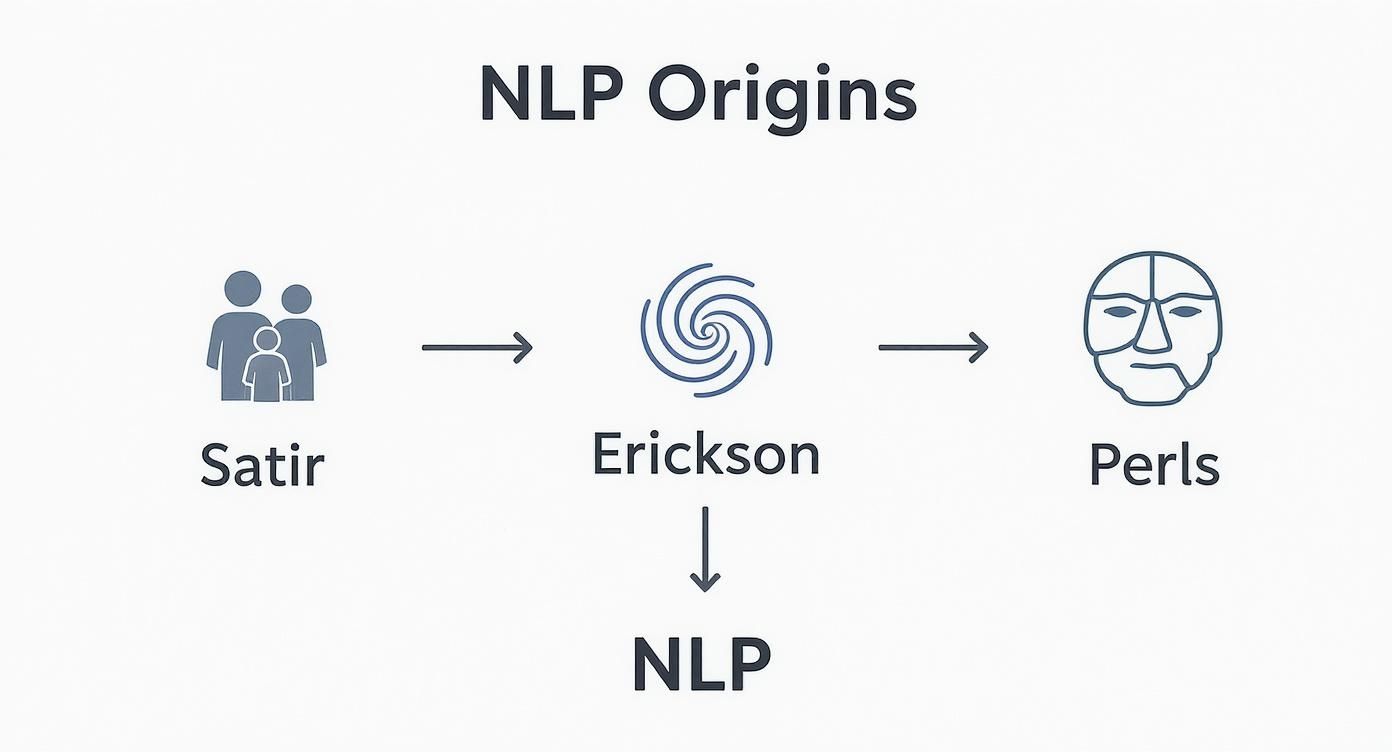
The visualization highlights that NLP is not a single invention but a synthesis of practical models drawn from experts who achieved remarkable results.
Change Your Perspective With Reframing
Reframing is the art of changing how you look at a situation to change what it means to you. It works just like changing the frame around a picture—the image stays the same, but your perception of it can shift dramatically. Reframing a thought can transform a negative experience into a resourceful one.
Actionable Reframe Exercise:
Think of a minor annoyance from today—perhaps you were stuck in traffic. Your initial frame might be, “This is wasting my time.”
Now, ask a new question: “What does this give me an opportunity to do?”
Maybe the new frame is: “This is 10 minutes of uninterrupted time to listen to a podcast” or “This is a chance to practice patience.” By actively reframing, you shift from feeling like a victim to feeling in control.
Reframing isn’t about positive thinking or ignoring reality. It’s about consciously choosing the most empowering interpretation of that reality. It puts you back in the driver’s seat of your emotional response.
Learn From The Best With Modeling
Modeling is the original foundation of Neuro-Linguistic Programming. It’s the process of deconstructing how someone who excels at a particular skill gets their results, so you can replicate their success. This goes way beyond simple imitation.
True modeling involves breaking down an expert’s entire strategy, including their:
- Beliefs: What do they believe about themselves, their skill, and the world that allows them to succeed?
- Physiology: How do they stand, breathe, and move when they’re performing at their absolute best?
- Mental Strategies: What is the exact sequence of thoughts, images, and internal dialogue they run through their mind?
By 1978, NLP had developed the core models and frameworks that became the backbone of its training programs around the world. As early as 1974, founders Bandler and Grinder created the ‘4-Tuple’ model—which mapped experiences through the Visual (V), Auditory (A), Kinesthetic (K), and Olfactory/Gustatory (O/G) senses. You can find more details on the history and evolution of NLP models.
This isn’t just theory; peer-reviewed research backs it up. One study in The Journal of Nursing Research found that an NLP-based communication training program, focused on modeling successful patient interactions, significantly improved the communication skills and empathy of nurses. These tools are proven methods for creating tangible, measurable improvement.
Simple NLP Exercises You Can Try Today
Knowing the theory is one thing, but the real magic of Neuro-Linguistic Programming happens when you actually put it to work. These exercises are simple, hands-on, and designed to create a noticeable shift in how you feel, right now. Think of them as tools you can use to build confidence, dial down stress, and see old problems in a completely new light.

You don’t need any special equipment for these—just a few quiet moments and a little curiosity about your own inner world. This is your first step into experiencing how NLP can empower you every single day.
Build Confidence with the Circle of Excellence
This exercise is a classic and powerful form of anchoring. It’s all about creating a resource state—in this case, pure confidence—that you can tap into whenever you need it. It’s perfect to use before a big meeting, a tricky conversation, or any moment where you want to feel and perform at your absolute best.
Here’s the breakdown:
- Imagine a Circle: Stand up and picture a circle on the floor in front of you, maybe a yard wide. Give it a color that feels like confidence to you.
- Recall a Time of Confidence: Let your mind drift back to a specific memory where you felt totally confident, unstoppable, and successful. Relive it as if you were there right now.
- Amplify the Feeling: As you dive into that memory, make the images brighter, the sounds sharper, and the feelings stronger. When that sense of confidence hits its peak, physically step into the circle you imagined.
- Anchor the State: Standing inside the circle, let that powerful feeling of confidence flood your entire body. Notice how you’re standing, how you’re breathing. At the absolute peak of this feeling, create a physical anchor—something simple, like touching your thumb and middle finger together.
- Step Out and Test: Step back out of the circle, leaving those feelings inside it. Shake it off for a second, then fire your anchor (touch your thumb and middle finger). You should feel that wave of confidence wash over you again.
Run through this a few times to make the connection stronger. Now you have a reliable trigger for confidence on demand. A peer-reviewed study in the Psychology Research and Behavior Management journal found that NLP interventions significantly reduced test anxiety and improved academic performance in students, demonstrating its effectiveness in high-pressure situations.
Find Opportunity by Reframing a Challenge
Reframing is about changing your perspective. It’s a core skill for building resilience that helps you turn a “problem” into an opportunity and is especially useful for dismantling the limiting beliefs that hold us back. This exercise helps you find the hidden positive intention behind something you might have initially labeled as negative.
“A problem is only a problem from a certain point of view.” – NLP Co-founder Richard Bandler
Let’s walk through a quick reframe:
- Identify a Challenge: Pick a recent, minor setback or “failure.” Maybe a project you poured your energy into didn’t quite land the way you’d hoped.
- Acknowledge Your Initial Frame: What’s your gut reaction? Maybe it’s, “I completely messed up and wasted all that time.” Notice the feeling that thought creates.
- Ask a New Question: Now, shift your focus. Ask yourself, “What can I learn from this?” or “What’s the opportunity here that I’m missing?”
- Find the Positive Intent: Could this “failure” actually be a crucial lesson in what not to do next time? Did it expose a weak spot in a process that you can now make stronger? Maybe that time wasn’t wasted at all—it was valuable practice.
- Create a New Frame: Put it into a new, more empowering sentence. Something like, “This experience gave me critical data to make my next approach even better.”
This simple shift doesn’t ignore reality; it just gives you a more resourceful way to look at it. When you change the frame, you change the meaning, and you take back control of your emotional state. To explore this further, check out our guide on overcoming limiting beliefs.
Reduce Stress with Sensory Awareness
This simple technique uses the VAKOG model (Visual, Auditory, Kinesthetic, Olfactory, Gustatory) to pull your focus into the present moment—a proven way to get out of your head and reduce stress. A study published in the Journal of Evidence-Based Complementary & Alternative Medicine confirmed that mindfulness interventions focusing on sensory awareness can significantly lower perceived stress levels and improve psychological well-being.
Give this a try for just two minutes:
- Visual: Mentally name five things you can see right now. Don’t just glance; notice their color, shape, and texture.
- Kinesthetic: Acknowledge four things you can feel. It could be the solidness of the chair you’re sitting on, your feet on the floor, or the fabric of your clothes against your skin.
- Auditory: Listen for three things you can hear. Maybe it’s the quiet hum of a laptop, birds outside, or the sound of your own breathing.
- Olfactory: Pinpoint two things you can smell. These might be subtle, like the scent of coffee or the air in the room.
- Gustatory: Finally, notice one thing you can taste. It could be the lingering flavor of your last drink or simply the neutral taste in your mouth.
This exercise grounds you in your immediate reality, acting as an emergency brake for a racing mind. It’s a practical, profound way to apply what you’ve learned about NLP to your daily well-being.
Navigating The Science And Skepticism
Let’s be upfront: no honest chat about Neuro-Linguistic Programming is complete without touching on its controversial reputation. When you dig into NLP, you’ll find a fascinating mix of powerful, life-changing techniques right alongside a history of skepticism from the scientific community. It’s crucial to walk this path with open eyes.
A big part of the criticism comes from NLP being labeled a pseudoscience. This label really took hold because NLP’s founders built it by modeling subjective, personal experiences, not through the kind of controlled, double-blind studies that are the gold standard in science. On top of that, some of the wild, over-the-top claims made by practitioners back in the 70s and 80s created a cloud of hype that’s been tough to clear ever since.
Acknowledging The Criticisms
It’s true—NLP doesn’t have a single, unified theory that’s been put through the wringer of rigorous testing like, say, cognitive-behavioral therapy (CBT) has. Critics often point out that its core ideas are tricky to measure objectively, which makes it hard to squeeze into traditional scientific boxes.
But does that mean its techniques don’t work? Not at all. Many modern practitioners don’t see NLP as a standalone science, but more like a powerful toolbox filled with practical psychological models. The goal has shifted from trying to prove a grand, all-encompassing theory to simply using specific methods that get real results in coaching, therapy, and personal growth. That distinction is everything.
What The Peer-Reviewed Research Says
While sweeping claims about NLP are difficult to prove, many of its specific techniques have been studied and shown to have positive results. This is where we can really start to separate the old hype from today’s evidence-based applications.
- Anxiety Reduction: One study in the Journal of Counseling, Development and Communication found that NLP techniques helped significantly reduce anxiety in university students. They gave them a practical way to get a handle on their stressful inner states.
- Boosting Confidence: Research published in Social Behavior and Personality showed that a group receiving NLP training had a significant increase in self-esteem compared to a control group. This backs up its value for building stronger, more resourceful emotions on demand.
- Psychological Well-being: A study in the Journal of Experiential Psychotherapy reported that an NLP-based training program had a positive impact on the psychological well-being and overall life satisfaction of those who took part. This shows that the toolkit, when used properly, can genuinely contribute to better mental health.
The modern value of NLP lies not in its scientific purity but in its practical utility. It offers a framework for understanding and influencing subjective experience, which can be a powerful catalyst for personal change.
This approach fits perfectly with the idea of neuroplasticity—the brain’s amazing ability to reorganize itself by creating new neural pathways. If you want to dive deeper into this, you can learn more about how to rewire your brain for lasting change.
At the end of the day, the best way to look at NLP is to separate its core ideas from its practical tools. While the “science” of NLP as a whole is still up for debate, many of its methods—like reframing, anchoring, and modeling—are built on solid psychological principles and have proven their worth time and again. This balanced view lets you appreciate NLP for what it is: a pragmatic toolkit for change, even as you acknowledge its scientific limits.
Finding a Credible NLP Trainer Who’s Right for You
So, you’re ready to dive deeper into Neuro-Linguistic Programming. That’s fantastic, but finding the right guide is absolutely crucial. The world of NLP training is a bit like the Wild West—it’s largely unregulated, which means the quality of programs can swing from brilliant to downright disappointing. It’s up to you to be a savvy consumer and make sure your investment in time and money is a good one.
This isn’t just about scrolling through flashy websites and believing bold promises. You’re looking for someone—or an organization—grounded in real skill, strong ethics, and a genuine desire to help you grow. The right training can truly open up new ways of thinking and being. The wrong one? It’s often just a frustrating waste of money.
What To Look For In a Qualified Practitioner
A credible NLP trainer or coach will always have a clear, verifiable background. They know their expertise comes from a solid foundation, and they won’t be shy about sharing their journey. It’s no different than checking the credentials of any other professional you’d hire.
Here are a few green flags to keep an eye out for:
- A Clear Lineage and Certification: Ask them: Where did you train? Who were your teachers? Reputable practitioners can trace their training back to well-known NLP figures and are usually certified by established bodies like the Society of NLP or the International NLP Trainers Association (INLPTA).
- A Heavy Emphasis on Ethics: A truly ethical practitioner is upfront about what NLP can and cannot do. They manage expectations and operate with a clear code of conduct, always putting your well-being first.
- Proven, Real-World Experience: Look for trainers who don’t just teach NLP but actively use it. Do they have a background in coaching, therapy, or business where they’ve applied these skills to get results? Experience in the trenches is often the best sign of true competence.
Think of it this way: you’re looking for an educator, not a salesperson. A great practitioner is focused on empowering you with skills, not on using high-pressure tactics to lock you into an expensive program.
Red Flags to Watch Out For
Knowing what to look for is half the battle; knowing what to avoid is the other half. Certain warning signs should give you serious pause and make you think twice. These red flags often point to a lack of depth, professionalism, or ethical grounding.
Be wary of any trainer or organization that:
- Promises “Instant Cures” or Guarantees Unrealistic Results: NLP is an incredibly powerful tool for change, but it isn’t magic. Anyone promising to fix all your problems over a weekend or guaranteeing you’ll become a millionaire is selling snake oil, not authentic training.
- Uses High-Pressure Sales Tactics: If you feel rushed, cornered, or pressured with “limited-time offers” that expire in an hour, it’s a massive red flag. Quality training speaks for itself and doesn’t need aggressive, used-car-salesman tactics.
- Is Vague and Lacks Transparency: If a practitioner gets cagey about their certification, training history, or what’s actually in their curriculum, it’s time to walk away. Transparency is the bedrock of professional credibility.
In the end, finding the right NLP training comes down to doing your homework. Research different schools and trainers, read reviews, and if you can, talk to former students. And don’t forget to trust your gut—the right practitioner will feel professional, ethical, and genuinely invested in helping you succeed.
Answering Your Lingering NLP Questions
As we round the final corner of our journey into Neuro-Linguistic Programming, it’s time to tackle some of the most common questions that come up. Let’s clear up any final points so you can walk away with a solid, real-world grasp of NLP.
So, Is NLP Just Another Word for Therapy?
That’s a great question, and the answer is no. While you’ll often find NLP techniques woven into therapeutic practices, it’s not a regulated form of therapy on its own.
It’s better to think of NLP as a powerful model for communication and personal change. A licensed therapist might certainly use NLP tools, but someone who is only an NLP practitioner isn’t a therapist. It’s a toolkit, one that’s incredibly versatile for therapy, coaching, business, and your own personal growth.
How Quickly Can I Expect to See a Change?
This is the classic “it depends” answer, but for a good reason. Some NLP tools can create an immediate, noticeable shift. You could use a simple anchoring technique and genuinely feel more confident or calm in just a few minutes.
But for those deeper, more ingrained habits or limiting beliefs? That takes more time. Think of it like this: you can feel a jolt of energy from a single good workout, but lasting fitness comes from consistent effort. The same is true here. Quick wins are common, but real, lasting change comes from practicing these new mental patterns until they become second nature.
What’s the Deal with NLP and Science?
This is where things get a bit messy and debated. As we’ve touched on, NLP is frequently criticized as a pseudoscience because its foundations were built on modeling successful people, not on sterile, controlled lab experiments.
That said, many of the individual techniques that make up the NLP toolkit have found backing in modern psychology and even peer-reviewed studies. It’s a bit of a paradox.
- A meta-analysis published in the journal Frontiers in Psychology confirmed that NLP interventions have a positive effect on psychological outcomes, suggesting its practical value despite theoretical debates.
- Research has also pointed to its effectiveness in improving emotional regulation and treating phobias.
- It’s even been demonstrated to be a useful tool for reducing public speaking anxiety, as shown in multiple studies.
So, while the grand, unified theory of NLP might lack scientific consensus, many of its practical tools are rooted in sound psychological principles that get real, measurable results.
Ready to feel how modern tools can help you rewire your mind? 9D Breathwork masterfully blends the power of NLP with immersive breathwork, sound, and guidance. It’s an experience designed to break old patterns and help you build a more empowered you from the inside out.