Somatic therapy is a unique, body-first approach to healing. It helps you work through stored stress and trauma by tuning into your physical sensations—the tight shoulders, the knot in your stomach, the shallow breath—instead of getting lost in just the thoughts and memories swirling in your head. It’s grounded in the idea that our nervous systems can get stuck in a survival loop, and healing happens when we gently guide our bodies back to feeling safe and balanced.
Understanding What Somatic Therapy Actually Is
Imagine your body is like a detailed archive, holding the complete story of your life. While your conscious mind might forget the specifics of certain events, your body remembers everything—especially those moments of intense stress, fear, or sudden shock. Somatic therapy, at its core, is simply learning to read the language of that archive.
Instead of just talking about what happened, this approach guides you to notice how the story of that experience is showing up in your body right now. The focus shifts to questions like:
- Where is that anxiety living in your body? Is it a tightness in your chest or a queasy feeling in your gut?
- What happens to your breath when you think about that looming deadline? Does it get shorter? Do you hold it?
- As you remember that tough conversation, do you feel your jaw clench or your shoulders creep up toward your ears?
This isn’t about re-living anything painful. It’s about making safe, gentle contact with the physical imprints those experiences left behind, so you can finally let them go. A practical first step you can take right now is to pause, take one slow breath, and ask yourself: “What is one sensation I feel in my body?” Simply noticing is the beginning of somatic awareness.
The Core Idea: The Body Knows How to Heal
A foundational principle of somatic therapy is that your body has a natural, built-in capacity to heal itself. We know from research that unresolved trauma can lock the nervous system into a state of high alert—that chronic “fight-or-flight” response that fuels everything from anxiety to burnout.
“When we experience trauma, the body often goes into survival mode: fight, flight, freeze, or collapse. If the trauma is deeply stored and these responses are not addressed, they can stick like glue to the nervous system.”
Somatic therapy gives you the tools to gently “unstick” these old survival patterns. For instance, a study in the European Journal of Psychotraumatology confirmed that body-oriented therapies are effective at reducing symptoms of post-traumatic stress disorder (PTSD), underscoring just how crucial it is to bring the body into the healing conversation.
To make this clearer, let’s break down the core concepts behind this work.
The Four Pillars Of Somatic Therapy
This table breaks down the core concepts of somatic therapy into simple, actionable ideas, showing how each contributes to the healing process.
| Pillar | What It Means For You | An Actionable Example |
|---|---|---|
| Interoception | Learning to notice and understand the subtle signals your body sends you, like hunger, tension, or warmth. | Action: Pause for 30 seconds. Scan your body from head to toe. Name three things you feel: “My feet are warm,” “My jaw feels tight,” “My stomach is calm.” |
| Titration | Processing difficult emotions or sensations in small, manageable doses to avoid feeling overwhelmed. | Action: If you feel a wave of anxiety, focus on just 5% of that feeling for 10 seconds. Then, deliberately shift your focus to something pleasant in the room. |
| Pendulation | Gently shifting your attention between a sensation of stress or discomfort and a place in your body that feels calm and safe. | Action: Notice the knot in your stomach, then intentionally move your focus to the feeling of your hands resting on your legs. Shuttle back and forth a few times. |
| Resourcing | Identifying and cultivating internal and external sources of strength, safety, and calm that you can turn to. | Action: Close your eyes and vividly recall a memory of a time you felt safe and happy. Feel the physical sensations of that memory in your body for one minute. |
By working with these pillars, you learn to navigate your inner world with more confidence and less fear, building a foundation for lasting change.
Shifting From Surviving To Thriving
Ultimately, the goal is to expand your nervous system’s capacity to handle life’s stressors without getting completely overwhelmed. By learning to track your bodily sensations—a practice known as interoception—you start developing a profound new level of self-awareness. It’s no surprise that studies show a strong link between better interoceptive awareness and improved emotional regulation.
This awareness empowers you to move from a state of just surviving your emotional triggers to actively building resilience. You learn to catch your body’s early distress signals and respond with conscious actions that create safety and calm, guiding yourself back to your natural state of balance. It’s a process that puts you back in the driver’s seat of your own well-being, one sensation at a time.
How Your Body Remembers and Stores Stress
Have you ever felt your shoulders creep up toward your ears during a tense meeting, even as you’re consciously trying to relax? Or that familiar, sinking feeling in your stomach when an unexpected email hits your inbox?
Those physical reactions aren’t just random. They’re direct messages from your body, revealing a much deeper story about how we hold on to unresolved experiences long after our minds have tried to move on. Your body keeps a physical record, and this is where somatic work truly begins.
Think of your nervous system as a highly advanced security system for your home. When all is well, it’s in a calm, “green light” state. But the moment it detects a threat—whether it’s a car horn blaring, a sharp word from a colleague, or even just the memory of a past trauma—the alarms start ringing.
This triggers the classic fight-or-flight response. A cocktail of stress hormones like adrenaline and cortisol floods your system. Your heart races, muscles tighten, and your senses go on high alert, all designed to prepare you to either face the danger or get away from it.
The Nervous System Security System
In an ideal world, once the threat is gone, your nervous system gets the “all clear” and settles back down. The problem is, when stress is chronic or an experience is deeply traumatic, that security system can get stuck in the “on” position. It’s like a smoke detector that won’t stop blaring, even though the smoke cleared out hours ago.
This state of being perpetually on high alert is known as nervous system dysregulation. A study published in Biological Psychiatry highlighted how prolonged stress activation is directly linked to a whole host of health issues, from chronic pain and fatigue to anxiety and depression. Your body is essentially living in a state of emergency 24/7, even when there’s no real and present danger.
This concept map breaks down the core pillars of somatic work, showing how the mind-body connection, nervous system, physical sensations, and the act of release all fit together.
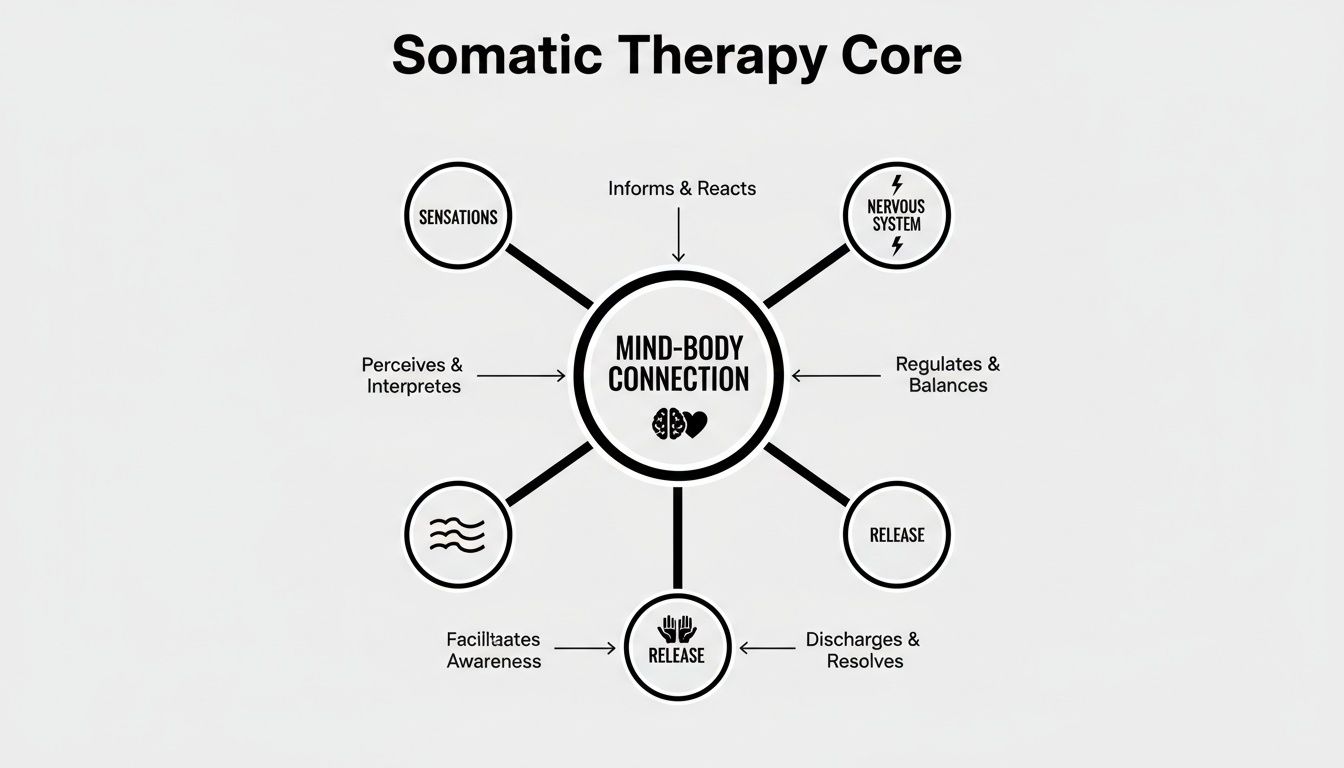
As the visual shows, true healing isn’t just a mental game. It requires us to tune into our nervous system and listen to our physical sensations to find genuine, lasting release.
Introducing Polyvagal Theory and the Vagus Nerve
So, how do we get “unstuck”? This is where the groundbreaking work of Dr. Stephen Porges and his Polyvagal Theory comes in. It might sound a bit academic, but the core idea is surprisingly simple and incredibly empowering. It gives us a clear roadmap of how our nervous system operates—and, more importantly, how we can consciously work with it.
At the heart of this theory is the vagus nerve. It’s the longest cranial nerve in your body, acting like a superhighway connecting your brain to all your major organs. You can think of it as the master switch for your internal security system. The vagus nerve is constantly scanning your environment, helping your brain decide whether you’re safe or in danger.
When your vagus nerve is functioning well—what experts call having a high “vagal tone”—it acts as a powerful brake on your stress response. It helps you shift out of that frantic fight-or-flight mode and back into a state of calm, connection, and social engagement.
This is where somatic therapy gets really practical. Actionable tip: Hum or sing loudly for a few minutes. The vibrations in your throat directly stimulate the vagus nerve, sending a calming signal to your brain. This simple technique sends a clear message: “You are safe now. You can stand down.” A meta-analysis in Frontiers in Psychiatry confirmed that practices improving vagal tone can significantly lower anxiety and enhance our ability to regulate emotions.
Listening to Your Body’s Messages
Those physical sensations you feel—the tightness in your chest, the heat in your face, the numb feeling in your hands—are not the problem. They are actually the solution. They are the trail of breadcrumbs your body is leaving for you, guiding you back to the source of the stored stress.
When you learn to listen to these signals without judging them, you can finally begin to work with them instead of against them. This is the very heart of releasing trapped energy. You might discover, for example, that the chronic tension in your jaw is tied to all the things you never said during a past conflict. A somatic approach helps you acknowledge that link and finally complete the biological stress response that got frozen in time. You can learn more about how to do this in our guide on how to release stored trauma.
A 2017 study in Neuroscience & Biobehavioral Reviews found that people with a higher awareness of their internal bodily signals (interoception) also reported greater emotional well-being. This powerfully reinforces the core principle of somatic work: tuning into your body is a direct path to healing.
Alongside somatic therapy, other powerful methods like EMDR therapy for trauma healing also work with how the body stores traumatic memories, just using a different toolkit. By truly understanding that your body remembers, you gain the power to help it finally let go and return to its natural state of balance.
A Century of Listening to the Body
Somatic therapy isn’t a new-age fad. It’s a field with deep roots, built over nearly a century of clinical practice and scientific inquiry that challenged the old idea that healing only happens in the mind. To really get what somatic work is all about, it helps to understand where it came from.
The story really starts in the 1930s with Wilhelm Reich, who was once a student of Sigmund Freud. Reich noticed something his peers had overlooked: his patients’ repressed emotions weren’t just abstract psychological forces. They were showing up in their bodies as chronic muscle tension—a kind of physical shield he called “body armoring.” This was a huge shift in thinking; the idea that our psychological pain gets physically locked away in our tissues.
Reich’s work cracked the door open for what would become over 70 years of body-focused therapies. By the 1950s, one of his students, Alexander Lowen, ran with these ideas and developed Bioenergetic Analysis. He created practical exercises—like deep breathing and grounding postures—specifically to help people release that stored tension. Many of those core techniques are still used today to help people unwind years of built-up stress. You can see the full timeline of the evolution of somatic therapy on RedBeardSomaticTherapy.com.
Lessons from the Animal Kingdom
The next big leap came in the 1970s from Dr. Peter Levine. He was wrestling with a simple but profound question: why don’t wild animals get PTSD? They face life-or-death threats constantly, yet they don’t seem to carry the same chronic trauma symptoms that humans do.
What he saw was that after a chase, an animal like a gazelle would physically discharge the stress. It would shake, tremble, and take deep, spontaneous breaths. This instinctual, physical release allowed the massive surge of survival energy to move through and out of its nervous system, bringing it back to a state of calm.
Levine realized that we humans, with our complex brains, often interrupt this natural process. We tell ourselves to “be strong” or “get a grip,” and in doing so, we trap that same survival energy inside our bodies. That trapped energy is what festers and turns into chronic anxiety, stress, and overwhelm.
“Trauma is not what happens to us, but what we hold inside in the absence of an empathetic witness.” – Peter A. Levine
This core insight was the basis for Somatic Experiencing (SE), the method he developed to help people gently and safely release that pent-up energy, just like animals do in the wild.
Building on Decades of Insight
Levine’s work proved that the body has a natural, biological blueprint for healing itself. We just have to learn how to listen to it and get out of its way. Since then, the field has continued to grow, weaving in modern neuroscience and a much deeper understanding of how our nervous system actually works.
Other key pioneers helped shape the landscape, including:
- Ron Kurtz: He founded the Hakomi Method, which beautifully blended somatic awareness with mindfulness. It offered a gentle yet powerful way to uncover the core beliefs we hold in our bodies.
- Pat Ogden: As the creator of Sensorimotor Psychotherapy, she brought together somatic techniques with attachment theory and neuroscience to help people work through developmental trauma.
These innovators, and many others, completely changed how we approach mental and emotional health. They showed us that by bringing the body into the conversation, we can finally access and heal wounds that talk therapy alone can’t always reach. This rich history isn’t just trivia; it’s proof that somatic therapy is a time-tested, robust approach, refined over decades to help people tap into their own resilience.
What a Typical Somatic Therapy Session Looks Like
The thought of walking into any new therapy session can be a little nerve-wracking. Not knowing what to expect is often the biggest hurdle. But a somatic therapy session isn’t about bracing for some intense emotional excavation. It’s a gentle, collaborative process focused on creating a safe space for your body to finally tell its side of the story.
Unlike traditional talk therapy, where we spend most of our time analyzing the “what happened,” a somatic session is all about how that story lives in your body right now. The therapist isn’t there to interpret your past, but to act as a compassionate guide, helping you reconnect the dots between your mind and your physical experience.
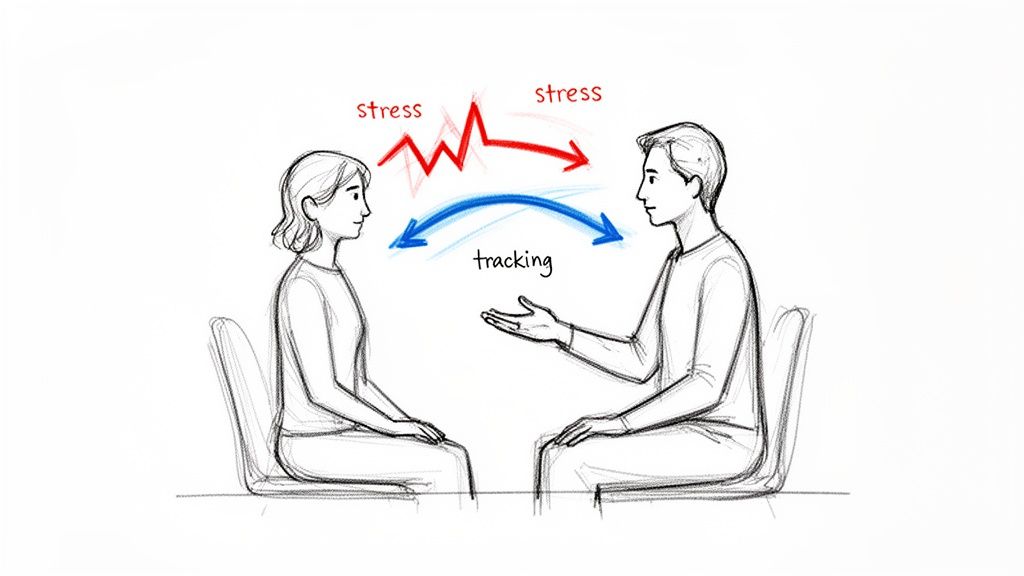
It almost always starts with finding a sense of safety and grounding in the present moment. Your therapist might invite you to simply notice the feeling of your feet on the floor or the solidness of the chair supporting you. This isn’t just a fluffy relaxation exercise; it’s a direct signal to your nervous system that you are here, you are safe, and you are present.
Core Techniques in Action
Once you feel settled, the therapist will guide you through a few core techniques. Think of these less as rigid steps and more as gentle invitations to explore your inner world. The most important thing to know is that you are always in the driver’s seat. The therapist follows your lead, making sure you never go further or faster than feels right for your system.
You’ll likely encounter three key techniques:
- Tracking: This is simply the practice of mindfully following a physical sensation from beginning to end. If you say you’re feeling anxious, the therapist might ask, “And where do you feel that in your body?” Maybe it’s a tightness in your chest. The goal isn’t to fix it but just to get curious and observe it without judgment.
- Titration: This is about processing difficult feelings or memories in small, manageable bits. Instead of diving headfirst into a trauma, you might touch on one tiny piece of it for a few seconds before intentionally returning to a feeling of safety. This keeps you from getting overwhelmed and slowly builds your capacity to handle stress.
- Pendulation: This involves gently shifting your focus back and forth between a sensation of stress (that chest tightness) and a part of your body that feels neutral or even pleasant (like the warmth in your hands). This natural rhythm teaches your nervous system that it can move from a stress state back to a balanced one, building incredible resilience over time.
A study in the Journal of Traumatic Stress found that body-awareness-based interventions significantly reduced PTSD symptoms. This highlights how techniques like tracking and titration directly help the nervous system finally complete those unresolved survival responses.
A Focus on Safety and Empowerment
Throughout the entire process, the real focus is on safety. The therapist helps create an environment where your nervous system can finally learn it’s okay to let its guard down. For example, if you start to feel disconnected or zoned out, they might gently bring you back with simple prompts. We cover many of these powerful tools in our guide on grounding techniques for dissociation.
The proof is in the results. Research published in Frontiers in Psychology showed that somatic approaches effectively reduced symptoms of anxiety and depression by strengthening that mind-body connection. Another clinical trial published in the Journal of Affective Disorders found that Somatic Experiencing led to major, long-lasting improvements for people with PTSD.
Ultimately, a somatic session is about empowering you. It teaches you how to listen to your body’s unique language, trust its signals, and gently guide your nervous system back to a place of wholeness, one sensation at a time.
Practical Somatic Exercises for Immediate Stress Relief
Understanding somatic therapy is one thing, but putting it into practice is where the real magic happens. The great news is you don’t have to wait for a formal therapy session to start listening to your body and calming your nervous system.
These simple yet powerful exercises can be done pretty much anywhere—at your desk, right before a big meeting, or at home. They’re designed to give you immediate relief when stress and anxiety feel like they’re taking over.
The goal isn’t to magically erase stress. Instead, think of these exercises as building your capacity to handle it. You’re essentially starting a conversation with your body, using the language of physical sensation to send it signals of safety. A study in the Journal of Affective Disorders even found that body-awareness practices significantly improve our ability to manage our emotions, showing a direct link between tuning in and feeling more in control.
Exercise 1: Grounding Through Your Feet
When your mind is racing, one of the fastest ways to find your center is to pull your awareness out of your head and down into your body. This grounding exercise uses the simple, solid sensation of your feet on the floor to anchor you firmly in the present moment.
How to do it:
- Get comfortable, sitting or standing. If you’re sitting, make sure both feet are flat on the floor. If you’re standing, keep a slight, soft bend in your knees.
- Shift your attention downward. Gently close your eyes or just soften your gaze, and shift all your focus to the soles of your feet.
- Notice what you feel. Get curious. Can you feel the texture of your socks? The firm pressure of the floor against your heels? The temperature? Try wiggling your toes and feel each one connect with your shoes or the ground.
- Imagine roots growing from your feet. Picture them extending down, deep into the earth, giving you a sense of stability and support. Just stay with this feeling for 30-60 seconds.
Why it works: This exercise taps into your body’s proprioceptive sense—your internal GPS for where your body is in space. By focusing on the solid, unmoving ground beneath you, you send a direct message to your brain’s alarm center (the amygdala) that you are physically safe and stable. This helps dial down that fight-or-flight response.
Exercise 2: The Self-Soothing Hand Gesture
Supportive touch is one of the most powerful tools we have for regulating our nervous system. This self-holding exercise is a beautiful way to mimic the feeling of being comforted, sending signals of safety and care directly to your body.
How to do it:
- Find a comfortable spot, sitting or lying down.
- Gently place one hand over your heart and the other on your belly.
- Feel the points of contact. Close your eyes and bring your awareness to the warmth of your hands and the gentle pressure on your body.
- Track your breath. Without trying to change a thing, just notice the subtle rise and fall of your chest and belly as you breathe. Stay here for a few slow, mindful breaths.
Why it works: This simple gesture helps stimulate the vagus nerve, which acts as the main “brake” on your body’s stress response. Research published in Psychological Science has shown that gentle pressure and warmth can trigger the release of oxytocin—a hormone that fosters feelings of connection and safety—which is incredibly effective at calming a frazzled nervous system. To go deeper, you can explore a variety of polyvagal theory exercises that build on this same principle.
Exercise 3: Orienting to Your Environment
When we’re stressed, our focus tends to narrow dramatically onto whatever we perceive as a threat, whether it’s a packed inbox or a looming deadline. Orienting is the simple practice of intentionally broadening your awareness to your surroundings, which tells your nervous system that you aren’t in any immediate danger.
How to do it:
- Let your eyes slowly wander around the room. No rush.
- Find something pleasant or neutral to look at. Land your gaze on something that feels calming. It could be a plant, a favorite color on the wall, or the way light is streaming through a window.
- Silently name what you see. For example, “I see the green leaves of the plant,” or “I notice the blue of that coffee mug.”
- Check in with your body. As you do this, notice your physical response. Is there a slight softening in your shoulders? Is your breath a little deeper? That’s your nervous system beginning to downshift.
Why it works: This practice interrupts the brain’s threat-detection loop. By consciously taking in your environment, you’re feeding your brain new sensory data that confirms you are safe right here, right now. A study in PLOS ONE confirmed that mindfully paying attention to one’s surroundings can reduce the physiological markers of stress.
These exercises are foundational tools for building body awareness. To deepen your understanding of internal physiological states and learn self-regulation, exploring resources on biofeedback therapy can offer valuable insights into how technology can support this process.
How Modern Breathwork Can Supercharge Somatic Healing
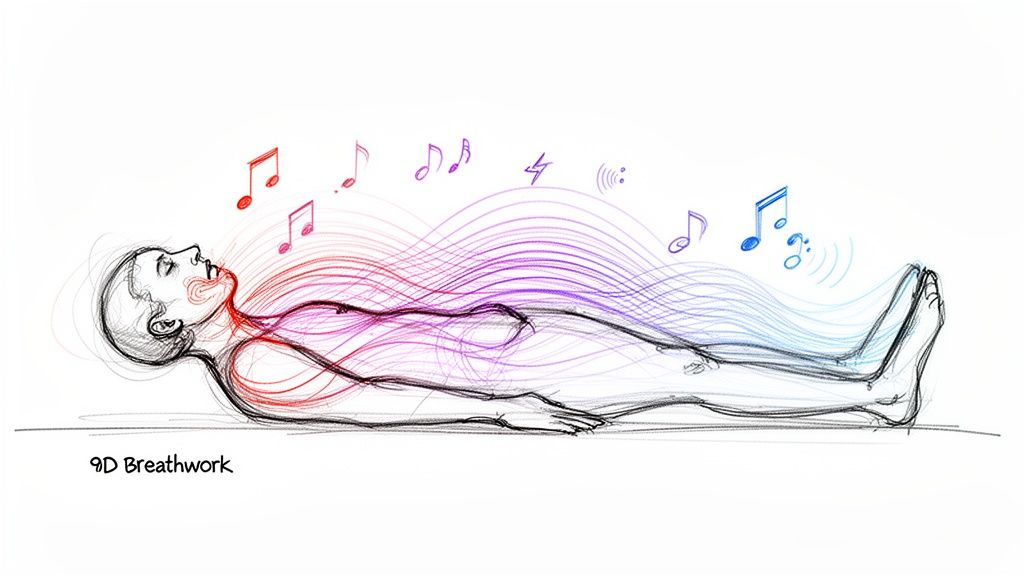
Traditional somatic therapy is a beautiful, gentle process of coaxing your nervous system back into balance. But what if you could accelerate that journey? This is where certain modern practices, like 9D Breathwork, come in, offering a more direct route to safely access and release the survival energy that’s been locked away in the body for years.
This isn’t about replacing the core principles of somatic work, but rather giving them a turbo-boost. Think of it like this: if standard somatic therapy is like carefully untangling a knotted rope, one strand at a time, then intentional breathwork is like a powerful current that loosens the entire knot at once. This makes the individual strands much easier to see, work with, and finally smooth out.
Beyond Just Managing Stress: It’s About Rewiring Your Response
The real power of modern breathwork is in its multi-layered, immersive design. It’s not just about breathing. By weaving together specific breathing patterns, binaural beats, carefully chosen music, and guided coaching, it creates a unique environment where you can safely move past the defenses of your conscious mind.
This approach helps you tap into deep-seated emotional energy that might take far longer to surface in more conventional talking therapies. You’re making a fundamental shift from simply managing stress to completely rewiring how your body instinctively responds to it.
A 2017 study in Frontiers in Psychology backed this up, confirming that certain breathing techniques can directly regulate the autonomic nervous system, which in turn influences our emotional state. This shows that controlled breathing is a direct key to unlocking the body’s stored patterns.
How Breathwork Breaks Old Patterns
This kind of immersive experience is designed to intentionally shake up the old, stuck patterns in your nervous system. When you consciously change how you breathe, you create physiological shifts that interrupt the autopilot mode your body has been running on for so long.
This process helps you:
- Finally Release Trapped Survival Energy. By activating the body with your breath, you can complete the fight-or-flight responses that were frozen in time. This allows that stagnant, pent-up energy to finally move through and out of your system.
- Access Subconscious Beliefs. The combination of sound and breath helps quiet the noisy, analytical mind. This opens a doorway to the subconscious, where limiting beliefs and old emotional imprints are stored.
- Build a New Foundation of Resilience. Every session is like a workout for your nervous system, teaching it a new, more regulated way of being. Research in the Journal of Neuroscience has even shown how rhythmic breathing can influence brain waves, leading to better emotional control and memory.
“Many individuals experience lasting relief from trauma-related symptoms, as SE targets the root physiological causes of stored trauma in the body.”
By incorporating these powerful breathwork journeys, you’re not just exploring somatic healing—you’re actively fast-tracking it. This method helps you build a strong foundation of resilience from the inside out, making it an incredible tool for deep, lasting change. You can dive deeper into this specific approach in our full guide on what breathwork therapy is.
A Few Common Questions About Somatic Therapy
It’s completely normal to have a few practical questions when you’re exploring something new like somatic therapy. Let’s clear up some of the most common ones so you can get a better sense of whether this body-first approach feels right for you.
How Is This Different From Yoga or Massage?
That’s a great question. While practices like yoga and massage are fantastic for the body and can definitely calm your nerves, somatic therapy is a specific form of psychotherapy. The main goal here isn’t just relaxation—it’s about intentionally healing emotional wounds and deep-seated stress.
Think of it this way: a massage therapist works on your body, while a somatic therapist works with your body’s wisdom. They guide you to use your physical sensations as a pathway to process stored trauma and help your nervous system find its way back to balance. Research has shown this guided, body-focused work is a powerful tool for reducing post-traumatic stress symptoms, often getting to the root of things in a way that general bodywork can’t.
Is It Safe for Someone With Severe Trauma?
Yes, absolutely—but with a crucial condition: it must be guided by a certified, experienced, and trauma-informed practitioner. Safety is the absolute foundation of this work. A good somatic therapist is trained to create a secure space, moving at a pace that your nervous system can comfortably handle without feeling overwhelmed.
This deliberate, gentle approach is what makes the process healing rather than re-traumatizing. Clinical trials have consistently found that somatic methods lead to significant, long-lasting relief for people with PTSD precisely because they address the physiological imprint of trauma held in the body.
How Long Does It Take to Feel a Difference?
Healing isn’t a race, and everyone’s timeline is unique. There’s no one-size-fits-all answer here. Some people feel a noticeable shift in just a few sessions, especially as they start building a kinder, more attentive relationship with their own body.
For others dealing with more complex or long-term trauma, it’s a more gradual journey of building resilience layer by layer. A key study on body awareness confirmed that strengthening this internal connection is directly linked to better emotional regulation. The whole point of somatic therapy is to create sustainable, deep-rooted change, not just to offer a temporary fix.
Ready to move beyond just managing stress and start rewiring your system from the inside out? 9D Breathwork integrates powerful breath patterns, specialized sound, and guided coaching to accelerate the somatic healing process.
Discover the 9D Breathwork experience and start your journey today.