At its core, breathwork therapy is the simple yet profound practice of using your breath on purpose to change how you feel—mentally, emotionally, and even physically. It’s like discovering you have a remote control for your own nervous system, one that lets you dial down the stress and turn up the calm.
Your First Step Into Conscious Breathing
Think of your body as having two main operating systems. First, there’s the sympathetic nervous system, better known as your “fight-or-flight” response. This is the high-gear, high-alert mode that kicks in when you’re facing deadlines, sitting in traffic, or dealing with any of life’s daily pressures.
Then there’s the parasympathetic nervous system, or “rest-and-digest” mode. This is where the magic of recovery happens—your body repairs itself, your mind settles, and you find a sense of balance. The problem is, most of us spend way too much time stuck in fight-or-flight.
Breathwork therapy acts as a manual override. It gives you a direct line to activate your parasympathetic nervous system whenever you choose. Simply by changing the pace and depth of your breath, you send clear signals to your brain that it’s safe to stand down and relax.
The Power of Intentional Breathing
Unlike meditation, where you might passively observe your breath, breathwork is an active practice. You’re consciously and deliberately guiding your breath to produce a specific result. This direct, intentional control is what makes it such a powerful tool for managing your inner world.
Different patterns produce different outcomes. For instance:
- Slow, deep belly breaths can almost instantly lower your heart rate and blood pressure, ushering in a wave of peace.
- Faster, more rhythmic breathing can energize your entire system, help release pent-up emotional tension, and sometimes lead to incredible personal insights.
Take Action Now: Try this simple exercise. Place one hand on your chest and the other on your belly. Take a slow, deep breath in through your nose for four seconds, feeling your belly expand. Then, exhale slowly through your mouth for six seconds. Repeat this five times. Notice the immediate shift in your state. This is breathwork in action.
This goes far beyond simple relaxation. It’s about taking the reins of your internal state. A 2017 study published in the International Journal of Yoga demonstrated that even simple slow-breathing exercises significantly reduced anxiety and improved cardiovascular function in young adults. It’s a practical, accessible tool for self-healing. To get started, you can explore more in our guide on the essentials of guided breathwork.
Breathwork Therapy at a Glance
To give you a clearer picture, I’ve put together a quick summary of the fundamentals. Think of this as your cheat sheet for understanding the core ideas we’ll be diving into throughout this guide.
| Aspect | Description |
|---|---|
| Core Principle | Using conscious, controlled breathing to influence your physiological and psychological state. |
| Primary Goal | To shift from a stress-induced (sympathetic) state to a calm, restorative (parasympathetic) state. |
| Common Methods | Includes techniques ranging from simple calming exercises to deep, cathartic sessions for emotional release. |
| Key Benefits | Reduced stress and anxiety, improved emotional regulation, increased energy, and enhanced self-awareness. |
Having these key concepts in mind will give you a solid foundation as we move on to explore the science, techniques, and real-world applications of this incredible practice.
The Science of How Breathing Rewires Your Brain and Body
To really get what breathwork therapy is, we need to pop the hood and look at the incredible connection between your lungs, nervous system, and brain. This isn’t just about “feeling” calm; it’s a real, tangible process where you intentionally change your body’s chemistry and neurological patterns with every breath you take.
Think of your breath as the most direct access point to your autonomic nervous system (ANS). The ANS is the control center for all the stuff you don’t consciously think about—your heart rate, digestion, and blood pressure. It has two main modes that work like a gas pedal and a brake.
When you’re stressed, your sympathetic nervous system—the gas pedal—is slammed to the floor. The flip side is your parasympathetic nervous system—the brake—which brings you back to a “rest-and-digest” state. Breathwork therapy is simply you learning how to master that brake, giving you control over a system that usually runs on its own.
Taming the Fight-or-Flight Response
When you deliberately slow down your breathing, especially your exhales, you send a powerful signal straight to your brain through the vagus nerve. This nerve is basically a superhighway of information connecting your brain and body. A long, slow exhale tells it, “We’re safe. You can power down the emergency alert system.”
This simple action kicks off a cascade of calming effects throughout your body:
- Your heart rate slows down, shifting out of that frantic, anxious rhythm.
- Your blood pressure drops, easing the strain on your entire cardiovascular system.
- Your muscles start to unclench, releasing physical tension you might not have even known you were holding.
A 2017 study in Frontiers in Psychology backed this up, showing that slow breathing techniques directly fire up the parasympathetic nervous system. It’s solid proof that you can manually switch your body from high alert to deep relaxation. This whole connection is a core idea in Polyvagal Theory, which you can learn more about with these practical Polyvagal Theory exercises.
Building Your Stress Resilience
One of the best scientific markers we have for measuring your body’s ability to handle stress is heart rate variability (HRV). HRV is just the tiny variation in time between each of your heartbeats. High HRV is a great sign; it means you have a healthy, adaptable nervous system that can easily shift between stress and calm.
A higher HRV points to a well-balanced autonomic nervous system, making you more resilient when life throws curveballs. Low HRV, on the other hand, is often linked to chronic stress, anxiety, and burnout.
Breathwork is one of the most effective tools out there for improving your HRV. By practicing controlled breathing patterns, you’re essentially training your heart and nervous system to work together in a more orderly, coherent way. In fact, a 2019 study in Complementary Therapy in Medicine showed that even a short-term breathwork practice could significantly increase HRV, giving participants a real boost in resilience.
And it’s not just about conscious breathing. Other oxygen-based treatments also show profound effects on the brain. For instance, research into the impact of hyperbaric oxygen therapy on brain health and cognitive function reveals different, yet related, ways that oxygen can support and improve our cognitive well-being.
Interrupting Anxious Thought Loops
The benefits aren’t just physical—they’re deeply psychological. When you’re anxious, your mind gets stuck in a loop, replaying the same worries over and over. Intentionally focusing on the physical sensation of your breath is a powerful pattern interrupt.
This intense focus yanks your awareness away from those spiraling thoughts and anchors it firmly in the present moment. It literally disrupts the neural circuits that fuel anxiety. A 2018 study in Consciousness and Cognition found that breath-focused attention makes the mind less likely to wander, which is a major source of anxiety and general unhappiness.
Practical Action: The next time you feel caught in a worry loop, stop and focus entirely on your breath for one minute. Don’t change it, just observe. Feel the air entering your nostrils, filling your lungs, and then leaving your body. This simple act of focused attention breaks the cycle and returns you to the present.
Exploring Different Types of Breathwork Therapy
Think of breathwork like exercise. There isn’t just one way to do it. You have countless styles and methods, each designed for a different purpose. Some are like a deep, restorative yoga class, while others are more like a high-intensity workout.
They all use the breath as the core tool, but how they use it and why can be worlds apart. Understanding these differences is the first step to finding a practice that truly clicks with what you need, whether that’s healing old wounds or sharpening your mental edge. The world of breathwork is vast, pulling from ancient traditions and cutting-edge science. Let’s explore some of the major players.
The Foundational Pillars of Modern Breathwork
Most of the breathwork you hear about today stands on the shoulders of a few pioneering methods. Holotropic Breathwork, Rebirthing, and the Wim Hof Method are three of the big ones, and each carved out a unique path.
- Holotropic Breathwork: Developed by psychiatrists Stanislav and Christina Grof, this is a deep dive into the psyche. Using rapid breathing and powerful, evocative music in a group setting, it’s designed to guide you into a non-ordinary state of consciousness. The idea is to unlock the subconscious and process deeply buried material. It can be intense and cathartic, often leading to profound personal breakthroughs. To get a better sense of what’s involved, you can explore specific Holotropic Breathwork techniques in our detailed guide.
- Rebirthing-Breathwork: Created by Leonard Orr, Rebirthing is a gentler, more circular practice. The technique involves “conscious connected breathing,” where you eliminate the pause between your inhale and exhale, creating a steady, flowing rhythm. Its primary aim is to surface and release suppressed emotions and limiting beliefs, especially those connected to birth trauma. It’s a process of gently unwinding patterns that have been with you since your earliest moments.
- Wim Hof Method: This one is all about building physical and mental resilience. It’s a powerful trio of a specific breathing pattern, mindset training, and—most famously—cold exposure. The breathing itself involves cycles of deep, rhythmic inhales followed by a long breath-hold. It’s known for its incredible impact on the body, from strengthening the immune system to tamping down inflammation. In fact, a landmark 2014 study in PNAS showed that practitioners could consciously influence their immune and nervous system responses—something science long thought was impossible.
Each of these methods shows how deliberately changing your breath can create a ripple effect through your entire system.
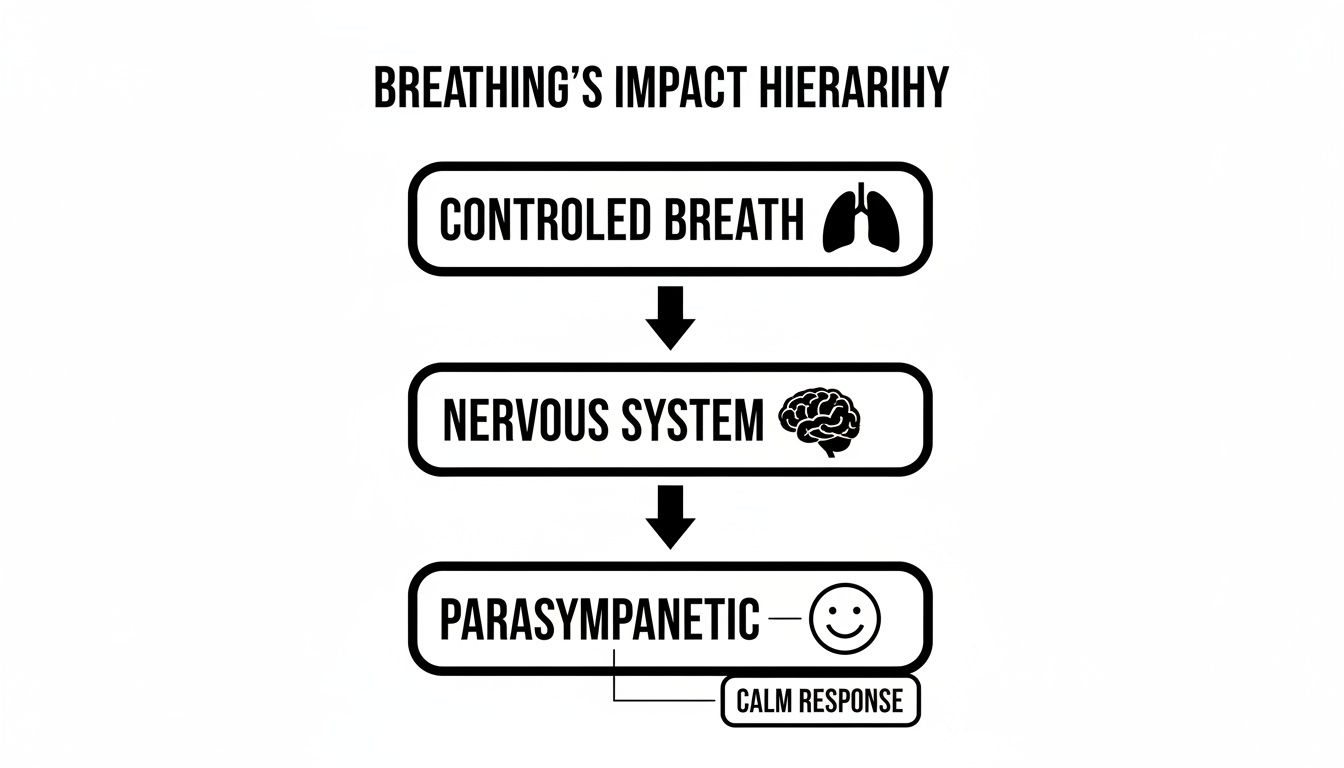
As you can see, the breath is the trigger. You consciously control it, which then sends a direct signal to your nervous system to shift gears, often moving you out of a “fight-or-flight” state and into one of calm and recovery.
The Next Wave: A Multidimensional Approach
Building on these powerful foundations, newer methods are weaving in modern science and technology to create even more precise and immersive experiences. 9D Breathwork is a perfect example of this evolution. It takes the core of conscious breathing and layers it with other potent tools that work on your mind and subconscious at the same time.
It’s not just about the breath anymore. A 9D session is a full-body, full-mind experience that combines several key elements:
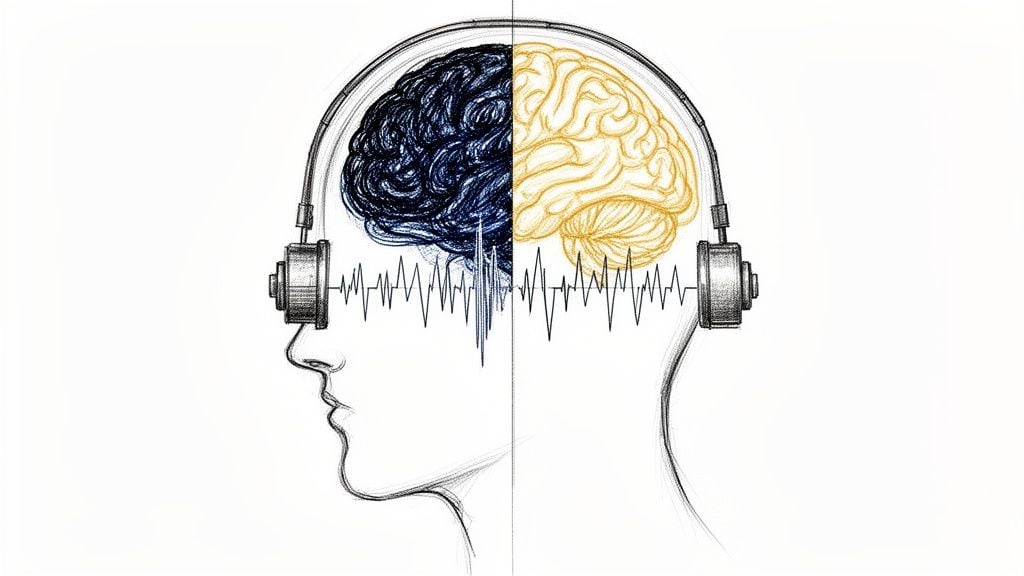
- Binaural Beats: Special audio frequencies are played through headphones to gently guide your brain into specific states of awareness. Different frequencies can help you sink into deep relaxation (theta waves) or access creative insights (gamma waves), making it easier to shift your mental state. A 2018 meta-analysis in Psychological Research even confirmed that binaural beats can significantly lower anxiety.
- Hypnotic Guidance & NLP: Throughout the session, a facilitator’s voice uses carefully chosen words and Neuro-Linguistic Programming (NLP) techniques. This isn’t stage hypnosis; it’s about using language to help you reframe old stories, break negative thought loops, and install more empowering beliefs directly into your subconscious.
- Subliminal Messaging: Woven into the soundscape are positive affirmations at a frequency your conscious mind can’t hear, but your subconscious can pick up. This bypasses your inner critic and helps reinforce the positive changes you’re working on from the inside out. Studies, like one from 2017 in Neuroscience of Consciousness, continue to show how these hidden prompts can shape our feelings and decisions.
By layering these elements, 9D Breathwork goes beyond general wellness. It creates a highly targeted journey designed to help you tackle specific challenges, whether that’s releasing trauma, overcoming anxiety, or building unshakeable self-worth.
Comparing Popular Breathwork Modalities
With so many options, how do you know where to start? This table breaks down the key differences between the major modalities to help you find the best fit for your goals.
| Modality | Primary Focus | Key Techniques | Best For |
|---|---|---|---|
| Holotropic | Psychological exploration, healing deep trauma. | Rapid breathing, evocative music, group setting. | Individuals seeking deep psychological insights. |
| Rebirthing | Releasing birth trauma and emotional blocks. | Conscious connected circular breathing. | People looking to address early life patterns. |
| Wim Hof | Physical resilience, immune support, energy. | Rhythmic breathing, breath holds, cold exposure. | Anyone wanting to boost physical performance. |
| 9D Breathwork | Targeted emotional and mental reprogramming. | Breath, binaural beats, hypnotic guidance, NLP. | Those wanting to rewire specific thought patterns. |
Ultimately, there’s no single “best” type of breathwork. The right path is the one that resonates with you and aligns with what you want to achieve. Whether you’re drawn to the primal power of a traditional method or the precision of a modern, multi-layered approach, your breath is an incredible tool just waiting for you to use it.
Unlocking the Benefits of a Consistent Breathwork Practice
The real magic of breathwork therapy happens when you move beyond a single session and weave it into the fabric of your life. Think of it like going to the gym. One workout is great, but consistent training is what builds strength and endurance. The same goes for your nervous system.
Regular breathwork practice builds your capacity for resilience, clarity, and emotional balance. These aren’t just fleeting moments of calm; they are lasting changes that ripple through every part of your well-being. Your body literally learns a new default setting—one of calm instead of high alert—giving you a powerful buffer against the pressures of modern life.
Sharpening Your Mental Wellness
One of the first things people notice is a dramatic drop in stress and anxiety. When you’re overwhelmed, your breath naturally becomes short and shallow, sending panic signals to your brain. By consciously taking control and shifting to a slow, deep rhythm, you directly interrupt that feedback loop.
This isn’t just a feeling; it’s a measurable physiological shift. A 2023 study in Scientific Reports confirmed that structured breathwork programs significantly cut down on perceived stress levels and the physical symptoms of anxiety. It’s a simple, powerful way to regain your footing when your mind feels like it’s spinning out.
Actionable Example: Imagine you’re about to give a high-stakes presentation. Your heart is pounding, and thoughts are racing. Instead of letting nerves take over, duck into a quiet room for five minutes of Box Breathing: inhale for four, hold for four, exhale for four, hold for four. This simple exercise short-circuits the anxiety response, calms your system, and lets you walk into that meeting with a clear head and steady confidence.
Enhancing Your Physical Health
The connection between your breath and your physical vitality is impossible to ignore. So many of us are caught in a cycle of fatigue and restlessness, struggling with low energy during the day and poor sleep at night. Breathwork can be the key to breaking that cycle.
In fact, it’s an incredible tool for improving sleep. A 2021 study published in Nature and Science of Sleep found that slow-paced breathing exercises before bed helped participants fall asleep faster and experience fewer awakenings during the night. By intentionally activating your “rest-and-digest” system, you give your body a clear signal that it’s safe to power down. There are many effective non-pharmacological options, and you can explore how bedtime meditation techniques that incorporate simple breath practices can lead to much sounder sleep.
Cultivating Emotional Regulation
Beyond just managing stress, breathwork offers something more profound: emotional freedom. It creates a critical pause between a triggering event and your reaction. With practice, you start to notice an emotion like frustration or sadness rising without being immediately swept away by it.
Your breath becomes an anchor. It’s a neutral point of focus that gives you the space you need to choose your response instead of being driven by impulse. This is the very foundation of emotional intelligence.
This isn’t wishful thinking; there’s solid science behind it. A 2018 meta-analysis in Frontiers in Human Neuroscience concluded that mind-body practices centered on breath regulation, like yoga and meditation, effectively improve emotional regulation. With global stress and anxiety rates having surged, accessible tools are more critical than ever.
Practical Example: You receive a frustrating email at work. Your immediate impulse is to fire back a sharp reply. Instead, you pause. You take three slow, deliberate breaths, extending your exhale each time. In that short space, the initial heat of your anger subsides, allowing you to craft a more measured and professional response.
This practice also provides a safe container to process and release stuck emotional energy. Active breathwork techniques help move stagnant energy, allowing for a gentle, cathartic release. For anyone looking for targeted methods, our guide on how to reduce stress naturally offers strategies that pair perfectly with a breathwork routine.
Navigating Your First Breathwork Session
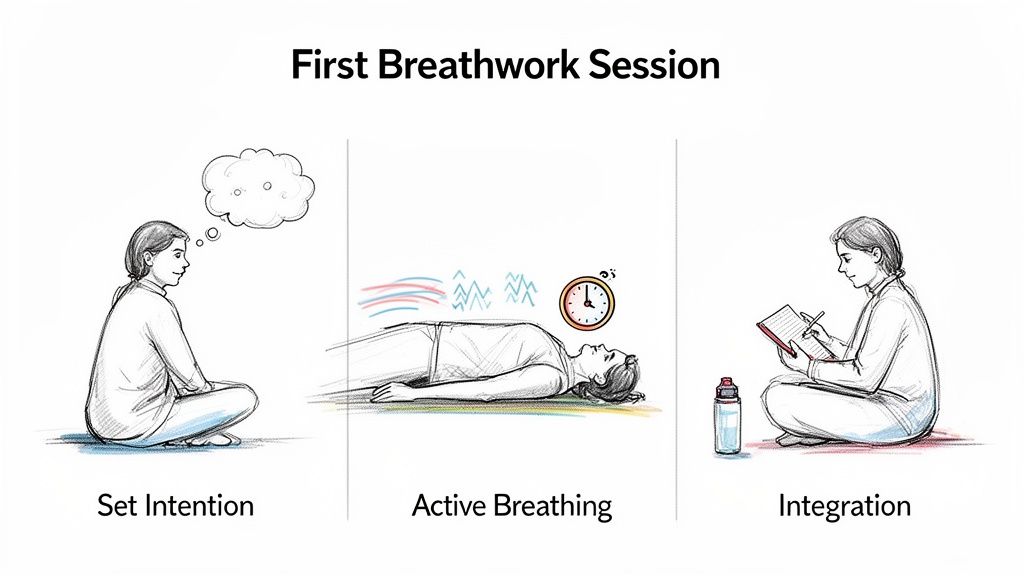
It’s completely normal to feel a mix of curiosity and maybe a little nervousness before your first breathwork session. Knowing what’s coming can help turn any apprehension into a sense of empowerment. Think of a session as a guided journey, carefully structured in three parts to help you feel safe, supported, and ready to explore.
The experience doesn’t just jump into intense breathing. First, your facilitator’s main job is to create a welcoming space and walk you through what the session will look and feel like. This is all about setting the stage for your inner work.
You’ll be invited to set an intention, which is just a clear, simple goal for your time. It could be anything from wanting to let go of a specific worry to finding clarity on a personal question. This intention becomes your anchor, giving your journey a sense of purpose.
The Breathing Journey Itself
Once you’re settled and your intention is set, the active breathing begins. Your guide will lead you into a specific rhythm of breathing, usually with music playing to help you drop deeper into the experience. This is more than just taking deep breaths; it’s a conscious, connected pattern that you’ll maintain for a set period.
As you get into the rhythm, you’ll likely notice a whole range of physical sensations. It’s very common to feel tingling in your hands and feet, a shift in body temperature, or even a feeling of weightlessness. These are just natural responses to the changes in oxygen and carbon dioxide in your body—a clear sign that the process is working.
Emotionally, anything can come up. You might feel a sudden rush of joy, a burst of creative insight, or a gentle release of old sadness. The idea is to simply allow these feelings to surface and pass through without judgment. Throughout it all, your facilitator is right there to make sure you feel completely secure.
Integration: The Crucial Final Step
When the active breathing portion winds down, you’ll move into what many consider the most important phase: integration. You’ll rest quietly, often lying down, as the music softens and your breath finds its own natural pace again.
This is where the magic really settles in. It’s a time for your nervous system to recalibrate and for any insights from the session to land. Your facilitator might offer some soft words, but this part of the journey is mostly for you and your inner world.
The process doesn’t stop when the session ends. Integration is your chance to honor the experience and begin weaving the insights you gained into your daily life. Rushing straight back into your to-do list can short-circuit this vital step.
To really make the most of your first session, a little preparation and aftercare go a long way:
- Hydrate Well: Drink plenty of water before you arrive and after you leave. Your body will thank you.
- Journal Your Thoughts: Take a few minutes to jot down any feelings, images, or ideas that came up. It’s a great way to make sense of it all.
- Allow for Quiet Time: If you can, book your session for a time when you don’t have to rush off immediately. A gentle walk or just relaxing quietly can make a huge difference.
By taking these simple steps, you create the best possible conditions to have a profound and meaningful first experience with what breathwork therapy has to offer.
Important Safety Considerations for Breathwork
Breathwork is an incredibly powerful tool, and for most people, it’s perfectly safe. But just like you wouldn’t jump into an advanced workout without knowing the ropes, it’s smart to approach breathwork with respect for your body and its limits. This isn’t about creating fear—it’s about empowering you to have the best and safest experience possible.
Some breathwork practices are wonderfully gentle and calming, making them a great fit for almost anyone. Others are designed to be much more activating, creating some pretty significant shifts in your body and mind. It’s these more intense styles that require a little extra caution, especially if you’re managing a pre-existing health condition.
When to Talk to Your Doctor First
For some folks, having a quick chat with a doctor before diving into an intense session (like Holotropic, Rebirthing, or 9D Breathwork) is a really good idea. It’s a simple step that ensures you’re setting yourself up for a positive, safe journey.
It’s particularly wise to seek medical guidance if you have a history of:
- Severe Cardiovascular Issues: This includes things like heart disease, a previous heart attack, or high blood pressure that isn’t well-managed. A 2021 study in the Journal of Clinical Medicine highlighted the importance of medical screening before engaging in intense respiratory exercises for those with cardiovascular conditions.
- Neurological Conditions: If you have a history of seizures, epilepsy, or a recent stroke, you’ll want to be careful.
- Specific Psychiatric Histories: For those with severe PTSD, bipolar disorder, or schizophrenia, intense sessions can sometimes surface very challenging emotions. A 2020 review in the Journal of Traumatic Stress emphasized the need for trauma-informed care and qualified facilitation in such cases.
- Pregnancy: Gentle, calming breathing is usually fine, but it’s best to avoid the more intense practices, especially in later trimesters, unless your healthcare provider gives you the green light.
Finding a Guide You Can Trust
This is huge. The single most important part of having a safe and profound experience is the person guiding you. A great facilitator creates a space where you feel completely secure to explore, while an unqualified one can, frankly, do more harm than good. A 2021 review in Frontiers in Psychology actually highlighted that the facilitator’s skill and therapeutic alliance are critical factors for safety during deep experiential work.
Think of your facilitator as your co-pilot. Their job isn’t to fly the plane for you, but to help you navigate your inner world safely. Trust and professionalism are everything.
So, how do you find a good one? Here are a few practical steps:
- Ask About Their Training: Don’t be shy. Ask where they got certified and how extensive their training was. A solid facilitator will be happy to tell you about their credentials.
- Inquire About Their Experience: How long have they been leading sessions? Who did they learn from? Real-world experience is invaluable, especially when it comes to helping people through big emotional releases.
- Discuss Their Safety Plan: Ask them what they do if someone has a difficult emotional or physical reaction. They should have a clear, reassuring answer that shows they’re prepared.
- Watch for Red Flags: Be wary of anyone who guarantees a specific outcome, pushes you to sign up, or brushes off your questions. A true professional respects your boundaries and your right to say no.
Common Questions About Breathwork Therapy
It’s one thing to read about the science and benefits of breathwork, but it’s another to figure out how it actually fits into your life. If you’re starting to ask practical questions, that’s a great sign. It means you’re really thinking about this. Let’s walk through some of the most common questions I hear to clear things up.
How Quickly Can I Expect to See Results?
This is probably the number one question people have, and the answer has two parts. The great news is that most people feel something shift in their very first session. It might be a deep sense of calm, a quiet mind for the first time in ages, or a feeling of lightness. That immediate feedback is what gets so many people hooked.
But for the kind of deep, lasting change—like rewiring chronic anxiety or shifting stubborn negative thought patterns—consistency is everything. Committing to just 10-15 minutes a day can create a noticeable difference in your mood and how you handle stress in just a few weeks. A 2020 study in the Journal of Affective Disorders found that a daily breathwork practice significantly reduced symptoms of depression and anxiety over an eight-week period, showing the cumulative power of consistency.
Can I Practice Breathwork On My Own at Home?
Absolutely. In fact, you should! Simple techniques are perfect for daily self-regulation at home. Things like Box Breathing (inhaling, holding, exhaling, and holding for the same count) or the 4-7-8 breath are fantastic tools for hitting the reset button on stress, and you can do them anywhere.
However, for the deeper, more intense journeys like Holotropic or 9D Breathwork, I always recommend starting with a trained facilitator. They know how to create a safe space to guide you through what can be a powerful, and sometimes overwhelming, emotional experience. Once you’re comfortable with the process, guided audio journeys are a brilliant way to continue that deeper work from home.
Practical Action: Try this right now. Set a timer for 3 minutes and do a simple Box Breath: Inhale for four counts, hold for four, exhale for four, and hold again for four. Just notice how that one small act can change your entire state.
How Is Breathwork Different From Meditation?
This is a great question because they often get grouped together. While both are powerful mindfulness tools, their approaches are quite different.
Think of meditation as passive observation. You’re typically watching your breath as an anchor to quiet the mind, but you’re not trying to change it.
Breathwork is an active process. You are deliberately changing your breathing pattern to create a specific outcome in your body and mind. It’s often more physical and dynamic, designed to stir up and release stuck energy and emotion. They aren’t competing practices, though. They actually support each other beautifully. Many people find that a breathwork session can clear out the mental clutter, allowing them to drop into a much deeper state of meditation afterward.
Ready to feel the difference for yourself? 9D Breathwork isn’t just about breathing; it’s an experience that weaves together breath, sound technology, and powerful psychological tools to help you release what’s holding you back.