Improving your heart rate variability is all about building your body’s resilience to stress. It’s not about some quick fix, but rather about developing consistent, targeted habits. We’ll get into the specifics, but the core strategies revolve around slow, paced breathing, regular movement, quality sleep, and smart nutrition.
By focusing on these areas, you can directly influence your autonomic nervous system, guiding it toward a state of calm and recovery.
What Is Heart Rate Variability and Why Does It Matter?
Heart Rate Variability, or HRV, is a fascinating metric. It measures the tiny, millisecond-level fluctuations in time between each of your heartbeats. It’s not about how fast your heart is beating (your heart rate), but how adaptable and responsive it is from one beat to the next.
Think of it as a direct window into your autonomic nervous system (ANS). This is the subconscious command center running everything in the background—your breathing, digestion, and all the other automatic processes.
The ANS is a constant balancing act between two main branches:
- The Sympathetic Nervous System (SNS): This is your “fight-or-flight” response. It’s the gas pedal that kicks in during stress, danger, or a tough workout, ramping up your heart rate and getting your body ready for action.
- The Parasympathetic Nervous System (PSNS): This is your “rest-and-digest” system. It’s the brake pedal. It takes over when you’re relaxed, slowing things down to promote recovery, digestion, and repair.
A healthy, resilient person can switch smoothly between these two states. When your body can efficiently shift from a stress response back to a relaxed one, the time between heartbeats varies more. This is what gives you a higher HRV.
On the flip side, if you’re chronically stressed, exhausted, or getting sick, your “fight-or-flight” system gets stuck in the “on” position. Your heart starts beating more like a metronome—very regular, with little variation. This leads to a lower HRV.
This isn’t just a “nice-to-have” metric. A 2022 review of multiple studies confirmed that lower HRV values are significant predictors of higher mortality across different populations, making it a powerful indicator of your overall health.
Your Personal Resilience Score
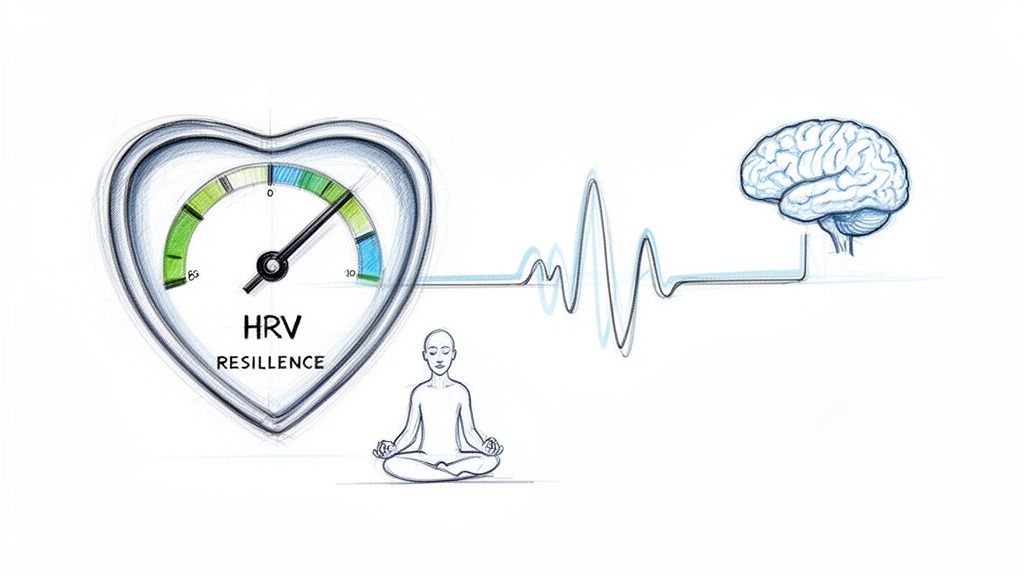
Watching your HRV trends gives you real-time feedback on how well your body is coping with life’s demands. It’s a reflection of your physical and psychological stress load, which makes it an incredible tool for building self-awareness.
A high HRV score is a sign that your nervous system is balanced and you’re well-recovered. A low score is your body’s way of telling you it’s under strain and needs more rest.
When you learn how to improve your heart rate variability, you’re not just chasing a number on a wearable device from companies like WHOOP or Oura. You’re actively training your nervous system to be more adaptive.
This training translates directly into better stress management, sharper mental clarity, and a greater sense of well-being. This guide is designed to give you actionable, evidence-backed strategies to do just that.
Key Factors That Influence Your HRV
Your daily HRV score is a composite of many different inputs. Understanding what moves the needle is the first step toward improving it. Here’s a quick look at the primary lifestyle and biological factors that can raise or lower your Heart Rate Variability.
| Factor | Positive Influence (Increases HRV) | Negative Influence (Decreases HRV) |
|---|---|---|
| Exercise | Regular, moderate-intensity aerobic exercise; post-workout recovery | Overtraining; intense exercise without adequate rest |
| Sleep | Consistent sleep schedule; 7-9 hours of quality, restorative sleep | Sleep deprivation; inconsistent sleep patterns; poor sleep quality |
| Nutrition | Hydration; balanced diet rich in whole foods, omega-3s, and nutrients | Dehydration; processed foods; excessive sugar and alcohol intake |
| Stress | Meditation; mindfulness; slow, paced breathing; positive social connection | Chronic stress; anxiety; emotional distress; negative thought patterns |
| Health | Good physical health; strong immune function | Illness; infection; inflammation; chronic disease |
| Age | N/A (HRV naturally declines with age, but can be maintained) | Natural aging process (though lifestyle can mitigate this decline) |
As you can see, the things that are good for your overall health—like good sleep, a healthy diet, and managing stress—are also the things that will boost your HRV. Your score is simply a reflection of how well you’re taking care of your body’s internal environment.
The Daily Habits That Build a Higher HRV
You don’t boost your heart rate variability with a single, heroic effort. It’s not about overhauling your entire life overnight. Real, lasting improvement comes from the small, consistent things you do every single day. Think of these habits as compounding interest for your nervous system—small deposits that grow into significant resilience over time.
These aren’t just generic wellness tips; they are targeted actions that directly influence your body’s ability to handle stress and recover effectively.
Master Your Breath to Signal Safety
Your breath is the most powerful, direct lever you can pull to shift your nervous system out of “fight-or-flight” and into “rest-and-digest.” When you’re stressed, your breathing gets shallow and quick, telling your body there’s a threat. By consciously slowing it down, you can manually flip that switch, and your HRV will reflect that change almost immediately.
The simplest and most effective way to do this is with resonant frequency breathing. This technique involves breathing at a pace that syncs up perfectly with your body’s own cardiovascular rhythms, usually around 5-6 breaths per minute.
Here’s a simple way to practice it:
- Find a comfortable spot where you won’t be interrupted.
- Breathe in gently through your nose for 5.5 seconds.
- Breathe out slowly through your nose for another 5.5 seconds.
- Keep this rhythm going for at least 5 minutes.
This slow, steady breathing is a direct line to your vagus nerve, the superhighway of your parasympathetic (rest-and-digest) nervous system. Research confirms that this specific breathing pattern can give your HRV an instant lift. I recommend setting a reminder to do this once in the morning to start your day centered and again in the afternoon to diffuse any accumulated stress.
This 5-minute practice is more than just a relaxation trick. You’re having a direct conversation with your nervous system, telling it, “You’re safe.” This gives your body permission to downshift from high alert into recovery mode.
Fuel Your Body for a Stable Nervous System
What you eat directly impacts your body’s internal stress load and, by extension, your HRV. The goal here is simple: give your body the high-quality fuel it needs to run smoothly, without adding stressors like inflammation or wild blood sugar swings.
Every meal is an opportunity to either stress your system or support it. Things like highly processed foods, loads of sugar, and alcohol are physiological stressors, and you’ll often see the proof in a tanked HRV score the next morning. On the flip side, nutrient-dense whole foods create stability from the inside out.
Focus on these nutritional cornerstones:
- Omega-3 Fatty Acids: You’ll find these in fatty fish like salmon and mackerel, plus in plant sources like chia seeds and walnuts. A 2017 study in Psychophysiology clearly linked higher omega-3 intake with better vagal tone and a higher HRV.
- Magnesium: This mineral is a game-changer for muscle relaxation and keeping your nervous system calm. Load up on leafy greens like spinach, almonds, avocados, and even a bit of high-quality dark chocolate.
- Balanced Blood Sugar: Big spikes and crashes in blood sugar are a recipe for stress hormone release, which crushes your HRV. The fix? Never eat a “naked” carb. Pair your carbohydrates with protein and healthy fats—think avocado and egg on your toast, not just toast alone.
And please, don’t forget about hydration. Even slight dehydration registers as a stressor to your body, which can be enough to lower your HRV. Make a habit of sipping water throughout the day, long before you actually feel thirsty.
Tame Cortisol and Manage Daily Stressors
Chronic stress is the arch-nemesis of a healthy HRV. It keeps your body locked in a state of high alert, flooding your system with the stress hormone cortisol. This constant sympathetic “on” switch makes it impossible for your body to recover. Managing your daily stress isn’t a luxury; it’s a non-negotiable part of this process.
This means going beyond just a few breathing exercises. It’s about building a lifestyle that proactively dials down your stress load. For instance, a 2022 research review showed that practices like mindfulness and meditation measurably improve HRV by strengthening the parasympathetic nervous system.
Start small. Pinpoint your biggest daily stressors and make one small change. Maybe it’s setting a firm “no work after 6 PM” rule, using an app for a 10-minute guided meditation, or just getting outside for a walk during your lunch break. If you want to go deeper on this, check out our guide on how to reduce cortisol levels naturally.
These three pillars—breathing, nutrition, and stress management—are the foundation. They work together to create an internal environment where your nervous system doesn’t just survive, but actually thrives.
Using Strategic Exercise to Boost Your HRV
When most people think about exercise, they picture building muscle or cranking up their cardio. But movement is also one of the most powerful tools we have for training our autonomic nervous system. The right kind of exercise doesn’t just stress your body; it teaches it how to recover more efficiently, which is a direct path to higher heart rate variability.
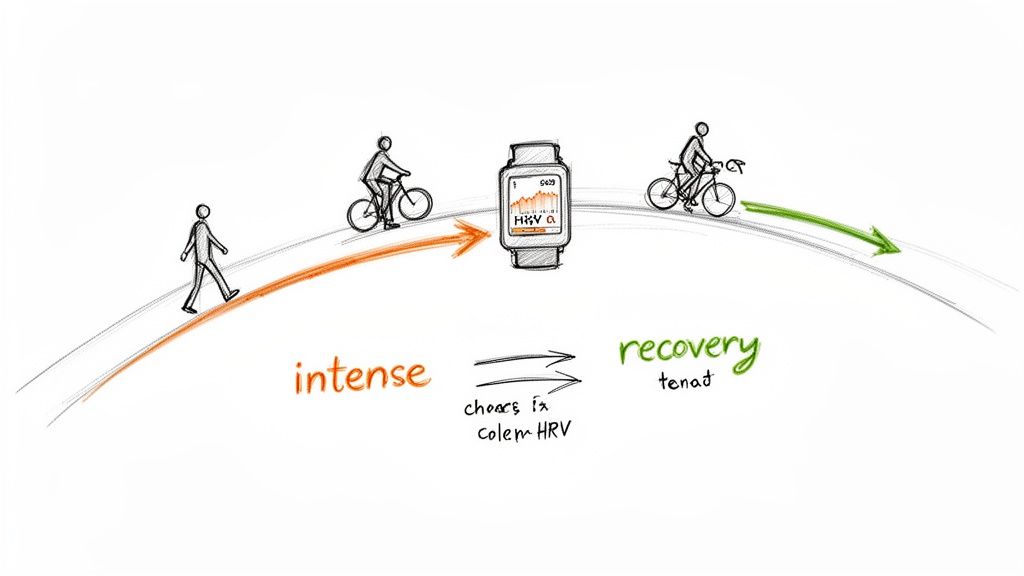
The trick is to ditch the “no pain, no gain” mentality. Pushing yourself to the absolute limit every single day is a fast track to overtraining, which will tank your HRV and leave you feeling completely run down. The real goal is to strike a smart balance between beneficial stress and active recovery.
Find Your Aerobic Sweet Spot
For consistently raising your HRV, moderate aerobic exercise is your best friend. This is the kind of activity where you can still hold a conversation, but you’re definitely feeling the effort. Think of a brisk walk, a steady bike ride, a light jog, or swimming some laps.
This type of movement strengthens your heart and lungs without jacking up your stress hormones. Over time, it enhances the parasympathetic (“rest and digest”) response, conditioning your body to get back to a calm state much faster after you’ve pushed it.
Actionable Example: Instead of trying to run five miles on your first day, start with a 30-minute brisk walk three times this week. Use the “talk test”: if you can speak in full sentences without gasping, you’re in the right zone.
Let Your HRV Guide Your Training
This is where things get really interesting. Instead of blindly following a rigid workout calendar, you can use your daily HRV score to decide how to move your body that day. It’s called HRV-guided training, and it’s a game-changer for preventing overtraining and getting the most out of your efforts.
Here’s a real-world scenario:
Tuesday is your high-intensity interval training (HIIT) day. But you wake up, check your wearable, and your HRV score is in the gutter. This is your body telling you loud and clear that it hasn’t recovered from yesterday’s stress, a bad night’s sleep, or something else.
Instead of powering through that HIIT session and digging yourself into an even deeper recovery hole, you adapt. You swap the intense workout for a 30-minute recovery walk or some light stretching. The next morning, you wake up, and your HRV has bounced back. Now you’re ready for that tougher session.
Using HRV-guided training transforms your fitness routine from a guessing game into a conversation with your body. You’re no longer just following a plan; you’re responding to your body’s real-time needs, ensuring every workout contributes to your resilience instead of draining it.
Practical Ways to Apply HRV-Guided Training
Getting started is easier than it sounds. Most modern wearables will give you a “readiness” or “recovery” score that’s heavily based on your HRV.
Here’s a simple framework to work with:
- High HRV (Green Zone): Your body is recovered and ready to go. This is the day to tackle a high-intensity workout, go for a long run, or lift heavy. Go for it.
- Moderate HRV (Yellow Zone): You’re doing pretty well but aren’t at 100%. Stick with moderate-intensity aerobic exercise. A steady-state run, a longer yoga class, or a standard strength workout would be perfect.
- Low HRV (Red Zone): Your body is under significant strain. Pushing it hard today will only set you back. Prioritize active recovery: a gentle walk, some stretching, or even a full rest day. This is also a great time to lean on other recovery tools, like exploring some breathing for energy techniques to help your system reset.
Beyond the direct physical benefits, it’s worth remembering how moving your body can quiet a spiraling mind. By syncing your physical activity with your nervous system’s capacity, you’re not just building a stronger body but a more balanced and resilient mental state. It’s an intelligent approach that makes sure your hard work is always moving you forward.
Mastering Sleep for Optimal Nervous System Repair
If you could only do one thing to improve your heart rate variability, this would be it: master your sleep. While diet and exercise get a lot of attention, nothing resets and repairs your nervous system quite like a night of high-quality, restorative rest. It’s during these critical hours that your body switches gears, letting the parasympathetic “rest-and-digest” system take over to mend, recharge, and build resilience for the next day.
But this isn’t just about logging eight hours. The real magic for your HRV happens when you focus on the quality of your sleep. This means intentionally creating a routine and an environment that tells your body it’s safe to power down completely. When you get this right, you don’t just wake up rested—you wake up restored.
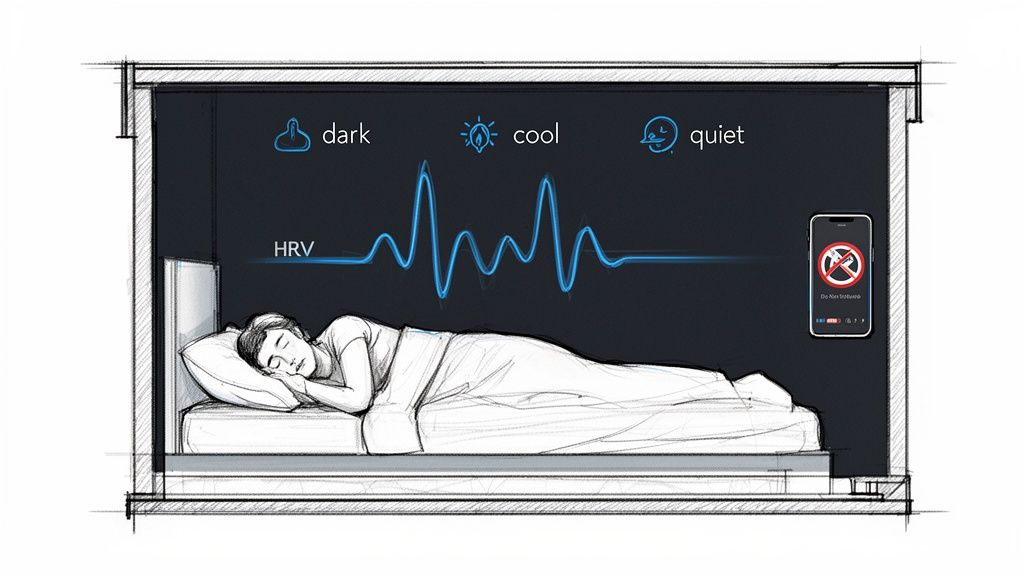
Engineer Your Ideal Sleep Environment
Think of your bedroom as a sanctuary for sleep. Right now, it might be a multi-purpose room full of distractions, but the goal is to strip it back to its core purpose: rest. To do that, you need to eliminate any sensory input that might subtly signal your brain to stay on high alert.
There are three non-negotiables here: cool, dark, and quiet.
- Cool Down Your Room: To initiate sleep, your body’s core temperature needs to drop. Setting your thermostat between 60-67°F (15-19°C) can make a surprisingly huge impact on how deeply you sleep.
- Embrace Total Darkness: Light is the most powerful signal telling your brain it’s time to be awake. Even a tiny bit of light from a digital clock or a street lamp can mess with melatonin production. Blackout curtains are a game-changer. So is covering up any and all glowing electronics.
- Cultivate Silence: You might not think that distant traffic or a humming appliance affects you, but unpredictable sounds can pull you out of deep sleep cycles. A white noise machine or a good pair of earplugs can create a consistent, peaceful soundscape that protects your rest.
This isn’t just anecdotal advice. A 2022 study in PNAS found that even moderate light exposure during sleep was enough to impair cardiovascular function and glucose regulation—two systems directly tied to your nervous system balance and HRV. Turning your room into a cool, dark, quiet cave is a foundational first step.
Manage Light to Protect Your Melatonin
The light you’re exposed to before bed is just as important as the darkness in your room. Blue light, the kind blasted from our phones, tablets, and TVs, is especially problematic. It effectively tricks your brain into thinking it’s still midday, hitting the brakes on melatonin, the hormone that orchestrates your entire sleep-wake cycle.
The solution is to create a “digital sunset.” Make a hard rule to put all screens away at least 60-90 minutes before your head hits the pillow. This buffer gives your brain a chance to wind down and start producing the melatonin you need for truly restorative sleep. It’s a key component of everything from daily well-being to advanced marathon recovery strategies, where deep rest is crucial for nervous system repair and adaptation.
Think of this pre-sleep window as your personal power-down sequence. Instead of scrolling, pick up a physical book, do some gentle stretching, or just listen to some calming music. The goal is to swap stimulation for relaxation.
Implement a Wind-Down Routine and Non-Sleep Deep Rest
A consistent pre-sleep ritual is one of the most powerful cues you can give your body that the day is done. It doesn’t need to be elaborate, but it has to be relaxing and consistent.
Of course, sometimes your mind just won’t shut off, no matter how perfect your environment is. This is where tools like Non-Sleep Deep Rest (NSDR) and guided meditations can be incredibly helpful. Protocols like Yoga Nidra are designed to guide your body into a state of profound relaxation, even if you don’t actually fall asleep.
These practices are brilliant for calming an overactive sympathetic nervous system. They train you to consciously shift into a parasympathetic state—the exact skill you need to improve your HRV. If a racing mind is your biggest bedtime battle, our guide on how to quiet your mind has some great techniques to try. Just 10-20 minutes of NSDR before bed can make a world of difference, helping you fall asleep faster and wake up with a much-improved HRV score.
Go Deeper: Directly Train Your Nervous System
Once you’ve nailed the fundamentals, it’s time to get more hands-on with your nervous system. Think of this as moving from passively supporting your body to actively training it. This is where specific practices like targeted breathwork come into play—and they’re much more than just a way to relax. They are precise tools for shifting your physiology on command.
When you consciously change the way you breathe, you’re tapping directly into your vagus nerve. This nerve is the superhighway of your parasympathetic “rest-and-digest” system. By breathing in a specific way, you send a powerful signal of safety through your entire body, coaxing it out of a stress state and into recovery. The result? An almost immediate bump in your HRV.
The Instant Effect of Slow, Paced Breathing
So, how does this actually work? It’s pretty straightforward. When you breathe slowly and deeply, you increase the pressure changes inside your chest. This helps pull more blood back to your heart, a process known as respiratory sinus arrhythmia (RSA). RSA is the main reason your HRV fluctuates from moment to moment, and seeing it happen is a clear sign of a healthy, adaptable nervous system.
You’re essentially using your diaphragm like a pump to improve your vagal tone. Research backs this up completely. One study in Frontiers in Psychology found that slow breathing, particularly at a rhythm of about six breaths per minute, triggered an immediate and significant jump in HRV. It’s a clear cause-and-effect relationship between your breath and your nervous system.
Try This 3-Minute Breathing Reset Right Now
Curious to feel the shift yourself? Here’s a simple exercise that can make a real difference in just a few minutes. I use this all the time before a big presentation, after a workout, or anytime I just need to get grounded.
- Get comfortable: Sit up straight with your feet on the floor, or just lie down. Close your eyes.
- Inhale through the nose: Take a slow, smooth breath in for a count of four. Let your belly expand first.
- A brief hold: Pause at the top for a count of two. This little pause is key for switching gears into a calmer state.
- Exhale slowly: Breathe out gently through your mouth or nose for a count of six. That longer exhale is what really drives the relaxation response.
- Repeat: Keep this 4-2-6 pattern going for three full minutes.
Once you’re done, just sit for a moment and notice the change. It might be subtle—a sense of quiet, slower thoughts, or your shoulders dropping an inch. If you had an HRV tracker on, you’d likely see the numbers climb right away.
Rewiring Old Stress Patterns with Deeper Work
While quick exercises are fantastic for managing stress in the moment, deeper, more structured practices are what help you rewire those ingrained stress patterns for good. This is where we move beyond simple paced breathing and into more immersive territory.
By combining specific breathing techniques with other sensory inputs, it’s possible to access and reprocess stored emotional stress that keeps your nervous system on high alert. This helps to lower your baseline stress level, leading to a sustained increase in your average HRV.
For anyone who wants to take this further, understanding what is breathwork therapy can provide a great roadmap. For instance, multi-sensory breathwork journeys use a powerful mix of dynamic breathing, curated music, and guided cues to help you safely work through and release that deep-seated tension. It’s less about managing daily stress and more about upgrading your nervous system’s entire operating system for the long haul.
Of course, breathwork is a direct intervention, but it shines brightest when paired with other consistent habits. For those dealing with a lot of anxiety, exercise offers a powerful complementary path to better HRV. A recent meta-analysis showed that exercise programs lasting eight weeks or more significantly improved the body’s stress markers. You can learn more about these findings from the full research on long-term exercise and HRV. When you combine physical conditioning with intentional breathwork, you’re building a truly robust strategy for profound and lasting resilience.
Your Personal HRV Improvement Action Plan
Knowing the “what” and “why” of HRV is one thing, but putting it into practice is where the real change happens. It’s time to build a routine that actually fits your life. Forget trying to be perfect; the goal here is consistency.
Start small. Seriously. Pick one or two new habits from this guide, weave them into your days for a couple of weeks, and just watch what your HRV data tells you. Once they feel like second nature, you can start layering in something new.
Sample Routines for Real-World Scenarios
Every lifestyle comes with its own set of challenges, so your plan has to work with your schedule, not against it. Let’s look at a couple of examples of how you might realistically integrate these practices.
The Busy Executive
This schedule is all about efficiency and managing stress when you have a packed day.
- Morning (7:00 AM): The very first thing you do—before your phone touches your hand—is a 5-minute resonant frequency breathing exercise. This sets a calm, focused baseline for the day ahead.
- Lunch (12:30 PM): You have to step away from the desk. A 20-minute brisk walk outside gives you a crucial dose of movement and light exposure, breaking up a long, sedentary morning.
- Evening (9:00 PM): Time for a hard stop on screens. Institute a digital sunset 60 minutes before you plan to sleep. Use that time to read a real book or listen to some calming music.
The Individual Managing Anxiety
Here, the focus is on down-regulating the nervous system and building a stronger sense of safety and calm from within.
- Morning (8:00 AM): Ease into the day with a gentle 20-minute yoga or stretching session. The key is to really tune into the connection between your breath and your body’s movements.
- Afternoon (3:00 PM): That mid-afternoon energy slump is real. Instead of reaching for another coffee, which can sometimes heighten anxiety, try a 3-minute 4-2-6 breathing exercise to reset your nervous system.
- Bedtime (10:00 PM): Once you’re settled in bed, put on a 15-minute guided meditation or a Non-Sleep Deep Rest (NSDR) track. This can be a game-changer for quieting a mind that won’t shut off.
Troubleshooting Common HRV Hurdles
You’re going to hit some bumps in the road. Everyone does. The trick is knowing how to read the signs and adjust without getting discouraged.
Remember, a low HRV score isn’t a failure—it’s data. Think of it as your body giving you valuable feedback that something’s a bit off. Maybe it’s poor sleep, an oncoming illness, or just accumulated stress. Acknowledge the signal and adjust.
This simple decision tree can help you figure out what to do in the moment.
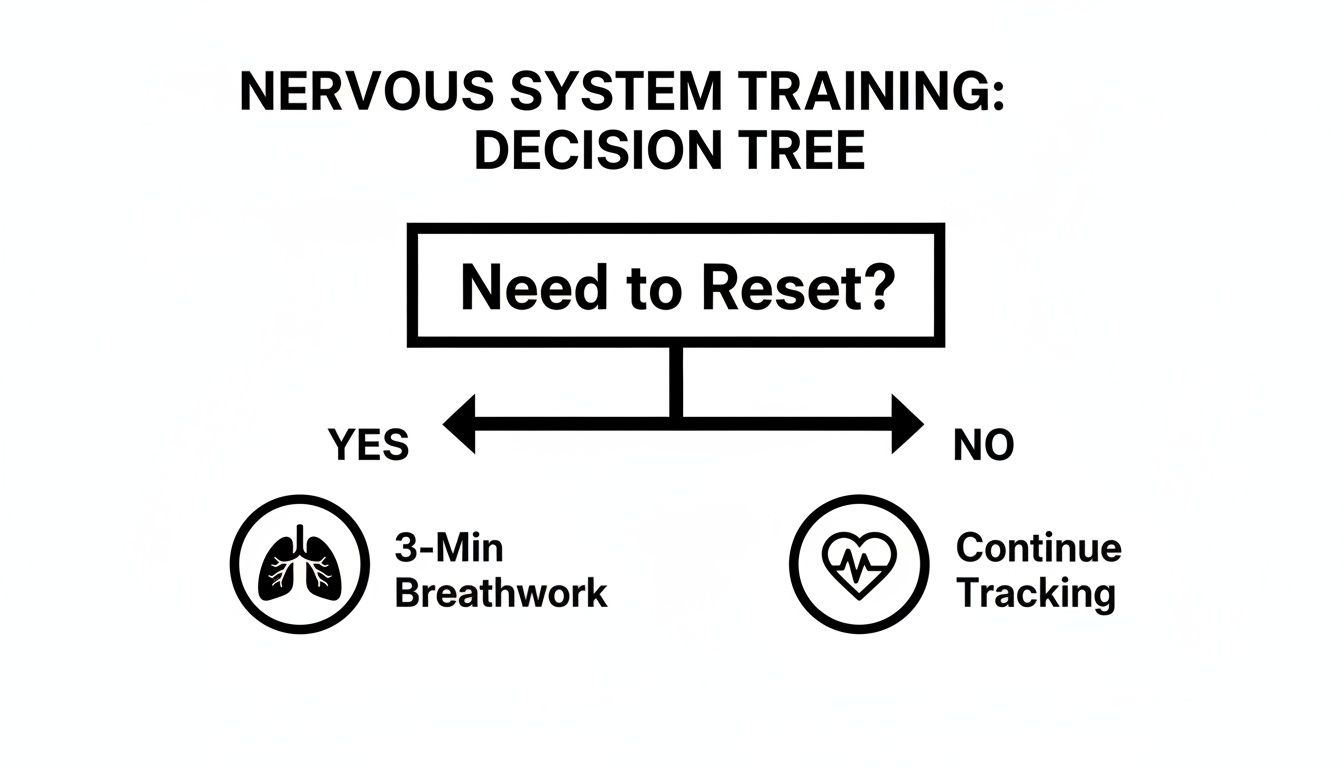
Use this as a quick mental checklist each day. It simplifies your check-in and helps you decide whether to push forward or take a quick time-out for a nervous system reset.
What to Do When Your HRV Plateaus
Sooner or later, your numbers might level out after a period of solid improvement. This is completely normal. When you find your progress has stalled, it’s just a sign to re-evaluate your approach.
- Review the Basics: Honestly, are you still being consistent with sleep, nutrition, and hydration? More often than not, a plateau happens because we’ve let one of the fundamentals slip a little.
- Introduce New Stimuli: Your body is smart; it adapts. If you’ve only been doing steady-state cardio, maybe it’s time to add one day of light interval training. If your breathing exercises have all been short, try a longer, more immersive breathwork session.
- Prioritize Recovery: A plateau can also be a sign of overtraining. This is where daily HRV readings become a powerful tool. A 2025 study found that using HRV data to guide training intensity led to significant fitness and autonomic health gains in previously inactive adults. It proves that HRV is an incredibly smart way to prescribe your daily exercise. You can learn more about the specifics of HRV-guided training from this research.
Improving your HRV is really a journey of self-awareness and small, consistent changes. You have the map now—all you have to do is take that first small step today.
Ready to go beyond just tracking your numbers and start actively training your nervous system for deep resilience? 9D Breathwork offers multi-sensory experiences that fuse powerful breathwork with sound, hypnotic guidance, and other modalities. It’s designed to help you release stored stress and rewire your system from the inside out. Explore our transformative journeys today.