When that 3 PM wall hits, what’s your go-to? If it’s another cup of coffee, you’re not alone. But what if you could tap into a cleaner, more sustainable energy source that’s already within you? Using intentional breathing for energy is the quickest way I know to shake off the fog and get back in the zone. It’s about using specific patterns to send a clear signal to your nervous system: it’s time to wake up.
Your Built-In Antidote to the Afternoon Slump
Most of us barely notice our breath during a busy workday. It becomes shallow and automatic, a quiet habit that, over hours, can seriously drain your energy reserves. You end up feeling depleted and don’t even realize why. The great thing is, you can flip that script just by taking conscious control of your breath.
Think of it as a remote control for your body’s energy levels. By deliberately changing the pace, depth, and rhythm of your inhales and exhales, you can physically tell your body to switch from tired to alert. This isn’t just a mental trick; it’s a direct physiological command that sharpens your mind and boosts performance without any caffeine jitters.
The Science of How Breath Fuels Energy
The link between breathing and energy is about as fundamental as it gets. At a cellular level, your body needs oxygen to create energy. While the actual work of your respiratory muscles only uses about 5% of your total oxygen consumption at rest, it’s a critical part of the non-stop process that keeps you going. Every single breath is a direct input into your body’s energy-making factory.
When you start providing better inputs—deeper, more intentional breaths—you get a much better output. This is where shifting from autopilot breathing to mindful breathwork completely changes the game.
By consciously regulating your breath, you can directly influence your autonomic nervous system, shifting it from a state of rest and digest (parasympathetic) to one of alertness and action (sympathetic) right when you need it most.
Taking It a Step Further Than Just “Deep Breaths”
Look, any deep breath is a step up from a shallow one. But structured, targeted techniques are where you see the real results. We’re not talking about complicated, hour-long practices, either. Some of the most potent exercises can be done right at your desk in just a few minutes, giving you an immediate lift you can actually feel. If you’re new to this, exploring the essentials of guided breathwork and its benefits is a great place to start.
For long-term success, think of these breathing exercises as one tool in a larger toolkit. Integrating them with broader strategies to avoid burnout and reclaim your energy creates a powerful, holistic approach. It’s all about building simple, effective habits that support your energy all day long.
Three Actionable Breathing Techniques for an Instant Boost
Alright, let’s get practical. When that 3 PM wave of fatigue hits, it’s so easy to grab a sugary snack or another coffee. But what if you had a tool to generate clean energy on demand? That’s exactly what these breathing exercises offer—a way to tap into your body’s own energy source, anytime, anywhere.
I’m going to walk you through three of my go-to techniques. These are field-tested methods you can do right at your desk to sharpen your focus and feel more awake almost instantly. We’ll cover how to do each one, the perfect real-world scenario to use it, and how little time it actually takes.
Think of it this way: when you feel that slump coming on, you have a choice.
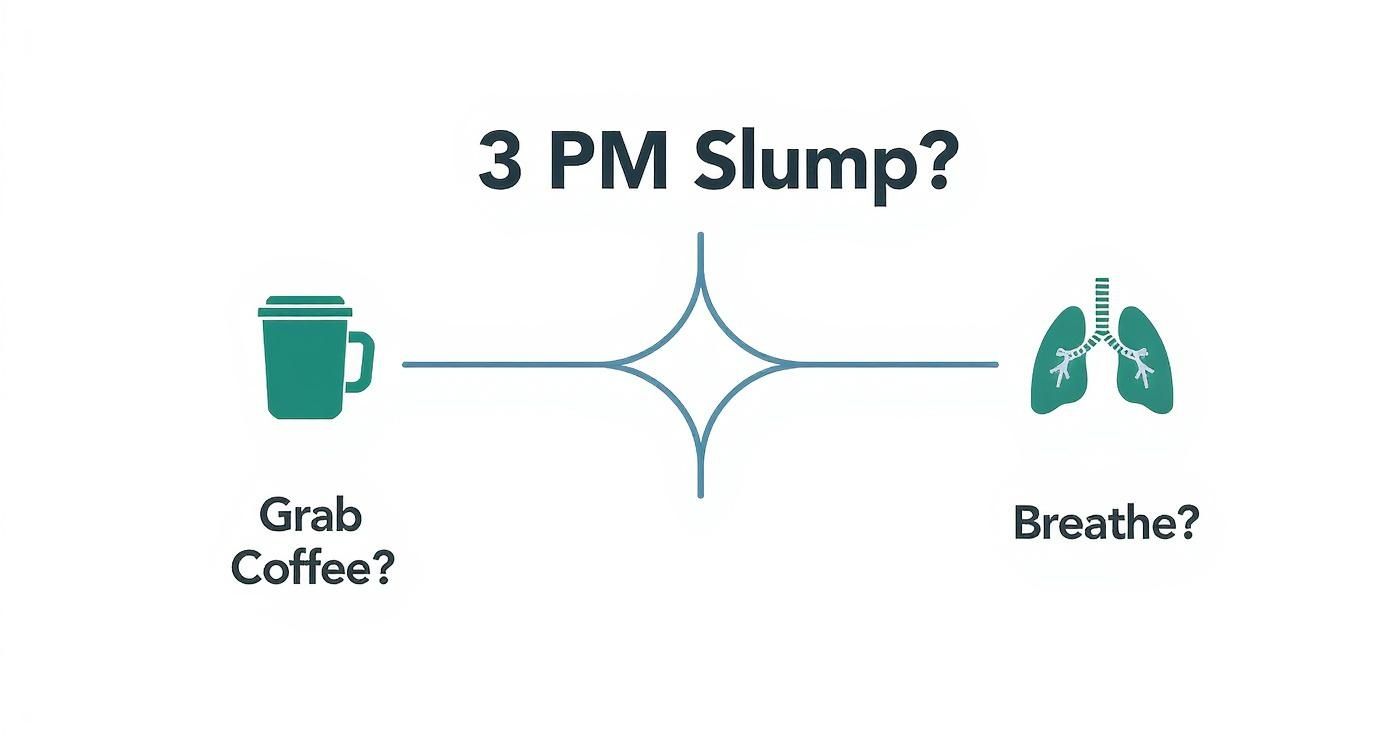
Sure, both options are tools. But your breath is an internal, sustainable solution that won’t leave you with a crash later.
Bellows Breath (Bhastrika) for a Rapid Jolt
Think of this as your biological espresso shot. Bellows Breath, or Bhastrika, is a powerful, energizing technique that floods your system with oxygen and flips the switch on your sympathetic nervous system—your body’s internal “go” signal. It’s perfect for shaking off grogginess right before you need to be “on.”
When to Use It:
- Just before a big presentation: It’s fantastic for clearing your mind and summoning a surge of confident energy.
- To kickstart a tough project: When you’re just staring at a blank screen, this can spark the motivation you need.
- To beat the post-lunch slump: Instead of nodding off, a quick round will re-engage your brain for the afternoon.
How to Practice (1-2 Minutes):
- Sit up straight: Keep your shoulders relaxed and down, away from your ears.
- Breathe powerfully: Take a sharp, forceful inhale through your nose, immediately followed by a sharp, forceful exhale through your nose.
- Engage your diaphragm: The movement should come from your belly, like a blacksmith’s bellows. Your chest and shoulders should stay relatively still.
- Find your rhythm: Aim for one full breath cycle (inhale and exhale) per second.
- Do one round: Start with a round of 20-30 breaths.
- Pause and notice: After the round, breathe normally for 30-60 seconds and simply notice the shift in your energy and mental clarity.
Pro Tip: Keep your face and jaw relaxed. All the power should come from your core, not from tensing your neck or shoulders. If you start to feel lightheaded, that’s your cue to stop and return to normal breathing.
Coherent Breathing for Calm Alertness
Sometimes you don’t need a jolt; you need sustained, calm focus. That’s where Coherent Breathing comes in. Also known as resonance breathing, this practice brings your heart, lungs, and brain into a beautifully synchronized state. This is my absolute favorite for settling a scattered mind and getting into a flow state for deep, focused work.
When to use it:
- When you have a deadline: Use it to calm anxiety and sharpen your focus on the task at hand.
- Before a creative session: It helps quiet the mental chatter so new ideas can emerge.
- In between back-to-back meetings: A few minutes can reset your nervous system and prevent mental fatigue.
How to Practice (3-5 Minutes):
- Find a comfortable seat: Rest your hands in your lap and close your eyes if you feel comfortable.
- Set your pace: The goal is a steady rhythm of about six breaths per minute. To do this, you will inhale for a count of five and exhale for a count of five.
- Inhale slowly: Breathe in smoothly through your nose as you silently count: 1… 2… 3… 4… 5…
- Exhale slowly: Breathe out smoothly through your nose as you silently count: 1… 2… 3… 4… 5…
- Continue for 3-5 minutes: Focus on making the breath a continuous, gentle wave, without pausing at the top or bottom. This balanced rhythm is incredibly effective at regulating your nervous system.
If you’re interested in going deeper, the conversation on Mastering Your Breathing to Give You Energy When You Want Or To Calm You Down explores this and other powerful methods.
Double Inhale for an Oxygen Boost
This one feels amazing. The Double Inhale is a quick and surprisingly effective way to fully expand your lungs and maximize your oxygen intake. It works by using a short, sharp inhale followed immediately by a longer one to fill every last air sac in your lungs. Then, you release it all with a long, controlled exhale.
When to use it:
- When you first wake up: A few rounds can help clear morning grogginess faster than hitting snooze.
- During a long drive: Use it to stay alert and fight off highway hypnosis.
- When you feel your posture slumping at your desk: It naturally encourages you to sit up taller and open your chest.
How to Practice (2-3 Minutes):
- Sit or stand tall: Elongate your spine to create space for your lungs to expand.
- Take the first inhale: Inhale sharply through your nose about halfway, filling the lower part of your lungs.
- Take the second inhale: Without exhaling, immediately take another sip of air through your nose to fill your lungs to their absolute capacity.
- Exhale slowly: Open your mouth and let the air release with a long, controlled sigh.
- Repeat: Continue this “short inhale, long inhale… long exhale” pattern for 2-3 minutes.
Repeating this is a fantastic way to fight off sleepiness and give your mind a quick refresh. For more simple routines like this, you might enjoy trying a guided 5-minute breathwork break designed for busy professionals.
Your Quick-Start Guide to Energy Breathing Techniques
Feeling overwhelmed by the options? Don’t be. This simple table can help you choose the right breathing exercise based on how you feel right now and how much time you have.
| Technique | Best For | Duration | Expected Feeling |
|---|---|---|---|
| Bellows Breath | A quick, powerful jolt of energy before a demanding task. | 1-2 minutes | Alert, stimulated, and ready for action. |
| Coherent Breathing | Creating sustained, calm focus for deep work or creative thinking. | 3-5 minutes | Centered, focused, and mentally clear. |
| Double Inhale | A refreshing oxygen boost to overcome grogginess or mental fog. | 2-3 minutes | Revitalized, awake, and mentally refreshed. |
Think of these as different tools in your mental toolkit. With a little practice, you’ll intuitively know which one to reach for to shift your state in minutes.
How Breathwork Energizes Your Body and Brain
It’s pretty incredible how just a few minutes of focused breathing can completely flip the switch on your energy levels. But this isn’t some kind of magic trick; it’s pure physiology. Once you understand the simple science behind why breathing for energy is so effective, you can use these techniques with a lot more confidence and intention.
At its core, energizing breathwork is all about deliberately changing the balance of gases in your bloodstream—mainly oxygen (O₂) and carbon dioxide (CO₂). When you dive into rapid, powerful breathing exercises, you’re essentially flooding your system with oxygen while pushing out CO₂ at a faster rate.
This rapid exchange temporarily shifts your blood’s pH, making it slightly more alkaline. That small change sets off a chain reaction in the body, including the release of adrenaline. The result? A clean, sharp feeling of alertness, but without the jittery crash you get from a double espresso.
Tapping Into Your Nervous System
Think of your nervous system as having two primary modes: the parasympathetic (“rest and digest”) and the sympathetic (“fight or flight”). While the sympathetic system often gets a bad rap because of its link to stress, it’s also your body’s built-in “gas pedal.”
Energizing breathwork patterns, like the Bellows Breath, are designed to consciously and safely tap into this system.
- Controlled Activation: Unlike a sudden stressful event that hijacks your system, breathwork lets you press the gas pedal on your own terms.
- Adrenaline Release: This intentional stimulation nudges your adrenal glands to release a small, helpful dose of adrenaline.
- Resulting Alertness: The payoff is heightened focus, a slightly elevated heart rate, and a very real surge of physical and mental energy.
It’s a bit like revving a car engine before a race. You’re priming your whole system for peak performance, completely under your own control. This is the critical difference between a jolt of anxiety and a state of focused readiness.
The Power of Your Diaphragm
So many of us are chronic “chest breathers.” We take shallow little sips of air that barely fill the tops of our lungs, which is an incredibly inefficient way to get oxygen and a major reason we feel so tired all the time. Real, sustainable breathing for energy begins and ends with the diaphragm.
This big, dome-shaped muscle sits right at the base of your lungs, and it’s meant to be your primary breathing engine. When you engage it properly through what’s often called diaphragmatic or “belly” breathing, you pull air deep into the lower parts of your lungs. This is exactly where you have the densest concentration of blood vessels ready for oxygen exchange.
Actionable Step: Find Your Diaphragm
Not sure if you’re doing it right? Try this right now:
- Lie on your back or sit comfortably.
- Place one hand on your upper chest and the other on your belly, just below your rib cage.
- Breathe in slowly through your nose. Your goal is to feel the hand on your belly rise, while the hand on your chest stays relatively still.
- Exhale slowly through your mouth, feeling the hand on your belly fall.
This simple shift supercharges your oxygen uptake and gives your circulation a significant boost. Scientific studies have shown that deep, diaphragmatic breathing improves the body’s energy efficiency. One study, for instance, found that these exercises led to a measurable jump in resting metabolic rate, from 24.34 kcal/kg to 29.46 kcal/kg. You can dig into the study’s findings on metabolic rates if you’re curious.
By simply switching from shallow chest breathing to deep diaphragmatic breathing, you ensure your body’s cells receive the maximum amount of oxygen needed to produce energy, fighting fatigue at its source.
Making Energy Breathing a Daily Habit
Knowing a few breathing techniques is great, but the real magic happens when they become a reliable, go-to habit. The point isn’t to jam another task onto your already packed to-do list. It’s about cleverly weaving these powerful breathing for energy exercises into the small, overlooked moments of your day. That’s how you build a consistent practice that feels second nature.
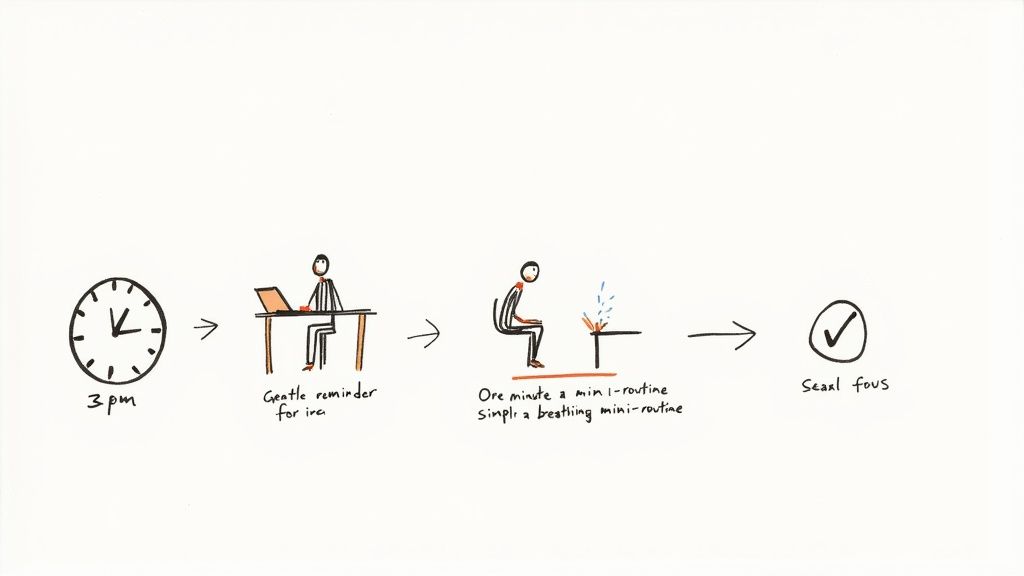
The secret is to tether your breathing practice to things you already do every day. This is called “habit stacking.” Instead of mustering up willpower, you’re simply letting one daily event trigger the next. This approach makes the habit stick so much faster.
Identifying Your Trigger Moments
Your workday is already sprinkled with perfect little windows for a quick energy reset. You just have to learn to spot them. We’re not talking about long, scheduled breaks, but the micro-pauses that pop up naturally.
Think about these common moments in your own day:
- Right before a client call or important meeting: This is your cue to center yourself and sharpen your focus. Action: Perform 2 minutes of Coherent Breathing.
- The moment a big file or software is loading: Instead of getting impatient, use those 30-60 seconds for a quick round of Bellows Breath.
- Just after you’ve wrapped up a challenging task: A few intentional breaths can act as a mental palate cleanser before you dive into the next thing. Action: Do 5 Double Inhales.
- When you feel that first whisper of a mid-afternoon slump: That’s your signal to act before the fatigue really takes hold.
When you start identifying your personal trigger moments, you’re essentially creating a custom blueprint for your practice. It stops being something you have to remember and becomes an automatic response to your daily rhythm.
The most effective habits aren’t built on finding more time, but on better using the time you already have. Linking a new behavior to an existing one is the fastest way to make it stick.
Two Actionable 5-Minute Energy Reset Routines
To get you started, here are two simple, pre-designed routines you can use immediately. Find the one that fits the moment and give it a try next time you hit one of your triggers.
Routine 1: The Pre-Meeting Power-Up
This sequence is perfect for clearing your head, boosting alertness, and grounding your energy right before you need to be “on.”
- First, Coherent Breathing (2 Minutes): Settle in by inhaling for a count of five and exhaling for a count of five. This quickly quiets any pre-meeting jitters and brings your mind into the present.
- Then, Bellows Breath (1 Minute): Jump into 30 seconds of powerful, rapid breaths, followed by a 30-second pause to let it all settle. Think of this as your clean, biological espresso shot.
- Finally, Deep Diaphragmatic Breaths (2 Minutes): Finish up with slow, deep belly breaths. This locks in that calm alertness, so you can walk into your meeting feeling centered and ready for anything.
Routine 2: The Afternoon Slump Buster
When your focus starts to fade and your energy dips after lunch, this routine can bring you back to life without reaching for more caffeine.
- Start with the Double Inhale (2 Minutes): Begin with two minutes of the “short inhale, longer inhale, full exhale” pattern. This is fantastic for super-saturating your blood with oxygen and waking up your brain.
- Next, Bellows Breath (1 Minute): Follow up with a minute of Bellows Breath to kick your sympathetic nervous system into gear for a quick, powerful surge of alertness.
- Finish with Coherent Breathing (2 Minutes): End with two minutes of balanced, five-second inhales and exhales. This helps smooth out that energy surge, transitioning you into a state of sustained, calm focus.
As a final tip, a simple calendar reminder set for 2:30 PM that just says “Breathe for 5 mins” can be an incredibly effective nudge until the habit becomes truly automatic.
Taking Your Practice Further with 9D Breathwork
The daily exercises we’ve covered are fantastic for a quick, in-the-moment energy boost. They absolutely work. But what if you’re looking for more than just a temporary lift? What if you’re ready to unlock deeper, more lasting shifts in your energy and mindset?
This is where things get really interesting. We move from simple techniques into a full sensory experience.
Think of it this way: humming a tune is pleasant, but standing in a concert hall listening to a full orchestra is a completely different reality. It’s layered, immersive, and triggers a much more profound emotional and physiological response. That’s the leap from basic breathwork to what we do with 9D Breathwork.
It all starts with the breathing for energy patterns you’ve been learning. From there, we begin to layer in other powerful, science-backed audio technologies. Each element is intentionally chosen to amplify the breath’s effects, creating a holistic experience that engages your body, your conscious mind, and even your subconscious programming.
The Power of Layered Modalities
By integrating specific audio technologies, these sessions can guide you far deeper than breathing alone ever could. It’s not just breathing; it’s a structured journey designed to help you access different states of awareness and unlock new reserves of energy and clarity.
Here are the three key layers that make this possible:
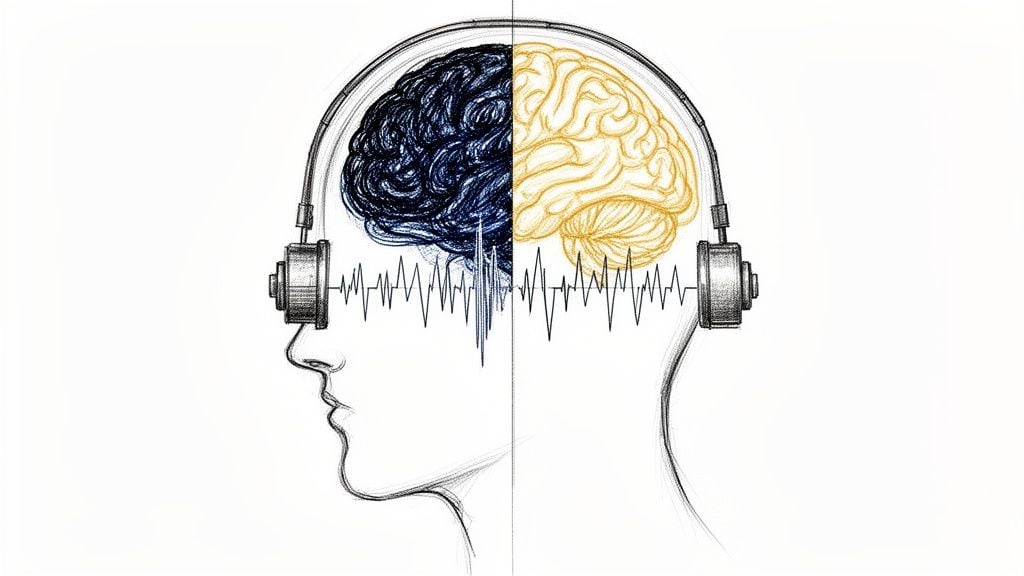
- Binaural Beats: This isn’t just background music. We use precisely engineered audio frequencies played through headphones. Each ear receives a slightly different frequency, and your brain naturally creates a third tone—the binaural beat. This beat gently encourages your brainwaves to shift into states associated with deep focus, creativity, or profound relaxation.
- Guided Voice Scripts: A skilled guide’s voice provides a clear narrative, giving structure and purpose to your session. It helps anchor your attention, keeping you present and focused so your mind doesn’t wander off into its usual loops.
- Subliminal Messaging: We embed positive affirmations into the audio at a frequency just below the threshold of conscious hearing. The idea is to bypass your inner critic and speak directly to your subconscious, helping to rewire old, limiting beliefs that could be draining your energy without you even realizing it.
When you bring these elements together, something incredible happens. The breathwork opens up your physical and energetic state, while the audio technologies provide the mental and emotional framework to make that state truly meaningful and impactful.
This multi-layered approach is the bridge between a quick five-minute reset and a session that can genuinely change your baseline.
If you’re feeling curious and want to understand how all these pieces fit together, our guide on what 9D Breathwork is and how it works breaks it all down. It’s the perfect next step for anyone ready to explore the full potential of their own breath.
Got Questions About Breathing for Energy?
Whenever you’re trying something new, a few questions are bound to pop up. And when it comes to something as fundamental as your own breath, it’s smart to get a feel for the territory before you jump in. Knowing the ins and outs is what builds the confidence to make these practices a real, lasting part of your day.
Let’s walk through some of the questions I hear all the time. Getting these cleared up will help you feel safe, prepared, and excited to start.
Is It Safe to Do These Exercises Every Day?
For most healthy people, absolutely. The techniques we’ve covered are generally safe for daily use. Gentle practices like Coherent Breathing or simple belly breathing can be done several times a day without a second thought.
The more intense stuff, like Bellows Breath, is best kept in your back pocket for when you really need a jolt of energy—maybe once or twice a day when that afternoon slump hits.
The golden rule here is simple: listen to your body. If you ever feel dizzy, lightheaded, or just plain uncomfortable, stop. Just ease back into your normal, gentle breathing.
Your body knows best. Think of any discomfort as a signal to pull back, not to push through.
Will Breathing for Energy Help Me Lose Weight?
This one comes up a lot, and it’s a great question. While these breathing exercises aren’t a magic bullet for weight loss, the connection between your breath and metabolism is genuinely fascinating.
When your body actually burns fat for fuel, a huge portion of it is literally breathed out. For every 10 kg of fat you lose, an incredible 8.4 kg exits your body as carbon dioxide (CO₂) through your lungs. The other 1.6 kg becomes water.
That little fact completely reframes the role of our lungs—they’re a primary exit ramp for fat. You can dig into the science behind it in this medical breakdown of how fat leaves the body. So, while breathing more won’t magically shed pounds, it’s clear that an efficient respiratory system is a core component of a healthy metabolism.
Can I Do These Exercises After Eating?
Good question. It’s usually best to wait a bit, especially for the more powerful techniques. Exercises like Bellows Breath really get your diaphragm and abdominal muscles pumping, which can feel pretty awkward if your stomach is full from a big meal.
Here’s a quick, actionable guide:
- Gentle Breathing (Coherent, Diaphragmatic): These are fine anytime. In fact, they can aid digestion. Feel free to do them right after a meal.
- Intense Breathing (Bellows Breath): Wait at least 60-90 minutes after eating. This gives your body time to start digesting so the practice feels energizing, not uncomfortable.
A little bit of timing makes a big difference. It lets your body focus on either digestion or activation, so your practice feels energizing, not uncomfortable.
Ready to go beyond a quick energy fix and dive into something deeper? 9D Breathwork takes these powerful breathing principles and integrates them with advanced audio technology, creating experiences that can truly shift your state of being.
See what our guided journeys are all about and start your experience today at the official 9D Breathwork website.