When most people hear “breath-hold training,” they picture elite freedivers plumbing the ocean depths. But you don’t need to be an extreme athlete to reap its benefits. This is a powerful, practical tool for anyone looking to master their stress response, sharpen their focus, and stay calm under pressure.
At its heart, the practice is about systematically training your body to become more comfortable with higher levels of carbon dioxide (CO2). By doing this, you’re essentially rewiring your nervous system for greater resilience, building a powerful buffer against the pressures of daily life.
The Hidden Power of Breath Hold Training
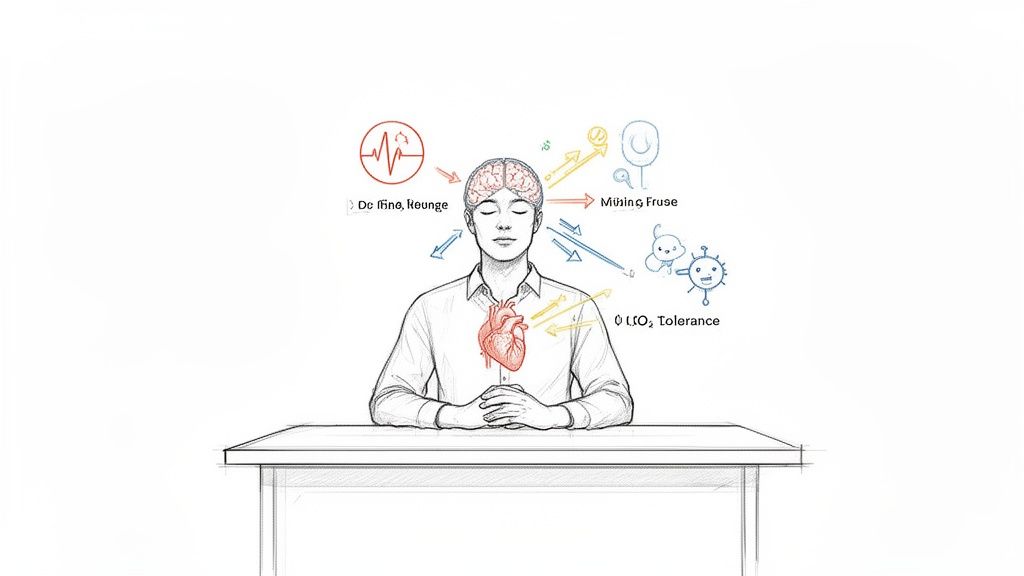
Picture this: you’re facing a high-stakes presentation or a looming deadline. Your heart pounds, your thoughts race, and your focus shatters. Now, what if you had a built-in switch to instantly calm your nervous system? That’s exactly what breath-hold training gives you. It’s less about pushing your physical limits and more about everyday self-regulation.
This training works by gently exposing your body to increased CO2. This recalibrates the chemoreceptors in your brain that trigger the frantic urge to breathe. As your tolerance for this “air hunger” grows, so does your tolerance for stress in the real world. You learn to stay centered when things get chaotic because you’re no longer panicking at your body’s internal signals.
Upgrading Your Internal Operating System
Think of your stress response as a car alarm that’s way too sensitive—it goes off at the slightest nudge. Breath-hold training lets you fine-tune that sensitivity. By teaching your body that a bit of extra CO2 isn’t an emergency, you build profound physiological resilience.
This brings some incredible, practical benefits:
- Laser-Sharp Focus: A calmer nervous system allows for much greater mental clarity and sustained concentration.
- Better Stress Management: You become far less reactive to daily triggers, whether it’s anxiety at work or personal challenges.
- Improved Physiological Efficiency: Your body gets better at using oxygen, thanks to stronger autonomic control.
One of the coolest things at play here is the mammalian diving response. This is a powerful, primal reflex that kicks in when you hold your breath, especially when your face is in cold water. It instantly slows your heart rate and shunts oxygen-rich blood to your most vital organs: your brain and heart. With regular practice, this response gets stronger, making your body operate more efficiently under any kind of pressure.
From Ancient Skill to Modern Science
What began as a survival skill has evolved into a well-studied discipline for enhancing human performance. The average untrained adult can hold their breath for about 60–120 seconds. Yet, trained freedivers often push past 5 minutes.
These numbers aren’t just trivia; they show how incredibly adaptable our respiratory and nervous systems are. We can radically expand our perceived limits with consistent training.
The benefits aren’t just physical. Breath holding is a potent tool for mental well-being, and those interested in the clinical applications might find an online mental health certification provides deeper professional insights into these techniques.
A 2023 Stanford University study discovered something remarkable: just five minutes of daily breathwork, including techniques with breath holds, improved mood more effectively than mindfulness meditation.
This research underscores just how accessible and powerful these practices are. While many methods exist, from Box Breathing to the 4-7-8 technique, they all tap into the fundamental link between breath and mind. To see how some popular methods stack up, check out our guide on Box Breathing vs. 4-7-8 Breathing. Starting this journey is a concrete step toward mastering your inner world.
What’s Really Going On When You Hold Your Breath?
Ever wondered what’s happening inside your body during a breath hold? Most people think that panicky urge to breathe is your body screaming for oxygen. But that’s not the whole story. The real driver behind that feeling is actually the rising level of carbon dioxide (CO2) in your blood.
This is a game-changer. Once you understand this, you stop fighting a losing battle against a phantom oxygen debt. Instead, you can work with your body’s signals, learning to stay calm as the CO2 alarm bell gets louder.
It’s a CO2 Trigger, Not an Oxygen Problem
Deep inside your brain and major arteries, you have tiny sensors called chemoreceptors. Think of them as your body’s internal chemists. Their main job is to constantly check the chemistry of your blood, and they are especially sensitive to CO2.
When you hold your breath, your cells keep producing CO2 as a byproduct of metabolism. Since you’re not exhaling, it starts to build up, making your blood a tiny bit more acidic. Your chemoreceptors pick up on this change almost instantly and send an urgent memo to your brain: “Time to breathe!” This is what triggers that classic “air hunger” and the involuntary contractions of your diaphragm.
It’s crucial to remember this isn’t a sign of immediate danger. It’s just a very sensitive, early-warning system doing its job.
A study in the Journal of Affective Disorders found that just five minutes of structured breathing—including holds—can boost your mood and dial down physiological stress more effectively than mindfulness meditation alone. This shows just how quickly you can tap into your nervous system by playing with these CO2 signals.
With practice, you’re not trying to suffocate this signal. You’re simply recalibrating your response to it. You’re teaching your nervous system to stay cool and collected as CO2 rises, essentially increasing your tolerance and pushing that alarm further down the road.
Your Body’s Built-In Superpower
The moment you hold your breath, your body kicks into an amazing, ancient survival mode called the mammalian diving response. This is a powerful set of reflexes we inherited from our evolutionary ancestors, designed to conserve oxygen whenever we’re underwater.
Here’s a look at what happens without you even thinking about it:
- Bradycardia: Your heart rate slows down almost immediately, sometimes by 25% or more. A slower heart needs less oxygen, which is the first step in conserving energy.
- Peripheral Vasoconstriction: The blood vessels in your arms and legs begin to narrow. This clever move shunts oxygen-rich blood away from your extremities and redirects it to where it matters most: your heart and brain.
- Spleen Contraction: Your spleen, which acts as a storage tank for red blood cells, squeezes and releases a fresh supply of oxygenated blood into your system. It’s like getting a natural, internal oxygen boost.
Together, these reflexes make your body incredibly efficient. Consistent breath-hold training strengthens this response, helping you stay clear-headed and relaxed for longer, whether you’re in a stressful meeting or pushing through a workout.
From Physiology to Real-World Calm
So, what does this all mean for your daily life? Strengthening your mammalian diving response and improving your CO2 tolerance has a direct, positive effect on your autonomic nervous system—the command center for your stress response.
Every time you practice, you’re essentially giving your nervous system a workout, training it to shift more easily into a parasympathetic (or “rest-and-digest”) state. This creates real, tangible benefits that you’ll feel throughout your day.
For instance, studies on slow-paced breathing with long exhales—a core part of recovering from breath holds—show a significant boost in parasympathetic activity. This means your body gets much better at pumping the brakes and calming itself down after stress. This change is directly measured by your heart rate variability (HRV), a key indicator of your nervous system’s resilience. To learn more, check out our guide on how to improve heart rate variability.
Ultimately, the science here isn’t just about holding your breath longer; it’s about gaining more control over your internal state. A 2022 study in Scientific Reports confirmed that regular resonance breathing, which uses similar principles, improved cognitive function and lowered stress markers in young adults. By understanding and working with your body’s brilliant design, you build a powerful foundation for mental clarity and emotional balance.
Putting Theory Into Practice with CO2 and O2 Tables
Alright, you’ve got the science down. Now it’s time for the fun part—actually applying this knowledge through structured breath hold training. But before we dive in, let’s get the most critical safety rule out of the way.
Safety First: Never, ever practice breath holds in or near water alone. All the exercises we’re about to cover are designed for “dry” practice. Find a comfortable spot on land, like lying on a bed or a yoga mat, where you can fully relax.
The foundation of this training rests on two specific protocols: CO2 tables and O2 tables. Don’t let the names intimidate you; they’re simply targeted workouts for your nervous system and respiratory system, each designed to train a different physiological response.
This is what’s happening inside your body every time you hold your breath:
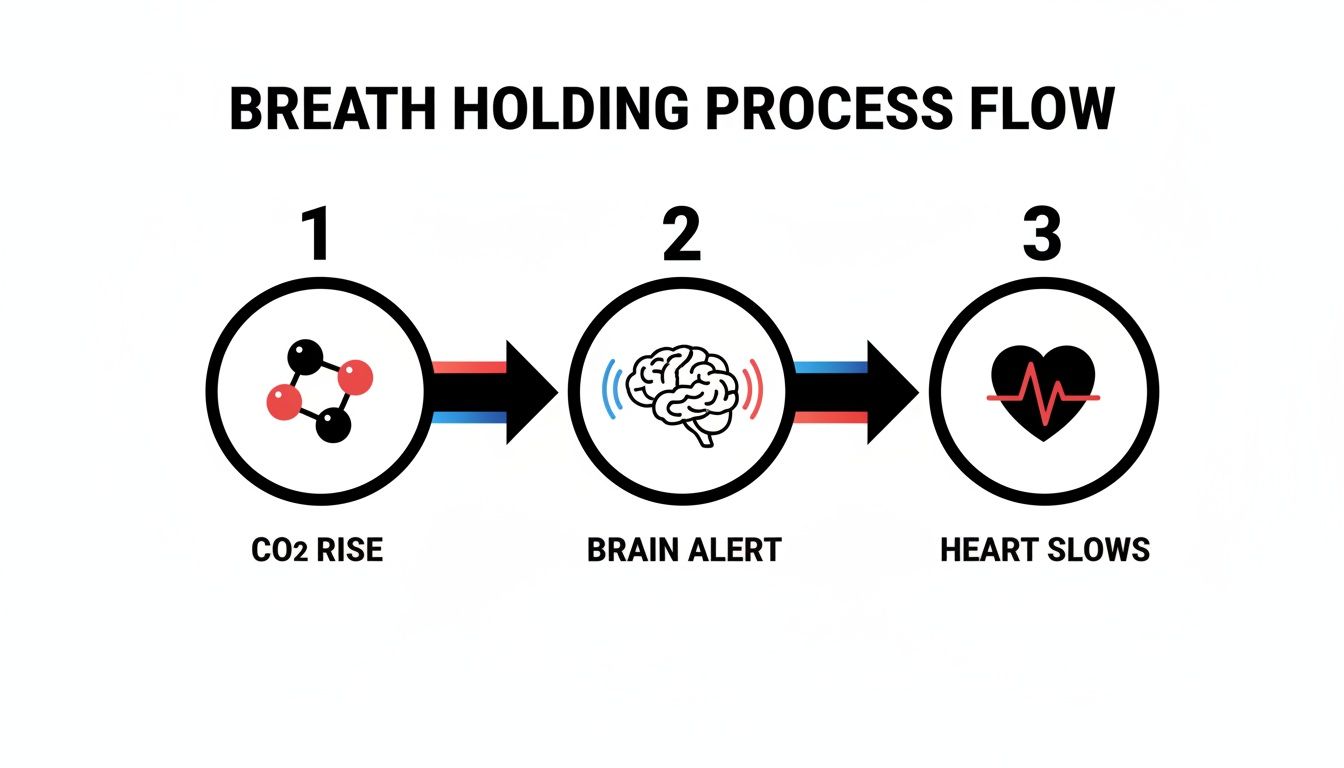
As you can see, the rising CO2 is the initial trigger that sets everything else in motion. It alerts the brain, which then activates the mammalian diving response to slow your heart and conserve precious oxygen. We can train our response to this entire sequence.
Mastering CO2 Tables for Stress Resilience
Think of the CO2 table as your primary tool for building mental fortitude. Its purpose is to systematically increase your tolerance to carbon dioxide. This is powerful because you’re directly training your mind to stay calm and centered even as the physical urge to breathe grows stronger.
The goal isn’t about hitting a new personal best on your hold time. It’s about becoming comfortable with the discomfort of air hunger.
The structure is beautifully simple. You’ll perform a series of breath holds where the recovery time between each hold gets shorter and shorter. This means you start the next hold with a little more residual CO2 in your system than the last, gently nudging your body to adapt.
A 2024 review in Experimental Physiology even found that breath-holding can cause the spleen to contract and release extra red blood cells, giving you a temporary oxygen boost. It’s just one example of how intelligently the body adapts to this kind of controlled stress.
Here is a great starting point for beginners. You can use a simple stopwatch or a dedicated app to keep track of your times.
This table is designed to get you accustomed to the feeling of rising CO2 in a controlled way. Notice how the hold time stays the same, but your rest period shrinks with each round.
Beginner CO2 Tolerance Training Table
| Round | Hold Time | Recovery Breaths |
|---|---|---|
| 1 | 1 min 00 sec | 2 min 00 sec |
| 2 | 1 min 00 sec | 1 min 45 sec |
| 3 | 1 min 00 sec | 1 min 30 sec |
| 4 | 1 min 00 sec | 1 min 15 sec |
| 5 | 1 min 00 sec | 1 min 00 sec |
| 6 | 1 min 00 sec | 45 sec |
| 7 | 1 min 00 sec | 30 sec |
| 8 | 1 min 00 sec | 15 sec |
The key here is to stay relaxed. Lie down, take a full (but not forced) breath, and begin your hold. When the timer goes off, exhale and breathe calmly through the recovery period. No gasping for air—just smooth, diaphragmatic breaths.
Using O2 Tables for Physiological Efficiency
If CO2 tables are for mental grit, then O2 tables are for physical efficiency. This protocol trains your body to operate effectively on lower oxygen levels, which strengthens that powerful mammalian diving response we talked about.
With an O2 table, the structure is flipped. Your recovery time between holds remains constant, but the duration of each breath hold gets progressively longer. This gently and safely pushes your body to adapt to mild states of hypoxia.
Here’s an example of what a beginner’s O2 table might look like:
| Round | Hold Time | Recovery Breaths |
|---|---|---|
| 1 | 1 min 00 sec | 2 min 00 sec |
| 2 | 1 min 15 sec | 2 min 00 sec |
| 3 | 1 min 30 sec | 2 min 00 sec |
| 4 | 1 min 45 sec | 2 min 00 sec |
| 5 | 2 min 00 sec | 2 min 00 sec |
| 6 | 2 min 15 sec | 2 min 00 sec |
| 7 | 2 min 30 sec | 2 min 00 sec |
| 8 | 2 min 45 sec | 2 min 00 sec |
Making The Practice Your Own
These tables aren’t set in stone. The most important skill you can develop in breath-hold training is learning to listen to what your body is telling you.
- Adjust Your Starting Point: Is a 1-minute hold too much right now? Start with 30 or 45 seconds. Too easy? Start at 1 minute 30 seconds. The numbers are just a guide.
- Relaxation is Everything: Your number one job during a hold is to stay as relaxed as a wet noodle. Scan your body from head to toe. Is there tension in your jaw? Your shoulders? Consciously let it go.
- Focus on Recovery: After a hold, your first few breaths are crucial. A good technique is a passive exhale, a sharp and quick inhale, hold for just a second, then another quick “sip” of air in before a full, relaxed exhale. This helps you re-oxygenate efficiently.
- Never Push to Blackout: This is training, not a competition. You should always end a hold feeling in control. If you start to feel dizzy or see stars, stop immediately. We’re aiming for gentle adaptation, not extreme strain.
A 2012 study on freedivers showed that consistent training led to real physiological changes, like increased hemoglobin levels. This just goes to show that if you practice safely and consistently, your body will respond in amazing ways.
A good way to start is by dedicating different days to different tables. Maybe try CO2 tables twice a week and O2 tables on two other days, making sure to schedule rest days in between. Over time, you’ll build a powerful new capacity for both mental calm and physical performance.
Integrating Breath Holds Into Your Daily Routine
While structured training with CO2 and O2 tables is incredibly effective, the real magic happens when you bring these skills off the mat and into your life. The ultimate goal of breath hold training isn’t just to chase longer times on a stopwatch; it’s about translating that newfound physiological control into real-world composure when you need it most.
Think of it as closing the loop between practice and performance. The resilience you build during a dedicated session becomes a powerful resource you can tap into at a moment’s notice—whether you’re walking into a tough conversation or trying to find that deep-focus flow state for work.
This is where your improved CO2 tolerance becomes a practical superpower. Instead of getting hijacked by the fight-or-flight response under pressure, you gain the ability to consciously downshift your nervous system, keeping your mind clear and your body calm.
Priming Your Nervous System for Performance
One of the best ways to use breath holds is as a “primer” before a big event. Just like an athlete warms up their muscles before a game, you can warm up your nervous system to be calm, focused, and ready for action.
Actionable Example: Let’s say you have a major presentation in 30 minutes. Your heart is starting to race, and those familiar jitters are creeping in. Instead of letting that anxiety snowball, find a quiet spot—an empty office, your car, even a bathroom stall will do. Perform just three rounds of breath holds.
- Inhale fully but gently, and hold your breath for 45 seconds.
- Exhale slowly and breathe calmly for 60 seconds.
- Repeat this two more times.
This simple routine takes less than five minutes but the effect is profound. It gently nudges your CO2 levels up, which kicks your parasympathetic “rest-and-digest” system into gear and slows your heart rate. You walk into that presentation feeling grounded and in control, not scattered and on edge.
Weaving Mini-Holds Into Your Workday
You don’t need to carve out time for a full training session to reap the benefits. Integrating “mini-holds” throughout your day is a fantastic strategy for managing stress and sharpening your focus on the fly. These are just short, informal holds you can do right at your desk without anyone noticing.
The idea is to use these micro-doses of CO2 tolerance training to punctuate your day, especially when you feel tension rising or your mind starting to wander. This practice helps keep your autonomic nervous system in balance. A study in Experimental Physiology even found that brief breath holds can trigger helpful adaptations, like causing the spleen to release a reserve of oxygen-rich red blood cells into circulation.
Actionable Example: The next time you sit down to start a focused work block, try this. Take one slow, deep breath in, and then hold it for a comfortable 15-20 seconds. As you exhale, imagine letting go of all distractions. This simple act brings you back to the present moment and reasserts conscious control over your physiological state.
Of course, for this to work well, your everyday breathing mechanics need to be solid. To ensure you’re getting the most out of every breath, you can explore our detailed guide on how to master diaphragmatic breathing.
A Scenario for Managing On-the-Spot Stress
Let’s walk through a common high-stress scenario. You’re a project manager, and an unexpected, critical email from a client just landed in your inbox. Your immediate reaction is that jolt of adrenaline—your heart pounds, your shoulders tense up.
Instead of firing off a knee-jerk reply, use a mini-hold. Push your chair back, close your eyes if you can, and perform a simple exhale hold. Gently breathe all your air out and just hold the emptiness for a comfortable 10–15 seconds.
This brief hold on the exhale is especially good for calming the system. When you feel the urge to breathe, take a slow, deep inhale. Repeat this two or three times. You’ve just short-circuited the stress response, giving your prefrontal cortex—the rational part of your brain—a chance to come back online so you can craft a thoughtful, strategic response instead of an emotional one.
This technique is backed by research showing that extending the exhale significantly increases parasympathetic tone, which is exactly what you need to counter acute stress. It’s a small tool, but when used consistently, it builds lasting resilience.
Safety First: Navigating Your Breath-Hold Practice
While breath-hold training offers some incredible benefits, how you practice is just as important as the practice itself. Your safety has to be the top priority. Think of it less like a set of rigid rules and more like building a solid foundation—it’s what makes the entire journey sustainable and genuinely effective.
Let’s get the biggest one out of the way first. This is non-negotiable: never, ever practice breath holds in or near water alone. This goes for pools, the ocean, a lake, and even your bathtub. There’s a risk of shallow water blackout, and while it’s extremely rare in the controlled dry training we’re doing, it becomes a life-threatening danger in water. All the protocols in this guide are designed for dry land practice only.
Setting Up Your Training Space
Your environment makes a huge difference. You’ll want to find a spot where your body can completely let go. Lying down on your bed, the couch, or a yoga mat is perfect. If you prefer sitting, just make sure you’re propped up with pillows so you’re supported and not holding any tension.
The idea is to eliminate any physical effort. Tense muscles burn through oxygen, which shortens your holds and makes the whole experience feel more difficult.
Actionable Example: Before starting a session, take 60 seconds to do a “relaxation scan.” Lie down, close your eyes, and mentally check in with your body. Are your eyebrows furrowed? Is your jaw tight? Consciously soften those areas. This simple one-minute investment will make your entire practice more effective.
Troubleshooting Common Roadblocks
It’s completely normal to hit a few snags along the way. In fact, you should expect them. The key is to see them as part of the process, not as signs of failure.
- Intense Diaphragm Contractions: Those involuntary spasms you feel are just a normal, healthy response to rising CO2 levels. Instead of tensing up and fighting them, get curious. Try to observe the sensation and consciously relax around it. You’ll often find this helps them feel less intense.
- A Wave of Panic or Anxiety: The urge to breathe can be a powerful, almost overwhelming feeling, especially when you’re starting out. When that feeling hits, try bringing all your focus to one small, relaxed part of your body, like your hands or your forehead. Remind yourself that you’re safe, you’re in total control, and you can take a breath whenever you want.
- Hitting a Plateau: Sooner or later, your hold times might stop improving. Don’t panic! This is usually a sign to mix things up, not to push harder. If you’ve been doing CO2 tables, try switching to O2 tables for a week. Or maybe spend more time on relaxation and body scanning before you start your holds. Often, the breakthrough comes from easing off the gas pedal.
Here’s a powerful mindset shift: view these challenges not as problems, but as direct feedback from your nervous system. Every contraction, every flutter of anxiety, is an opportunity to practice staying calm under pressure—which is the exact skill we’re here to build.
When to Check in With a Professional
For most healthy people, breath-hold training is perfectly safe. However, there are a few conditions where you absolutely need to get the green light from your doctor before you start.
Please consult a medical professional if you have any of the following:
- Serious cardiovascular conditions (like high blood pressure or heart disease)
- Respiratory issues such as COPD or severe asthma
- A history of seizures or epilepsy
- If you are pregnant
Taking this simple step ensures you can move forward with confidence. The body adapts to this kind of training surprisingly fast. A 2018 study in the European Journal of Applied Physiology showed that just 14 days of consistent practice can dramatically increase hold times and strengthen the body’s “diving response,” making oxygen use far more efficient.
This rapid adaptation is deeply connected to our nervous system. The sensations you feel during a hold are directly linked to your vagus nerve, which acts as the brake pedal for your stress response. Understanding this relationship can make your practice even more powerful. To explore this further, check out our guide on vagus nerve stimulation techniques and see how beautifully these practices complement each other.
Got Questions About Breath-Hold Training?
Diving into breath-hold training naturally brings up a lot of questions. It’s a new frontier for your body and mind, so it’s smart to be curious. Here, I’ll walk you through some of the most common things people ask, sharing what I’ve learned from my own practice and from guiding others.
How Often Should I Actually Be Training?
When it comes to building your breath-hold capacity, consistency trumps intensity every single time. There’s no need to push yourself to the absolute limit every day.
For most people, a schedule of three to four times per week is the sweet spot. This gives your nervous system and body plenty of time to adapt and recover. A full CO2 or O2 table session really only takes about 20-30 minutes, so it’s easy to fit into your routine. The real magic happens over weeks of regular, short sessions, not in one heroic, grueling hold.
A great way to approach it is to alternate your focus. This keeps the training fresh and targets different aspects of your physiology.
Actionable Example: Here is a sample weekly rhythm you can try:
- Monday: CO2 Table (Building that CO2 tolerance)
- Tuesday: Rest or some light, mindful breathing
- Wednesday: O2 Table (Working on oxygen efficiency)
- Thursday: Rest
- Friday: CO2 Table
- Saturday & Sunday: Active recovery or full rest days
What Is This Supposed to Feel Like?
A breath hold is a fascinating journey through a cascade of physical sensations. Learning to calmly observe them is the entire point of the practice.
At first, you’ll probably just feel a quiet stillness. But as your CO2 levels start to climb, you’ll get that first little nudge—the “urge to breathe.” It’s often subtle, maybe a tickle in your throat or a faint tightness in your chest. Don’t fight it; just notice it.
As you hold longer, those signals get louder. You’ll likely start to feel involuntary contractions of your diaphragm, which feels like a muscle spasming just below your ribs. This is a completely normal, safe, and expected part of the process.
The real skill you’re developing is telling the difference between productive discomfort and actual distress. The urge to breathe and those diaphragm contractions are just uncomfortable signals of adaptation. Dizziness, seeing stars, or feeling like you might pass out? That’s your cue to stop immediately and breathe.
Why Do I Feel So Anxious When I Hold My Breath?
It’s incredibly common to feel a rush of anxiety or even a bit of panic during a hold, especially when you’re new to it. There’s a good physiological reason for this.
The rising CO2 triggers the exact same chemoreceptors in your brainstem that fire up your body’s “uh-oh, something is wrong” alarm system. Your brain interprets this powerful chemical signal as a genuine threat, even though you’re in a controlled and safe environment.
This is the very thing you’re training to master. A 2021 study showed how controlled breathing, especially with a focus on a long, slow exhale, directly strengthens the parasympathetic nervous system—your body’s built-in “calm down” button.
By staying relaxed through that intense urge to breathe, you are actively rewiring that primitive response. You’re teaching your nervous system, “Hey, this sensation isn’t a life-or-death emergency.” Over time, this builds profound resilience that carries over into how you handle stress in your everyday life.
Will This Really Help My Athletic Performance?
Absolutely, though the specific benefits can vary depending on your sport of choice. The most obvious gains are for athletes in sports like swimming or surfing where breath control is part of the game. But the physiological adaptations are valuable for almost anyone.
Research on freedivers, like in this 2012 study, found that intensive training can lead to incredible adaptations, like increased hemoglobin levels for better oxygen transport. While you might not see changes that dramatic, you can certainly expect to benefit from:
- Improved CO2 Tolerance: This is a game-changer. It helps you stay calm and efficient when you’re breathing hard during intense efforts, delaying the onset of that panicked, breathless feeling.
- Rock-Solid Mental Focus: The ability to remain calm under intense physical pressure is a massive competitive advantage, no matter your sport.
- A Stronger Diaphragm: You are directly strengthening your main breathing muscle, which can improve your stamina and respiratory efficiency.
Actionable Example: For land-based athletes, try incorporating “exhale holds” during your warm-up. While jogging, exhale fully and run for 10-15 paces before inhaling again. Repeat this 5-8 times. This simple protocol boosts CO2 tolerance and trains your muscles to work more efficiently with less oxygen.
Ready to see how these techniques feel in a fully immersive, guided experience? At 9D Breathwork, we pair the science of breath holds with powerful music, sound, and somatic guidance to help you rewire your nervous system and access your full potential.