When you look at box breathing vs. 4-7-8, the fundamental difference boils down to your immediate goal. Box breathing, with its steady 4-4-4-4 rhythm, is designed to balance the nervous system for a state of calm focus. Think of it as a tool for managing stress throughout a busy workday. On the other hand, 4-7-8 breathing uses a deliberately long 8-second exhale to deeply sedate the nervous system, making it a go-to for battling acute anxiety or preparing your body for sleep.
Understanding How Breath Controls Your Nervous System
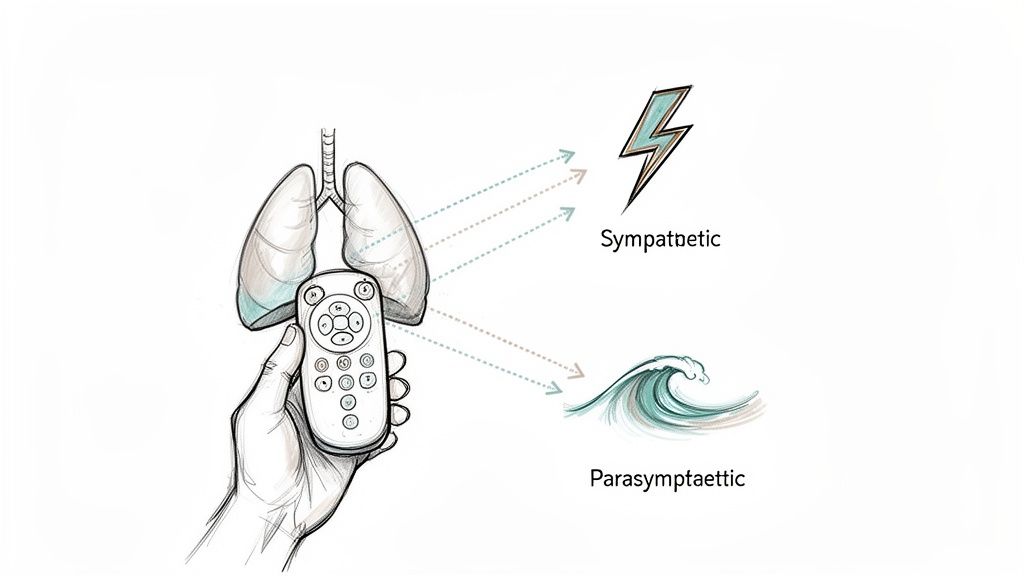
Your breath is the most powerful and direct tool you have for shifting your mental and physical state. Every second of the day, your autonomic nervous system (ANS) is running the show in the background, handling everything from your heart rate to your digestion. This system has two main branches that essentially act as a gas pedal and a brake for your body.
When you’re feeling stressed or anxious—say, right before a major presentation—your sympathetic nervous system kicks into high gear. This is your “fight-or-flight” response. Your heart races, your breathing gets shallow, and your system is flooded with stress hormones like cortisol. The counterbalance to this is the parasympathetic nervous system, your “rest-and-digest” mode, which helps you feel calm, lowers your heart rate, and promotes recovery.
The Science of Conscious Breathing
This is where conscious breathing techniques, or breathwork, come in. They give you a way to manually influence these automatic processes. By deliberately changing how you breathe, you send a direct signal to your brain that it’s safe to calm down.
- Slow, deep inhales give a slight boost to the sympathetic nervous system, increasing alertness.
- Long, extended exhales are the secret to activating the parasympathetic system, which triggers a profound calming effect.
This physiological connection is precisely why techniques like Box Breathing and 4-7-8 work so well. They aren’t just psychological feel-good exercises; they’re grounded in science. Research consistently shows that specific breathing patterns can dramatically improve mood and lower respiratory rate, often more effectively than mindfulness meditation alone.
A 2023 study in Cell Reports Medicine found that structured breathwork practices created greater daily improvements in positive mood compared to other common relaxation methods.
Why This Matters for Professionals
For busy professionals, grasping this concept is a game-changer. Instead of being at the mercy of stress, you can intentionally select a breathing pattern to fit what you need in that moment.
A 2022 study published in Physiological Reports highlighted that the long exhale in the 4-7-8 technique significantly boosts heart rate variability (HRV) and lowers blood pressure—clear proof of its potent relaxing effect. Other studies have found that just a few minutes of daily breathwork can reduce overall stress and improve sleep. This makes breathwork therapy an incredibly practical skill for navigating the demands of a modern career.
By mastering your breath, you effectively gain a remote control for your own nervous system. It gives you the power to consciously shift from high-alert anxiety to grounded focus, or from a state of burnout to deep, restorative rest—often in just a few minutes.
Mastering Box Breathing for Unshakable Focus
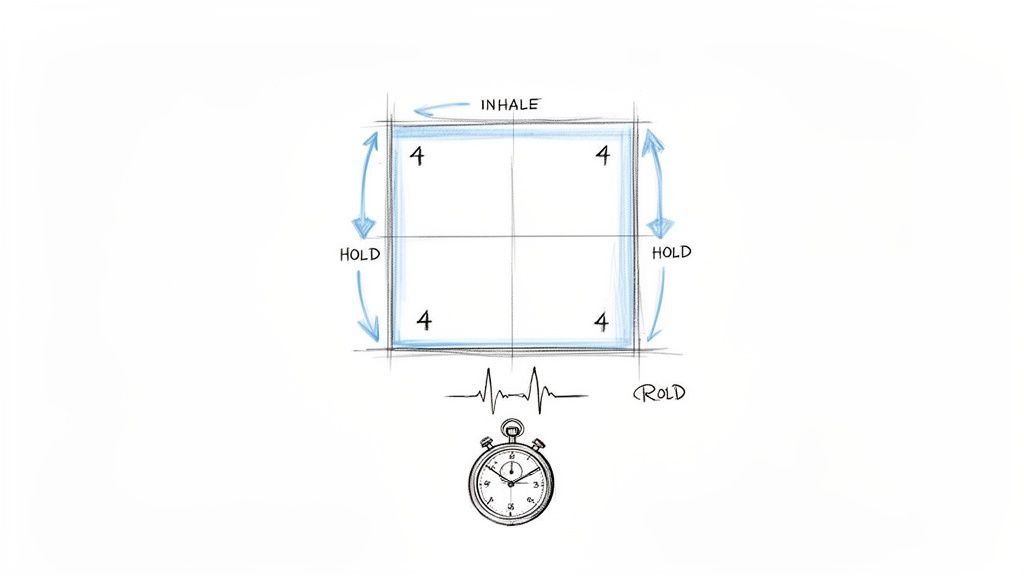
Box breathing, also called “square breathing,” is a powerful technique for building mental resilience. It’s famous for being a go-to tool for U.S. Navy SEALs, who use it to stay calm and sharp in high-stakes environments. Its main purpose is to bring your nervous system back into balance, helping you quiet mental noise and regain focus.
This makes it an incredible tool for professionals trying to stay composed during a chaotic workday. Unlike other breathing exercises aimed at deep relaxation, box breathing is all about structure and control. The simple 4-4-4-4 rhythm is easy to remember and can be done discreetly, whether you’re at your desk or about to walk into a crucial meeting.
How to Practice Box Breathing
The beauty of this technique is its simplicity. You’re essentially drawing a square with your breath, with each side of the box representing a four-second count. Here’s a practical, step-by-step guide to get started right now.
- Find a comfortable seat. Sit up straight in a chair with your feet flat on the floor and rest your hands in your lap. A good posture helps your lungs expand fully.
- Exhale completely. Gently breathe out through your mouth, pushing all the air out of your lungs.
- Inhale for 4 seconds. Close your mouth and inhale slowly through your nose for a count of four. Feel your belly expand.
- Hold for 4 seconds. Hold your breath at the top of the inhale for a count of four. Avoid tensing your shoulders.
- Exhale for 4 seconds. Slowly and steadily release the breath through your mouth for a count of four.
- Hold for 4 seconds. Hold your breath with your lungs empty for a final four-second count before starting the next cycle.
Your Action Plan: Try this for five full rounds. This will take less than two minutes. The goal is to make the rhythm smooth and even.
The Physiology of Calm Focus
So, how does it work? Box breathing directly influences your autonomic nervous system. By making the inhale, hold, and exhale phases equal, you create a state known as autonomic coherence. This is where your heart rate, blood pressure, and breathing fall into a stable, synchronized rhythm.
The two breath-holds are the secret sauce of box breathing. Pausing after the inhale and exhale allows carbon dioxide to build up slightly in your blood. This has a calming effect on the nervous system and actually improves how efficiently oxygen gets delivered to your brain.
This physiological reset helps dial down cortisol levels and quiets that “fight-or-flight” response. A study from the Journal of Affective Disorders found that slow, paced breathing exercises like this are effective in reducing symptoms of anxiety and depression, demonstrating their clinical value.
Actionable Scenarios for Professionals
The real strength of box breathing is how practical it is. This isn’t a long, drawn-out meditation—it’s a tool you can pull out of your pocket anytime, anywhere.
Here are a few real-world situations where it shines:
- Before a Presentation: Feeling those pre-meeting jitters? Action: Find a quiet corner and complete five cycles. It will slow your heart rate and clear your head so you can speak with confidence.
- During a Difficult Conversation: When a discussion gets tense, you can do this without anyone even noticing. Action: As the other person speaks, quietly perform a few rounds. The rhythm keeps you grounded and stops you from saying something reactive.
- To Combat Decision Fatigue: After a long day of back-to-back meetings, your brain can feel fried. Action: Before tackling your last big task, do three minutes of box breathing to reset your mind and make a sharper decision.
Mastering this technique is a foundational skill for mental fitness. By practicing it consistently, you are actively improving focus and concentration for the long haul. It’s an immediate, effective way to manage your state and stay sharp when it matters most.
Using 4-7-8 Breathing for Deep Relaxation and Sleep
While box breathing is all about finding a steady, focused rhythm, the 4-7-8 breathing technique plays a completely different role. Popularized by Dr. Andrew Weil, it’s best thought of as a natural tranquilizer for your nervous system. Its sole purpose is to usher you into a state of profound calm, making it an incredible ally for anyone who struggles to switch off their racing mind.
The 4-7-8 method uses an intentionally unbalanced rhythm to activate your body’s “rest-and-digest” mode. By making the exhale twice as long as the inhale, you’re sending a direct, powerful message to your brain that it’s safe to power down. This is what makes it so uniquely effective for tackling insomnia or managing those sudden waves of anxiety.
Mastering the 4-7-8 Technique
The practice itself is straightforward, but the key is focusing on a controlled, audible exhale. You’ll want to create a gentle “whooshing” sound as you breathe out, which helps regulate the release of air. Here’s your action plan.
- Get into position. Sit with a straight back or lie down comfortably in bed.
- Set your tongue. Place the very tip of your tongue against the ridge of tissue right behind your upper front teeth. Keep it there for the entire exercise.
- Exhale completely. Let all the air out through your mouth with a distinct whoosh sound.
- Inhale for 4. Close your mouth and breathe in quietly through your nose to a slow count of four.
- Hold for 7. Hold the breath for a count of seven. This might feel long at first, but try to stay relaxed.
- Exhale for 8. Breathe out slowly and audibly through your mouth for a full eight seconds, making that same whoosh sound.
Your Action Plan: That’s one complete cycle. Your goal is to repeat this sequence for a total of four cycles, especially when you’re first starting. This takes less than two minutes.
The Science Behind Deep Relaxation
That extended, eight-second exhale is the secret ingredient. This long, slow release of air is what stimulates the vagus nerve—the main pathway of your parasympathetic nervous system. When you activate this nerve, you’re essentially hitting the brakes on your body’s stress response.
Research backs this up. A study published in the journal Neurological Sciences found that slow breathing techniques significantly improved heart rate variability and reduced anxiety in participants, highlighting the direct link between extended exhales and physiological calming.
This technique isn’t just about calming your thoughts; it’s about creating a profound physiological shift. The seven-second hold allows oxygen to fully saturate your bloodstream, while the eight-second exhale efficiently expels carbon dioxide, creating a deeply calming effect.
Actionable Scenarios for Unwinding
While the 4-7-8 breath is fantastic for promoting rest, you can also explore complementary habits like using a sauna for sleep to enhance your overall sleep quality. But the real strength of 4-7-8 is how you can use it as a precision tool for specific challenges.
- Can’t Fall Asleep: Is your mind replaying the day’s events on a loop? Action: Perform four full cycles while lying in bed. It’s a powerful pattern interrupt for anxious thoughts, physically preparing your body for rest.
- Waking Up at 3 AM: That middle-of-the-night cortisol surge is a common problem. Action: Instead of reaching for your phone, immediately practice three to four rounds of 4-7-8 to gently guide yourself back into sleep.
- Decompressing After Work: Use this technique as a ritual to draw a clear line between your professional and personal life. Action: Before you start your evening, take two minutes to complete four cycles. It helps you mentally clock out and be more present.
Ultimately, mastering 4-7-8 is about learning how to quiet your mind on command. It’s an invaluable skill for anyone looking to reclaim their sleep and manage stress with more grace.
Comparing Box Breathing vs 4-7-8 Side by Side
So, how do you choose between box breathing and 4-7-8? It really comes down to one question: are you trying to find focus in the middle of a storm, or are you trying to find the off-switch for your brain? One is a tool for steadying the ship; the other is for dropping anchor and calling it a day.
Getting this core difference is what makes these techniques so powerful. Let’s dive into what sets them apart.
Primary Goal and Physiological Impact
The biggest split in the box breathing vs 4-7-8 debate is what they’re actually built to do inside your body.
Box breathing is all about creating balance. That symmetrical 4-4-4-4 rhythm is designed to get your body into a state of autonomic coherence. Think of it as tuning an orchestra—your heart rate, breath, and blood pressure all sync up into a smooth, stable rhythm. It’s not meant to knock you out, but to ground you and keep you composed under pressure.
The 4-7-8 technique, on the other hand, is built for sedation. The magic is in that long, eight-second exhale. Making your exhale deliberately twice as long as your inhale powerfully stimulates the vagus nerve, which essentially slams the brakes on your stress response. It’s a direct line to activating your “rest-and-digest” system.
Key Takeaway: Grab box breathing when you need to be calm but still sharp (like before a big presentation). Use 4-7-8 when you need to shut down and completely relax (like getting ready for sleep).
Cognitive Impact and Use Case
These physical responses naturally lead to very different mental states. Box breathing brings focus, while 4-7-8 brings quiet.
- Box Breathing for Cognitive Clarity: The even rhythm helps cut through mental fog and quiet the background noise of anxiety. It’s an active tool for when you need to perform. Research in Cell Reports Medicine backs this up, showing that structured breathing like this improves mood and lowers respiratory rate—both of which help you concentrate.
- 4-7-8 for Mental Quiet: That intense parasympathetic jolt from the long exhale is fantastic for shutting down racing thoughts. It’s more of a passive tool designed to help you “let go,” which is why it’s so effective for winding down. A 2022 study in Physiological Reports confirmed this, finding that 4-7-8 breathing creates an immediate drop in blood pressure and improves heart rate variability, which are clear signs of deep relaxation. If you want to go deeper, our guide explains how to improve your heart rate variability.
Ease of Learning and Application
Both techniques are simple, but one is a bit more beginner-friendly and discreet, especially if you’re not alone.
Box breathing is incredibly easy to pick up and can be done literally anywhere without anyone noticing. The even 4-4-4-4 count is simple to remember, and since there’s no audible exhale, you could do it in the middle of a meeting, and no one would have a clue.
The 4-7-8 technique is also straightforward, but it has a couple of quirks. That 7-second hold can feel a little long when you’re just starting, and the audible “whoosh” exhale makes it less subtle for an open-plan office. It’s really best done in a private space where you can fully let go.
Box Breathing vs 4-7-8 At a Glance
To make the choice even simpler, here’s a quick side-by-side look at the two techniques. This table breaks down the key differences to help you decide which one fits your needs in the moment.
| Feature | Box Breathing (4-4-4-4) | 4-7-8 Breathing |
|---|---|---|
| Primary Goal | Balance the nervous system | Sedate the nervous system |
| Best For | Focus, mental clarity, and managing stress on-the-fly | Insomnia, high anxiety, and deep relaxation |
| Physiological Effect | Creates autonomic coherence and stability | Strongly activates the parasympathetic (calming) system |
| Cognitive Impact | Sharpens focus and reduces mental clutter | Quiets racing thoughts and promotes mental stillness |
| When to Use | During the workday, before presentations, in meetings | Before bed, when waking at night, after a stressful day |
| Ease & Discretion | Very easy and highly discreet | Easy, but the audible exhale makes it less discreet |
Ultimately, the choice between box breathing vs 4-7-8 isn’t about which one is “better.” It’s about knowing which tool to pull out of your toolbox for the job at hand. A meta-analysis in Scientific Reports confirmed that different kinds of breathwork are highly effective for reducing stress, which shows just how valuable it is to have a few techniques ready to go.
By understanding their unique strengths, you can consciously shift your state and meet whatever a situation demands.
Choosing the Right Tool for the Job: Practical Scenarios
It’s one thing to understand the mechanics of box breathing and 4-7-8, but it’s another thing entirely to know which one to pull out of your back pocket when you’re staring down a deadline or lying awake at 3 a.m. The real power of these techniques comes alive when you apply them to specific, real-world challenges.
Let’s get practical. Here are a couple of common situations you’ve probably found yourself in, along with my recommendations for which technique works best and a simple plan to put it into action.
Scenario 1: Before a High-Stakes Presentation
You’re about to walk into that big meeting. Your heart is hammering, your palms are slick with sweat, and a thousand “what-ifs” are running through your head. You need to calm down, but you also need to be sharp and focused. This isn’t the time to get sleepy; you need grounded, confident composure.
Recommended Technique: Box Breathing
The steady, symmetrical rhythm of box breathing is perfect for this. It gently taps the brakes on your body’s “fight-or-flight” response without sending you into a state of deep relaxation. Think of it as finding your center, creating a state of calm alertness. A 2023 study published in Cell Reports Medicine even showed that this kind of structured breathing improves mood and slows your breathing rate—both essential for speaking with confidence.
The 5-Minute Pre-Meeting Focus Routine:
- Find a quiet spot. Duck into an empty office, a restroom stall, or even just turn away from your screen for a moment.
- Sit up straight. A straight spine and feet flat on the floor give your diaphragm room to work properly.
- Do 5 rounds of Box Breathing:
- Breathe in through your nose for 4 counts.
- Gently hold that breath for 4 counts.
- Breathe out through your mouth for 4 counts.
- Hold with your lungs empty for 4 counts.
- Keep it going for 3-5 minutes. Continue this cycle until you feel your heart rate settle and the mental static clears. You’ll walk into that room feeling present and in control.
Scenario 2: When Your Brain Won’t Shut Off at 2 AM
You wake up with a jolt, and your mind is already racing—that to-do list, the email you still have to write, the project that’s falling behind. Your nervous system is on high alert, making it impossible to drift back off. The goal here is simple: quiet the mental chatter and tell your body it’s time to rest.
Recommended Technique: 4-7-8 Breathing
The magic of the 4-7-8 technique is its long exhale. This is a powerful signal to your parasympathetic nervous system, basically acting like a natural tranquilizer for your body. It’s exactly what you need to counter the cortisol spike that’s keeping you wide awake. Research in Physiological Reports has confirmed that this specific pattern improves heart rate variability and can lower blood pressure, creating the perfect internal environment for sleep.
A major meta-analysis in Scientific Reports highlighted how different breathing techniques effectively reduce stress. This drives home the point: when your goal is to get back to sleep quickly, you need a tool like 4-7-8, which is specifically designed for sedation.
The 10-Minute Bedtime Wind-Down Practice:
- Get comfortable in bed. Settle into your favorite sleeping position.
- Position your tongue. Lightly touch the tip of your tongue to the ridge of tissue just behind your upper front teeth. Keep it there for the whole exercise.
- Complete 4-6 cycles of 4-7-8 Breathing:
- Exhale completely through your mouth, making a gentle whoosh sound.
- Close your mouth and inhale quietly through your nose for 4 seconds.
- Hold your breath for a count of 7 seconds.
- Exhale completely through your mouth with another whoosh for 8 seconds.
- Let go. After your last cycle, just breathe normally. Notice the feeling of heaviness and relaxation spreading through you. Whatever you do, don’t reach for your phone—just let the technique do its job.
By having these simple protocols in your toolkit, you can shift from feeling like a victim of your stress to being the one in charge of your own nervous system. You’ll know exactly which tool to grab when life throws these common hurdles your way.
Taking Your Breathwork to the Next Level with 9D
Getting a handle on foundational practices like Box Breathing and 4-7-8 is a game-changer. These techniques are your entry point for developing what we call interoceptive awareness—basically, your ability to tune into and manage what’s happening inside your body. Think of them as daily mental hygiene, the essential tools you need to handle stress as it comes and get your nervous system ready for deeper work.
But here’s the thing: while these methods are fantastic for managing symptoms in the moment, they tend to stay on the surface. They’ll calm a racing heart or quiet a busy mind, but they don’t always get to the deep-seated patterns locked away in your subconscious. For real, lasting growth, you eventually need to go deeper.
From Managing Symptoms to Healing the Root Cause
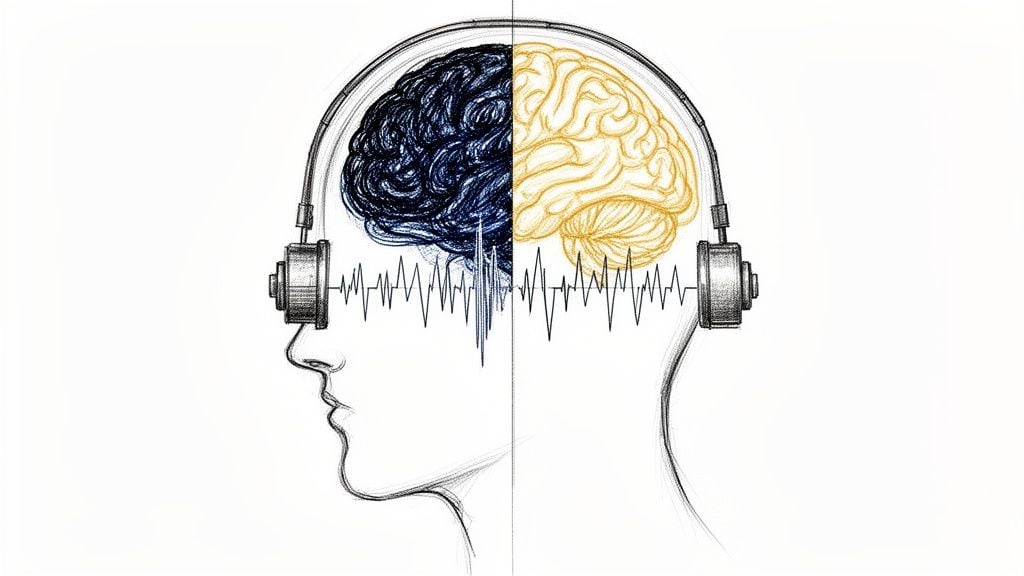
This is where we move past the Box Breathing vs. 4-7-8 comparison and look at what comes next. More advanced modalities, like 9D Breathwork, are built to do more than just regulate. They weave together specific somatic breathing patterns with advanced sound technology, binaural beats, and expert guidance to help you access the subconscious mind.
Daily practices are about managing the nervous system. Immersive breathwork journeys are about rewiring it. A meta-analysis in Scientific Reports backed this up, confirming that breathwork is incredibly effective for stress reduction. 9D just takes it a step further by aiming directly at the source of that stress.
This layered approach helps you release emotions and old stories that have been stuck for years, disrupting ingrained patterns that simpler techniques just can’t touch. We know from research that breathwork has a significant positive impact on mental health; when you combine it with other sensory inputs, those effects are magnified.
How Daily Practice and Deep Dives Work Together
Your daily Box Breathing or 4-7-8 practice doesn’t get replaced—it becomes the support system for this deeper exploration. By keeping your nervous system in a calmer, more regulated state day-to-day, you build a solid foundation. This makes you far more receptive to the powerful shifts that can happen during an immersive 9D journey.
- Your Daily Practice: This is for handling daily stress and building your emotional resilience.
- Immersive Journeys: These are for addressing core patterns and rewriting subconscious beliefs.
Studies consistently show that regular breathwork boosts mood and dials down anxiety. This daily consistency is what preps your mind and body, allowing you to go deeper and achieve more meaningful breakthroughs when you’re in a guided session. In short, those simple daily exercises aren’t just for today—they’re the training ground for the transformation you’re working towards tomorrow.
Common Questions About Box Breathing & 4-7-8
As you start exploring different breathwork methods, it’s natural to have a few questions. Deciding between techniques like box breathing and 4-7-8 can feel confusing at first. Here are some straightforward, practical answers to help you build a practice that feels right for you.
Can I Practice Both Box Breathing And 4-7-8 On The Same Day?
Absolutely. In fact, it’s a great idea. Think of them as different tools in your mental wellness toolkit, each suited for a specific task.
For instance, you might use a few rounds of box breathing before a big presentation to feel grounded and focused. Later that night, you could switch to the 4-7-8 technique to signal to your body that it’s time to wind down for sleep.
Using both techniques allows you to be more intentional about managing your energy and mental state throughout the day. A 2023 study published in Cell Reports Medicine actually found that daily breathwork significantly improves mood, which really supports the idea of weaving these small practices into your daily life.
What Should I Do If I Feel Lightheaded While Practicing?
Feeling a little dizzy or lightheaded isn’t unusual, especially when you’re just starting out. It’s typically just your body getting used to the change in oxygen and carbon dioxide levels. Nothing to panic about.
If it happens, just pause the exercise and let your breath return to its natural rhythm. The next time you try, maybe shorten the counts—for example, start with 3-second intervals for box breathing instead of four. You can always work your way up. And remember, always practice in a safe, comfortable position, either sitting or lying down.
How Quickly Will I Notice The Benefits?
Many of the effects are almost immediate. You can often feel a real drop in your heart rate and a wave of calm after just a few minutes of either technique. A 2022 study in Physiological Reports confirmed this, showing that 4-7-8 breathing can lower blood pressure and improve heart rate variability right away.
But for the deeper, more lasting changes—like building real stress resilience or finally getting consistently good sleep—it all comes down to consistency. A meta-analysis in Scientific Reports pointed out that the real magic happens from the cumulative effects of regular practice, which lead to significant long-term stress reduction. Just 5-10 minutes a day is all it takes to start building that momentum.
Ready to go beyond these foundational techniques and get to the root of what’s causing your stress and anxiety? 9D Breathwork combines powerful somatic breathing with advanced sonic technology and guided coaching, helping you rewire your nervous system from the inside out. Explore a 9D Breathwork journey today.