If you feel like improving your focus is a constant uphill battle, you’re definitely not alone. The digital world we live in is practically engineered to fracture our attention. But the good news is, you can absolutely reclaim your mental clarity. It just takes a structured approach.
The path forward is built on a four-part framework: Foundational Habits, Deep Work Rituals, Lifestyle Alignment, and Sustainable Practice. Think of these as the building blocks for creating lasting, unshakable focus.
Why We’re Losing the Battle for Our Attention

It’s not just a feeling—our environment is actively fighting against our ability to concentrate. From the constant barrage of notifications to the addictive pull of the infinite scroll, our brains are being rewired to expect and even crave interruption. This makes deep, meaningful work feel next to impossible.
I remember hitting a point where my workdays were just a frantic blur of half-finished tasks and a low-grade hum of anxiety. My creativity was completely stalled. Even simple projects took twice as long because my attention was constantly being hijacked by a ping, a buzz, or the siren call of a new email. This fragmented attention doesn’t just tank productivity; it ramps up stress and chips away at our sense of accomplishment.
The Real Cost of a Distracted Mind
The impact of this constant distraction is very real. Research shows our collective ability to sustain attention is shrinking. A 2015 Microsoft Corp. study found the average human attention span dropped to a mere 8.25 seconds—that’s a staggering 33% decrease in just over a decade. This isn’t just a quirky stat; it reflects a fundamental shift in how we process information.
This mental fragmentation leads to some serious consequences:
- Diminished Productivity: Every time you switch tasks, even for a second, you pay a “cognitive cost.” It makes it harder to get back into the flow and complete work efficiently.
- Heightened Stress: A mind that’s always scattered often feels overwhelmed and out of control. A study published in Computers in Human Behavior found a direct link between the number of times people checked their email and higher stress levels. This can keep your body in a state of chronic stress. If this sounds familiar, learning how to calm your nervous system is a critical first step: https://9dbreathwork.com/calm-nervous-system/
- Reduced Creativity: Those “aha!” moments and innovative solutions rarely happen in a state of distraction. They require long, uninterrupted stretches of deep thought—a luxury that’s becoming increasingly rare.
To truly get a handle on this, it helps to explore evidence-based strategies to improve focus and master your attention. It’s the first step toward taking back control.
A Clear Framework for Reclaiming Your Focus
The best part is that you can fight back and win this battle. Improving focus and concentration isn’t about finding some magic-bullet technique; it’s about building a reliable system that works for you. This guide is built on a practical, four-pillar framework designed to give you actionable control over where your attention goes.
This framework gives you a clear roadmap. Below is a quick overview of what we’ll be building together.
The 4 Pillars of Enhanced Concentration
| Pillar | Objective | Key Actions |
|---|---|---|
| Foundational Habits | Build a strong daily baseline for mental clarity. | Morning routines, mindfulness, short breathwork sessions. |
| Deep Work Rituals | Create the optimal environment for intense focus. | Time blocking, distraction-free setups, pre-work protocols. |
| Lifestyle Alignment | Support your brain with the right inputs. | Optimize sleep, nutrition, and physical movement. |
| Sustainable Practice | Turn focus into a lifelong skill. | Measure progress, troubleshoot setbacks, and adapt your system. |
Each pillar works together to create a powerful, self-reinforcing system. In the sections ahead, we’ll dive into how to implement each one, with step-by-step instructions and real-world examples to help you build lasting mental clarity.
Build a Morning Routine That Primes Your Brain for Focus
How you kick off your day pretty much dictates your ability to concentrate for the next eight hours. For most of us, what’s the very first move? We grab our phones. That one habit immediately floods our brains with a firehose of high-stress stuff—work emails, social media notifications, and breaking news. It’s like programming your mind for distraction before your feet even hit the floor.
If you want to get serious about improving your focus, the trick is to swap that reactive, chaotic start for something proactive and intentional. A simple, 15-minute morning ritual can be a total game-changer, setting the stage for clarity, calm, and deep work all day long.
I’ll admit, I used to be a chronic email checker. My alarm would go off, my hand would find my phone, and I’d be scrolling through my inbox, feeling my stress levels climb with every unread message. The single biggest shift for me was swapping that habit for a two-minute gratitude practice. I’d just lie there and think of three specific things I was genuinely thankful for. It felt almost too simple, but the science is there: practices like this can measurably lower cortisol, the stress hormone that absolutely kills your focus.
Your Actionable 15-Minute Focus Routine
Think of this routine as a set of building blocks. You can mix and match them based on how you feel or what you need on any given day. The goal isn’t perfection—it’s just about showing up consistently.
- Minutes 1-5: Hydrate and Breathe. Before you do anything else, drink a big glass of water. Your brain needs it. Then, find a quiet spot and just sit for five minutes, focusing on your breath. A 2018 study in Frontiers in Human Neuroscience found that even a single session of mindfulness meditation can enhance attention. A simple go-to is box breathing: inhale for four, hold for four, exhale for four, and hold for four. If you want to go deeper, you can explore different meditation and guided breathing techniques to see what clicks for you.
- Minutes 6-8: Gratitude or Journaling. Grab a notebook or just do it in your head. Name three specific things you’re grateful for. This tiny act shifts your brain from a state of stress and scarcity to one of appreciation. A 2018 study in Psychotherapy Research found that people who wrote gratitude letters reported significantly better mental health. It works.
- Minutes 9-12: Mental Rehearsal. Pick the most important thing you need to accomplish today and visualize it. Don’t just think about it; mentally walk through the entire process, from start to finish. If you have a big presentation, see yourself delivering it with confidence. Research from the Journal of Imagery Research in Sport and Physical Activity confirms that this kind of mental practice boosts both performance and confidence. You’re basically giving your brain a dress rehearsal for success.
- Minutes 13-15: Set a Single Intention. Now, decide on the one thing that, if you get it done, will make today a win. Write it down on a sticky note and put it where you can’t miss it. This gives you a single, clear target and stops your to-do list from becoming an overwhelming beast of a distraction.
The Pre-Work Shutdown Ritual
How you transition into your workday is just as crucial as how you start your morning. Before you crack open that laptop or walk into the office, try this quick “pre-work shutdown.”
Take 60 seconds. That’s it. Close your eyes, take three slow, deep breaths, and make a conscious decision to leave your personal life at the door. For example, before you start your first task, you might silently say, “I am now fully present for my work.” This creates a sharp mental boundary, preventing home-life clutter from creeping in and sabotaging your focus when you need it most.
Mastering Deep Work with Actionable Protocols
Once you’ve primed your mind in the morning, the real challenge is channeling that clarity into concrete results. This is where we shift from theory to practice, building a structured system that helps you dive into deep work and stay there. It’s all about creating an intentional, distraction-proof bubble for your focus.
Most of us have heard of the Pomodoro Technique, but the real key to making it work is to stop treating it as a one-size-fits-all rule. Think of it more like a flexible framework you can adapt to whatever you’re working on.
Tailor Your Work Intervals
Not all tasks demand the same mental energy, so why would we use the same work interval for everything? The secret is matching your focus sprint to the cognitive load of the task. This simple tweak prevents burnout on heavy-duty projects and keeps you from losing steam on the smaller stuff.
Here’s a practical breakdown I use myself:
- For Intense Creative or Strategic Work: Go with a 50/10 cycle. This means 50 minutes of pure, uninterrupted work followed by a 10-minute break. The longer sprint is perfect for complex problem-solving because it gives you enough time to achieve a flow state. During your break, try walking to the kitchen for water or doing a few stretches—anything to physically and mentally disengage.
- For Routine Administrative Tasks: The classic 25/5 cycle is your best bet here. A 25-minute burst is ideal for clearing out your inbox, filing documents, or organizing your digital workspace. The short, frequent breaks keep you fresh without letting these less-demanding tasks drain your willpower.
Making this small adjustment can completely change the rhythm and productivity of your day. If you want to dig deeper into setting up your environment for success, our guide on how to improve focus at work is packed with more strategies like this.
Your Deep Focus Session Checklist
To make this dead simple, I have a pre-session checklist I run through every single time. It’s a non-negotiable ritual that acts as a signal to my brain: it’s time to focus.
Before I start any high-value task, I quickly go through these five steps. It takes less than two minutes.
- Set a Clear Objective: I physically write down the one thing I need to accomplish in this block. For example: “Draft the first section of the marketing report.”
- Silence All Notifications: Phone goes into “do not disturb” and into another room. All desktop notifications are off.
- Clear Physical and Digital Space: I tidy my desk and close every single browser tab and app that isn’t essential for the task.
- Prepare My Tools: I open only the documents, software, or tools I need. Nothing else.
- Initiate the Protocol: A few deep breaths to center myself, and then I hit start on my timer.
This little routine removes decision fatigue and closes the door on the most common distractions before they can even knock.
The image below gives a great visual of a simple three-step flow—gratitude, breath, and visualization—that you can use to prime your mind before any focus session.
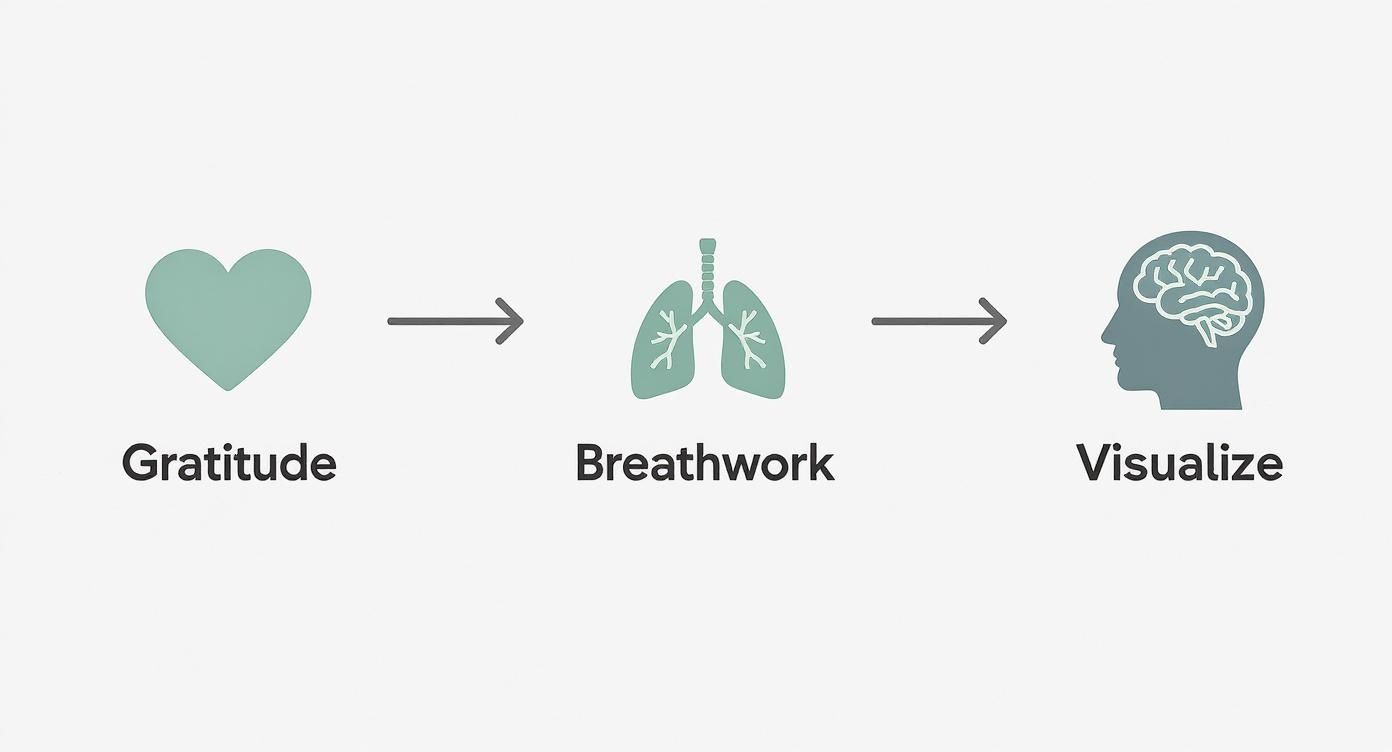
This process really underscores how integrating small moments of mindfulness can create a powerful launchpad for deep concentration.
Combining Breathwork and Binaural Beats
Want to take your focus sessions to the next level? Try stacking a couple of proven tools: breathwork and binaural beats. A 2019 study in Psychological Research showed that listening to binaural beats in the beta frequency range (12-30 Hz) can enhance sustained attention and working memory.
Here’s an incredibly effective routine you can try today:
- First, do five minutes of box breathing. This is a simple but powerful technique: inhale for a count of four, hold for four, exhale for four, and hold for four. It’s fantastic for calming the nervous system.
- Next, put on a 40-minute beta-wave (14-30 Hz) binaural beats track. You can find these all over YouTube or Spotify. Beta frequencies are directly linked to active concentration and problem-solving.
- As soon as the audio starts, dive right into your most important task. Don’t hesitate.
The difference this makes is staggering. Research from McKinsey shows that executives in a state of flow report being up to 500% more productive. Not only that, but information retention can jump by up to 30%, and people often reclaim around 2.1 hours of productive time each day.
Fine-Tune Your Lifestyle for Lasting Mental Clarity
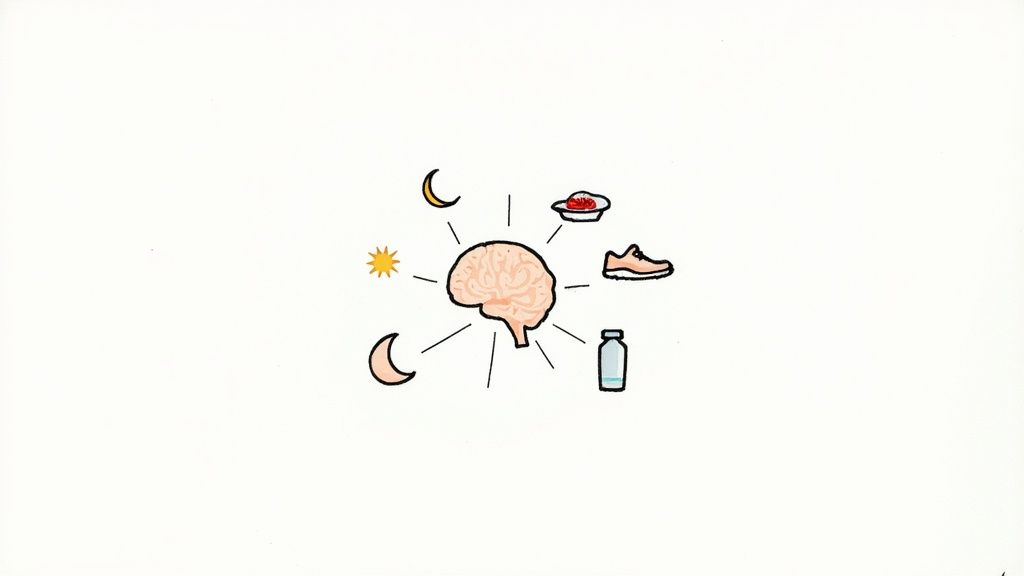
All the routines and protocols we’ve covered are incredibly potent, but they work best when built on a solid foundation. True, lasting mental clarity isn’t something you just switch on at your desk; it’s a direct reflection of how you care for your body and mind around the clock.
Think of your brain as a high-performance engine. You can be the most skilled driver, but if you’re using low-grade fuel and never letting the engine cool down, you’ll never reach top speed. Optimizing your sleep, nutrition, and daily habits is how you provide the premium fuel and recovery your brain needs to operate at its peak.
Master Your Sleep for a Sharper Mind
Sleep isn’t just downtime—it’s your brain’s most vital maintenance period. While you rest, your brain is busy clearing out metabolic waste that builds up during the day. A landmark study in the journal Science showed just how critical this cleanup process is for cognitive function. Without it, our ability to focus and think clearly plummets.
Getting 7-9 hours of quality sleep is non-negotiable if you’re serious about improving your focus. But remember, quality is just as important as quantity.
Here’s a practical checklist to upgrade your sleep hygiene, starting tonight:
- Create a Cave: Your bedroom should be dark, cool, and quiet. Blackout curtains and a room temperature around 65°F (18°C) send powerful signals to your body that it’s time for deep, restorative rest.
- Set a Blue Light Curfew: Put away your screens—phones, tablets, TVs—at least 90 minutes before you plan to sleep. The blue light they give off actively suppresses melatonin, the hormone that governs your sleep-wake cycle.
- Establish a Wind-Down Ritual: A consistent pre-sleep routine is key. Try reading a physical book, doing some light stretching, or journaling to get the day’s thoughts out of your head and onto paper.
Fuel Your Brain with the Right Nutrients
What you eat has a direct and profound impact on your brain’s structure and function. Certain nutrients are absolute superstars when it comes to supporting neurotransmitter health, taming inflammation, and protecting your brain cells.
Start by adding a few of these brain-boosters to your next grocery list:
- Fatty Fish: Salmon, mackerel, and sardines are loaded with omega-3 fatty acids, which are the essential building blocks for brain and nerve cells.
- Blueberries: These are packed with antioxidants that can help delay brain aging and sharpen your memory.
- Walnuts: As the only nut with a significant amount of ALA (a plant-based omega-3), walnuts are a true powerhouse for cognitive health.
On top of adding good stuff in, you need to manage the bad. Chronic stress jacks up cortisol, a hormone that can seriously impair your focus. Learning how to reduce cortisol levels naturally through diet and other habits is a huge win for mental clarity. For a more comprehensive guide, check out these top tips on hydration, nutrition, exercise, and sleep, as they all play a critical role.
Structure Your Day with Task Batching
Beyond your biology, how you organize your day has a massive effect on your ability to concentrate. Task batching is a deceptively simple strategy that protects your focus from the constant barrage of distractions. Instead of jumping between different types of work, you group similar activities together and knock them out in dedicated blocks.
A 2017 study revealed a startling statistic: the average office worker gets interrupted every three minutes and five seconds. After each one of those interruptions, it can take over 23 minutes to fully regain focus. Task batching is your best defense against this constant cognitive drain.
Here’s what this looks like in the real world. A marketing manager is trying to develop a new campaign strategy, but her email notifications keep pulling her away. Instead of reacting to every new message, she implements task batching:
- 10:00 AM – 10:30 AM: Her first email batch. She clears her entire inbox.
- 4:00 PM – 4:30 PM: The second and final email batch for the day.
Outside of those two windows, her email client is completely closed. This simple shift carves out huge, uninterrupted chunks of time for the deep, strategic work that actually moves the needle. Her focus and productivity soar.
How to Track Progress and Overcome Focus Barriers
Improving your focus isn’t a “one-and-done” deal. It’s a skill, and like any skill, you get better with deliberate practice. The problem is, how do you know if you’re actually getting better?
Without a way to measure your progress, it’s easy to feel like you’re just spinning your wheels. That feeling kills motivation faster than anything. The trick is to create a simple feedback loop that shows you what’s working, keeping you in the game.
You don’t need some complicated app or an elaborate spreadsheet. In my experience, the simplest methods are the ones that stick. The goal here is to make the abstract idea of “getting better at focusing” tangible—something you can actually see and feel good about.
Simple Ways to Measure Your Focus
Start by picking one or two incredibly simple things to track every day. This gives you immediate feedback and helps you connect the dots between your actions (like getting a good night’s sleep) and your ability to concentrate the next day.
Here are a couple of my favorite, battle-tested methods:
- The Daily Focus Score: At the end of your workday, take literally 30 seconds to rate your overall focus on a scale of 1-10. A ‘1’ means you were a human pinball, bouncing from one distraction to the next. A ’10’ means you were in a state of pure, uninterrupted flow. Jot this down in a notebook or a note on your phone. Over a few weeks, you’ll start seeing clear patterns.
- Deep Work Session Count: If a subjective score isn’t your thing, go for a pure output metric. Just count how many deep work blocks (your 50/10 or 25/5 sessions) you successfully completed. Did you nail three blocks today? Awesome. Four? Even better. This shifts your goal from a vague feeling to a concrete number you can hit.
A study in the Journal of Applied Psychology confirmed what many high-performers already know: people who monitor their progress are significantly more likely to achieve their goals. The simple act of tracking builds self-awareness and hardwires the very behaviors that lead to success.
Troubleshooting Common Focus Roadblocks
Look, even with a great system, you’re going to have days where your brain feels like a browser with 100 tabs open. It happens to everyone.
The key is to stop seeing these moments as failures and start seeing them as data. Instead of just trying to “focus harder” (which rarely works), you can diagnose the root cause and apply a specific fix.
To help you with that, I’ve put together a quick-reference guide for the most common focus-killers I see.
Common Focus Problems and Actionable Solutions
Think of this table as your field guide for navigating internal distractions. When you hit a roadblock, don’t just get frustrated. Identify the problem and use the corresponding tool to get back on track.
| Common Problem | Underlying Cause | Practical Solution |
|---|---|---|
| Constant Mental Chatter | An overactive mind that just won’t settle down. | Use the ‘note and dismiss’ technique. When a random thought pops up, mentally acknowledge it (“Ah, there’s that thought about email again”) and then gently let it go without judgment. Picture it floating away as you return to your task. |
| Internal Anxiety/Worry | Stressors and anxieties hijacking your attention. | Before you start a deep work session, spend five minutes with a ‘worry journal.’ Dump every single anxiety, to-do, and concern onto the page. This act of externalizing the thoughts gives your brain permission to let them go for the next hour. |
| Feeling Overwhelmed | The task feels so massive that you don’t even know where to begin. | Break it down into the smallest possible first step. Your goal isn’t “write the report.” It’s “open the document and write one sentence.” Getting that tiny win releases a little hit of dopamine, creating the momentum you need to keep going. |
By learning to recognize these patterns, you move from being a victim of your distractibility to being the architect of your focus. It’s a subtle but powerful shift.
That last point about dopamine is backed by some fascinating science. A 2018 study in Neuroscience & Biobehavioral Reviews shows just how critical this neurotransmitter is for motivation. When you achieve small, manageable goals, you trigger your brain’s reward system, which in turn strengthens your drive to tackle the bigger objective.
Another powerful tool comes from the world of mindfulness. Research published in Frontiers in Human Neuroscience has demonstrated that regular meditation can physically strengthen the prefrontal cortex—the part of your brain that acts as your attention’s CEO.
When a distracting thought or feeling arises, mindfulness trains you to simply observe it without getting swept away. For instance, if you’re deep in a task and suddenly feel a wave of anxiety about a deadline, you can pause, acknowledge the feeling (“This is anxiety”), take three deep breaths, and then gently guide your focus back to your work. This builds incredible mental resilience, making it easier to stay on task even when your internal world feels a bit stormy.
Frequently Asked Questions About Improving Focus
As you start putting these focus strategies into practice, you’re bound to have questions. This isn’t about getting it perfect overnight; it’s about making steady progress. Having answers to common sticking points can be the difference between giving up and breaking through.
Think of this section as your troubleshooting guide. If a particular technique isn’t working for you, these insights can help you tweak your approach, clear a hurdle, and keep building a more focused mind.
How Long Does It Realistically Take to See Improvements in Focus?
You might feel a nice burst of clarity right after your first breathwork session, but building deep, reliable concentration is more like training a muscle than flipping a switch. The real, lasting changes come from consistency.
Most people start to feel a tangible difference—like being less rattled by distractions and more in control of their attention—within 2-4 weeks of consistent daily practice. This is usually when new habits, like a 10-minute morning routine, start feeling natural instead of like a chore.
Truly significant shifts, like being able to drop into deep work states and stay there for extended periods, typically build over 2-3 months. Just remember, a daily 10-minute focus session is infinitely more powerful than trying to cram in a two-hour session once a week.
Are Focus-Enhancing Apps and Tools Actually Effective?
They definitely can be, but with a big caveat: they’re a support system, not a magic pill. The best tools don’t create focus for you; they create an environment where you can focus.
Some apps are fantastic for setting the stage for deep work:
- Website Blockers: Tools like Freedom or Cold Turkey are brilliant for creating a distraction-free digital space. You simply can’t get sidetracked by sites that are blocked.
- Timers: A simple Pomodoro timer is all you need to add structure to your work sprints, removing the mental energy of deciding when to work and when to rest.
- Mindfulness Apps: For anyone new to meditation, a guided app can be an incredible way to build a consistent practice.
Be wary, however, of “brain training” games. A 2016 Federal Trade Commission ruling highlighted that many claims about these games are not supported by scientific evidence, as skills rarely translate to better performance on real-world tasks. The best tools are the ones that help you nail the fundamentals we’ve already covered. They should support your good habits, not try to replace them.
How Can I Improve Concentration in a High-Stress Job?
When you’re in a high-interruption environment, trying to eliminate all distractions is a losing battle. The real strategy is to create and fiercely protect small pockets of intense concentration throughout your day.
You have to shift your mindset from long, uninterrupted hours to short, powerful “focus sprints.” Maybe that’s a 15-minute blitz on a high-priority task between back-to-back meetings. The goal is to be incredibly intentional with the small windows of time you actually control.
The most critical skill to develop here is the micro-recovery. After an inevitable interruption pulls you away, take 60 seconds for three slow, deep breaths. This simple act resets your nervous system, allowing you to return to your task with a clear head instead of carrying the stress and mental clutter of the interruption with you.
Get aggressive with task batching. Group all your reactive work—like answering emails or Slack messages—into dedicated blocks. You can’t stop every tap on the shoulder, but you can absolutely control how quickly and effectively you recover.
What Is the Single Most Important Habit for Better Focus?
If you could only make one change, it would be this: master your relationship with your smartphone. That constant stream of notifications is the number one enemy of sustained concentration in the modern world. Every single ping, buzz, and banner is an invitation for your brain to switch gears, and that context-switching shatters your focus.
The most impactful habit you can build is to turn off all non-essential notifications. No banners, no sounds, no red bubbles for social media, email, or news. This one change flips your relationship with technology from reactive to proactive.
Instead of your phone telling you where your attention should go, you get to decide. You can then schedule specific times to check those apps intentionally. This is how you reclaim the mental space required for deep, meaningful work.
Ultimately, the best techniques for improving focus blend behavioral changes, environmental control, and direct mental training. Methods like the ‘Pomodoro Technique’ work so well because they align with our natural attention spans, while mindfulness trains the brain to stay present and calm. As you weave these habits together, you’ll find that sustaining focus gets easier and easier. If you want to explore these integrated strategies further, you can cut through the chaos with these insights on Betaboom.com.
Ready to go deeper and rewire your system for unshakable focus? 9D Breathwork combines powerful breathwork techniques with binaural beats, hypnotic guidance, and NLP to help you disrupt old patterns at the root. Explore our transformative journeys and experiences today at https://9dbreathwork.com.