If you feel like your attention is under constant assault at work, you’re not imagining things. The struggle to lock in and concentrate isn’t a personal failure—it’s a direct result of the modern work environment we’re all navigating.
We’ve been sold the idea that multitasking is a superpower, but the research tells a different story. It’s a myth, and it’s quietly sabotaging our productivity.
Why You Can’t Focus at Work
Every time you jump from that important report to answer a quick email, then pivot to a Slack notification, you’re forcing your brain to slam on the brakes and completely reorient. This is called context switching, and it’s a massive drain on your mental fuel, leaving you feeling frazzled and busy, but not truly productive.
It’s not just a feeling, either. A study from the Journal of Experimental Psychology found that the tiny mental roadblocks created by task-switching can eat up as much as 40 percent of a person’s productive time.
The True Cost of Interruptions
The constant ping of notifications and the unspoken pressure to be available right now create a perfect storm for distraction. On average, workers are interrupted roughly every three minutes. What’s worse? A study published in Human-Computer Interaction found it takes a staggering 23 minutes to get back into that deep state of focus after each interruption.
These little breaks systematically chip away at any chance of achieving that coveted state of “flow” or deep work.
The real problem isn’t a lack of willpower. It’s a work culture that rewards constant availability over deep, sustained attention. To get your focus back, you have to first reclaim control of your time and your environment.
This state of partial attention doesn’t just tank our output; it’s also terrible for our well-being. A study in the journal Computers in Human Behavior found a direct link between workplace “telepressure”—that compulsive urge to respond instantly—and higher rates of burnout and feeling detached from your work.
Taking Your First Steps Toward Better Focus
The good news? You can absolutely fight back and retrain your brain. It all starts with recognizing the external forces at play and consciously building a defense system. This takes a shift in mindset and a real commitment to building your self-awareness. If you’re looking to explore that inner world, our guide on how to increase self-awareness is a great place to start.
Here are a few immediate things you can do to start taking back control:
- Silence the noise. Actionable step: Go into your phone and computer settings right now and turn off banners and sounds for all apps except calls. Do the same for your desktop apps like Slack and email.
- Book “Do Not Disturb” time. Actionable step: Open your calendar and block out a 90-minute “Focus Block” for tomorrow morning. Label it clearly and set your status to “Do Not Disturb” during that time.
- Embrace single-tasking. Actionable step: Pick your most important task for the day. Set a timer for 25 minutes and work on only that task. No email, no other tabs. Just one thing.
Implementing these small, strategic changes begins the process of rewiring your brain for concentration. For a more comprehensive game plan, you can explore these actionable steps to focus better at work.
To make this even easier, I’ve put together a quick-start guide for the most common focus-killers you’re likely facing right now.
Immediate Focus Boosters Your Quick-Start Guide
This table is your go-to cheat sheet. When you feel your attention slipping, find your challenge below and apply the immediate fix.
| Challenge | Immediate Action | Long-Term Benefit |
|---|---|---|
| Constant Notifications | Turn off all non-essential alerts on your phone and desktop for the next 90 minutes. | Retrains your brain to not expect constant external stimuli, reducing anxiety. |
| Open Tab Overload | Close all browser tabs except the one you need for your current task. Use a “read later” app. | Creates a clean digital workspace, minimizing visual clutter and temptation. |
| “Urgent” Interruptions | Set a “focus” status on Slack/Teams and communicate your availability boundaries to your team. | Establishes a culture of respect for deep work, for you and your colleagues. |
| Mental Fog/Fatigue | Step away from your desk for 5 minutes. Do a quick walk or a simple 2-minute box breathing exercise. | Resets your nervous system, improves blood flow to the brain, and breaks the stress cycle. |
Think of these not as one-time fixes, but as new habits you’re building. Each time you consciously push back against a distraction, you strengthen your ability to focus and take back ownership of your day.
Build Daily Routines for Unbreakable Focus
Lasting focus isn’t something you can just summon with willpower. It’s built, brick by brick, through smart systems that guard your attention. The real secret is creating daily routines that cut down on decision fatigue and make deep work feel like a natural habit, not a constant battle.
If you rely on motivation to get things done, you’re setting yourself up for an inconsistent, frustrating ride. A solid routine, on the other hand, is your commitment device. It protects your most precious resource—your attention—by giving your day a predictable rhythm. You’re essentially telling your brain what to focus on and when, which saves a ton of mental energy that would otherwise be spent figuring out “what’s next?”
The Power of Single-Tasking
In a culture that practically worships multitasking, the idea of doing just one thing at a time can feel radical. But the truth is, our brains aren’t built to handle multiple complex tasks at once. Research from the Journal of Experimental Psychology found that multitasking can torpedo your productivity by as much as 40%. When you think you’re multitasking, you’re actually just “task-switching”—forcing your brain to rapidly toggle its focus, which carries a massive cognitive cost.
Actionable Example: Imagine you need to create a sales presentation. Instead of working on slides while monitoring your inbox and responding to Slack messages, block out 90 minutes. During this time, turn off email and Slack notifications, close all unrelated browser tabs, and commit solely to building the presentation. You’ll likely finish faster and produce a higher-quality result.
By intentionally choosing to do one thing at a time, you move from a state of frantic reactivity to one of calm, deliberate action. This shift is fundamental to improving your focus at work.
Architect Your Day with Time-Blocking
Time-blocking is where the single-tasking philosophy gets practical. It’s all about scheduling your entire day into specific blocks of time, each one dedicated to a particular task. This proactive approach turns your calendar from a simple list of appointments into a roadmap for your attention. Using one of the best daily planner apps can give you the digital framework you need to structure your day and lock in that focus.
Actionable Example: Open your calendar for tomorrow. Block out these specific times:
- 9:00 AM – 10:30 AM: Deep Work. Assign your #1 most important task to this slot.
- 11:00 AM – 11:45 AM: Communication. Batch process all your emails and return calls here.
- 2:00 PM – 3:00 PM: Project Planning. Use this lower-energy time for admin or organizational tasks.
Suddenly, abstract goals become a concrete plan of action. You can take this even further by designing a morning routine that sets a productive tone. Instead of grabbing your phone and diving into emails, start with a 10-minute activity that primes your brain for focus, like journaling or running through some specific breathing exercises. You can learn more about how certain techniques like breathing for energy can give you a quick mental boost.
This infographic shows just how long it takes to regain your concentration after a typical workplace interruption.
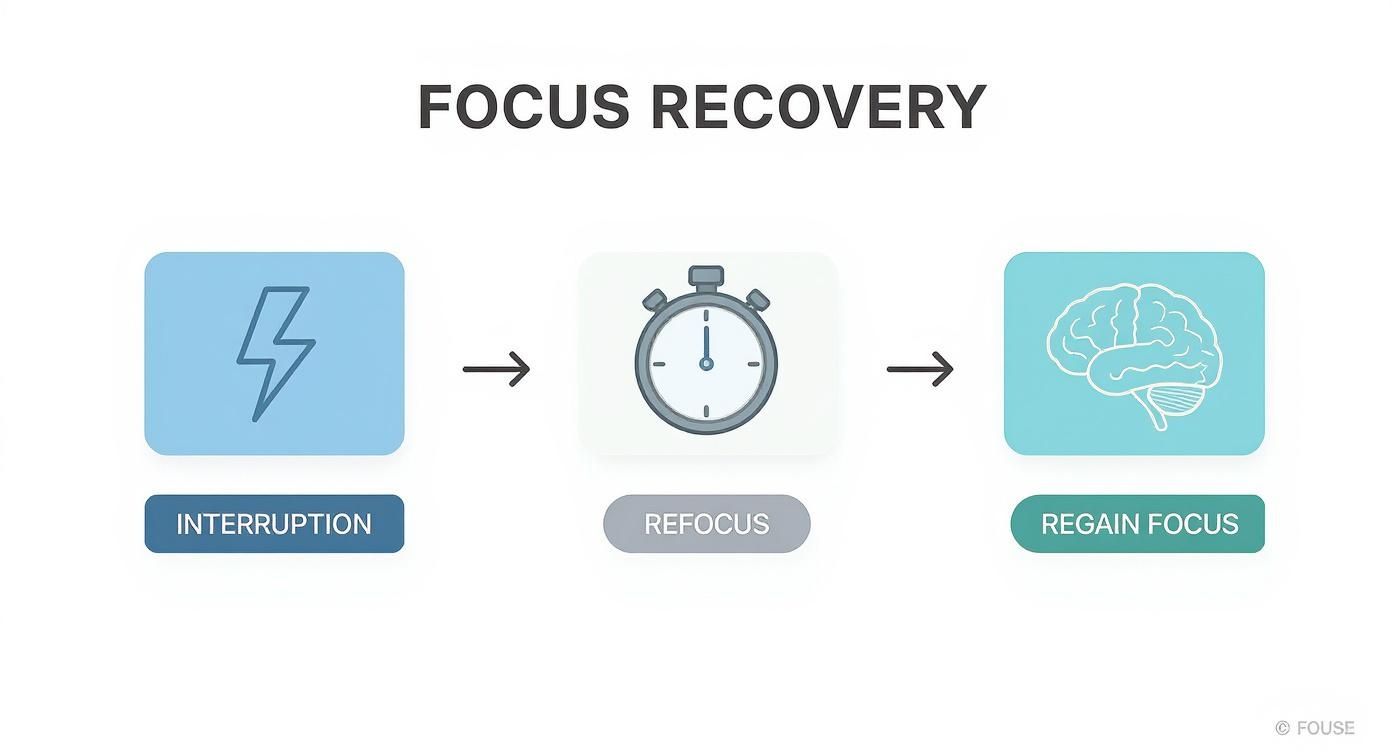
As you can see, even a minor distraction has a significant time cost, which really drives home the importance of building routines that protect your focus.
Optimize Your Workspace for Deep Work
Your environment is a powerful, and often invisible, force shaping your ability to concentrate. Think about it: a cluttered desk or a chaotic digital life creates constant, low-level friction. It makes finding your focus feel like an uphill battle from the start.
By consciously designing your surroundings, you can flip the script and make deep work the path of least resistance.
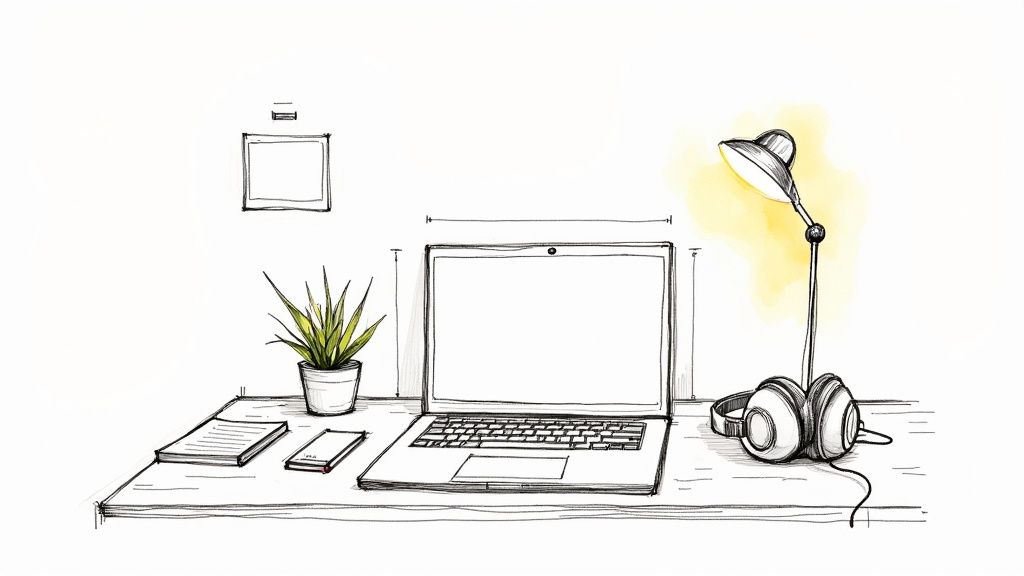
The state of your workspace directly mirrors the state of your focus. When your physical area is a mess, your brain has to work harder just to filter out irrelevant stuff, draining the very energy you need for complex tasks. This isn’t just about being tidy; it’s about creating an environment that signals to your brain, “Okay, it’s time to lock in.”
A study from the Princeton University Neuroscience Institute found that visual clutter actively competes for your attention, leading to decreased performance and increased stress. The simple act of clearing your desk of everything except what’s essential for your current task sends a powerful psychological cue to your brain.
Tame Your Physical Environment
Your immediate physical surroundings are your first line of defense against distraction. A few strategic adjustments can make a world of difference in your ability to stay locked in throughout the day.
Here are a few actionable ways to get your physical workspace on your side:
- Control the Noise: Actionable step: Invest in a quality pair of noise-canceling headphones. Even in a seemingly quiet office, the low hum of conversation can subtly splinter your deep thought.
- Optimize Your Lighting: Actionable step: If possible, position your desk near a window for natural light. If not, purchase a desk lamp with adjustable brightness to reduce eye strain and fatigue.
- Keep Essentials Within Reach: Actionable step: Before starting a focus block, place your water bottle, notebook, and any necessary documents within arm’s length. This prevents you from breaking your concentration to find something.
Creating a distraction-free environment isn’t about achieving perfection. It’s about removing the small, unnecessary obstacles that collectively derail your attention, allowing your mind to settle into that incredible state of productive flow.
Conquer Your Digital Clutter
In today’s world, digital distractions are often far more disruptive than physical ones. Your computer, which is supposed to be your greatest tool for productivity, can easily become the primary source of interruption if you let it.
This constant digital noise has a real cost. Employee engagement is directly tied to focus, yet as of 2024, a staggering 21% of employees worldwide reported feeling engaged. This leads to massive productivity losses, with workers spending four hours a week just refocusing after switching between apps. That’s 9% of productive time gone, just like that. You can dig deeper into how these productivity stats impact the modern workplace on Clockify.me.
To reclaim your digital space, you need a proactive plan.
Actionable Example: Take 15 minutes at the end of your day to reset your digital workspace.
- Desktop: Create a single folder named “To File” and drag all loose files into it.
- Notifications: Go into your main communication app’s settings and turn off all banner and sound alerts.
- Inbox: Close your email client. Commit to only opening it during your scheduled “Comms Block” tomorrow.
This one habit can liberate hours of focused time you never knew you had.
Rewire Your Brain for Sustained Attention
Let’s be honest, improving your focus goes way deeper than just silencing notifications or tidying up your desk. Those are external fixes. Real, lasting concentration? That’s an internal skill. By training your mind with a few powerful mental frameworks, you can actually strengthen your attention span and learn to manage that internal chatter that constantly pulls you off task.
It’s all about building a mental toolkit that helps you redirect your thoughts, find clarity on the most chaotic days, and work with intention—not just by accident.
Use Actionable Prompts to Reclaim Your Focus
When your mind inevitably wanders off—and it will—having a go-to script can be a game-changer for pulling you back to the present. Instead of just passively letting distraction win, you actively intervene. A study in the Journal of Cognitive Enhancement confirms that attentional control is a trainable skill, and using self-directed cues is a practical way to exercise that mental muscle.
Think of them as focus-driven questions you can ask yourself in real-time. The moment you catch yourself scrolling through social media or just daydreaming, pause and ask:
- “Is what I’m doing right now moving me toward my most important goal?”
- “What is the one thing I should be working on right now?”
Actionable Step: Write one of these questions on a sticky note and place it on the edge of your monitor. This visual cue will prompt you to self-correct when your attention drifts. If you want to go deeper, it’s helpful to understand how to break negative thought patterns, because the same principles of awareness and redirection are at play here.
Turn Overwhelming Projects into Micro-Goals
You know that feeling when a massive project lands on your to-do list? It can feel paralyzing, making it incredibly easy to procrastinate with busywork. This is where the concept of micro-goals comes in. It dismantles that overwhelm by breaking down a huge objective into tiny, achievable wins.
This approach works because it leverages your brain’s own reward system. A study in the journal Neuron explains how achieving small goals triggers a release of dopamine, which boosts motivation and, crucially, sharpens your focus for whatever comes next.
Actionable Example: Your task is “Create the quarterly report.” Break it down like this:
- Open a new document and create the title page.
- Outline the main sections.
- Gather data for section one.
- Write the first paragraph of the introduction.
Each time you check one off, you build momentum, making the next step feel so much less daunting.
Mental Models for Immediate Focus
When your focus starts to drift, having a few quick mental techniques and breathwork exercises in your back pocket can make all the difference. Think of this table as your emergency reset button for common workplace scenarios.
| Situation | Technique to Apply | Why It Works |
|---|---|---|
| You just got a stressful email. | Box Breathing: Inhale (4s), hold (4s), exhale (4s), hold (4s). Repeat 3-5 times. | It physically calms your nervous system’s fight-or-flight response, clearing the mental fog caused by anxiety. |
| You catch yourself mindlessly scrolling. | The “One Thing” Prompt: Ask, “What is the one most important thing I should be doing right now?” | This forces a conscious interruption of the distraction pattern and redirects your attention to your actual priority. |
| A huge project feels overwhelming. | Micro-Goal Breakdown: Identify the absolute smallest first step you can take in the next 5 minutes. | It bypasses procrastination by creating a small, achievable win, which triggers a dopamine release and builds momentum. |
| You’re stuck in a meeting that’s dragging on. | The 4-7-8 Breath: Inhale through your nose (4s), hold (7s), exhale through your mouth (8s). | The long exhale stimulates the vagus nerve, which has a powerful relaxing effect on your body and mind. |
These aren’t complex, time-consuming practices. They are quick, in-the-moment tools designed to pull you back from the edge of distraction and anchor you in the present.
Hit the Reset Button with Your Breath
When you feel your focus slipping or stress starting to creep in, your breath is hands-down the fastest way to reset your nervous system. Simple breathwork exercises can act as a real-time anchor, pulling your attention right back to the here and now.
Actionable Step: Practice Box Breathing Right Now
- Inhale slowly through your nose for a count of four.
- Hold your breath gently for a count of four.
- Exhale slowly through your mouth for a count of four.
- Hold at the bottom of the exhale for a count of four.
Repeat this cycle three to five times. You’ll notice how this controlled breathing immediately slows your heart rate and calms that fight-or-flight response, clearing the mental fog and letting you get back to your work with renewed clarity.
How to Measure and Troubleshoot Your Focus
Mastering focus isn’t a “one-and-done” kind of deal. It’s more like training a muscle—a continuous journey of tuning in, figuring out what works, and making small, consistent tweaks along the way. After all, you can’t improve what you don’t measure.
The first step is to become a detective of your own attention.
Actionable Step: For the next three workdays, use a simple notebook. Draw two columns: “High Focus” and “Low Focus.” Whenever you feel completely in the zone or totally distracted, note the time and the task you’re doing.
This simple act of observation gives you a goldmine of data. You might discover your peak creative energy hits between 9 AM and 10:30 AM, making that the absolute perfect window to tackle your most demanding work.
Pinpointing Your Focus Killers
Once you have a little data, start looking for patterns. Do you consistently hit a wall right after lunch? Does that mid-afternoon slump feel inevitable? A study in the journal Cognition found that even brief mental breaks can dramatically improve your ability to stay locked in on a long task.
So, instead of trying to bulldoze through that fatigue, try scheduling a deliberate 10-minute break to get up and walk away from your screen. You might be surprised by how much it helps.
Progress, not perfection, is the name of the game. Some days will be better than others. The real win is learning from the off days instead of letting them send you into a productivity guilt trip.
It’s also crucial to get honest about your biggest time-wasters. Is it the endless doomscrolling on social media, or do you get sucked into email chains that have nothing to do with your priorities? Once you name the culprit, you can fight back with a specific strategy, like using an app blocker during your deep work sessions.
Troubleshooting Common Focus Roadblocks
Even with the best plan in the world, life happens. Trying to get back into a rhythm after a vacation or navigating a super stressful week can feel like you’re starting all over again.
When you feel that way, don’t aim for a full day of flawless focus. Shrink the goal way down.
Actionable Step: Commit to just one 25-minute “focus sprint” using the Pomodoro Technique. Set a timer, work uninterrupted on one thing, and then take a 5-minute break. Research from the University of Illinois actually backs this up, suggesting that brief diversions from a task can significantly improve how long you can stay focused. These small wins are fantastic for rebuilding momentum without piling on more stress.
For a deeper shift that gets to the root of the problem, you might want to explore how structured practices like 9D Breathwork can help. By addressing the deep-seated causes of distraction stored in the subconscious, you can start to rewire your brain’s default settings for more effortless and sustained concentration over the long haul.
Got Questions About Workplace Focus? We’ve Got Answers.
Even with the best game plan, you’re bound to run into a few hurdles on the path to better focus. It happens to everyone. Let’s tackle some of the most common challenges people face when trying to win back their attention at work.
How Can I Stay Focused in a Noisy Open Office?
This is a big one. Your first line of defense is to take control of your personal soundscape. Noise-canceling headphones are non-negotiable here; they’re a powerful signal to your brain (and your coworkers) that it’s go-time.
Actionable Step: Pair your headphones with an app or website that plays ambient sounds like rain, a coffee shop, or white noise. This works wonders for masking the random chatter that pulls you out of the zone. Also, let your team know when you’re blocking out time for deep work. A simple “focus mode” status on Slack can stop interruptions before they start.
What if I Can’t Avoid Multitasking?
Look, some jobs just demand it. The trick isn’t to eliminate multitasking altogether but to shift from a chaotic, reactive approach to a more structured one. It’s all about “task batching.”
Instead of trying to write a report while fielding emails and Slack messages simultaneously, group all your similar tasks together.
Actionable Step: Schedule three specific 30-minute blocks in your calendar for “Communications.” Outside of those times, keep your email and Slack clients closed. The Harvard Business Review has shown that just having your smartphone in sight can drain your cognitive capacity. Apply that same logic to your digital tasks—out of sight, out of mind. This way, you’re still responsive, but you’re not constantly switching gears.
Is It Normal for My Focus to Fluctuate?
Absolutely, 100% normal. Your ability to concentrate isn’t a fixed switch you can just turn on. It ebbs and flows throughout the day based on everything from your sleep quality to your energy levels. A study in Neuroscience & Biobehavioral Reviews even points to how our dopamine levels influence our drive to stay on task.
So, instead of fighting your natural rhythm, learn to work with it.
Actionable Step: Use the data from your focus journal to identify your one or two peak focus hours. Guard that time fiercely for your most challenging projects. Save lower-energy periods for easier administrative tasks or for taking a guilt-free break to recharge.
The goal isn’t to achieve eight straight hours of perfect, laser-like focus. That’s just not how our brains work. It’s about creating consistent pockets of high-quality attention and respecting your mind’s natural need for rest and recovery.
Ready to stop just managing the symptoms of distraction and start rewiring the root cause? 9D Breathwork is a powerful way to clear out subconscious patterns, cut through mental fog, and build a foundation of unshakable focus from the inside out. Explore our guided journeys today and discover what true mental clarity feels like.