Dealing with chronic stress isn’t a one-shot fix; it’s about weaving together quick coping tools for those tough moments with deeper, long-term lifestyle shifts. It all starts with learning to spot the subtle signs in your daily grind and then taking real action with practical strategies like breathwork, smarter routines, and a little cognitive rewiring.
Understanding the Toll of Unmanaged Chronic Stress
Chronic stress isn’t just about having a few bad days. It’s that relentless, low-humming state of high alert that quietly chips away at your performance, your health, and frankly, your happiness.
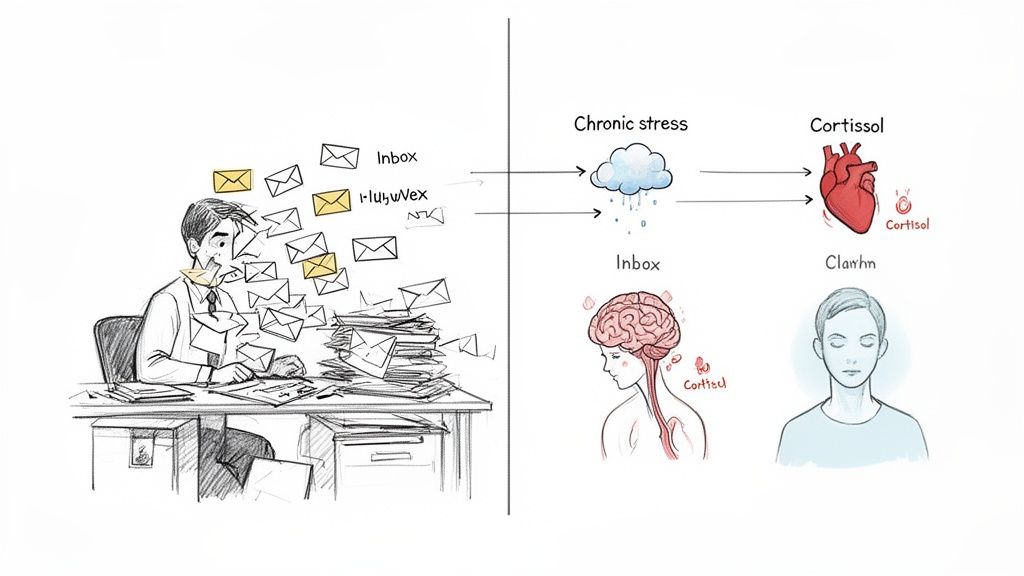
Unlike the useful jolt of acute stress that helps you swerve to miss a car, chronic stress leaves your body’s “fight or flight” switch stuck in the ‘on’ position.
This means you’re getting a constant, IV-drip of stress hormones like cortisol and adrenaline. While great for emergencies, a nonstop supply is seriously damaging. For busy professionals, this overload often masquerades as just another “part of the job.” A peer-reviewed study published in The Lancet highlighted that individuals with higher perceived stress have a greater risk of developing cardiovascular disease, demonstrating the direct physical consequences of leaving stress unchecked.
What Chronic Stress Looks Like in Real Life
Ever feel that jolt of anxiety when an email notification pops up? Or find yourself replaying work conversations on a loop long after you’ve shut your laptop? That’s not just the sign of a demanding job—it’s a classic symptom of an overactive stress response.
Here’s how it often shows up:
- A Constant Sense of Drowning: That feeling you’re always behind, no matter how hard you pedal. Actionable example: You spend an extra hour at work to “catch up,” but your to-do list is even longer the next day.
- A Short Fuse: Snapping at a colleague or family member over something small. Actionable example: A coworker asks a simple question, and you respond with sharp, unnecessary frustration.
- Physical Wear and Tear: Nagging tension headaches, an upset stomach, or a bone-deep fatigue you can’t shake. Actionable example: You wake up more tired than when you went to bed, reaching for a third coffee before 10 a.m.
- Brain Fog: Struggling to focus on one thing at a time, making you feel scattered and unproductive. Actionable example: You read the same email three times and still can’t process what it’s asking for.
These aren’t just annoyances; they’re your body’s alarm bells, signaling that you’re running on empty. This constant hormonal flood can lead to serious health issues down the line, which is why learning how to reduce cortisol levels naturally is one of the most powerful things you can do for yourself.
To get a clearer picture of where you stand, take a moment to reflect with this self-assessment.
Chronic Stress Red Flags: A Quick Self-Assessment
We often normalize symptoms of chronic stress, brushing them off as “just a busy week.” Use this table to honestly check in with yourself and see if any of these red flags are waving.
| Symptom Category | What It Looks Like | Personal Check-In Question |
|---|---|---|
| Cognitive | Indecisiveness, memory lapses, constant worrying, racing thoughts. | “Am I finding it harder to make simple decisions or stay focused lately?” |
| Emotional | Irritability, moodiness, feeling isolated, a sense of overwhelm. | “Have I been more easily agitated or withdrawn from others recently?” |
| Physical | Aches and pains, low energy, frequent colds, changes in appetite. | “Is my body trying to tell me something with these headaches or stomach issues?” |
| Behavioral | Procrastinating, sleeping too much or too little, nervous habits. | “Have my daily habits changed? Am I avoiding things I used to enjoy?” |
If you found yourself nodding along to several of these, it’s a clear sign that stress is taking a bigger toll than you might realize. It’s time to take it seriously.
The Widespread Impact on Professionals
If this all feels a little too familiar, you’re in good company. Gallup’s 2023 Global Workplace Report found that an incredible 44% of employees worldwide feel ‘a lot of stress’ every single day.
This isn’t just about feeling bad. It’s a massive drain on productivity, costing the U.S. economy a jaw-dropping $300 billion annually in absenteeism and healthcare.
This constant state of alert doesn’t just impact your work—it seeps into every corner of your life, straining relationships and diminishing your overall sense of well-being. Recognizing it is the first step toward reclaiming your balance.
The exhaustion of burnout, the end-stage of chronic stress, hits some harder than others. To understand the unique pressures certain groups face, this insightful guide on working mother burnout is well worth a read.
By finally acknowledging these signs in your own life, you can start to tackle the root causes and build a more resilient, balanced way of living.
Your On-the-Spot Toolkit for High-Pressure Moments
When you’re caught in the grip of chronic stress, thinking about long-term solutions can feel impossible. You need something that works right now—a way to break the cycle of overwhelm the second it hits.
This is your toolkit for those high-pressure situations. Whether you’re about to walk into a tough meeting or just staring at an overflowing inbox, these are your immediate, science-backed moves for relief. They’re discreet, surprisingly powerful, and you can do them anywhere. Think of them as a quick reset button for your nervous system.
Tame Your Nervous System with Box Breathing
Ever notice that when you feel anxious, your breathing gets shallow and quick? That’s your body’s alarm system going off. The fastest way to turn off that alarm is to consciously take control of your breath.
Box breathing is a simple, structured way to do just that. A study in Frontiers in Psychology found that even brief periods of controlled, slow breathing can significantly lower stress markers like heart rate and cortisol. It works by flipping the switch to your parasympathetic nervous system—your body’s “rest and digest” mode.
Here’s the technique:
- Inhale through your nose for a slow count of four. Really feel the air filling your lungs.
- Gently hold that breath for four counts. No need to clamp down, just pause.
- Exhale slowly through your mouth for four counts. Let it all go.
- Hold your lungs empty for a final four counts.
Actionable Example: You’re five minutes from a critical presentation, and your heart is hammering. Instead of spiraling, mute yourself on the video call, turn off your camera for a moment, and silently run through two cycles of box breathing. Feel your pulse slow and your mind clear. Now, you’re back in control.
To see how this stacks up against other methods, you can explore the differences between box breathing vs. the 4-7-8 technique and find what feels best for you.
Pull Yourself Out of a Thought Spiral with Grounding
Chronic stress loves to trap us in our own heads, replaying worries on an endless loop. The 5-4-3-2-1 grounding technique is an incredible tool for yanking your attention out of that chaotic inner world and back into physical reality.
It’s a sensory-based practice that short-circuits rumination by forcing your brain to focus on the here and now. Research from the journal Consciousness and Cognition backs this up, showing that directing our attention to simple sensory information dials down the intensity of negative thoughts.
Here’s how to walk through it:
- 5: Acknowledge FIVE things you can see. (Your monitor, a pen, a water bottle, a crack in the wall, the dust on your desk).
- 4: Notice FOUR things you can physically feel. (The pressure of your feet on the floor, the texture of your chair, the cool metal of your watch, the fabric of your shirt).
- 3: Listen for THREE things you can hear. (The low hum of a computer, traffic outside, the sound of your own breathing).
- 2: Identify TWO things you can smell. (The faint scent of your morning coffee, the sterile air from the vent).
- 1: Name ONE thing you can taste. (The lingering mint from your toothpaste or the last sip of tea).
This technique anchors you firmly in the present moment. It’s a powerful reminder to your brain that even if your thoughts are racing, you are physically safe right now.
Use Micro-Resets to Prevent Burnout
We’re often taught to just push through fatigue, but that approach only digs the hole of stress deeper. Enter the micro-reset: a brief, intentional break—sometimes as short as 60 seconds—that stops cognitive overload in its tracks.
A study in the Journal of Applied Psychology revealed that these short but frequent breaks significantly boost engagement and reduce that all-too-familiar end-of-day exhaustion. This isn’t about being lazy; it’s about being strategic with your energy to maintain peak performance.
Here are a few ways to build them into your day:
- Actionable Example: Between back-to-back meetings, stand up and stretch your arms overhead for 30 seconds.
- Actionable Example: After sending a complex email, walk to the window and just look at something far away for one minute.
- Actionable Example: Before starting a new task, close your eyes and take three slow, deliberate breaths.
- Actionable Example: Go get a glass of water and mindfully drink it—no phone allowed.
When you sprinkle these tiny resets throughout your day, you stop stress from snowballing. You’ll find you’re more resilient, focused, and in control when you turn back to your work.
Building a Stress-Resilient Daily Routine
While quick-fix tools are great for hitting the brakes when anxiety spikes, building real, lasting resilience to chronic stress is a different game altogether. It’s won in the small, consistent actions you take every single day.
This is about shifting from constantly reacting to stress to proactively building a foundation that makes you less vulnerable in the first place. Think of it like building a fortress, one brick at a time. Every decent night’s sleep, every nourishing meal, every short walk—it’s another layer of defense that prepares you for whatever professional pressures come your way.
Of course, the modern workplace doesn’t make this easy. A staggering 76% of people say stress messes with their sleep, and in the U.S., 43% of us feel tense every single day. These aren’t just personal problems; they have a massive economic fallout, contributing to an estimated $190 billion in annual U.S. healthcare costs. Research in the Journal of Occupational Health Psychology shows that workplace interventions focusing on building resilience through daily routines can significantly decrease psychological distress and improve employee well-being.
For overwhelmed professionals, getting a handle on this requires a deliberate strategy. You’ll find some great practical tips to reduce workplace stress that can help, but it all starts with your daily habits. Let’s break down the three core pillars you can build on.
Master Your Sleep with a “Digital Sunset”
You can’t out-strategize a sleep-deprived brain. Quality sleep is absolutely non-negotiable for managing chronic stress. When you’re running on fumes, your body’s cortisol levels can skyrocket, putting your emotional regulation on a hair trigger. A solid pre-sleep routine is your best defense.
This is where I love the idea of a “digital sunset.” It’s simple: you put away all screens—phones, tablets, laptops—at least 60 to 90 minutes before bed. The blue light from our devices actively suppresses melatonin, the very hormone that tells your brain it’s time to wind down.
Actionable Example: Tonight, set an alarm on your phone for 9:30 p.m. When it goes off, plug your phone in to charge outside of your bedroom. No exceptions. Use that time to read a real book, do some light stretching, or just listen to calm music. This one small change can radically improve your ability to fall and stay asleep.
The infographic below offers a quick visual on other simple techniques you can weave into your day to support better rest and bring your nervous system back into balance.
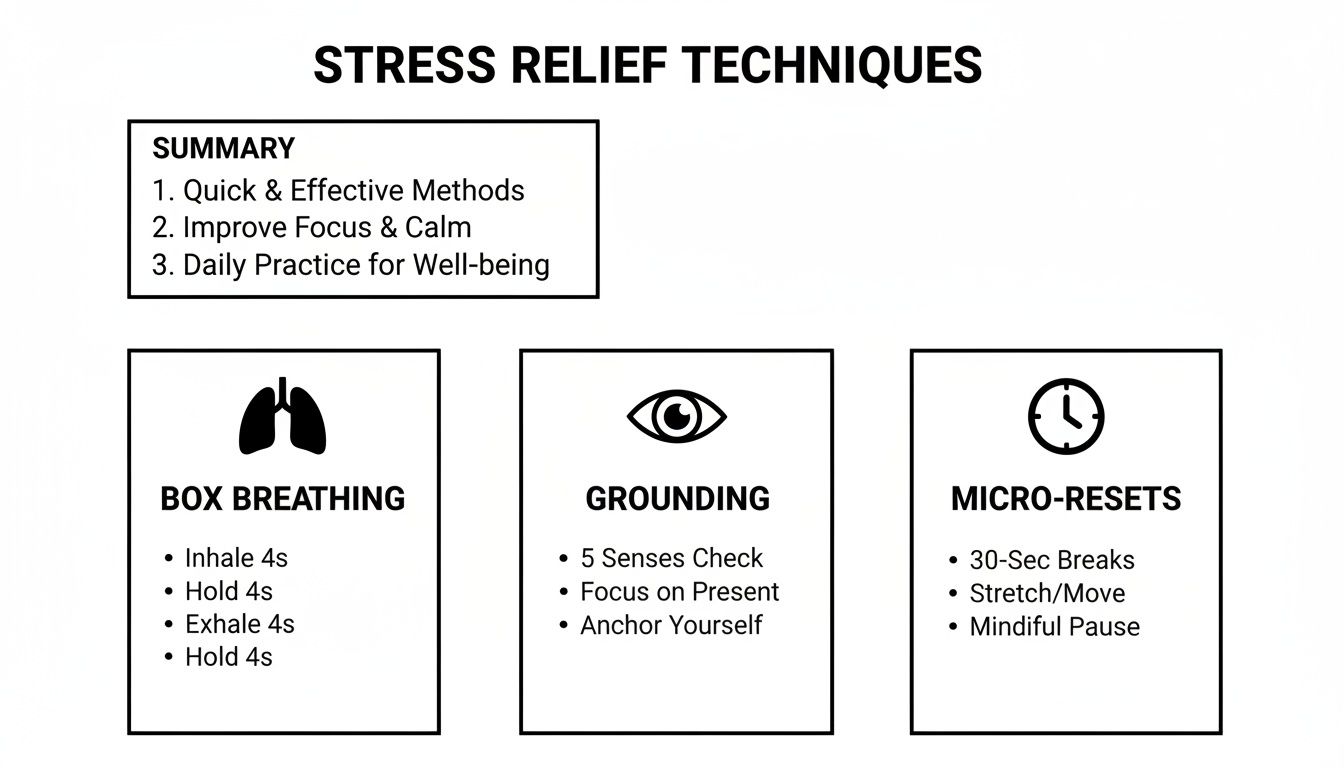
It’s a great reminder that even these tiny, consistent practices are fundamental to building a stress-proof lifestyle.
Sprinkle “Movement Snacks” Into Your Day
When you’re completely swamped, the thought of a one-hour gym session can feel more stressful than the stress you’re trying to relieve. Forget about it. The good news is that short, sharp bursts of movement—what I call “movement snacks”—are incredibly effective at breaking the stress cycle.
Physical activity helps your body metabolize excess stress hormones like cortisol and adrenaline while releasing endorphins, which are essentially natural mood boosters. Research consistently shows that even brief periods of movement can sharpen focus and beat back fatigue. A study in the Scandinavian Journal of Medicine & Science in Sports found that even short bouts of stair-climbing improved mood and energy levels more effectively than a low dose of caffeine.
Don’t aim for perfection; aim for consistency. A five-minute walk is infinitely better than the zero-minute workout you kept putting off.
Here’s how you can easily slip these into a packed schedule:
- Walk your calls: If you don’t need to be on camera, pace around your office or home while you talk.
- Try a “water cooler circuit”: Every time you get up for a drink, do 10 quick squats or calf raises. It takes seconds.
- Do a post-meeting reset: After a long sit, stand up and stretch your arms, neck, and back for just 60 seconds.
These little actions stop stress from getting physically lodged in your body, keeping you far more energized and clear-headed.
Stabilize Your Mood with Strategic Nutrition
What you eat directly and profoundly impacts how you handle stress. When your diet is full of sugary, processed foods, your blood sugar spikes and crashes—and your mood and energy levels are taken along for that chaotic ride.
Instead, focus on giving your nervous system a steady supply of clean fuel. Stable blood sugar is the bedrock of a stable mood.
Here are a few simple nutritional tweaks that make a big difference:
- Prioritize protein for breakfast: Swap the sugary cereal or pastry for eggs, Greek yogurt, or a protein smoothie. This sets you up for steady energy all morning.
- Hydrate relentlessly: Dehydration is a sneaky physical stressor. Keep a water bottle on your desk and make it a game to refill it at least three times during the workday.
- Set a caffeine curfew: A morning coffee is fine, but drinking caffeine after 2 PM can jack up your anxiety levels and sabotage your sleep later.
Building your daily routine around these pillars—sleep, movement, and nutrition—is how you start playing offense against stress.
Your Stress-Resilience Routine Builder
Integrating these habits can feel daunting, especially with a demanding schedule. This table breaks down how you can start small and scale up your efforts over time, no matter how busy you are.
| Pillar | Beginner Action (5 Mins/Day) | Intermediate Action (15 Mins/Day) | Advanced Action (30+ Mins/Day) |
|---|---|---|---|
| Sleep | Set a “digital sunset” alarm for 30 mins before bed. No screens after it rings. | Push the digital sunset to 60-90 mins. Add 5 mins of gentle stretching. | Maintain a 90-min digital sunset. Add a warm bath or 15 mins of reading a physical book. |
| Movement | Take one 5-minute “movement snack” walk during your workday. | Incorporate three 5-minute movement snacks (e.g., walking, squats, stretching). | Go for a 30-minute walk at lunch. Continue with short movement snacks throughout the day. |
| Nutrition | Start your day with a glass of water. Pack one healthy snack to avoid vending machine trips. | Swap a sugary breakfast for a protein-rich one. Set a 2 PM caffeine cutoff. | Plan and prep healthy lunches for the week. Prioritize whole foods and consistent hydration. |
Start with the beginner actions. Once they feel like second nature, move on to the intermediate level. The goal isn’t to do everything at once but to build a sustainable system that works for you.
Rewiring Your Mind With Cognitive Strategies
Calming your nervous system and building a solid routine are fantastic starting points, but they mostly deal with the physical side of chronic stress. If we want to make a real, lasting change, we have to go to the source: our own thoughts.
Chronic stress is often just a story we tell ourselves, a loop of automatic negative thoughts that keeps us stuck. It’s that internal monologue that whispers we’re not good enough, that things will go wrong, that we can’t handle it all.
The good news? You can become the editor of that story. Using cognitive strategies, many of which are borrowed from well-established practices like Cognitive Behavioral Therapy (CBT), you can start to challenge and rewrite the narratives that keep your stress on high alert. This isn’t about pretending problems don’t exist. It’s about consciously choosing a more accurate and empowering perspective.
Challenging Your Stress Narrative With Cognitive Reframing
Cognitive reframing is simply the practice of catching an unhelpful thought, questioning it, and finding a more balanced way to look at the situation. Think of it as stepping back and asking, “Is this really true? Or is there another way to see this?” This mental shift can dramatically change how you feel, both emotionally and physically.
And there’s science to back this up. A study in the Journal of Neuroscience found that when people reappraised a negative situation in a more positive light, it actually decreased activity in the amygdala—the brain’s fear center. Put simply, changing your thoughts literally calms your brain down.
Let’s make this real. Imagine this thought pops into your head:
- The Stressful Thought: “I’m completely buried in work. There’s no way I can get all of this done, and my boss is going to think I’m incompetent.” This kind of thinking sends you straight into panic mode.
- The Reframe (Actionable Thought): “Okay, this is a heavy workload, but panicking won’t help. What’s one small thing I can knock out right now? I’ll prioritize my list and just focus on that one task.”
See the difference? The second thought shifts you from feeling like a victim of your circumstances to being in control of your next action. It’s not about toxic positivity; it’s about practical problem-solving. Acknowledging the challenge but reframing it in a way that spurs action instead of anxiety is a game-changer. The more you practice this, the better you get at it, and you can learn even more about how to rewire your brain for this kind of resilience.
Using a Thought Record to Break Negative Cycles
To reframe your thoughts, you first have to catch them in the act. This is where a Thought Record is incredibly useful. It’s a simple tool from the CBT playbook that helps you identify and challenge those “Automatic Negative Thoughts” (ANTs) that trigger your stress.
By writing down your thoughts, you create distance. It lets you see them for what they are—just thoughts, not facts—and gives you the breathing room to challenge them.
This isn’t just a nice idea; research shows it works. A meta-analysis in Cognitive Therapy and Research confirmed that techniques like thought records are highly effective for reducing anxiety and depression by changing the underlying negative thought patterns. Another study from the Journal of Affective Disorders found that people who consistently used these cognitive exercises reported significant, long-term drops in their stress levels.
Here’s a simple way to set one up for yourself:
| Situation | Automatic Thought | Feelings (0-100) | Evidence Against the Thought | Alternative Thought |
|---|---|---|---|---|
| My manager gave me critical feedback on a project. | “I’m a failure. I can’t do anything right.” | Anxiety (90), Shame (80) | “I’ve successfully completed tons of projects before. This is feedback on one task, not my entire worth.” | “This feedback is a chance to learn and get better. It doesn’t define my capability.” |
| I have a networking event tonight. | “Everyone will think I’m awkward. I won’t have anything to say.” | Dread (75), Insecurity (85) | “I’ve had good conversations at past events. I can always just ask people questions about themselves to get started.” | “Networking is a skill I can practice. My only goal is to have one meaningful conversation tonight.” |
Keeping a thought record isn’t meant to be another chore. Think of it as an active training session for your mind. With a little practice, you’ll start catching and reframing these thoughts on the fly, long before they can hijack your nervous system. This cognitive work is how you dismantle the mental architecture of chronic stress from the inside out.
Using Advanced Breathwork for Deeper Release
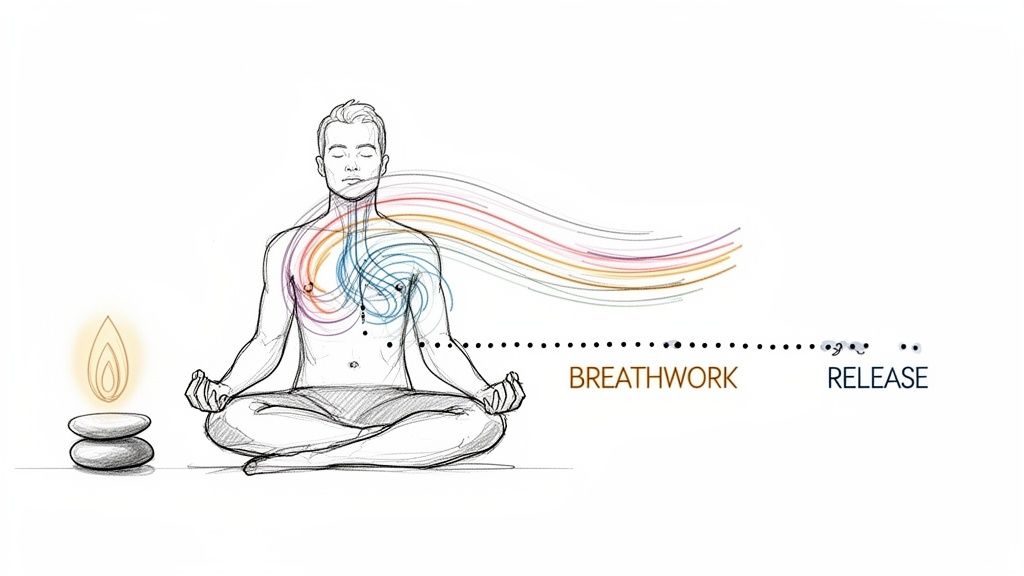
While quick tools like Box Breathing and cognitive reframing are fantastic for managing stress in the moment, sometimes they feel like they’re only scratching the surface. Chronic stress has a way of leaving deeper imprints on our nervous system—subconscious patterns and stored tensions that just don’t respond to conscious thought alone. To get to the root of the problem, we need to go deeper.
This is exactly where advanced breathwork comes in. These methods are far more than simple relaxation exercises; they are powerful practices designed to access and release deeply held stress from both the body and the mind. Think of it as a way to finally disrupt those old stress responses that have been running on autopilot for years.
Beyond Relaxation: A Tool for Genuine Release
Advanced breathwork isn’t meant to replace the other strategies we’ve discussed. Instead, it’s a powerful complement that can seriously accelerate the mental rewiring process. By using specific, dynamic breathing patterns—often combined with sensory inputs like sound and guided coaching—these practices help you bypass your conscious mind’s usual defenses.
This allows you to tap directly into the subconscious, which is where many of our deepest stress patterns and emotional blocks are stored. A peer-reviewed study in the Journal of Traumatic Stress found that breath-body-mind practices were effective in reducing symptoms of PTSD and depression, highlighting their power to address deep-seated trauma and stress.
For a professional struggling with the emotional toll of burnout, this can be a game-changer. Instead of just managing the day-to-day symptoms, you can start to process and release the underlying exhaustion and frustration that caused the burnout in the first place.
How Advanced Breathwork Actually Disrupts Stress Patterns
So, how does this all work? Advanced breathwork techniques intentionally and safely alter your physiological state. When you change the rhythm and depth of your breath, you can shift your brainwave patterns and activate parts of your nervous system that are normally dormant.
This process can bring stored emotions and physical tensions to the surface, allowing them to be fully felt and released in a controlled, supportive environment. It’s an active process of clearing out the “emotional clutter” that chronic stress leaves behind.
Think of it like this: if your nervous system is a computer running slow because too many programs are open in the background, advanced breathwork is the deep system reboot that closes them all out, freeing up processing power and restoring optimal function.
Another study published in Frontiers in Human Neuroscience showed that a consistent breathwork practice leads to lower levels of cortisol, the body’s primary stress hormone. This physiological shift helps create a new, calmer baseline for your body, making you far less reactive to future stressors. This isn’t just a fleeting feeling of peace; it’s a tangible change in your body’s chemistry.
Practical Applications for Professionals
For busy professionals, this deeper work can unlock breakthroughs in areas where you feel completely stuck. It’s not just about general stress relief; it can be targeted to specific challenges.
- Overcoming Performance Anxiety: If you dread public speaking or high-stakes presentations, breathwork can help release the root fear that triggers your anxiety, allowing you to tap into a state of calm confidence. Actionable step: Try a guided breathwork session focused on confidence the morning of a big presentation.
- Processing Burnout: For those who feel emotionally drained and cynical about their work, these practices can help process the accumulated weight of that exhaustion, paving the way for renewed purpose. Actionable step: Dedicate one session a week to a breathwork journey designed for emotional release.
- Releasing Limiting Beliefs: Chronic stress often stems from deep-seated beliefs like “I’m not good enough.” Advanced breathwork can help you access and reframe these subconscious narratives. Actionable step: During a session, set an intention to explore where that limiting belief comes from.
The stigma around mental health in the workplace is a huge barrier; data shows that 40% of stressed employees never discuss it. However, group breathwork sessions have been shown to reduce anxiety by over 50%. Techniques that draw from the Holotropic Breathwork technique offer structured ways to explore this inner landscape safely. By integrating these deeper practices, you’re not just coping—you’re investing in a more resilient and authentic version of yourself.
Still Have Questions About Managing Stress?
Even with a solid plan, actually putting these strategies into practice can bring up some tricky situations. Let’s tackle some of the most common questions and roadblocks that pop up when you start getting serious about handling chronic stress.
“How Can I Stay Consistent When I’m Already Drowning?”
This is the big one, isn’t it? When you’re already swamped, the idea of adding “manage stress” to your to-do list feels like a cruel joke.
The trick is to forget about big, sweeping changes. We’re aiming for tiny, almost ridiculously easy wins.
Don’t try to force a 30-minute meditation. Instead, commit to just three rounds of box breathing before you even open your laptop. That’s it. Less than 60 seconds. Forget planning a full workout—just do one “movement snack” by standing up and stretching for a minute after your next call.
The goal here isn’t perfection; it’s about building a little momentum. These tiny, consistent actions start carving out new neural pathways, making healthy responses feel more automatic over time.
Research in the European Journal of Social Psychology showed it can take anywhere from 18 to 254 days to form a new habit. By starting so small you can’t fail, you’re giving yourself a fighting chance to stick with it long enough for it to become second nature.
“What’s the Real Difference Between Stress and Burnout?”
It’s easy to use these terms interchangeably, but they’re not the same thing. Knowing the difference is crucial because it tells you what you’re up against.
- Stress feels like over-engagement. You’re frantic, hyperactive, and emotionally wired. You still have energy, but it’s chaotic and spinning out of control.
- Burnout is the opposite; it’s total disengagement. You feel empty, emotionally numb, and detached from everything. The hyperactivity is gone, replaced by bone-deep exhaustion and a loss of all motivation.
Here’s another way to think about it: when you’re stressed, you feel like you’re drowning in responsibilities. When you’re burned out, you feel like you’ve already drowned and are just… floating. The strategies in this guide are designed to pull you back from the edge before you hit that point of burnout.
“When Is It Time to Call in a Professional?”
Self-help tools are fantastic, but they have their limits. Sometimes, you need to bring in reinforcements, and there’s absolutely no shame in that.
It’s probably time to talk to a therapist, counselor, or doctor if you’re noticing:
- Your symptoms are getting worse, no matter what you try.
- You’re leaning on unhealthy crutches like alcohol, overeating, or other substances to cope.
- Your stress is damaging your relationships, your work, or your basic ability to get through the day.
- You’re feeling hopeless, persistently down, or having any thoughts of self-harm.
Asking for help is a sign of strength, not weakness. A professional can offer a clear diagnosis and provide proven therapies like CBT to give you a personalized roadmap. Remember, long-term stress isn’t just “in your head.” One study in the journal Biological Psychiatry showed it can lead to neuroinflammation and even change the brain’s structure, which really underscores why getting support is so important.
“Can I Really Change How My Brain Reacts to Stress?”
Yes, you absolutely can. This isn’t just wishful thinking; it’s based on the science of neuroplasticity. Your brain isn’t set in stone. It physically changes based on your thoughts, actions, and experiences.
Every time you choose to reframe a negative thought or do a quick grounding exercise, you’re strengthening new, calmer neural pathways.
Think of it like forging a new trail in a dense forest. At first, it’s hard work and takes a lot of conscious effort. But the more you walk that new path, the clearer and easier it becomes to follow. Eventually, it becomes the default route.
A study in NeuroImage even confirmed that mindfulness practices create measurable changes in brain regions tied to memory, self-awareness, and emotional regulation. By consistently using these tools, you are literally rewiring your brain for resilience. It takes time and repetition, but the change is very real.
Ready to go beyond surface-level techniques and address stress at its root? 9D Breathwork offers a powerful, multi-sensory experience that combines dynamic breathing with sound, hypnotic guidance, and NLP to release stored tension and rewire your nervous system from the inside out. Discover a deeper level of calm and resilience by exploring our journeys at https://9dbreathwork.com.