Leadership development programs are supposed to build better leaders. They’re structured initiatives designed to sharpen the skills, abilities, and confidence of the people you’re counting on to guide your organization into the future. The goal is to create a deep bench of talent ready to lead teams and crush business goals.
Simple enough, right? Yet, so many of these programs miss the mark entirely.
Why Traditional Leadership Training Often Fails

Companies pour massive budgets into leadership development, but the ROI just isn’t there. Why? Because there’s a huge disconnect between what’s taught in a sterile conference room and the chaotic reality leaders face every single day. Think constant digital pings, back-to-back Zoom calls, and managing teams teetering on the edge of burnout.
The gap is wider than most think. A shocking 75% of organizations admit their leadership development programs are ‘not very effective.’ This is despite a global spend that tops USD 366 billion. According to some eye-opening leadership training statistics from High5Test, the real problem is knowledge transfer—professionals say less than half of what they “learn” is ever actually applied back at their desks.
The Theory vs. Reality Disconnect
So many programs are built on textbook theories and academic frameworks. They look fantastic on a PowerPoint slide but completely fall apart under the pressure of a real workday.
Practical Action: Imagine a manager learns a five-step conflict resolution model in a workshop. A week later, two of her top performers are in a heated, emotional argument over a high-stakes project with a looming deadline. That textbook model suddenly feels pretty useless, doesn’t it? The actionable insight here is that training must include high-pressure simulations to bridge this gap. A study in the Academy of Management Learning & Education found that experiential learning, where participants actively engage in realistic scenarios, leads to significantly greater skill retention and application compared to passive lectures.
This is where the failure point is. These programs teach leaders what to do, but they almost never give them the emotional or physiological tools to handle how it feels to do it in the moment.
True leadership isn’t just about knowing the right strategy; it’s about having the internal resilience to execute that strategy with clarity and composure, even when stress levels are high.
A Focus on Symptoms, Not the Root Cause
Here’s another critical mistake: focusing on surface-level skills instead of the real, underlying issues. A program might offer a workshop on time management to a leader who is constantly behind and overwhelmed.
But what if the root problem isn’t their calendar? What if it’s an inability to regulate their own stress, which triggers procrastination, anxiety, and clouded decision-making? You can give them all the productivity hacks in the world, but you haven’t solved the core issue.
Effective leadership development training programs have to go deeper. They need to address the leader’s internal state first. Research in the Journal of Applied Psychology demonstrated that mindfulness training significantly reduces employee burnout and psychological distress, directly tackling the root causes of underperformance. When you build a solid foundation of emotional regulation and resilience, leaders naturally become more adaptable, creative, and inspiring. This approach doesn’t just build better managers; it’s one of the fundamental ways to improve company culture.
Crafting a Curriculum That Actually Works

The heart of any leadership program that gets results is the curriculum. A great curriculum doesn’t just teach isolated skills; it weaves together the hard-nosed business strategy with the deeply human skills needed to lead with guts and grace. It’s all about creating a balanced, hands-on journey that prepares leaders for the boardroom and the inevitable team meltdowns.
Let’s be honest, the old way of doing things is broken. Forget about a dry lecture on financial modeling in the morning, followed by a completely disconnected talk on empathy after lunch. That’s not how leadership works in the real world. A modern leader has to deliver tough financial news (the hard skill) while managing their own stress and holding their team together (the human skill). Your curriculum must mirror this messy, integrated reality.
And the demand for this new approach is skyrocketing. The global leadership development market is currently valued at a staggering USD 89.54 billion and is on track to hit USD 238.5 billion by 2035. This isn’t just a trend; it’s a clear signal that companies are desperate to build stronger leaders. Workshops are leading the charge, making up 45% of all training delivery methods.
The Secret Sauce: Blending Hard and Human Skills
Building a curriculum that sticks means creating a balanced architecture that addresses both sides of the leadership coin. Miss one, and you’re sending leaders into battle half-equipped.
- Hard Skills (The ‘What’): These are the nuts and bolts. Think financial literacy, strategic planning, project management, and data analysis. They’re the tangible competencies that help leaders make smart decisions for the business.
- Human Skills (The ‘How’): Often brushed off as “soft skills,” these are actually the powerhouse abilities that determine how a leader gets things done. This is your emotional intelligence, communication, conflict resolution, and resilience—the stuff that builds trust and gets people to follow you.
A landmark study in the Journal of Managerial Psychology drove this point home, finding that leaders with high emotional intelligence were dramatically more effective. They built better work environments and flat-out achieved more. Human skills aren’t just nice to have; they directly fuel business outcomes.
Design for the Real World, Not the Classroom
Knowledge is useless if it crumbles under pressure. Your curriculum has to be built around getting people out of their seats and into realistic, high-stakes scenarios.
Practical Action: Instead of just showing a slide with a feedback formula, create a high-pressure role-playing exercise.
- Scenario: A leader must deliver critical feedback to a top performer whose abrasive attitude is poisoning team morale.
- Execution: Coach the person playing the “team member” to get defensive and emotional.
- Objective: The leader must use the feedback model while actively managing their own adrenaline and de-escalating the conversation.
This isn’t just reciting a script—it’s building the muscle memory for difficult conversations.
This is where the magic happens. Active, experiential learning forges skills in a way a lecture never could. Research from the Academy of Management Learning & Education backs this up, showing that hands-on methods lead to far greater skill retention and actual behavior change.
The goal isn’t just to teach a concept; it’s to create a lived experience. You have to give leaders a safe sandbox to practice those difficult conversations so their first attempt isn’t during a real crisis with real consequences.
Core Curriculum Components for Holistic Leadership
A truly robust curriculum should be modular, giving you the flexibility to customize it while ensuring you cover all the critical bases. Here’s a look at the essential modules we build our programs around. For clients in specific sectors, like the culinary and hospitality industry, these pillars are adapted to fit the unique challenges of environments such as restaurant leadership development programs.
This table breaks down the key components for a program designed to build well-rounded, resilient leaders.
| Module Focus | Key Topics | Desired Outcome |
|---|---|---|
| Strategic Leadership | Financial Acumen, Market Analysis, Decision-Making Frameworks | Leaders can analyze business data to make informed strategic choices that drive growth. |
| Authentic Communication | Constructive Feedback, Active Listening, Public Speaking, Storytelling | Leaders can communicate with clarity, empathy, and influence to inspire action and build trust. |
| Team Dynamics & Culture | Conflict Resolution, Psychological Safety, Coaching & Mentoring | Leaders can cultivate high-performing, collaborative teams where individuals feel valued and supported. |
| Personal Resilience | Stress Management, Emotional Regulation, Mindfulness Practices | Leaders can maintain composure under pressure, prevent burnout, and model healthy behavior for their teams. |
A well-known study in Human Resource Management pointed out that leadership development can’t be a one-and-done event; it must be a continuous journey. That’s why your curriculum should be designed with a long-term view, where modules build on each other and are supported by ongoing coaching. This is how you ensure skills aren’t just learned, but are deeply integrated into a leader’s daily behavior for lasting change.
Integrating Somatic and Subconscious Tools

Real leadership breakthroughs don’t happen on a spreadsheet. They happen deep inside the nervous system, far below conscious thought. While most training focuses on cognitive skills, a truly powerful leadership development training program gives leaders the tools to manage their internal state. This is where somatic and subconscious practices come in, and frankly, they’re non-negotiable for modern leadership.
These aren’t just “feel-good” exercises. They are science-backed methods that give leaders direct influence over their own stress responses. When we integrate techniques that work with the autonomic nervous system, we give leaders a way to build resilience in real-time, sharpen their focus, and master their emotions—especially when the pressure is on.
The evidence is clear. A study in the Journal of Applied Psychology found that mindfulness training helped leaders stay composed and make better decisions under stress. It’s a crucial shift from simply managing a team to truly managing yourself first.
Facilitating a Simple Pre-Meeting Regulation Session
Picture a leader about to walk into a high-stakes negotiation. Their heart is pounding, their mind is racing, and their body is pumping out cortisol. In that state, strategic thinking goes right out the window. Here’s a practical, guided breathwork session you can teach them to quickly downshift their nervous system from fight-or-flight into calm, centered focus.
The Goal: We’re aiming to activate the parasympathetic nervous system (the body’s “rest and digest” mode) using a simple box breathing technique. The beauty of this is that it’s discreet, powerful, and can be done anywhere.
A Step-by-Step Facilitation Guide:
- Setting the Stage (30 seconds): “Let’s take a moment. Find a comfortable way to sit. If you’re okay with it, gently close your eyes or just lower your gaze. We’re going to take just three minutes to ground ourselves.”
- Initial Grounding (30 seconds): “Start with one deep breath in through your nose… and a long, slow sigh out through your mouth. Feel your body settle.”
- Introducing the Technique (1 minute): “Now, we’re going to move into a simple ‘box breathing’ pattern. I’ll guide you. We’ll inhale for a count of four, hold for four, exhale for four, and hold again for four. It’s just a simple, steady rhythm.”
- Guided Practice (1 minute): “Let’s begin. Inhale… two… three… four. Hold… two… three… four. Exhale… two… three… four. Hold… two… three… four.” (Repeat this cycle 3-4 times with a calm, steady voice).
This simple exercise does more than just calm nerves. It physically changes the body’s chemistry, lowering heart rate and blood pressure. This allows the prefrontal cortex—the brain’s CEO—to get back to work.
Why Breathwork Is a Leadership Superpower
Breathwork is one of the fastest, most direct routes to emotional regulation. Think of it as the bridge between your conscious mind and all those automatic physical responses. Research from Frontiers in Human Neuroscience shows that controlled breathing actually alters brainwave patterns, nudging the brain into states of calm and heightened awareness. You can dig deeper by exploring what breathwork therapy is and its applications.
Practical Action: Challenge leaders to set a recurring daily alarm for a one-minute “breath break.”
- When: Mid-morning and mid-afternoon, when stress typically peaks.
- How: Perform 3-4 rounds of box breathing.
- Result: This micro-habit builds the skill of proactive state management, preventing stress from accumulating throughout the day.
Beyond Breathwork: Other Subconscious Tools
While breathwork is an incredible entry point, other tools can create even deeper, more lasting change by working directly with the subconscious. Bringing in elements of guided visualization or Neuro-Linguistic Programming (NLP) can help leaders actively reframe the limiting beliefs that hold them back.
For example, a leader battling imposter syndrome could be guided through a visualization where they vividly recall past successes, anchoring the feeling of confidence in their body. This isn’t just positive thinking; it’s a way to actively rewire subconscious patterns. In fact, a study in the Journal of Leadership & Organizational Studies confirmed that developmental work targeting self-awareness and internal beliefs leads to more sustainable leadership growth than skill-based training alone.
By weaving these somatic and subconscious tools into your leadership development training programs, you move past simple information sharing. You start creating deep, physiological and psychological shifts that build not just better managers, but more resilient, present, and inspiring leaders.
Training and Empowering Your Facilitators
A brilliant curriculum can fall flat without the right person leading the room. Your program is only as effective as the facilitator guiding it, and that makes their training and empowerment a non-negotiable part of any serious leadership development plan.
These aren’t just instructors reciting slides; they are the guardians of a safe, transformative space where real growth actually happens.
The best facilitators don’t just present information. They model the very presence, empathy, and emotional regulation you want your leaders to develop. They hold the room with a calm confidence that allows participants to feel secure enough to be vulnerable—and vulnerability is the price of admission for deep, lasting change.
Cultivating the Core Qualities of a Great Facilitator
Let’s be honest, not everyone is cut out for this role. It demands a unique blend of skills that go far beyond just knowing the material. The real focus should be on finding and nurturing people who can create psychological safety, which is the absolute bedrock of effective group learning.
A landmark study by Google, Project Aristotle, found that psychological safety is the single most important factor in high-performing teams. That principle is just as vital, if not more so, in a training environment where you’re asking people to step outside their comfort zones.
When you’re selecting and training facilitators, zero in on these qualities:
- Deep Empathy: The ability to genuinely connect with what others are feeling, creating a non-judgmental atmosphere.
- Unwavering Presence: The skill of being fully attentive and grounded in the moment, which makes participants feel truly seen and heard.
- Expert Navigation of Vulnerability: Guiding leaders through emotionally charged exercises requires a steady hand and the instinct to de-escalate tension while encouraging breakthroughs.
A facilitator’s capacity to connect with participants on a human level is what separates a good program from a great one. You can get a much deeper look into these concepts in our guide on how to improve emotional intelligence, which I’d consider essential reading for anyone in a coaching or facilitation role.
Practical Coaching Techniques for Deeper Impact
Equipping your facilitators means giving them practical, in-the-moment coaching tools. They need to know exactly what to do when a role-playing exercise gets too intense or when a participant hits an emotional wall.
The facilitator’s job isn’t to have all the answers. It’s to ask the right questions and hold the space for participants to find their own. This shift from teaching to guiding is fundamental.
Practical Action: Train facilitators using this three-step “Notice-Inquire-Deepen” model.
- Notice (Somatic Cueing): “I notice your shoulders are tense. What’s happening in your body right now?” This brings awareness back to physical sensations.
- Inquire (Reflective Listening): “So what I’m hearing is that you feel a sense of pressure.” This validates their experience.
- Deepen (Powerful Questioning): “What would need to shift for you to feel more confident in that situation?” This empowers them to find their own solution.
The Power of a Certified System
Developing this level of facilitation skill from scratch is a massive undertaking. This is precisely why many organizations turn to a certified system or a franchise-style model. It gives you a proven, structured framework that ensures a consistent, high-quality experience, no matter who is leading the session.
This approach simply makes it far easier to scale an impactful program across an entire organization without diluting the quality.
The modern corporate landscape is already leaning into this hybrid approach. A recent study found that 43% of organizations blend internal and external resources for their leadership development. This trend helps them address ongoing challenges, with 62% now using employee surveys to measure effectiveness and 55% starting to prioritize new skills like generative AI. You can learn more about these 2025 leadership development findings to see where the industry is heading.
By investing in well-trained facilitators and a proven system, you’re not just delivering another program. You’re building a reliable, scalable engine for creating the next generation of resilient and inspiring leaders.
How to Measure Real Success and ROI
So, how do you prove that a holistic leadership program is actually making a difference? It’s about moving beyond the standard “smile sheets” and satisfaction surveys. To really show the value, you need a solid framework for tracking the metrics that the business truly cares about. When you can draw a straight line from your leadership development training programs to tangible business outcomes, you’re not just justifying a budget—you’re making a powerful, data-driven case for future investment.
This means looking at key business indicators before the training and then tracking them afterward. We’re talking about more than just who showed up. Let’s get into the nitty-gritty of employee retention figures, team engagement scores, and even project completion rates.
A landmark study in the Journal of Leadership & Organizational Studies backed this up, finding a direct link between leadership development and better financial performance. The research showed that companies investing in their leaders see real gains in both productivity and profitability. This isn’t just a “nice-to-have”; it’s a genuine driver of growth.
This chart paints a clear picture of the modern approach, where a mix of methods is used to see what’s working and stay ahead of the curve.
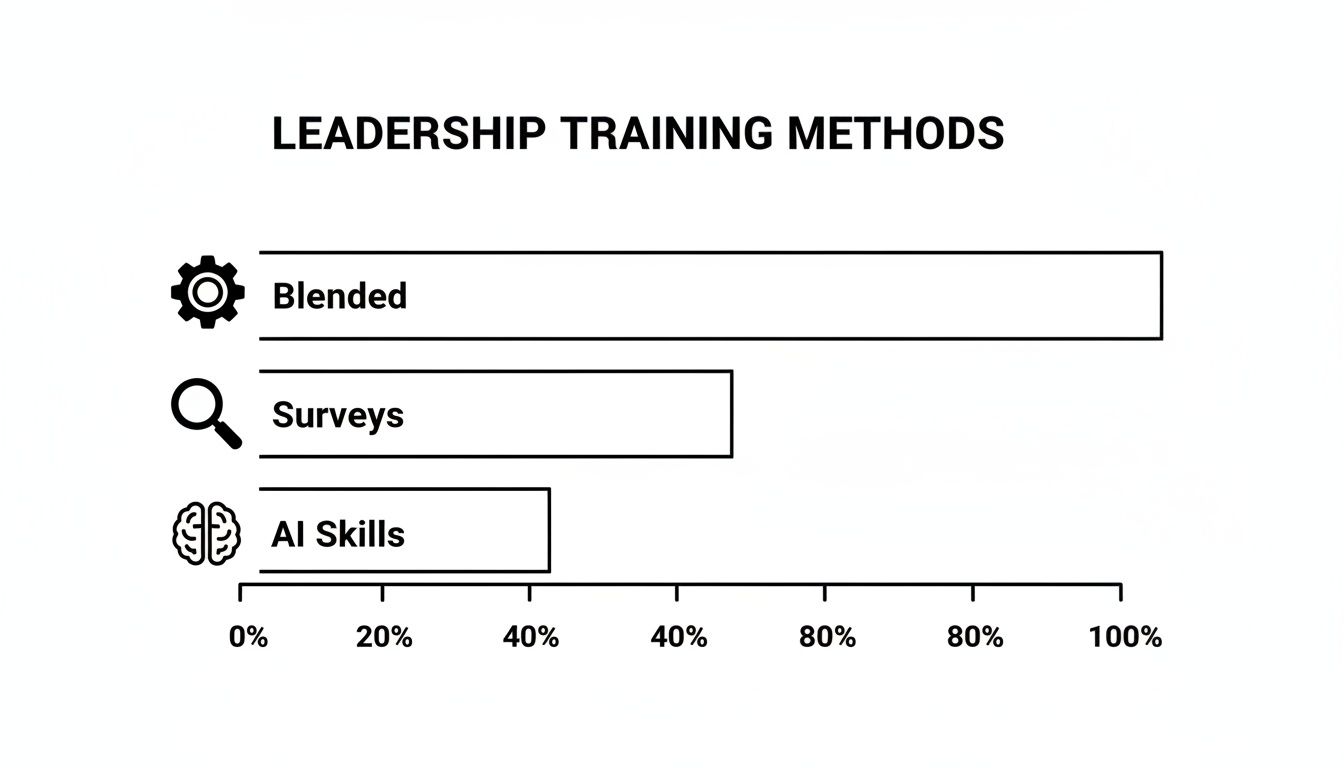
The data here shows a clear trend toward a hybrid strategy. Blended learning is now standard practice, backed by surveys to gauge impact and a growing focus on AI skills to make sure leaders are ready for what’s next.
Measuring Leadership Program ROI A Multi-Faceted Approach
To truly understand a program’s impact, we need to look beyond the obvious. Old-school metrics gave us part of the story, but a more holistic view connects leadership skills to the actual health and performance of the business. This table contrasts traditional KPIs with more meaningful, modern ones.
| Metric Category | Traditional KPI | Holistic KPI |
|---|---|---|
| Team Stability | Employee Turnover Rate | Voluntary Turnover Rate & Internal Mobility Rate |
| Productivity | Attendance & Hours Worked | Project Success Rates & Team Output Quality |
| Engagement | Annual Survey Score | Pulse Survey Trends & Anonymous Feedback Volume/Sentiment |
| Leadership Pipeline | Number of Promotions | “Ready-Now” Successor Percentage & Promotion Velocity |
| Well-being | Sick Days Taken | Burnout Scores & Self-Reported Psychological Safety |
By focusing on these more nuanced KPIs, you can tell a much richer story about how developing leaders directly strengthens the entire organization.
Moving Beyond Simple Feedback
Practical Action: Before launching a program, establish a baseline by collecting data on the teams these leaders manage. This is your “before” picture. Then, measure the same metrics again at three, six, and twelve months post-program. This allows you to track not just immediate effects but long-term behavioral integration.
The most compelling ROI stories are told by comparing a trained leader’s team to a control group. If the turnover rate in a trained manager’s department drops by 15% while a similar, untrained department’s rate holds steady, you have a powerful and quantifiable win.
Key Metrics to Track for Tangible ROI
If you want to build a solid business case, you have to measure what the C-suite actually cares about. This means framing your results in the language of business performance, not L&D jargon.
Here are the most impactful areas to focus on:
- Employee Retention and Turnover: This is one of the most direct and financially significant metrics you can track. Calculate the cost of replacing an employee in a specific role, then show how a better retention rate under a newly trained leader translates into cold, hard cost savings.
- Team Engagement Scores: Use standardized tools (like the Gallup Q12) to measure engagement before and after. A jump in engagement is a fantastic leading indicator of higher productivity and morale.
- Performance and Productivity: Look at concrete outputs. This could be anything from project completion rates and sales numbers to customer satisfaction scores. Can you draw a clear line from a leader’s new skills to their team’s improved performance? A study in Personnel Psychology confirmed this connection, showing that leadership training directly boosts team performance.
- Promotion Rates: Are the people who go through your program getting promoted more often than their peers? This is a great way to prove you’re building a strong internal talent pipeline and retaining your best people.
Calculating the Financial Return
To get to a clear ROI number, you have to assign a dollar value to the improvements you’ve measured. This is the secret to getting real executive buy-in.
A Practical Example:
Let’s say the average cost to replace an employee at your company is $50,000. A manager who went through your program leads a team of 20 people. Before the training, her team’s annual turnover rate was 25% (5 employees leaving per year). After the training, it drops to just 10% (only 2 employees).
- Cost of turnover before: 5 employees x $50,000 = $250,000
- Cost of turnover after: 2 employees x $50,000 = $100,000
- Annual Savings: $150,000
If the program cost $10,000 for that manager, the ROI is massive. It’s not just a hypothetical, either. Research in the Academy of Management Journal found that leaders trained in supportive behaviors saw a measurable drop in voluntary turnover on their teams. These improvements in retention are a core part of learning how to improve work performance across the entire business.
By focusing on these hard numbers, you completely change the conversation. Leadership development is no longer an expense—it’s a strategic investment that pays for itself many times over.
Answering the Tough Questions About Leadership Programs
Even the most well-designed leadership program will spark questions. It’s natural. When you’re asking for an investment of time and money, people want to know what they’re getting into. Over the years, I’ve heard them all, but a few pop up constantly.
Let’s tackle the big ones head-on so you can walk into those planning meetings with clarity and confidence.
“So, How Long Does This Need to Be?”
Everyone wants a magic number, but there isn’t one. What I can tell you is this: a one-day workshop is a waste of money if you’re looking for real, lasting change. It’s like a crash diet—the results disappear almost as soon as you go back to your old routine. You’re just checking a box.
True transformation takes time. People need a chance to learn, try things out back in the real world, stumble, and get feedback. We’ve found the sweet spot is a structure that unfolds over several months.
Practical Action: Propose a 6-month journey with steady touchpoints instead of a 2-day info-dump.
- Kickoff Intensive: Start with a 2 or 3-day deep dive to build trust and psychological safety.
- Monthly Deep Dives: Follow up with half-day sessions every month for 4-6 months to maintain momentum.
- Peer Coaching Circles: In between formal sessions, have participants meet in small groups to discuss applying the new skills to their actual jobs.
This isn’t just a hunch; it’s based on how our brains work. Spacing learning out over time is proven to dramatically improve how much people remember and use. A study in Applied Cognitive Psychology confirmed that this approach blows “cramming” out of the water.
Look at it this way: your goal isn’t just for people to finish the training. It’s for them to fundamentally change how they lead.
“How Do We Get the C-Suite on Board?”
Getting executive buy-in is everything. They hold the purse strings, and more importantly, their attitude sets the tone for the entire company. If they don’t see the value, nobody else will either.
To get their attention, you have to speak their language: business outcomes.
Practical Action: Run a small pilot program with a single, high-potential team. Track their metrics—project success rates, engagement scores, retention—and compare them to a control group. Walking into a boardroom with a successful case study backed by your own company’s data is the most powerful argument you can make. Frame the program as a direct solution to a painful, expensive business problem by showing them the hard numbers from your pilot.
“Isn’t This Just Management Training?”
This question comes up all the time, and drawing a clear line between the two is critical. If you confuse them, you end up with perfectly competent managers who don’t inspire anyone. They’re administrators, not leaders.
Here’s the simplest way to explain it:
- Management training is about process and stability. Think budgeting, project planning, and making sure the trains run on time. It’s the science of execution.
- Leadership development is about people and vision. It’s about building trust, inspiring people to follow you into the unknown, and coaching them to become their best selves. It’s the art of motivation.
Research from the Journal of Vocational Behavior has shown that while management skills keep the lights on, it’s leadership behaviors that truly drive employee engagement and loyalty. You need both, but they are not interchangeable. Be crystal clear about which one your program is designed to build.
“Okay, But How Do We Make Sure It Actually Sticks?”
This is the Achilles’ heel of corporate training, isn’t it? People attend a great session, feel inspired, and then reality hits Monday morning with an overflowing inbox. The new skills are forgotten by lunch.
For learning to stick, you have to build an entire support system around the program itself.
Practical Action: Implement this three-part support system to ensure skills are applied.
- Manager Involvement: Mandate a pre-program goal-setting meeting and a post-program application planning meeting between participants and their direct managers.
- Accountability Pods: Set up small peer groups that meet for 30 minutes every other week to troubleshoot challenges and share wins.
- Performance Integration: Build the leadership competencies taught in the program directly into your formal performance review system. What gets measured gets done.
It’s no surprise that a study in Human Resource Development Quarterly found that manager support and ongoing reinforcement are the two biggest factors in whether training translates to on-the-job results. Without these, even the world’s best curriculum is just entertainment.
At 9D Breathwork, we build programs that create lasting change from the inside out. Our approach fuses science-backed breathwork with powerful coaching to equip leaders with the resilience and clarity they need to thrive. Discover how we can help you build your next generation of leaders.