Improving your emotional intelligence isn’t about some grand, abstract theory. It all starts with a simple, foundational practice: understanding your own emotions and how they drive your actions.
This isn’t about bottling up what you feel. It’s about learning to recognize those feelings, manage them constructively, and use that insight to build better relationships, both at work and at home.
Laying the Groundwork for Higher Emotional Intelligence
Emotional intelligence, or EQ, isn’t a personality trait you’re stuck with. It’s a practical, learnable skillset that directly impacts how you handle stress and pressure. Think of it as the crucial pause between feeling an emotion and reacting to it.
For anyone in a demanding professional role, this skill is a genuine game-changer. It’s what helps a manager deliver tough feedback without demoralizing their team. It’s what allows you to navigate a tense negotiation and find common ground. A 2018 study in the Journal of Vocational Behavior even found that people with higher emotional intelligence consistently report greater job satisfaction and less work-related stress.
To get a clearer picture of what we’re building, let’s look at the four core components of emotional intelligence. I find it helpful to think of them as pillars supporting a strong, resilient structure.
The Four Pillars of Emotional Intelligence
| Pillar | What It Means | Example in Action |
|---|---|---|
| Self-Awareness | The ability to recognize your own emotional state, strengths, and weaknesses. | Noticing you get irritable and short-tempered when a deadline is looming, and understanding that’s your personal stress response. |
| Self-Management | Using your awareness to actively manage your emotions and impulses in a healthy way. | Instead of firing off a sharp reply to a frustrating email, you take a five-minute walk to cool down before crafting a calm, professional response. |
| Social Awareness | The capacity to sense and understand the emotions of others (empathy is a huge part of this). | You see a usually talkative colleague is quiet during a team meeting and make a point to check in with them privately afterward. |
| Relationship Management | Using your awareness of your own emotions and others’ to build connections and navigate social situations effectively. | Successfully mediating a disagreement between two team members by helping each one see the other’s perspective, leading to a productive solution. |
Each pillar builds on the one before it. You can’t manage your emotions if you aren’t aware of them, and you can’t truly connect with others if you can’t manage yourself. It’s a progressive journey.
This flowchart maps out that exact journey.
As you can see, genuine mastery starts from the inside out. You have to understand your own inner world before you can effectively influence the world around you.
Why Developing EQ Gives You a Professional Edge
In today’s workplace, your technical skills might get your foot in the door, but it’s your emotional intelligence that will carry you up the ladder. The surprising reality is that only about 36% of people have a solid handle on these skills.
This creates a massive opportunity for anyone willing to put in the work. Employees with higher EQ have been shown to earn an average of $29,000 more per year. It’s no wonder that 75% of HR professionals say they consider emotional intelligence a critical factor when making promotion decisions. If you’re interested in the data, there are some truly surprising emotional intelligence statistics that underscore its value.
Beyond promotions and paychecks, research from the University of Bonn also shows that people with higher EQ are simply better at making clear-headed decisions when the pressure is on.
Building Deep Self-Awareness in Your Daily Routine
Real emotional intelligence starts from the inside out. It all boils down to knowing yourself—not just what you’re good at, but the subtle emotional undercurrents that dictate how you show up every day. This isn’t about overhauling your life for a silent retreat; it’s about weaving small, intentional practices into the life you already have.
The whole point is to shift from living on autopilot to making conscious, intentional choices. It’s a bigger blind spot than most of us think. Research shows that while 95% of people believe they are self-aware, the reality is that only 10-15% truly are. That gap is where knee-jerk reactions and unmanaged stress live.
Building self-awareness is like tuning into a radio frequency you didn’t know existed. It’s the difference between lashing out when a project goes sideways and noticing the feeling of panic rising, taking a breath, and then steering the conversation back to solutions. To get a handle on your emotions, you have to learn to listen to yourself first. If you want to dig deeper, this is a great a guide on how to be more self-aware.
Connect Mind and Body with the 5-Minute Body Scan
Long before your brain registers “I’m stressed,” your body is already sending signals. A tight jaw, shallow breathing, shoulders creeping up to your ears—these are the physical red flags of your emotional state. The 5-Minute Body Scan is a deceptively simple way to start decoding these messages.
Actionable Step: Tonight, before you go to sleep, set a timer for five minutes and try this.
- Settle In: Find a comfortable seated or lying position. Close your eyes and take three deliberately slow, deep breaths.
- Start at Your Feet: Turn your attention to the soles of your feet. Just notice what’s there. Warmth? Tingling? The pressure of your shoes? No judgment, just observation.
- Scan Upward: Slowly guide your awareness up through your body—ankles, calves, your stomach, chest, arms, hands, and all the way to the top of your head. Give each area about 30 seconds of your attention.
- Just Notice: As you move, simply note the sensations. A knot of tension in your back? A feeling of lightness in your chest? The goal isn’t to fix anything, just to become aware of what is.
This exercise literally rewires your brain to recognize physical cues, giving you a head start on managing your emotions. In fact, a 2021 study in the journal Emotion linked this ability to sense internal body states—known as interoceptive awareness—directly to more effective emotional regulation.
Name Your Emotions with Precision Journaling
To manage an emotion, you have to be able to name it. “I feel bad” is uselessly vague. Are you frustrated? Disappointed? Overwhelmed? Worried? Each one calls for a completely different kind of response. A quick journaling practice can help you build the emotional vocabulary you need.
Actionable Step: Keep a small notebook or open a notes app. At the end of your workday today, take two minutes to answer these prompts:
- What was a friction point for me today? (e.g., “A client pushed back hard on the project timeline.”)
- What was the specific feeling? (e.g., “I felt a flash of defensiveness, followed by anxiety.”)
- Where did I feel that in my body? (e.g., “My chest got tight and I felt heat in my face.”)
Key Takeaway: The simple act of putting a precise name to an emotion—a technique called affect labeling—is proven to dial down its intensity. It engages the logical part of your brain (the prefrontal cortex) and calms down your reactive emotional center (the amygdala).
This works for the good stuff, too. Journaling about what made you feel energized or proud helps you understand your own sources of motivation.
Interrupt Reactive Behavior with the STOP Method
Your self-awareness is tested most in those high-stakes moments when you’re tempted to react without thinking. The STOP method is a mental circuit-breaker, creating that crucial space between a trigger and your response.
Actionable Step: The next time you receive an email that makes your stomach drop, apply this method immediately.
- Stop: Freeze. Do not start typing a reply. Just pause.
- Take a breath: One slow, conscious breath in and out. This grounds you in the present moment.
- Observe: Quickly check in. What are you thinking? What are you feeling in your body? What’s happening around you?
- Proceed: Now that you’ve gathered a little data, you can choose how to act instead of letting your emotions choose for you.
Practical Example: You get an email with some unexpectedly harsh feedback. The gut reaction is to fire off a defensive reply. But instead, you Stop. You Take a breath. You Observe the feeling of indignation and the tightness in your stomach. Then you Proceed by deciding to step away and draft a thoughtful, professional response later. That’s what emotional intelligence looks like in the real world.
Get a Handle on Your Emotions with Proven Regulation Tools
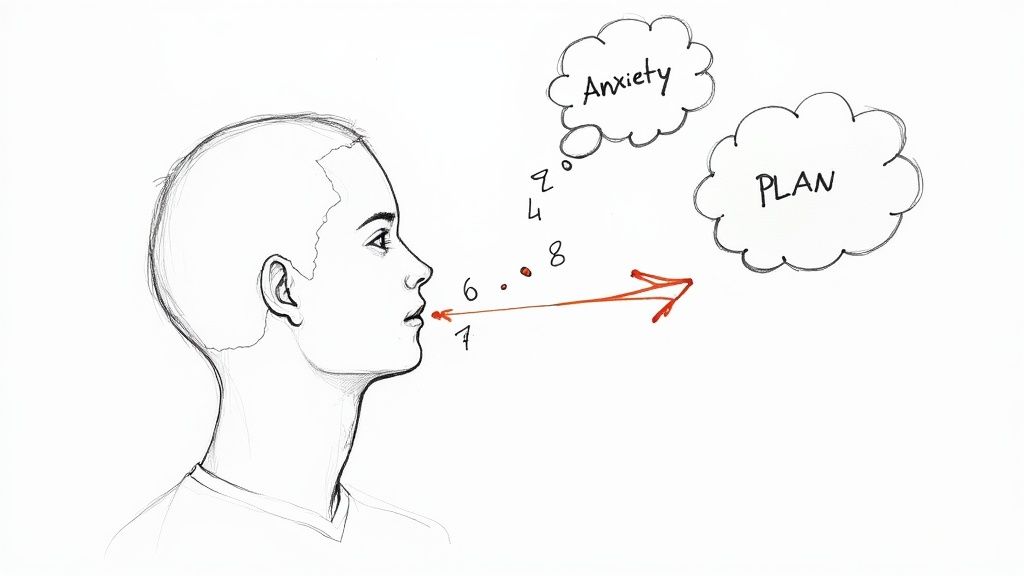
Once you can actually put a name to what you’re feeling, the real work begins: learning to manage those emotions instead of letting them run the show. This is all about self-management—the ability to hit pause on those knee-jerk reactions and guide your feelings toward a more productive outcome. It’s what separates a frustrated outburst from a focused, problem-solving response to a setback.
This isn’t about bottling things up or pretending you don’t feel anything. It’s about creating just enough space between the emotional trigger and your reaction. In that tiny pause, you reclaim your power, shifting from being controlled by your feelings to being in control of your actions. This is a game-changer in high-pressure environments.
Reframe Your Inner Monologue
Let’s be honest, the stories we tell ourselves have a massive impact on our emotional state. When left unchecked, that negative inner critic can send you spiraling into anxiety and analysis paralysis, especially after getting some tough feedback or when a project goes south. The trick is to consciously challenge and rewrite those thought patterns through cognitive reframing.
Practical Example: Imagine your boss points out a major flaw in a report you poured your heart into. Your gut reaction might be, “I’m a failure. They think I’m incompetent.” That thought immediately triggers feelings of shame and makes you defensive.
Actionable Step: Use cognitive reframing to challenge that instant, harsh interpretation.
- Poke holes in the story: Ask yourself: “Is it really a total failure, or is this just one piece of feedback on one section? Is it more likely my boss is invested in the project’s success and is trying to help me get it over the line?”
- Find a better story: Reframe the thought: “This feedback gives me a clear roadmap to make the report even better. It’s a chance to show I can take direction and elevate my work.”
That simple pivot can transform your emotional response from shame into a sense of purpose. It pulls you out of a feeling of helplessness and puts you firmly back in the driver’s seat. It’s one of the most practical ways to build your emotional intelligence, starting today.
Turn “What If” Anxiety into a Proactive Plan
Anxiety loves a vacuum. It thrives on vague, undefined fears about what might happen. The “What If” technique is a reframing tool I use all the time to drag that free-floating anxiety into the light and turn it into a concrete action plan. Instead of letting your mind race with worst-case scenarios, you meet them head-on.
Practical Example: Let’s say you’re nervous about a huge presentation. Your brain is screaming, “What if I totally freeze up? What if the client hates everything I’ve done?”
Actionable Step: Don’t let those questions paralyze you. Answer them. Methodically.
- “What if I freeze up?” My plan: I’ll have my key points on a few note cards, and I’ll practice my opening 20 times until it’s muscle memory. A strong start builds momentum.
- “What if the client hates it?” My plan: I’ll prepare three pivot points and have specific questions ready to uncover their real concerns. This turns criticism into a collaborative brainstorm.
This approach flips the script. It turns anxiety, an emotion rooted in uncertainty, into a plan, which is rooted in preparation. You’re no longer just hoping for the best—you’re genuinely equipped to handle the worst.
Calm Your Nervous System with Breathwork
Sometimes, you need a quick, physical reset to dial down an intense emotional wave. The 4-7-8 breathing technique is a powerful, science-backed tool that gets your body’s “rest and digest” system (the parasympathetic nervous system) to take over.
It’s incredibly effective before a tense meeting, right after a difficult conversation, or any time you feel that familiar spike of stress.
Actionable Step: Try this right now.
- Exhale everything out through your mouth, making a whoosh sound.
- Close your mouth and inhale quietly through your nose to a count of four.
- Hold your breath for a count of seven.
- Exhale completely through your mouth with another whoosh for a count of eight.
Do this cycle three or four times. That long exhale is the secret sauce—it sends a direct signal to your brain that the threat has passed and it’s safe to calm down.
Regularly practicing tools like this is why good EI development programs deliver such clear results. In fact, employees in high-EQ organizations are up to 18x more likely to feel a strong sense of success. It’s proof that these skills truly compound over time.
To really get a grip on your emotions, it’s worth diving into the essential emotional regulation skills for adults, which give you practical strategies you can use daily. And for a deeper toolkit, check out our guide on other powerful emotional regulation strategies.
Developing Stronger Connections Through Social Awareness
Once you’ve started to get a handle on your own inner world—your self-awareness and self-management—it’s time to turn that focus outward. This is where all that internal work really starts to pay off, fundamentally changing how you show up for your colleagues, clients, and team members.
Social awareness is simply your ability to pick up on the emotional temperature of a room. It’s about reading between the lines in a conversation and hearing what isn’t being said. You start noticing the subtle shifts in tone, the fleeting facial expressions, and the guarded body language that tell the real story.
Without this skill, you’re just processing words. With it, you’re actually understanding people. It’s the essential ingredient for building genuine empathy and managing relationships effectively.
Moving Beyond Hearing to Truly Listening
Let’s be honest: most of us listen with the intent to reply, not to understand. We’re so busy mentally rehearsing our next brilliant point that we completely miss the heart of what the other person is trying to tell us.
Active listening is a deliberate choice to break that habit. It’s about making the other person feel genuinely seen and heard. This isn’t just a “soft skill,” either. A 2021 study from the International Journal of Business Communication found a direct link between leaders who practice active listening and higher levels of team trust and performance. Why? Because it creates a space where people feel safe enough to voice real concerns and innovative ideas.
Actionable Step: In your next one-on-one meeting, commit to practicing these three skills.
- Paraphrase to Confirm: After someone explains something, try saying, “Okay, so what I’m hearing is that you’re suggesting we pivot to X because of Y. Do I have that right?” This simple act shows you’re paying attention and gives them a chance to clarify.
- Ask Better Questions: Ditch the yes/no questions like, “Did you finish the report?” Instead, ask something open-ended, like, “What was your biggest takeaway from putting that report together?” You’ll get a much richer, more insightful response.
- Tune Into Body Language: Notice the non-verbal cues. Are they making eye contact? Leaning in? Or are their arms crossed and their expression tight? These signals often communicate more than their words ever could.
This takes conscious effort, but it’s one of the most powerful changes you can make to build stronger professional bonds.
The difference between passively letting sound enter your ears and actively engaging in a conversation is night and day. One is a passive act, while the other is a strategic skill that builds trust and solves problems.
Active Listening vs Passive Hearing
| Characteristic | Passive Hearing | Active Listening |
|---|---|---|
| Intent | Waiting for your turn to speak. | Seeking to fully understand the speaker’s perspective. |
| Focus | On your own thoughts and reply. | On the speaker’s words, tone, and body language. |
| Behavior | Interrupting, multitasking, looking distracted. | Paraphrasing, asking clarifying questions, making eye contact. |
| Outcome | Misunderstandings, frustration, feeling unheard. | Clarity, trust, stronger relationships, and better solutions. |
Ultimately, active listening is an investment. It takes more energy upfront, but the return—in the form of stronger relationships and fewer conflicts—is immeasurable.
A Practical Exercise in Empathy
Empathy isn’t about feeling sorry for someone. It’s the intellectual and emotional work of trying to see the world from their seat, even when you disagree with their view. A great way to build this mental muscle is with a “Perspective-Taking” exercise.
Actionable Step: Think back to a recent, low-stakes disagreement you had with a colleague. Nothing major, just a moment of friction. Now, grab a notebook and try to map out the entire situation from their point of view.
Get specific by asking yourself:
- What deadlines or pressures are they under that I might be overlooking?
- From their role’s perspective, what are their key objectives? How did my action affect those?
- Could any of their past experiences be coloring their reaction in this situation?
- If I asked them, what would they say was their biggest frustration in our exchange?
Actionable Tip: Don’t just leave it in the realm of theory. If it feels right, have a follow-up conversation. You could open with, “Hey, I’ve been thinking about our chat yesterday, and I really want to understand where you’re coming from on the timeline. Could you walk me through your concerns again?”
This isn’t about admitting fault or winning an argument. It’s about expanding your own understanding. Research from the Journal of Personality and Social Psychology has shown that people who intentionally practice this skill are significantly more effective at negotiation and conflict resolution.
Navigating Conflict with Grace and Purpose
Conflict at work is inevitable. The difference is that emotionally intelligent people don’t run from it—they see it as a chance to clarify things and strengthen the relationship. The trick is to focus on the problem, not the person.
When you need to give tough feedback or work through a disagreement, the “Situation-Behavior-Impact” (SBI) model is your best friend. It strips the emotion and accusation out of the conversation, keeping it grounded in objective facts.
Actionable Step: The next time you need to have a difficult conversation, prepare your opening statement using this framework.
- Situation: First, state the specific when and where. “During this morning’s team meeting…”
- Behavior: Describe the action you observed, without judgment. “…you interrupted Sarah a few times while she was presenting her data.”
- Impact: Explain what happened as a result. “…and the impact was that it broke the flow of her presentation, and I think we missed some of her key points.”
This framework prevents the other person from getting defensive. Instead of feeling attacked, they’re more likely to engage in a productive conversation about what happened. This is a cornerstone of improving communication in the workplace, and it turns potential arguments into moments of connection. In fact, a 2017 study found that using this kind of structured, empathetic feedback dramatically boosts team cohesion and psychological safety.
Putting Your EI Skills to the Test in the Workplace
This is where all the practice pays off. Knowing the theory is one thing, but applying emotional intelligence when the pressure is on—that’s a different game entirely. High-stakes moments are the ultimate proving ground for your self-awareness, emotional regulation, and empathy.
Think about navigating a tense client negotiation or guiding your team through a stressful company-wide change. These are the situations where emotionally intelligent professionals don’t just survive; they thrive. They have a knack for turning potential crises into moments of connection and problem-solving, creating a culture where people feel psychologically safe.
How to Handle a Frustrated Client Call
Practical Scenario: A client is on the phone, and their voice is dripping with frustration. A project is delayed, and you’re the one in the hot seat. The knee-jerk reaction for most people? Get defensive, match their angry tone, or start rattling off excuses.
An emotionally intelligent approach flips the script. Instead of reacting to the surface-level anger, you tune into the emotion bubbling underneath it—usually fear, disappointment, or a feeling of being let down.
Actionable Framework:
- Acknowledge Their Reality: Start by showing you’re actually listening. Say something like, “I can hear how frustrating this is for you, and honestly, you have every right to be upset. I appreciate you telling me directly.” This simple act of validation can instantly disarm them.
- Make It a Partnership: Shift the dynamic from “you vs. me” to “us vs. the problem.” Try this: “Let’s figure this out together. My main goal is to get this back on track for you. What’s your single biggest concern right now?”
- Provide a Clear Path Forward: Never end the call on an ambiguous note. Give them a concrete action item. “Based on what you’ve told me, here’s exactly what I’m going to do the moment we hang up…”
By taming your own defensive instincts (self-management) and tapping into their underlying frustration (social awareness), you turn a complaint into a recovery mission. You’re not just fixing a problem; you’re showing them you’re a partner they can trust.
Leading Your Team Through Stressful Change
Reorganizations are a breeding ground for anxiety. Uncertainty is everywhere, and it can easily lead to resistance and fear. As a leader, your job is to be the anchor in the storm, and your emotional intelligence sets the tone for everyone else.
Your number one goal is to create psychological safety—an environment where people feel secure enough to voice their worries without fear of being penalized. This takes proactive, empathetic communication.
Actionable Steps for Leaders:
- Name the Elephant in the Room: Don’t let rumors swirl. Kick off a meeting by saying, “Look, I know there’s a lot of uncertainty right now with this reorg. Let’s talk openly about what we know, what we don’t, and how we’ll support each other through it.”
- Listen More Than You Speak: After sharing what you can, open the floor. Really listen to their questions. Paraphrase what you’re hearing (“So, it sounds like a major concern is how this impacts Project X…”) and thank them for being candid. It shows you respect their perspective.
- Highlight What’s Staying the Same: In the middle of chaos, people crave stability. Remind them of what isn’t changing—the team’s core mission, the importance of their work, or your commitment to them as individuals.
This isn’t just “soft skills” fluff; it has a real impact. A deep-dive analysis revealed that teams with high emotional intelligence can outperform their peers by up to 46%. What’s more, when EI is a core part of the strategy, organizational changes are 2.6 times more likely to succeed. For a closer look at the data, you can read more about the connection between emotional intelligence and performance.
How to Re-Engage a Checked-Out Colleague
We’ve all seen it. A teammate who was once full of ideas is now quiet, withdrawn, and just going through the motions. The easy thing to do is ignore it or, even worse, call them out on their performance.
A far better approach is to lead with empathy and curiosity.
Actionable Approach:
- Find the Right Time and Place. Don’t do it in a formal meeting. Ask them to grab a coffee or go for a quick walk.
- Start with Observation, Not Accusation. Use a gentle, fact-based opener. “Hey, I’ve noticed you’ve been a bit quieter in team meetings lately. Just wanted to check in and see how you’re doing.”
- Just Listen. Your goal isn’t to “fix” them. Just listen. They might be overwhelmed, bored, or dealing with something personal. Your job is to understand. Then, you can ask, “What would be most helpful for you right now?”
By creating a safe space for an honest conversation, you build trust and show that you see them as a person, not just a cog in the machine. Handling these tough conversations requires a strong inner foundation. To learn more about building that personal fortitude, check out our guide on how to build mental resilience.
Got Questions About Improving Your Emotional Intelligence?
As you start putting these ideas into practice, you’re bound to have questions. That’s a good sign—it means you’re engaging with the process. Think of improving your emotional intelligence less like flipping a switch and more like learning a new instrument; it takes time, practice, and a bit of guidance along the way.
Here are answers to some of the most common questions I hear from professionals who are serious about developing their EI.
How Long Does It Take to Actually See a Difference?
There’s no magic number, because your progress is tied directly to how consistently you practice. That said, many people tell me they start feeling more self-aware within a few weeks of doing daily exercises like the emotional check-ins. You’ll just start to notice things, like catching yourself right before you send a reactive email.
Bigger, more ingrained changes—like how you navigate a tense negotiation or lead your team through a crisis—often take a few months to become second nature. It’s a lot like getting in shape. You feel the small wins pretty quickly, but the real transformation comes from sticking with it.
The key isn’t intensity, it’s consistency. A few minutes every day will always beat a two-hour cram session once a month.
Can I Really Do This on My Own, or Do I Need a Coach?
You can absolutely make incredible progress on your own. The self-guided practices we’ve covered—mindfulness, journaling, active listening—are the bedrock of emotional intelligence. These are the tools that build the fundamental skills, one day at a time.
But working with a coach or therapist can be a powerful accelerator. They provide an outside perspective and can point out the blind spots we all have. A 2017 study in the Journal of Leadership & Organizational Studies even found that executive coaching specifically targeting EI skills led to significant bumps in leadership effectiveness.
My advice? Start on your own. Build some momentum and get a feel for it. If you hit a plateau or want to work through deeper relational patterns, that’s the perfect time to bring in a professional.
Is Emotional Intelligence More Important Than IQ?
This is a classic question, but it sets up a false choice. It’s not about one being “better” than the other. Think of it this way: your IQ is what gets you in the door. It’s your raw analytical horsepower, your technical skills, your ability to grasp complex ideas.
Your EI is what determines how well you do once you’re inside. It’s what helps you build alliances, stay resilient when things go wrong, and motivate the people around you. Especially in leadership, EI often becomes the stronger predictor of success simply because leadership is all about people.
If I Only Do One Thing, What’s the Most Powerful Habit to Start With?
If you’re going to pick just one habit, make it the daily ’emotional check-in.’ It’s a simple, one-minute pause you can take two or three times a day, and it’s a total game-changer.
Actionable Step: Set a recurring reminder on your phone for mid-morning and mid-afternoon. When it goes off, just stop, take a single deep breath, and ask yourself:
- What am I feeling right now?
- Where is this feeling showing up in my body?
- What might be triggering this feeling?
Don’t analyze or judge it. Just name it. “Okay, I’m feeling a knot of anxiety in my stomach about that upcoming presentation.” That’s it. This tiny act of awareness is the foundation for everything else. It breaks the autopilot mode of just reacting to things and puts you back in the driver’s seat.
At 9D Breathwork, we’ve seen that lasting change comes from working with emotional patterns at their source. We’ve designed a unique approach that brings together breathwork, hypnotic language, and powerful soundscapes to help you rewire your responses for more resilience and clarity. See how our guided journeys can support your growth at 9dbreathwork.com.