If you want to improve communication at work, you have to stop reacting and start responding. This isn’t just a small tweak; it’s a fundamental shift from assumption-based chats to intentional, thoughtful conversations.
It all boils down to three core areas: preparing yourself before you even speak, truly listening to understand what’s being said, and using clear frameworks to keep everyone on the same page. When you get these right, you don’t just have better conversations—you build a better team.
The Real Impact of Workplace Communication
Let’s be honest, “great communication” can sound like a fluffy HR buzzword. But in reality, it’s the engine that powers a high-performing team. It’s the difference between a project kickoff that immediately goes off the rails because of unspoken assumptions and one where everyone walks away with crystal-clear, shared goals.
This isn’t about being a natural-born talker. It’s a set of skills you can learn and practice.
When communication fails, the fallout is real and immediate. Misunderstandings snowball into rework, missed deadlines, and tense relationships. On the flip side, effective communication creates a space where people feel safe enough to voice concerns, share half-baked ideas, or even admit mistakes without fearing blame. That’s the kind of environment where innovation actually happens.
From Confusion to Clarity
Picture a marketing team trying to launch a new campaign. On a team with poor communication, the designer gets a vague brief and runs with it. The copywriter has a totally different interpretation. Meanwhile, a project manager just assumes everyone is magically aligned. The result is always the same: wasted time, frustration, and a final product that looks like it was made by three different companies.
Now, imagine that same kickoff meeting, but with some structure. The project manager provides a detailed brief, the team spends 20 minutes asking clarifying questions, and they all agree on the core message before a single piece of work begins. The difference is night and day. You get a cohesive campaign, delivered on time, by a team that actually enjoys working together.
Making this shift doesn’t happen by accident. It takes a deliberate, conscious effort, centered around a simple process.
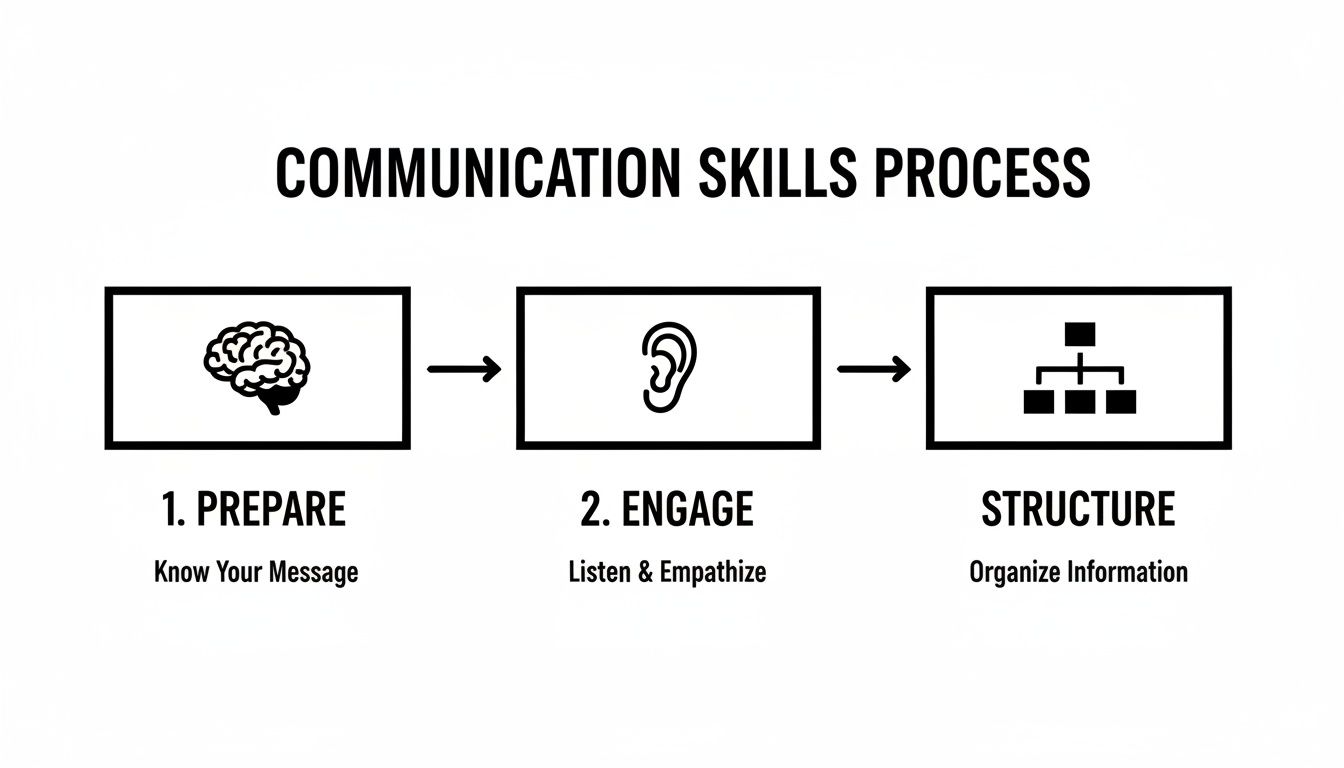
As you can see, great communication starts with you—with your own internal preparation—long before a word is ever spoken.
The Financial and Human Cost
The stakes here are much higher than just a single project’s success. A 2021 study published in the International Journal of Business Communication found that organizations with effective communication practices were 4.5 times more likely to have highly engaged employees. This engagement translates directly into productivity.
The cost of getting it wrong is staggering. Analysts estimate that miscommunication costs U.S. businesses a mind-boggling $1.2 trillion every year. This isn’t just a “soft skill”; it’s a critical business function with a direct link to the bottom line.
A landmark study from the Wharton School of Business found that companies on the “100 Best Companies to Work for in America” list delivered a 14% return on stock, dwarfing the market average of 6%. A huge part of their success came down to culture and leadership communication.
This connection to culture directly impacts retention, too. Teams that foster open and transparent communication consistently see lower turnover. If you’re looking to build a team that sticks around, a great place to start is with our guide on how to reduce employee turnover: https://9dbreathwork.com/how-to-reduce-employee-turnover/
It’s also important to remember that communication is shaped by more than just individual skills. Unconscious biases can create serious barriers. For anyone wanting to dig deeper into this, it’s worth reading up on understanding accent bias as a workplace challenge.
Getting Your Head in the Game: How to Prepare for Productive Conversations
The most important conversations start long before anyone says a word. Your own internal state—how calm, focused, and intentional you are—is what truly sets the stage. It’s the difference between a collaborative discussion and a defensive standoff.
Think about those high-stakes conversations, like a tense performance review or a project debrief gone wrong. They can trigger a real physiological stress response, that classic “fight-or-flight” feeling that makes you reactive and narrows your thinking. You simply can’t guide a conversation constructively if you’re agitated or distracted yourself.
Before you can really listen to others, you have to listen to yourself.
Find Your Calm with Box Breathing
One of the most powerful and discreet tools you can use is Box Breathing. It’s a simple technique used by everyone from Navy SEALs to surgeons to stay level-headed under extreme pressure. It works by slowing your heart rate and basically telling your brain that you’re safe, pulling you out of that reactive state.
Actionable Step: Five minutes before your next important meeting, find a quiet space (even your desk chair works) and complete five cycles of Box Breathing.
- Inhale: Slowly breathe in through your nose for a count of four.
- Hold: Gently hold that breath for another four seconds.
- Exhale: Slowly and completely exhale through your mouth for a count of four.
- Hold: Hold your breath again at the bottom of the exhale for a final four seconds.
Just repeat this cycle four or five times. You’ll notice a subtle shift—the goal is a quiet stability, not drowsiness. This simple practice is foundational if you’re serious about learning how to increase self-awareness and manage your emotional state.
Get Grounded in the Here and Now
Once you’ve found a sense of calm, the next step is to sharpen your focus. The 5-4-3-2-1 Grounding exercise is fantastic for pulling your attention away from anxious thoughts and planting you firmly in the present moment. It uses your five senses to anchor you in your immediate environment.
Studies in cognitive psychology show that our ability to control our attention is a limited resource. When we’re stressed, our focus turns inward to the perceived threat. Grounding techniques flip that switch, redirecting our attention outward and freeing up the mental space needed for active listening and problem-solving.
Actionable Step: Before a conversation you’re nervous about, take 60 seconds to perform this exercise. Quietly acknowledge:
- 5: Five things you can see around you (e.g., your monitor, a coffee mug, a plant).
- 4: Four things you can physically feel (e.g., your feet on the floor, the texture of your desk, the fabric of your shirt).
- 3: Three things you can hear (e.g., the hum of the AC, distant typing, a car outside).
- 2: Two things you can smell (e.g., the faint scent of coffee, your hand soap).
- 1: One thing you can taste (e.g., the mint from your gum, the last sip of water).
Picture a manager getting ready for a difficult performance review. Taking two minutes for Box Breathing and another minute for this grounding exercise can completely shift their mindset from dread to a state of focused, calm presence. This tiny investment of time transforms a potentially tense meeting into a chance for real, constructive dialogue.
Are You Really Listening, or Just Waiting to Speak?
Let’s be honest. In a busy workplace, it’s easy to fall into the trap of “hearing” without truly listening. We’re all guilty of nodding along during a meeting while mentally drafting our next email. But the difference between passively hearing sounds and actively listening for meaning is the bedrock of great workplace communication.
This isn’t just about being polite; it’s a game-changing skill that can completely transform your professional relationships.
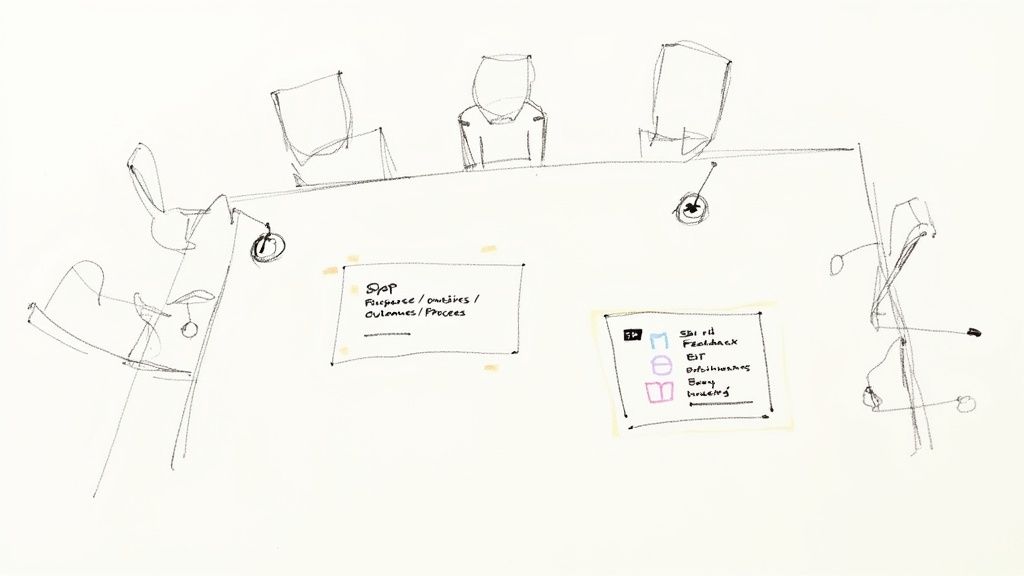
When you’re really listening, you’re not just silent. You’re fully engaged. Shockingly, research from the University of Missouri found that we typically remember only about 25% of what we hear. Think about that. Three-quarters of a conversation can get lost in translation.
That massive gap is where misunderstandings fester and projects go off the rails. The goal is to shrink that gap by making the other person feel genuinely heard and understood. It means intentionally quieting your own agenda and focusing completely on what they’re saying—with their words, their tone, and their body language.
From Hearing Words to Understanding Meaning
One of the most powerful habits of an active listener is paraphrasing. This simple act forces you to actually process what someone said and confirm you’ve got it right. It’s not about repeating their words back like a parrot, but about capturing the essence of their message in your own words.
Actionable Step: In your next one-on-one meeting, practice paraphrasing at least once. Use a lead-in like:
- “So, if I’m tracking with you, the core issue is…”
- “It sounds like your main concern is…”
- “Let me see if I’ve got this right. You’re suggesting that we…”
Another key is to ask open-ended questions. A closed question gets you a simple “yes” or “no,” which often shuts the conversation down. An open-ended question, on the other hand, invites the other person to share more, showing you’re genuinely curious and invested.
Practical Example: Instead of asking, “Did you finish the report?” try something like, “Can you walk me through your progress on the report and any roadblocks you’re hitting?” The difference in the quality of the response is huge.
A study in the Journal of Business and Psychology revealed a powerful link: employees who feel their managers truly listen to them report much higher levels of psychological safety. That feeling of safety is what allows teams to innovate, be creative, and take smart risks.
When a team member feels heard, they feel valued. This builds the trust you need for honest feedback and real problem-solving. It’s a foundational skill that requires you to manage your own reactions. To do that well, you need solid emotional regulation strategies to stay present and non-reactive in the moment.
It’s often tempting to jump in with a solution or interrupt with our own story. The table below breaks down some common passive habits and offers active alternatives you can start using today.
From Passive Hearing to Active Listening
| Passive Listening Habit | Active Listening Technique | Practical Example Phrase |
|---|---|---|
| Interrupting to share your own idea. | Pausing and Validating: Let them finish completely before you speak. | “That’s a really interesting point. Let me make sure I understand it before I add my thoughts.” |
| Thinking about your reply while they talk. | Reflecting and Clarifying: Paraphrase their point to confirm understanding. | “So, what I’m hearing is that the timeline is your biggest worry right now. Is that right?” |
| Answering with a simple “yes” or “no”. | Probing with Open-Ended Questions: Encourage them to elaborate. | “Can you tell me more about why you feel that way?” |
| Assuming you know what they mean. | Seeking Specifics: Ask for concrete examples. | “When you say the process is ‘inefficient,’ could you give me an example of what you mean?” |
Making these small shifts moves the focus from your understanding to a shared understanding, which is where real collaboration happens.
The Unspoken Conversation
Sometimes, what you don’t say speaks the loudest. Your nonverbal cues—your body language—can either reinforce your words or completely undermine them. Active listening is as much a physical act as it is a mental one.
Think about your posture. Leaning in slightly, maintaining comfortable eye contact, and nodding when you agree are all powerful signals of engagement. On the flip side, crossing your arms, glancing at your watch, or checking your phone sends a clear message: “I’m not interested.”
Practical Example: Imagine a team member is venting about their impossible workload.
- The passive listener keeps typing, glances up from their monitor, and mutters, “Okay, got it.” The employee walks away feeling completely dismissed.
- The active listener turns their chair, makes eye contact, and says, “Wow, it sounds like you are completely buried right now. Let’s pull up your calendar and look at this together.”
That simple shift validates the employee’s feelings, de-escalates the stress, and opens the door to actually finding a solution. This is how active listening becomes more than a buzzword—it becomes a practical tool for building trust and solving problems before they escalate.
Using Frameworks for Clearer Feedback and Meetings
Unstructured conversations are a recipe for confusion and wasted time. The good news is you don’t have to reinvent the wheel. By putting a few simple, proven frameworks in place, you can bring a sense of order to otherwise chaotic discussions, making your feedback more constructive and your meetings far more productive.
Think of these frameworks less as bureaucratic red tape and more as helpful guardrails. When giving feedback, it’s all too easy to inadvertently put someone on the defensive. A solid framework keeps the conversation focused on objective facts instead of subjective judgments. The same goes for meetings—a clear structure ensures everyone is on the same page about why they’re in the room and what needs to get done.
Giving Feedback That Builds People Up
One of the most powerful yet simple tools for delivering tough feedback is the Situation-Behavior-Impact (SBI) model. It’s a straightforward, non-confrontational way to talk about performance by breaking it down into three clean, objective pieces.
Here’s how it works:
- Situation: Start by grounding the conversation in a specific time and place.
- Behavior: Describe the exact, observable action—what you saw or heard.
- Impact: Explain the tangible effect that behavior had on you, the team, or the business.
Practical Example: Instead of a vague and accusatory “You were late with the report again,” use SBI: “During the project update meeting on Tuesday morning (Situation), the client report wasn’t submitted by the deadline (Behavior). This meant we had to present outdated figures to the leadership team (Impact).”
See the difference?
This approach immediately shifts the focus from blame to problem-solving. Research in organizational psychology backs this up, showing that feedback lands best when it’s specific, timely, and centers on behavior someone can actually change. SBI hits all three marks.
This structured method takes the personal sting out of the feedback, which makes it much easier for the other person to actually hear what you’re saying without getting defensive. It paves the way for a real conversation about solutions, turning a potentially difficult moment into a chance for growth. If you’re interested in the mental models that shape our reactions, you can learn more in our guide on what Neuro-Linguistic Programming is.
Running Meetings That Don’t Waste Time
Just as SBI brings much-needed structure to feedback, the Purpose, Outcomes, Process (POP) framework is a lifesaver for meetings. Before you even think about sending that calendar invite, take a moment to define these three things. It guarantees every meeting has a point and a plan.
- Purpose: Why are we even meeting? (e.g., To make a final decision on the Q3 marketing budget.)
- Outcomes: What tangible thing will we walk away with? (e.g., A finalized budget spreadsheet with assigned owners.)
- Process: How will we get there? What’s the agenda? (e.g., 15-min budget review, followed by a 30-min discussion and a final vote.)
Actionable Step: For your next meeting, write a one-sentence POP agenda and include it at the top of the calendar invite. This forces clarity and helps attendees prepare.
We have so many ways to communicate now, and how we use them matters. In fact, 77% of workers say digital tools boost their productivity, and companies using a mix of channels tend to have happier teams. You can see more on this in these workplace communication statistics. By creating a POP agenda and sharing it beforehand, you ensure every interaction is laser-focused.
How to Navigate Conflict and Difficult Conversations
Let’s be honest, conflict is just part of the deal when you work with other people. The real goal isn’t to create a workplace where no one ever disagrees—that’s impossible. It’s about learning how to manage those disagreements so they actually strengthen relationships instead of tearing them down.
With the right approach, you can turn a tense moment into a genuine opportunity to solve a problem together.
It’s Not You, It’s Me (Sort Of)
It all starts with how you frame things. One of the biggest mistakes people make is launching into a conversation with accusatory “you” statements. Think about it: “You always…” or “You never…” As soon as you say that, the other person’s defenses go right up. They stop listening and start preparing their rebuttal.
A small but incredibly effective shift is to use “I” statements. This isn’t about being soft; it’s about being smart. You’re taking ownership of your feelings and observations without pointing fingers.
Practical Examples:
- Instead of: “You always interrupt me in meetings.”
- Try: “I feel frustrated when I’m not able to finish my thought in meetings.”
- Instead of: “You missed the deadline again.”
- Try: “I was concerned about the project timeline when I saw the deadline was missed.”
This simple rephrasing shifts the focus from blame to the actual problem. It opens the door for a real conversation. When this kind of communication breaks down, the consequences are real. A 2022 Staffbase study confirmed this, revealing that 63% of employees considering quitting cited poor internal communication as a key reason. There’s a direct line between how we talk to each other and whether people decide to stay.
A Script to Hit the Reset Button
Even with the best intentions, conversations can get heated or just go in circles. You can feel the tension rising. Having a simple phrase in your back pocket can be a lifesaver, helping you pause the emotional spiral and get back to business.
Actionable Step: The next time a conversation gets tense, try this: “This is becoming unproductive. Can we take a brief pause and refocus on the problem we’re trying to solve here?”
This little script is brilliant for two reasons. First, it calls out what’s happening without blaming anyone. Second, it immediately pulls both of you back to the shared goal. It’s a powerful reset button. For a deeper look at this, you can find more practical strategies for handling difficult conversations.
From Clash to Collaboration: A Real-World Example
Let’s walk through a quick scenario. Alex missed a deadline, which is now holding up Sarah’s work.
- Sarah (initial reaction): “Alex, you completely derailed my week. Why are you always late?”
- Alex (defensive): “It’s not my fault! I was waiting on data from another team.”
The conversation is already a dead end. Now, let’s see what happens when Sarah uses a better approach.
- Sarah (using an ‘I’ statement): “Okay, let’s reset. I feel stressed because the client is expecting my part of the project today, and I can’t start without your input.”
- Alex (less defensive): “I understand. I’m also frustrated with the data delay. How can we solve this for the client right now?”
See the difference? By changing her opening, Sarah turned a personal attack into a shared problem. They went from opponents to teammates in a matter of seconds. That’s the core of navigating conflict like a pro.
Got Questions? We’ve Got Answers.
Putting communication strategies into practice is where the real work begins. Even with a solid plan, you’re bound to hit a few snags. Let’s tackle some of the most common questions that pop up when teams start working on how they talk to each other.
How Can We Encourage Quieter Team Members to Speak Up?
This is all about creating an environment where everyone feels safe and prepared to contribute. Not everyone is a quick-on-their-feet thinker, and that’s perfectly okay. The key is to build structures that invite their voices in.
Actionable Step: Before your next team meeting, send out the agenda with specific questions you want to discuss. This gives more introverted or internally-processing colleagues the space to gather their thoughts and come ready to share.
In the meeting itself, you could try a simple round-robin. Just go around the virtual or physical table and give each person a chance to speak without interruption. It takes the pressure off “finding the right moment” to jump in. Also, don’t forget about written communication. Platforms like Slack or shared Google Docs can be fantastic for people who express their ideas more clearly in writing.
Practical Example: When a quieter person does share an idea, make sure you validate it. Something as simple as, “That’s a great point, Sarah. Thanks for bringing that up,” goes a long way. It reinforces that their contribution is valued and makes them more likely to speak up next time.
What’s the Best Way to Communicate with a Difficult Coworker?
When you’re dealing with a challenging colleague, your best bet is to stay objective. The focus should always be on finding a solution, not getting bogged down in personality clashes. The SBI (Situation-Behavior-Impact) model is incredibly effective for this because it strips emotion and blame out of the conversation.
Actionable Step: Before speaking with them, write down your SBI statement. This forces you to be objective.
Practical Example: Instead of saying, “You were so negative in the meeting,” try framing it this way: “In yesterday’s planning meeting (Situation), when you referred to the project as a failure (Behavior), I noticed the team’s energy dropped, and it felt harder to brainstorm solutions (Impact).” See the difference? It’s factual, not accusatory.
Keep these conversations brief and professional. If it’s a significant issue, a quick follow-up email summarizing the discussion can be a good idea for documentation. And of course, if the behavior doesn’t change and continues to affect the team, it’s probably time to loop in a manager or HR.
How Do We Know If Our Communication Is Actually Getting Better?
You’ll feel it, but you should also be able to measure it. A mix of hard data and human feedback will give you the full picture.
- The Hard Numbers: Are projects getting finished faster? Are you having fewer meetings to make a single decision? Is your voluntary employee turnover rate going down? These are all concrete signs that things are improving.
- The Human Element: Use short, anonymous pulse surveys to ask people directly if they feel communication is clear, if they feel psychologically safe, and if they believe their opinions are heard. You’ll also notice fewer issues being escalated to management because teams are solving problems themselves—a huge win.
Actionable Step: Implement a quarterly, anonymous 3-question pulse survey asking: 1) On a scale of 1-10, how clear is team communication? 2) Do you feel safe voicing a dissenting opinion? (Y/N) 3) Do you feel heard by your direct manager? (Y/N). Track the results over time.
A 2018 study in the Journal of Organizational Behavior found a strong correlation between open communication climate and employee engagement, which in turn predicted higher team performance and lower turnover intentions. When people feel safe to speak their minds, the entire organization thrives.
Ultimately, getting better at workplace communication isn’t a one-and-done task. It’s a continuous process of trying things out, seeing what works, and adjusting along the way. Think of these strategies as your starting point for building a team that’s more connected, effective, and supportive.
At 9D Breathwork, we know that powerful communication starts with inner clarity. Real change happens when you break through the mental and emotional patterns holding you back. By blending breathwork, sound, and guided coaching, we help you find that clarity.
Ready to see how our experiences can reshape your professional and personal life?
Explore our journeys at https://9dbreathwork.com