Before you can fix your turnover problem, you have to figure out why your best people are walking out the door. It usually boils down to a handful of core issues: leadership, career growth, compensation, and the overall work environment. Tackling these root causes head-on is always going to be more effective than just reacting when another resignation letter hits your desk.
Why Your Best Employees Are Walking Away
Losing great talent isn’t just a morale killer; it’s a serious financial drain. Research from the Work Institute puts a number on it, finding that each departure can cost a company about 33% of that employee’s annual salary. That’s a significant hit to the bottom line, but it’s a manageable one if you get to the heart of what’s pushing people away.
Too many companies guess what will make their employees happy. They might launch a flashy wellness app or give a small across-the-board raise, yet the turnover rate doesn’t budge. Why? Because they’re treating the symptoms, not the actual disease.
Pinpointing the Real Problems
Any smart retention strategy starts with a proper diagnosis. A study in the Journal of Organizational Behavior pointed out that a major predictor of someone quitting is the gap between what they expected the job to be and what it actually is. Your job is to find those specific gaps in your organization.
Stop guessing and start listening. While the most common reasons people quit are pretty universal, how they show up in your company is unique. It’s about figuring out which issues are most pressing for your team. If you’re looking for more ideas, there are plenty of proven strategies to reduce staff turnover that can help guide your efforts.
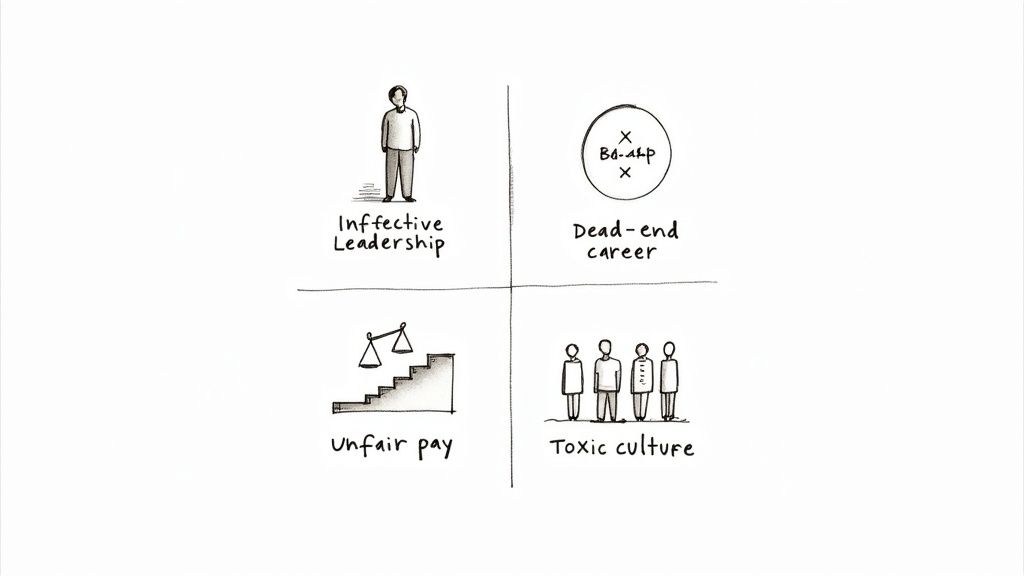
Here’s a quick look at the four big drivers of turnover and how to start thinking about solutions.
Four Core Turnover Drivers and Their Solutions
| Problem Area | Primary Cause | Actionable Solution |
|---|---|---|
| Ineffective Leadership | Managers lack training in communication, feedback, and empathy, leading to disengaged teams. | Action: Implement a mandatory manager training program focusing on active listening and constructive feedback frameworks. Use role-playing scenarios to build practical skills. |
| Dead-End Career Paths | Employees see no clear opportunities for advancement or skill growth within the company. | Action: Create transparent career ladders for key roles and launch an internal mentorship program. Host quarterly “career pathing” workshops with senior leaders. |
| Unfair Compensation | Pay and benefits lag behind the market, or compensation is perceived as inequitable. | Action: Conduct a compensation audit against industry benchmarks. Develop a clear compensation philosophy that links pay raises to specific skill acquisition and performance milestones. |
| Toxic Work Culture | Chronic stress, lack of recognition, and poor work-life balance are causing burnout. | Action: Launch a “wellbeing committee” to gather employee feedback and champion initiatives. Introduce “no-meeting Fridays” to allow for deep work and reduce calendar fatigue. |
These areas are deeply interconnected. Poor management often leads to a toxic culture, and a lack of career growth can make even a fair salary feel insufficient over time.
A study from the Academy of Management Journal hit on a crucial point: when employees feel the company genuinely values their work and cares about their well-being, their commitment skyrockets and they’re far less likely to leave. At the end of the day, feeling valued is one of the most powerful retention tools you have.
Transform Managers Into Retention Champions
You’ve heard the old saying: people don’t leave companies, they leave managers. It’s a cliché for a reason—it’s true. While things like pay and career growth certainly matter, the daily, person-to-person interaction with a direct supervisor can make or break an employee’s experience. A fantastic manager can make even the most challenging job feel worthwhile, but a bad one can poison a dream role.
This is exactly where so many retention strategies miss the mark. Companies will roll out new perks and benefits, but completely overlook the single most influential person in an employee’s work life. Investing in your managers isn’t just a “nice-to-have” item on a checklist; it’s one of the most direct and powerful levers you can pull to stop people from walking out the door. Your leaders are the ones on the ground, making your company culture a daily reality for their teams.

Give Your Managers the Right Tools
Think about how most people become managers. They were usually star performers in a non-management role. But being great at a technical skill has almost nothing to do with being great at leading people. It’s a critical gap. Without the right training, you’re essentially setting them—and their teams—up to fail.
What they need is a practical toolkit, one that’s focused on human connection and real-world leadership. This isn’t about fluffy theories; it’s about giving them tangible skills they can put to use immediately.
- Giving Feedback That Doesn’t Sting: Teach managers how to deliver constructive feedback that actually motivates people. For example, instead of a blunt, “This report is wrong,” a trained manager learns to use a framework like Situation-Behavior-Impact (SBI): “In the client presentation this morning (Situation), you presented the Q3 data without context (Behavior), which caused some confusion about our progress (Impact). For the next one, let’s work together to build a stronger narrative.”
- Leading with Empathy: Show them what it means to truly listen. For example, when an employee is frustrated, an untrained manager might get defensive or try to “solve” it too quickly. A trained one knows to ask thoughtful questions like, “It sounds like this process is really frustrating. Can you walk me through what’s causing the biggest bottleneck for you?” This validates their team member’s feelings first.
- Recognizing People Authentically: Help them move beyond the generic “good job” in a team huddle. Genuine recognition is specific. For example, “Sarah, the way you handled that difficult client call yesterday literally saved the account. Your calm demeanor and quick problem-solving were exactly what we needed. Thank you.”
These are the skills that turn a boss into a coach. And people don’t quit on great coaches.
Build a Foundation of Psychological Safety
Psychological safety is the bedrock of any high-performing, low-turnover team. It’s the shared belief that it’s okay to speak up with ideas, questions, concerns, or even mistakes without fear of being punished or humiliated. Guess who the primary architect of that environment is? The manager.
In fact, a study in the Journal of Applied Psychology found a direct link between psychological safety and lower turnover intentions. It makes perfect sense. When people feel safe, they’re more engaged, more innovative, and far more loyal. They aren’t afraid to ask for help or pitch a wild new idea.
The most effective way to slash employee turnover is by investing in strong manager training and fostering trust in leadership, as poor management is a top reason people quit. Research confirms that a staggering 50% of employees who leave their jobs do so primarily because of their manager, making this a critical lever for retention. This isn’t just anecdotal; an analysis summarizing 25 respected retention studies confirms that trust in leadership often trumps pay as a driver of long-term employee loyalty. To learn more about this connection, you can explore the full findings on leadership’s impact.
Create Feedback Loops for Your Leaders
If you really want to turn managers into retention champions, you have to help them see themselves the way their teams do. Self-awareness is a leader’s most powerful asset, and honest feedback is the only way to cultivate it.
This is where a 360-degree feedback process can be a complete game-changer. It involves gathering anonymous, structured feedback for a manager from the people who know their work best: their direct reports, their peers, and their own boss.
A Real-World Turnaround in a Manufacturing Plant
I once worked with a mid-sized manufacturing plant that was bleeding talent, staring down a 35% turnover rate on its assembly line. The exit interviews told a clear story: a few specific shift supervisors were known for their authoritarian, “my way or the highway” style.
Instead of just firing them, the HR director took a different approach. She rolled out a targeted coaching program that was tied directly to a 360-degree feedback review.
The supervisors were genuinely shocked to learn their “tough but fair” approach was actually being perceived as demeaning and disrespectful. Armed with that raw feedback, their coaches worked with them on concrete skills like active listening and using positive reinforcement.
The result? Within just six months, the turnover rate on their shifts plummeted to under 15%.
This proves that managers aren’t a liability; they’re an asset waiting to be developed. Giving them the right tools to lead with empathy doesn’t just reduce stress—it has a profound effect on the entire team’s wellbeing and loyalty. If you want to dive deeper into this, consider exploring specialized employee stress management programs designed to equip leaders with these very skills.
Design Career Paths People Actually Want
When your best people can’t see a future with you, they’ll start building one somewhere else. It’s a simple truth. A dead-end job is one of the most common—and entirely fixable—reasons great employees walk out the door. Creating clear, compelling career paths isn’t just a box-ticking HR exercise; it’s how you show your team you’re genuinely invested in where they’re headed.
This is about so much more than a title bump every few years. It’s about architecting a system where people know exactly what skills they need, what milestones to hit, and what doors can open for them—not just up, but sideways, too. When the path forward is clear, ambition doesn’t lead to LinkedIn—it leads to loyalty.
Map Out a Real-World Progression
Vague promises of “future opportunities” just don’t cut it. People, especially those early in their careers, need to see a map. A well-designed career ladder shows the journey from day one to a senior role within a team or function, making the abstract feel concrete.
But a map is useless if it’s not actionable. For every rung on that ladder, you need to define:
- Core Competencies: What are the non-negotiable skills and knowledge needed for this role? Example: For a Senior Marketing Manager, this could be “Develops and executes a multi-channel campaign budget of over $100k.”
- Performance Metrics: How do we objectively measure success? What does “great” look like? Example: Consistently achieves a 15% lead-to-conversion rate.
- Development Goals: What training, certifications, or on-the-job experiences will get someone ready for the next step? Example: Complete the ‘Advanced Google Analytics’ certification and lead one cross-functional project.
This level of transparency takes the guesswork out of promotions. An employee no longer has to wonder, “What do I need to do to get ahead?” The blueprint is right there, turning their career growth into a partnership between them and their manager.
Research from the Journal of Vocational Behavior backs this up. It found that when people see clear pathways for growth, their job satisfaction and commitment to the company skyrocket. They’re more engaged because they can draw a straight line from their daily grind to their long-term goals.
Go Beyond the Paycheck with a Smarter Compensation Philosophy
A competitive salary is just the price of admission. How you structure compensation, however, sends a powerful message about what your company truly values. A thoughtful compensation philosophy connects pay directly to performance and skill development, turning it from a static expense into a dynamic motivator. It explains the “why” behind the numbers.
Instead of just a standard annual raise, think about a more strategic approach:
- Skill-Based Pay Bumps: Offer defined salary increases for earning valuable certifications or mastering new, in-demand skills relevant to the business. Example: A software engineer who earns an AWS Certified Solutions Architect certification receives an automatic $5,000 pay increase.
- Performance-Tied Bonuses: Link a portion of earnings to hitting clear, pre-defined goals, whether individual or team-based. Example: If the sales team exceeds its quarterly target by 10%, every member receives a 1.5x bonus multiplier.
This shifts compensation from being a passive benefit to an active incentive. It signals to your team, “The more value you create, the more you’ll be rewarded.” It’s a merit-based system that your top performers will absolutely thrive in.
Pairing competitive pay with clear growth opportunities is a one-two punch against turnover. This is especially true in high-churn industries where salary is a key factor in 40% of voluntary quits. We’ve seen that while average voluntary turnover can be as high as 13.0%, companies with structured career paths often see 20-30% drops in early-stage attrition. Considering it can cost 30-400% of an employee’s salary to replace them, the ROI is massive.
Career Growth vs Compensation as Retention Levers
While both are crucial, career development and compensation often appeal differently across generations and have varying long-term effects. Understanding these nuances helps you build a more holistic and effective retention strategy.
| Retention Strategy | Impact on Gen Z & Millennials | Impact on Gen X & Boomers | Implementation Cost | Long-Term Effectiveness |
|---|---|---|---|---|
| Career Development | Very High. Seen as a primary driver for loyalty and engagement. | Moderate to High. Valued for skill enhancement and staying relevant. | Moderate. Requires investment in training, mentorship, and platform tools. | Excellent. Builds institutional knowledge and deepens employee commitment. |
| Compensation | High. Essential for meeting financial goals but less effective alone. | Very High. Often a key factor for financial security and retirement planning. | High. Directly impacts payroll and benefits budget. | Good, but can be temporary. Competitors can always offer more money. |
Ultimately, the most successful approach doesn’t pit one against the other. Instead, it integrates them, creating a system where growth in skills and responsibilities is directly and transparently rewarded with growth in compensation.
Build an Internal Talent Marketplace
Your next superstar hire might be sitting just a few desks away. A robust internal mobility program makes it easy for employees to find their next challenge inside your company, not with a competitor. It transforms your organization into a dynamic talent marketplace.
This isn’t just about climbing the ladder. It’s also about “jungle gym” moves—lateral shifts that let people build a broader skill set. Maybe a talented engineer has a knack for user experience and wants to try product management, or a marketing specialist is curious about a role in sales. These moves are a powerful antidote to career stagnation.
A simple first step? Create an internal-only job board and make it a policy to consider internal candidates first. It’s a clear, powerful signal that you believe in and invest in your own people. This entire journey is about helping individuals connect their work to a deeper sense of direction, which is the bedrock of long-term fulfillment. You can dive deeper into this concept in our guide on how to find purpose in life.
Master the Art of the “Stay Interview”
Exit interviews tell you why people left. Stay interviews tell you why people are still here—and, more importantly, what might make them leave in the future. These proactive, informal conversations are one of the most powerful tools you have for getting ahead of retention problems.
A stay interview isn’t a performance review; it’s a candid one-on-one between a manager and an employee focused entirely on engagement and satisfaction. The goal is to listen, not to evaluate.
Here are a few questions to get the conversation started:
- “What do you look forward to when you come to work each day?”
- “What are you learning here, and what skills are you hoping to build next?”
- “If you had a magic wand, what’s one thing you would change about your job?”
- “Be honest—what kind of offer from another company might tempt you to leave?”
The Corporate Leadership Council found that regular, meaningful career conversations can slash an employee’s intent to leave by up to 63%. Stay interviews create the perfect space for these conversations, letting you spot and fix small frustrations before they grow into reasons for resignation.
Build a Culture That Prioritizes Wellbeing
A great salary is table stakes these days. If you really want to keep your best people, you need to offer something more: a workplace that genuinely supports them as whole human beings. Forget the ping-pong tables and free snacks. Real retention comes from building a culture where wellbeing is baked into how you operate every single day.
This is about creating an environment where people feel seen, valued, and empowered to do their best work without burning out. It’s a conscious shift from just offering benefits to actively creating a supportive ecosystem. When you get this right, your company culture becomes one of your biggest assets—a magnet for top talent.
Move Beyond Perks to Genuine Flexibility
Let’s be clear: true flexibility isn’t about letting people duck out early on a Friday. It’s about trusting your team to manage their own time and energy to get the job done right. This simple act of trust shows you understand that life happens outside of a rigid 9-to-5 box and gives people the autonomy to blend their work and personal lives successfully.
Here’s what that looks like in practice:
- Embrace Asynchronous Workflows: Not every message needs an instant reply. Actionable Tip: Standardize the use of tools like Slack or Asana where non-urgent updates can be posted for review later, reducing the pressure for immediate response.
- Focus on Outcomes, Not Hours: Ditch the butts-in-seats mentality. Judge performance on the quality and impact of the work, not the hours logged. Actionable Tip: Define clear, measurable goals for each role and review progress against those goals, not timesheets.
- Schedule “No-Meeting” Blocks: Carve out sacred time each week where no meetings can be booked. This gives everyone a chance to do deep, focused work and helps kill the calendar fatigue we all feel. Actionable Tip: Implement “Focus Fridays” where internal meetings are discouraged company-wide.
Research from the International Journal of Human Resource Management confirms what many of us have experienced firsthand: employees who have more control over their schedules report higher job satisfaction and are far less likely to look for a new job. Giving your team this kind of autonomy is a powerful way to show you respect them, and that respect builds serious loyalty.
Create Recognition That Resonates
Everyone wants to feel their work matters, but a generic gift card just doesn’t cut it. To be truly effective, recognition needs to be specific, timely, and personal. It should spotlight the exact behaviors and contributions that you want to see more of, making people feel that their unique impact is truly seen and valued.
The real goal here is to make appreciation a daily habit, not a quarterly event. It’s about creating a constant feedback loop of positive reinforcement that keeps people motivated and strengthens the bonds within your team.
One of the best ways to do this is with a peer-to-peer recognition platform. Practical Example: Create a dedicated #kudos channel in your company’s Slack or Teams. Encourage employees to post public shout-outs celebrating colleagues who went above and beyond. At the end of each month, leadership can highlight the most impactful posts in a company-wide email. Of course, a culture that values its people also invests in their security. For example, considering health insurance for startups as a retention tool is a foundational way to show you care about your team’s long-term wellbeing.
Make Mental and Emotional Health a Priority
The conversation around mental health has thankfully changed. Today, people expect their employers to provide real, accessible support that goes far beyond a basic Employee Assistance Program (EAP) flyer. This means creating a psychologically safe space where it’s okay to talk about stress and burnout without worrying about being judged.
This is more important than ever as we face the ‘Great Detachment,’ where disengaged employees mentally check out or “quietly quit.” Alarming research shows that 40% of employees are thinking about leaving for a better opportunity or have simply stopped trying. With U.S. employee engagement hitting an 11-year low, the companies that are winning are the ones taking this head-on. In fact, firms that actively invest in wellness see turnover drop by 20-25%.
Offering proactive resources shows you’re not just talking the talk. This could mean subsidized therapy sessions or even cutting-edge tools designed to manage stress at the nervous system level. Our guide on workplace wellness program examples gets into how innovative options like 9D Breathwork journeys can help employees process stored stress and build resilience.
When you integrate programs like these, you send a powerful message: we care about you, and we’re invested in giving you the tools you need to thrive. That kind of proactive support is the bedrock of a culture people won’t want to leave. A study in the Journal of Occupational and Environmental Medicine even proved that comprehensive wellness programs are directly linked to lower absenteeism and turnover, making the ROI crystal clear.
Measure What Matters to Refine Your Strategy
You can’t fix what you don’t measure. Throwing new retention programs at the wall to see what sticks is a great way to waste time and money. It’s like navigating without a map—you’re moving, but you have no idea if you’re actually getting closer to your destination. To see if your efforts are truly making a dent, you need to stop guessing and start measuring.
This means getting specific. Vague goals like “improving our culture” are nice, but they’re not actionable. We need to turn those aspirations into hard numbers. By setting up the right key performance indicators (KPIs), you can see exactly which programs are hitting the mark, which are falling flat, and where to invest your resources for the biggest win.
Establish Your Baseline Metrics
Before you can see how far you’ve come, you have to know where you’re starting. The first step is to lock in a few core retention metrics. These numbers become your benchmark, the line in the sand that lets you measure the impact of every single change you implement.
- Voluntary Turnover Rate: This is your vital sign. It’s the percentage of employees who chose to walk out the door over a given period. If this number is climbing, it’s a huge red flag that something in the system is broken.
- Regrettable Loss Rate: Let’s be honest, not all turnover is created equal. This metric zeroes in on the departure of your top performers—the people you absolutely can’t afford to lose. A high regrettable loss rate is a five-alarm fire demanding immediate attention.
- Employee Net Promoter Score (eNPS): This is a quick and surprisingly powerful gauge of employee loyalty. It all comes down to one question: “On a scale of 0-10, how likely are you to recommend our company as a great place to work?” It gives you a fantastic snapshot of overall morale.
These metrics are the bedrock of a solid retention strategy. A study from Personnel Psychology actually found that organizations that actively track and act on this kind of data see much better results. Why? Because they can pinpoint the real problems instead of just acting on a hunch.
Dig Deeper with Qualitative Data
Numbers tell you what is happening, but they rarely tell you why. To get the full story, you have to pair your quantitative data with real, human insights gathered straight from your team. This is where you uncover the stories behind the stats.
Combining hard data with human insights is the key to a successful retention strategy. Metrics can flag a problem in a specific department, but only by listening to your people will you understand the root cause—be it a difficult manager, unclear expectations, or burnout.
You can get this crucial information from a few key places:
- Pulse Surveys: These are short, frequent surveys that act like a stethoscope for your organization. Actionable Tip: Use a tool like Officevibe or Culture Amp to send a 5-question survey every two weeks, focusing on a different theme each time (e.g., manager support, workload, recognition).
- Exit Interview Analysis: Don’t let exit interview forms just gather dust in a folder. Systematically comb through them to find recurring themes. Actionable Tip: Create a simple spreadsheet to tag exit feedback by theme (e.g., “compensation,” “management,” “career growth”). Look for patterns, especially within specific departments or roles.
This process helps move wellbeing from a fuzzy concept to a concrete plan of action, starting with recognition, moving to flexibility, and cementing it all with genuine support.
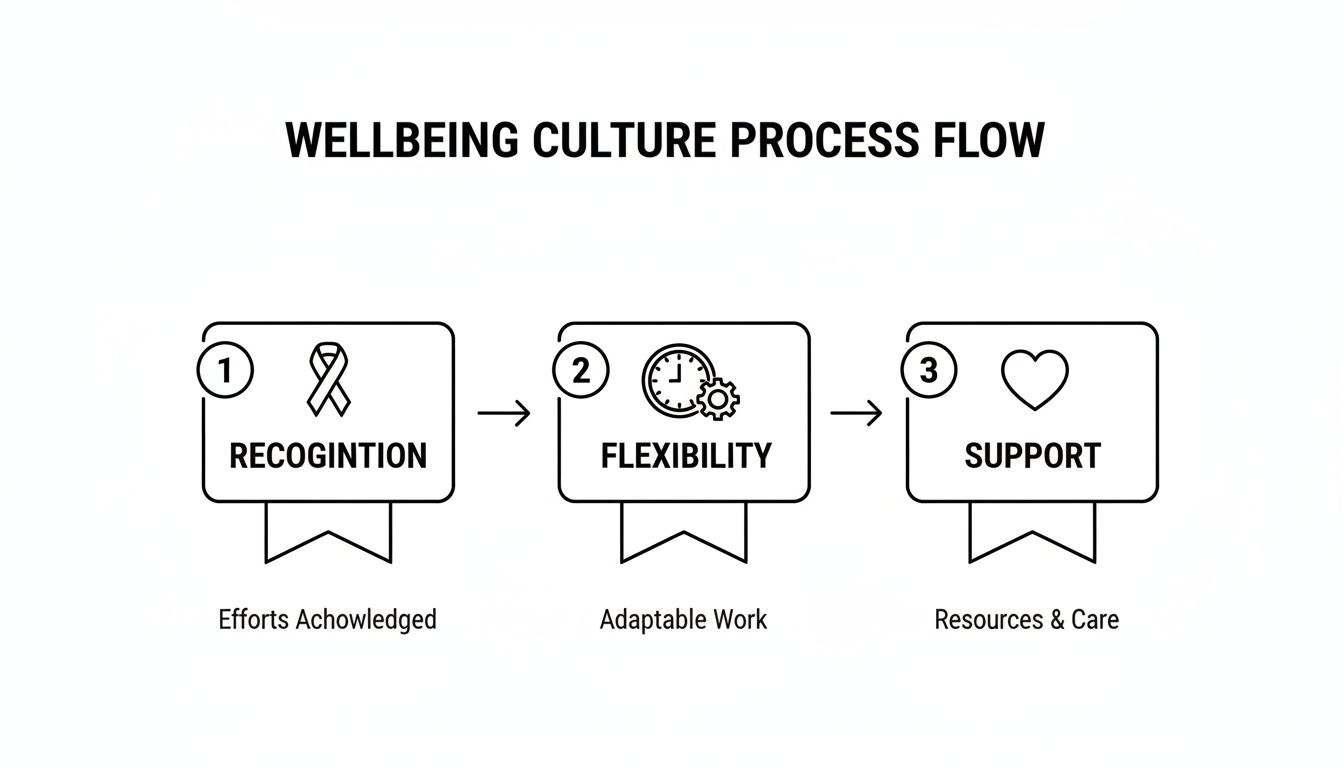
This simple flow really drives home the point that a strong culture isn’t an accident. It’s built intentionally on a foundation of recognizing people’s work, giving them flexibility, and offering support when they need it.
Test Your Initiatives with Precision
When you’ve identified a potential problem, it’s tempting to roll out a massive, company-wide solution right away. My advice? Resist that urge. A much smarter move is to A/B test your new idea on a smaller scale first. This lets you measure the real impact, tweak your approach, and prove the ROI before you go all-in with time and budget.
Let’s say your data points to a lack of mentorship as a key reason junior employees are leaving. Instead of launching a universal program from day one, you could try this:
- Select a Pilot Group: Pick one department to be your test case.
- Implement the Program: Roll out the new mentorship program for that team only.
- Measure and Compare: After a set period, say six months, compare the voluntary turnover rate and eNPS of the pilot group against a control group (a similar department that didn’t get the program).
Research in the Journal of Business and Psychology backs this up, showing that these kinds of controlled experiments in HR help companies adopt changes that are empirically proven to work for their specific environment.
If the pilot program works—if turnover drops and engagement scores go up—you now have a compelling, data-backed case to justify a company-wide rollout. This methodical, test-and-learn approach doesn’t just reduce risk; it builds credibility for your HR initiatives and fosters a culture of smart, continuous improvement.
Got Questions? Let’s Get Them Answered.
When you’re trying to figure out how to keep your best people, a lot of questions come up. It’s a complex issue, and there’s no single magic bullet. Here are some of the most common questions I hear from leaders, along with straightforward, practical answers to help you get started.
Where Do I Even Begin with Reducing Turnover?
Before you do anything else, you have to play detective. Don’t just throw solutions at the wall and hope something sticks—that’s a common mistake that wastes time and money. Your first move is to figure out why people are actually leaving your company.
Start gathering real data. Use a mix of anonymous surveys, candid exit interviews, and proactive “stay” interviews to get the full picture. Are the reasons about compensation? Bad managers? No clear path for growth? Or is it straight-up burnout? The data will tell you exactly where the fire is, so you can focus your efforts there first instead of guessing.
How Long Will It Take to Actually See a Difference?
That really depends on what you’re trying to fix. Some changes can deliver results pretty quickly. If you’re tackling things like manager coaching or making salary adjustments, you can often see a positive shift in morale and a dip in resignations within 3-6 months. These are the “quick wins” that address immediate pain points.
But for the bigger, more foundational issues—like building out a real career development program or making a lasting change to your company culture—you need to be more patient. Those kinds of shifts usually take a good 12-18 months to really take hold and show up in your turnover numbers.
Pro Tip: Track both leading and lagging indicators. A leading indicator, like an improved employee Net Promoter Score (eNPS), might tick up fast, telling you you’re on the right track. The actual turnover rate is a lagging indicator; it will take longer to catch up and reflect your hard work.
We’re a Small Business with a Tight Budget. Can We Realistically Do This?
Absolutely. In fact, some of the most effective retention strategies cost very little money. They’re more about investing time, intention, and trust—things that often build far more loyalty than a pay bump ever could.
Here are a few high-impact, low-cost ideas you can start with:
- Train your managers to give consistent, meaningful feedback. This is huge. It makes people feel seen and supported.
- Set up a simple peer-to-peer recognition system. A dedicated Slack channel for shout-outs can do wonders for morale. It costs nothing but creates a culture of appreciation.
- Offer flexibility where you can. Giving your team autonomy over their schedules is a powerful way to show you trust them.
- Start doing stay interviews. These are proactive chats to find out what keeps your best people here and what might make them leave. You can uncover small problems before they become big ones.
Time and again, research shows that feeling valued and having a great relationship with a manager are top reasons people stay. These actions build the kind of trust that money just can’t buy.
At 9D Breathwork, we’ve seen firsthand how unaddressed stress and burnout are silent drivers of turnover. Our approach focuses on helping your team manage their nervous systems, build genuine resilience, and feel more connected to their work. This creates a workforce that is not only more present but also more committed.
Discover how our corporate wellness programs can transform your team from the inside out.