Let’s be honest: the whole idea of “finding your purpose” feels huge. It’s this massive, overwhelming question that can leave you feeling stuck, especially when you’re already juggling a high-pressure job or navigating your mental health. The pressure to have it all figured out is immense, and it often leads to doing nothing at all.
But what if we’ve been asking the wrong question?
The search for purpose isn’t about uncovering some grand, singular destiny. It’s about building a life that feels meaningful, piece by piece, right where you are. It starts by shifting your focus from “What do I want to do?” to “Who do I want to be?” and then making small, deliberate choices that align with that answer.
Moving Beyond the Big Question

Instead of searching for a destination on a map you don’t have, think of purpose as something you build from the inside out. This approach takes the pressure off and makes the process about tangible, present-moment actions rather than some abstract goal in the distant future.
Debunking the Grand Passion Myth
There’s a common myth that everyone has one all-consuming passion they just need to discover. This idea can be pretty damaging. It implies that if you haven’t found your “one thing,” you’re falling behind. The truth? For most of us, purpose is much quieter and more woven into the fabric of our daily lives.
It’s not about fleeting moments of happiness, either. A study published in the Journal of Positive Psychology demonstrates that having a strong sense of purpose is more closely linked to overall well-being than simply chasing pleasure. Meaning comes from feeling like you contribute and that your life makes sense.
Purpose isn’t a job title or a destination; it’s the meaning you choose to bring to your actions. You don’t find purpose—you create it in every moment by aligning with who you want to be.
This guide is designed to give you a practical, no-nonsense framework to do just that. We’re skipping the big, paralyzing questions and starting with a simple kit that cuts through the overwhelm and helps you take immediate action. The whole approach is built on getting clear on two things:
- Your Core Values: These are your non-negotiables—the principles like integrity, connection, or creativity that guide how you live.
- Your Innate Strengths: These are the things you’re naturally good at, the skills that make you feel energized and capable when you use them.
Focusing on these internal building blocks is where the magic happens. When you start living in a way that honors your values, life satisfaction increases, as confirmed by a study in the Journal of Research in Personality.
And it gets better. Another study from the Journal of Happiness Studies found that using your signature strengths in new ways leads to long-term boosts in happiness and even helps reduce depressive symptoms. This isn’t about a life overhaul. It’s about taking small, intentional steps that honor who you really are, starting right now.
Your Purpose-Building Starter Kit
| Concept | Initial Action | Why It Works |
|---|---|---|
| Values | Identify your top 3-5 core values. Action: Spend 15 minutes journaling on a time you felt proud and a time you felt angry. What values were being honored or violated? (e.g., freedom, security, compassion). | Aligns your decisions with what truly matters to you, creating a sense of inner coherence and reducing internal conflict. |
| Strengths | Pinpoint a few things you do well that also energize you. Action: Ask three friends what they think you’re best at, or take the free VIA Character Strengths survey online. | Using your natural talents makes work feel less like work. It builds confidence and makes your contributions feel more impactful. |
| Small Actions | Find one small way to express a value or use a strength today. Action: If “kindness” is a value, send a thoughtful text. A 5-minute action is enough. | Breaks the cycle of overwhelm by proving that purpose is built in the present moment, not found in a distant future. |
This starter kit is your foundation. By focusing on these simple, internal guideposts, you begin to build a life that feels authentic and meaningful from the inside out, no matter what external pressures you’re facing.
Map Your Inner Compass with Values and Strengths
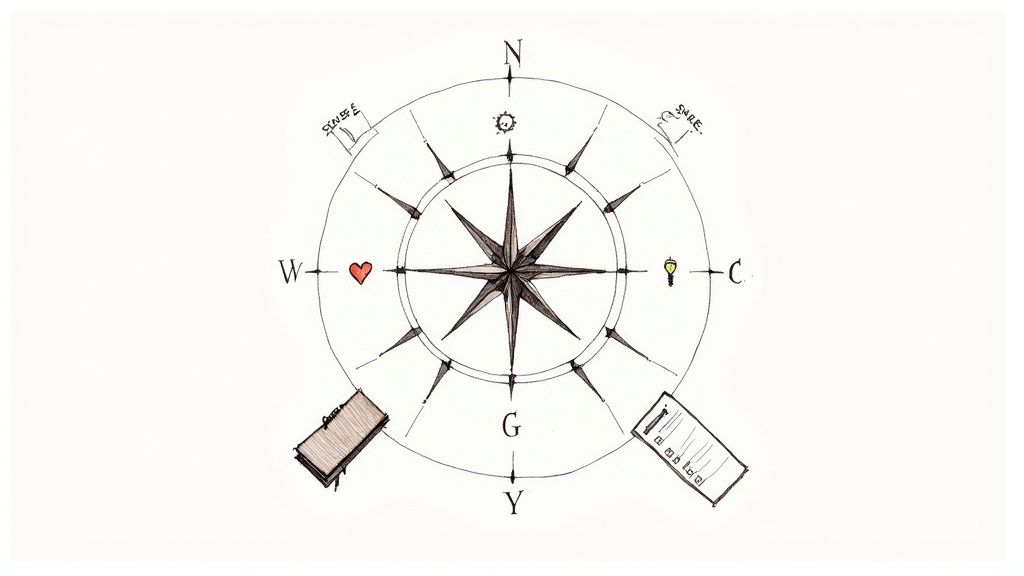
Forget the idea that your purpose is some mystical thing you’ll find “out there.” It’s not. It’s an internal compass you build, piece by piece, by getting brutally honest about what makes you tick. To find that deep-seated sense of purpose, you have to look inward and get past all the generic advice.
The foundation of this compass is built on two core elements: your personal values and your natural strengths. Think of your values as your North Star and your strengths as the engine that gets you there. When you align your daily actions with them, even the most mundane tasks start to feel more intentional.
Identify Your Core Personal Values
Your values are the non-negotiable principles that quietly guide your life. They’re the real reason behind your best days and your worst moments. Pinpointing them is the first step toward building a life that feels like your own.
So, how do you actually find them? This isn’t some abstract exercise. The clues are hidden in your own life experiences.
- Actionable Prompt 1: Think about a peak moment when you felt truly alive and proud. What were you doing? Maybe you felt a surge of courage when you spoke up in a meeting, or a sense of deep connection while mentoring a junior colleague.
- Actionable Prompt 2: Look at your frustrations. What makes you angry or resentful? Those feelings are powerful signals that a core value is being ignored. If you can’t stand being micromanaged, it’s a good bet that autonomy or freedom is a big deal for you.
Grab a journal and spend 15 minutes jotting down whatever comes to mind from those prompts. Don’t edit yourself. Once you have a list, circle the words that hit you in the gut. Whittle it down to your top three to five.
These values become your personal decision-making filter. Before taking on a new project or accepting a job offer, ask a simple question: “Does this align with my values of [creativity, security, compassion]?” This simple check-in can save you from years of misalignment and burnout.
Uncover Your Innate Strengths
Next up are your strengths. These aren’t just things you’re good at; they’re the activities that energize you and make you feel engaged. Leaning into your strengths is one of the most direct paths to fulfillment. A study in the Journal of Occupational Health Psychology found that employees who used their strengths at work were more engaged and reported higher levels of well-being.
A fantastic, evidence-based tool for this is the free VIA Character Strengths survey. It will help you identify what you’re naturally wired for, whether it’s creativity, curiosity, leadership, or kindness.
Once you know your top five strengths, the trick is to find small ways to weave them into your current life. This isn’t about quitting your job tomorrow. It’s about reframing what you already do.
Here’s a practical example:
Let’s say you’re a project manager feeling bored and boxed-in. You take the survey and discover your top strengths are Creativity and Love of Learning.
- Instead of: Slogging through the same old project workflow.
- You could: Propose redesigning the team’s reporting dashboard to be more visual and intuitive (using your Creativity).
- You could also: Spend 30 minutes a week learning a new project management software to share with your team (tapping into your Love of Learning).
These small shifts reconnect your daily tasks to what makes you feel competent and alive. This kind of proactive self-awareness is critical for navigating modern life and work. If you want to go deeper, check out our guide on how to increase self-awareness and build a stronger inner foundation.
This push for authenticity isn’t just a wellness trend. A global EY study found that 84% of young adults see authenticity as highly important, and 66% believe that hard work aligned with their goals is the key to a successful future. The data shows a powerful link between purposeful effort and life satisfaction. You can explore the full report on generational values to see these trends for yourself.
By mapping your values and strengths, you create a tangible profile of what a purposeful life looks like for you. This inner compass gives you the clarity to filter every choice, ensuring you stay true to the person you’re becoming.
Use Mindfulness to Hear Your Inner Voice
So, you’ve started to map your inner compass. That’s a huge step. But now comes the real challenge: actually hearing it over the constant noise of daily life. Between deadlines, pings, and the general hum of stress, your inner voice can get pretty drowned out.
This is where mindfulness and somatic practices come in. And I don’t mean them as just another wellness trend; I mean them as practical, essential tools for getting clear on what matters.
Most of us live in our heads, completely disconnected from our bodies. But your body holds an incredible amount of wisdom. That feeling of being overwhelmed? It’s not just a thought—it’s a racing heart, shallow breath, and tense shoulders. To find your purpose, you first need to create enough inner stillness to actually listen.
Ground Yourself with Intentional Breath
You don’t need to carve out an hour for a meditation session to do this. A simple, potent breathwork technique can be done right at your desk, creating the space you need for real introspection. The point isn’t to empty your mind, which is nearly impossible. It’s about giving it a single, calming anchor to hold onto.
There’s solid science behind this. A study in NeuroImage found that mindfulness practices, especially focused breathing, can literally calm down the amygdala—the brain’s alarm system. When you intentionally slow your breathing, you’re sending a direct signal to your nervous system that you’re safe.
This physical sense of safety has a direct ripple effect on your mind. Another study, this time in Frontiers in Human Neuroscience, showed how mindfulness strengthens the prefrontal cortex. That’s the part of your brain handling big-picture thinking, emotional regulation, and decision-making.
By calming your body, you empower your mind to think more clearly. It’s a powerful feedback loop: physical stillness leads to mental clarity, allowing your true values and sense of purpose to surface without being clouded by anxiety.
A Practical Breathwork Exercise for Clarity
Here’s a simple technique you can use anytime you feel that familiar wave of overwhelm. The goal is just to shift from chaotic thinking to a more grounded presence.
- Action Step 1: Settle In: Sit upright in your chair, feet flat on the floor. Let your hands rest on your lap. Close your eyes if that feels comfortable.
- Action Step 2: Try the Box Breath: Slowly inhale through your nose for a count of four. Hold your breath for a count of four. Gently exhale through your mouth for four. And hold the exhale for four.
- Action Step 3: Repeat for Three Minutes: Continue this 4-4-4-4 pattern for at least three minutes. Pour all your focus into the physical sensation of breathing and the rhythm of the count.
Your mind will wander. That’s what minds do. When it happens, just gently guide your attention back to your breath without any judgment. Think of it as a bicep curl for your attention span.
From Calmness to Insight
Once you’re done, don’t just jump back into your to-do list. Sit for another minute or two in the stillness you’ve created. This is the sweet spot for introspection. With your brain’s alarm system quieted, you can access your own wisdom much more easily.
Research from the Journal of Experimental Psychology even shows that a calm, positive mood boosts creative problem-solving and insight. You’re essentially priming your mind for those “aha” moments by shifting your physical state first.
It’s in this quiet space that you can ask yourself better questions, without the usual filter of stress:
- What’s one small thing I can do today that lines up with my value of [insert your value]?
- How can I use my strength of [insert your strength] to handle this challenge?
- What is my gut telling me about this situation?
The answers that pop up in this state of calm are almost always more authentic. They come from you, not from your anxiety. For a deeper dive into this, our guide offers more techniques on how to quiet your mind and find clarity in the chaos.
This simple act of grounding yourself is a real, tangible step toward a purpose-driven life. It’s not about finding some monumental answer in a single sitting. It’s about consistently creating these small pockets of quiet, giving your inner voice a chance to finally be heard.
Translate Self-Discovery Into a Purpose-Driven Plan
All those a-ha moments and deep reflections are fantastic, but they don’t mean much if they stay stuck in your journal. You’ve done the tough internal work—figuring out what you value, what you’re naturally good at. Now comes the exciting part: building a bridge from that inner knowing to your actual, everyday life.
This isn’t about drafting a rigid five-year plan that will likely change anyway. Think of it more like creating a flexible blueprint, one that leaves room for you to experiment, learn, and grow. We’ll approach this by breaking it down into two manageable chunks: immediate, short-term experiments and a longer-term sense of direction.
This is how you shift from passively “finding” your purpose to actively creating it. You stop waiting for a lightning bolt of inspiration and start building your own momentum, one small, intentional choice at a time.
Create Your Short-Term Action Plan
Let’s treat the next 30-90 days as your own personal laboratory. The goal isn’t to overhaul your entire existence overnight. Instead, you’re going to run a few small, low-risk experiments to test out the ideas you’ve uncovered about your purpose. This is how you get real-world feedback on what actually lights you up.
Practical Example in Action:
Meet Sarah, a marketing manager who’s feeling completely drained by her job. After doing some self-reflection, she’s realized her core values are Connection and Growth, and a key strength of hers is Mentorship. Her gut tells her that her purpose has something to do with helping other people unlock their potential.
Instead of dramatically quitting her job to become a life coach, Sarah can design a few small, concrete actions to test the waters:
- Action 1 (Volunteer): She finds a local nonprofit and dedicates two hours a week to mentoring a college student. This is a direct, low-commitment way to see if she truly enjoys it.
- Action 2 (Pitch an Internal Project): At her current company, she offers to lead a lunch-and-learn workshop on a skill she has mastered, like public speaking. It lets her flex her mentorship muscles right where she is.
- Action 3 (Host a Mini-Workshop): On a Saturday, she hosts a simple, one-off workshop for friends or local professionals on a topic she loves, like “Building Your Personal Brand.”
The point of these steps isn’t to find the final answer. It’s about getting out of your head and into the real world, gathering feedback, and discovering which activities genuinely give you energy.
Set Your Long-Term Direction
Your short-term plan is all about experimenting. Your long-term vision, on the other hand, gives you a North Star to aim for over the next 1-3 years. It’s not a rigid roadmap but a general direction that answers the question, “If these small tests go well, where could this all lead?”
For our friend Sarah, a long-term direction might look something like this:
- Year 1: Focus on getting more hands-on experience through formal mentorship roles at work. Maybe she’ll even look into getting a coaching certification to build her skills.
- Year 2: Start looking for a new role with a heavier focus on training and development, or maybe start a small coaching side-hustle to build a client base.
- Year 3: At this point, she can realistically evaluate if she has the clients, confidence, and income to take her coaching business full-time.
Having this general direction ensures your short-term actions aren’t random; they’re all building blocks toward something bigger and more meaningful.
This simple infographic below illustrates how you can move from feeling overwhelmed to having real, purpose-driven clarity.
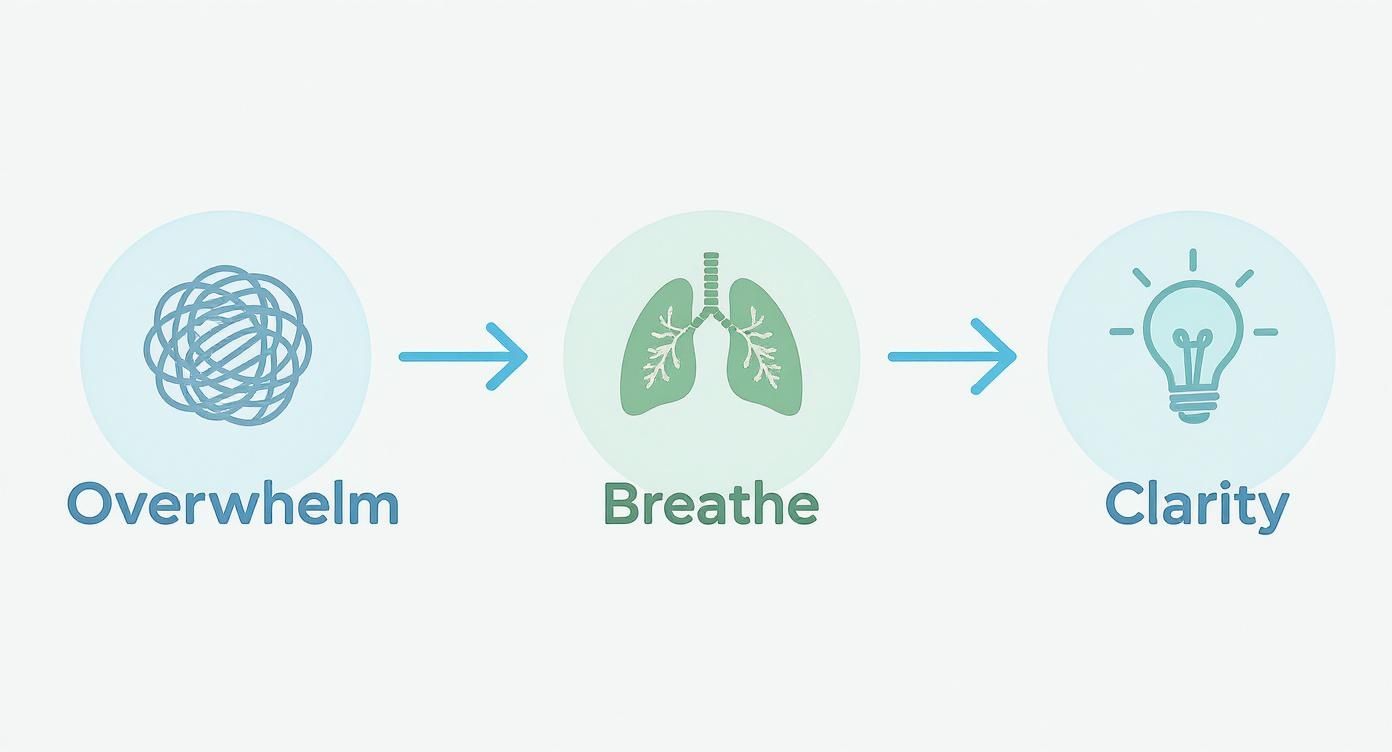
As you can see, those intentional pauses—like the breathwork exercises we’ve discussed—are what make it possible to bridge the gap between feeling stuck and taking clear, confident action.
Develop a Purpose-Aligned Decision Filter
Once you start moving, new opportunities will pop up—job offers, side projects, collaborations. To avoid getting pulled back off course, you need a simple filter to run every new possibility through.
Before you say “yes” to anything, ask yourself these three quick questions:
- Values Alignment: Does this honor my core values of [your value #1] and [your value #2]?
- Strengths Engagement: Will I get to use my strengths in [your strength #1] and [your strength #2]?
- Growth Potential: Does this move me even a tiny bit closer to my long-term vision?
The goal isn’t perfection. It’s about consistently making conscious choices that stack the odds in favor of a life that feels right. Over time, these small, aligned decisions compound into something truly fulfilling.
This idea isn’t unique to personal development; even in business, like building an online community, success often comes down to the importance of a clear purpose. When you know your “why,” the “what” and “how” become much clearer.
This search for meaning is a growing global trend. A Gallup poll of over 140 countries found that having a strong sense of purpose is a key differentiator between those who are “thriving” and those who are just “struggling.” People are actively seeking to connect their daily actions to a deeper sense of meaning.
Your purpose isn’t a static destination you arrive at. It’s a path you walk, and it will evolve as you do. The key is to just start walking.
Navigating Roadblocks and Building Real Resilience
Let’s be honest: the journey to find your purpose isn’t a straight line. It’s full of hairpin turns, moments of intense doubt, and the messy, beautiful reality of being human. Just when you feel like you’re getting somewhere, a roadblock like imposter syndrome or pressure from others will inevitably pop up, threatening to send you right back to where you started.
The first step isn’t to pretend these challenges don’t exist. It’s to acknowledge them head-on. Building resilience isn’t about avoiding setbacks; it’s about learning how to navigate them with a toolkit that keeps you moving forward, even when it feels tough.
Taming the Inner Critic and Imposter Syndrome
One of the most common obstacles is that relentless inner critic—the voice of imposter syndrome. It’s that nagging feeling that you’re a fraud, that you aren’t qualified, and that any success you’ve had is just dumb luck. This feeling gets especially loud when you dare to step outside your comfort zone to chase something that actually matters to you.
The best way to fight back is with cold, hard proof.
Actionable Tip: Create a “Brag File” or an “Accomplishment Log.” This isn’t about ego; it’s about evidence. It can be a simple document or a note on your phone where you jot down every single win, no matter how small.
- Example entry: “Received an email from a colleague thanking me for my help on the Q3 report.”
- Example entry: “Successfully navigated a difficult conversation with my manager about my workload.”
- Example entry: “Finally finished that online course on data analytics.”
When that self-doubt starts whispering, open this file. It’s your objective evidence against the irrational feelings of inadequacy, grounding you in your actual history of competence and effort. Building true resilience often means designing a future proof career that grows with you, and that starts with recognizing your own value.
Managing Anxiety and the Fear of Failure
The fear of failure can be absolutely paralyzing. It’s the single biggest thing that keeps people stuck, preventing them from taking the very actions needed to build a life they love. This fear often shows up as anxiety—that constant, low-level hum of worry about what could go wrong.
Instead of fighting the anxiety, work with it. The somatic techniques we’ve talked about are your superpower here.
Actionable Tip: When you feel that surge of fear, anchor yourself with a few rounds of intentional box breathing (inhale 4, hold 4, exhale 4, hold 4). A study in the Journal of Clinical Psychology showed that even brief mindfulness interventions can significantly reduce anxiety. This simple act can physiologically reset your nervous system, pulling you out of a panic state and allowing your logical brain to come back online.
Once you feel a bit more grounded, you can start to reframe your thoughts. This means consciously challenging the stories that fuel your fear.
Instead of asking, “What if I fail?” try flipping the script: “What if I succeed? And what will I learn from this, no matter what happens?”
This simple shift turns failure from a terrifying dead-end into just another data point on your journey. It’s a vital practice for overcoming limiting beliefs that hold you back from what you’re truly capable of.
Navigating Pressure from the Outside World
Sometimes, the biggest roadblocks aren’t inside your head at all. They come from the expectations of family, friends, and society. You might feel intense pressure to chase a more “prestigious” or “stable” career, even when every fiber of your being is telling you it’s the wrong fit.
What’s fascinating is that purpose often thrives outside our conventional ideas of success. A landmark Harvard Global Flourishing Study of over 200,000 people in 22 countries found that people in middle-income nations actually reported higher levels of meaning and purpose than those in high-income ones. This tells us that purpose isn’t tied to a paycheck, but to an internal compass we have to set for ourselves.
To stand firm against external pressure, you need that strong internal compass. Your defined values become your shield. When you’re faced with a decision that feels off, check in with them.
- Actionable Self-Check: “My family thinks I should take this promotion, but does it align with my core value of autonomy? Or will it just mean more micromanagement?”
- Actionable Self-Check: “This job offer has a great salary, but is it honoring my deep need for creativity? Or will I be stuck in spreadsheets all day?”
Having this clarity makes it so much easier to say “no” to the things that look good on paper but feel empty inside. It gives you the backbone to choose your own path, backed by the quiet confidence that you are living in alignment with who you are meant to be.
Got Questions? Let’s Talk About Purpose.
As you start this journey, a lot of very practical questions are bound to pop up. It happens to everyone. Let’s tackle some of the most common ones head-on, so you can keep moving forward with confidence.
“Is My Passion the Same as My Purpose?”
It’s so easy to mix these two up, but understanding the difference is a game-changer.
Think of it like this: a passion is something that lights you up. It’s an interest or hobby that fills your cup—maybe it’s painting, mountain biking, or deep-diving into historical documentaries. It’s all about what excites you.
A purpose, however, is your fundamental why. It’s bigger than just you. It’s how you channel your energy outward to contribute to something meaningful. It’s about service, connection, and making a difference in a way that resonates with your soul.
Practical Example:
- Passion: “I love coding and building apps in my spare time.”
- Purpose: “I want to use my coding skills to build tech that makes daily life easier for people with disabilities.”
Your passions can absolutely fuel your purpose, but they don’t have to be the same thing. In fact, a study in the Journal of Vocational Behavior showed that a sense of calling—which is right at the heart of purpose—is more about the meaning you get from your work than the specific tasks themselves.
“How Do I Find Meaning in a Job I Can’t Stand?”
This is a tough one, and you’re not alone if you feel stuck in a job that pays the bills but doesn’t feed your spirit. The good news? You don’t have to walk out tomorrow to start living with more purpose.
The secret is to shift your perspective from what you’re doing to how you’re doing it.
Actionable Tip: Look for small, almost hidden opportunities to bring your core values and signature strengths to life right where you are. This is called “job crafting.”
- If your value is connection: Action: Take the initiative to mentor a new hire or organize a low-key team lunch.
- If your strength is creativity: Action: Volunteer to redesign that tired, old PowerPoint deck or suggest a fresh approach to a clunky internal process.
Researchers call this “job crafting,” and studies from the Journal of Occupational and Organizational Psychology prove it works. By actively reshaping small parts of your role to align with what makes you tick, you can reclaim a sense of control and significantly boost your feeling of meaning at work.
“What if My Purpose Changes?”
Good. It’s supposed to.
Your purpose isn’t some static thing you find once and lock away. It’s a living, breathing part of you that will naturally grow and shift as you move through life. The person you are at 25 has a completely different set of experiences, priorities, and wisdom than the person you’ll be at 45.
Embrace the idea of having seasons of purpose. What felt profoundly important in one chapter of your life will naturally evolve into something new in the next. The goal isn’t to find a single, final answer—it’s to stay curious and keep asking yourself, “What matters to me right now?”
Research published in the Journal of Personality and Social Psychology has shown that our sense of purpose often evolves after major life events. That’s not a sign of failure; it’s a sign of growth.
Actionable Tip: Schedule a “purpose check-in” with yourself every six months. Spend 30 minutes with a journal and ask: Do my core values still feel right? Am I using my strengths? Is my long-term direction still exciting to me? This keeps you intentionally engaged with your own evolution.
So, keep checking in with yourself. Revisit your values, explore your strengths, and give yourself the grace to adjust course when your inner compass points in a new direction. The journey itself is the whole point.
Ready to stop searching and start building a life aligned with your deepest self? At 9D Breathwork, we guide you through powerful somatic experiences that quiet the noise and connect you to your inner wisdom. Discover our transformative journeys and begin creating your purpose today at 9dbreathwork.com.