Learning how to build mental resilience is like developing a psychological immune system. It’s not something you’re born with; it’s a skill you forge through consistent practice, using the power of neuroplasticity to literally rewire your brain’s response to whatever life throws at you.
Understanding the Foundation of Mental Resilience
Think of mental resilience as the psychological version of physical fitness. You don’t just show up at the gym and lift the heaviest weight on day one. You train your muscles over time. The same goes for your mind—you can train it to handle greater stress and bounce back faster.
This isn’t about becoming emotionless or ignoring pain. It’s the complete opposite. It’s about building the capacity to face adversity head-on, process it constructively, and actually come out stronger on the other side.
Deep down, mental resilience is a dynamic process happening inside your brain. It’s a sophisticated dance between your amygdala (the brain’s “threat detector”) and your prefrontal cortex (your “thinking brain”). When a stressful event hits, the amygdala lights up, kicking off that classic fight-or-flight response. A resilient mind, however, has a well-practiced prefrontal cortex that can step in, logically assess the situation, and dial down that initial alarm.
The Science of a Strong Mind
Here’s the really exciting part, backed by neuroscience: our brains are incredibly adaptable. This concept, known as neuroplasticity, means we can physically change our brain’s structure and function just by repeating certain thoughts and actions.
Every single time you choose a thoughtful response over a knee-jerk reaction, you’re strengthening the neural pathways for resilience. You’re carving out a new, more effective way for your brain to operate.
This isn’t just theory; it’s backed by solid science. A study in the Journal of Neuroscience discovered that people with higher resilience showed greater prefrontal cortex activity when managing negative emotions, demonstrating their brains were better at hitting the brakes on that initial stress signal from the amygdala. Another key piece of research from the journal NeuroImage showed how practices like mindfulness and cognitive training can increase gray matter density in the parts of the brain tied to emotional regulation and self-awareness. This is tangible proof that targeted mental exercises create real, measurable changes in your brain.
“True mental toughness is having the capacity to emerge stronger and more capable from challenging experiences. It involves resilience, a positive attitude, emotional intelligence, and the ability to remain focused and calm under pressure.”
Why Resilience Matters Now More Than Ever
In today’s world, building mental resilience isn’t just a ‘nice-to-have’—it’s a critical shield for your mental health. With stress and uncertainty on the rise, we all need better tools in our toolkit. A startling report from the CDC revealed that in 2021, 42% of students reported persistent feelings of sadness or hopelessness, a clear signal that we need proactive mental wellness strategies now. Building resilience gives you those tools.
A big piece of the puzzle is understanding the different kinds of stress we face. Not all stress is bad for you; some of it is actually necessary for growth. To get a handle on this, check out our guide on distress and eustress to learn how to tell the difference between negative stress that drains you and positive stress that strengthens you.
The ability to “bounce back” is supported by a mountain of scientific evidence. Research published in Clinical Psychology Review confirmed that resilience acts as a powerful buffer, significantly softening the negative impact of adversity on mental health. It stops stressors from spiraling into more serious conditions like anxiety or depression. The evidence couldn’t be clearer: building resilience is one of the most powerful investments you can make for your long-term wellbeing.
Ready to start building these foundational skills right now? This quick guide breaks down the core pillars into simple, actionable first steps you can take today.
Your Resilience Quick-Start Guide
| Pillar | Core Principle | Simple First Step |
|---|---|---|
| Mindfulness | Stay present to reduce reactive thinking. | Take 3 deep, slow breaths the next time you feel stressed, focusing only on the air entering and leaving your body. |
| Cognitive Reframing | Change your perspective on challenges. | Ask yourself: “What’s one other way I can look at this situation?” when you face a setback. |
| Physical Wellness | A healthy body supports a resilient mind. | Go for a 10-minute walk outside without your phone. Notice the sights and sounds around you. |
| Connection | Strong social ties buffer against stress. | Send a text to a friend or family member just to check in and say hello. |
These small actions might seem simple, but they are the building blocks of a truly resilient mind. Consistency is far more important than intensity, so pick one and get started.
Daily Habits That Forge a Resilient Mind
Mental resilience isn’t something you’re born with, and it certainly isn’t built in a single, dramatic moment. It’s forged in the small, intentional choices you make every single day. Think of these habits as the bedrock of a strong mind, giving you the power to regulate your nervous system and face life’s pressures with clarity, not chaos.
The whole journey begins when you grasp the undeniable link between your body and your mind. When you feel that familiar wave of overwhelm, that’s your sympathetic nervous system—your “fight or flight” mode—kicking into high gear. The good news? You can consciously hit the brakes by engaging practices that activate your parasympathetic nervous system, which is your body’s built-in “rest and digest” signal.
Master Your Breath to Master Your Mind
Your breath is the most powerful and immediate tool you have for building this resilience. It’s always with you. Specific breathing patterns can directly hijack your physiological state, shifting you from high alert to calm control in just a few minutes.
Two of the most effective, science-backed protocols are the physiological sigh and box breathing. They’re simple, discreet, and you can do them anywhere.
- The Physiological Sigh: When stress hits, what does your body naturally do? It often takes a double inhale followed by a long, relieved exhale. Stanford University research published in Cell Reports Medicine has shown this is the fastest way to dial down acute stress. Actionable Step: The next time you feel a wave of anxiety before a meeting, perform one physiological sigh. Inhale deeply through your nose, then take another short sip of air at the top. Exhale long and slow through your mouth.
- Box Breathing: Famous for its use by Navy SEALs, this technique is a game-changer for focus and calming the nervous system. Actionable Step: While waiting for your computer to boot up, practice three rounds of box breathing. Inhale for a count of four, hold for four, exhale for four, and hold for four. Just a few rounds can make a world of difference.
Integrating these is easier than you think. Try one physiological sigh before you fire off a stressful email. Practice a few rounds of box breathing while your morning coffee brews. These little moments compound, strengthening your ability to manage stress on demand. The more you practice, the more you are teaching your brain new, more effective ways to respond to pressure—a core element of learning how to rewire your brain for resilience.
The flowchart below shows how this works in practice. A stressor hits, your brain processes it, and then you adapt. It’s that “process” part where these daily habits become your secret weapon.
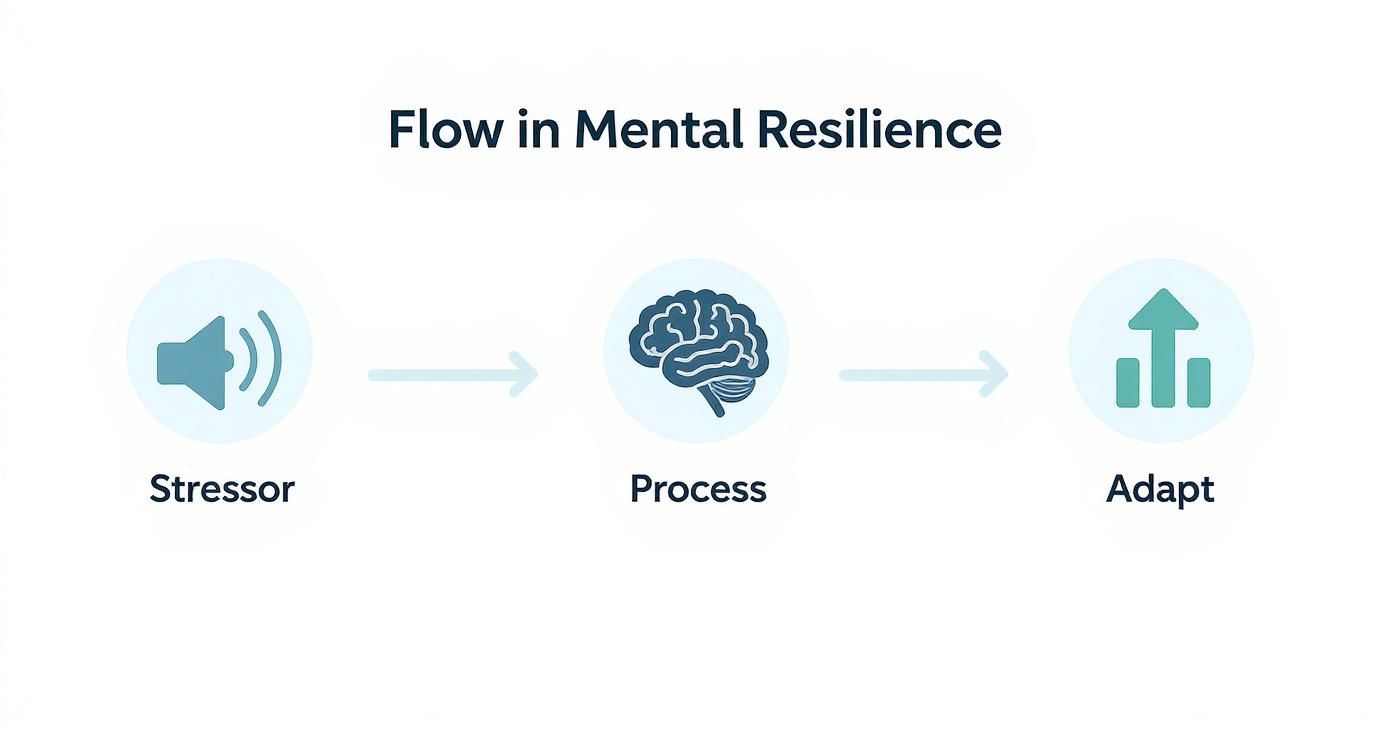
This visual drives home a key point: resilience is an active process of adaptation, not just passively enduring stress. Your daily habits are what empower your brain to adapt effectively.
Fuel Your Brain and Body for Resilience
Your physical health and your mental fortitude are two sides of the same coin. The trio of sleep, nutrition, and exercise aren’t just “nice-to-haves”; they are the non-negotiable pillars of mental resilience. Ignoring them is like trying to build a house on a shaky foundation.
A study in the Journal of Affective Disorders found a powerful link between poor sleep and lower resilience. It showed that people who slept better were far more capable of bouncing back from tough emotional experiences.
To start, make your bedroom a sanctuary for sleep. That means keeping it cool, dark, and quiet. Actionable Step: Tonight, put your phone on a charger across the room, not on your nightstand. This simple act removes the temptation to scroll, which disrupts your body’s natural melatonin production.
Strategic Nutrition for a Stronger Mind
The food you eat is fuel for your brain. To build a resilient mind, you need to give it the right nutrients. Omega-3 fatty acids, found in foods like salmon and walnuts, are critical for cognitive function and have been shown to help dial down anxiety.
Another key player is magnesium, which you can find in leafy greens like spinach and in almonds. It’s crucial for regulating your body’s stress-response system. Actionable Step: This week, add one resilience-boosting food to your grocery list. Toss a handful of spinach into your morning smoothie or swap your usual afternoon snack for a small handful of almonds.
The Power of Movement
Getting your body moving is one of the most effective stress-busters on the planet. I’m not talking about running a marathon. Even a 15-minute brisk walk can have a profound impact, flooding your system with feel-good endorphins and tamping down stress hormones like cortisol.
Research in The Lancet Psychiatry confirmed what many of us feel instinctively: regular physical activity is a powerful shield against depression. Actionable Step: Look at your calendar for tomorrow and schedule a 15-minute “walking meeting” or a solo walk during your lunch break. Put it in your calendar as a non-negotiable appointment with yourself.
The key is finding something you don’t hate and sticking with it. Learning how to make exercise a habit that actually lasts can be a turning point. Whether it’s dancing in your living room, hiking a local trail, or cycling, find your thing. The goal is to make these practices feel like a natural part of your life, not just another chore on your to-do list.
Rewiring Your Thoughts with Cognitive Strategies
Your inner dialogue is the silent narrator of your life. The stories you tell yourself—especially when things get tough—literally shape your reality, dictating how you feel and react. This is where the real work of building mental resilience begins. When you learn to consciously steer your thoughts, you can change your entire response to stress.
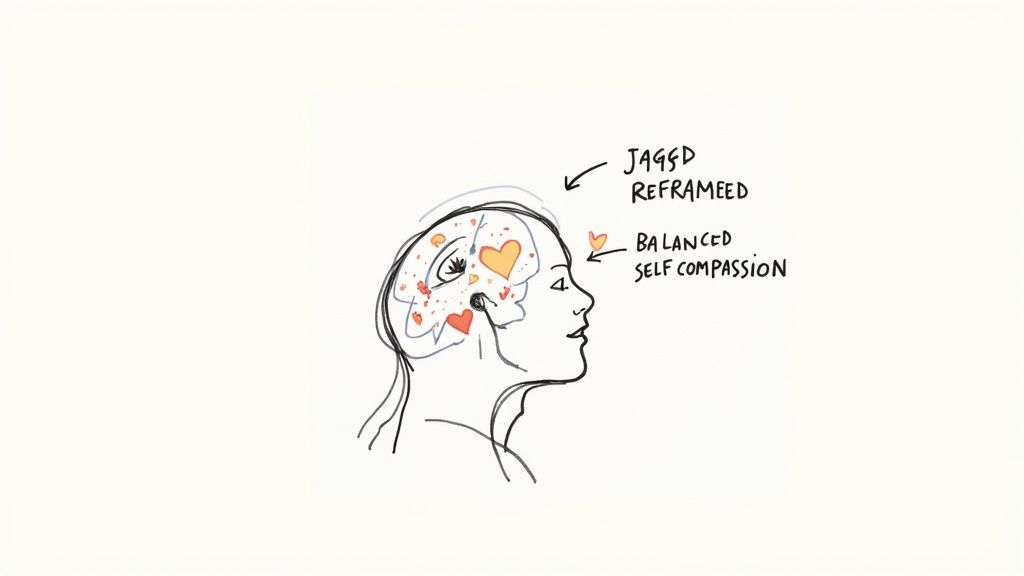
This isn’t about slapping on a fake smile or ignoring real problems. It’s about developing the skill to see situations with clarity and balance. We call this cognitive reframing. It’s a powerful technique, rooted in Cognitive Behavioral Therapy (CBT), that gives you the power to spot unhelpful thought patterns and actively choose a more constructive way of looking at things.
Identifying Your Common Thought Traps
The first step is simply noticing what your brain does on autopilot. Most of us fall into common cognitive distortions, or “thought traps,” that crank up our stress levels and chip away at our resilience.
Do any of these sound familiar?
- Catastrophizing: A small mistake at work spirals into you imagining getting fired. A text goes unanswered for an hour, and you’re convinced you’ve been ghosted. This is blowing a single event way out of proportion.
- All-or-Nothing Thinking: You’re either a runaway success or a total failure. If you skip one gym session, your entire fitness journey feels pointless. This black-and-white view leaves zero room for the messy reality of progress.
- Mind Reading: You assume you know exactly what others are thinking, and it’s usually not good. “I just know my boss hated that presentation.” This common trap creates anxiety from pure fiction.
Actionable Step: For the next 24 hours, pay attention to your self-talk. When you feel a spike of stress or frustration, grab a notebook (or a notes app) and jot down the thought that caused it. Don’t judge it, just capture it. This practice alone builds the awareness needed to change. If you want to go deeper on this, our guide on how to break negative thought patterns has even more specific strategies.
To see how this works in the real world, check out the examples below. It’s all about catching the thought, identifying the distortion, and consciously choosing a better perspective.
Cognitive Reframing in Action
| Negative Thought | Cognitive Distortion | Reframed Perspective |
|---|---|---|
| “I completely failed that presentation. I’m so incompetent.” | All-or-Nothing Thinking | “One part of the presentation didn’t go as planned, but the other sections were strong. I’ll ask for feedback to improve next time.” |
| “My partner is quiet tonight. They must be mad at me.” | Mind Reading | “My partner seems quiet. I can’t know why without asking. I’ll check in and see if everything is okay with them.” |
| “This project delay is a disaster. Everything is ruined now.” | Catastrophizing | “This delay is frustrating, but it’s not a disaster. What’s one productive step I can take right now to get things back on track?” |
It’s a subtle but powerful shift from automatic reaction to intentional response.
Cultivating Self-Compassion as Your Counter-Strategy
Your inner critic can be the single biggest roadblock to resilience. The antidote? Self-compassion. It’s about treating yourself with the same kindness and understanding you’d offer a good friend who’s having a hard time.
It’s not just a nice idea; the science backs it up. Research from the journal Self and Identity shows a direct link between self-compassion and resilience. People who practice it are better at handling failure, learning from mistakes, and staying motivated when things get tough. It’s not about letting yourself off the hook—it’s about creating a supportive inner environment where you can actually grow.
A study in the Personality and Social Psychology Bulletin even found that self-compassion helps people take more personal responsibility for their mistakes, because it removes the paralyzing fear of self-punishment.
So, how do you actually do this? The next time you mess up and that critical voice pipes up, try this three-step pause:
- Acknowledge the Pain: Just say to yourself, “This is really hard right now,” or “This hurts.” This simple act validates your feelings instead of fighting them.
- Recognize Common Humanity: Remind yourself, “Everyone makes mistakes,” or “Struggling is just part of being human.” It pulls you out of isolation.
- Offer Kindness: Ask yourself, “What would I say to a friend right now?” Maybe it’s, “It’s okay, you did your best,” or “You can learn from this.”
Training Your Brain to See the Good
Just like you train your muscles at the gym, you can train your brain to focus on the positive. Gratitude is an incredibly effective tool for this. It actively shifts your attention away from what’s going wrong and shines a spotlight on what’s going right.
A famous study published by the American Psychological Association had people jot down a few things they were grateful for each week. Compared to a group that focused on their daily hassles, the gratitude group reported significantly higher levels of optimism and overall life satisfaction.
A simple way to put this into practice is with the “Three Good Things” exercise.
Actionable Step: Tonight, before bed, take two minutes to write down three specific things that went well today and why.
- Example 1: My morning coffee was perfect. (Because I took the time to make it just right.)
- Example 2: My coworker thanked me for my help. (Because I was able to share my knowledge.)
- Example 3: I saw a beautiful sunset on my way home. (Because I looked up from my phone.)
This practice isn’t about pretending life is perfect. It’s about making sure the daily struggles don’t completely overshadow the good stuff that’s also there, building a more balanced and resilient mindset over time.
Building Resilience in a High-Pressure Workplace
The modern workplace can feel like ground zero for stress. The constant deadlines, high-stakes projects, and tricky professional relationships can feel absolutely relentless. But with the right strategies, you can learn to manage this pressure without letting it steamroll you into burnout.
Successfully navigating this environment isn’t about trying to eliminate stress—that’s a losing battle. It’s about learning how to respond to it more effectively. This means setting firm boundaries, proactively managing your energy, and cultivating a mindset that sees challenges as opportunities for growth, not threats to your stability.
A recent Gallup report drives this home, finding that employee stress is at a record high. Meanwhile, another report in the International Journal of Environmental Research and Public Health notes that high job demands with low control is a key recipe for burnout. The crucial difference between those who thrive and those who just get by is often resilience—the ability to manage stress and regulate emotions effectively.
Setting Healthy Professional Boundaries
Learning how to say ‘no’ at a high-pressure job is one of the toughest—and most crucial—skills you can develop. A strategic ‘no’ is a powerful tool for protecting your focus and keeping burnout at bay.
The trick is to be clear, concise, and professional. You don’t need to offer up a long, winding excuse.
Here are a few actionable scripts you can make your own:
- When you’re at full capacity: “Thank you for thinking of me for this. My plate is full right now with [mention priority task], so I won’t be able to give this the attention it deserves.”
- When you need to negotiate: “I can definitely help with this, but to do it well, I’d need to shift focus from [other task]. Can we talk about which one should be the priority?”
- When it’s outside your role: “That sounds like an important project. My expertise is really in [your area], so I might not be the best person for this. Have you thought about asking [colleague’s name]?”
Actionable Step: This week, identify one opportunity to set a small boundary. This could be declining a non-essential meeting to protect your focus time or waiting until morning to respond to a non-urgent evening email.
Proactive Stress Management Tactics
If you wait until you’re completely overwhelmed to deal with stress, you’re already behind. A much more resilient approach is to weave proactive stress management techniques right into your workday. Instead of trying to power through an eight-hour stretch, you can sprinkle in small, intentional breaks to reset your nervous system.
One incredibly effective method is the Pomodoro Technique. This strategy breaks your work into focused 25-minute sprints separated by short breaks. A study in the Journal of Organizational Behavior highlights the importance of such micro-breaks for maintaining energy and focus throughout the day.
“Mental toughness involves recognizing what’s best for your wellbeing and knowing when to say no. Setting healthy limits doesn’t mean being inflexible. It’s about having the confidence to assert your boundaries.”
Actionable Step: Tomorrow, try one Pomodoro cycle. Set a timer for 25 minutes of focused work on a single task. When the timer goes off, take a true 5-minute break—get up, stretch, look out a window—before diving back in. It’s also worth looking into proactive company policies, like understanding wellness leave as a tool for combating burnout.
These strategies are especially powerful for anyone who gets hit hard by professional stress. For a deeper dive into specific techniques, you might find our guide on dealing with work anxiety helpful. The goal is to make these practices a normal part of your routine—turning stress management into a consistent habit, not just an emergency response.
How to Track Your Progress and Navigate Setbacks
Building mental resilience is a journey, not a destination with a finish line. Just like getting physically fit, it takes consistent work. There will absolutely be days where you feel like you’re not making progress, or even sliding backward. That’s normal.
The real key to making this a lifelong skill—and not just some fad you tried for a month—is learning how to see your own growth and navigate the inevitable setbacks with grace.
It’s not about hitting a certain number on a resilience scale. It’s about noticing the subtle, internal shifts in how you respond to life over time. The goal here is genuine self-awareness.
Simple Ways to Measure Your Resilience
You don’t need complicated tools to see how far you’ve come. Simple, consistent self-check-ins provide the most powerful insights.
Here are a few practical ways to get started:
- Targeted Journaling Prompts: At the end of each week, zoom in on one specific challenge you faced. Actionable Step: This Friday, ask yourself: How did I react in the moment? A month ago, would I have reacted differently? What resilience tool (like box breathing or reframing) did I try to use?
- Use a Mood-Tracking App: Sometimes we’re too close to see the patterns. Apps like Daylio or Moodpath can connect the dots for you. Seeing concrete data—like noticing you’re less anxious on days you take a 15-minute walk—is solid proof that your new habits are working.
- The “Bounce-Back” Metric: Pay close attention to your recovery time. A resilient mind doesn’t mean you never get knocked down; it means you get back up faster. Actionable Step: The next time you get frustrating news, notice how long the emotional sting lasts. A month from now, when something similar happens, check in again. A shorter recovery time is a huge win.
Normalizing and Navigating Setbacks
Everyone has bad days. Heck, everyone has bad weeks. A crucial part of building resilience is changing how you frame these moments.
Setbacks are not failures. They are data points. They simply show you where your system is still a bit vulnerable and what needs a little more reinforcement.
A fascinating study in the Journal of Experimental Psychology: General found that people who view setbacks as learning opportunities, rather than personal failings, are far more likely to persist and ultimately succeed. This “growth mindset” is the absolute bedrock of long-term resilience.
This is where self-compassion comes in. Research in the journal Self and Identity shows a rock-solid link between treating yourself with kindness and the ability to cope with failure. So, instead of beating yourself up, try acknowledging the difficulty. It’s okay to say, “This is hard right now.”
Your Troubleshooting Guide for Common Hurdles
When you hit a wall, it’s easy to get discouraged. Here’s a quick guide for course-correcting when things go sideways.
- “My breathing exercises aren’t working.”
When stress is high, it’s hard to calm down. Don’t force it. Actionable Step: Go for a physical pattern interrupt. Splash cold water on your face, do 10 jumping jacks, or take a quick, brisk walk around the block. This lowers your physiological arousal just enough for the breathing techniques to actually land. - “I had a horrible week and dropped all my habits.”
The temptation is to try and restart everything at once, which is a recipe for overwhelm. Actionable Step: Pick the one, smallest habit that feels easiest and do it once. Maybe that’s a single physiological sigh or a five-minute walk. Small wins build momentum.
The evidence is clear: our ability to adapt our coping strategies is a true hallmark of resilience. A study in the European Journal of Personality highlighted that psychological flexibility—the ability to pivot your approach when one strategy isn’t working—is a key predictor of mental well-being. By viewing setbacks as a chance to adjust your strategy, you aren’t just failing; you are actively practicing resilience.
Common Questions About Building Mental Resilience
As you start weaving these practices into your daily life, it’s completely normal for questions to bubble up. Let’s tackle some of the most common ones I hear, giving you the clarity and confidence you need on this journey.
How Long Does It Take to See Results?
This is usually the first thing people ask, and the answer has two parts: you’ll likely feel some benefits right away, but the deep, lasting change takes time.
A single session of box breathing can absolutely dial down your stress in the heat of the moment. But building the deep-rooted neural pathways that make that calm response your default setting? That’s a longer game.
Think of it like tending a garden. You don’t plant a seed and come back the next day expecting a full-grown oak tree. The real magic happens with consistent, daily attention.
A fascinating study in the European Journal of Social Psychology found it can take anywhere from 18 to 254 days for a new habit to really stick. The big takeaway here is that consistency beats intensity, every time. A five-minute daily practice is far more powerful than a two-hour session once a month.
Actionable Advice: Don’t focus on the timeline. Focus on the next 24 hours. Pick one small resilience habit—like your three good things or one minute of box breathing—and just do it today. Tomorrow, do it again. The results will take care of themselves.
Is It Possible to Lose Mental Resilience?
Yes, absolutely. Mental resilience isn’t a trophy you win and put on a shelf. It’s a dynamic skill that needs ongoing maintenance.
It’s just like physical fitness. If you stop working out, you’re not going to stay strong. Life’s stressors don’t take a break, so your practice can’t either.
A long period of intense stress without proper recovery can wear down even the most resilient person. This is exactly why the daily habits we’ve covered are so vital. They’re your maintenance plan, keeping your psychological “muscles” toned and ready for whatever life throws at you.
If you feel your resilience slipping, that’s not a sign you’ve failed. It’s simply a signal from your body and mind to get back to basics and reinvest in your foundational practices—sleep, nutrition, connection, and mindfulness.
What Is the Single Most Important Habit?
If I had to boil it all down to one thing, the foundation that makes every other resilience practice work, it’s self-awareness.
It’s the simple, yet profound, ability to have an honest, clear-eyed view of your own thoughts, emotions, strengths, and weaknesses.
Without it, the rest of the tools are useless.
- You can’t reframe a negative thought if you’re not even aware it’s running on a loop in your head.
- You can’t use a breathing technique to calm down if you don’t recognize the subtle, early signs of your own stress response.
- You can’t set healthy boundaries if you aren’t tuned into what’s actually draining your energy.
Research consistently points to self-awareness as the cornerstone of emotional intelligence and effective coping. One study in Personality and Individual Differences confirmed a powerful link between self-awareness and the ability to manage emotions and handle stress. Honing this skill through practices like journaling and mindfulness is the ultimate key to unlocking lasting mental strength.
Actionable Step: Set a recurring alarm on your phone for three random times a day. When it goes off, pause and ask yourself: “What am I thinking right now? What am I feeling in my body?” Just notice, without judgment. This is self-awareness in action.
Ready to go deeper and really accelerate your journey to resilience? 9D Breathwork offers a powerful, immersive experience that blends ancient breathing techniques with modern science. It’s designed to help you release stored stress, rewire limiting beliefs, and build a truly resilient mind from the inside out.