If you feel like you’re spinning your wheels at work—busy but not productive—you’re not alone. The secret to leveling up your performance isn’t about working longer hours. It’s about working smarter. This means getting strategic about where you invest your two most valuable resources: your focus and your energy.
Your Blueprint for High Work Performance
Breaking through a performance plateau can feel impossible, but it rarely comes down to a lack of effort. More often, it’s about a lack of a clear, sustainable system. High performers don’t just work hard; they build intentional habits that protect their attention, manage their energy, and direct their efforts toward what truly matters.
Think about it: a recent study found that only about 35% of U.S. workers feel truly engaged at their jobs. That’s a huge number of people who feel disconnected, and that disconnection kills productivity and personal satisfaction. A 2021 study in the International Journal of Environmental Research and Public Health confirmed that higher work engagement is directly linked to better job performance. The way out is to build your own framework that tackles the root causes of underperformance—distractions, burnout, and fuzzy objectives.
Let’s break down the core components of this framework.
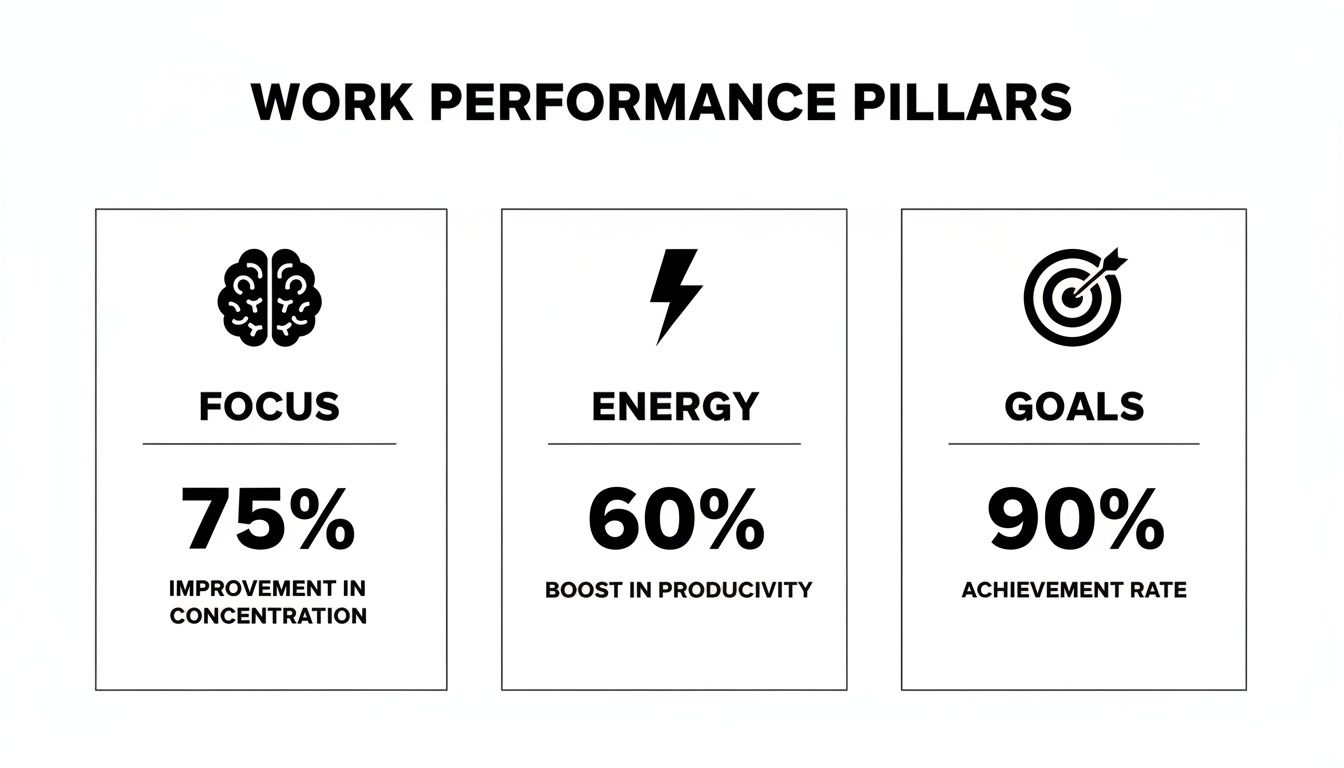
The Three Pillars of High Work Performance
To genuinely improve your output and feel better doing it, you need to move beyond simple time-management hacks. True high performance is built on a foundation of three interconnected pillars.
Here’s a quick overview of what they are and, more importantly, how you can start putting them into practice today.
| Pillar | Core Principle | Your First Actionable Step |
|---|---|---|
| Mastering Your Focus | In a world of constant notifications, deep concentration is your competitive edge. This is about creating an environment where you can do real, meaningful work without interruption. | Block out a 90-minute “focus session” on your calendar for tomorrow. Turn off all notifications—phone, email, and chat—for that entire period. Example: Use this time to write the first draft of that report you’ve been putting off. |
| Managing Your Energy | Your brainpower isn’t an infinite resource. This pillar is about aligning your most demanding tasks with your natural energy peaks to avoid burnout and produce your best work. | Identify your personal “peak productivity window” (e.g., 9-11 a.m.). Schedule your most important, high-concentration task for that time. Example: If you’re a designer, do your creative brainstorming in the morning and save administrative tasks for the afternoon. |
| Aligning with Goals | Effort without direction is just wasted motion. This is about making sure every task you undertake is a clear step toward a meaningful outcome for you and your company. | At the start of your next workday, write down your #1 priority for the day. Make sure it directly contributes to a larger weekly or quarterly goal. Example: If the quarterly goal is to increase customer retention, your #1 priority might be “Follow up with three at-risk clients.” |
Nailing these three pillars creates a powerful, self-reinforcing system. Your goals give your focus a target, and your energy management ensures you have the fuel to hit it.
“High performance compounds. It builds credibility with peers and leaders, unlocks opportunities, and strengthens your organization’s results.”
Of course, none of this works without a solid foundation of well-being. A crucial part of managing your energy and maintaining focus under pressure is building mental resilience. For more practical advice on this, you can also explore this guide on how to boost your overall work performance and productivity.
Master Your Focus in a Distracted World
Let’s be honest, the biggest hurdle to getting things done at work isn’t your skill level—it’s the constant flood of interruptions. Every ping, email, and “got a sec?” shoulder tap yanks you out of the zone, leaving you feeling frazzled and busy, but not actually productive. This constant mental whiplash is called context switching, and it’s a huge drain on your brainpower.
The cost is genuinely shocking when you see the numbers. Workplace studies have found that we get interrupted, on average, every 3 minutes. What’s worse is that it takes a staggering 23 minutes to get your head fully back into what you were doing. A couple of “minor” disruptions can easily kill a whole hour. It adds up fast.
Build Your Fortress of Focus
Getting your attention back isn’t about trying harder; it’s about being smarter. You need to build a “fortress of focus” around your most critical tasks, making deep work the default setting for your day. A study published in Applied Cognitive Psychology highlighted that brief mental breaks can significantly improve one’s ability to maintain focus on a long task. This supports the idea of working in focused sprints.
A simple but incredibly effective way to start is with timeboxing. You’ve probably heard of the Pomodoro Technique, and there’s a good reason it’s so popular: it works. The idea is to break your day into short, dedicated sprints.
- Set a timer for 25 minutes. Pick one thing to work on. Actionable Example: Decide your single task is “drafting the introduction for the client proposal.”
- Go all in. No email, no phone, no distractions. Just that one task.
- Take a 5-minute break when the timer rings. Get up, stretch, do anything but work.
- After four of these sprints, give yourself a proper 15-30 minute break.
This method does more than just manage your time—it trains your brain to concentrate for sustained periods while building in recovery so you don’t burn out.
Reset Your Attention on Demand
Even with the best-laid plans, distractions are going to sneak through. The trick is having a way to quickly reset and get back on track without losing half an hour. This is where a quick mindfulness exercise can be a game-changer.
The 5-Minute Focus Reset: Just close your eyes and take three slow, deep breaths. For the next few minutes, put all your awareness on the physical feeling of your breath moving in and out. Your mind will wander. That’s okay. When it does, just gently bring your attention back to your breathing.
This isn’t about clearing your mind completely. It’s about exercising your “attention muscle.” Practicing small techniques like this is fundamental to improving focus and concentration over the long haul. When you start weaving these habits into your day, you take back control of your attention and, ultimately, your performance.
Find the Deeper Meaning in What You Do
Getting your focus dialed in is a huge win, but let’s be honest—true, lasting high performance isn’t just about blocking out distractions. It’s fueled by something much deeper: purpose. When you feel like you’re just going through the motions, your energy, the quality of your work, and your overall happiness at work will eventually crater.
Think about it. Are you just paddling a boat, or are you rowing toward a specific destination you care about? Both take energy, but only one feels like you’re actually getting somewhere meaningful. Being truly invested in your work isn’t some fluffy, nice-to-have idea. It’s the engine that drives exceptional performance.
The lack of this connection is a massive, global problem. Only about 21% of people actually feel engaged at work. This isn’t just a bummer for them; it’s a huge drain on the economy, costing an estimated $438 billion in lost productivity. On the flip side, teams that feel connected to their mission see up to 14% higher productivity and a whopping 78% less absenteeism. Even a small spark of connection can create a huge impact. You can dig into more of these critical workplace statistics on cake.com.
Find Your “Why” in the Daily Grind
It’s so easy to lose the plot when you’re swimming in a sea of spreadsheets, emails, and back-to-back meetings. To really level up your performance, you have to consciously connect the dots between your daily tasks and the bigger company mission.
Get into the habit of asking yourself one simple question every Monday morning: “How does my number one priority this week push our team’s goal forward?” This tiny mental shift can transform a boring to-do list into a series of strategic moves.
- Here’s how it works in real life: A marketing coordinator might feel like all they do is schedule social media posts. But if they connect that task to the larger goal of “increasing brand awareness by 15% this quarter,” suddenly each post becomes a tactical play, not just another chore to check off.
Don’t Wait for a Perfect Role—Create It
Sitting around and waiting for your dream project to fall into your lap is a recipe for frustration. The people who consistently knock it out of the park don’t just do the work they’re assigned; they actively look for ways to shape their roles around their natural talents and interests. This creates a powerful feedback loop where motivation fuels achievement, and achievement fuels more motivation.
Research published in the Journal of Occupational and Organizational Psychology backs this up. It found that people who practice “job crafting”—meaning they proactively redesign parts of their job—report feeling more satisfied, more engaged, and perform at a higher level.
Pinpoint the parts of your job that you genuinely love and are great at. Is it digging into data? Is it mentoring new hires? Is it solving complex client problems? Once you know, talk to your manager about how you can lean into those areas more.
- Actionable Tip: Let’s say you’re a data analyst who also has a knack for storytelling. You could propose creating a monthly “insights digest” for the leadership team that translates dense data into clear, compelling narratives. You get to do more of what you love, and the company gets incredibly valuable information. Everybody wins.
When you take this approach, you stop being a passenger in your career and become the architect. By weaving your personal drivers into your professional duties, your job can become something that doesn’t just take your energy, but actually gives it back.
Manage Your Energy, Not Just Your Time
We’ve all been sold the same idea: master your time, master your life. But let’s be honest, tracking every single minute of your day is a recipe for burnout if you’re running on empty. True high-performers know a little secret: your energy is your most valuable asset, not your time. A perfectly planned schedule is useless if you’re too exhausted to think straight when your most critical task finally comes up.
The real shift happens when you stop being a time manager and become an energy manager. It’s about working with your body’s natural rhythms instead of constantly fighting against them. In fact, a study in the Journal of Applied Psychology found that employees who matched their work to their personal energy levels felt more engaged and, no surprise, performed better.
Conduct Your Personal Energy Audit
Before you can manage your energy, you have to get to know it. A personal energy audit sounds complicated, but it’s just a simple way to map out your daily peaks and valleys.
For one week, just pay attention. Keep a small notebook or a note on your phone and jot down how you’re feeling every couple of hours. Use a simple 1-5 scale, where 1 is “totally drained” and 5 is “ready to take on the world.” You’ll start to see a pattern emerge pretty quickly. Are you a morning person who does their best thinking before lunch? Or do you find your focus sharpening later in the afternoon?
Once you have this data, you can start building your schedule around your own biology.
Here’s what that looks like in the real world:
Your audit shows you’re razor-sharp between 9:00 AM and 11:00 AM. That’s your golden window. Block that time off for your most brain-intensive work—writing that big proposal, digging into complex data, or brainstorming a new strategy. Save the low-energy periods, like that post-lunch slump, for lighter lifts like clearing your inbox or sitting in on routine calls.
If you want to get serious about this, look for tools with robust daily planning features that let you visually block out your day based on your newfound energy map.
Work in Sprints, Not Marathons
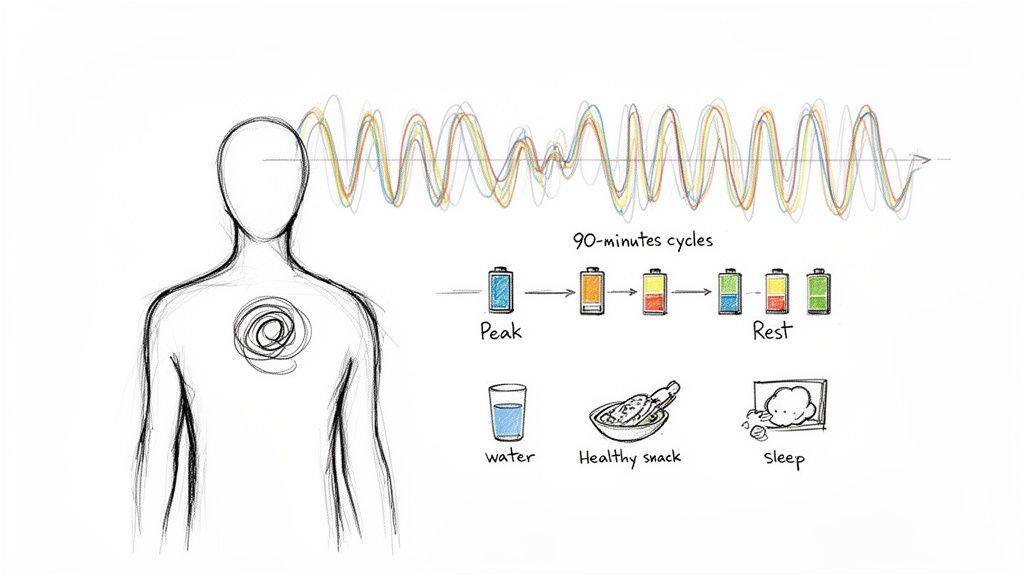
Your brain was never built to maintain intense focus for eight hours straight. It’s just not how we’re wired. We naturally operate in cycles of high energy followed by a need for recovery. These are called ultradian rhythms, and they typically last about 90-120 minutes.
Instead of trying to power through fatigue, which never ends well, try structuring your work around these natural sprints.
- Set a timer and go all-in on a single task for 90 minutes. No distractions.
- When the timer goes off, take a real break for 15-20 minutes.
- And by “real break,” I mean get away from your screen. Stretch, walk outside for a minute, or grab a healthy snack.
This rhythm helps you stay sharp all day long and prevents the kind of mental fog that settles in after a marathon work session.
Beat the Afternoon Slump with Your Breath
Ah, the 3 PM crash. It’s the productivity killer we all know and dread. The first instinct is often to grab another coffee, but that can mess with your sleep later on. There’s a better way.
You can use a simple breathwork technique to jolt your system back online and restore mental clarity. It’s a powerful, stimulant-free way to reset your nervous system and boost alertness. Certain breathing patterns increase oxygen flow to the brain, giving you a completely natural surge of energy.
To learn more about this, check out these different approaches to https://9dbreathwork.com/breathing-for-energy/ and find a simple routine you can use anytime. When you start putting your energy first, you’ll find that the time you have becomes infinitely more effective.
Set Clear Goals and Track Your Progress
Putting in the hours without a clear destination is like running on a treadmill—you’re expending a ton of energy but not actually going anywhere. To genuinely move the needle on your performance, you need a roadmap. It’s about turning those big, fuzzy ambitions into concrete, daily actions.
Most of us have heard of SMART goals, but the real magic isn’t in knowing the acronym. It’s in applying it.
Research backs this up. A well-known study in the Journal of Applied Psychology confirmed that people who set specific, challenging goals consistently get better results than those with vague targets like “do better.” When you know exactly what you’re aiming for, your focus sharpens, and it becomes much easier to sidestep the distractions that pull you off course.
From Vague Ideas to Actionable Plans
Let’s get practical. A goal like “get better at presentations” is a nice thought, but it’s not a plan. You can’t act on it.
Instead, let’s break it down into something you can actually work on.
- Specific: I want to deliver more engaging quarterly reports by improving my presentation delivery and slide design.
- Measurable: I’ll track my progress by aiming to cut my filler words (like ‘um’ and ‘ah’) by 50%. Success also means getting an average feedback score of at least 8/10 on my next report.
- Actionable: My plan is to watch three expert talks on storytelling, find a clean template for my next slide deck, and do two full practice runs with a colleague to get their honest feedback.
- Relevant: This matters because communicating our team’s wins effectively to leadership boosts our department’s visibility and my own career path.
- Time-bound: My deadline is the Q3 quarterly review on September 15th.
See the difference? We’ve just turned a vague wish into a tangible project with clear next steps. The guesswork is gone.
Break Down Your Goals into Micro-Tasks
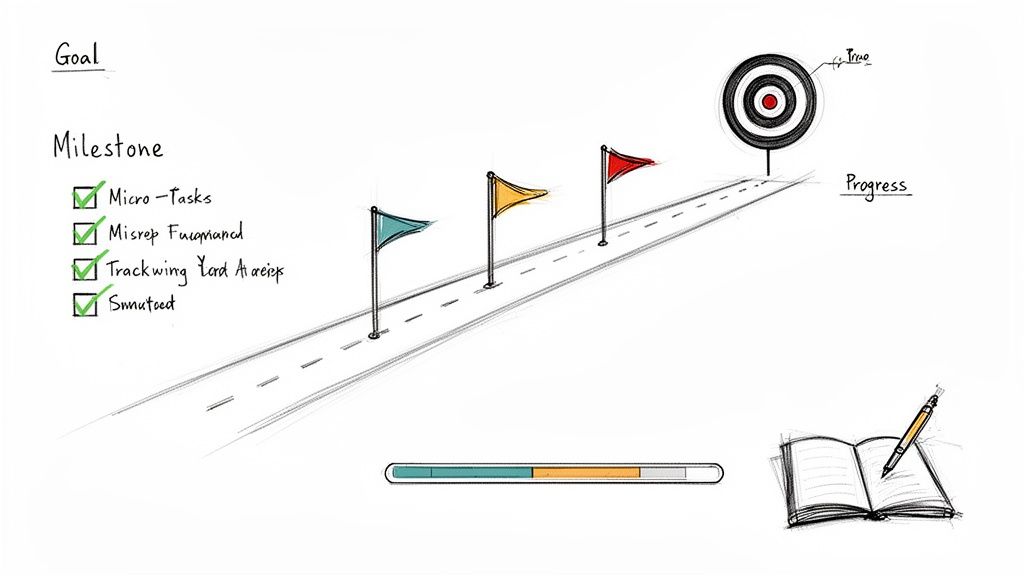
Even a perfectly defined goal can feel overwhelming when you look at it as one giant task. The secret is to chop it up into tiny, manageable “micro-tasks.”
Each small step you complete gives you a little psychological win. It builds the momentum you need to keep going. This process is deeply connected to your brain’s wiring; you’re literally carving out new neural pathways with each small success. To learn more about this, check out our guide on how to rewire your brain for success.
A Stanford University study pinpointed the power of “small wins.” The researchers discovered that making progress—any progress—on meaningful work is the single most powerful human motivator. Seeing those small steps add up is what fuels our drive.
Make Your Progress Visible
What gets measured gets managed. It’s a cliché for a reason. You need a simple, consistent way to see how you’re doing and hold yourself accountable.
This doesn’t have to be complicated.
- For the tech-savvy: Apps like Asana, Trello, or even a basic Google Sheet are great for listing tasks, setting deadlines, and visually moving things from “To-Do” to “Done.” Actionable Example: Create a Trello board for your “Improve Presentations” goal. Make columns for “To Do,” “In Progress,” and “Done.” Add cards for each micro-task like “Watch storytelling talk” and “Find new template.”
- For the analog fans: A dedicated notebook or a whiteboard in your office can be just as powerful. There’s something deeply satisfying about physically checking a box with a pen.
By tracking your progress, you create a feedback loop. You can see what’s working, celebrate the small victories, and adjust your plan when you hit a snag. It’s this data-driven, honest look at your own efforts that truly underpins continuous improvement.
Got Questions? We’ve Got Answers.
When you’re trying to level up at work, it’s natural to have a few questions. Let’s get straight to the point and tackle some of the most common hurdles professionals face. These are the real-world, no-fluff answers you can start using today.
How Can I Improve My Work Performance When I’m Completely Burned Out?
When you’re running on fumes, pushing harder is the absolute worst thing you can do. The real path forward is to focus on recovery, because peak performance is built on well-being, not exhaustion. It’s not just a feeling; studies on workplace stress confirm that chronic stress literally tanks the cognitive functions you need to do good work.
Start with the basics that you can’t afford to skip: get consistent sleep and eat meals that actually fuel you. Next, build “micro-breaks” into your day. Just five minutes away from your desk, maybe a quick walk outside, can do wonders to reset your focus. Actionable Step: Put two 10-minute “walk breaks” on your calendar right now for tomorrow—one in the morning and one in the afternoon.
The final step is often the toughest but the most crucial: have an honest chat with your manager. Talk about your workload. Work together to find a pace that’s sustainable, not one that’s driving you into the ground.
What’s the Fastest Way to See a Real Improvement in My Work Quality?
If you want to see results fast, the magic formula is combining intense, single-task focus with a tight feedback loop. This isn’t just a hunch; research on “deliberate practice” shows that focusing your effort and getting immediate feedback is the secret sauce for learning any skill quickly.
Try this: block out a 90-minute “deep work” session for your most important task. That means all notifications are off—phone, computer, everything. For those 90 minutes, you’re completely immersed in producing your best work without any distractions.
As soon as you have a draft, go get specific feedback. Don’t just ask, “What do you think?” Instead, ask a colleague or manager you trust, “What is the one thing I could do to make this stronger?” Then, apply that single piece of advice right away. This creates a powerful cycle of rapid, visible improvement. Actionable Example: After writing a client email, ask a coworker: “Could you read this? What’s one change I could make for a clearer call to action?”
My Manager Says I Need to Be More Proactive. What Does That Even Mean?
In a nutshell, being “proactive” means you’re thinking one step ahead and taking action before someone asks you to. It’s about showing ownership over your work and anticipating what’s needed next. You can build this habit with small, consistent actions.
Research from the Journal of Management backs this up, showing that proactive employees consistently get rated as top performers. Why? Because they actively shape their environment instead of just reacting to whatever comes their way.
Here’s a practical example: when you turn in a project, don’t just send the file. Include a quick summary that answers the questions you know your manager will have and points out the key results.
Another easy win? Find a small, nagging problem your team deals with all the time—like a messy file-naming system—and propose a simple, clear solution. That’s proactivity in action. Actionable Step: Next time you complete a task, send an update email that includes “Status: Complete. Next Steps: I will begin [the next logical task] unless you have other priorities.”
At 9D Breathwork, we know that unlocking your best performance starts from the inside. Our guided breathwork journeys are designed to help you cut through the mental clutter, get a handle on stress, and build the resilience you need to perform at your peak consistently. Discover how 9D Breathwork can help you achieve your professional goals.