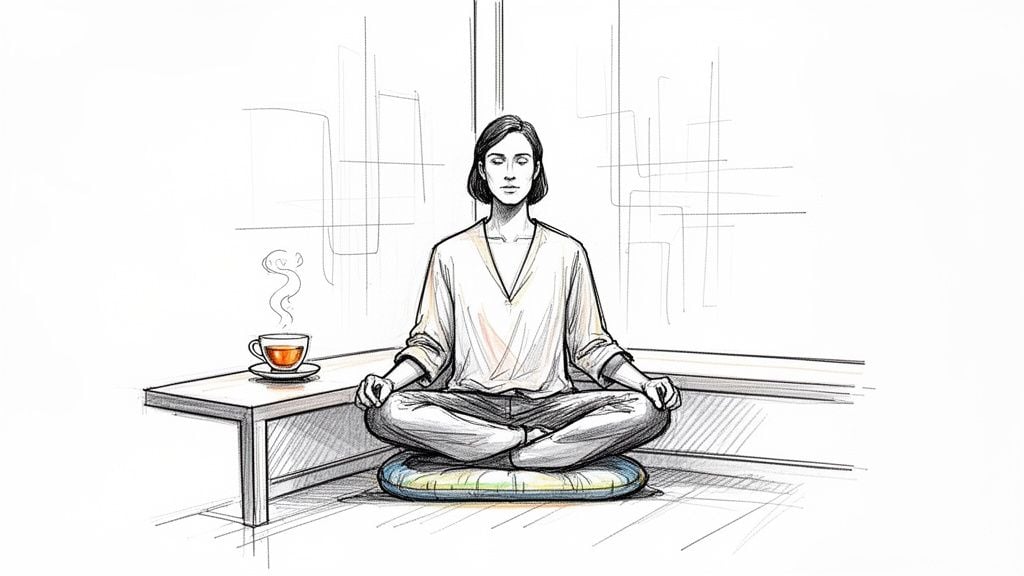
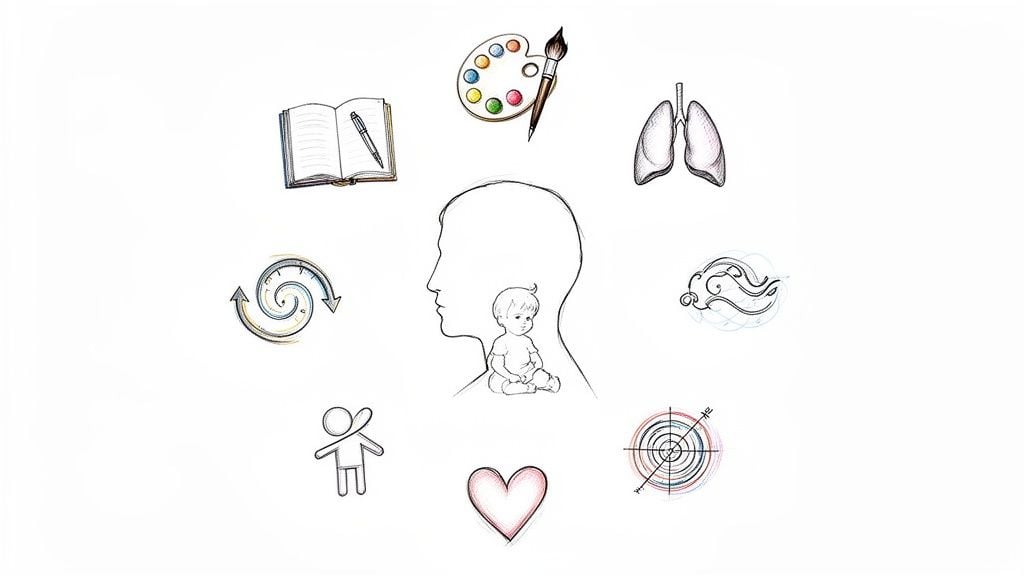
So, what exactly is pranayama? It’s an ancient yogic practice that’s all about conscious breath control. This isn’t just about breathing—it’s about learning to intentionally steer your body’s energy and your mental state.
The Foundation of Mindful Breathing

Think of your energy like a river. On any given day, that river can feel chaotic—rushing with stress one moment, then stagnant with fatigue the next. Pranayama gives you a set of tools, like gates and channels, to guide that flow. It helps you transform the chaos into a calm, focused, and powerful stream.
The word itself comes from two Sanskrit terms: “Prana,” which means vital life force, and “ayama,” which means to extend or control. Together, pranayama translates to the “control of life force.” While it’s a specific discipline, it’s also part of a much wider world of conscious breathing practices. If you’re curious about the therapeutic side of this work, it’s worth exploring what is breathwork therapy and its modern applications.
The Three Pillars of Breath Control
Pranayama revolves around three distinct phases of the breath. Mastering these is your first step toward influencing your nervous system.
- Puraka (Inhalation): This is the active process of drawing air into your lungs. Think of it as taking in energy. Actionable Step: Try a slow, 4-second inhale through your nose right now. Feel your belly expand.
- Rechaka (Exhalation): This is the release, linked to letting go and calming the mind. Actionable Step: Match your exhale to your inhale—a gentle 4-second release through your nose.
- Kumbhaka (Retention): This is the pause, the moment of stillness between breaths where profound physiological shifts can occur. Actionable Step: After your next inhale, hold your breath for just 2 seconds before exhaling. Notice the heightened awareness.
When you consciously play with the length and rhythm of these three parts, you gain direct influence over your body. A 2023 study in Frontiers in Psychology confirmed that slow-breathing exercises significantly improve cardiovascular function and reduce anxiety. For instance, making your exhalations longer than your inhalations activates the parasympathetic nervous system—your body’s “rest and digest” mode.
Try this now: Inhale for 4 seconds, hold for 2, and exhale for 6 seconds. Do this three times. You’ve just actively calmed your nervous system.
It goes even deeper. Research from a 2021 study published in the Journal of Affective Disorders found that certain pranayama techniques could decrease symptoms of depression by helping to regulate the body’s stress response. A systematic review in the Journal of Alternative and Complementary Medicine (2018) also showed that yogic breathing is an effective method for improving symptoms of major depressive disorder. This ancient practice isn’t just a spiritual idea; it’s a powerful, science-backed tool you can use to manage your well-being.
From Ancient Wisdom to Modern Science
While you might see pranayama breathing popping up everywhere in modern wellness circles, it’s anything but a new discovery. This practice isn’t some fleeting trend; it’s a time-tested discipline for mastering the mind and body, with a history that stretches back thousands of years.
In fact, its lineage goes back over 7,000 years. Ancient yogic texts attribute its invention to Lord Shiva as a way to control the breath and direct prana, our vital life force energy. The early yogis who developed these practices meticulously documented their insights in foundational texts like the Yoga Sutras of Patanjali, where pranayama stands as the fourth limb of Ashtanga yoga. It was seen as an essential step toward achieving mental clarity and inner peace. If you’re curious, you can explore the rich history of pranayama and its core principles to get a deeper sense of its roots.
These ancient practitioners intuitively understood something profound: the breath was the key to influencing the mind. Without any modern scientific equipment, their detailed observations laid the groundwork for what we are only now beginning to prove in labs today.
The Nasal Cycle: A Bridge Between Past and Present
One of the most fascinating examples of this ancient insight is the concept of the nasal cycle. Yogis observed that our breathing naturally alternates between nostrils. For about 60-90 minutes, one nostril is more dominant, and then the body automatically switches to the other.
They realized this pattern wasn’t random at all; it directly influenced a person’s mental and energetic state. Breathing through the right nostril was linked to an active, fiery, and alert mind, while breathing through the left nostril brought on a calm, cool, and receptive state.
Fast-forward to today, and science has confirmed their observations. The nasal cycle is a recognized biological rhythm that helps regulate our autonomic nervous system. It creates a natural seesaw effect between:
- The Sympathetic Nervous System: Our “fight-or-flight” response, which gets us revved up and ready for action.
- The Parasympathetic Nervous System: Our “rest-and-digest” mode, which promotes calmness, recovery, and healing.
When we consciously guide our breath through different nostrils, using techniques like Anuloma Viloma (Alternate Nostril Breathing), we can intentionally tip this balance one way or the other. It’s a direct, hands-on way to steer your own nervous system toward either calm or alertness—a practical tool first documented thousands of years ago.
The link between breath and mind isn’t just philosophical. A 2018 study in the Journal of Neurophysiology showed that different breathing patterns can directly impact memory and emotional processing, confirming the ancient yogic belief that how we breathe literally shapes how we think and feel.
Scientific Validation of an Ancient Art
The journey from ancient scripture to modern scientific paper truly gained momentum in the 20th century. A pivotal figure in this was Swami Kuvalayananda, who in 1924 established an institute in India dedicated to studying the physiological effects of yoga and pranayama. He was one of the very first to apply scientific methods to measure what was happening in the body—like changes in oxygen consumption and carbon dioxide levels—during specific breathing exercises.
His groundbreaking work built a vital bridge, proving that the benefits described in ancient texts weren’t just folklore; they could be measured, quantified, and understood through a modern scientific lens. Since then, research has only strengthened this connection. For example, a study in the International Journal of Yoga found that certain pranayama practices could significantly improve respiratory function and lower people’s own ratings of their stress levels.
This growing body of evidence makes it clear: what ancient yogis discovered through deep personal exploration is now being validated by peer-reviewed studies. Pranayama is more than just a spiritual exercise; it’s an evidence-based method for improving both mental and physical health. It offers a powerful and accessible tool for anyone looking to build resilience and find a greater sense of balance in their life.
How Pranayama Rewires Your Brain and Body
So, what’s actually happening inside your body when you practice pranayama? When you consciously change your breathing, you’re doing far more than just taking in air. You’re sending direct signals that fundamentally rewire your body’s internal operating system. This practice is a direct line of communication to your nervous system.
Think of your nervous system as having two primary modes. You have the high-alert, “fight-or-flight” response (the sympathetic nervous system), which is fantastic for real emergencies but utterly draining when it’s stuck in the “on” position. Then there’s the calm, “rest-and-digest” state (the parasympathetic nervous system), which is where healing, recovery, and a sense of peace happen.
Pranayama is like a manual override, giving you the power to shift from that high-alert state back to calm. Slow, deep, and intentional breathing patterns are the secret. They work by activating a critical nerve that runs all the way from your brain down to your gut.
Activating the Vagus Nerve for Calm
This all-important player is the vagus nerve, the longest cranial nerve in your body. It helps to think of it as the superhighway for your parasympathetic nervous system. When you deliberately slow down your exhale, you gently stimulate this nerve, which sends a powerful all-clear signal to your brain and body that it’s safe to relax.
This stimulation kicks off a cascade of welcome physiological shifts:
- Lowered Heart Rate: Your heart stops pounding and settles into a much calmer rhythm.
- Reduced Blood Pressure: The tension in your blood vessels begins to release.
- Decreased Stress Hormones: The production of cortisol, your body’s main stress hormone, starts to dial down.
One of the biggest wins from a consistent pranayama practice is the ability to directly influence your physiological state, offering actionable ways to regulate your nervous system. You gain real, tangible control over your body’s stress response—a skill that’s invaluable in our hectic world.
The image below nicely shows how this ancient practice has evolved from a core part of yogic philosophy to a method now being validated by modern science.

As you can see, pranayama has made the journey from ancient wisdom to a modern, evidence-backed tool for well-being.
The Science-Backed Evidence
And the proof is in the data. A growing body of research is finally confirming what yogis have understood for centuries. For example, a 2017 study in the journal Annals of the New York Academy of Sciences found that slow, mindful breathing techniques directly influence brain structures involved in emotion regulation. Similarly, research published in Psychophysiology demonstrated that specific breathing patterns can reduce symptoms of anxiety and improve attention.
Takeaway: Your breath isn’t just an automatic function; it’s a powerful lever you can pull to change how you feel, both mentally and physically. By controlling your breathing, you directly influence your stress levels, heart rate, and overall state of mind.
This isn’t just about feeling better in the moment; it’s about making your body more resilient over time. Another huge benefit is the improvement of Heart Rate Variability (HRV), which is a key marker of your body’s ability to handle stress. A higher HRV is a great sign—it means your nervous system is balanced and can easily adapt to life’s challenges.
Studies show that regular pranayama can significantly improve HRV, pointing to a real shift toward a more relaxed and resilient state. If you want to dive deeper into this, check out our guide on how to improve heart rate variability. By practicing these breathing exercises, you are quite literally training your body to recover from stress more efficiently and building a science-backed foundation for better health.
Pranayama Techniques You Can Use Today

While understanding the theory behind pranayama is great, the real transformation happens when you actually do it. This is where the rubber meets the road. Below, I’ll walk you through a few of the most accessible and powerful techniques, complete with simple instructions and real-world scenarios for when to use them.
Before starting any of these exercises, get into a comfortable seated position, keeping your spine naturally straight. Good posture is the scaffolding for good breathing. And remember, all of these techniques build upon the foundation of proper belly breathing. If you’re a little rusty, it’s worth taking a moment to review how to do diaphragmatic breathing to make sure you’re getting the full benefits.
Anuloma Viloma for Balance and Calm
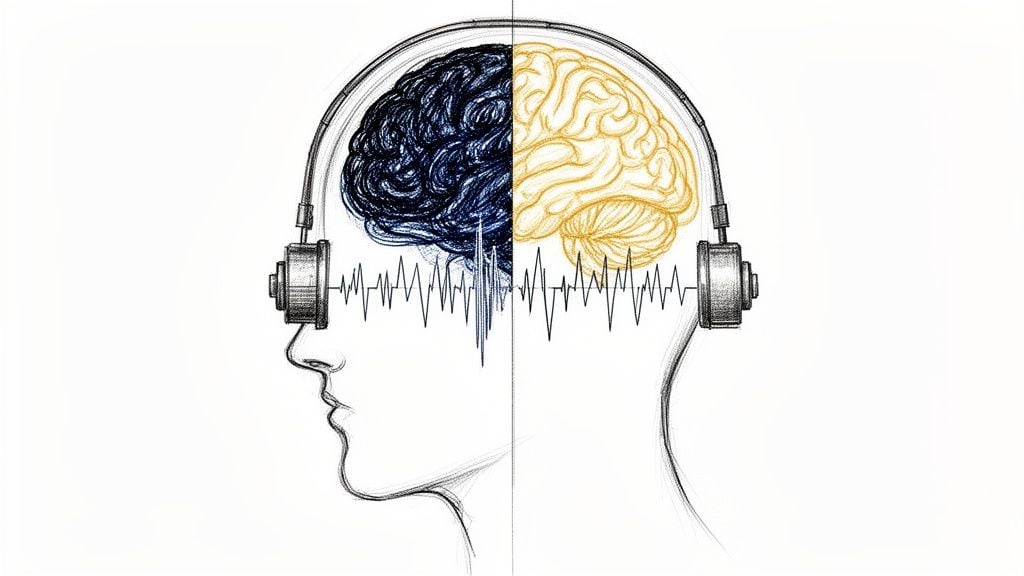
If there’s one classic pranayama practice, it’s Anuloma Viloma, or Alternate Nostril Breathing. Think of it as a reset button for your entire system. By guiding the breath through one nostril and then the other, you’re gently balancing the left and right hemispheres of the brain and telling your nervous system it’s safe to relax. It’s incredibly effective for cutting through mental clutter and finding your center.
When to Use It:
- Right before a high-stakes meeting to settle your nerves and sharpen your focus.
- In the middle of a frantic workday when you need a moment of peace.
- Before bed to quiet a racing mind so you can drift off to sleep.
How to Practice Anuloma Viloma:
- Sit comfortably with your spine tall. Close your eyes and settle in with a few deep, natural breaths.
- Raise your right hand to your face, folding your index and middle fingers down toward your palm. Your thumb will close your right nostril, and your ring finger will close your left.
- Use your thumb to gently close your right nostril. Inhale slowly through your left nostril for a count of four.
- Now, close your left nostril with your ring finger, release your thumb from the right, and exhale slowly through the right nostril for a count of six.
- Keeping the left nostril closed, inhale through the right nostril for a count of four.
- Finally, close your right nostril again, release the left, and exhale through the left nostril for a count of six. That’s one full round. Continue for 5-10 rounds.
Bhastrika for Energy and Alertness
On the complete opposite end of the spectrum is Bhastrika, or Bellows Breath. Forget calming down—this one is like a natural shot of espresso for your body and mind. It uses powerful, rapid inhales and exhales to flood your system with oxygen, revving up your metabolism and waking you up almost instantly.
When to Use It:
- When you’re trying to shake off that morning grogginess.
- To power through that classic mid-afternoon energy slump at your desk.
- Before a workout to boost your stamina and get mentally prepped.
How to Practice Bhastrika:
- Sit tall, keeping your shoulders relaxed and down.
- Start with a deep, forceful inhale through your nose, letting your belly expand fully like a balloon.
- Immediately follow it with a sharp, forceful exhale, also through the nose, as you snap your belly back toward your spine.
- Keep this powerful, rhythmic pump going for 10-15 breaths to complete one round. The inhale and exhale should be equally strong and quick.
- After the round, pause and breathe normally. Notice the tingling, energized feeling in your body. Start with just one round and you can build up to three over time.
Caution: Bhastrika is a very active practice. It is not recommended for those who are pregnant or have high blood pressure, heart disease, or epilepsy. Always listen to your body and stop if you feel dizzy.
Bhramari for Instant Soothing
Bhramari Pranayama, affectionately known as Humming Bee Breath, is my go-to for instant relief from anxiety or agitation. The magic is in the vibration. By creating a gentle humming sound on the exhale, you directly stimulate the vagus nerve, which activates your body’s relaxation response. It’s an incredibly simple yet profound way to calm a frazzled nervous system.
The data backs this up. A 2017 study in the International Journal of Yoga found that practicing Bhramari for five minutes significantly lowered both heart rate and blood pressure, demonstrating its immediate calming effect. Another study in a 2019 issue of the Journal of Traditional and Complementary Medicine highlighted its potential to reduce anxiety and improve cognitive function.
When to Use It:
- When you feel that familiar wave of overwhelm or anxiety at your desk.
- To release frustration or anger in a healthy, constructive way.
- As a simple ritual to transition from the stress of your workday to your personal time.
How to Practice Bhramari:
- Find a quiet place to sit comfortably.
- Gently close your eyes. You can lightly press your index fingers on the cartilage of your ears to help tune out external noise.
- Take a slow, deep breath in through your nose.
- As you exhale, keep your mouth closed and begin to make a low-to-medium pitched humming sound, like a bee buzzing. Try to feel the vibration resonate in your head, throat, and chest.
- Hold the humming sound for the entire length of your exhale.
- Repeat this for 5-10 rounds, letting your awareness rest on the calming sensation of the vibration.
Weaving Pranayama into a Busy Life
Knowing what pranayama is and actually making it a habit are two very different things. If you’re a busy professional bouncing between meetings or someone navigating the choppy waters of anxiety, adding one more thing to your to-do list can feel impossible. But here’s the secret: you don’t need an hour on a yoga mat to feel a real shift.
The whole game changes when you focus on consistency over duration. Just a few minutes of intentional breathing each day can create a profound sense of calm that sticks with you. The idea is to make these practices so simple and accessible that they become your natural reflex for stress, not just another chore.
Don’t just take my word for it. Research shows again and again that even brief, regular sessions of controlled breathing make a big impact. A study in the Journal of Occupational Health Psychology found that short mindfulness breaks, including simple breath awareness, helped cut down on emotional exhaustion and increase job satisfaction among workers. It’s proof that a little goes a long way.
The Three-Minute Desk Reset
Picture this: you’ve just wrapped up a tense video call, and you’ve got another one in five minutes. Your mind is buzzing and your shoulders feel like they’re attached to your ears. Instead of doom-scrolling through emails, use that tiny window to hit the reset button on your nervous system.
Here’s how to do it:
- Sit Tall: Settle into your chair. Straighten your spine, uncross your legs, and plant your feet on the floor. Let your hands rest easily in your lap.
- Minute One (The Inhale): Close your eyes. Breathe in slowly through your nose for a count of four. Feel your belly expand first, then your ribcage. Pause at the top for just two seconds.
- Minute Two (The Exhale): Now, breathe out slowly through your mouth for a count of six. That longer exhale is a direct message to your body to relax. Keep repeating this 4-in, 2-hold, 6-out pattern for the full minute.
- Minute Three (The Return): Let go of the counting. Just breathe naturally for this final minute. Notice the new space in your chest and the quiet that’s settled in your mind. Open your eyes when you feel ready.
The Five-Minute Anxiety Anchor
Anxiety can roll in like a sudden storm, pulling you into a spiral of what-ifs. This practice is your anchor. It’s designed to ground you firmly in the present moment when you feel yourself starting to drift. It borrows from the logic of Nadi Shodhana (Alternate Nostril Breathing) to interrupt anxious thoughts and restore a sense of balance.
A study in the Journal of Clinical Psychiatry found that slow-breathing exercises can be as effective as some medications for managing anxiety symptoms, especially when practiced consistently. This really highlights the power you already have within your own breath.
Here’s the practice:
- Find Your Seat: Sit down wherever you are. Close your eyes and take one deep, cleansing breath—in through your nose and sigh it out through your mouth.
- Visualize the Flow (2 minutes): Without using your hands, just visualize your breath. Imagine inhaling cool air up through your left nostril to the space between your eyebrows. Then, picture it flowing down and out through your right nostril.
- Reverse the Flow (2 minutes): Now, switch it up. Imagine inhaling up the right side and exhaling down the left. Continue this mental alternate-nostril breathing, keeping your rhythm slow, smooth, and even.
- Center and Observe (1 minute): Let go of the visualization. Allow your breath to flow naturally through both nostrils. Notice the stillness. Feel the solid ground beneath you. You are here, you are safe, and you are in control.
These quick, targeted practices show that what is pranayama breathing isn’t some rigid, time-sucking activity. It’s a flexible skill you can pull out of your back pocket anytime, anywhere, to reclaim your sense of calm and focus.
The Evolution of Breathwork Beyond Traditional Pranayama
For thousands of years, yogis have used pranayama as a powerful tool to master their inner world, achieving incredible mental clarity and physical balance. It’s an ancient and proven foundation. But what happens when you take that ancient wisdom and pair it with modern science and technology?
That’s exactly where the next chapter in breathing practices is unfolding. These modern methods don’t seek to replace pranayama. Instead, they amplify its time-tested principles, layering new tools on top to create faster and more profound experiences. Think of it as taking the core engine of pranayama and adding a turbocharger. You can learn more about the broader landscape of conscious breathing practices and their various forms through the study of breathwork.
Integrating Technology with Ancient Wisdom
A new generation of breathwork, like 9D Breathwork, is a perfect example of this fusion. It all starts with the fundamentals you find in pranayama—the intentional control of your inhales, exhales, and holds. From there, it adds several other sensory layers designed to create a comprehensive journey that engages your mind, body, and emotions all at once.
This multi-layered approach combines specific, pranayama-style breathing with:
- Binaural Beats: These are carefully crafted audio frequencies that help guide your brainwaves into specific states, whether that’s deep relaxation or focused creativity.
- Hypnotic Guidance: Spoken words and suggestions work directly with your subconscious, helping you to gently release limiting beliefs and old emotional patterns that no longer serve you.
- Somatic Soundscapes: This isn’t just background music. It’s an immersive sound experience engineered to resonate through your body, helping you release stored tension and emotion held deep within your tissues.
This isn’t just a new-age relaxation fad. Research continues to highlight how practices originating from yoga, including breath control, support a more balanced and skillful approach to daily life. A 2018 meta-analysis in PLoS ONE involving over 1,400 participants found that mind-body practices like yoga and tai chi (which incorporate breath control) significantly reduce inflammatory biomarkers, providing a biological basis for their health benefits.
The global significance of these practices is undeniable. The United Nations even established the International Day of Yoga, which includes pranayama, underscoring the universal appeal and proven health benefits of these ancient techniques.
An Accelerated Path to Transformation
Traditional pranayama is like building a sturdy foundation brick by brick—it creates resilience and calm through steady, consistent practice. Integrated methods, on the other hand, are designed for efficiency. They offer a potent and direct path to access deeper states of awareness and release emotional baggage more quickly than with breath control alone.
Some of these approaches even draw inspiration from powerful therapeutic techniques designed to create significant psychological shifts. You can learn about some of these deeper methods by exploring other holotropic breathwork techniques.
Ultimately, this evolution provides an incredibly effective tool for personal growth. It honors the wisdom of what is pranayama breathing while using today’s science to make its benefits more accessible and impactful for our busy, modern lives. This fusion creates a remarkably direct route to rewiring old patterns and creating deep, lasting change.
A Few Common Questions About Pranayama
As you start to explore pranayama, you’ll naturally have some practical questions. Let’s tackle a few of the most common ones to give you the confidence to get started and turn these ancient concepts into real-world practice.
How Long Until I Feel the Benefits?
Many people are surprised to feel a shift almost immediately. After just one session, you might notice a sense of calm and mental clarity washing over you. That’s your nervous system responding in real time to the change in your breathing pattern.
For the kind of deep, lasting benefits that really stick, consistency is what matters most. A dedicated 15-20 minute practice each day will do far more for you than one long, infrequent session. In fact, studies show that this level of regular practice can lead to measurable improvements in blood pressure, anxiety, and stress hormones like cortisol in as little as 6 to 8 weeks. The immediate feeling is wonderful; the long-term change is what it’s all about.
Can I Practice Pranayama with Health Conditions?
This is a really important question, and the answer for most people is yes, but with some crucial adjustments.
- Gentle Techniques: Practices like Anuloma Viloma (Alternate Nostril Breathing) are generally safe and incredibly effective for calming the body and mind, even for those with high blood pressure. They focus on balance without creating stress.
- Forceful Techniques: On the other hand, more energizing breaths like Bhastrika (Bellows Breath) or any practice involving long, held breaths might be too intense. They can place undue strain on the system, especially for anyone with cardiovascular or respiratory issues like asthma.
Actionable Tip: The golden rule is simple: talk to your doctor before beginning any new breathing practice, especially if you have a pre-existing health condition. And always, always listen to your body. Never force the breath or push through pain or discomfort.
Isn’t Pranayama Just Deep Breathing?
While deep breathing is certainly part of it, thinking pranayama is just deep breathing is like saying learning the alphabet is the same as writing poetry. Deep breathing is the foundation, but pranayama is a much more intricate and purposeful system built upon it.
Pranayama is about the conscious, intentional control of the entire breath cycle—the inhale (Puraka), the exhale (Rechaka), and the pauses in between (Kumbhaka). Each technique has its own specific rhythm, count, and purpose, all designed to guide prana (your life force energy) to achieve a particular result. For example, the Ayurvedic technique Nadi Shodhana uses this precise control to bring the mind into balance and dial down anxiety. It’s a sophisticated art form, not just a big gulp of air.
Ready to see how these ancient breathing principles can be amplified by modern science? 9D Breathwork masterfully blends pranayama with immersive soundscapes, hypnotic guidance, and somatic therapy to facilitate profound and lasting change. If you’re looking for a powerful path to emotional release and nervous system regulation, you can explore a 9D Breathwork journey today.