To really get a handle on workplace stress, you need a two-pronged attack. First, you need some immediate tactics you can use to calm yourself down when things get intense. Second, you need to make long-term changes to your environment and routines to cut down on the chronic pressure. This combo is key—it helps you manage your internal reaction while also fixing the external problems causing the stress in the first place.
Why Typical Stress Advice Falls Short at Work
Ever had someone tell you to “just relax” when you’re buried under a mountain of deadlines? It’s not just unhelpful; it’s completely out of touch with reality. The modern workplace often throws us into a constant state of high alert. Our nervous systems are wired for fight-or-flight, which was great for escaping predators, but it’s terrible for dealing with back-to-back Zoom calls and a never-ending inbox.
This isn’t a personal flaw. It’s a biological reaction to a work culture that often demands too much.
And the numbers back this up. A massive Gallup study in 2023 found that 44% of employees worldwide felt a lot of stress the previous day. What’s really interesting, though, is that the same study found a clear link between how engaged you are at work and how stressed you feel. It turns out that highly engaged employees are almost four times less likely to report daily stress. That tells you a lot about the importance of a healthy work environment.
The Problem with ‘Band-Aid’ Solutions
So many of the common tips for stress—like taking a five-minute walk—are just temporary fixes. They’re like putting a band-aid on a deep wound. Sure, it helps for a moment, but it does absolutely nothing to solve the real problems, like a crushing workload or a difficult boss.
Workplace stress often comes down to a simple mismatch: the demands of the job are greater than the resources, control, or support a person has. Telling someone to “think positive” in that situation is like trying to fix a leaky pipe with a motivational poster. It completely misses the point.
This is exactly why we need a better plan. Digging into the underlying causes of loss in job satisfaction makes it crystal clear why surface-level tips don’t work. When the core issues are things like a lack of autonomy or poor management, you need more than just personal coping skills to make a real difference.
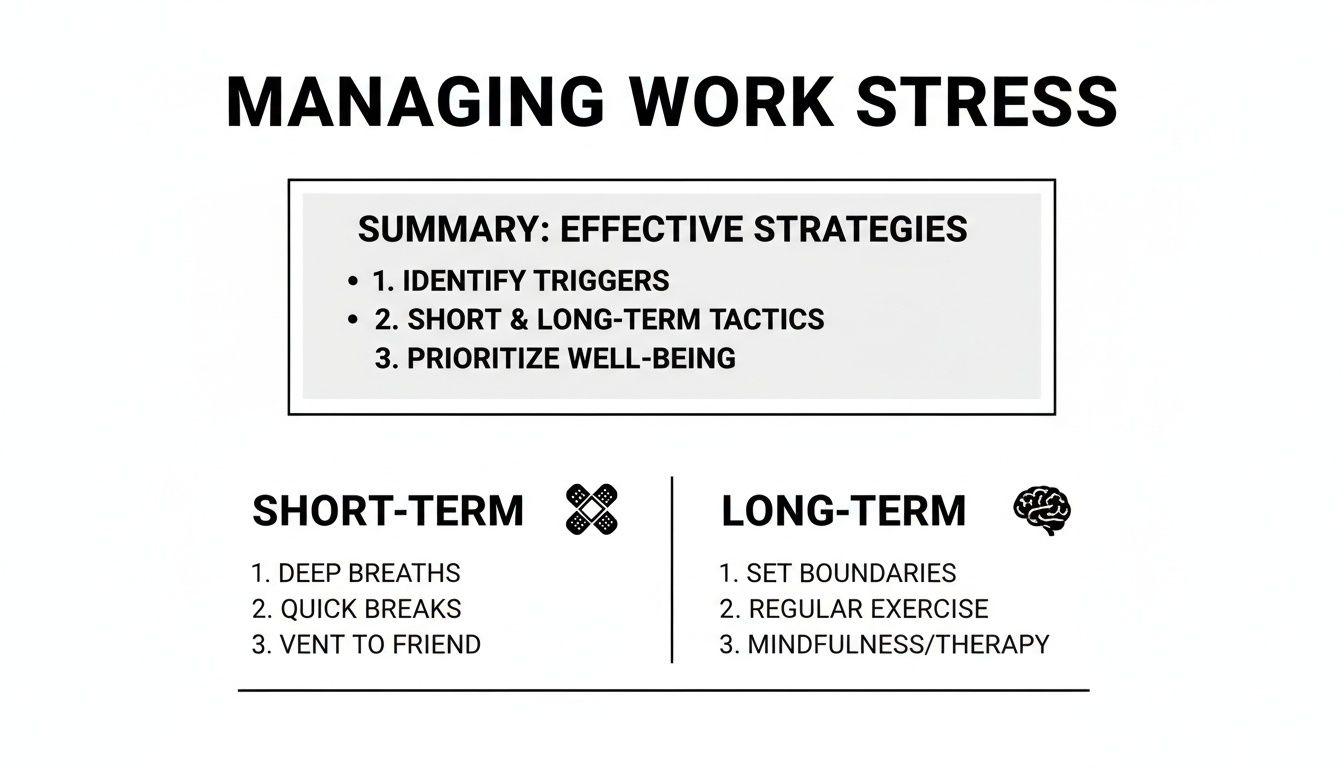
To see this in action, let’s contrast the quick-fix “band-aid” solutions with the more sustainable strategies we’re going to cover. This table shows the shift from just coping day-to-day to actually building long-term resilience.
Immediate Stress Relief vs Long-Term Resilience Strategies
| Strategy Type | Examples | Primary Goal | Effectiveness |
|---|---|---|---|
| Immediate Relief | Taking a 5-minute break, deep breaths, venting to a coworker. | Reduce acute stress in the moment. | Short-term. Provides temporary relief but doesn’t solve the root cause. |
| Long-Term Resilience | Setting boundaries, improving time management, regular exercise, changing job roles. | Reduce or eliminate chronic stressors and build coping capacity. | Sustainable. Addresses underlying issues for lasting change and well-being. |
As you can see, while immediate relief is essential for getting through a tough day, true resilience comes from making systemic changes and building proactive habits.
A Better Approach to Managing Workplace Stress
Instead of just trying to grit your teeth and push through, this guide is about tackling stress from both the inside and the outside. We’re going to give you actionable strategies that actually work. These methods are designed to build resilience over time, which is a cornerstone of effective workplace mental health programs.
Here’s what we’ll dive into:
- Quick, in-the-moment resets to instantly calm your nervous system.
- Proactive daily routines, including some incredibly powerful breathwork techniques.
- Practical adjustments you can make to your workspace and personal boundaries.
- Long-term practices to support your overall mental and emotional health.
- Clear guidance on when it’s time to ask for help, either from a professional or your employer.
By approaching stress from all these angles, you can go from just surviving your workday to actually thriving in it.
Instant Resets for High-Pressure Moments
Stress doesn’t exactly book a meeting in your calendar. It ambush-calls you during a tense conversation, DMs you after a critical email, or crashes your brain moments before a big presentation. When that happens, you don’t need a five-year plan; you need an immediate circuit breaker for your nervous system.
These are the practical, science-backed tricks you can pull out right at your desk to get back in the driver’s seat in under five minutes. The idea isn’t to magically erase stress but to dial down the intensity so you can actually think straight again. When your heart is pounding and your mind is racing, you’re in fight-or-flight mode. These resets tell your brain the immediate threat is over, letting your logical mind get back to work.
The Fastest Way to Calm Down: The Physiological Sigh
When you feel that wave of panic rising, your first instinct is probably to take a single, deep breath. But it turns out there’s a better way. Researchers have identified a specific breathing pattern called the Physiological Sigh, and it works wonders.
A 2023 study from Stanford University published in Cell Reports Medicine actually found this technique was more effective at boosting mood and slashing anxiety than mindfulness meditation.
And the best part? It’s incredibly simple and actionable.
Action Step: The next time a stressful email lands in your inbox, before you even type a reply, perform three Physiological Sighs.
- Breathe in sharply through your nose, then—without exhaling—take another quick sniff of air right on top of it. This double-inhale pops open the tiny, collapsed air sacs (alveoli) in your lungs.
- Now, let it all go with one long, slow, controlled exhale through your mouth.
So, why does this work so well? That double inhale and long exhale combination off-loads the maximum amount of carbon dioxide from your body in a single go. This directly stimulates your vagus nerve, which tells your heart to slow down. It’s like hitting the emergency brake on your body’s stress response. Try it once, or do it three times in a row for a seriously powerful calming effect.
Anchor Yourself with the 5-4-3-2-1 Grounding Method
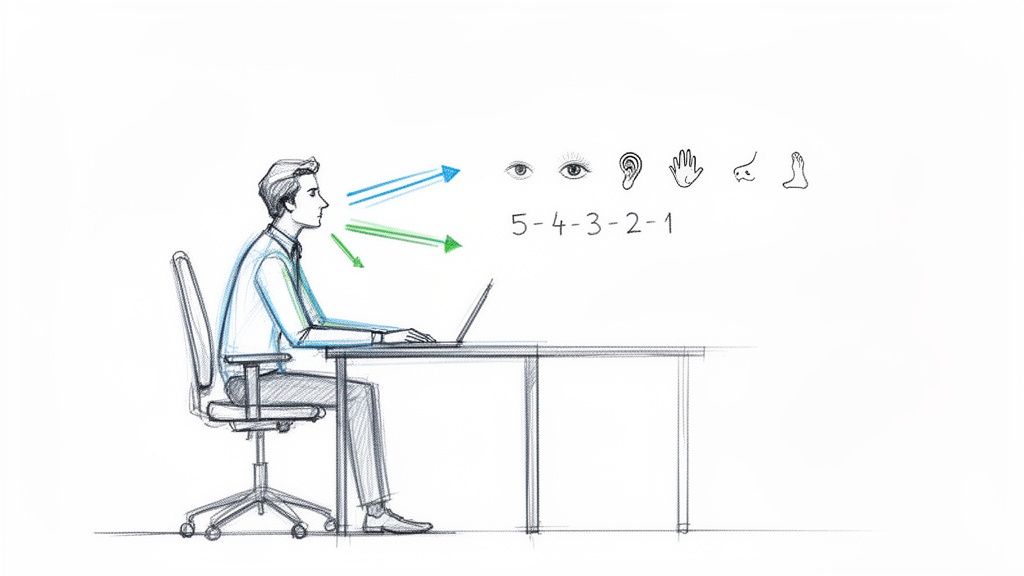
Anxiety loves to drag you into a vortex of “what-if” scenarios about the future. The 5-4-3-2-1 method is your anchor, forcefully pulling your attention back to the here and now by engaging all five of your senses.
This isn’t just some feel-good trick; it’s a form of sensory awareness, a core part of mindfulness that studies consistently show reduces our perception of stress. A 2021 study in the Journal of Affective Disorders found that even brief mindfulness-based exercises can significantly reduce symptoms of anxiety and depression. You’re basically forcing your brain to stop worrying about abstract fears and focus on what’s real and tangible.
Action Step: Practice this right now at your desk. Silently, in your head:
- 5 Things You Can See: Really look around. Don’t just glance. Name five specific objects. “My blue pen, the smudge on my monitor, the plant in the corner, my worn-out mousepad, the light fixture overhead.”
- 4 Things You Can Feel: Tune into the physical sensations you’ve been ignoring. “The pressure of my feet on the floor, the texture of my keyboard, the warmth of my coffee mug, the slight breeze from the A/C.”
- 3 Things You Can Hear: What sounds are in the background? Listen for them. “The hum of the server room, someone typing down the hall, my own quiet breathing.”
- 2 Things You Can Smell: This one can be subtle, so you might have to concentrate. “The faint scent of coffee, the smell of the disinfectant wipe from this morning.”
- 1 Thing You Can Taste: What’s the lingering taste in your mouth right now? “That last sip of water, or the mint from my gum.”
This simple sequence is a powerful pattern-interrupt for anxious thoughts. Research shows that even quick mindfulness exercises like this can act as a buffer against the wear-and-tear of workplace stress. It’s one of the most discreet yet effective tools for how to manage stress at work when your mind starts to spiral.
While the Physiological Sigh is your go-to for a rapid reset, it’s worth having other breathing patterns in your toolkit. You can explore a comparison of popular methods like box breathing vs the 4-7-8 technique to see which one feels most natural for you. The key is to find what works and practice it, so when the pressure mounts, you have a reliable way to turn a moment of panic into a moment of control.
Building Proactive Anti-Stress Routines
While those in-the-moment resets are fantastic for getting through a tough afternoon, true, lasting resilience comes from being proactive. To really get a handle on workplace stress for the long haul, you need to build routines that strengthen your mind and body before the pressure cooker gets turned on.
This isn’t about cramming more into your already packed schedule. It’s about weaving small, powerful habits into the fabric of your day to create a natural buffer against chronic stress.
Think of it this way: instead of constantly running around putting out fires, you’re building a more fire-resistant foundation. This shift is critical because the cost of unmanaged stress is staggering. It’s not just draining; it’s a productivity killer. A shocking 42% of stressed workers lose 15-30 minutes of work daily, and another 34% lose a full hour or more.
Implement a “Digital Sunset”
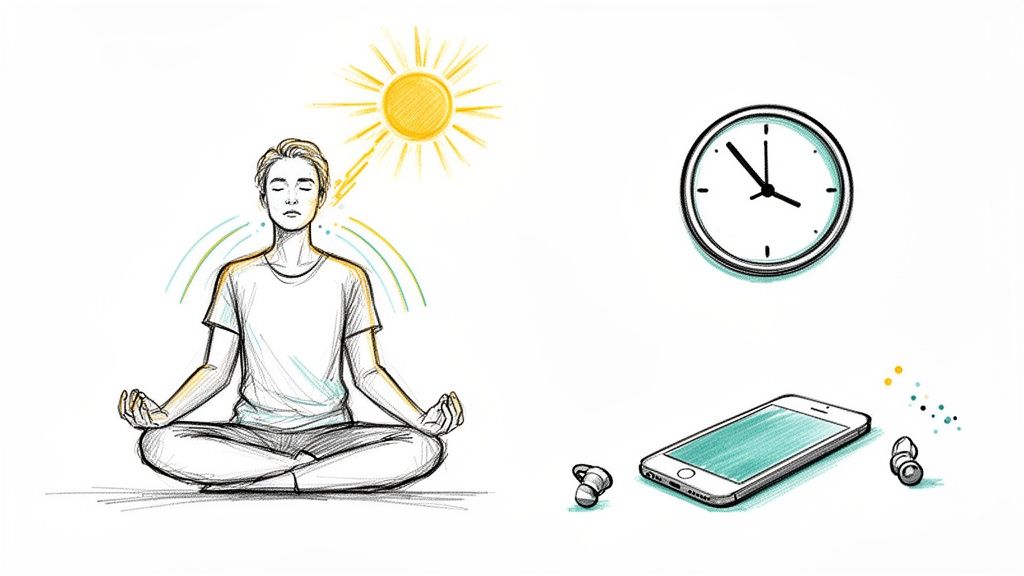
One of the sneakiest stressors in the modern workplace is the inability to truly switch off. The endless ping of notifications keeps your brain tethered to work, robbing you of the deep rest you need to recover. A “digital sunset” is a firm boundary you draw with technology to reclaim your peace.
The idea is simple: Pick a time every evening—ideally 60-90 minutes before bed—and put all work devices away. No more checking emails, no scrolling through team chats, and definitely no “quick peek” at tomorrow’s calendar.
A 2018 study in Applied Psychology found a direct link between late-night work smartphone use and being more tired and disengaged the next day. By creating this tech-free window, you give your brain the signal to shift from problem-solving mode to rest-and-relax mode. This can dramatically improve your sleep and cut down on that “what-if” anxiety about the next day.
Action Step: Set a recurring alarm on your phone for tonight, 90 minutes before your bedtime. Name it “Digital Sunset.” When it goes off, plug your phone in to charge—away from your bed—and leave it there.
Kickstart Your Day with a Morning Breathwork Ritual
How you begin your morning really does set the tone for the hours that follow. Before you even think about grabbing your phone and diving into the chaos of emails and news alerts, set aside just 10 minutes for a simple breathwork practice. This one habit might just be the most important tool in your stress-management toolkit.
This isn’t just about “chilling out.” You are intentionally regulating your autonomic nervous system, guiding it from a “fight-or-flight” state to a “rest-and-digest” one. Doing this first thing creates a foundation of calm that makes you far less reactive to whatever the workday throws at you.
- Action Step: Tomorrow morning, before checking any device, sit on the edge of your bed. For five minutes, try a simple rhythmic breath: inhale through your nose for a count of four, and exhale slowly through your mouth for a count of six. That longer exhale is key—it actively tells your nervous system to calm down. For the next five minutes, just notice your natural breath without trying to change it.
Retrain Your Brain with Sound
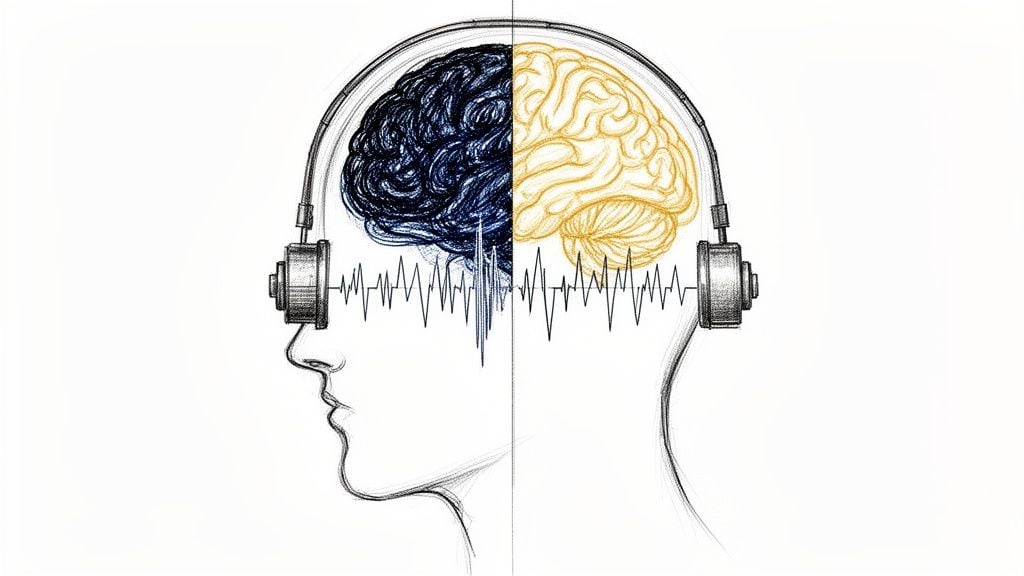
If you want to deepen your practice, try pairing your breathwork with specific auditory tools like binaural beats. This isn’t science fiction; it’s based on the way our brains respond to sound.
Binaural beats work by playing two slightly different sound frequencies in each ear (you’ll need headphones). Your brain perceives the difference between the two as a single, low-frequency tone and starts to sync up with it. Research has shown that listening to frequencies in the theta (4-8 Hz) range can create a state of deep relaxation, similar to meditation.
By playing a calming theta-wave track during your morning breathwork, you’re giving your brain a powerful, two-pronged signal to unwind. Over time, you’re helping retrain your neural pathways so that a calm, focused state becomes your new normal.
Of course, managing stress long-term is about more than just one or two tricks. It’s about building a healthier lifestyle at the office. For more ideas, check out these 5 habits for maintaining a healthy office lifestyle. When you start integrating these proactive routines, stress management stops being a desperate reaction and becomes a daily practice of building unshakable calm.
Redesigning Your Work Environment and Boundaries
While internal routines are powerful, you can’t meditate your way out of a fundamentally stressful situation. Let’s be honest: sometimes the most significant source of stress isn’t what’s happening inside you—it’s your external environment. To truly get a handle on workplace stress, you have to take control of your workspace, your schedule, and how you interact with colleagues.
This is about actively designing an environment that supports your well-being instead of draining it. It means creating systems and boundaries that protect your most valuable resources: your time, energy, and focus. This shift from passively reacting to your day to proactively shaping it is where you’ll find real, long-term relief.
Master the Art of Setting Boundaries
Setting boundaries isn’t about being difficult or unhelpful. It’s about professionally and clearly communicating what you can and can’t do. An automatic “yes” to every single request is a fast track to burnout. You have to learn to respond with clear, non-confrontational language that respects both your colleague’s needs and your own limits.
This subtle shift in how you communicate is crucial for managing expectations. For more on this, our guide on improving communication in the workplace is packed with great strategies.
Action Step: The next time a colleague asks you to take on a non-urgent task, instead of saying “yes” immediately, try one of these scripts:
- To buy time: “That sounds important. Let me check my current priorities and I’ll get back to you in an hour with a realistic timeline.”
- To manage workload: “To give this new project the attention it deserves, I’ll need to shift something else on my plate. Can we chat about which task should be deprioritized?”
- To protect focus time: “I’m in a deep work session until 11 AM to hit a deadline, but I’d be happy to connect with you right after.”
These simple reframes change the conversation from a question of your willingness to a matter of logistics and priorities. They are firm but respectful, positioning you as a strategic partner, not just a reactive task-doer.
Optimize Your Physical and Digital Workspaces
Your environment is constantly sending signals to your brain. A cluttered desk and a chaotic digital desktop create a low-grade hum of stress that makes it incredibly hard to focus. Taking deliberate steps to organize both can have a profound impact on your mental state.
This isn’t about achieving perfection; it’s about reducing friction in your day-to-day.
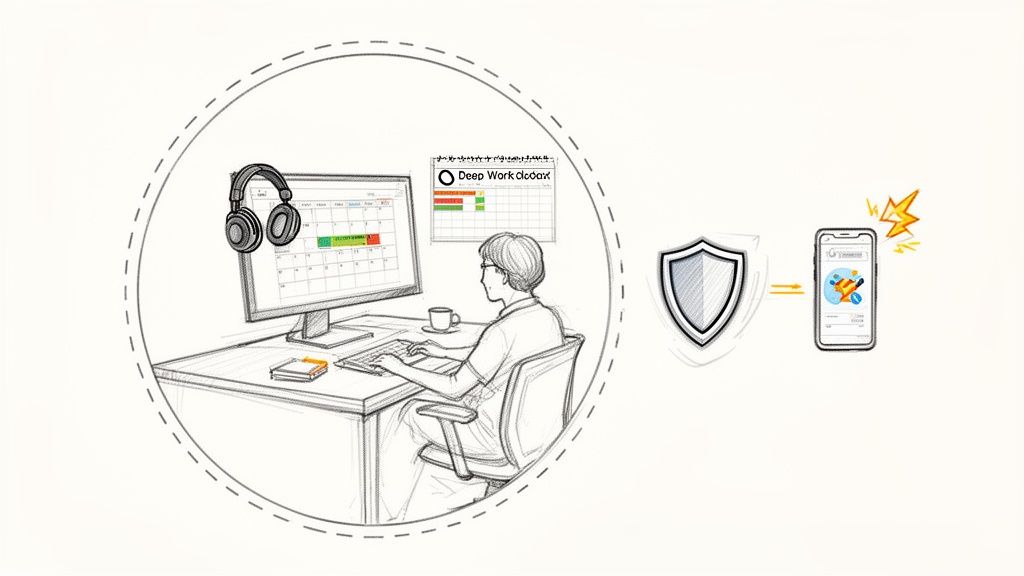
Key Takeaway: Every minute you spend searching for a file, getting sidetracked by a notification, or trying to focus in a noisy space is a small withdrawal from your energy bank. When you optimize your environment, you plug these energy leaks, leaving you with more capacity for the real work.
Action Step: Before you finish work today, take 15 minutes to implement one of these:
- Create a Focus Zone: Even in a loud, open office, you can carve out a personal bubble. Noise-canceling headphones are the universal sign for “do not disturb.” Put them on, even with no music, to signal you are unavailable for interruptions.
- Declutter Your Digital Desktop: Drag every loose file on your desktop into a single folder named “Sort Later.” A clean, calm visual field makes a huge difference.
- Schedule “Deep Work” Blocks: Open your calendar now and block out two 90-minute “Do Not Disturb – Deep Work” slots for tomorrow. Guard these blocks like you would an important meeting—don’t let anyone schedule over them. This is how you protect your most productive time.
The environment you work in has a massive effect on your mental health. Research from the American Psychological Association’s 2023 Work in America Survey shows that toxic workplaces are a catastrophic source of stress. A staggering 59% of dissatisfied U.S. workers label their environment as toxic, and people in those settings are more than three times as likely to suffer mental health harm. You can read the full findings on workplace well-being and toxicity on APA.org.
External factors like a toxic culture are often beyond your immediate control. But by intentionally redesigning the elements you can control—like your personal workspace and professional boundaries—you build a crucial buffer that protects your well-being and makes it much easier to navigate the challenges that come your way.
Knowing When Self-Care Is Not Enough
All the personal strategies we’ve talked about—breathwork, setting boundaries, building better routines—are fantastic tools for managing the daily grind. They’re your first line of defense. But sometimes, the pressure builds to a point where those tools just aren’t enough anymore.
It’s crucial to know when you’ve moved past everyday stress and into the territory of genuine burnout or chronic overload. Trying to push through is like trying to patch a leaky dam with duct tape; you might slow the trickle, but you’re not fixing the underlying crack. Recognizing this isn’t a sign of failure. It’s a signal that the problem has outgrown your personal toolkit.
Recognizing the Red Flags
So, how do you know when you’ve crossed that line? It’s usually not one big, dramatic moment. It’s more like a slow burn, a gradual wearing down of your energy and enthusiasm. You need to look for patterns that stick around, even when you’re doing all the “right things” to cope.
Research in the Australian Journal of Psychology found a direct link between personality traits like perfectionism and workaholism and the likelihood of burning out. This is a huge tell—our own drive and dedication can actually blind us to how bad things have gotten until we’re completely running on fumes.
Keep an eye out for these warning signs:
- Persistent Low Mood: This isn’t just a “case of the Mondays.” It’s feeling cynical, irritable, or just plain down about your job for weeks on end.
- Chronic Fatigue and Sleep Issues: You wake up feeling just as tired as when you went to bed. Or maybe you can’t fall asleep because your mind is racing with work-related anxieties.
- A Complete Lack of Motivation: You find yourself thinking, “I just don’t care anymore” about projects and goals that once felt important. The passion is gone.
- Physical Symptoms: Are you getting more headaches? Stomach problems? That nagging tension in your shoulders that never seems to go away? These can be physical manifestations of chronic stress.
If this list feels a little too familiar, it’s a sign you’re likely dealing with something more serious than stress. It’s important to understand how to cope with job burnout, because it’s a condition that almost always requires support from others to overcome.
Your Options for Professional Support
Think of getting professional support as a proactive career move, not a last-ditch effort. A professional athlete has a coach to stay at the top of their game; you can do the same for your mental and professional well-being.
Seeking help is a sign of high self-awareness. It demonstrates that you understand the problem’s scale and are resourceful enough to find the right tool for the job.
Here are a few paths you can take:
- Therapy or Counseling: A therapist provides a safe, confidential space to dig into the root causes of your stress. They can equip you with proven strategies, like Cognitive Behavioral Therapy (CBT), to reframe your thinking.
- Career or Performance Coaching: If your issues are more about navigating workplace dynamics, setting boundaries, or figuring out your next career move, a coach can offer practical, forward-looking guidance.
- Employee Assistance Programs (EAPs): Don’t forget to check your company benefits! Many employers offer EAPs, which provide a set number of free, confidential counseling sessions. It’s an excellent and surprisingly underused resource.
Talking to Your Manager or HR
The thought of telling your boss you’re overwhelmed can be daunting, but it doesn’t have to be a confrontation. The secret is to approach it as a collaborative, problem-solving conversation.
Instead of walking in and saying, “I’m completely swamped,” frame it around shared goals and outcomes.
Action Step: The next time you need to discuss your workload, use this script: “I’m fully committed to delivering great results on both Project X and Project Y. Looking at the current timelines, I’m concerned about maintaining quality across both. Could we sit down and talk about priorities, or perhaps look at adjusting a deadline?”
See the difference? You’re not complaining. You’re flagging a potential business risk and inviting your manager to help you find a solution. This makes you a proactive team player, not just an employee who’s struggling.
Your Questions About Workplace Stress, Answered
Even with the best strategies, real-world work situations can be messy. Office politics, difficult personalities, and just figuring out what’s going on in your own head are tough challenges. Here, I’ll tackle some of the most common questions I hear about managing stress on the job, offering straight-up answers for those tricky spots.
Think of this as your troubleshooting guide for the nuanced, frustrating problems that often cause the most strain. We’ll take the core ideas we’ve talked about and apply them directly to the situations where you need them most.
What If My Boss Is the Main Source of My Stress?
This is an incredibly common—and difficult—situation. When the person you report to is the primary stressor, it can feel like you’re trapped. The most important thing you can do is shift your focus from their behavior (which you can’t control) to your strategy (which you can).
First, start keeping a private log of specific interactions. This isn’t about building a legal case; it’s about gaining clarity. Is the problem micromanagement? Unrealistic deadlines? Vague communication? Pinpointing the pattern moves the issue from a general feeling of “my boss is a nightmare” to a specific, solvable problem like, “I’m consistently given urgent tasks without any adjustment to my existing workload.”
Once you have that clarity, you can use the boundary-setting language we discussed earlier.
- Instead of saying, “This is too much work,” reframe it: “I can absolutely get this new task done by Friday. To make that happen, I’ll need to pause my work on Project A. Which one is the higher priority for you right now?”
See the difference? You’ve just turned a potential confrontation into a collaborative, logistical discussion. You’re not complaining; you’re being a strategic partner. Of course, if the behavior veers into unprofessional or abusive territory, it’s time to review your company’s HR policies. Approaching them with documented, work-related examples is always more powerful than just venting.
What Is the Most Effective Thing I Can Do in Under Five Minutes?
When you’re completely overwhelmed and have no time, you need an emergency brake. The single most effective tool for this is the Physiological Sigh.
It’s simple: two quick, sharp inhales through your nose, followed by one long, slow exhale through your mouth. That’s it. A fascinating 2023 study in Cell Reports Medicine found this specific breathing pattern is the fastest way to hit the reset button on your nervous system and slow your heart rate—even more effective than mindfulness meditation for immediate anxiety relief.
You can do it at your desk, during a tense call (just mute your mic), or in the bathroom before walking into a big presentation. It takes less than a minute.
How it works: That double-inhale pops open the tiny air sacs (alveoli) in your lungs, maximizing the surface area for oxygen. The long, slow exhale then dumps a maximum amount of carbon dioxide, which sends a direct signal to your brain via the vagus nerve to calm everything down. It’s your body’s built-in off-switch for stress.
If you have a full five minutes, a guided breathwork session on an app can make a huge difference. Just remember, consistency trumps duration every time. A few focused minutes each day will build more lasting resilience than one long session every few weeks.
How Can I Differentiate Between Normal Stress and Burnout?
This is a critical question because stress and burnout require very different solutions. Think of it this way: normal stress is acute and tied to a specific challenge, like a major project deadline. You feel pressured and overwhelmed, but there’s a light at the end of the tunnel. It’s temporary.
Burnout, on the other hand, is a state of chronic depletion. The World Health Organization defines it with three main symptoms:
- Overwhelming exhaustion: You feel emotionally and physically drained, day after day.
- Cynicism and detachment: You feel disconnected from your job and colleagues. The work starts to feel pointless.
- A sense of ineffectiveness: No matter how hard you try, you feel like you aren’t making a meaningful impact.
If stress feels like you’re drowning, burnout feels like you’re completely dried up. If you’re nodding along to the burnout symptoms, self-care routines, while helpful, won’t be enough. That’s a clear signal you need professional support and likely a significant change in your work environment to truly recover.
Can Technology Like Binaural Beats Genuinely Help with Stress?
Yes, they can. The science behind tools like binaural beats is legitimate and quite promising. They work by playing two slightly different frequencies in each ear (you have to use headphones). Your brain processes the mathematical difference between these two tones and perceives a third, single low-frequency beat.
This triggers something called a “frequency-following response,” where your brainwaves naturally start to sync up with that new, perceived beat. Different frequencies are associated with different mental states. For example, beats in the theta wave range (4-8 Hz) are known to guide the brain toward a state of deep relaxation and meditation, which is fantastic for dialing down anxiety.
A 2019 study published in Psychological Research confirmed that listening to these frequencies can tangibly reduce anxiety. While they aren’t a silver bullet, they are a powerful, science-backed tool for helping you regulate your nervous system. When you combine them with something like guided breathwork, the calming effects are often amplified, making them a worthy addition to your stress-management toolkit.
At 9D Breathwork, we know that managing stress at work is about more than just coping. It’s about rewiring your response from the inside out. Our experiences combine breathwork with binaural beats, hypnotic guidance, and custom soundscapes to help you release stored tension and build deep, lasting resilience. If you’re ready to reclaim your calm, explore our journeys at https://9dbreathwork.com.