To really start coping with job burnout, you first have to call it what it is. It’s not just stress. It’s a deeper kind of exhaustion that seeps into everything, and the key is to spot the warning signs before you’re completely running on fumes. From there, you can start taking small, practical steps to build back your energy and create some much-needed distance from the daily grind that got you here.
Recognizing Burnout Before It Takes Over
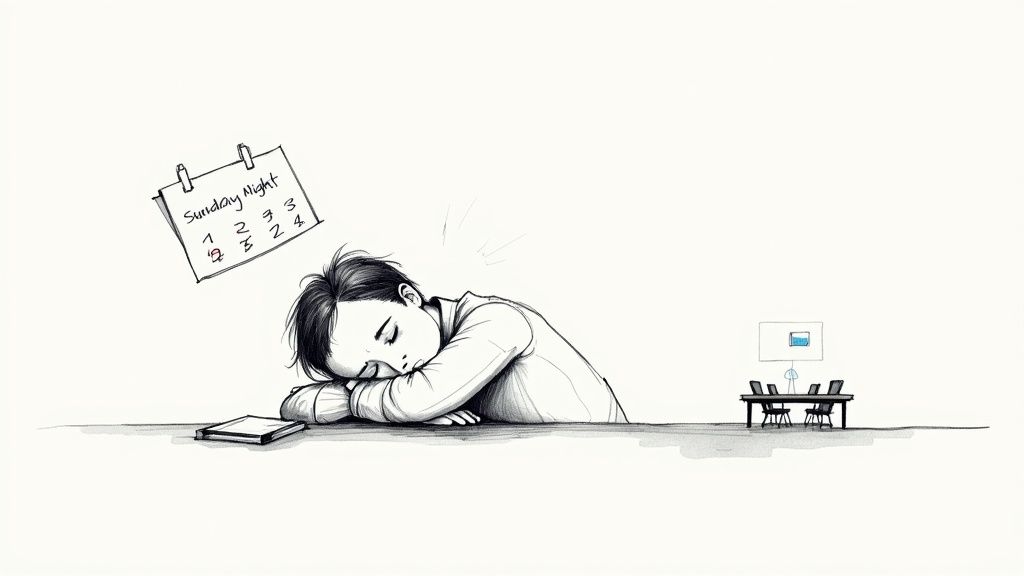
Let’s be real. Burnout isn’t just “feeling tired.” It’s that heavy, sinking feeling you get on Sunday night. It’s zoning out in meetings, feeling totally detached from the conversation. It’s that nagging voice in your head telling you none of this work even matters.
This isn’t a personal failure—it’s your body and mind’s natural response to being under excessive, prolonged stress. The American Psychiatric Association points to three core dimensions of burnout: overwhelming exhaustion, a cynical or detached view of your job, and a feeling that you’re just not effective anymore. A 2018 study published in the Journal of Organizational Behavior reinforced this, finding that emotional exhaustion is the most predictive component of burnout, often leading to increased cynicism as a coping mechanism.
You’re not just having a bad week. You’re completely tapped out.
The Three Core Signs of Job Burnout
Getting a handle on these signs is the first real step toward recovery. They usually feed off each other, creating a downward spiral that can feel impossible to escape.
- Emotional Exhaustion: This is the bone-deep weariness that makes getting out of bed feel like a monumental task. For example, you might find yourself snapping at a family member over something small after work, simply because you have zero emotional reserves left.
- Cynicism and Detachment: Have you started feeling like a spectator in your own career? Maybe sarcasm is your go-to response in team meetings, or you feel completely disconnected from your coworkers and the company’s mission. You’re just going through the motions.
- Lost Sense of Accomplishment: This is when you start to believe your work makes no difference. Self-doubt creeps in, you lose confidence in your skills, and your productivity tanks, leaving you feeling stuck and ineffective. For instance, you might stare at a project you once would have tackled easily and feel completely incapable of starting.
If this is hitting a little too close to home, it’s worth taking a closer look. Our guide on the specific signs of workplace burnout breaks these down even further to help you get clarity on what you’re feeling.
What Causes This Downward Spiral?
Burnout rarely just appears out of nowhere. It’s often the result of specific workplace issues that slowly chip away at your well-being. Looking at the common causes of job dissatisfaction can be eye-opening, revealing how things like a toxic culture or a lack of control can pave the way to full-blown burnout.
The World Health Organization officially recognizes workplace burnout as an “occupational phenomenon.” It’s not a personal problem; it’s the result of chronic workplace stress that hasn’t been properly managed.
This is so important to remember. What you’re experiencing is real, and it has a name. The good news is that companies are finally starting to catch on. Research shows that organizations conducting quarterly workload reviews saw a 30% reduction in burnout rates, and 65% of employees felt less overwhelmed when their roles and responsibilities were crystal clear.
To see if these signs are showing up for you, take a moment to go through this quick checklist.
Burnout Symptoms Self-Assessment Checklist
Use this table to quickly gauge whether you’re experiencing the classic signs of burnout. Be honest with yourself as you check off any that apply.
| Symptom Category | Common Signs | Check If Applicable |
|---|---|---|
| Emotional | Feeling drained and unable to cope, constant irritability, anxiety | ☐ |
| Lack of motivation, feeling trapped in your job | ☐ | |
| Sense of dread about work, increased cynical or negative outlook | ☐ | |
| Physical | Chronic fatigue, frequent headaches or muscle pain | ☐ |
| Changes in sleep habits (insomnia or oversleeping) | ☐ | |
| Lowered immunity, getting sick more often | ☐ | |
| Behavioral | Withdrawing from responsibilities, isolating yourself from others | ☐ |
| Procrastinating or taking longer to get things done | ☐ | |
| Using food, drugs, or alcohol to cope | ☐ |
Seeing a few checks on this list can be a clear signal that it’s time to take action. It’s not about being weak; it’s about recognizing you’ve been carrying too much for too long.
Immediate Steps to Create Breathing Room
When you’re deep in the throes of burnout, thinking about long-term solutions can feel completely overwhelming. Right now, what you need is just a moment to catch your breath.
Think of these as emotional first-aid. They aren’t the ultimate cure, but they’re crucial for stopping the freefall and carving out the mental space you need to even begin thinking about real recovery.
First things first, you have to reclaim your evenings. This means setting a non-negotiable ‘hard stop’ to your workday. Actionable step: Pick a time, say 5 PM, and set a recurring alarm on your phone labeled “End Workday.” When it goes off, treat it like an iron-clad appointment you cannot miss. Log out of Slack and email on your phone, and physically close your laptop and put it away. It sounds almost too simple, but it’s a powerful first boundary.
Create Pockets of Pause
Burnout thrives on momentum—that relentless, non-stop churn of tasks and demands. Your job is to interrupt it. Instead of just gritting your teeth and pushing through another draining afternoon, sprinkle ‘micro-breaks’ throughout your day. These are tiny, intentional pauses that act as a pressure release valve.
It doesn’t have to be complicated. After you finally hit send on a difficult email or get off a long call, don’t just dive into the next thing on your list. Try one of these instead:
- Actionable step: Stand up and stretch for 60 seconds. A simple neck roll or reaching for the ceiling can release physical tension. Really focus on letting go of the tension that’s probably gathered in your neck and shoulders.
- Actionable step: Look out a window for two minutes. Let your eyes relax and focus on something far away, like a tree or a cloud. This gives your eyes a break from screen strain.
- Actionable step: Try a quick breathing exercise. Just a few deep, intentional breaths can work wonders on a frazzled nervous system. In fact, knowing how to reduce stress naturally with your breath is one of the most effective tools you can have in your back pocket.
These aren’t about slacking off; they’re about preventing your stress from snowballing. As highlighted by Psychiatry.org, maintaining a sense of agency—that feeling you’re still in control—is absolutely essential for fighting the helplessness that defines burnout. Micro-breaks are a small but tangible way to take that control back.
Clear Your Mind Before You Leave
One of the worst things about burnout is the way work follows you home. Your body might have left the office, but your brain is still stuck in meetings and replaying conversations. A simple ‘brain dump’ can be a game-changer here.
Before you officially clock out, take 15 minutes. Grab a notebook and write down every single work-related thing cluttering your mind. Unfinished tasks, worries about that big presentation, ideas you’re afraid you’ll forget—get it all out.
Dumping it onto paper sends a signal to your brain: “This is captured. You don’t have to keep juggling it. We’ll deal with it tomorrow.”
This isn’t just about making a to-do list. It’s an act of psychological detachment, which a 2017 study in the Journal of Applied Psychology found is absolutely vital for recovering from work fatigue and preventing emotional exhaustion. You’re drawing a clear, conscious line between your work self and your home self, giving your mind the genuine rest it’s crying out for.
Building Your Personal Burnout Recovery Plan
Getting out from under burnout isn’t something a long weekend can fix. It takes a real, conscious plan. Think of it less like a quick fix and more like building a personal blueprint to get your energy back, draw some hard lines in the sand, and find the parts of yourself that work has buried. This isn’t about some massive, overnight life change. It’s about stringing together small, consistent actions that actually stick.
A fantastic starting point is simply reclaiming your physical and mental space. This is all about creating a clear divide between your “work life” and your “home life,” which is especially tricky if you work from home. One global study found that while remote work can be great, the real magic happens when people set firm boundaries. At companies that actively encouraged defined work hours and regular breaks, employees saw a 35% drop in burnout symptoms. That’s the power of structure right there. If you’re interested, you can dig into the full study on work flexibility and burnout here.
Re-Establishing Boundaries That Actually Work
Good boundaries are your best defense against falling back into old patterns. But they have to be practical and, frankly, non-negotiable if they’re going to protect your time and energy.
- Create ‘No-Work’ Zones: If your office is also your home, make certain areas laptop-free zones. Your bedroom is a great one. The dining table is another. This physical separation really does help your brain switch off. Actionable step: Tonight, move your work laptop and charger out of your bedroom and commit to keeping it that way.
- Schedule ‘You’ Time Like a Client Meeting: Literally block out time in your calendar for a walk, a hobby, or just to sit and do nothing. Treat this appointment with the same gravity you would a meeting with your boss. Don’t you dare cancel on yourself. Actionable step: Open your calendar now and block 30 minutes for yourself later this week. Label it “Personal Appointment.”
- Set Clear Communication Rules: Use your email’s out-of-office reply after hours. Set your Slack status to “away” and mean it. These simple tools communicate your availability for you, so you don’t have to constantly explain yourself. Actionable step: Write a simple auto-reply now, like “Thank you for your message. I am currently offline and will respond during business hours (9 am-5 pm).” Save it to use tonight.
This simple workflow is a powerful way to hit the brakes when you feel your mind starting to race.
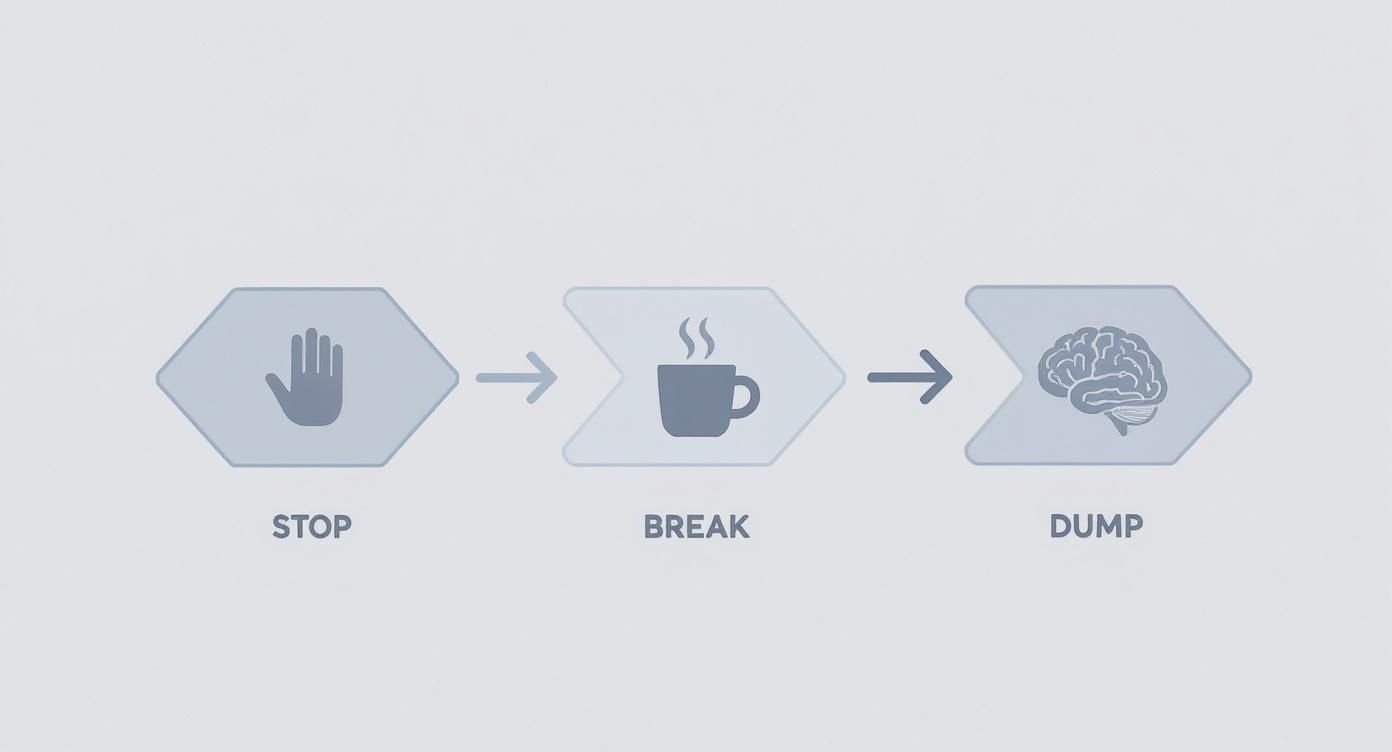
The key is the sequence: stop what you’re doing, take a real break (even a short one), and then get all those swirling thoughts out of your head and onto paper.
To help you get started, here is a sample weekly structure. Think of it as a template you can adapt to fit your own life and needs.
Weekly Burnout Recovery Actions
| Day of the Week | Focus Area | Actionable Task Example |
|---|---|---|
| Monday | Setting Intentions | Write down one non-negotiable boundary for the week. (e.g., “I will take a full lunch break away from my desk.”) |
| Tuesday | Mindful Movement | Take a 15-minute walk without your phone during your lunch break. |
| Wednesday | Reconnecting | Schedule a 30-minute coffee or call with a friend. |
| Thursday | Creative Outlet | Spend 20 minutes on a hobby you enjoy (e.g., drawing, music). |
| Friday | Digital Detox | Log off all work accounts 30 minutes earlier than usual. |
| Saturday | Joyful Activity | Do something purely for fun, with no goal in mind. |
| Sunday | Rest & Reflect | Plan one small, restful activity for the evening (e.g., reading, bath). |
This isn’t about adding more chores to your week. It’s about intentionally carving out moments that refill your tank instead of draining it. Consistency is far more important than intensity here.
Reconnecting With Your Identity Outside of Work
When you’re deep in burnout, it’s easy for your job title to become your entire identity. A crucial part of healing is remembering who you are when you’re not “on the clock.” It’s a powerful reminder that your value as a person has nothing to do with your productivity levels.
Think back. What did you love to do before work consumed everything? Was it painting, hiking, playing an instrument, or trying out new recipes? You don’t have to dive into the deep end. Actionable step: Choose one activity and schedule just 30 minutes for it this weekend. The only goal is to start.
One of the biggest lies burnout tells us is that we don’t have time for the things that recharge us. The truth is, making time for them is what creates more energy for everything else. It’s an investment, not an expense.
This isn’t about adding another task to your to-do list. It’s about consciously picking an activity that brings you genuine joy and has zero performance metrics. The only goal is to enjoy the process and get reacquainted with the version of yourself that exists just for the fun of it.
Changing Your Work Environment to Prevent Relapse
Your personal recovery plan is crucial, but it’s only half the battle. If you don’t address what caused the burnout in the first place, you’re just patching a leak in a broken pipe. To make a lasting recovery, you have to look squarely at the source: your work environment.
This isn’t about blaming your job or company. It’s about taking back control and actively reshaping your professional life into something that’s actually sustainable for the long haul.
Lasting change often boils down to a single, courageous conversation. So many of us put off talking to our managers about workload. We worry we’ll sound incompetent, or worse, like we’re just complaining. The trick is to frame the discussion around effectiveness and shared goals, not your personal stress levels.
How to Talk to Your Manager About Your Workload
Instead of walking in and saying, “I’m completely overwhelmed,” you need a more strategic approach. Book a specific time to talk about your role and what the real priorities are.
Here are a few ways to kick off that conversation:
- To clarify what really matters: “I’m focused on delivering great results for projects A, B, and C. To make sure I can do that, could we look at my other tasks and decide what can be pushed back or maybe delegated for a bit?”
- To tackle scope creep head-on: “I love the direction this project is going. Since the scope has grown, I think it would be helpful to map out a new timeline and figure out the resources we’ll need to hit these new targets.”
These kinds of openers show you’re thinking like a proactive problem-solver who cares about quality, not someone who’s just trying to get out of work.
The only real way to beat job burnout for good is to change the conditions that created it. Individual coping strategies are a great start, but they can’t fix a systemic issue. The real progress comes from addressing workload, control, and reward at the organizational level.
This isn’t just about making your own life easier; it’s about making your entire team more successful.
Strategically Negotiating a Better-Aligned Role
Sometimes the problem isn’t the amount of work, but the type of work. If your daily tasks constantly drain your energy, it’s a huge red flag. A powerful move is to start negotiating for a role that plays to your actual strengths and interests.
Actionable step: For one week, keep a simple “Energy Log.” At the end of each day, write down which tasks left you feeling drained and which ones left you feeling energized. This data will help you identify patterns and build a case for shifting your responsibilities.
For example, if you’re a natural innovator stuck with a mountain of administrative tasks, you could use your log to propose leading a small, creative side project, showing your manager how your energy for that type of work leads to better outcomes.
This is where a supportive environment makes all the difference. In fact, research from the American Heart Association found that organizations with solid wellness programs saw a 25% reduction in employee burnout. You can explore the findings on workplace well-being here to see the data for yourself.
Mastering the Art of the Strategic No
Finally, you have to learn how to say “no.” This is non-negotiable for preventing a relapse. A strategic “no” isn’t about being difficult or unhelpful; it’s about protecting your time and energy so you can deliver excellent work on your most important commitments.
When a new request lands on your desk, don’t just give a flat “no.” Try one of these instead:
- “That sounds like an important initiative. I’m completely focused on [current priority] right now. Can we circle back on this next month?”
- “I can definitely help with that, but it would mean pulling me off [another task]. Which one should be the priority?”
This approach turns a simple “no” into a collaborative discussion about what matters most. It reinforces your value and protects your most important asset: your energy.
Using Mind-Body Practices for Deeper Recovery
Job burnout isn’t just in your head; it’s a very real physiological state. Your nervous system essentially gets stuck in a high-alert, ‘fight-or-flight’ mode. The problem is, you can’t just “think” your way out of it. To truly start healing from burnout, you have to address the physical toll it’s taken on your body.
That’s where powerful mind-body practices come in. These techniques are designed to help you regulate your system and get back to a place of rest and safety. Research from the American Psychiatric Association actually shows that long-term stress can make us feel hopeless and out of control. By using these tools, you start to reclaim that sense of control from the inside out.
From Overwhelmed to In Control
When you’re constantly under pressure, your body is swimming in cortisol, the main stress hormone. One of the most direct ways to counteract this is through tactical breathing. It’s a simple but potent technique that works by stimulating your vagus nerve, which is like hitting the “brake” pedal for your nervous system.
A 2019 study in Frontiers in Psychology confirmed this, demonstrating that just five minutes of deep, slow breathing can significantly reduce cortisol levels and improve heart rate variability, a key marker of stress resilience. You don’t need a yoga mat or a quiet room to start. Actionable step: Try this simple box breathing exercise right now, wherever you are.
- Inhale slowly through your nose for a count of four.
- Hold your breath gently for another count of four.
- Exhale slowly through your mouth for a count of four.
- Hold at the bottom of the breath for a final count of four.
Just repeat this cycle for a couple of minutes. You’ll probably be surprised at how quickly it can settle a racing mind and ease tension in your body, giving you immediate relief when things feel like they’re too much.
Tuning Into Your Body’s Signals
Another incredibly useful practice is something called somatic tracking. It’s really just the act of paying curious attention to the physical sensations in your body, without judging them. When we’re burned out, we often tune out our bodies—ignoring the headaches, the tight shoulders, and the knots in our stomach until they’re screaming at us.
Somatic tracking is about reversing that habit. Actionable step: Take a second to scan your body. Where are you holding tension right now? Is your jaw tight? Are your shoulders creeping up toward your ears? Just noticing these signals is the first step toward letting them go.
Burnout lives in the body as much as it does in the mind. Becoming fluent in your body’s language—its whispers of tension and fatigue—is the key to addressing stress before it screams for your attention.
Practices like guided breathwork are fantastic for this because they help you process stored stress that you might not even realize is there. If that’s a new concept for you, you can learn more about the essentials of guided breathwork and its benefits and see how it could fit into your own recovery.
Of course, a huge part of this mind-body connection is getting truly restorative sleep. It’s worth looking at your sleep environment and seeing what you can improve, even something as simple as choosing the right pillow for better sleep.
By weaving these small, consistent practices into your life, you build deep, lasting resilience. You’re no longer just coping with job burnout—you’re fundamentally rewiring your entire response to stress.
Common Questions About Recovering from Job Burnout
Once you realize you’re burnt out, a million questions start swirling. It’s completely normal to wonder what the road back looks like, how long it will take, and whether you have to blow up your whole career to feel better. Let’s get into some of the questions I hear most often.
How Long Does It Really Take to Recover from Burnout?
This is the big one, and the honest answer is: it varies. There’s no magic number. For some people, a few dedicated months of change can bring significant relief. For others, especially if the burnout is severe, it might take a year or more.
The timeline really depends on two things: how deep the burnout goes and how much you can actually change the circumstances that got you there.
You’ll likely feel some immediate relief within weeks just by taking small steps, like actually logging off at 5 PM. But true recovery—that feeling of being re-engaged, energized, and capable again—is a slower burn. It’s built on a consistent commitment to new habits, stronger boundaries, and, often, some real shifts in your work environment.
Is It Possible to Recover Without Quitting My Job?
Yes, absolutely. Quitting feels like the only escape hatch sometimes, but it’s not always necessary or even possible for most people. You can recover in your current role, but it requires getting brutally honest about the root causes.
This is where the hard work comes in. It means having frank conversations with your manager about an unsustainable workload. It means setting—and enforcing—firm boundaries around your personal time. It’s about finding ways to reconnect with the parts of your job that once gave you a sense of purpose. The goal is to fundamentally reshape your relationship with your work.
A study from the American Psychiatric Association drives this home, highlighting how crucial it is to reclaim your sense of control to fight the helplessness that burnout feeds on. Now, if your workplace is fundamentally toxic and leadership is completely unwilling to change, leaving might be your healthiest option. But don’t assume it’s your only one.
Think of it this way: Stress is about over-engagement, while burnout is about disengagement. When you’re stressed, you feel like you’re drowning in pressure, but you still believe you can get on top of it. When you’re burnt out, you feel empty, detached, and the urgency is replaced by exhaustion.
When Should I Consider Getting Professional Help?
If you’ve been trying to implement changes on your own and you’re just not seeing any improvement, it’s a good sign that you need more support. It’s definitely time to reach out if your symptoms feel overwhelming and are starting to damage your health or personal relationships.
Watch for red flags like a persistent sense of hopelessness, symptoms of anxiety or depression that won’t lift, or if you simply feel like you can’t function in your daily life.
A good therapist, counselor, or coach can be a game-changer. They provide a much-needed objective perspective and give you strategies tailored to your specific situation, helping you navigate the tough conversations and decisions that are almost always part of a real burnout recovery.
True recovery from burnout isn’t just about managing stress; it’s about rewiring your response to it from the inside out. 9D Breathwork offers a powerful way to do this, using immersive, guided journeys that combine breath, sound, and subconscious reprogramming to release stored tension and regulate your nervous system.
You can explore how to build this kind of deep, lasting resilience by visiting the 9D Breathwork website.