If you're looking to improve your sleep, the best place to start is with the basics: build a consistent routine, make your bedroom a sanctuary for rest, and find ways to actively manage stress before your head hits the pillow. Simple actions like getting some sun first thing in the morning, cutting off caffeine in the afternoon, and creating a calming wind-down ritual are incredibly effective. They send a clear signal to your body that it's time to power down for some serious, restorative rest.
Why Quality Sleep is Your Ultimate Performance Enhancer
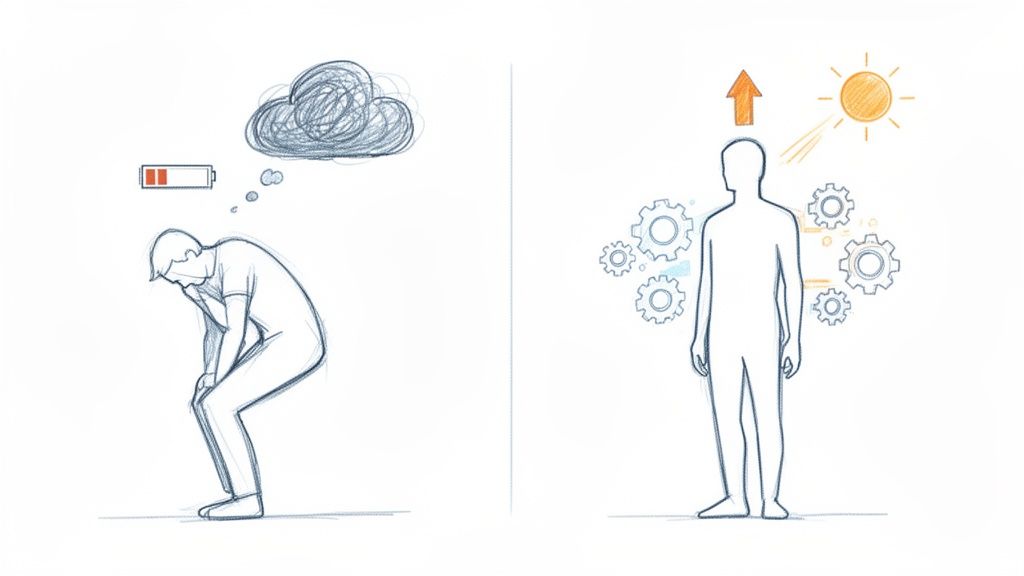
Struggling with sleep is more than just feeling tired—it's a massive roadblock to hitting your full potential. I find it helps to think of high-quality sleep not as passive downtime, but as an active process of mental and physical restoration. When you sleep well, your brain is busy consolidating memories, flushing out metabolic junk, and regulating your emotions.
This nightly tune-up has a direct and powerful impact on your waking hours. Without it, you’re basically running on empty. Decision-making slows down, creative problem-solving feels like climbing a mountain, and your emotional resilience tanks. Even one night of bad sleep can make you more reactive to stress and less able to focus on anything remotely complex.
The Ripple Effect of Poor Sleep
The fallout from skimping on rest goes way beyond a bit of morning grogginess. Over time, chronic sleep debt can seriously degrade your health and torpedo your productivity.
Think about it this way: a landmark study in Sleep found that after just two weeks of sleeping only six hours a night, participants' cognitive performance was as poor as someone who had been awake for two full days. Another study from the Journal of Sleep Research showed a direct link between poor sleep and emotional instability, making people more prone to mood swings and anxiety.
This isn't just a personal problem; it's a global one. A recent analysis of over 105 million nights of sleep revealed that sleep quality is on the decline worldwide. And while eight out of ten adults want to sleep better, a staggering 60% have never sought help, according to insights from SleepCycle.com. That's a huge gap between wanting to fix something and actually doing it.
The truth is, mastering your sleep is one of the most powerful levers you can pull to enhance your life. It's the foundation upon which your energy, mood, and mental clarity are built.
From Surviving to Thriving
When you finally start getting the deep, restorative sleep your body craves, the shift is undeniable. You stop just surviving your days and actually start thriving in them.
- Sharpened Mental Acuity: Your focus becomes laser-sharp, helping you knock out tasks faster and with way fewer mistakes.
- Enhanced Emotional Stability: You're just better equipped to handle stress and navigate challenges without feeling like you're about to snap.
- Increased Physical Vitality: Your energy is steady and reliable, powering you through everything from workouts to demanding projects and family time.
This connection is crystal clear. Learning how to improve sleep quality is a direct investment in your daily effectiveness. In fact, many of the same principles for better sleep are also key to learning how to improve work performance. Ultimately, the journey to better sleep is a journey to a better you.
Crafting the Perfect Sleep Sanctuary
Your bedroom needs to be a haven for rest, not a command center for your life. To really get a handle on your sleep, you have to forge a powerful psychological link: when you walk into your bedroom, your brain knows it's time to switch off. This all starts with getting serious about the three pillars of a sleep-promoting environment: light, temperature, and sound.
This isn't about vague advice. We're talking about specific, actionable steps. It's not just about making the room dark; it's about making it pitch-black. It's not just about keeping it quiet; it's about taking full control of what you hear.
Master Your Light Exposure
Light is the single most powerful lever controlling your body's internal clock, your circadian rhythm. Even a sliver of light, especially the blue light from screens, can fool your brain into thinking it's still daytime, slamming the brakes on your production of melatonin—the hormone of darkness. A study in the Proceedings of the National Academy of Sciences (PNAS) confirmed that exposure to room light before bedtime shortens melatonin duration by about 90 minutes, making it harder to fall asleep.
The most impactful change you can make? Commit to total darkness. Think of your bedroom as a cave. That means hunting down and eliminating every single source of light.
- Black out your windows. Those flimsy sheer curtains aren't going to do the job. To get your room truly dark, you'll want to check out this ultimate guide to the best blackout curtains for your bedroom. They are an absolute game-changer for blocking out pesky streetlights and that early morning sun.
- Kill the electronic glow. Get a roll of black electrical tape and cover those tiny, annoying LED lights on your TV, power strips, and chargers. If you use a digital clock, find one with a dim red display. Red light is far less disruptive to melatonin production than the typical blue or white light.
- Enforce a strict "no screens" rule. This one is non-negotiable. Put away all phones, tablets, and laptops at least 60-90 minutes before you plan to sleep. As a practical first step, try leaving your phone charger in another room, like the kitchen. This forces you to physically separate from your device before bed.
It’s not just in your head. A study in the Journal of Clinical Endocrinology & Metabolism found that even moderate room light during sleep can mess with your cardiovascular function and increase insulin resistance the next day. That’s how sensitive our bodies are to light, even when our eyes are closed.
Regulate Your Room Temperature
Ever found yourself tossing and turning in a room that's just a degree too warm? There's a solid biological reason for that. To initiate and maintain deep sleep, your body's core temperature actually needs to drop by a couple of degrees. A cool room doesn't just feel nice; it actively helps this process along.
The sweet spot for sleep is surprisingly cool, typically somewhere between 60 and 67 degrees Fahrenheit (that's about 15.5 to 19.4 Celsius).
Setting your thermostat to a cooler temperature isn't just about comfort; it's a direct signal to your body to begin its nightly shutdown sequence, making it easier to fall asleep and stay asleep.
Actionable Tip: Set a recurring "Sleep" schedule on your smart thermostat to automatically cool the house an hour before your bedtime. Play around within this range to discover what works for you. Switching to breathable bedding made from natural fibers like cotton, bamboo, or linen can also make a huge difference in helping your body regulate its temperature all night long.
Control Your Sound Environment
Nothing shatters a peaceful sleep cycle faster than an unexpected noise—a distant siren, a neighbor's dog, or even a partner's snoring. The goal isn't necessarily absolute silence, which can sometimes make small sounds seem even louder. Instead, you want to create a consistent, predictable soundscape.
This is where sound masking becomes your best friend. By introducing a constant, soothing sound, you can effectively drown out those jarring interruptions that would otherwise wake you up.
- White Noise: A dedicated white noise machine or even a simple fan can create a smooth, consistent blanket of sound that makes sudden noises far less noticeable. Tonight's action: download a free white noise app on your phone (but keep the screen off!) and try it out.
- Earplugs: If you're particularly sensitive to noise, don't underestimate the power of a good pair of comfortable foam or silicone earplugs. They can be incredibly effective.
How much does our environment matter? A survey from the Global Wellness Institute found that noise (75%) and lighting (72%) were the top two sleep disruptors for travelers. The fact that a whopping 91% were willing to pay more for hotels that offered sleep-enhancing features tells you everything you need to know about the value of a controlled environment.
You can use the checklist below to methodically build your own sleep sanctuary, turning your bedroom into a space that actively works for your rest, not against it.
Your Sleep Environment Optimization Checklist
Use this checklist to create a bedroom environment that actively promotes deep, uninterrupted sleep.
| Environmental Factor | Optimal Condition | Practical Action Steps |
|---|---|---|
| Light | Pitch-black, like a cave | • Install high-quality blackout curtains or blinds. • Cover all electronic LEDs with black tape. • Use a dim, red-light alarm clock. • Enforce a no-screen policy for 60-90 minutes before bed. |
| Temperature | Cool: 60-67°F (15.5-19.4°C) | • Set your thermostat to this range. • Use a programmable thermostat to cool the room before bedtime. • Choose breathable bedding (cotton, linen, bamboo). • Use a fan for air circulation. |
| Sound | Consistent and predictable | • Use a white noise machine or a fan to mask disruptive sounds. • Invest in comfortable earplugs if needed. • Ensure doors and windows are properly sealed to reduce outside noise. |
| Air Quality | Fresh and clean | • Open windows during the day for ventilation. • Consider an air purifier to remove allergens and dust. • Add a few air-purifying plants like snake plants or spider plants. |
| Clutter & Comfort | Minimalist and relaxing | • Remove work-related items, exercise equipment, and general clutter. • Invest in a comfortable mattress and pillows that suit your sleep style. • Make your bed every morning to create a welcoming space. |
Taking control of these environmental factors isn't just a minor tweak; it's one of the most powerful and direct actions you can take to fundamentally improve the quality of your nightly rest.
Crafting Your Daily and Nightly Sleep Routines
Great sleep isn't something that just magically happens when your head hits the pillow. It’s the direct result of the choices you make all day long, starting from the moment your alarm goes off. By building consistent, predictable routines, you're essentially training your body and mind to transition smoothly from the chaos of the day into a state of deep, restorative rest.
It all starts with sunlight. This is the most powerful, natural signal for your internal body clock. Just 10-15 minutes of natural light exposure shortly after waking helps to lock in your circadian rhythm. Actionable Step: Tomorrow morning, drink your coffee or tea outside, or simply stand by a bright window for a few minutes before starting your day. This small action sets the timer for your wind-down cues later that evening.
Fine-Tuning Your Daytime Habits for Better Sleep
What you do during the day—and more importantly, when you do it—has a massive impact on your ability to fall and stay asleep at night. The two biggest levers you can pull here are timing your caffeine and exercise.
We all know caffeine is a powerful stimulant. It’s fantastic for that morning boost, but its effects hang around much longer than you think. With a half-life of roughly five to six hours, that 3 PM coffee can still be buzzing through your system at 9 PM. A non-negotiable rule I recommend is to set a firm caffeine cutoff time at least eight hours before you plan to sleep.
Likewise, consistent physical activity is one of the absolute best things you can do for your sleep. Research from the Journal of Sleep Research has shown that regular exercise can seriously improve both sleep quality and how long you stay asleep. But timing is everything. A high-intensity workout too close to bedtime can crank up your core body temperature and heart rate, making it much harder for your body to cool down and relax.
- My Pro Tip: Try to wrap up any intense exercise at least three hours before you plan to turn in for the night. This doesn't mean you have to be a couch potato all evening; gentle activities like stretching or a quiet walk are perfectly fine.
Designing Your Perfect Wind-Down Ritual
Just as a morning routine wakes you up, a nightly "wind-down" ritual is your signal to your body that it's time to prepare for rest. This isn’t about some rigid, complicated schedule. It’s about creating a simple, repeatable sequence of calming activities for 30-60 minutes before bed. The secret sauce here is predictability.
Your wind-down ritual is the buffer zone between the stress of your day and the peace of your night. It’s dedicated time to lower cortisol, quiet your racing mind, and gently guide your nervous system into a state of rest.
Chronic stress is a known enemy of sleep, keeping your cortisol levels high when they should be naturally falling. If you often lie in bed with your mind replaying the day's worries, building a routine to offload that mental clutter is a game-changer. For many, this is a crucial first step when learning how to reduce cortisol levels naturally before trying to sleep.
Here are a few ideas to get you started on building your own ritual. Just pick two or three that sound good to you and try doing them in the same order every night:
- The "Brain Dump": Spend 10 minutes journaling. Write down anything and everything that’s on your mind—worries, the to-do list for tomorrow, even things you’re grateful for. Getting it out of your head and onto paper can provide an incredible sense of relief.
- Read a Real Book: Step away from the screens. The simple act of reading a physical book under dim, warm light is a fantastic way to detach from the digital world and its stressors.
- Gentle Movement: Try some light stretching or restorative yoga poses. Focus on slow, mindful movements that release the physical tension we all hold in our necks, shoulders, and backs.
- A Warm Bath or Shower: It's not just relaxing; there's science to it. The rise and subsequent drop in your body temperature after a warm bath can actually help trigger sleepiness. A study in Sleep Medicine Reviews found that a warm bath 90 minutes before bed can significantly improve sleep quality.
The flowchart below breaks down the key environmental factors that work hand-in-hand with your new routines to create the ideal sleep sanctuary.
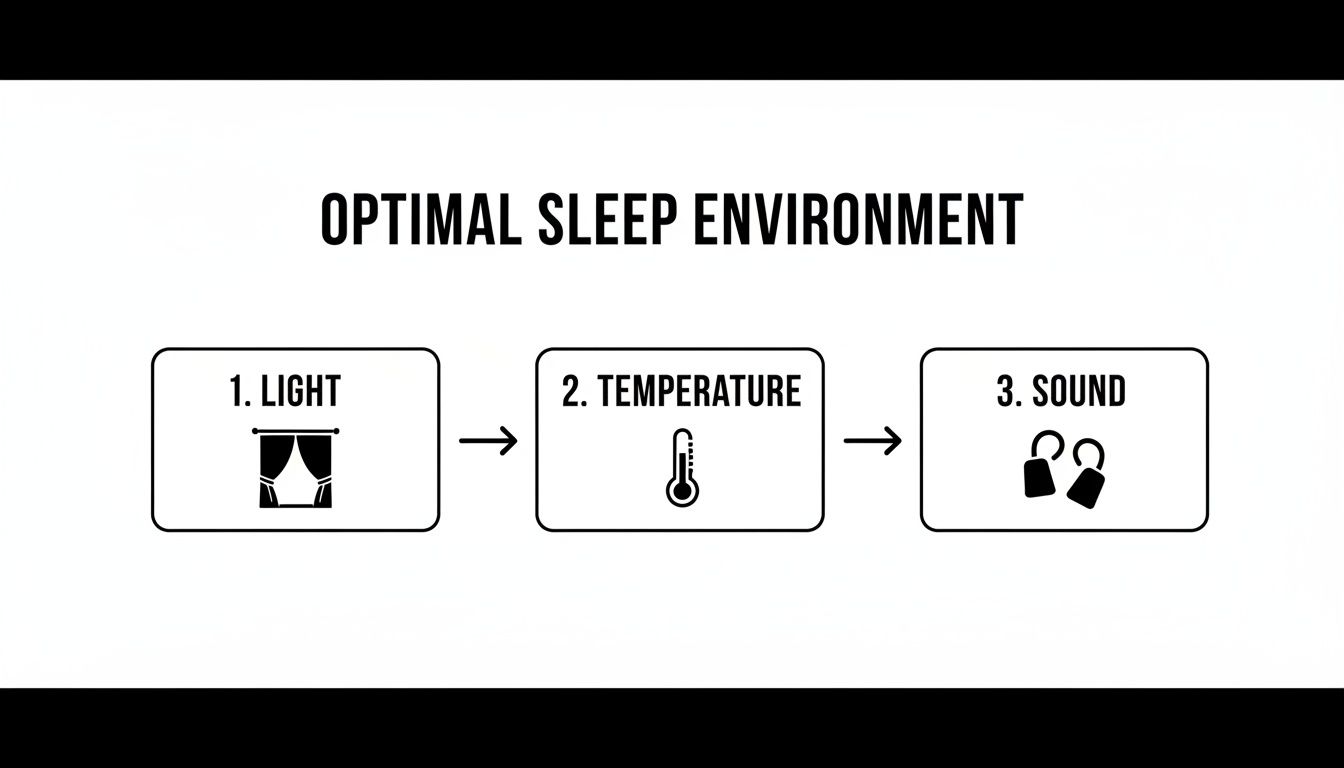
As you can see, managing light, temperature, and sound is the physical foundation for a great night's sleep. When you combine these environmental controls with the powerful behavioral routines you’ve established, you’re sending an undeniable signal to your body that it’s time to power down, making restorative sleep your new nightly reality.
How to Calm a Racing Mind Before Bed

So, you’ve done everything right. The room is dark, the temperature is perfect, but the moment your head hits the pillow, your brain decides it’s showtime. The day's anxieties, tomorrow’s to-do list, and a highlight reel of embarrassing moments from a decade ago all start playing at once.
If this sounds familiar, you're not alone. This isn't a willpower issue; it's a physiological one. When you're stressed, your body is stuck in "fight or flight" mode—the sympathetic nervous system is running the show. It pumps out cortisol and adrenaline, keeping your heart rate up and your mind on high alert. That’s great if you’re running from a bear, but terrible when you’re trying to sleep.
The trick is to manually shift gears into your "rest and digest" state, governed by the parasympathetic nervous system. And the good news is, you have the controls.
Activate Your Relaxation Response with Breathwork
Your breath is the most powerful, direct tool you have to tell your nervous system it's safe to power down. By consciously slowing your breathing, you send a clear signal to your brain to chill out. One of the most effective and time-tested methods for this is the 4-7-8 breathing technique.
Think of it as a natural tranquilizer. It’s not just a folk remedy; a study in the International Journal of Yoga confirmed that even a few minutes of slow, deep breathing significantly lowers heart rate and blood pressure—the physical markers of a shift toward relaxation.
Here’s how to do it, right in your bed:
- Lightly touch the tip of your tongue to the ridge of tissue just behind your upper front teeth. Keep it there for the whole exercise.
- Exhale completely through your mouth with a soft "whoosh" sound.
- Close your mouth and quietly inhale through your nose for a count of four.
- Hold your breath for a count of seven.
- Exhale completely through your mouth, making that "whoosh" sound again, for a count of eight.
That’s one cycle. Do it three more times, for a total of four breaths. The magic is in that long, controlled exhale—it’s a powerful trigger for your body’s relaxation response.
Tame Anxious Thoughts with Cognitive Strategies
Breathwork handles the physical side of things, but what about the runaway thoughts themselves? Trying to force your mind to go blank is like trying not to think about a pink elephant—it just doesn't work. A better approach is to give your brain a structured way to handle its worries.
Two of my favorite, incredibly practical strategies are scheduling "worry time" and using the "cognitive shuffle."
Research backs this up. A study in Behaviour Research and Therapy showed that people who set aside a 30-minute "worry period" earlier in the evening saw a major drop in anxious thoughts and insomnia. You’re essentially training your brain that there's a time and place for worrying, and it's not when you're trying to sleep.
How to Do a "Worry Time" Session
An hour or two before bed, grab a notebook and set a timer for 15-20 minutes. This is your dedicated time to worry. Write down everything that's on your mind. Brainstorm solutions. Make a plan for tomorrow. When the timer goes off, you shut the notebook and you're done. If a worry pops up later, you can confidently tell yourself, "I've already handled that. It's on tomorrow's list."
Break the Loop with the Cognitive Shuffle
Sometimes the problem isn't a list of worries, but one or two thoughts stuck on a maddening loop. The cognitive shuffle is a brilliant technique for derailing these repetitive patterns by giving your brain a simple, non-stressful task.
Here’s how it works:
- Pick a random, emotionally neutral word with at least five letters. Let's use "SLEEPY".
- Starting with the first letter, S, begin to silently picture things that start with it. Sock, sun, sandwich, star. Spend a few seconds on each image.
- When you run out of "S" words, move to the next letter, L. Lamp, leaf, lemon.
- Continue through the letters of your word. Honestly, most people are asleep before they even get to the third letter.
This technique works because it occupies the part of your brain that would otherwise be spinning its wheels on anxiety. It’s just engaging enough to hold your attention without causing any stress, gently leading your mind away from worry and toward sleep.
If you’re looking for more ways to get your mind on your side, you can explore other powerful techniques on how to quiet your mind for relaxation and sleep. With these tools, you can take back control and transform bedtime from a battleground into a welcome retreat.
Why Great Sleep Changes Everything
Let's be clear: getting better sleep isn't just about feeling less groggy in the morning. It's a total upgrade for your mind, your mood, and your ability to handle whatever life throws at you. When you get consistent, high-quality rest, you're not just surviving the day—you're setting yourself up to actually thrive.
Think about it in a real-world scenario. Imagine a high-stakes work project lands on your desk with a tight deadline. If you're well-rested, you can think on your feet, map out a plan, and tackle the pressure without spiraling. Your brain is firing on all cylinders, making connections and solving problems. It’s a challenge, sure, but a manageable one.
Now, picture that same scenario when you’re running on fumes. The pressure feels immense. You can't focus, small mistakes creep in, and your patience is shot. The project hasn't changed, but your ability to handle it has completely crumbled. That's the difference good sleep makes.
Giving You a Sharper Mental Edge
Quality sleep is probably the most effective cognitive booster there is. While you're in those deep stages of rest, your brain is hard at work consolidating memories, processing the day's information, and literally cleaning out metabolic junk that causes brain fog. You wake up with a clearer, faster mind.
When you’re consistently sleeping well, you’ll notice:
- Laser-like Focus: Tasks that used to feel like a drag are suddenly easier to get through because your attention isn't scattered.
- Creative Problem-Solving: You start seeing solutions and connecting ideas in ways a tired brain simply can't.
- Stronger Memory: Sleep is what cements learning. You'll find it easier to recall names, details, and important information when you need it most.
This kind of mental clarity isn't a "nice-to-have"—it's essential for performing at your peak, whether at work, at home, or in your personal pursuits.
Building Your Emotional Armor
Deep, restorative sleep is also a game-changer for your emotional stability. It helps keep your amygdala—the brain’s emotional command center—in check. When you're sleep-deprived, the amygdala goes into overdrive, which is why you might feel more anxious, irritable, or prone to mood swings.
Someone who struggles with anxiety often feels it ten times worse after a bad night's sleep. Triggers feel more intense, and their usual coping mechanisms just don't work as well. But after a night of truly restful sleep, they often feel a sense of calm and control, making the day's challenges far easier to navigate.
The link here is undeniable. A global ResMed survey showed that people who improved their sleep reported a better mood (42%), sharper concentration (41%), and even stronger physical health (39%).
This shows that making sleep a priority is a direct investment in your mental and emotional resilience. You can see more from the global sleep survey.
Sleep is an Investment, Not a Chore
It’s time to stop thinking of sleep as something you have to "get through" and start seeing it for what it is: a powerful, non-negotiable investment in your health and happiness. The benefits build on each other, creating a powerful upward spiral. Better sleep leads to better days, and better days make it easier to get great sleep. If you're ready to get serious about this, you can dive into proven techniques for natural and restful sleep.
The physical benefits are just as impressive. Deep sleep is crucial for regulating your nervous system and managing stress. In fact, you can learn how to improve Heart Rate Variability—a key metric for your body's resilience—through better sleep. Prioritizing rest doesn't just make you feel better; it builds a healthier, more capable you from the inside out.
Got Questions About Better Sleep? We’ve Got Answers.
As you start changing your habits, you're bound to run into some speed bumps and questions along the way. That's completely normal. Let’s tackle some of the most common concerns I hear, so you can keep making progress and finally get the rest you deserve.
"How Long Until I Actually Start Feeling Better?"
This is the big one, isn't it? While some people might notice a small shift after just a few nights—maybe from trying a new breathing exercise or finally blacking out their room—real, lasting change takes a little more time.
Generally, you should give it about two to four weeks of consistent effort. That’s the sweet spot for your body’s internal clock, or circadian rhythm, to truly sync up with your new routine. Think of it like training a muscle; it doesn’t happen overnight.
Patience really is key here. Research from the Journal of Clinical Sleep Medicine repeatedly shows that a rock-solid, consistent sleep schedule is one of the most powerful tools against insomnia. You're building a new habit, one night at a time.
My best advice? Track the small wins. Don't just focus on the end goal. Did you feel even 5% less groggy this morning? Did you fall asleep a little quicker last night? Celebrate those moments—they’re proof that you’re moving in the right direction.
"Help! I Woke Up at 3 AM. What Do I Do Now?"
First and foremost, whatever you do, do not look at the clock. I can’t stress this enough. Clock-watching is the fastest way to kick your anxiety into high gear, and that stress is the very thing keeping you awake. It instantly flips a switch in your brain from "rest" to "panic."
If you’re still tossing and turning after what feels like 20 minutes, it's time for a change of scenery. Get out of bed. Go into another room with very dim lighting and do something incredibly boring. Read a user manual, listen to some quiet ambient sounds, or do a few gentle stretches. No thrillers, no screens.
The whole point is to break the frustrating cycle of associating your bed with being awake and worried. You only get back into bed when you feel that wave of sleepiness pull you back. This strategy retrains your brain to see your bed as a place for sleep, not for struggle.
"Are Naps a Good Idea or a Bad Idea?"
Naps can be your best friend or your worst enemy—it all comes down to timing and length.
A short "power nap" of 20-30 minutes taken in the early afternoon (think before 3 PM) can be a fantastic way to recharge your batteries and boost your focus without messing up your night.
The danger lies in long naps or napping too late in the day. These can drain your "sleep drive," which is the natural pressure that builds all day long, making you feel sleepy at bedtime. A long nap is like letting the air out of the tire too early. As studies in the journal Sleep have shown, short naps improve performance, while long ones just leave you groggy and wide awake at midnight.
"Do I Have to Give Up My Morning Coffee?"
Good news for coffee lovers: absolutely not! For most of us, a cup or two in the morning is perfectly fine and won't throw a wrench in your sleep plans. The secret is knowing when to say when.
Caffeine has a surprisingly long half-life—around 5-6 hours. That means half of the caffeine from your last cup is still circulating in your system that many hours later. A solid rule of thumb is to cut off all caffeine (coffee, certain teas, energy drinks, even some sodas) at least 8 to 10 hours before you plan to go to sleep.
So, if you’re aiming to be asleep by 10 PM, your final sip of coffee should be no later than 2 PM. This gives your body plenty of time to clear the stimulant from your system, so it won’t interfere with your ability to fall into a deep, restorative sleep.
By making a practice like breathwork part of your evening wind-down, you can actively dial down your nervous system and cue your body for rest. 9D Breathwork provides guided audio journeys specifically designed to help you release the day's stress and quiet a busy mind, making it that much easier to drift off and stay asleep. Find out how you can transform your nights at 9D Breathwork.