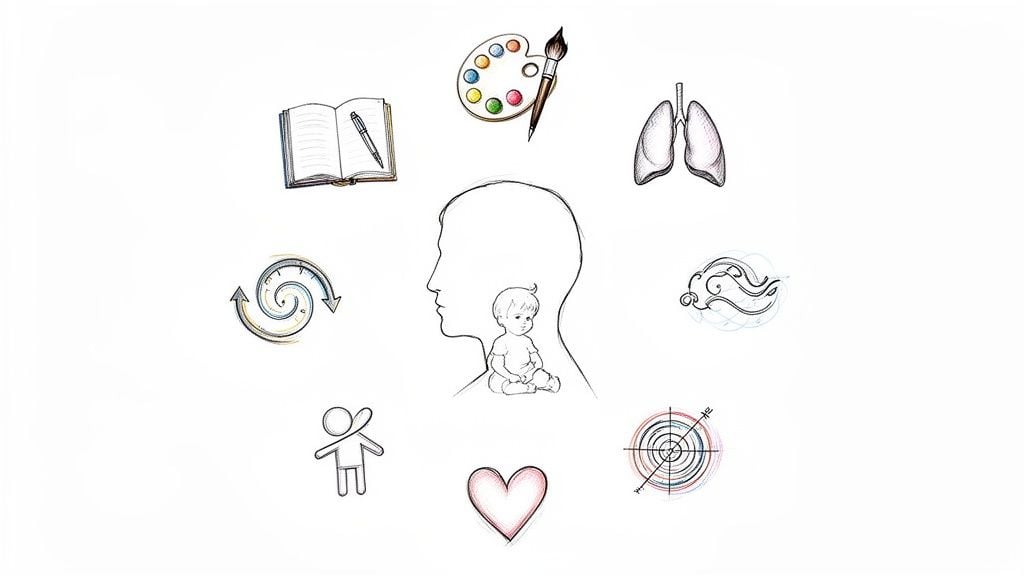
Before you can even begin to think about what you’re passionate about, you have to create a little bit of quiet. The goal isn’t to find that one “perfect” calling right away. It’s about taking small, deliberate steps that show you what genuinely lights you up. This journey doesn’t start with some grand, external search; it starts by turning down the volume on the outside world so you can finally hear what’s going on inside.
Why Finding Your Passion Feels Impossible Today

If you feel like you’re just going through the motions, stuck in a job that drains you, you’re definitely not alone. So many driven professionals feel this way—trapped by stress and a mountain of mental clutter that makes it impossible to see what they actually want.
The modern workplace is a master at building subconscious walls that cut us off from our inner compass. The relentless pressure to perform, hit targets, and keep everyone happy leaves very little room for our own desires. We’re wired for external validation, not internal fulfillment, so our own interests naturally get shoved to the back burner.
The Myth of the Grand Epiphany
We’ve all been sold this idea that finding your passion is supposed to be a single, lightning-bolt moment of clarity. This myth just creates a ton of pressure, making the whole process feel intimidating. And when that “aha!” moment doesn’t show up, we feel like we’ve failed.
The truth? It’s much quieter and more accessible than that.
Discovering your passion is rarely a lightning strike. Instead, it’s a gradual unfolding that comes from a series of small, intentional explorations. It’s about trading the pressure of finding “the one thing” for the curiosity of trying many things.
Forget the giant leap; this is a journey of small, manageable steps. It’s about noticing which tasks make you lose track of time or what subjects you could talk about for hours. A 2018 study published in Psychological Science confirmed this, finding that passions aren’t just found—they’re developed. Interest grows as we gain skills and have positive experiences in a new area. It’s an active process, not a passive one.
Creating Mental Space for Self-Discovery
To get started, the first real task is to clear the mental fog. When you’re living with chronic stress, your nervous system is constantly on high alert. That state makes creative, reflective thinking pretty much impossible. This is where mind-body practices become practical, essential tools.
- Breathwork as a Reset Button: Intentional breathing is a scientifically-proven way to cut through the noise. Research has shown that controlled breathing calms the sympathetic nervous system—your “fight-or-flight” response—which in turn reduces cortisol and creates genuine mental calm. A 2017 study in Frontiers in Human Neuroscience found that just a few minutes of deep, diaphragmatic breathing can significantly lower psychological stress.
- Disrupting Subconscious Patterns: Once you create that calm, you can start to sidestep the ingrained thought patterns and limiting beliefs that have been holding you back. When your mind is finally quiet, you can start to hear the subtle whispers of your genuine interests. If you’re ready to go deeper on this, our guide on overcoming limiting beliefs is a great place to start.
By taking care of your internal environment first, you’re preparing the fertile ground where real self-discovery can finally begin to grow.
Run a Personal Energy Audit
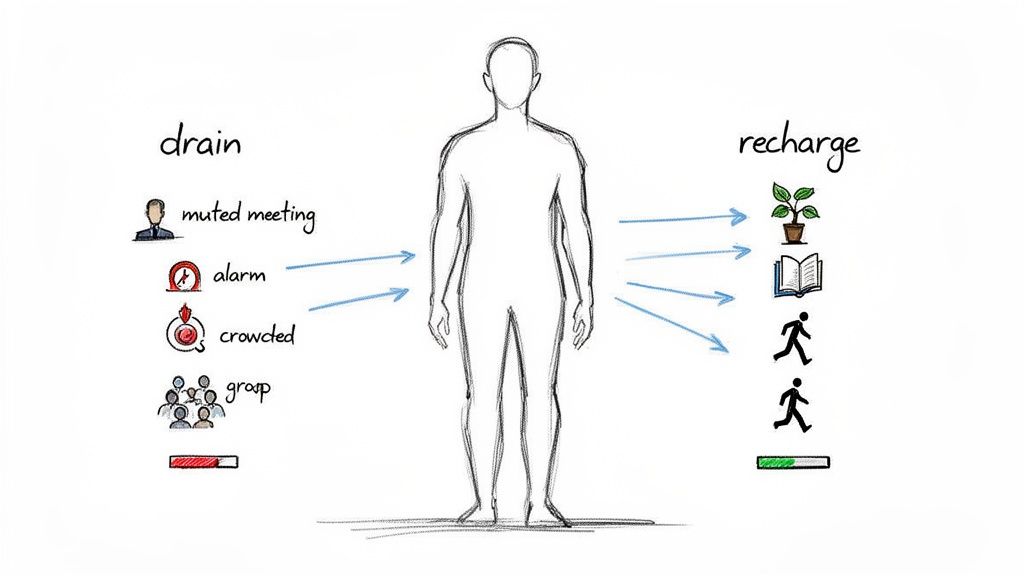
Before you can find what lights you up, you need to know what’s burning you out.
Think of your daily energy like a bank account. Every single thing you do is either a deposit or a withdrawal. A personal energy audit is simply the process of looking at your statement to see what’s leaving you feeling bankrupt.
This isn’t just about your to-do list at work. It covers everything: the meetings you sit through, the people you talk to, the news you consume, and even the rooms you spend your time in. The goal is to get a brutally honest, data-driven look at your life to find the patterns hiding in plain sight.
How to Track Your Energy Fluctuations
The best way to start is with a simple 7-day tracking journal. For one week, your only job is to be a curious observer of your own internal state. No fancy apps needed—a notebook or a note on your phone is perfect.
A few times a day—maybe mid-morning, right after lunch, and at the close of your workday—just take 60 seconds. Log what you were just doing and how it made you feel. A 2019 study in the Journal of Personality found that people who regularly checked in with their feelings and energy levels reported higher life satisfaction and a stronger sense of purpose. This simple habit is the first step toward building the self-awareness you need to find your passion.
An energy audit isn’t about judging yourself. It’s about gathering clues. The whole point is to see your life clearly, identifying the subtle things that either drain your battery or recharge it—often without you even noticing.
You’ll start to see beyond the obvious drains, like a stressful project. Maybe you’ll find that a 15-minute chat with a certain coworker tanks your energy, or that a quick walk outside gives you a surprising boost.
Your 7-Day Energy Audit Template
To make this super practical, here is a simple template to get you started. Focus on consistency; you don’t need to write a novel. At the end of the week, circle your top 3 “drainers” and top 3 “rechargers.” This is your action plan.
| Day/Time | Activity/Task/Interaction | Energy Level Before (1-10) | Energy Level After (1-10) | Notes/Feelings |
|---|---|---|---|---|
| Mon/9 AM | Team stand-up meeting | 7 | 4 | Felt drained by the negative tone. |
| Mon/1 PM | 20-min walk outside | 3 | 6 | Mind cleared, felt more optimistic. |
| Tue/8 PM | Scrolling social media | 5 | 3 | Anxious and mentally cluttered. |
After a week of this, you’ll have a clear, personalized report. This isn’t just a list of complaints; it’s your own instruction manual for how to get your energy back.
This process moves you from vaguely feeling tired to precisely knowing what’s causing it. Recognizing these patterns directly improves your ability to self-regulate and can even impact key physiological markers. If you’re interested in that mind-body connection, you can learn more about how to improve your heart rate variability through these kinds of mindful practices.
By pinpointing and reducing the drains, you free up the precious mental and emotional space you need to finally explore what truly makes you feel alive.
Tuning In: How Your Body Can Reveal Your Subconscious Passion
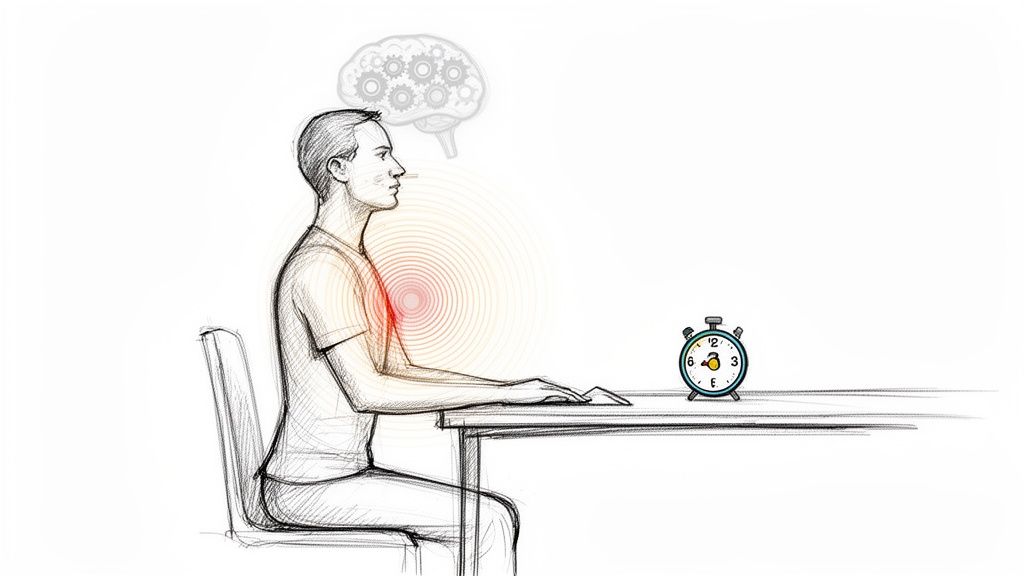
Let’s be honest. Your deepest interests are probably buried under years of deadlines, performance reviews, and the relentless pressure to just keep up. When your mind is a constant buzz of to-do lists and worries, it’s impossible to hear the quiet, subtle signals your body has been sending you all along.
This is exactly why figuring out how to discover your passion often requires moving beyond pure logic and learning to listen to your body.
Practices like breathwork are incredibly effective because they let you bypass that overthinking, analytical brain for a while. You get to tap directly into the wisdom your body holds.
The science here is pretty cool. Certain breathing patterns can quiet down the brain’s default mode network (DMN). Think of the DMN as the part of your brain that loves to ruminate, wander, and criticize. A 2018 study in NeuroImage showed that mindfulness meditation (which is closely related to breathwork) can decrease DMN activity. When you dial it down, you create a space of heightened awareness where new insights can finally bubble to the surface.
Quieting the Noise to Hear the Signal
Chronic stress puts your body in a low-grade “fight or flight” mode, pumping it full of cortisol. In this state, your focus narrows to pure survival. Creativity and introspection get shoved to the back of the line. You simply can’t find what you love when your nervous system is just trying to make it through the day.
Breathwork cuts right through that.
By consciously controlling your breath, you send a direct signal to your nervous system that you’re safe. This immediately starts to lower cortisol levels and interrupts those sticky, anxious thought loops.
This isn’t about vaguely “clearing your mind.” It’s about creating a tangible shift in your neurology. It gives your authentic interests and curiosities the space they need to emerge, turning self-discovery from a frustrating mental chore into something more intuitive and embodied.
It’s no wonder the global breathwork therapy market is projected to hit USD 3.2 billion by 2032, as more professionals look for real, effective ways to manage the daily grind.
A 5-Minute Breathing Exercise for Instant Clarity
You don’t need a whole hour or a silent retreat to get started. You can do this simple exercise right at your desk to reset your mind and reconnect with your body.
Action Step: Set a recurring alarm on your phone for midday. Label it “5-Min Reset.” When it goes off, follow these steps:
- Get Settled: Sit upright in your chair with your feet flat on the floor. Let your hands rest on your lap and gently close your eyes.
- Breathe In: Take a slow, deep breath in through your nose for a count of four. Feel your belly expand, then your chest.
- Hold: Gently hold your breath at the top for a count of four.
- Breathe Out: Slowly exhale through your mouth for a count of six, like you’re blowing through a straw. Feel your shoulders drop as you release the air.
- Repeat: Continue this cycle for 5 minutes—inhale for four, hold for four, exhale for six. When your mind wanders (and it will), just gently guide your focus back to the feeling of your breath.
This simple technique, a variation of “box breathing,” extends the exhale to activate your parasympathetic nervous system—the body’s “rest and digest” mode. Through consistent practice, you’ll start to uncover deeper truths, which is a huge step to truly rediscover yourself.
By making this a regular habit, you’re training your brain to access a calmer, more receptive state whenever you need it. In that quiet space, free from the usual mental clutter, the clues to your passion finally have a chance to be heard.
For those ready to go deeper, our guide on subconscious mind healing offers more advanced tools to continue the journey.
Time to Play: Testing Your Curiosities with Micro-Experiments
You can’t think your way to a passion. It’s an illusion. Passion isn’t a lightning bolt of insight you get while meditating; it’s something you stumble into by doing.
The single biggest mistake I see people make is treating this search like a massive, life-altering decision. That pressure is paralyzing. It’s why so many of us stay stuck. The antidote? Reframe the entire process. Stop searching for one big answer and start running a series of low-stakes, playful micro-experiments.
A micro-experiment is just a small, tangible project designed to test a curiosity in the real world, without the scary weight of long-term commitment. Think of it as the difference between enrolling in a six-month, expensive coding bootcamp and spending a Saturday afternoon building a simple website with a free online tutorial. One is a huge leap of faith; the other is simply a data-gathering mission.
This isn’t just a nice idea; it’s how our brains are wired to develop interests. A fascinating study in Psychological Science revealed that passions aren’t just “found”—they are actively developed. People who believe their interests are fixed and waiting to be discovered are actually less likely to explore. On the other hand, those with a “growth mindset” who see interests as things that can be cultivated are the ones who try new things and end up with deep, lasting passions.
Designing Your First Experiment
The goal here is to get you out of your head. We need to move from a vague thought like, “I’m kind of interested in photography,” to a concrete, time-bound action. This little shift dissolves the overwhelm, making it easy to start, even when your calendar is screaming at you.
A solid micro-experiment has four simple ingredients:
- The Curiosity: Get specific. What exactly are you curious about? (e.g., “I’m curious about creative writing.”)
- The Tiny Action: What’s the smallest possible step you can take to explore it? (e.g., “Write a 500-word short story.”)
- The Timeframe: Box it in. When will you do it? (e.g., “I’ll spend two hours on it this Saturday afternoon.”)
- The “Success” Metric: How will you know if it worked? (e.g., “Success isn’t a perfect story. Success is feeling engaged and losing track of time while writing.”)
This simple framework completely changes the game. It shifts the focus from a terrifying, high-stakes outcome to the simple, fun act of exploration. Self-discovery starts to feel less like a final exam and more like a game of learning what makes you come alive.
A micro-experiment isn’t about succeeding or failing. It’s about collecting data on what energizes you. Learning that you absolutely hate something is just as valuable as discovering a new love—both bring you one step closer to what’s true for you.
From Interest to an Actionable Plan
Let’s make this real. Say you’re intrigued by graphic design. Instead of immediately looking up expensive design courses, your micro-experiment could be to design a new logo for a friend’s side hustle using a free tool like Canva. It’s a small, contained project that gives you a genuine taste of the actual work.
Action Step: Open your calendar right now. Find a 2-hour slot this week and schedule your first micro-experiment. Title it “Passion Project.” For example, if your energy audit showed you enjoy nature, your experiment could be “Go on a 2-hour solo hike at a new local trail.”
This hands-on approach is where the magic happens. Research on experiential learning consistently shows that we learn and integrate information far more deeply through active participation than by passively reading or watching.
Taking action—no matter how small—creates momentum. It provides instant, real-world feedback on what actually resonates with you, which is essential for making better choices going forward. If you want to get better at interpreting that feedback, our guide on how to improve decision-making skills offers some powerful frameworks.
By running these little tests, you stop hoping to find your passion and start actively building it, one tiny experiment at a time.
Building Your 30-Day Passion Discovery Action Plan
Alright, let’s pull all these threads together. You’ve done the deep work—the energy audit, the self-reflection, the micro-experiments—and now it’s time to create a simple, repeatable roadmap.
Think of this not as a frantic, one-month sprint to find your “one true passion.” That’s a myth that just adds pressure. The real goal here is to build a sustainable system for self-discovery, one that shifts you from just thinking about change to actively exploring it.
This 30-day plan is your bridge. It’s designed for the real world, for busy schedules, focusing on small, consistent steps that build genuine momentum.
Week 1: Foundation and Awareness
The first week is all about setting the stage. We’re taking the insights you’ve already gathered and weaving them into your daily rhythm.
- Action 1: Finalize Your Energy Audit: Go back to that 7-day log. Circle your top three energy drainers and your top three energizers. This week, your mission is to actively reduce one of those drainers and double down on one of the energizers.
- Action 2: Start Your Breathwork Practice: This is non-negotiable. Commit to just five minutes of breathwork every single day. A 2019 study published in the Journal of American College Health found that brief mindfulness and breathwork sessions significantly reduced stress in university students, creating the headspace for new ideas to bubble up.
Week 2: Brainstorm and Design
Now that your mind is a bit clearer, we can get creative. In week two, you’ll design three distinct micro-experiments based on the curiosities and high-energy activities you’ve already identified.
Keep these small and low-stakes. For example, let’s say you felt a surprising jolt of energy from organizing a chaotic shared drive at work. This could be a clue that you enjoy creating order from chaos. A micro-experiment isn’t to start an organizing business; it’s to spend two hours helping a friend declutter their home office.
Or maybe you’ve been curious about podcasting. Don’t go buying a fancy microphone. Your experiment is to simply record a 10-minute “episode” on your phone, talking about something you love. The goal is to test the feeling, not to launch a show.
This is the simple, repeatable flow we’re aiming for.
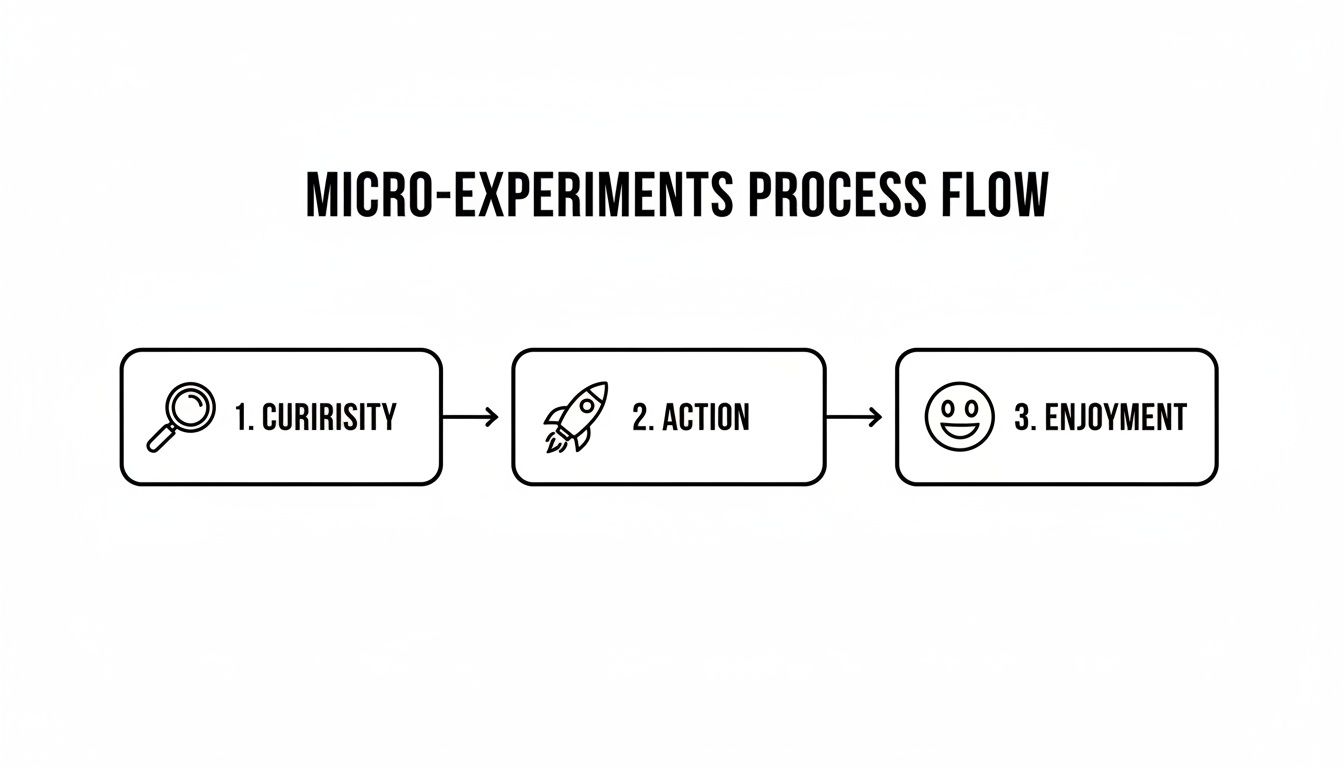
It’s all about focusing on the experience itself. The outcome doesn’t matter nearly as much as how engaged and energized you feel while doing it.
Weeks 3 and 4: Experiment and Reflect
The final two weeks are all about execution and honest reflection. This is where the rubber meets the road.
- Week 3: Pick one of your experiments and just do it. As soon as you finish, carve out 15 minutes to journal about it. Did you lose track of time (a classic sign of “flow”)? Did it leave you feeling buzzed with energy, or totally drained?
- Week 4: Time to complete your other two experiments. At the end of the week, sit down with your journal entries. Look for patterns. Which paths feel like they have more energy? Which ones are worth exploring a little further?
As you start getting clearer signals, you might wonder how these budding interests could fit into your professional life. For some practical tips on that front, there are great resources on how to choose a career path that matches your interests and skills.
Remember, this 30-day plan isn’t a finish line. It’s the beginning of a new, more intentional relationship with yourself—a repeatable cycle of curiosity, action, and reflection that will continue to reveal what truly makes you come alive.
Got Questions About Finding Your Passion? Let’s Talk.
As you start down this path, it’s completely normal for a few big questions to pop up. The journey to reconnect with what truly lights you up can feel a little fuzzy at first. Let’s clear the air and tackle some of the most common things that come up when people begin this work.
“But What If I Genuinely Have No Passions?”
This is probably the single most common thing I hear, especially from people crawling their way out of burnout. If the word “passion” feels like too much pressure, drop it. For now, let’s talk about curiosity.
What are you even a tiny bit curious about? Think of the micro-experiments as data collection. Finding out what you don’t like is just as important as finding what you do. It all helps narrow the search.
So, be gentle with yourself. This isn’t a race. It’s a slow, steady process of getting reacquainted with your own inner world, especially if it’s been neglected for a while.
“How Am I Supposed to Find Time for This?”
The secret is to start so small it almost feels silly. This whole framework was built for the reality of a packed schedule, not for someone with an empty calendar.
- Your Energy Audit: This is literally five minutes of quiet thought before you go to sleep.
- A Breathwork Session: You can do a powerful, nervous-system-resetting session in the three to five minutes it takes to make a coffee.
- Micro-Experiments: We call them “micro” for a reason. Your experiment could be just one hour blocked out on a Saturday.
This isn’t about finding huge, new chunks of time. It’s about being intentional with the small pockets of time you already have. You’ll likely find that the clarity and energy you get back far outweigh the small time investment.
This isn’t about finding more time; it’s about making the time you already have more meaningful. The small, consistent investment in yourself will pay dividends in energy and clarity.
“Is It Actually Realistic to Make a Career Out of a Passion?”
Yes, it can be. But that is not the goal right now. Putting the pressure of making money on a brand-new interest is the fastest way to kill the joy. For now, your only job is to explore what energizes you, just for the sake of it.
Let the joy lead.
Once you’ve spent real, consistent time with something and feel that deep, authentic pull, then you can start thinking about what it might look like as a side project or a new career. Don’t forget, plenty of people find that keeping their passion as a hobby is what keeps it sacred—a personal source of energy that fuels them for their day job.
Ready to quiet the noise and tap into your subconscious wisdom? 9D Breathwork combines breath, sound, and guided coaching to disrupt old patterns and unlock your inner clarity. Start your journey today at the official 9D Breathwork site.