To get a handle on fear and anxiety, it helps to first understand what’s actually going on inside you. This isn’t about a lack of willpower; it’s about your body’s ancient survival system kicking into high gear at the wrong moments. The trick is to learn how to work with this system, not against it. By using practical, body-based techniques and shifting your thought patterns, you can recalibrate that internal alarm, turning overwhelming feelings back into manageable signals.
This whole process really starts with tuning into your physical sensations, questioning the stories your mind is spinning, and building a more resilient foundation day by day.
What’s Really Happening in Your Brain and Body
Before diving into solutions, let’s demystify what’s happening when fear or anxiety takes over. It’s crucial to know that these feelings are not a personal failing or a sign of weakness—they’re powerful, deeply ingrained biological responses.
When your heart starts racing, your palms get sweaty, or your hands begin to shake, it’s not “all in your head.” These are tangible signs that your body’s alarm system has been triggered.
This is the classic ‘fight-or-flight’ mechanism at play. When your brain senses a threat—real or imagined—your amygdala, which acts as the brain’s emotional hub, sends out a distress signal. This sets off a cascade of hormones like adrenaline, getting your body ready for action by pumping up your heart rate, sharpening your senses, and tensing your muscles. It’s a brilliant system for escaping immediate danger, but it becomes a major problem when it’s constantly set off by worries about the future.
Fear vs. Anxiety: A Critical Distinction
People often use the words “fear” and “anxiety” interchangeably, but they aren’t the same thing. Knowing the difference is a game-changer.
- Fear is your response to a clear and present danger. If you see a snake on a hiking trail and your heart pounds, that’s fear. It’s immediate, specific, and all about survival right now.
- Anxiety, on the other hand, is a response to a potential, future, or undefined threat. Lying in bed worrying about possibly seeing a snake on tomorrow’s hike? That’s anxiety. It’s more vague and tends to linger.
Making this distinction helps you see anxiety for what it is: a misfiring alarm. Your body is trying to protect you from something that isn’t actually happening in this moment. Grasping this is a huge first step. It validates your physical experience while giving you the power to question the mental story that’s driving it.
Understanding the “why” behind these feelings allows you to shift from being a victim of them to an active participant in managing them. You can learn to work with your body’s responses, not against them.
If you feel this way, you’re far from alone. Anxiety has become a massive global issue. Research shows that between 2020 and the post-pandemic period, the number of people with anxiety disorders shot up from about 298 million to 374 million. That’s a staggering 27.9% increase in cases in 2020 alone. You can find more details on the direct food-mood connection.
Regaining a sense of control begins with learning to regulate your own nervous system. A lot of these automatic, high-alert responses are managed by the vagus nerve, a major player in your body’s ability to relax. By exploring various vagus nerve stimulation techniques, you can learn how to actively soothe your physical state when those alarm bells start ringing.
Grounding Techniques For Moments Of Panic
When a wave of panic hits, your mind can feel like a runaway train, speeding into worst-case scenarios. In these moments of intense anxiety, your most powerful tool isn’t complex mental analysis; it’s your own body.
Grounding techniques are your first line of defense. They are immediate, actionable strategies designed to pull you out of spiraling thoughts and anchor you firmly in the present. They work by interrupting the chaotic signals firing between your brain and body, giving you a chance to regain control.
These aren’t just clever tricks. They are practical, science-backed methods for down-regulating your nervous system when it’s stuck in high alert.
The Power Of The Physiological Sigh
One of the most effective and discreet tools you have is the physiological sigh. You’ve actually been doing this your whole life without realizing it. It’s an involuntary breathing pattern the body uses to offload carbon dioxide efficiently, which in turn signals the brain to relax.
A 2023 study in Cell Reports Medicine found that just five minutes of this practice daily improved mood and reduced anxiety more effectively than mindfulness meditation.
Here’s how to do it on purpose:
- Take a deep inhale through your nose.
- Before you exhale, take another short, sharp inhale to completely fill your lungs.
- Exhale slowly and completely through your mouth. Make it a long, drawn-out sigh.
Take Action: The next time you feel that familiar surge of panic before a high-stakes work meeting, try this. You can do the physiological sigh silently at your desk. No one will notice, but you’ll feel an immediate calming effect as it activates your parasympathetic nervous system—your body’s “rest and digest” mode.
Anchoring Yourself With Your Senses
Another fantastic technique is the 5-4-3-2-1 Senses Method. This exercise forces your brain to focus outward on your environment instead of inward on your anxious thoughts. It breaks the feedback loop of panic by deliberately engaging all five of your senses.
The process is simple and can be done anywhere:
- 5: Name FIVE things you can see. (The pen on your desk, a crack in the ceiling, the color of a colleague’s shirt).
- 4: Acknowledge FOUR things you can feel. (The texture of your jeans, the cool surface of your phone, the warmth of your own skin).
- 3: Listen for THREE things you can hear. (The hum of the air conditioner, distant traffic, the sound of your own breathing).
- 2: Identify TWO things you can smell. (The scent of coffee brewing, the faint smell of hand sanitizer).
- 1: Focus on ONE thing you can taste. (The lingering taste of toothpaste, or just take a sip of water).
This flowchart shows the simple process of how an external trigger activates the brain’s fear center, which then creates a physical response in the body.
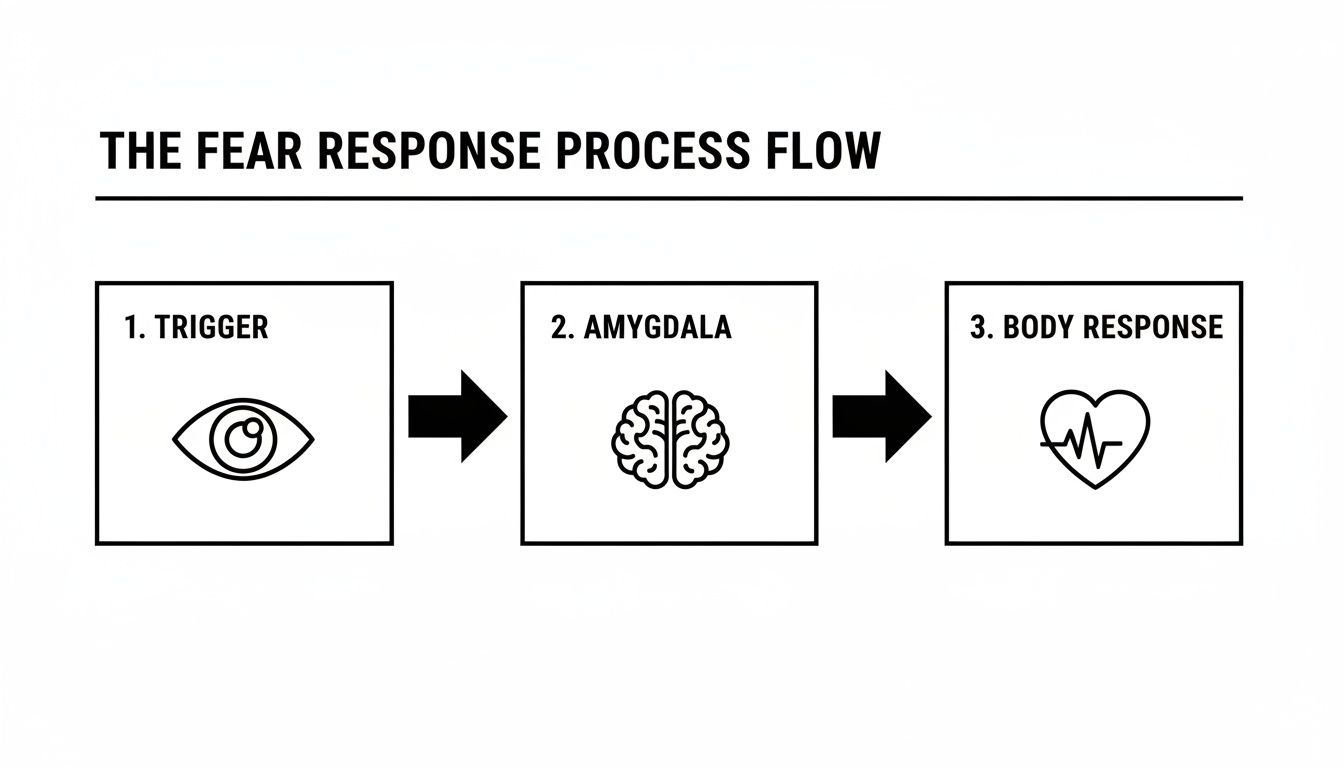
Techniques like the 5-4-3-2-1 method effectively interrupt this automatic process. You’re redirecting your brain’s focus away from the amygdala’s alarm signal and back to the real world. When anxiety strikes, having quick, effective strategies is vital. For more immediate relief, check out these 7 tips for calming anxiety fast.
Regulating Your Rhythm With Box Breathing
Box breathing, also known as four-square breathing, is a powerful technique used by Navy SEALs to stay calm and focused under extreme pressure. Research has confirmed that controlled, slow breathing can significantly reduce physiological signs of anxiety. One study in the journal PLOS ONE even showed that these practices activate brain regions associated with emotional control and attention.
The structured rhythm gives your racing mind something predictable to latch onto, calming the entire nervous system.
Imagine drawing a box with your breath: Inhale for a count of 4, hold for 4, exhale for 4, and hold again for 4. Repeat the cycle. This simple pattern is easy to remember and incredibly effective at restoring your balance.
These grounding exercises are particularly useful for reconnecting with your body when you feel detached or unreal. If you’re interested in exploring this further, our comprehensive guide on grounding techniques for dissociation offers more specialized strategies.
The key is to practice these tools when you are calm, so they become second nature when you need them most.
Here’s a quick-reference table to help you remember which technique to pull from your toolkit.
Your In-the-Moment Anxiety Toolkit
| Technique | Core Principle | When to Use |
|---|---|---|
| Physiological Sigh | Rapidly offloads CO2 to signal relaxation to the brain. | For an immediate and discreet reset, like in a meeting or public space. |
| 5-4-3-2-1 Senses | Shifts focus from internal panic to the external environment. | When your thoughts are racing and you feel disconnected from reality. |
| Box Breathing | Uses a structured rhythm to regulate the nervous system. | To build focus and calm before a stressful event or during ongoing stress. |
Think of these not just as exercises, but as skills. The more you use them, the stronger and more automatic they’ll become, giving you a real sense of control when you feel like you’re losing it.
Changing the Anxious Stories You Tell Yourself
To create real, lasting change, you have to get to the root of the mental habits that keep anxiety going. While grounding techniques are brilliant for pulling you back from the edge of panic in the moment, learning how to conquer fear and anxiety for good means changing the unhelpful stories your mind loves to spin.
Think of your anxious mind as a storyteller that’s gotten really good at writing dramatic, worst-case-scenario thrillers. Our job isn’t to shut the storyteller up—that never works. Instead, we need to become a discerning editor who can spot the plot holes, question the drama, and rewrite a more believable ending. This is a practical skill often called cognitive reframing.
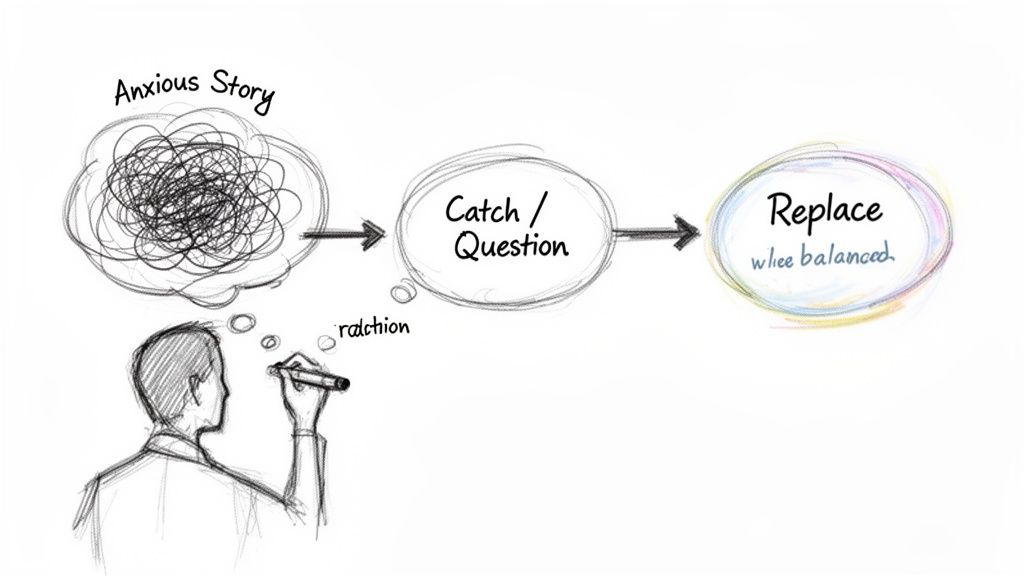
Let’s be clear: this isn’t about slapping on a fake smile or pretending everything is fine. It’s about developing a more balanced, realistic perspective. Research consistently backs this up. A 2017 study in Behaviour Research and Therapy found that individuals who were trained in cognitive reappraisal (another term for reframing) showed reduced activity in the amygdala—the brain’s fear center—when faced with negative stimuli.
Spotting Common Thought Traps
First things first, you have to learn to recognize the cognitive distortions—or “thought traps”—your mind defaults to. Think of these as faulty mental shortcuts that feel true but are almost always inaccurate and unhelpful.
Here are a few of the biggest culprits:
- Catastrophizing: This is the brain’s tendency to leap from a small problem to the worst possible outcome. You make one tiny mistake at work, and your mind immediately declares, “That’s it, I’m definitely getting fired.”
- Black-and-White Thinking: This trap lets you see things only in absolutes. If your performance wasn’t perfect, you conclude you are a “total failure.” There’s no room for nuance or shades of gray.
- Mind Reading: This is when you assume you know exactly what someone else is thinking—and it’s usually negative. A coworker walks past without saying hello, and your immediate thought is, “She must be mad about what I said in that meeting.”
Just becoming aware of these patterns is a huge step. You can’t start rewriting a story you don’t even realize you’re telling yourself.
A Practical Three-Step Reframing Process
Once you start spotting these thought traps in the wild, you need a straightforward way to challenge them. This isn’t complex psychology; it’s a simple, repeatable skill that gets stronger with practice.
- Catch the Thought: The second you feel that familiar spike of anxiety, just pause. Ask yourself, “What story am I telling myself right now?” Isolate that specific automatic thought. For example, after a slightly awkward chat, the thought might be: “Everyone here thinks I’m so weird.”
- Challenge the Thought: Now, get curious. Interrogate that story like a detective looking for evidence. Is there any hard proof for this thought? What are some other, more likely explanations? A 2017 study in the Journal of Behavior Therapy and Experimental Psychiatry found this simple act of questioning significantly loosens the grip of anxious beliefs.
- Change the Thought: Finally, craft a new, more balanced alternative. It doesn’t have to be overly positive—just more realistic. The catastrophic thought “Everyone thinks I’m so weird” can be reframed into something like, “That conversation felt a bit clunky, but they were probably just distracted. Most people are too busy thinking about their own lives to analyze my every word.”
This process isn’t about winning an argument with your anxiety. It’s about gently and consistently guiding your mind toward a more helpful, truthful place. Every time you do this, you weaken the old, anxious neural pathway and build a stronger, more balanced one.
Putting It Into Practice With a Thought Record
To turn this skill into a solid habit, using a structured tool can make a world of difference. A thought record is just a simple way to walk yourself through this three-step process on paper.
Take Action: Tonight, take five minutes to fill out one row of this table. Think of a moment today that made you anxious and walk through the process.
| Situation | Automatic Thought | Evidence For/Against | Balanced Alternative |
|---|---|---|---|
| My boss sent a one-word email: “Urgent.” | “I’ve messed something up. I’m in big trouble.” | Against: My boss is always brief. “Urgent” is just how she flags priorities. My recent work has been solid. | “This task is a high priority. I should check in to see exactly what’s needed.” |
| I wasn’t invited to a friend’s small get-together. | “They’re leaving me out on purpose. They don’t like me anymore.” | Against: It was just a small group. I saw them last week. People have different friend circles and busy lives. | “It’s okay that I wasn’t at this one thing. It doesn’t mean our entire friendship is over.” |
This might feel a bit mechanical at first, but with repetition, you’re training your brain to do this automatically. If you’re ready to go deeper on this, our detailed guide explains more about how to break negative thought patterns.
By becoming the editor of your own internal narrative, you stop being a passive victim of anxiety and start becoming the active architect of your own peace of mind.
Building a Resilient Foundation in Your Daily Life
Tackling anxiety isn’t just about putting out fires when panic strikes; it’s about building a life that’s less flammable in the first place. Think of it this way: the in-the-moment techniques are your emergency toolkit, but your daily habits are the very foundation of your mental well-being. This is where you get proactive and work on lowering your baseline anxiety levels, day in and day out.
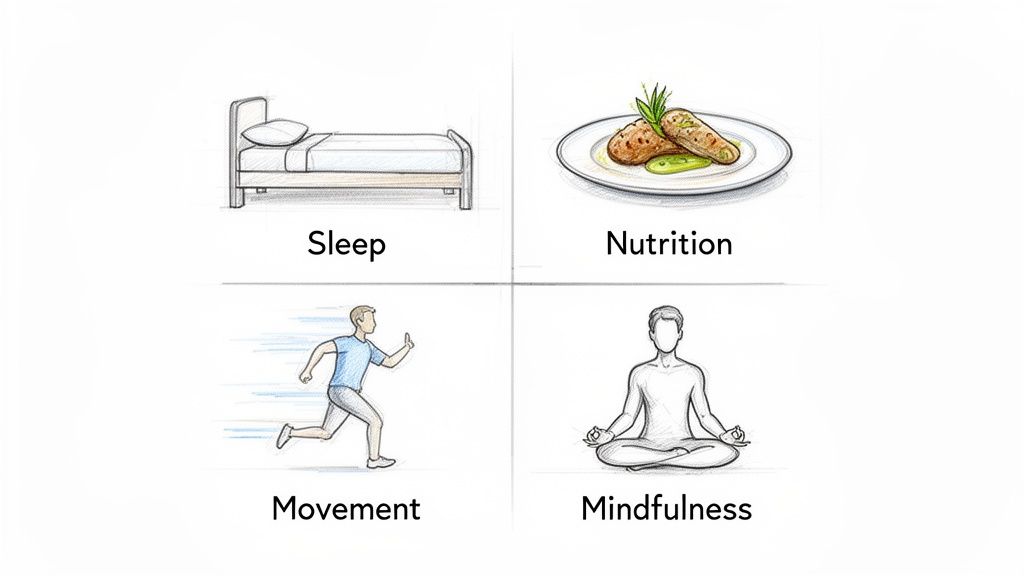
We’re going to focus on four pillars that create a truly resilient foundation: quality sleep, balanced nutrition, regular movement, and mindfulness. This isn’t a call for a massive, overnight life overhaul. It’s about making small, consistent tweaks that, over time, build a powerful defense against fear and anxiety.
Prioritize Restorative Sleep
Sleep and anxiety are caught in a nasty feedback loop. Anxiety ruins your sleep, and a lack of sleep sends your anxiety skyrocketing. It’s not just a feeling; research from the Journal of Behavior Therapy and Experimental Psychiatry showed that even one night of poor sleep can cause a significant jump in anxiety levels. Breaking that cycle is non-negotiable.
Take Action: Tonight, create a simple 15-minute ‘wind-down’ routine. One hour before bed, put your phone away. The blue light it emits messes with melatonin, the hormone that tells your body it’s time to rest. For those 15 minutes, do something genuinely calming: read a physical book (not a thriller), listen to quiet music, or do gentle stretches. This creates a clear boundary, signaling to your brain that the day is done and it’s safe to power down.
Fuel Your Body to Stabilize Your Mood
What you eat has a direct line to your brain chemistry. Ever felt shaky, irritable, with a racing heart? That could be low blood sugar, which happens to mimic the exact physical sensations of a panic attack. For someone prone to anxiety, that feeling can easily trigger a full-blown spiral.
You can get ahead of this by focusing on balanced meals. This means steering clear of sugary snacks and drinks that cause a dramatic spike and then a miserable crash in your blood sugar. Instead, aim for a solid mix of protein, healthy fats, and complex carbs with every meal.
Take Action: The next time that afternoon slump hits, swap the candy bar for a handful of almonds and an apple. The protein and fiber deliver sustained energy, helping you avoid the mood dips that anxiety loves to feed on. Notice how you feel 30 minutes later compared to when you eat a sugary snack.
Move Your Body to Move Your Mind
Physical activity is one of the most powerful, readily available tools for managing anxiety. Exercise doesn’t just burn off nervous energy; it boosts feel-good endorphins and helps your brain get a better handle on cortisol, the body’s main stress hormone. A massive meta-analysis in the British Journal of Sports Medicine confirmed what we’ve known for a while: physical activity is incredibly effective at easing anxiety symptoms.
Take Action: Find a type of movement you actually enjoy. If it feels like a punishment, you’ll find any excuse to avoid it. You don’t need to sign up for a marathon. Forget the “no pain, no gain” mentality. When it comes to anxiety, the goal is consistency, not intensity. A 20-minute walk outside can do more for your mental state than a grueling, high-stress gym session you absolutely dread. Schedule one 20-minute walk into your calendar for tomorrow.
Cultivate Mindful Moments
Mindfulness is simply the practice of paying attention to the here and now, without judging it. It’s a way to train your brain to step off the hamster wheel of “what if” thoughts that fuel so much anxiety. And no, this does not require an hour of silent meditation on a cushion (unless you want it to).
Take Action: Try a “mindful minute” while you wait for your coffee to brew tomorrow morning. Instead of doomscrolling, just tune into your senses. Notice the sound of the machine, the aroma of the coffee, the warmth of the mug in your hands. That’s it. You just practiced mindfulness.
These lifestyle factors become even more critical as we get older. A recent meta-analysis found that the global prevalence of anxiety symptoms among older adults is a staggering 28%, meaning nearly one in three seniors is struggling. You can learn more about the factors that amplify this risk by reading the full research about anxiety in older populations. Building this resilient foundation isn’t just a short-term fix; it’s a powerful, proactive strategy for life.
Diving Deeper with Tools Like 9D Breathwork
Grounding yourself and reframing your thoughts are fantastic tools for handling anxiety day-to-day. They’re your first line of defense. But what happens when the roots of your fear run deeper than your conscious mind can reach?
For those moments, and for anyone looking to really accelerate their healing, a more immersive approach can be a game-changer. It’s about adding another layer to your toolkit.
This is where modalities like 9D Breathwork can make a real difference. It’s a world away from the simple calming breaths we talked about earlier. Think of it as a structured, multi-sensory journey designed to work directly with your nervous system and subconscious mind. The goal is to help you release that stored emotional charge and fundamentally rewire old, automatic fear responses.
What Makes This Approach Different?
Let’s use an analogy. Your conscious mind is like the captain of a ship, making decisions and steering the vessel. But your subconscious is the massive engine room below deck—it’s where your deepest beliefs, emotional memories, and knee-jerk reactions live. Cognitive strategies are great for talking to the captain, but 9D Breathwork is designed to go right down into the engine room.
It gets there by weaving several powerful elements together into a single experience:
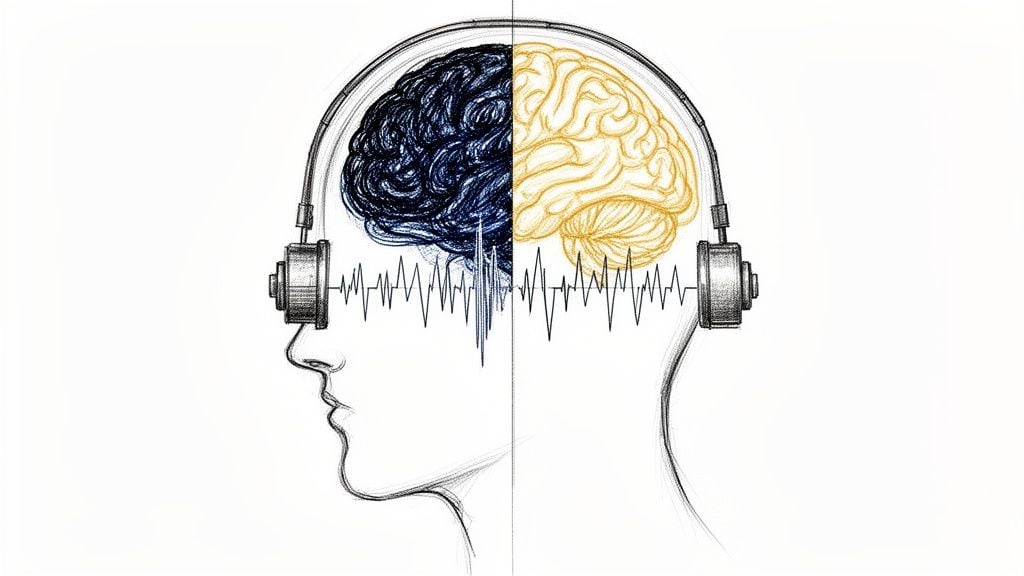
- Custom-Composed Sound: The entire session is backed by a soundscape that uses binaural beats. These are specific audio frequencies that can gently shift your brainwaves from a state of high alert (beta) to a much calmer, more open state (alpha or theta). In fact, a 2018 study in PLOS ONE showed that listening to these beats can significantly lower anxiety levels.
- Guided Vocal Coaching: This isn’t just a soothing voice talking you through it. The guidance uses specific language patterns and Neuro-Linguistic Programming (NLP) techniques to help you access and re-process subconscious patterns. It’s all about creating a safe space to connect with and release stored emotions.
- Subliminal Messaging: Positive, empowering affirmations are layered into the audio, just below the threshold of conscious hearing. This helps bypass the analytical part of your brain and introduce new, more helpful beliefs directly to your subconscious.
By blending these elements, you create an environment where your body finally feels safe enough to let go of old tension. Your mind becomes more open to new ways of seeing things. It’s less about thinking your way out of anxiety and more about releasing it from the body up.
How It Works in Practice
Think about a common fear, like public speaking. You can tell yourself, “I’m perfectly safe, there’s nothing to worry about,” but your heart still pounds and your palms get sweaty. That’s a classic sign that the fear isn’t logical—it’s a program running deep in your subconscious.
A guided breathwork journey helps you get to the emotional energy fueling that fear. Through the process, you might not only calm your nerves in the moment but also release the physical tightness you’ve held in your chest and throat for years, every single time you even thought about speaking up.
This doesn’t replace the other strategies in this guide. It works with them. Building a solid foundation with good sleep, nutrition, and daily grounding exercises makes your nervous system more resilient. Adding a deeper practice like 9D Breathwork can then help you clear out the old programming that was making you so reactive to begin with.
The science backs this up. A study published in the journal Frontiers in Psychology found that different breathing patterns directly influence our emotional states. It shows a clear, undeniable link between how we breathe and how we feel.
If you’re ready to move beyond just managing symptoms and want to start addressing anxiety at its source, you can explore the essentials of guided breathwork and its benefits to see if it’s the right next step for you.
Knowing When to Bring in Professional Support
Look, the tools and strategies in this guide can be incredibly powerful. For many people, they’re enough to make a real, lasting difference. But your journey is your own, and sometimes, the bravest and smartest move you can make is to ask for help.
Let’s be clear: reaching out to a professional isn’t a sign of failure. It’s about being strategic. Think of it as adding a seasoned expert to your corner—someone who can provide a safe, confidential space to unpack the roots of your anxiety and co-create a plan that’s built just for you.
Red Flags: When Is It Time to Call a Pro?
So, how do you know when you’ve hit a wall that self-help can’t quite get you over? Everyone’s experience is different, but there are some common signals that it’s time to seriously consider professional support.
If any of these sound familiar, it might be time to make that call:
- Life Feels Unmanageable: Your anxiety is consistently getting in the way of your work, your relationships, or even just getting through the day. For example, you start avoiding social events you used to enjoy or find it impossible to concentrate at work.
- Your Body is Screaming for Help: You’re dealing with constant headaches, stomach problems, or a sense of exhaustion that has no other medical explanation. These are classic physical manifestations of chronic anxiety.
- You’re Leaning on Unhealthy Crutches: You find yourself using alcohol, substance use, or total avoidance of situations as your primary way to cope.
- The Joy is Gone: Fear and worry have completely taken over, squeezing out any room for pleasure or enjoyment, even from things you used to love.
Bringing in a therapist is a proactive step toward getting your life back. And the data backs this up. A major study in The Lancet Psychiatry found that cognitive-behavioral therapy (CBT) is incredibly effective, with 51% of people seeing a major drop in their anxiety symptoms.
Reaching out for professional help isn’t giving up control; it’s taking it back in the most powerful way possible. It’s a strategic investment in your well-being.
I know that finding the right therapist can feel like a challenge in itself. A great place to start is the Anxiety & Depression Association of America’s therapist directory. It can help you find qualified professionals in your area.
Remember, building a calmer, more resilient mind is a skill. Combining the personal tools you’re learning here with expert guidance gives you the strongest possible foundation for success.
Common Questions Answered
When you’re starting a new path to manage fear and anxiety, it’s natural to have questions. Let’s tackle some of the most common ones that come up as people begin to apply these strategies in their own lives.
How Long Does It Take to Feel a Difference?
This is probably the most common question, and the answer has two parts. You can get relief almost instantly with some of the techniques we’ve covered. Things like the Physiological Sigh or the 5-4-3-2-1 grounding exercise are designed for in-the-moment rescue. They can dial down acute anxiety in just a couple of minutes.
Building real, lasting resilience, however, is a longer game. Think of it like getting in shape. One workout feels good, but true strength is built over time. The same applies here. A study in the Journal of Affective Disorders showed significant drops in anxiety symptoms after eight weeks of consistent mindfulness. Most people I’ve worked with start to feel a real shift in their baseline anxiety levels after a few weeks of consistent practice.
The immediate techniques are your first aid kit. The long-term strategies are how you build a stronger emotional immune system so you need the kit less and less.
Can I Do This If I’m Already on Anxiety Medication?
Yes, absolutely. The strategies in this guide—breathwork, grounding, cognitive reframing, and lifestyle adjustments—are designed to work beautifully alongside conventional treatments like medication and therapy. They give you practical, hands-on tools to manage the day-to-day ups and downs.
The key is communication. Always talk to your doctor or therapist before adding new practices to your routine. This ensures everything is working together harmoniously. And it’s critical to remember: never change your medication dose or schedule without speaking to your doctor first.
What if Trying These Techniques Makes My Anxiety Worse?
It’s a valid concern, and it does happen. For some people, especially those with a history of trauma, turning your focus inward can feel more threatening than calming at first. Research in Frontiers in Psychology has shown that for those with anxiety disorders, suddenly paying close attention to internal body signals (interoception) can be overwhelming.
If this is your experience, don’t push through it. Stop, and try something that pulls your focus outward instead. The 5-4-3-2-1 method is perfect for this because it directs your attention to the world around you, not what’s happening inside.
If you consistently find that these exercises spike your anxiety, that’s a really important signal. It’s a sign that it would be incredibly helpful to work with a trauma-informed therapist or a certified breathwork facilitator. They can create a safe space and guide you through the process gently, making sure you never feel overwhelmed.
Ready to stop just coping with anxiety and start rewiring your response from the ground up? The multi-sensory journeys from 9D Breathwork are specifically designed to help you release trapped emotional energy and build genuine resilience. Explore our transformative experiences today.