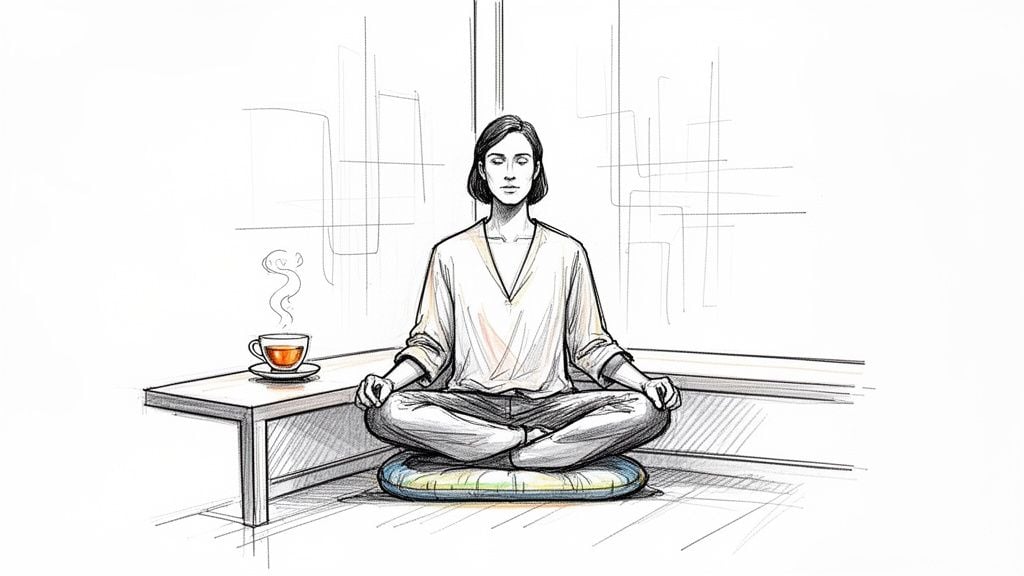
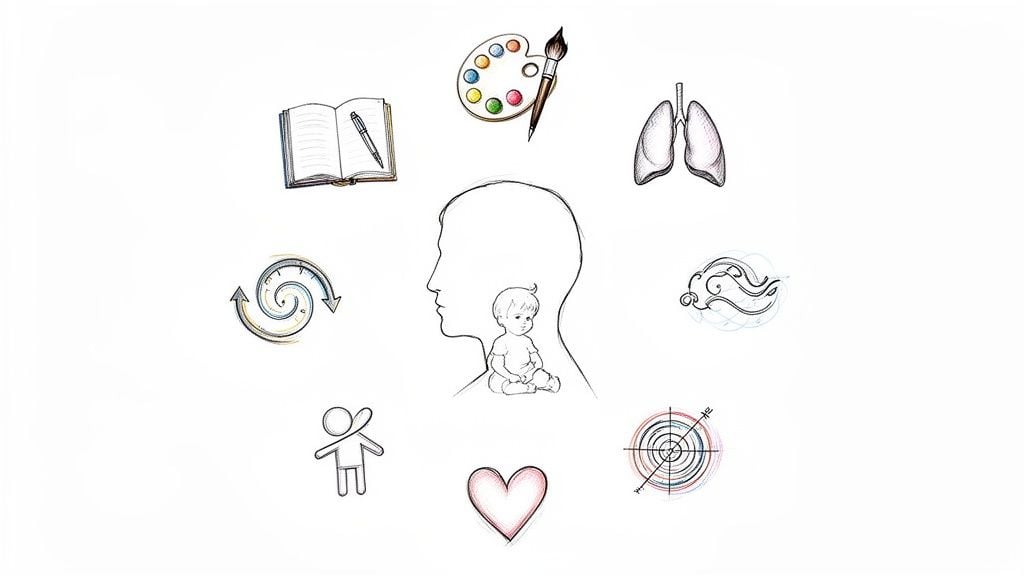
Guided meditation is much more than just a way to quiet your thoughts. Think of it as a set of practical, structured methods that use verbal cues to steer your focus toward specific goals, whether that’s deep relaxation or laser-like focus. These practices aren’t about emptying the mind—they’re active training tools for building resilience, managing stress, and getting to know yourself better.
Actionable Tip: Take 60 seconds right now. Close your eyes, and just notice your breath. Don’t change it. Just feel the air entering and leaving your body. This is the first step.
Beyond Just Relaxing: A Modern Take on Meditation
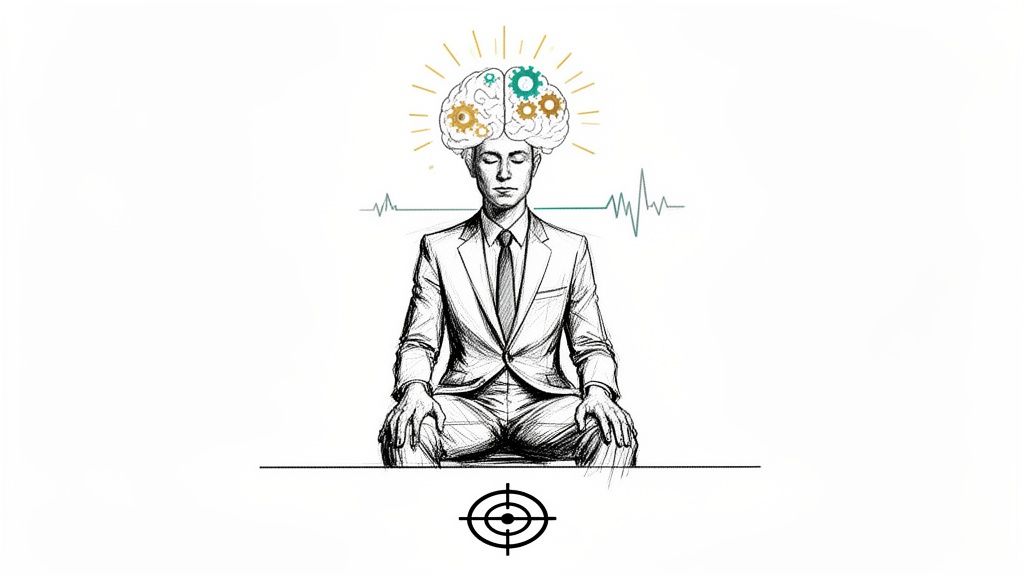
Let go of the old idea that meditation is some passive activity reserved for a quiet mountaintop. Today, it’s a powerful, science-backed discipline for anyone navigating the pressures of modern life, from busy professionals to people simply looking to improve their mental health. It’s an active process of self-regulation.
This isn’t just a feeling; it’s a massive trend. The global meditation market was valued at USD 5.26 billion in 2023 and is projected to skyrocket to USD 17.83 billion by 2032. That kind of growth shows a huge shift in how we see mental wellness—not as something we passively hope for, but as a skill we can actively build. You can get more details on this expansion from econmarketresearch.com.
What Modern Meditation Aims to Achieve
The goal has moved far beyond just “relaxing.” Modern guided meditation techniques are engineered to create real, measurable changes in your mind and body. For example, a 2018 study in Behavioural Brain Research found that even brief mindfulness sessions can significantly lower levels of cortisol, the body’s main stress hormone.
It’s less like zoning out and more like hitting a mental gym. The core benefits are tangible:
- Enhanced Focus: When you train your attention to keep returning to a single point, like your breath, you’re strengthening your ability to concentrate on demanding tasks at work.
- Improved Emotional Regulation: By simply observing your thoughts without getting caught up in them, you create a vital pause between a trigger and your reaction. This gives you the space to respond more thoughtfully.
- Greater Self-Awareness: Practices like the body scan help you tune into subtle physical and emotional signals you’d normally ignore throughout a busy day.
Ultimately, guided meditation offers a pathway to deep introspection and is a powerful tool for building a strong sense of self.
From Niche Practice to Mainstream Tool
The journey from a niche spiritual practice to a mainstream health tool is paved with solid scientific evidence. Research from The Journal of Positive Psychology in 2019 showed that just 10 minutes of daily mindfulness meditation can help stop your mind from wandering and sharpen your cognitive performance.
On top of that, a study in JAMA Internal Medicine found that mindfulness meditation was effective at easing symptoms of anxiety, depression, and even pain. These findings really highlight why so many people are turning to guided techniques not just for a moment of peace, but for long-term mental strength.
When you engage with a guided practice, you aren’t trying to escape reality. You’re learning to navigate it with more clarity, composure, and intention. It’s about taking control of your inner world so you can better handle the outer one.
Choosing Your Guided Meditation Technique
To get started, it helps to match a technique to what you want to achieve. This table offers a quick snapshot of the core techniques we’ll cover, helping you pick the right practice for your immediate goal—whether that’s calming anxiety before a meeting or just improving your physical awareness.
| Technique | Best For | Primary Outcome |
|---|---|---|
| Breathwork | Quickly reducing stress and grounding yourself in the present. | Immediate calm and nervous system regulation. |
| Visualization | Cultivating positive emotions, rehearsing success, or problem-solving. | Increased motivation, creativity, and confidence. |
| Body Scan | Reconnecting with your body and releasing physical tension. | Greater mind-body awareness and deep relaxation. |
| Binaural Beats | Accessing specific brainwave states for focus or deep sleep. | Enhanced concentration or improved sleep quality. |
| Hypnotic Language/NLP | Reprogramming limiting beliefs and setting positive intentions. | Mindset shifts and behavioral change. |
Actionable Tip: Look at the table. What is your #1 goal right now? Choose the technique that matches and commit to trying just one five-minute session this week.
Using Your Breath as an Anchor for Calm
We’ve all been told to “just take a deep breath” when we’re stressed out. It’s good advice, but it’s missing the most crucial part—the how. Your breath is so much more than a way to get oxygen; it’s a direct line to your autonomic nervous system, the command center that controls your stress response. By consciously changing your breathing patterns, you can literally flip the switch from a high-alert “fight-or-flight” mode to a calmer, more grounded “rest-and-digest” state.
This isn’t just a mind-over-matter trick. Research from Frontiers in Psychology shows that slow-breathing techniques directly engage the parasympathetic nervous system, which leads to real, measurable drops in heart rate and blood pressure. You’re basically using your lungs as a remote control for your internal state.
These techniques aren’t about forcing an empty mind. Instead, they give your attention a simple, reliable anchor. When your thoughts are racing or emotions feel overwhelming, bringing your focus back to the physical sensation of your breath pulls you right back into the present moment. One inhale, one exhale at a time.
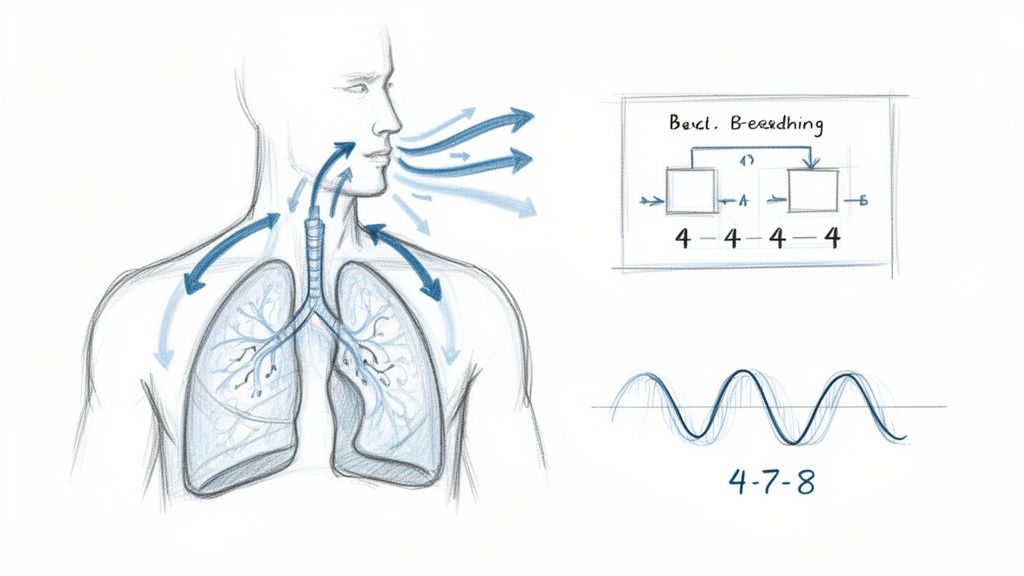
The Box Breathing Technique for Instant Composure
Picture this: you’re about to walk into a high-stakes presentation. Your heart is pounding, and your mind is a total blank. This is the perfect time to use Box Breathing. It’s a remarkably powerful technique for maintaining focus under pressure, used by everyone from Navy SEALs to surgeons.
Try It Now:
- Inhale slowly through your nose for a count of four.
- Hold your breath at the top for another count of four.
- Exhale slowly through your mouth for a count of four.
- Hold the breath out at the bottom for a final count of four.
Just repeat this cycle three to five times. That slight hold increases the carbon dioxide in your blood, which has a calming and regulating effect on your nervous system. By imposing this steady, even rhythm, you’re hitting the brakes on the shallow, rapid breathing that signals panic to your brain.
The 4-7-8 Technique for Deep Relaxation and Sleep
When the goal is to completely downshift your system—maybe right before bed or after a really long day—the 4-7-8 Breathing technique is your best friend. Developed by Dr. Andrew Weil, this pattern is often called a “natural tranquilizer” for the nervous system.
Action Plan for Tonight:
- Get comfortable, either sitting or lying down. Place the tip of your tongue against the ridge of tissue just behind your upper front teeth and keep it there.
- Exhale completely through your mouth, making a gentle whoosh sound.
- Now, close your mouth and inhale quietly through your nose to a mental count of four.
- Hold your breath for a count of seven.
- Exhale completely through your mouth, making that whoosh sound again, to a count of eight.
That’s one full cycle. Repeat it three more times for a total of four breaths. The magic is in that long exhale; it sends a powerful signal of profound relaxation throughout your body. Research in the International Journal of Yoga Therapy backs this up, confirming that practices with longer exhalations significantly boost parasympathetic activity, which helps slash anxiety and promote rest. Even more fascinating, a study in Cell Reports pinpointed a specific group of neurons that connect breathing to relaxation, which get stimulated by this kind of controlled respiration.
A Practical Script for Guided Breathwork
When you’re guiding someone, simple cues that connect the breath to physical calm work wonders. It’s less about the numbers and more about building awareness.
“To begin, just bring your attention to your breath. Don’t try to change anything just yet. Simply notice it. Feel the cool air as it enters your nostrils… and the warm air as it leaves.
Now, let’s begin to deepen it slightly. Imagine your belly is a small balloon, gently inflating as you breathe in… and slowly deflating as you breathe out. In… and out.
With each long, slow exhale, just feel a little more tension leaving your shoulders… your jaw… your hands.”
This kind of guidance makes the experience more immediate and effective by linking the abstract idea of “breathing” to real, tangible sensations. Many of these cues are built on the principles of diaphragmatic breathing. To really get a handle on this, check out our in-depth guide on how to master diaphragmatic breathing. Honing that foundational skill will make every other breathwork technique you use even more powerful.
Mastering Visualization and Body Scan Practices
While breathwork is your anchor to the present moment, other techniques like visualization and body scans use sensory awareness to forge an even deeper mind-body connection. Think of them as ways to shift your focus from abstract thoughts to tangible, internal experiences. You’re learning to use your mind not just to think, but to feel, create, and even heal.
These aren’t just about picturing a peaceful beach. They are active mental rehearsals and internal check-ins that can have a profound impact on both your psychological state and your physical well-being. By engaging your imagination and bringing awareness to your body, you tap into its innate intelligence.
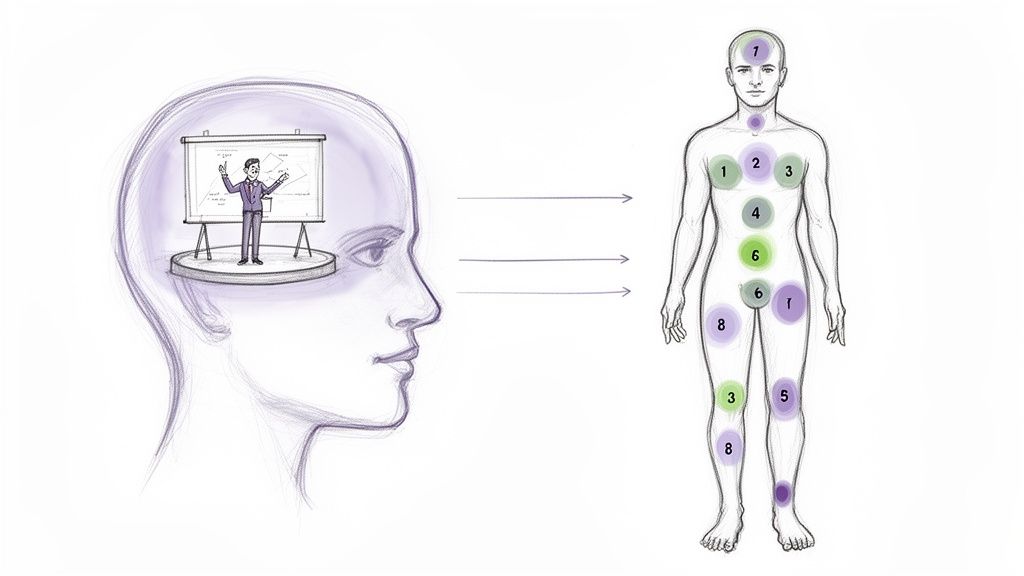
Harnessing the Power of Visualization
Visualization, or mental imagery, is simply the practice of creating a detailed sensory experience in your mind. It’s a technique you see everywhere once you know what to look for—from elite athletes mentally running through a perfect performance to surgeons walking through a complex procedure before ever making an incision. It works because your brain often responds to a vividly imagined scenario much like it would a real one.
Forget generic scenes and make your visualizations practical and goal-oriented.
- For Professional Success: Before a big client presentation, don’t just hope it goes well—visualize it. Picture yourself walking in with confidence, speaking clearly, and seeing nods of agreement from the room. Actually feel the sense of accomplishment as you close the deal.
- For Physical Healing: If you’re recovering from an injury, imagine your body’s natural healing processes at work. You can envision strong, healthy cells repairing tissue and restoring full function. While this is never a replacement for medical care, it can be a powerful complement.
This isn’t just wishful thinking. A study in the Journal of Consulting and Clinical Psychology found that guided imagery significantly reduced preoperative anxiety in patients, highlighting the direct link between what we create in our minds and how our bodies respond.
The Systematic Art of the Body Scan
The body scan is a cornerstone of mindfulness. It involves methodically sweeping your attention through your entire body, part by part. The goal isn’t to change anything you feel, but simply to notice the raw sensations—warmth, tingling, tightness, or even nothing at all—with a curious and non-judgmental attitude. This practice is incredibly effective for reconnecting with your physical self and releasing stored tension you might not even realize you’re carrying.
The heart of a body scan is gentle, focused awareness. By paying close attention to each part of your body without judgment, you’re training your mind to be present. This allows deep-seated tension to dissolve all on its own.
Your Action Plan: Try a mini-scan right now.
- Get Comfortable: Settle into your chair.
- Focus on Your Hands: Bring all of your attention to your hands. Notice their temperature, the feeling of the air on your skin, any tingling. Spend 30 seconds just feeling them.
- Move to Your Shoulders: Now, shift your focus to your shoulders. Are they tense? Relaxed? Just notice without judgment. On your next exhale, imagine them softening just 10%.
- Acknowledge and Release: When you notice an area of tightness, just acknowledge it. On your exhale, imagine that tension softening and releasing. This is one of the most direct ways to learn how to release tension in your body using mindful awareness.
Overcoming Common Hurdles
It’s perfectly normal to run into a few challenges with these sensory practices. Your mind will wander, or you might get sleepy, especially during a body scan. That’s part of the process.
Here are a few tips from practitioners to help you stay engaged:
- If Your Mind Drifts: Gently and kindly guide it back. The real “practice” isn’t in having a perfectly focused mind; it’s in the act of noticing your thoughts have wandered and returning your focus, again and again.
- If You Feel Sleepy: Try doing the body scan while sitting upright in a chair instead of lying down. You can also briefly open your eyes to re-engage your senses before continuing.
- If You Feel Nothing: That’s okay, too! The practice is about noticing whatever is present, even if it’s a complete lack of sensation. Simply acknowledge the “nothingness” and move on.
The benefits are well-documented. One meta-analysis published in Pain Medicine confirmed that body scan meditation is an effective tool for reducing both pain intensity and stress. With consistent practice, you’ll find it becomes easier to stay present and feel truly connected to yourself.
How Sound and Language Can Supercharge Your Practice
Once you’ve got the basics of breath and body awareness down, you can start exploring some really fascinating techniques that use sound and language to directly influence your brain. This is where guided meditation moves beyond simple relaxation and into the realm of neurological and psychological fine-tuning.
Think of it this way: instead of just observing your mind, you’re giving it specific tools to create faster, deeper shifts. By layering in certain audio frequencies or using carefully chosen words, a guide can help you access states of focus or emotional release that might otherwise take years of silent practice to find.
Tuning Your Brain with Binaural Beats
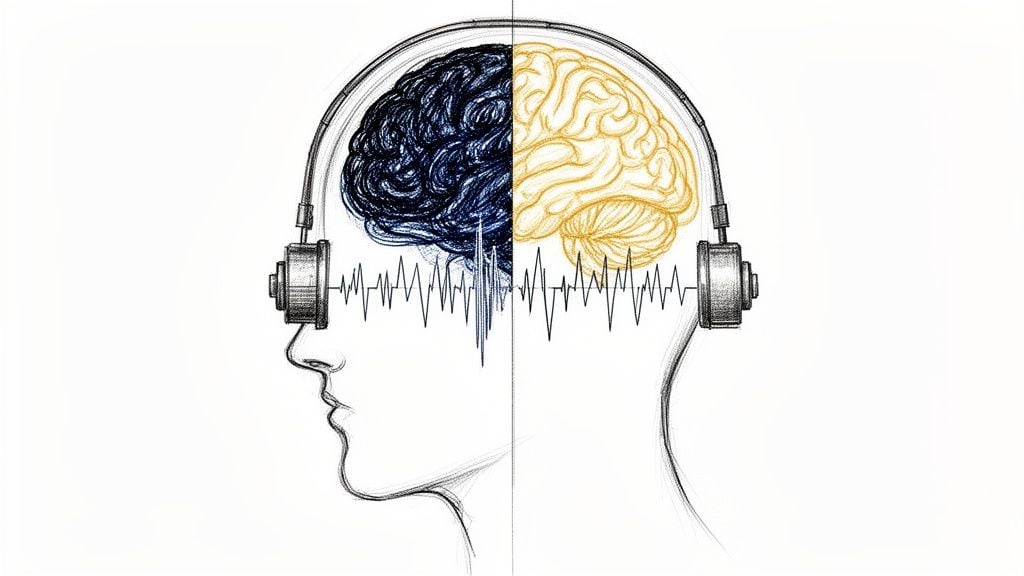
One of the most powerful ways to do this is with binaural beats. It sounds complex, but the concept is pretty simple. You listen to two slightly different sound frequencies, one in each ear. Your brain naturally tries to resolve the difference and, in doing so, creates a third “phantom” frequency.
This isn’t just a fun auditory illusion; it’s a process known as brainwave entrainment. Your own brainwaves start to sync up with this new phantom frequency, which allows a guide to gently steer your mind into a specific state.
- Alpha Waves (8-13 Hz): Need to be calm but sharp? Alpha waves are your ticket. Listening to these frequencies helps cultivate a state of relaxed alertness, perfect for creative brainstorming or getting in the zone before a big presentation.
- Theta Waves (4-8 Hz): These are the frequencies of deep meditation, REM sleep, and those “aha!” moments of intuition. Using Theta beats in a session can open the door to your subconscious, making it an incredible tool for working through emotions or uncovering deep insights.
This isn’t just theory. A study in Frontiers in Human Neuroscience confirmed that auditory stimulation like binaural beats can absolutely modulate brain activity. It’s solid science backing up what practitioners have known for years: what we hear can profoundly change how we think and feel. If you want to go deeper on this, we’ve put together a full guide on using binaural beats for stress relief.
The Power of Words: Permissive vs. Direct Language
The words a guide chooses are just as crucial as the sounds they use. The language itself can completely change the dynamic of a session, either by gently inviting your awareness or by giving your subconscious direct instructions.
Permissive language is all about soft, open-ended invitations. You’ll hear phrases like, “You might begin to notice a feeling of warmth in your hands,” or “Perhaps you can allow your shoulders to relax.” This approach is fantastic for beginners or anyone who bristles at being told what to do. It builds trust and lets you feel like you’re making the discoveries on your own.
On the other hand, direct commands and hypnotic language are designed for more powerful, targeted shifts. These are phrases like, “Let go of all tension now,” or “Your mind is becoming calm and clear.” This is a cornerstone of Neuro-Linguistic Programming (NLP), a method built around changing thought patterns. While it sounds authoritative, a skilled guide can use direct suggestions to bypass your critical mind and help rewire old, unhelpful beliefs.
A facilitator might craft a prompt like this: “Imagine a door in front of you that represents an old habit. When you are ready, see yourself opening that door and confidently walking through it, leaving that habit behind forever.” This blend of visualization and direct command is a powerful mental rehearsal for real-world change.
These kinds of sophisticated techniques are becoming more common for a reason. In 2023, North America accounted for 53% of the global mindfulness meditation app market, a surge driven by corporations looking for effective mental health tools for their teams. This shows a clear demand for practices that deliver tangible results. You can read more about the mindfulness meditation app market here.
And science backs this up, too. Research from the journal Brain and Cognition showed how simple words can activate specific neural pathways, proving language has a direct physiological effect. Another study in Social Cognitive and Affective Neuroscience found that reframing language literally changes how the brain processes emotion. A guide who chooses their words wisely isn’t just talking; they’re helping you reshape your own neural landscape.
Designing Your Personal Meditation Routine
Knowing about different meditation techniques is one thing, but actually building a practice that sticks is where the magic happens. A solid routine is your roadmap, helping you make the most of whatever time you have—whether it’s five minutes squeezed between meetings or a full half-hour to yourself. It’s about creating a ritual that works for you, not trying to fit into someone else’s mold.
The real key is matching the session to what you want to achieve. Think about it: you wouldn’t use the same workout for building muscle as you would for running a marathon. Meditation is no different. When you tailor your routine to a specific goal, it becomes far more powerful and something you’ll actually want to come back to.
Crafting Your Session Structure
No matter how long the session, a good meditation follows a natural, three-part flow. This simple framework helps you gently ease into the practice and then smoothly transition back into your day, so you feel grounded instead of jolted.
- The Arrival (1-2 minutes): This is your runway into the session. Simply find a comfortable spot, settle in, and turn your attention to your breath. The only goal here is to shift gears from the frantic pace of your day to a quiet moment of presence.
- The Core Technique (5-20 minutes): Here’s where the work gets done. You’ll dive into your chosen meditation technique, whether that’s a body scan to release tension, a visualization to build focus, or a specific breathwork pattern.
- The Return (1-3 minutes): Time to come back. Gently bring your awareness back to the room. Wiggle your fingers and toes, listen for any sounds around you, and slowly open your eyes when you feel ready. This gradual reentry helps you carry the calm from your session into the rest of your day.
To see what this looks like in practice, here are a few goal-oriented sessions you can try.
| Session Goal | Total Time | Structure | Best For |
|---|---|---|---|
| Morning Focus Booster | 10 Minutes | 2 min Arrival, 6 min Visualization, 2 min Return | Setting a clear, positive intention before a busy workday. |
| Midday Stress Reset | 5 Minutes | 1 min Arrival, 3 min Box Breathing, 1 min Return | Quickly calming the nervous system during a stressful day. |
| Evening Unwind | 25 Minutes | 2 min Arrival, 20 min Body Scan, 3 min Return | Releasing physical tension and preparing the body for sleep. |
When working with sound-based meditations, the journey often follows a specific path from a relaxed, focused state into deeper levels of consciousness where insight and healing can occur.
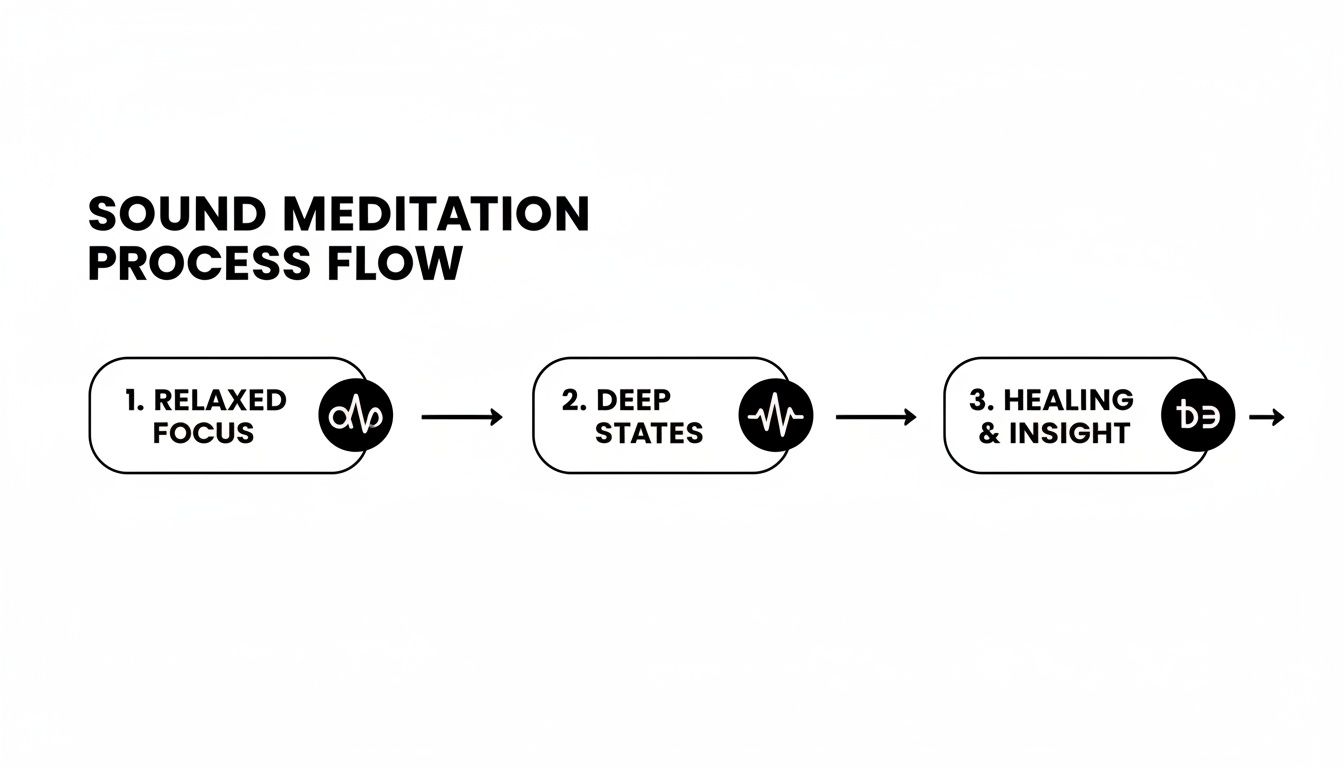
This flow shows how sound can guide the brain into different wave states, which is what allows for such targeted mental and emotional outcomes.
Measuring Your Progress Beyond Feelings
While “feeling calmer” is a fantastic result, sometimes the most profound changes are the ones you can actually measure. Tracking a few key metrics can be incredibly motivating because it gives you tangible proof that your efforts are paying off. Seeing the data makes the subtle, cumulative benefits impossible to ignore.
A landmark study published in The Lancet found that mindfulness-based programs can lead to significant and measurable reductions in stress-related biomarkers like C-reactive protein (an inflammation marker). It’s not just in your head; the benefits are real and observable.
Tracking your progress isn’t about judging your performance; it’s about validating your commitment. When you see the numbers change, it transforms meditation from a hopeful practice into a proven tool for well-being.
Actionable Tip: For one week, track these two things:
- Qualitative (The Vibe): At the end of each day, jot down a score from 1-10 for your stress level. Note one time you responded more calmly than you normally would have.
- Quantitative (The Data): If you have a wearable device or a good smartphone app, keep an eye on your resting heart rate (RHR) and sleep quality. A lower RHR and more deep sleep are classic signs that your nervous system is finding its balance.
Creating a supportive environment can also make all the difference. Simple things, like using The Candles for Creating a Calm and Relaxing Atmosphere, can signal to your brain that it’s time to unwind. Over time, consistent practice with these techniques can lead to profound shifts. If you’re curious about the science behind it, you can dive deeper into how to rewire your brain through this kind of dedicated work.
Common Questions About Guided Meditation
When you’re just starting out with something as personal as guided meditation, it’s natural to have a lot of questions. Am I doing this right? Is this normal? It’s easy to get hung up on whether you’re meeting some unspoken standard.
Let’s clear the air. The real goal isn’t to follow a rigid set of rules, but to get curious and build a better relationship with your own mind. Here are some practical answers to the most common questions I hear, designed to help you move forward with confidence.
What If I Can’t Stop My Thoughts During Meditation?
This is, hands down, the biggest misconception about meditation. The goal has never been to stop your thoughts. Trying to force your mind into a silent, blank state is like trying to stop the waves in the ocean—it’s not only impossible, it’s a recipe for frustration.
Your mind is supposed to think. That’s its job.
Actionable Reframe: The next time you sit to meditate, set an intention not to “clear your mind,” but to “notice your thoughts.”
- When a thought pops up, silently label it: “planning,” “worrying,” “remembering.”
- Acknowledge it without judgment.
- Gently guide your focus back to your anchor, like your breath or the guide’s voice.
Think of your mind as the sky and your thoughts as passing clouds. The point isn’t to get rid of the clouds, but to recognize that you are the vast, stable sky itself, capable of holding all of it without getting lost in the storm.
Every time you gently bring your attention back, you’re doing a rep for your focus muscle. It’s not about achieving a perfectly empty mind; it’s all about mastering that gentle return.
Is It Okay If I Fall Asleep During a Body Scan?
Yes, absolutely. It happens to almost everyone, especially when you’re tired or just beginning. If you doze off during a body scan, it simply means your body is getting the deep rest it’s been craving. See it as a sign that you’ve successfully relaxed, not as a failure.
Now, if your intention is specifically to train your awareness and stay present, you can try a few simple tweaks.
- Adjust Your Posture: Instead of lying down, try sitting upright in a chair with your feet flat on the floor. This position naturally encourages more alertness.
- Pick a Better Time: If you’re meditating right before bed, sleep is the logical next step. Try a session in the morning or mid-afternoon when you have more natural energy.
- Soften Your Gaze: If you feel yourself drifting, you can open your eyes for a moment to a soft, unfocused gaze. This can help you reconnect with the space before gently closing them again.
Don’t beat yourself up if you fall asleep. Just acknowledge that your body got what it needed and set a gentle intention to stay awake next time.
How Long Should I Meditate to See Real Benefits?
When it comes to building a practice that sticks, consistency will always beat duration. A daily 10-minute session will create more meaningful, lasting change than one heroic hour-long sit once a week. It’s the cumulative effect of showing up regularly that rewires your brain and builds resilience.
Many people start feeling calmer and more centered after just one or two weeks of daily practice. The science backs this up, too. A study from Biological Psychiatry found that as little as 10 minutes of daily mindfulness meditation can sharpen your attention and quiet the mental chatter.
Actionable Challenge: Commit to just five minutes a day for one week. That’s it. Use a timer. By the end of the week, notice how it feels. Once that’s easy, you can add more time if you feel called to. The key is to find a rhythm that fits into your life, not something that feels like another chore.
Can Meditation Help If I Have Severe Anxiety or Trauma?
Guided meditation is an incredible tool for managing everyday stress, but if you’re dealing with severe anxiety, PTSD, or a history of trauma, it’s essential to proceed with caution. Some techniques, particularly those that encourage deep emotional release, can sometimes be triggering without the right support.
Your safety is always the number one priority. For that reason, it’s best to start with gentle, grounding practices that keep you anchored in the present moment.
- Simple Breath Awareness: Just notice the physical sensation of air moving in and out, without trying to change it.
- Grounding Body Scans: Focus on the points of contact between your body and the chair or the floor.
- Mindful Walking: Pay close attention to the feeling of your feet making contact with the ground as you walk.
A study in the Journal of Traumatic Stress highlighted the need for a trauma-informed approach, showing that these practices are most helpful when they increase a sense of safety and personal control. For any practice that involves exploring deep emotions or past events, please work with a trauma-informed facilitator or a qualified therapist. They can create a safe space for you to explore, helping you navigate whatever comes up so your journey is truly one of healing.
At 9D Breathwork, we create experiences that go beyond traditional meditation, using a fusion of breathwork, sound, and guided language to help you access deep states of awareness safely and effectively. Discover how our scientifically-backed journeys can help you release stored emotions and rewire your mind from the inside out. Explore our offerings at https://9dbreathwork.com.