Binaural beats offer a surprisingly simple way to dial down stress. Using nothing more than a pair of stereo headphones, this sound-based technique coaxes your brain into a state of deep calm, helping your brainwaves sync up with patterns of relaxation and focus. It’s a practical, accessible tool for managing the pressures of a busy life.
Your Path to a Calmer Mind Using Sound
In a world that’s always “on,” finding a moment of genuine peace can feel like a monumental challenge. The relentless buzz of notifications, looming deadlines, and daily responsibilities keeps our nervous systems stuck in high gear. For many of us, stress and overwhelm have become the default setting.
This is where binaural beats come in. They aren’t a magic wand, but they are a science-backed method for steering your brain toward a more tranquil state.
Think of it like tuning an old-school radio. Your brain operates on different frequencies—what we call brainwave states—and each one corresponds to how you feel. When you’re stressed or anxious, your brain is humming along in a high-frequency Beta state. The goal is to gently turn the dial down to a calmer frequency, like the relaxed waves of Alpha or the deep calm of Theta.
Why Sound Can Soothe Your Nervous System
Binaural beats give you a simple way to make that shift happen. In fact, a 2023 study published in Brain and Behavior showed that listening to binaural beats for just 20 minutes led to significant drops in both heart rate and blood pressure—two clear physical signs of relaxation.
This kind of research shows how targeted sound can have a direct, positive impact on your autonomic nervous system. It helps you switch from the frantic “fight-or-flight” mode into the healing “rest-and-digest” state.
Actionable Step: Try this right now. Find a 10-minute Alpha wave (10Hz) binaural beat track on YouTube. Put on your headphones, close your eyes, and just breathe. Notice the subtle shift in your body and mind. This simple action is the first step to harnessing this tool.
Learning to manage your stress response is fundamental to your long-term mental and physical health. Before diving into the specifics of binaural beats, it’s worth taking a moment to appreciate the manifold benefits of stress management for a healthier, more balanced life. This foundational knowledge is also the first step if you want to learn how to calm your nervous system on a deeper level.
Your Quick Guide to Brainwave States for Stress Relief
So, what exactly are we aiming for when we listen to these sounds? Understanding the different brainwave states helps you pick the right track for the right moment. This table breaks down the frequencies and what they mean for your mind.
| Brainwave State | Frequency Range (Hz) | Associated Mental State | Practical Action |
|---|---|---|---|
| Beta | 13-30 Hz | Active, alert, focused, but also anxious | This is likely where you are now. The goal is to use other beats to shift away from it. |
| Alpha | 8-13 Hz | Relaxed focus, mindfulness, light calm | Action: Use a 10Hz track for a 10-minute midday break to dissolve work stress. |
| Theta | 4-8 Hz | Deep relaxation, meditation, creativity | Action: Play a 6Hz track for 20 minutes after work to deeply unwind and disconnect. |
| Delta | 0.5-4 Hz | Deep, dreamless sleep, healing, restoration | Action: Listen to a 2Hz track for 30 minutes before bed to promote restorative sleep. |
Think of these states as different gears for your brain. Knowing which one to shift into can make all the difference in managing your stress effectively.
How Binaural Beats Actually Work
Ever listen to two guitarists tuning up at the same time? When their notes are just slightly off, you hear that distinctive “wah-wah-wah” pulse. That’s the basic idea behind binaural beats, but it happens inside your head.
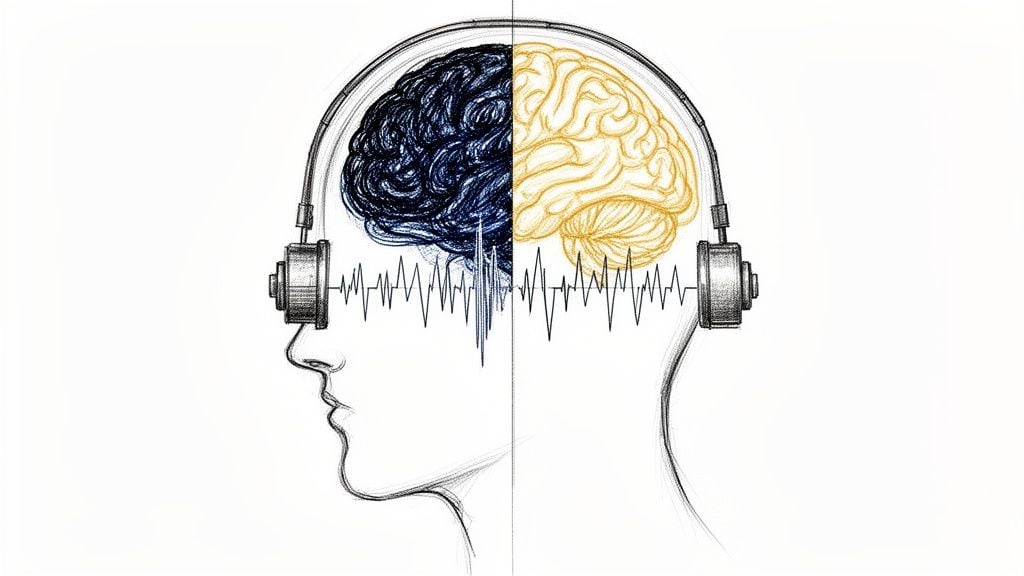
It’s an auditory illusion, really. You need stereo headphones for it to work because the trick is to feed a slightly different frequency into each ear. Let’s say your left ear gets a pure tone of 200 Hz, and your right ear gets 210 Hz.
Your brain, in its attempt to process these two different signals, creates a third, phantom beat. The frequency of this beat is the exact difference between the two tones—in this case, 10 Hz. This clever process of getting your brain to sync up with an external rhythm is called brainwave entrainment.
Nudging Your Brain Toward Calm
So what is brainwave entrainment? Think of it less as forcing your brain to do something and more like giving it a gentle nudge. You’re offering it a rhythm to follow, an invitation to slow down.
When you’re stressed, your mind is racing, and you’re in that “go-go-go” mode, your brain is humming along in a high-frequency Beta state (13-30 Hz). The whole point of using binaural beats for stress relief is to guide your brainwaves out of that frantic state and down into calmer, lower-frequency territory.
Key Takeaway: Binaural beats aren’t music. They’re a specific tool designed to work with your brain’s natural rhythms, helping you shift gears from high alert to deep calm.
It’s all about using the right tools to influence your mental state, and sound is one of the most direct routes we have.
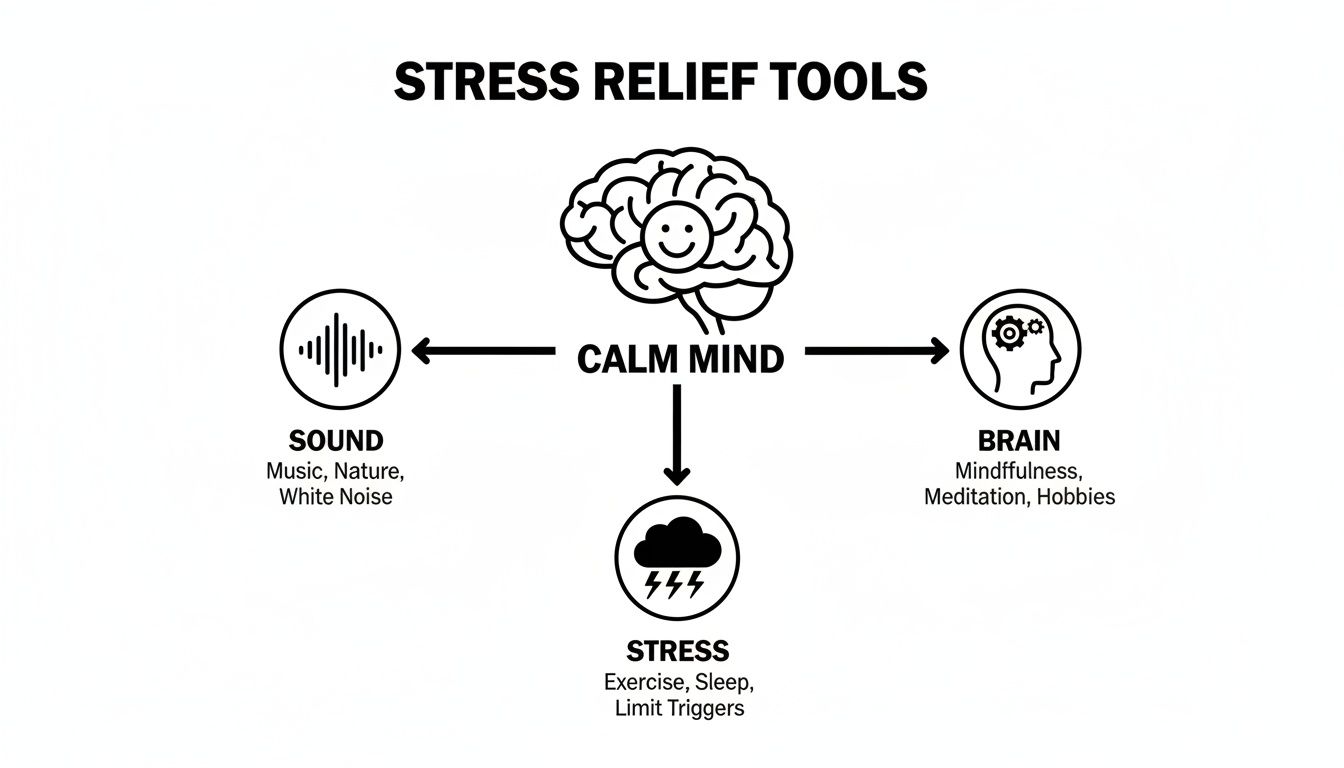
As you can see, sound is a powerful input for engaging the brain and dialing down the stress response.
From Theory to Action: A Practical Example
Let’s put this into a real-world context. Imagine it’s the end of a chaotic workday. Your mind is still buzzing with to-do lists and worries; you just can’t seem to switch off. That’s a classic sign you’re stuck in a high-beta brainwave pattern.
Here’s a simple protocol to shift your state:
- Find a quiet space and pop on your stereo headphones.
- Select an Alpha wave track. Search online for a track featuring a binaural beat in the 8-13 Hz range. This is the frequency associated with relaxed awareness, creativity, and light meditation.
- Listen for 15 minutes. Just close your eyes and breathe. Don’t try to make anything happen; let the sound do the work.
Before the 15 minutes are up, you’ll probably notice your racing thoughts starting to drift away. Your breathing will likely become slower and deeper, and that knot of tension in your shoulders might finally begin to loosen. You’ve just used a specific sound frequency to coax your brain from an anxious Beta state into a calm Alpha one.
And this isn’t just wishful thinking; the science backs it up. A 2019 study in Frontiers in Psychology found that listening to binaural beats for just 20 minutes led to significant drops in heart rate and blood pressure—clear physical signs of relaxation. Another peer-reviewed study confirmed that athletes listening to Alpha frequency (10 Hz) beats showed reduced anxiety before a competition. It’s effective even under pressure.
Even more impressive, a third study on theta waves showed that a brief session with 6 Hz beats could induce a meditative state in novices that was comparable to that of experienced practitioners, all while lowering anxiety and improving their mood.
The Science Backing Binaural Beats for Anxiety
It’s one thing to say that a specific sound can influence your brainwaves, but it’s fair to wonder: is this a real, measurable effect, or is it just a placebo?
Thankfully, the idea of using binaural beats for stress relief has moved out of the realm of pure wellness theory and into controlled clinical settings. A growing body of scientific research shows that this auditory illusion has a tangible, physiological impact on the human body. These aren’t just calming tunes; they’re specific frequencies proven to dial down the physical markers of stress and anxiety.
Let’s look at three powerful studies that put binaural beats to the test in very different high-pressure situations.
Calming Nerves in High-Stress Medical Settings
Few things are more stressful than preparing for surgery. The anxiety beforehand is intense and can even impact how well a patient recovers. This makes it the perfect environment to test a non-invasive tool like binaural beats.
A landmark study by Padmanabhan and his research team did just that, and the results were remarkable. Patients listening to binaural beats before surgery saw their anxiety levels plummet by an incredible 26.3%. That’s more than double the reduction seen in the group listening to regular music (11.1%) and worlds apart from the control group that had no audio at all (3.6%).
Actionable Insight: If you face a high-stress event like a presentation or important meeting, try this. For 15 minutes beforehand, listen to an Alpha (10Hz) binaural beat track. This simple action, proven effective in a clinical setting, can significantly lower your anxiety and help you perform at your best.
This study makes a strong case for binaural beats as a practical, drug-free tool in hospitals where managing patient stress is critical. For anyone dealing with specific anxieties around well-being, there are also dedicated strategies and resources on how to stop health anxiety and find your footing again.
Reducing Physical Stress in Students
Academic pressure is another huge source of modern stress. Juggling deadlines, exams, and high expectations can leave students in a chronic state of fight-or-flight. A study published in Frontiers in Neuroscience set out to see if binaural beats could offer some real, measurable relief.
Researchers had students listen to a 6 Hz Theta frequency binaural beat for a short time while monitoring their physiological responses. The results were clear and objective: participants’ heart rates dropped significantly, a key sign that the body is shifting out of its high-alert state and into a mode of rest and recovery.
Key Findings from the Study:
- Lower Heart Rate: The Theta wave track prompted a noticeable drop in heart rate, signaling a move toward a state of genuine calm.
- Better Mood: Afterward, the students reported feeling less anxious and having a more positive outlook.
- Effortless Meditation: The 6 Hz frequency was found to guide even inexperienced listeners into a meditative state, showing just how accessible this tool can be for deep relaxation.
This study demonstrates that the calming effects aren’t just in your head—they show up in your body’s core functions. This shift toward a calmer physiological state is directly tied to a more regulated nervous system. To learn more, check out our guide on how to improve heart rate variability, a key marker of a healthy, resilient nervous system.
Boosting Performance and Slashing Stress at Work
The corporate world can be a pressure cooker, where intense focus and constant demands lead straight to burnout. An innovative study looked at whether binaural beats could do two things at once: reduce stress and improve cognitive performance in a simulated work environment.
Participants were exposed to a 16 Hz Beta frequency track, which is associated with focused attention. Researchers then measured their performance on a high-vigilance task while also tracking their stress levels by analyzing salivary alpha-amylase (a reliable stress biomarker).
The results were impressive on both fronts. Not only did participants show a 14% improvement in their performance, but their stress levels, as measured by the biomarker, dropped by 20%.
This is huge. It proves that binaural beats can help create a state of “calm focus”—the sweet spot for any professional trying to stay productive without getting overwhelmed. It’s a perfect example of how binaural beats for stress relief can be a game-changing tool in the workplace.
Your Practical Guide to Using Binaural Beats
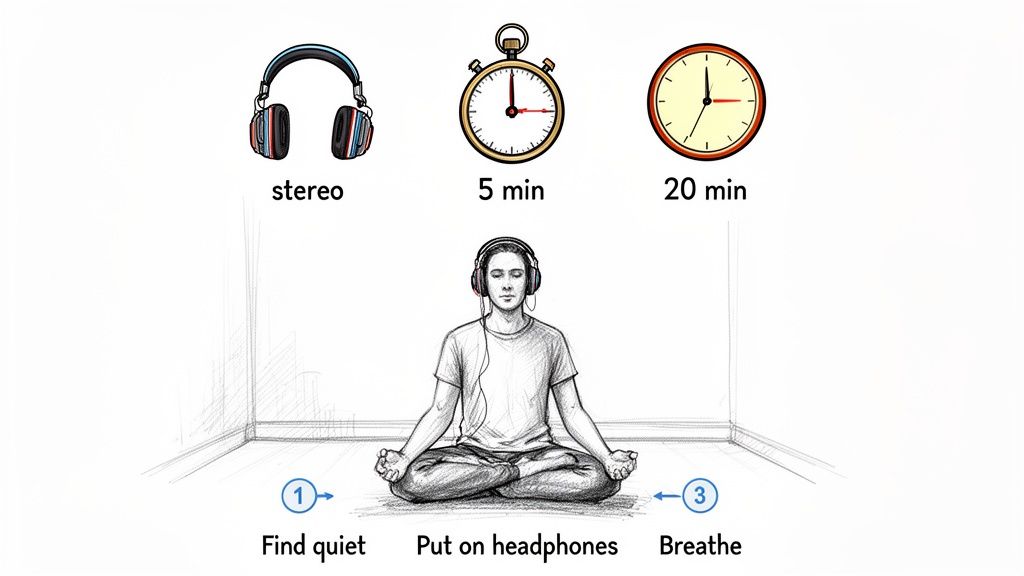
The science is fascinating, but the real magic of using binaural beats for stress relief happens when you actually press play. So let’s get practical. This is your action plan, a simple guide to take all the guesswork out of it and get you started right away.
With just a few key steps, you can start actively guiding your own mental state. The process itself is incredibly simple, but getting the details right makes all the difference in whether you feel a subtle shift or a profound change.
Setting Yourself Up for Success
Before you dive in, a little prep work goes a long way. Think of it like creating the perfect environment for a great conversation—you wouldn’t try to have a heart-to-heart in the middle of a loud party. The same principle applies here.
Your Quick Start Checklist:
- Find a Quiet Space: This is all about minimizing distractions. Your office with the door shut, a quiet corner at home, even your car during a lunch break can work perfectly. The goal is to give your brain a chance to tune in without interruption.
- Use Stereo Headphones: This part is non-negotiable. The whole effect of binaural beats depends on sending a slightly different frequency to each ear. You can’t get that from speakers. A decent pair of stereo headphones or earbuds is essential.
- Choose Your Frequency: Pick a track that matches your goal. For a quick mental reset to find calm focus, an Alpha wave (8–13 Hz) track is ideal. If you need to unwind and decompress after a long day, go for a Theta wave (4–8 Hz) track.
- Set an Intention: Before you start, take a single deep breath and decide what you want from the session. It could be as simple as, “I am letting go of today’s stress,” or “I am finding a moment of calm.”
Actionable Tip: Don’t just think the intention—say it out loud. “My intention is to release tension.” Voicing it makes it more concrete and focuses your mind on the goal of the session, enhancing its effectiveness.
Two Actionable Protocols for Immediate Relief
Okay, you’re set up and ready to go. Here are two straightforward, practical protocols you can use today to manage stress and get back in the driver’s seat of your mind.
Protocol 1: The 5-Minute Mental Reset
Think of this as your emergency off-switch for overwhelm. It’s perfect for those moments in a chaotic workday when you feel your stress spiking and your focus crumbling.
- When to Use: In between back-to-back meetings, right before a tough conversation, or anytime you feel mentally scattered.
- Frequency: Alpha Waves (10 Hz is a fantastic starting point).
- Steps:
- Duck into your quiet spot and put on your headphones.
- Start the 10 Hz Alpha wave track.
- Close your eyes and take three slow, deep breaths—in through your nose, and a long sigh out through your mouth.
- For the next five minutes, just focus on the feeling of your breath moving in and out. Let the sound wash over you. When your mind wanders (and it will), gently guide it back to your breathing.
This quick intervention helps shift your brain out of that high-alert Beta state and into a much calmer, more focused Alpha state. It’s often all you need to regain the clarity to handle the rest of your day. To go deeper on this, our guide on guided meditation breathing explores how to pair sound with powerful breath patterns.
Unwinding with a Deeper Session
When you have a bit more time on your hands, a longer session can unlock a much deeper level of relaxation and allow your nervous system to truly decompress.
Protocol 2: The 20-Minute Decompression Session
Use this protocol to create a clear boundary between your workday and your personal time. It helps you leave the day’s stress behind so you can be fully present and enjoy a restorative evening.
- When to Use: Right after work, before bed, or on a weekend when you need to fully recharge.
- Frequency: Theta Waves (6 Hz is incredibly effective for deep relaxation).
- Steps:
- Get comfortable, either sitting up or lying down.
- Play your 6 Hz Theta wave binaural beats track.
- For the first few minutes, just close your eyes and tune into your breath.
- Next, do a simple body scan. Starting with your toes, mentally check in with each part of your body, consciously inviting any tension you find to melt away.
- For the rest of the time, simply let go. Allow yourself to drift and just be.
This longer session gives your brain and body the time they need to enter a deeply restorative state, promoting real recovery and mental peace. And this isn’t just about feeling good—it’s backed by measurable data. A recent workplace study found that listening to binaural beats at 16 Hz not only improved behavioral performance by 14% but also triggered a 20% reduction in stress levels, as measured by a key physiological biomarker. You can read the full research on workplace stress reduction and see the numbers for yourself.
How We Amplify Results with the 9D Breathwork Method
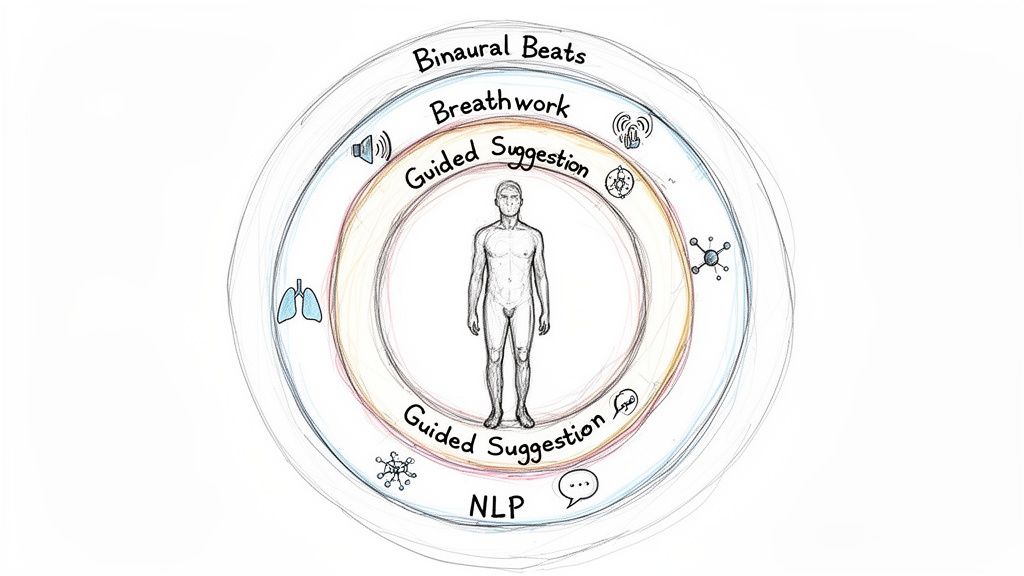
Using binaural beats for stress relief on their own can be a fantastic way to find calm. But their real power is unleashed when they’re part of a bigger, multi-sensory experience.
Think of it like an orchestra. A single violin can play a beautiful tune, but when you bring in the strings, the brass, and the percussion, you get an immersive sound that moves you on a completely different level.
That’s exactly how we approach binaural beats in the 9D Breathwork method. They aren’t just a solo act. We weave them into a carefully constructed tapestry with other powerful techniques to guide you on a journey that goes far beyond simple relaxation.
The Power of a Multi-Layered Approach
The 9D Breathwork experience is designed to intentionally layer several science-backed modalities, with each one making the others more effective. This creates a cohesive session where the whole becomes so much greater than the sum of its parts.
These core components work in concert to guide you into a deeply altered state of consciousness—the perfect space for real, lasting change to happen.
- Intentional Breathwork: We use specific, guided breathing patterns to activate your nervous system, helping you release stored physical and emotional tension from your body. To go deeper on this, you can learn more about how breathwork therapy works and why it’s a foundational piece of the puzzle.
- Hypnotic Guidance: Carefully crafted verbal suggestions help you bypass the critical, chattering conscious mind. This opens a direct pathway for positive messages of empowerment and change to be received by your subconscious.
- Neuro-Linguistic Programming (NLP): We use principles from NLP to help you spot and reframe the limiting beliefs and negative thought loops that fuel stress and anxiety in the first place.
When you combine these elements with the brainwave entrainment from binaural beats, the effect is profound. The breathwork opens up your body, the hypnotic guidance quiets your mind, and the binaural beats set the stage, nudging your brain into that receptive, deeply relaxed theta state.
Going Beyond Stress Relief to Rewire Your Brain
This integrated method isn’t just about managing stress in the moment. It’s about getting to the root of it by accessing the subconscious mind, which is the command center for our deepest patterns, beliefs, and emotional reactions. A study in the journal Frontiers in Psychology confirmed this, finding that combining sound therapy with other mindfulness practices significantly boosted emotional regulation, proving that a multi-faceted approach really does get better results.
In a 9D Breathwork journey, the binaural beats are what help create the ideal brainwave state for this subconscious work. The Theta state, often called the “twilight state,” is where the barrier between the conscious and subconscious mind becomes thin and permeable.
This is where the real rewiring happens. While you’re in this state, guided by NLP and hypnotic suggestion, you can start to update your old internal “software”—the outdated beliefs and automatic reactions that keep you stuck in cycles of stress. You’re not just calming your nervous system; you are actively reprogramming it to be more resilient.
This approach allows you to shift from passively listening to a track to actively participating in your own transformation. It’s the difference between watching a movie about climbing a mountain and actually making the ascent yourself, fully equipped with the right gear. By integrating binaural beats for stress relief into this larger framework, you can unlock deeper insights and create far more sustainable changes in your mental and emotional well-being.
A Quick Word on Safety and Best Practices
Binaural beats are a safe and powerful tool for most people looking for stress relief, but it’s smart to go in with your eyes open. Anytime you’re working with something designed to shift your mental state, a little awareness goes a long way.
Think of these not as strict rules, but as simple, common-sense guidelines to make sure your experience is a good one.
For a few people, it’s best to proceed with caution. If you have a history of seizures or epilepsy, please talk to your doctor before diving in. The whole point is to influence brainwave activity, and that could potentially trigger a neurological response. The same goes for anyone with a pacemaker or other implanted medical device—it’s always best to get a medical opinion first.
How to Get the Most Out of Your Sessions (Safely)
To build a practice that feels good and actually works, keep these simple things in mind. This isn’t just about avoiding problems; it’s about setting yourself up for the best possible results.
- Keep the Volume Reasonable: You don’t need to blast the audio for the beats to work their magic. A comfortable, moderate volume is all you need. This protects your hearing over the long haul and, frankly, is just more relaxing. The effect comes from the subtle frequency difference your brain perceives, not from how loud it is. A 2022 review in the International Journal of Environmental Research and Public Health confirmed that while binaural beats are safe, prolonged exposure to any loud audio can harm hearing, so keeping the volume moderate is key.
- Start Short and Drink Water: If you’re just starting out, ease into it. Begin with shorter sessions—maybe just 5 to 10 minutes at a time—to see how your mind and body feel. And don’t forget to stay hydrated. Your brain works better when it has enough water, which can make the whole experience more effective.
- Never, Ever Listen While Driving: This one is non-negotiable. The very frequencies that guide you into deep relaxation (like Alpha and Theta) are designed to make you feel calm, meditative, or even a bit drowsy. That’s the last thing you want when you’re behind the wheel, operating machinery, or doing anything else that requires your full, focused attention.
Actionable Safety Tip: Create a “Binaural Beats” playlist on your phone and a separate “Driving” playlist. Keeping them physically separate prevents you from accidentally playing a relaxation track when you need to be alert.
Your Questions About Binaural Beats, Answered
Let’s tackle some of the most common questions that come up. Think of this as a quick-start guide to clear up any final uncertainties and get you feeling confident about diving in.
How Long Does It Take to Feel a Difference?
Most people notice a subtle shift pretty quickly, often within the first 5 to 10 minutes. You might feel your shoulders drop, your breathing slow down, or the frantic pace of your thoughts begin to ease. It’s a gentle, immediate release of tension.
For deeper, more lasting changes to your overall stress levels, it’s all about consistency. Think of it like training a muscle. A daily practice of just 15-20 minutes over a few weeks can help retrain your nervous system to be more resilient and less reactive.
And science backs this up. One study showed that after only 20 minutes of listening, participants had a lower heart rate and other clear physiological signs of relaxation. If you’re curious about the data, you can read the full findings on physiological stress reduction and see just how fast your body can respond.
Do I Really Need Fancy Headphones?
Nope. You don’t need to break the bank on expensive audio gear. The only thing that truly matters is that you use stereo headphones or earbuds.
Why? The whole magic of binaural beats happens because a slightly different frequency is delivered to each ear. Your brain then creates the “beat” internally. This simply won’t work with mono sound or open-air speakers. So, any comfortable pair of stereo headphones you have on hand will do the trick perfectly.
Can I Listen to These While I’m Working?
This is a great question, and the answer is: it depends entirely on the frequency you’re using and what kind of work you’re doing.
Here’s a simple breakdown of how to use binaural beats for stress relief in different situations:
- For Getting in the Zone: If you’re tackling repetitive or low-focus tasks, a Beta frequency track (14-30 Hz) can sometimes help with alertness and concentration.
- For True De-Stressing: To genuinely unwind and reduce stress, Alpha (8-13 Hz) and Theta (4-7 Hz) frequencies are your best bet. These are most powerful when you can step away from your screen, close your eyes, and let go of distractions.
Actionable Tip: Create a “Work Focus” playlist with Beta tracks and a “De-Stress” playlist with Alpha/Theta tracks. This makes it easy to choose the right tool for the right moment without having to think about it.
At 9D Breathwork, we don’t just use binaural beats—we weave them into a complete sensory experience. By combining them with powerful breathwork and guided hypnosis, we create a journey that can help you do more than just manage stress; it can help you fundamentally change your relationship with it.
See how our multi-layered approach works by starting your journey at https://9dbreathwork.com.