That feeling of drowning—like you’re being hit by a tidal wave of emails, deadlines, and personal responsibilities—isn’t just in your head. It’s a very real physiological response.
When your brain perceives too many demands at once, it flips the switch on your sympathetic nervous system, trapping you in a state of high alert.
This is your classic “fight-or-flight” mode. It’s a brilliant system for short-term survival, but it’s terrible for navigating a complex workday. When it’s activated, your body gets flooded with cortisol, the main stress hormone. Your heart pounds, your muscles clench up, and your ability to think clearly or creatively takes a nosedive. You’re not failing; your biology is just doing what it was programmed to do.
The trick to regaining control isn’t about muscling through or suddenly becoming more productive. It’s about learning how to deliberately send a signal of safety to your nervous system.
The Science Behind the Spiral
Overwhelm is a vicious feedback loop. The more stressed you feel, the less capable you become of actually handling your tasks, which—you guessed it—creates even more stress.
This is why a simple to-do list can suddenly feel like an insurmountable mountain. Your brain’s prefrontal cortex, the part responsible for planning and decision-making, effectively goes offline.
But here’s the good news: you can consciously break this pattern. Simple, targeted actions can interrupt that stress response and bring your logical, thinking mind back into the driver’s seat. It’s also helpful to remember that not all stress is bad. Understanding the difference between productive pressure and debilitating distress is a game-changer. You can dive deeper into how different types of stress affect you in our guide on distress versus eustress.
Start Small to Reclaim Your Calm
If you feel like you’re constantly fighting a battle with stress, you are far from alone. Recent statistics are pretty staggering, showing that 83% of U.S. workers suffer from work-related stress, with many pointing to their job as a huge source of that pressure.
The solution, however, is often much simpler than we make it out to be. A study in the journal Frontiers in Human Neuroscience found that mindfulness practices, which are at the core of many anti-overwhelm techniques, significantly alter brain structures associated with stress and emotional regulation. You can find more data exploring workplace stress and its remedies over at Apollotechnical.com.
The most powerful tool you have to stop feeling overwhelmed is your own breath. Think of it as the remote control for your nervous system—it lets you downshift from panic to peace in just a few moments.
Regaining control doesn’t start with a massive life overhaul. It starts with small, intentional shifts. It’s about creating tiny pockets of calm that give you the mental space to think clearly and choose your next move, rather than just reacting to the chaos around you.
Sometimes, you need a quick reset right now. When you feel that wave of overwhelm building, having a few go-to techniques can make all the difference.
Here’s a quick-reference table with three simple actions you can take the moment you start to feel underwater.
Immediate Actions to Counter Overwhelmed Feelings
| Technique | Core Principle | When to Use It |
|---|---|---|
| Box Breathing | Rhythmic Control: Inhale for 4, hold for 4, exhale for 4, hold for 4. This pattern directly engages the parasympathetic nervous system. | Action: When your thoughts are racing, close your eyes and do five full rounds. Use it right before a tough conversation or after an unexpected, stressful email. |
| 5-4-3-2-1 Grounding | Sensory Engagement: Name 5 things you see, 4 you feel, 3 you hear, 2 you smell, and 1 you taste. This pulls you out of your head and into the present. | Action: When you’re stuck in a “what-if” loop, do this silently at your desk. Actually touch the surface of your desk, feel the fabric of your clothes. Make it physical. |
| Mindful Micro-Break | Pattern Interruption: Step away from your screen. Look out a window for 60 seconds, stretch your arms overhead, or sip a glass of water slowly. | Action: When you’ve read the same sentence three times, stand up. Walk to the other side of the room and back. The physical shift interrupts the mental block. |
These aren’t long-term fixes on their own, but they are incredibly effective pattern-interrupters. They give you just enough breathing room to move on to the next step with a clearer head.
Practical Techniques for In-the-Moment Calm
When your mind starts racing and your chest tightens, you don’t need a long-term strategy—you need an emergency brake. The key to learning how to stop feeling overwhelmed is having a few go-to techniques that can pull you out of a stress spiral in minutes. These methods are discreet, powerful, and designed for real-world pressure.
I think of it as a simple three-part process: Recognize, Interrupt, and Act. You have to first notice you’re spinning out, then do something to break the cycle before you can actually move forward effectively.
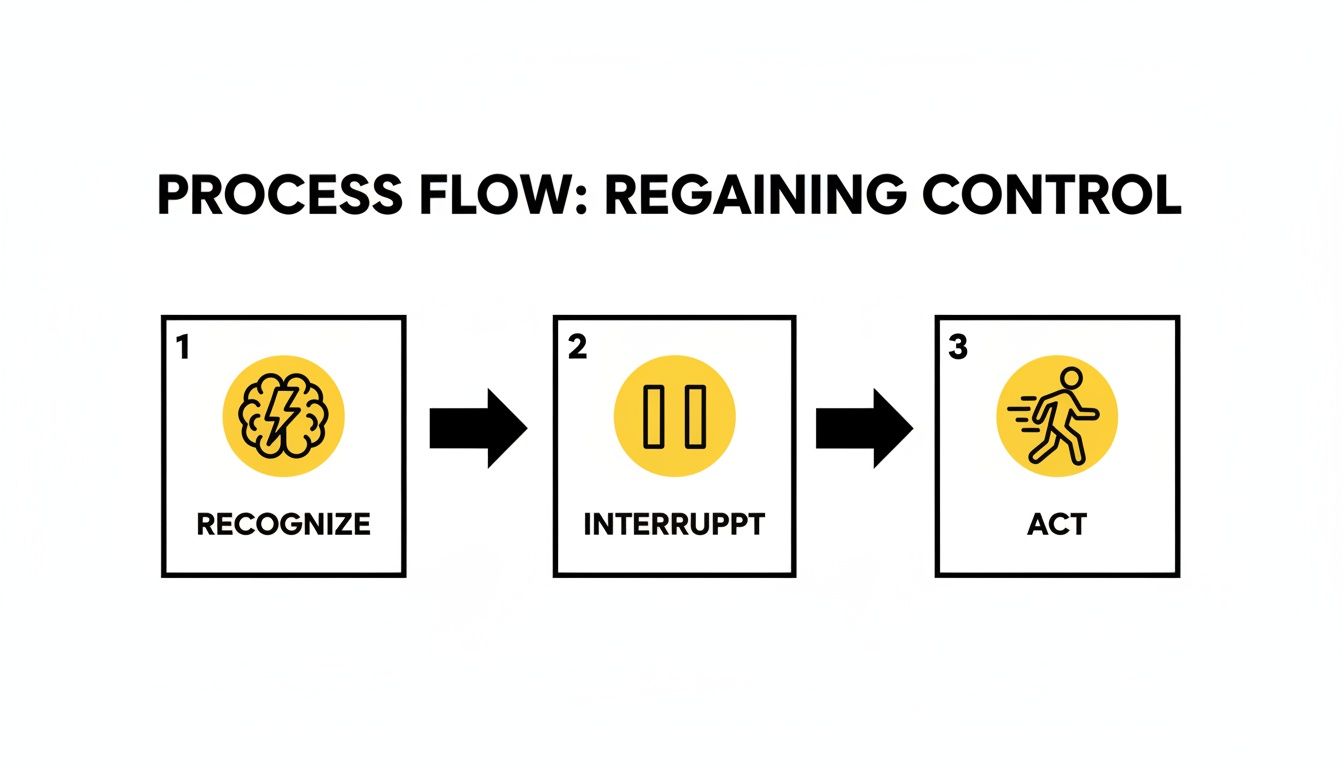
This little flow chart nails it. You can’t skip that middle step—the interruption is what gives you the space to choose a better response than panic.
Master Box Breathing
One of the most effective tools in my own toolkit is Box Breathing. There’s a reason Navy SEALs use it to stay level-headed under extreme pressure. It works by directly tapping into your parasympathetic nervous system, which is basically your body’s built-in “calm down” button.
It couldn’t be simpler:
- Breathe in through your nose for 4 seconds.
- Hold your breath for 4 seconds.
- Breathe out through your mouth for 4 seconds.
- Hold the exhale for 4 seconds.
Just repeat that cycle for a minute or two. The steady rhythm is incredibly good at slowing down a runaway heart rate. A 2017 study published in Frontiers in Psychology found that slow, deep breathing techniques significantly decrease cortisol levels and improve cognitive performance under stress. You can dive deeper into how intentional breathing works in our guide on how to calm anxiety naturally.
Actionable Example: Imagine you just opened your calendar and see three meetings have been booked back-to-back over your lunch break. Your heart starts pounding. Before reacting, mute your microphone, turn off your camera if you’re on a call, and do three complete cycles of Box Breathing. Then, open your email to politely decline or reschedule one of the meetings. That 60-second pause gives you clarity instead of a panicked response.
Use the 5-4-3-2-1 Grounding Technique
When you feel overwhelmed, your mind is usually stuck spinning in future worries or past mistakes. Grounding techniques are designed to yank you right back into the present moment, and the 5-4-3-2-1 method is one of the best. It works by forcing your brain to stop its abstract worrying and focus on concrete, sensory information.
It’s easy to do anywhere, anytime. Just quietly notice:
- 5 things you can see: Your keyboard, a coffee ring on your desk, a scuff on your shoe, a plant in the corner, the light hitting the wall.
- 4 things you can feel: The solidness of the floor under your feet, the fabric of your jeans, the cool surface of your desk, the smooth back of your phone.
- 3 things you can hear: The hum of a computer, distant sirens, your own breathing.
- 2 things you can smell: The faint scent of coffee, the soap you used this morning.
- 1 thing you can taste: The last sip of water or the faint taste of toothpaste.
This isn’t just a distraction; it’s a proven way to hijack the anxious thought loop. Research in Applied Psychophysiology and Biofeedback has shown that shifting your attention to sensory details can physically reduce the body’s stress response. A 2019 article in the journal Emotion confirmed that this kind of “attentional deployment” is a highly effective way to regulate intense feelings on the spot.
Think of these techniques as your first line of defense. They provide that critical, immediate relief so you have the headspace to start tackling the real source of the stress.
Using Cognitive Tools to Reframe Your Workload
Once you’ve calmed your body’s immediate stress response, it’s time to work with your mind. That crushing feeling of being overwhelmed often isn’t just about the sheer volume of tasks on your plate—it’s about your perception of them. By using a few practical mental models, you can shift your perspective from chaotic to controlled.
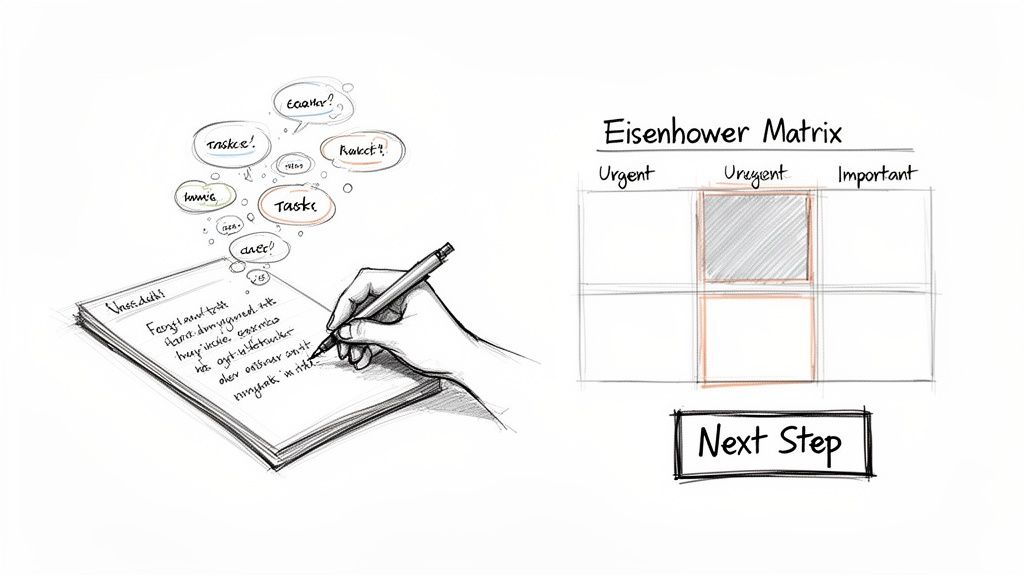
This mental shift is everything. Our thoughts directly fuel our feelings of stress. A great starting point is understanding common cognitive distortions that might be making things worse. Recognizing patterns like “catastrophizing”—where you automatically jump to the worst-case scenario for every task—is the first step toward dismantling them.
Start with a Brain Dump
The first technique sounds almost too simple, but its power is in that simplicity: get everything out of your head. When tasks, worries, and half-baked ideas are just swirling around in there, they feel infinite and tangled. A brain dump takes that internal chaos and makes it external, finite, and manageable.
Actionable Step: Grab a pen and paper right now. Set a timer for 10 minutes. Write down absolutely everything that’s taking up mental real estate. Don’t organize it. Just get it all out—the big work projects, the small personal errands (“buy milk”), that nagging worry about an email you forgot to send. The only goal here is to create a complete, unfiltered inventory of your mental load.
This act alone provides instant relief. Your brain no longer has to burn precious energy just trying to hold onto everything, which frees up mental bandwidth to actually start solving problems. It’s also a foundational step in learning how to break negative thought patterns that thrive in a cluttered mind.
Prioritize with the Eisenhower Matrix
Okay, you have your list. Now it’s time to bring some order to the chaos. The Eisenhower Matrix is a classic for a reason—it’s a powerful decision-making tool that helps you separate what’s truly important from what just feels urgent.
Actionable Step: Draw the four quadrants on a fresh sheet of paper. Go through your brain dump list item by item and place each one into one of the four boxes:
- Urgent & Important (Do First): These are the true fires—the crises and hard deadlines that need your attention now. Example: “Finish the client report due by 5 PM today.”
- Not Urgent & Important (Schedule): This is where real progress happens. Think long-term planning, relationship building, and deep work. Example: “Research professional development courses for next quarter.”
- Urgent & Not Important (Delegate): These are the interruptions, many meetings, and tasks that scream for your attention but don’t actually move the needle on your core goals. Example: “Respond to a non-critical team-wide email.”
- Not Urgent & Not Important (Delete): These are the distractions, time-wasters, and bad habits. Example: “Scrolling social media for 20 minutes.”
Sorting your brain dump into this matrix is often a revelation. You’ll probably find that only a handful of items actually land in that “Urgent & Important” box. Suddenly, your monster to-do list shrinks to a few clear priorities, giving you an obvious and manageable starting point.
This isn’t just about time management; it’s about managing your energy and focus. Workplace stress is a massive problem, with one poll showing that 44% of U.S. workers are thinking about quitting due to burnout. Cognitive tools like these are a form of mindfulness, and a 2022 meta-analysis in JAMA Psychiatry found that mindfulness-based interventions can reduce anxiety symptoms on par with standard medication. You can explore more insights on the state of stress at work on Insightful.io.
Building Long-Term Resilience to Prevent Overwhelm
While in-the-moment fixes are lifesavers, the real game-changer is learning how to stop feeling overwhelmed for good. The goal is to build a system that prevents the tidal wave before it even has a chance to form. This means creating a sustainable rhythm for your work and life that protects your energy and strengthens your nervous system over time.
Instead of constantly reacting to stress, you can proactively lower your baseline stress level. When you do this, you become far less likely to tip into overwhelm when unexpected challenges pop up. Think of it as building a fortress, not just patching up walls after every attack.
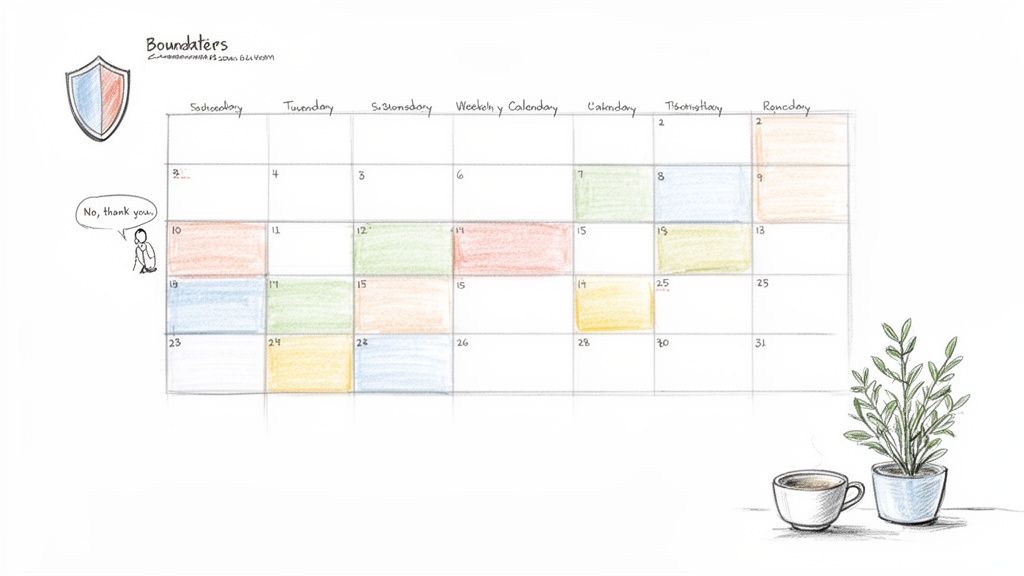
Establish Rock-Solid Boundaries
Boundaries are the gatekeepers of your time and energy. Without them, you’re leaving the door wide open for other people’s priorities to flood your schedule. Let’s be clear: learning to say “no” isn’t selfish. It’s a fundamental act of self-preservation and one of the most powerful ways to build resilience.
Actionable Step: Identify one area where your boundaries are weak. Is it late-night emails? Saying yes to every meeting? Pick one. Then, prepare a script you can use.
- For a new project when you’re at capacity: “Thank you for thinking of me for this. My plate is full with [Project X and Y] right now, and I want to ensure I deliver high-quality work on my current commitments. I won’t be able to take this on.”
- For a last-minute request: “I understand this is a priority, but I’m in the middle of a time-sensitive task. I can look at this after [specific time or day].”
- For a meeting invite with no agenda: “I’d love to attend. Could you please share the agenda so I can prepare and make sure I can contribute effectively?”
These responses are respectful, firm, and completely professional. They communicate your capacity without creating conflict, putting you back in control of your workload. A study in the Journal of Applied Psychology linked the ability to set boundaries and detach from work with lower levels of burnout and higher overall well-being.
Structure Your Day with Time Blocking
Time blocking is a simple but powerful method where you schedule every part of your day—including breaks and downtime. Instead of staring at a vague to-do list, you assign specific tasks to specific blocks of time on your calendar. This proactive approach fights overwhelm by giving your day structure and intention.
A 2014 study in the Journal of Experimental Psychology found that this kind of structured planning reduces cognitive load because you’ve already made the tough decisions about what to work on and when. You can just get to work, rather than spending precious mental energy deciding what to do next.
Actionable Step: Open your calendar for tomorrow. Block out a 90-minute chunk for your most important task (“deep work”). Then, block out a 15-minute break immediately after. Even starting with one block builds momentum.
For this to really stick, it helps to explore effective strategies to build mental resilience that can support your new structure. A resilient mindset helps you honor your time blocks, even when distractions inevitably pop up.
You can also find deeper guidance on how to build mental resilience in our dedicated article, which explores techniques to fortify your mind against daily pressures. Creating these systems isn’t just about managing tasks; it’s about building a life that feels intentional, controlled, and sustainable.
Recognizing When It’s Time for More Support
The strategies we’ve covered are fantastic for handling the overwhelm that crops up in daily life. But what happens when that feeling isn’t just a temporary visitor? Sometimes, it settles in for the long haul, becoming a persistent signal that something deeper needs attention. It’s so important to know when self-help tools aren’t cutting it anymore and it’s time to call in reinforcements.
If you find that feeling of being completely swamped has become your new normal and it’s starting to interfere with your life, it might be time to get some help. This isn’t a sign that you’ve failed. Far from it—it’s a sign of incredible self-awareness and strength. Think of it like this: you wouldn’t hesitate to call a plumber for a major leak you can’t fix yourself. This is no different.
Red Flags That You Might Need Professional Help
Be honest with yourself. Are you experiencing any of these signs on a regular basis?
- You feel numb or disconnected. It’s like you’re watching your life from a distance, unable to connect with your work, hobbies, or even the people you love.
- You’re constantly irritable or down. Little things set you off, you’re quick to anger, or there’s a persistent feeling of dread you just can’t shake.
- You’re physically exhausted all the time. This isn’t just feeling tired. It’s a deep, bone-weary exhaustion that sleep doesn’t seem to fix—a classic symptom of burnout.
- Nothing feels fun anymore. The things that used to light you up and bring you joy now just feel like another box to check on your endless to-do list.
These aren’t just signs of a bad week. They often point toward more serious conditions like clinical burnout, anxiety, or depression. In fact, a 2021 study in the Journal of Clinical Psychology found a major overlap between severe burnout and symptoms of depression, highlighting why getting a proper diagnosis from a professional is so critical.
Actionable Step: If these red flags resonate, take one small step today. Search for therapists in your area on a platform like Psychology Today, or ask your primary care physician for a referral. Simply looking up options is a powerful, proactive step.
A professional can help you dig deeper and uncover the true roots of your overwhelm, which often go beyond a heavy workload. They can help you see challenging thought patterns or life situations you might be stuck in. We know this works—countless studies have shown how effective therapies like Cognitive Behavioral Therapy (CBT) are for treating stress and anxiety. Similarly, other research has shown that executive coaching can dramatically reduce stress at work and make you more resilient.
Making the choice to get help isn’t just about getting through the day; it’s an investment in your long-term health and your ability to truly thrive.
Got Questions About Overcoming Overwhelm? Let’s Get Them Answered.
It’s one thing to read about these strategies, but it’s another to actually put them into practice when you’re in the thick of it. Questions always come up, so let’s tackle some of the most common ones I hear about how to stop feeling so overwhelmed.
How Quickly Can I Actually Feel a Difference?
Faster than you probably think.
When you’re in the middle of that deer-in-the-headlights feeling, immediate techniques like Box Breathing or the 5-4-3-2-1 grounding exercise can offer relief in just a few minutes. They work by directly hitting the brakes on your body’s stress response. A 2019 study actually confirmed that simple shifts in your attention like these are incredibly effective for managing your emotions in the moment.
For the bigger-picture stuff—like setting real boundaries or using the Eisenhower Matrix to sort your priorities—it’s all about consistency. Give it a week or two of genuine effort, and you’ll likely feel a noticeable drop in your daily stress levels. The aim here is steady progress, not a magical overnight fix.
What’s the Very First Step If I’m Too Overwhelmed to Even Start?
This is a big one. When you’re so swamped that you’re frozen, trying to tackle your entire to-do list is the worst thing you can do. The best first step is always a small, physical action that takes zero brainpower.
Actionable Step: Stand up right now. Stretch your arms as high as you can for 30 seconds. Then, take three deliberately slow breaths. In through your nose for four counts, and out through your mouth for six. Research from Applied Psychophysiology and Biofeedback has shown that this simple act can physically dial down your body’s stress response, carving out just enough mental space to decide on the next tiny step.
A study in the journal Emotion found that even minor physical actions paired with focused breathing can effectively interrupt intense emotional states. It’s a powerful tool to use when you feel completely stuck.
This isn’t about solving the problem; it’s about breaking the paralysis. It’s the circuit breaker you need to get things moving again.
Can This Stuff Actually Help If My Job Is the Real Problem?
Yes, absolutely. While these techniques won’t change a toxic work environment, they change your ability to handle it. That’s where your power lies.
When you learn to regulate your own nervous system, you can think more clearly, even when chaos is erupting around you. This allows you to set boundaries from a place of calm confidence instead of frazzled reaction. You can communicate what you need without the emotional charge. Building that internal resilience is what gives you the clarity to navigate the situation, address it head-on, or decide it’s time to make a change.
Feeling overwhelmed is a signal—your system is overloaded. If you’re ready to stop just coping and start rewiring your response to stress for good, 9D Breathwork offers a profound way to do just that. Our sessions guide you through an immersive experience of breath, sound, and coaching to help you release deep-seated stress and build resilience from the inside out.