When anxiety hits, the fastest way to find solid ground is to pull yourself out of your head and back into your body. Simple, immediate techniques like engaging your senses or controlling your breath can stop a panic response in its tracks. They work by breaking the cycle of anxious thoughts and anchoring you firmly in the present moment, offering real relief, right when you need it.
Your Toolkit for Immediate Relief
Anxiety can feel like your mind is just spinning out of control. That racing heart, the tight chest, the whirlwind of “what if” thoughts—it’s all your sympathetic nervous system, your body’s built-in alarm system, going into overdrive. The trick isn’t to wrestle with that feeling, but to gently show your nervous system that the threat has passed.
For that, you need practical, in-the-moment tools. These aren’t long-term strategies; they’re your first aid kit for when you’re overwhelmed. Whether you’re about to walk into a nerve-wracking meeting, stuck in a crowded subway, or just frozen by anxiety at home, these methods are designed to cut through the noise and offer immediate calm.
Think of them as an anchor. When your mind is being dragged into a storm of future worries or past regrets, these techniques tether you to the here and now.
The 5-4-3-2-1 Sensory Grounding Method
One of the most powerful ways to halt an anxiety spiral is to reconnect with your senses. The 5-4-3-2-1 method is brilliant because it forces your brain to shift focus from abstract fears to the tangible world right in front of you. It’s discreet, easy to remember, and it just works.
Actionable Step: Try this right now, wherever you are.
- See 5 things: Look around you and name five objects you can see. Don’t just glance. Notice details. For example: “I see my blue coffee mug. I see a photo of my family. I see the wood grain on my desk. I see my dusty houseplant. I see the blinking cursor on my monitor.”
- Feel 4 things: Tune into physical sensations. Acknowledge the firm support of the chair against your back, the texture of your jeans on your legs, the solid ground beneath your feet, and the cool metal of your watch on your wrist.
- Hear 3 things: Listen intently and pick out three distinct sounds. It could be the low hum of your computer, the distant sound of traffic, or even the quiet rhythm of your own breathing.
- Smell 2 things: What can you smell? Perhaps it’s the lingering scent of your morning coffee or the faint smell of soap on your hands. If you can’t easily identify two scents, just imagine two of your favorites, like freshly cut grass or baking cookies.
- Taste 1 thing: Focus on one thing you can taste. Take a small sip of water, notice the minty aftertaste of your toothpaste, or simply become aware of the sensation of your tongue resting in your mouth.
This technique isn’t magic; it’s neuroscience. By forcing your brain to process sensory input, you’re redirecting its resources away from the feedback loop that fuels anxiety. You’re giving your mind a different job to do, which helps quiet the alarm bells and brings you back to a state of calm.
Control Your Breath, Control Your Mind
Your breath is the remote control for your nervous system. When you’re anxious, you take short, shallow breaths, which tells your brain there’s danger. By deliberately slowing down your breathing, you send a powerful signal back that says, “I’m safe.”
A tried-and-true technique for this is Box Breathing, famously used by Navy SEALs to stay calm under intense pressure. It’s a simple, four-part rhythm.
Actionable Step: Let’s do three rounds together.
- Inhale slowly through your nose for a count of four.
- Hold your breath at the top for a count of four.
- Exhale slowly through your mouth for a count of four.
- Hold your breath at the bottom for a count of four. Repeat.
Just repeating this cycle for a minute or two can make a huge difference. The steady, predictable pattern helps lower your heart rate and activates your parasympathetic nervous system—your body’s “rest and digest” state. If you want to explore this further, there are many breathing exercises to lower your heart rate that offer a profound sense of immediate calm.
The best part? You can do this absolutely anywhere—in your car before a tough conversation, at your desk, or in the middle of a chaotic grocery store—to instantly feel more in control.
Building Daily Habits for Lasting Calm
While those in-the-moment techniques are fantastic for stopping an anxiety spiral, building a true sense of lasting calm is a different game entirely. It’s not about finding a single magic bullet. Instead, it’s about weaving small, consistent habits into your days that act as a buffer against stress.
Think of it like building up your mental and emotional resilience. These daily practices strengthen your nervous system, so when life inevitably throws you a curveball, you’re better equipped to handle it without getting overwhelmed. We’re moving beyond quick fixes to focus on the foundational pillars of well-being: how you move and how you rest.
Harnessing Movement for Mental Clarity
There’s no denying the powerful link between body and mind. When you’re anxious, your body tenses up, flooded with stress hormones like cortisol. One of the best ways to hit the reset button is simply to move.
And no, you don’t need to sign up for a punishing gym routine to see a difference.
Even a brisk 15-minute walk on your lunch break can do wonders. It gets you out of your head, releases mood-boosting endorphins, and helps your body process all that nervous energy. It’s a simple, powerful way to interrupt the cycle of anxious thoughts.
The science backs this up, too. A huge 2021 meta-analysis found that regular exercise led to an average 20% drop in anxiety symptoms. Just aiming for 30 minutes of moderate activity most days is a game-changer for managing anxiety naturally.
Actionable Tip: Open your calendar right now and schedule a 20-minute “walking meeting” or “stretch break” for tomorrow. Treat it as a non-negotiable appointment with yourself. When it’s in the calendar, you’re far more likely to do it.
Crafting a Sleep Routine for a Regulated Nervous System
Sleep isn’t a luxury; it’s the foundation of a calm mind. It’s when your brain gets to work processing emotions and filing away memories, giving your entire nervous system a much-needed reset. When you’re chronically sleep-deprived, your body stays stuck in a high-alert state, making you far more vulnerable to anxiety.
This is where good sleep hygiene comes in. Creating a solid pre-sleep routine sends clear signals to your brain that it’s time to power down. The goal is to create a peaceful runway from the chaos of the day to a state of deep rest.
Below is a great visual reminder of two simple techniques—Box Breathing and the 5-4-3-2-1 Method—that are perfect for both immediate relief and for winding down at night.
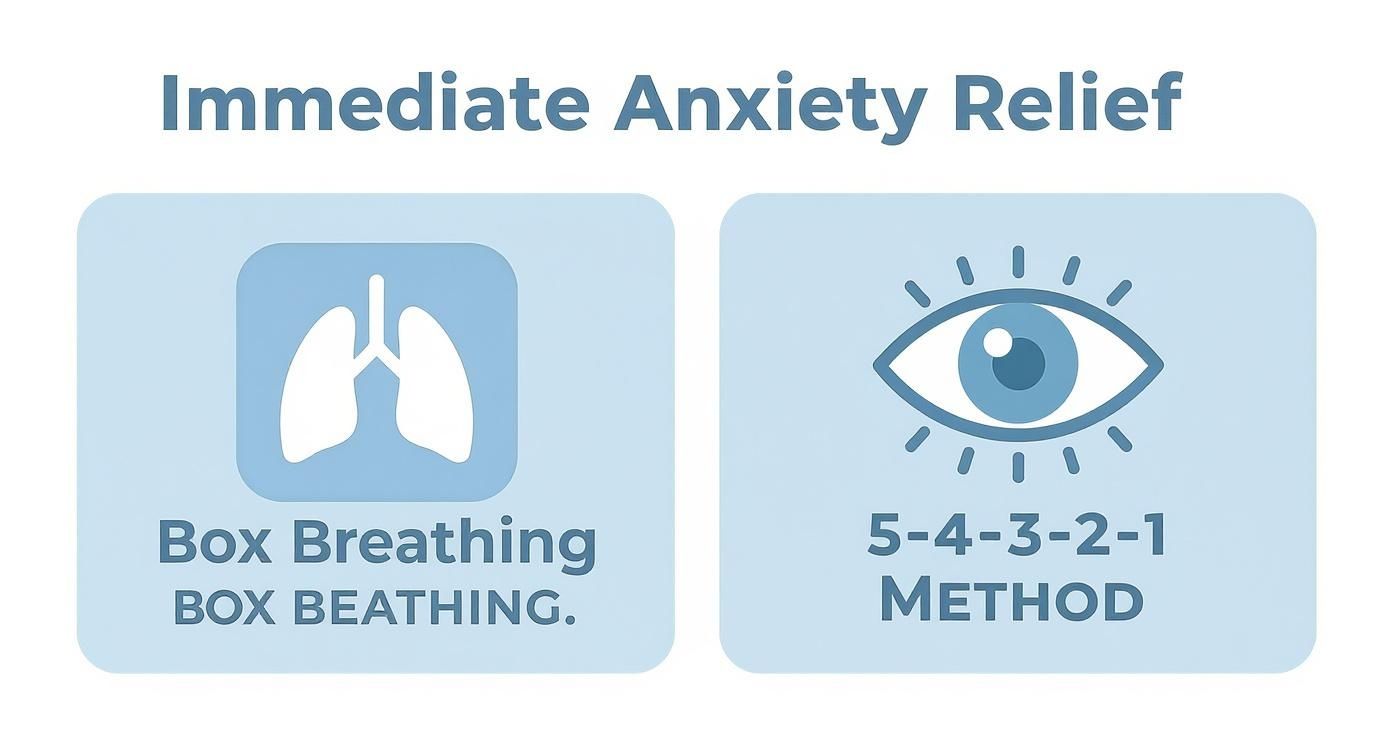
As the infographic shows, both controlled breathing and sensory grounding are direct lines to your parasympathetic nervous system (the “rest and digest” side), making them ideal for your evening routine.
Practical Steps for Better Sleep Hygiene
You don’t need a complicated overhaul to improve your sleep. Just start with a few of these simple, effective habits.
- Dim the Lights: About an hour before you want to be asleep, start lowering the lights. This simple cue helps your body start producing melatonin, the hormone that governs your sleep-wake cycle.
- Disconnect from Screens: The blue light from our phones and laptops is a known melatonin-blocker. Tonight, set a phone alarm for 60 minutes before your bedtime. When it goes off, plug your phone in across the room and leave it there.
- Create a Relaxing Ritual: Find a calming activity you genuinely enjoy. Maybe it’s reading a physical book (not on a tablet!), listening to some chill music, or journaling to get any racing thoughts out of your head and onto paper.
- Consider a Calming Beverage: A warm, soothing drink can be a powerful signal to your body that the day is done. There are some fantastic calming herbal blends for bedtime that can help you unwind.
To give you a clearer picture of how these habits work together, here’s a quick-reference table.
Daily Habits for Natural Anxiety Management
This table breaks down how these key lifestyle changes directly impact anxiety and gives you a simple first step for each.
| Habit | Impact on Anxiety | Simple Action Step to Start |
|---|---|---|
| Consistent Sleep | Regulates the nervous system, processes emotions, and reduces cortisol. Poor sleep heightens the “fight or flight” response. | Create a “wind-down” hour before bed: dim lights, no screens, and read a physical book. |
| Regular Movement | Releases endorphins (natural mood-lifters) and metabolizes stress hormones like adrenaline and cortisol. | Schedule a 15-minute walk into your lunch break every day this week. |
| Mindful Nutrition | Stabilizes blood sugar to prevent mood swings. Certain nutrients (e.g., magnesium) support nervous system function. | Add a handful of leafy greens (like spinach) to one meal each day. |
| Hydration | Dehydration can trigger physical symptoms that mimic anxiety (e.g., dizziness, heart palpitations). | Keep a water bottle on your desk and aim to refill it at least twice during the workday. |
Remember, it’s the small, consistent actions that compound over time. By prioritizing both movement and restorative sleep, you’re doing more than just managing symptoms—you’re building a more resilient and balanced nervous system from the ground up. These small shifts are also a fantastic way to learn how to reduce cortisol levels naturally, which is a cornerstone of long-term anxiety relief.
The Surprising Link Between Diet and Anxiety
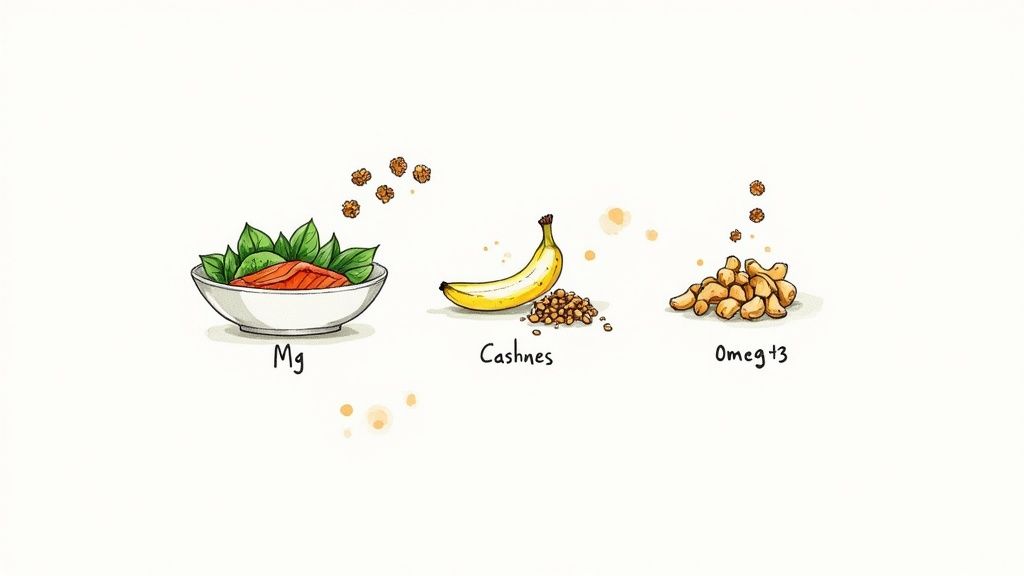
It’s easy to overlook, but what you put on your plate has a direct and surprisingly powerful influence on your mental state. While breathing exercises and grounding techniques are fantastic for in-the-moment relief, understanding the deep connection between your gut and your brain is a game-changer for long-term anxiety management.
This isn’t about a restrictive, joyless diet. It’s about making a few smart, simple choices to nourish your nervous system from the inside out.
Think of your gut and brain as being in constant conversation through something called the gut-brain axis. When your gut is happy and full of beneficial bacteria, it sends calming signals upstairs. But an imbalanced gut can send out stress signals, contributing to those familiar feelings of unease and anxiety.
Simply put, the food you eat can either soothe your nervous system or accidentally put it on high alert. By focusing on whole, nutrient-dense foods, you’re not just feeding your body—you’re actively building a calmer, more resilient mind.
Foods That Soothe Your Nervous System
Weaving specific anxiety-reducing foods into your diet is way easier than it sounds. Many everyday foods are packed with compounds that help regulate mood and dial down the physical symptoms of stress. The secret is to simply add them to what you’re already eating, not to overhaul your entire life overnight.
Here are a few powerhouse examples:
- Magnesium-Rich Foods: Often called “nature’s tranquilizer,” magnesium is a champ at calming the nervous system. You can find it in leafy greens like spinach, as well as in almonds, avocados, and even dark chocolate.
- Omega-3 Fatty Acids: Famous for their anti-inflammatory power, omega-3s are absolutely vital for brain health. Great sources include fatty fish like salmon, along with walnuts and chia seeds.
- Zinc-Packed Options: This mineral is a key player in neurotransmitter function and has been directly linked to lower anxiety. Cashews, chickpeas, and pumpkin seeds are all fantastic sources.
- B Vitamins: These are your brain’s best friends for producing mood-regulating chemicals like serotonin and dopamine. Load up on whole grains, eggs, and lean meats.
Actionable Step: For your next meal, add just one of these foods. Toss a handful of walnuts into your morning oatmeal, add sliced avocado to your toast, or mix some spinach into your scrambled eggs. It’s a small choice with a big impact.
The Impact of Smart Dietary Choices
This isn’t just folk wisdom; the science is catching up. Global studies now estimate that 20–25% of anxiety symptoms can be improved through better dietary patterns alone. For instance, a recent meta-analysis found that omega-3 supplements could lessen anxiety severity by up to 19%.
On the flip side, diets high in processed foods were linked to a 30% greater risk of anxiety disorders. You can find more nutrition’s role in mental health on WHO.int if you’d like to dive deeper into the research.
Common Anxiety Triggers Hiding in Your Diet
Just as some foods can bring a sense of calm, others can put your nervous system on high alert. Becoming mindful of these common culprits is a huge part of managing anxiety naturally. This doesn’t mean you have to ban them forever, but knowing their impact helps you make better choices, especially on days you’re already feeling fragile.
Two of the biggest offenders are:
- Excessive Caffeine: That morning coffee can feel like a non-negotiable, I get it. But too much caffeine can perfectly mimic the physical symptoms of anxiety. It triggers adrenaline, which leads to a racing heart, jitters, and restlessness—sensations that can easily spiral into a full-blown panic attack if you’re sensitive.
- Processed Foods and Sugar: That afternoon cookie or bag of chips? They cause your blood sugar to spike and then crash violently. This rollercoaster directly messes with your mood, causing irritability, brain fog, and a spike in anxiety. These foods also fuel inflammation, which disrupts that all-important gut-brain communication.
Actionable Step: Today, swap one sugary snack for a piece of fruit. Instead of a cookie, grab a banana. You’ll get potassium and B vitamins that actually support your brain, helping to stabilize your blood sugar and fight anxiety instead of fueling it.
Cognitive Tools to Reframe Anxious Thoughts
Beyond the breathing exercises and lifestyle changes, the real battleground for anxiety is often inside our own heads. The stories we let run on a loop can either build us up or slowly wear us down.
Anxiety is frequently fueled by old, automatic thought patterns that trip your body’s alarm system, even when there’s no immediate danger. But here’s the good news: you have the power to interrupt and reshape how you think.
This isn’t about slapping a layer of fake positivity on top of real feelings. It’s about building a more honest and realistic relationship with your thoughts. Using a few simple cognitive tools, you can learn to question the narratives your anxiety spins and choose a more empowering one instead.
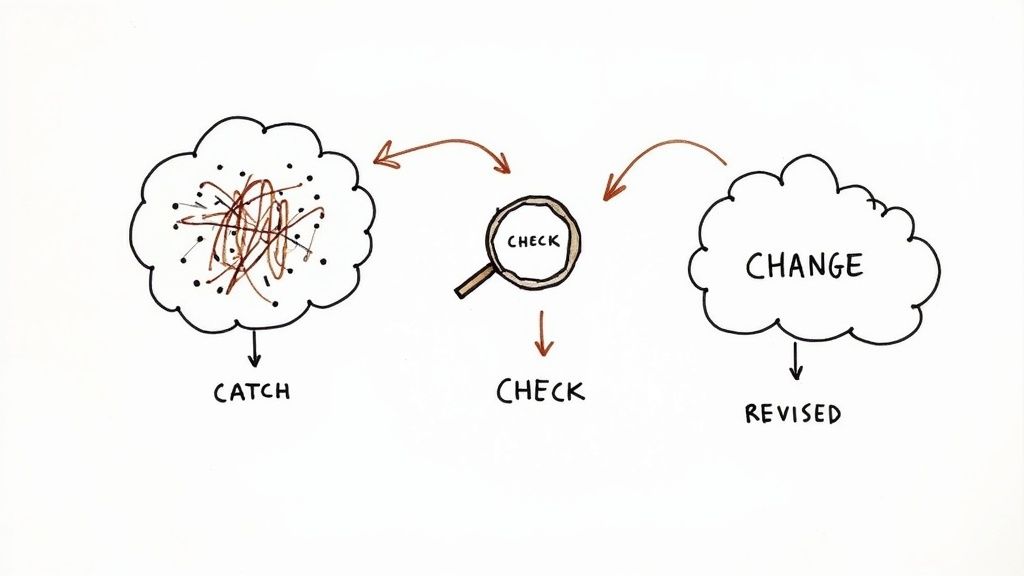
Use the Catch, Check, and Change Method
One of the most practical ways to get started is with a simple three-part method inspired by Cognitive Behavioral Therapy (CBT). It gives you a structured way to stop a negative thought spiral before it picks up speed. Think of it as becoming a detective of your own mind.
First, you have to catch the thought. These are often called Automatic Negative Thoughts (ANTs) because they pop up so fast we barely register them. An ANT might sound like, “I’m going to completely bomb this presentation,” or “Everyone here thinks I’m awkward.” The first step is just to notice it, without judging yourself for having it.
Next, you check the thought for actual evidence. Anxiety loves to speak in absolutes and worst-case scenarios, but it rarely sticks to the facts. This is where you put the thought on trial by asking some pointed questions.
Finally, you actively change the thought to something more balanced and helpful. This isn’t about telling yourself a lie; it’s about finding a more realistic, less catastrophic perspective.
By consistently running through this cycle, you’re training your brain to stop accepting anxious thoughts as gospel. You create a tiny but crucial gap between the trigger and your emotional reaction, giving you space to respond thoughtfully instead of just reacting. This is a core skill for anyone wanting to learn how to calm anxiety naturally.
Putting the Method into Practice
Let’s walk through how this works with a common stressor: a looming work deadline.
- The Situation: You have a massive project due at the end of the week.
- Catch the Thought: An automatic thought jumps in: “There’s no way I’ll finish this on time. I’m going to let everyone down.” This immediately sparks feelings of panic and overwhelm.
- Check the Evidence: Now, challenge it. Ask yourself:
- “Is it 100% certain I won’t finish? Or is that just my fear talking?”
- “What evidence do I have that I’ve met a tough deadline before? What happened then?”
- “What parts are already done? What is the very next small, physical step I can take?”
- Change the Perspective: Replace the original thought with a more balanced one. Something like: “This is a challenging deadline, but I’ve handled tough projects before. I will focus on the first task, which is [insert specific task], and ask for help if I get stuck. Doing my best is all I can control.”
See the difference? The new thought acknowledges the reality of the challenge without spiraling into disaster. It’s grounded, action-oriented, and immediately lowers the emotional heat, letting you focus on solutions instead of getting paralyzed by fear.
Observing Thoughts with Mindfulness
Another powerful tool is mindfulness—the practice of observing your thoughts and feelings from a distance, without getting tangled up in them.
Mindfulness has become a go-to strategy for natural anxiety relief for a good reason. A major review of clinical trials found that mindfulness-based programs can reduce anxiety symptoms by around 30% compared to control groups. You can dive deeper into these anxiety-reducing findings on Priorygroup.com if you’re curious about the data.
Here’s a great mental image for it: Picture yourself sitting peacefully on a riverbank. Your thoughts are like leaves floating by on the water. Some are nice, some are neutral, and some are definitely stressful. Your job isn’t to jump in the river to grab, stop, or analyze every leaf. It’s simply to sit and watch them drift past.
Actionable Step: Try this 2-minute mindfulness exercise right now.
- Find a comfortable place to sit and gently close your eyes.
- Bring your attention to your breath, just noticing the physical sensation of air moving in and out of your body.
- When a thought inevitably pops up—and it will—just gently acknowledge it. You can even mentally label it (“worrying,” “planning,” “judging”).
- Then, without getting frustrated, gently guide your focus right back to your breath.
This simple act of returning your attention, over and over, is like a workout for your brain. It teaches you that you are not your thoughts. They are just temporary mental events that come and go. This realization creates a profound sense of inner freedom and is a cornerstone of managing anxiety from the inside out.
Knowing When to Seek Professional Support
The natural strategies we’ve talked about are powerful tools for managing the anxiety that comes with everyday life. They can genuinely help you get a handle on your nervous system, shift your mindset, and build real resilience. But it’s just as important to be honest with yourself and recognize when these tools aren’t quite cutting it.
Reaching out for professional help isn’t admitting defeat. Far from it. It’s a brave, smart move toward deeper healing. You’d see a doctor for a physical issue that just won’t go away, right? Taking care of your mental health is no different—it’s a sign that you value yourself enough to get the specialized support you deserve.
Signs It Might Be Time to Reach Out
So, how do you know when anxiety has shifted from a manageable wave to a full-blown storm that requires a professional hand? Everyone’s line is different, but a few key signs are pretty universal. Spotting them early can make all the difference in finding your way back to solid ground.
Take a moment and see if any of this sounds familiar:
- It’s Disrupting Your Daily Life: Are you struggling to get to work on time, finish basic tasks, or keep up with things at home? When anxiety consistently gets in the way of your ability to just function, it’s a clear signal to get support.
- It’s Hurting Your Relationships: Have you started pulling away from friends and family? Is anxiety sparking arguments with the people you love? Our connections are a lifeline, and if anxiety is fraying them, professional guidance can help you mend them.
- It’s Showing Up in Your Body: Chronic anxiety isn’t just in your head. It can cause persistent digestive problems, tension headaches, sore muscles, or a feeling of being completely drained all the time. Your body is trying to tell you something.
- You’re Relying on Unhealthy Coping Habits: Are you turning to alcohol, food, or other behaviors to try and numb the anxious feelings? This is a common sign that you need healthier, more sustainable ways to cope.
Here’s the most important question to ask yourself: Is anxiety shrinking my world? If you find yourself avoiding places, people, or opportunities you used to love, that’s a huge red flag that it’s time to get help reclaiming your life.
Finding the Right Professional for You
I know that starting the search for a therapist can feel overwhelming, but think of it as taking back control. The whole point is to find someone you click with—a person who gets what you’re going through and can give you the right kind of tools. When self-help isn’t cutting it, or for more severe anxiety, professional Anxiety Counselling offers the structured support that can be a game-changer.
As you start looking, think about what you need. Different therapists have different styles. Some focus on practical strategies like Cognitive Behavioral Therapy (CBT), while others use more body-based, somatic approaches. Many offer a free initial chat, which is a fantastic, no-pressure way to see if you vibe with them.
Questions to Ask a Potential Therapist
That first call or session is a two-way street. You’re interviewing them just as much as they’re getting to know you. Don’t be shy about asking questions.
- What’s your experience helping people with the kind of anxiety I’m feeling?
- Can you tell me a little about your approach or philosophy?
- What would our first few sessions look like?
- How do you and your clients track progress?
Finding the right person is everything. It’s the foundation for building trust and making real, lasting change. And hey, it’s totally okay if the first person you talk to isn’t “the one.” Keep looking. You deserve to find someone who makes you feel safe, heard, and hopeful.
While therapy provides that crucial structured support, you can also explore other powerful practices alongside it. For those curious about deep, body-based release, our guide on how to do Holotropic Breathwork explains a method known for helping people process stored emotions.
Your Questions, Answered
When you’re exploring new ways to manage anxiety, it’s natural to have questions. Getting solid, practical answers is a huge part of feeling confident enough to try these techniques and see what sticks. Let’s dig into some of the most common things people ask when learning how to calm anxiety naturally.
How Long Until These Natural Methods Actually Start Working?
This is probably the biggest question on everyone’s mind, and the honest answer is: it depends entirely on the method. There’s no single timeline.
- For immediate relief: Techniques like box breathing or the 5-4-3-2-1 grounding exercise are designed for the heat of the moment. You can feel a very real shift in your state—a dialing-down of that intense, panicky feeling—within just a few minutes. Think of these as your emergency brake.
- For lifestyle shifts: Things like changing your diet, committing to a regular movement practice, or fixing your sleep schedule are a longer game. You’re building a foundation of resilience. Most people start to notice a more stable mood and a general decrease in their baseline anxiety levels within about two to four weeks of consistent effort.
- For mental habits: Cognitive tools, like learning to reframe your thoughts, can give you a flicker of relief in an instant. But making that a default, automatic reaction instead of a conscious effort? That takes practice over weeks and months, like building any other muscle.
Some tools are for the sprint, others are for the marathon. The most effective approach uses both.
Can I Use These Techniques if I’m Already in Therapy or on Medication?
Yes, absolutely. In fact, that’s often the ideal scenario. These natural strategies aren’t a replacement for professional care; they’re a powerful complement to it. They’re the day-to-day work you can do to support the deeper work you’re doing with a professional.
Think about it: the breathing techniques you master can become an incredible resource for managing difficult emotions that surface between your therapy appointments. Or, by eating in a way that keeps your blood sugar stable, you create a more predictable emotional landscape, which can help your medication work more effectively.
The most important thing here is to keep your healthcare provider in the loop. Always talk to your doctor or therapist about any new practices you’re incorporating, especially if they involve supplements or major dietary changes. It ensures everyone is on the same page and your plan is safe and cohesive.
What’s the Single Best Thing to Do During a Full-Blown Anxiety Attack?
When you feel that wave of panic cresting, your one and only goal is to slam the brakes on your body’s “fight or flight” alarm system. To do that, you need a technique that yanks your brain’s attention out of the internal storm and into the external world.
For this, the 5-4-3-2-1 grounding method is king. It’s so effective because it forces you to reconnect with your immediate, physical surroundings through your senses, which short-circuits the feedback loop of panic.
Here’s a quick refresher:
- See: Look around and name 5 separate things you can see right now. (The blue pen, the wood grain on the desk, a dust bunny in the corner.)
- Feel: Acknowledge 4 things you can physically feel. (The soft fabric of your sweater, the cool air on your skin, the solid chair beneath you.)
- Hear: Listen carefully and pinpoint 3 distinct sounds. (The hum of your computer, a car passing outside, your own breathing.)
- Smell: Identify 2 things you can smell. (The faint scent of coffee, the soap on your hands.)
- Taste: Focus on 1 thing you can taste. (The mint from your gum, the sip of water you just took.)
This simple sensory scan is one of the most powerful ways to pull your nervous system out of a nosedive and plant your feet firmly back on the ground.
Ready to explore a method that brings many of these powerful principles together in a single, immersive experience? 9D Breathwork uses a unique combination of somatic breathing, focused intention, and powerful soundscapes to help you release the root of stress and build a more resilient nervous system. Discover the 9D Breathwork Journeys and begin your path to lasting calm.