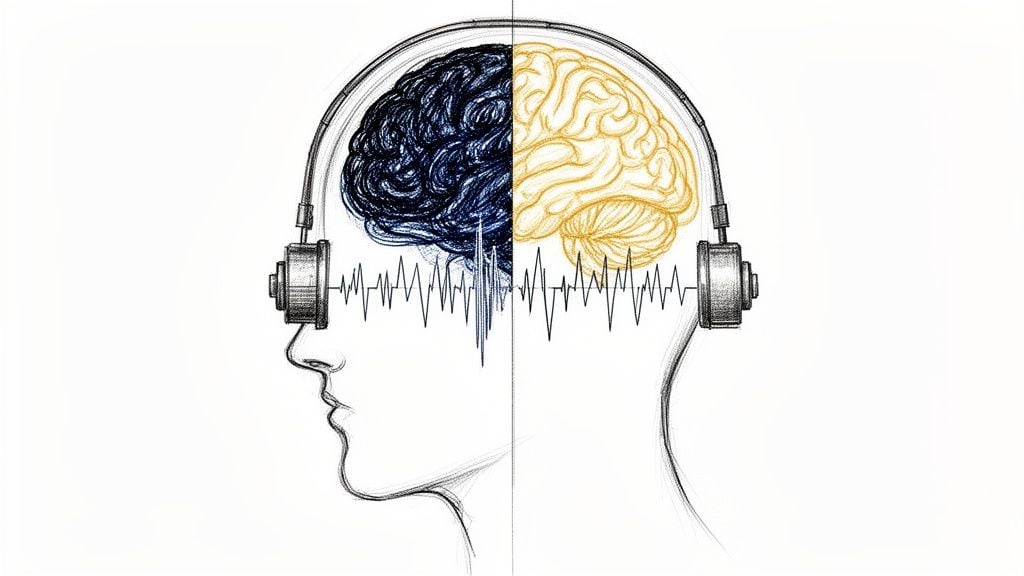
Holotropic breathing is a unique and powerful way to explore the inner self, using nothing more than accelerated breathing and evocative music to enter a non-ordinary state of consciousness. It’s a bit like finding a key to the deeper, less-traveled corridors of your own mind, creating a space for genuine emotional release and personal insight. The entire practice is built around gently lowering the ego's usual defenses to clear the way for healing and self-discovery.
The Foundations of Holotropic Breathwork
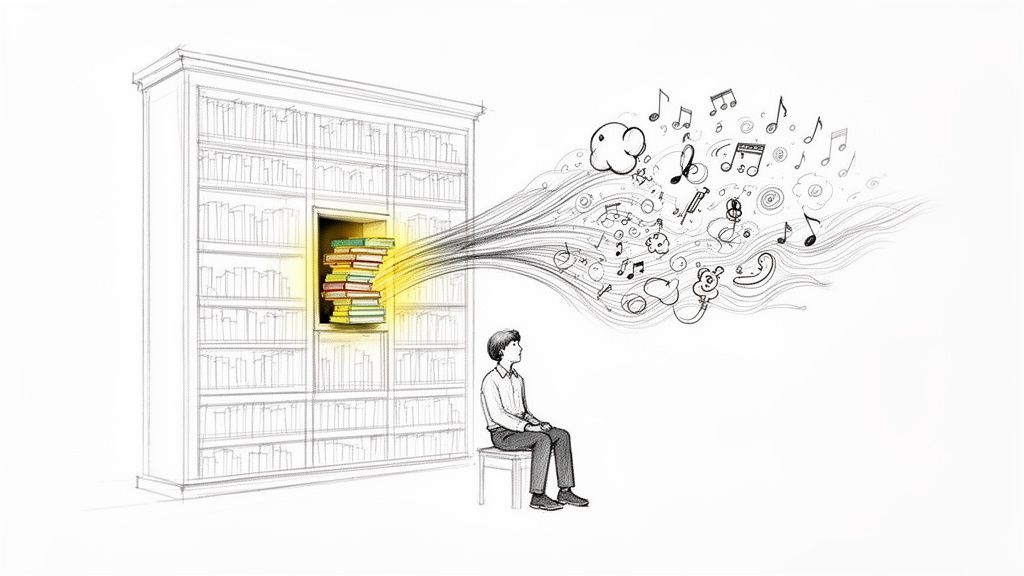
Think of your mind as a massive library where you usually stick to the ground floor. The core idea behind holotropic breathing is to give you a reliable way to access the restricted sections—those deeper, often subconscious layers that hold so much of your personal history.
This practice wasn't born overnight. It was carefully developed by pioneering Czech psychiatrist Stanislav Grof back in the early 1970s. He was searching for a non-drug alternative to psychedelic therapy, and what he found changed our understanding of what the breath alone can do.
Grof’s work with LSD in the 1950s and 1960s showed him that people in altered states often began breathing deeply and rapidly, which seemed to intensify their experiences. When LSD was outlawed, he and his wife Christina pioneered a new method that could evoke similar profound states. They combined accelerated breathing with carefully curated music and a safe, supportive setting—no substances required.
How Does It Create Such a Powerful Experience?
So, how can something as simple as breathing lead to such a profound experience? It all comes down to a specific breathing pattern: faster, deeper, and more continuous than your everyday breath, sustained over a set period.
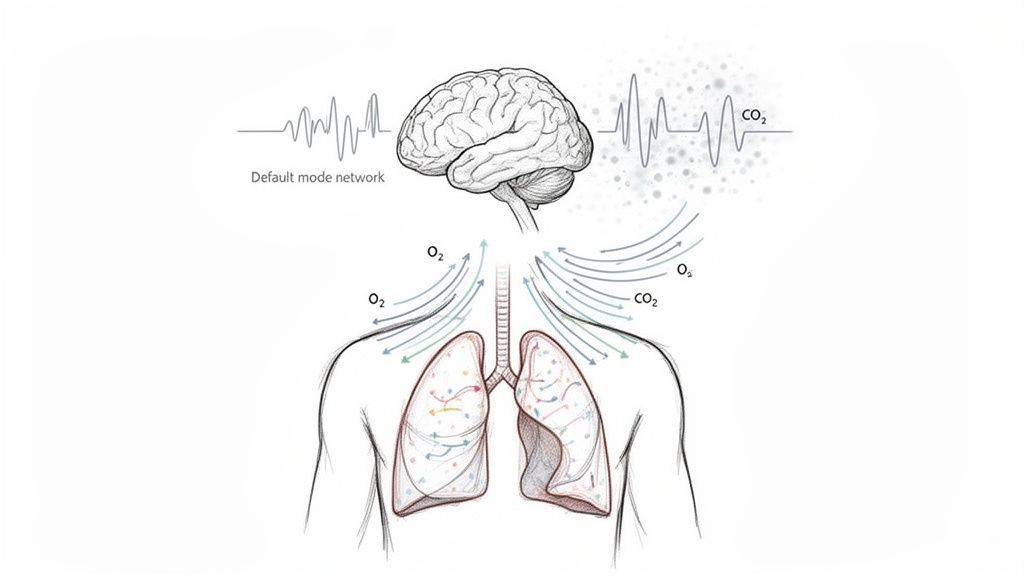
This isn't about hyperventilating randomly; it's a controlled technique. This style of breathing temporarily shifts the balance of oxygen and carbon dioxide in the body, which directly affects brain activity. Specifically, it helps quiet down the "default mode network"—the brain region that’s always chattering away, managing your sense of self and analytical thoughts.
The goal is to create a "non-ordinary state of consciousness," a safe and natural state where the logical mind takes a step back, and deeper awareness can come forward. This allows for healing and insight that might not be accessible during regular waking consciousness.
This shift opens a window where your own inner healing intelligence can step forward and guide the process. You can dig deeper into how different methods achieve this by exploring our complete guide on breathwork therapy.
Who Can Benefit from This Practice?
Holotropic breathwork isn’t just for spiritual gurus. It offers very real, tangible benefits for anyone feeling stuck, overwhelmed, or just plain curious about their inner world.
- Professionals Facing Burnout: For anyone caught in the high-stress corporate grind, this practice can be a lifeline. It offers deep stress relief and helps you reconnect with your sense of purpose. Actionable step: Schedule a session during a long weekend or vacation to create ample space for processing the experience without immediate work pressure.
- Creatives Experiencing Blocks: Artists, writers, and innovators often use it to shatter creative stagnation. By quieting that nagging inner critic, it allows fresh ideas to bubble up from the subconscious. Actionable step: Keep a journal or sketchbook handy immediately after your session to capture raw ideas before your analytical mind filters them.
- Anyone Seeking Deeper Self-Understanding: If you want to process old experiences, release stuck emotions, or just get a clearer picture of who you are, this practice provides a structured, supportive path for that journey. Actionable step: Set a clear, open-ended intention before your session, such as, "I am open to understanding my relationship with…" to guide your inner exploration.
Ultimately, these techniques offer a practical framework for anyone ready to explore their inner landscape, find lasting stress relief, and build a more authentic connection with themselves.
The Science Behind How Holotropic Breathing Works
While Holotropic Breathwork can feel profound and even mystical, its effects are grounded in some fascinating physiological changes happening inside your body and brain. It’s not just about breathing faster; it's a very specific technique for altering your internal chemistry to access deeper states of awareness.
Think of your normal, everyday consciousness as being tuned to a single radio station. Holotropic breathing is like turning the dial, letting you tap into different frequencies that are usually drowned out by the noise of daily life. Much of that "static" comes from a brain network known as the Default Mode Network (DMN).
Quieting the Inner Critic
The DMN is your brain's autopilot. It’s the part of you that’s always busy—thinking about yourself, worrying about the future, or replaying the past. While it's vital for our sense of identity, an overactive DMN is often linked to anxiety and feeling "stuck."
Holotropic breathing techniques intentionally disrupt this pattern. The sustained, deep breathing causes a temporary state of voluntary respiratory alkalosis, which is just a technical way of saying the carbon dioxide (CO2) levels in your blood drop. This slight dip in CO2 causes a temporary and safe constriction of blood vessels in the brain, which in turn reduces activity in the otherwise dominant DMN.
When the DMN quiets down, the brain's analytical "gatekeeper" essentially takes a coffee break. This creates a unique opportunity for other parts of the brain to communicate more freely, allowing deeply buried memories, emotions, and insights to surface in a safe, controlled way.
How Body Chemistry Shifts Your Consciousness
At its core, the magic of holotropic breathing lies in the dynamic dance between oxygen (O2) and carbon dioxide (CO2). Your body is incredibly sensitive to this balance, and small, intentional shifts can have powerful effects.
- Accelerated Breathing: By consciously breathing faster and deeper than normal, you flood your system with oxygen.
- Reduced Carbon Dioxide: This rapid exchange also expels CO2 much faster than your body produces it, causing its concentration in the bloodstream to drop.
- Altered Brainwaves: This shift in blood chemistry encourages the brain to transition from the busy Beta brainwaves of waking thought to the slower Alpha and Theta waves. These are the same brainwaves associated with deep meditation, creativity, and the dreamlike state right before you fall asleep.
This chain reaction is what opens the door to a "non-ordinary state of consciousness." It’s a completely natural process, using your body's own wiring to explore expanded awareness without any external substances. The experience can feel intensely liberating, giving you a chance to observe your thoughts and feelings without the usual layer of judgment.
By changing your physiology through breath, you create the psychological space needed for profound self-exploration and emotional release. The body becomes the doorway to the mind.
What the Science Says About the Psychological Benefits
These benefits aren't just anecdotal—they're backed by compelling clinical research. Scientists have measured significant changes in people's mental and emotional states after engaging in these practices.
For instance, a 2015 pilot study looked at the psychological impacts of Holotropic Breathwork and found notable reductions in traits associated with anxiety and hostility. Specifically, scores for harm avoidance—a personality trait closely tied to anxiety—dropped from 97.11 to 91.22 after the sessions. You can dive into the detailed findings of this study on the National Center for Biotechnology information website.
Other research highlights the powerful effect that controlled breathing has on our autonomic nervous system. A study published in the journal Frontiers in Psychology confirmed that slow, deep breathing techniques significantly increase vagal tone. This activation of the vagus nerve enhances the parasympathetic "rest-and-digest" response, directly counteracting the "fight-or-flight" state driven by chronic stress. You can learn more about this incredible connection in our guide to polyvagal theory exercises.
Another study in Scientific Reports showed how breathwork can directly improve self-awareness and our ability to regulate emotions. Participants reported stronger feelings of connectedness and transcendence, which correlated with lasting boosts in their mood and overall outlook. This suggests the experiences unlocked through holotropic breathing can lead to durable, positive changes in how we see ourselves and the world around us.
Ultimately, the science confirms what practitioners have known for decades: by changing your breath, you can truly begin to change your mind.
What to Expect in a Guided Holotropic Breathing Session
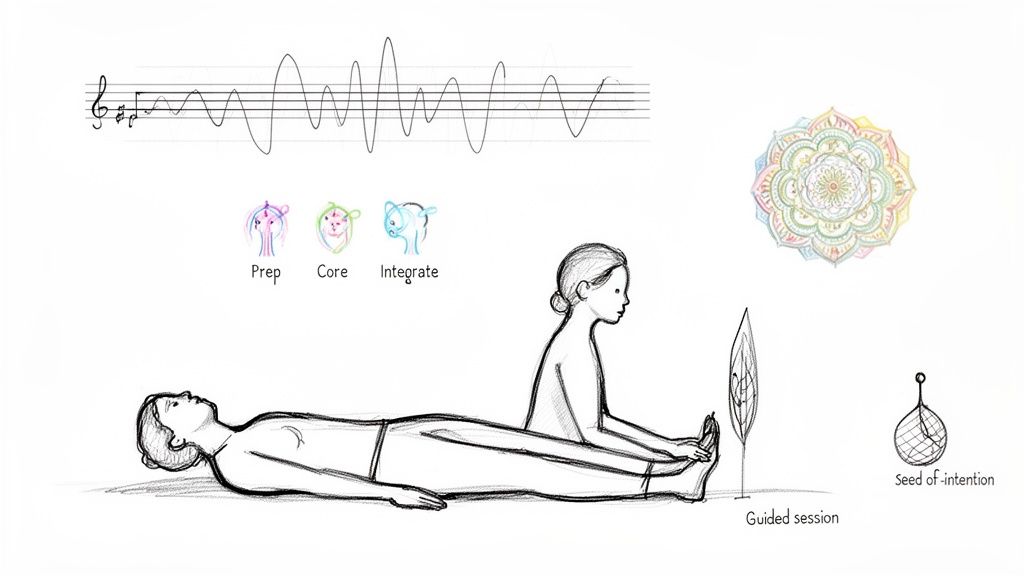
Stepping into your first holotropic breathing session can feel like preparing for a journey into the unknown. Knowing what to expect can ease any nervousness and help you arrive with a confident, open mind. These sessions are carefully structured to create a secure container for deep inner work.
The environment itself is designed for comfort and safety. You'll usually find a welcoming space with mats or mattresses on the floor, often with pillows and blankets to make sure you feel physically supported from start to finish.
The Setup and Key Roles
A central part of the traditional holotropic framework is the partnership between the "breather" and the "sitter." In a group setting, participants pair up and take turns in these roles, creating a reciprocal system of support.
- The Breather: This is you, the person actively engaging in the accelerated breathing. Your only job is to lie down, follow the breathing cues, listen to the music, and allow whatever comes up to unfold without trying to control it.
- The Sitter: The sitter’s role is one of quiet, compassionate presence. They don't interfere with your process but are right there for simple, non-intrusive support—like offering a tissue or a hand to hold if you ask.
This dynamic builds a powerful sense of community and shared safety. The facilitator's job is to guide the entire session, explain the breathing technique, and provide expert assistance if needed.
The sitter acts as a guardian for the breather's journey, ensuring they feel completely safe to let go and trust the process. This supportive presence is a cornerstone of the experience.
The Three Phases of the Journey
So, how does it all play out? A typical holotropic breathing session unfolds in three distinct stages, each with its own purpose. This structure gives the experience a clear beginning, a deep middle, and a gentle end.
Understanding what to expect in a guided session can make all the difference, helping you feel prepared and ready to dive in. The table below breaks down the typical flow of a Holotropic Breathwork journey.
Phases of a Typical Holotropic Breathwork Session
| Phase | What Happens | Your Role (Actionable Tip) |
|---|---|---|
| 1. Preparation | The facilitator explains the process, answers questions, and helps everyone get comfortable. You’ll be guided to set a personal intention. | Arrive with an open mind. Your intention isn't a rigid goal but a gentle inquiry—something like, "What do I need to see?" Write it down beforehand to give it clarity. |
| 2. The Journey | The evocative music begins, and you start the faster, deeper breathing. This is where you enter a non-ordinary state of consciousness. | Surrender to the experience. When you feel the urge to control or analyze, bring your focus back to the physical sensation of your breath and the music. Just breathe. |
| 3. Integration | The music softens, the breathing portion ends, and you're given time to gently return. You’ll be encouraged to draw a mandala to express your experience. | Express yourself creatively without judgment. Grab the provided art supplies and let your hand move freely. Afterward, consider sharing in the group circle; speaking your experience is a powerful way to ground it. |
This process—from setting an intention to integrating the insights—is what makes the experience so profound. It’s not just about the breathing; it’s about creating a complete circle of exploration and understanding.
Learning about the different stages can help you feel more prepared for any guided breathwork session. If you want a broader overview, you can explore the essentials of guided breathwork and its benefits in our detailed article. This preparation ensures you can relax into the experience and receive its full value.
Safety Guidelines and When to Proceed with Caution
While holotropic breathing offers a powerful path to self-discovery, safety has to come first. This isn't a casual practice you can just jump into unprepared; it's a deep dive into your own psyche that absolutely requires a secure and supportive setting. Knowing when to go forward and when to hit the pause button is a critical part of a responsible breathwork journey.
The sheer intensity of the experience can feel overwhelming if it's not managed well. That's precisely why working with a certified facilitator is non-negotiable, especially for your first few times. These guides are trained to create a safe container, help you navigate difficult moments, and assist you in making sense of it all when you're done.
Identifying Potential Contraindications
Holotropic breathing triggers some pretty significant shifts, both physically and psychologically. Because of this, it's simply not for everyone. Certain pre-existing health conditions can turn this powerful practice into a risky one.
It is absolutely essential to be upfront about your complete health history with your facilitator before you even think about booking a session. This practice is generally not advised if you have a history of the following conditions:
- Cardiovascular Issues: This includes high blood pressure, heart disease, or a history of heart attacks, strokes, or aneurysms. The rapid, deep breathing can put real strain on the heart and circulatory system.
- Severe Mental Health Conditions: If you have a personal history of psychosis, bipolar disorder, schizophrenia, or complex PTSD, you need to approach this with extreme caution. It should only be considered under the guidance of a clinical professional who is also trained in this specific modality.
- Recent Physical Trauma: If you've recently had major surgery, a serious injury, or broken bones, your body needs time to heal. It's best to wait until you're fully recovered.
- Neurological Conditions: Those with a history of seizures, epilepsy, or similar conditions should avoid this practice.
- Pregnancy: Due to its intensity and the unpredictable nature of what can be released, holotropic breathing is not recommended for pregnant women.
- Glaucoma or Detached Retina: There's a potential for increased pressure in the eyes, which makes this a risky practice for anyone with these conditions.
Your Action Plan for a Safe Experience
Taking ownership of your safety is empowering. The most important step you can take is choosing a qualified, experienced guide. A great facilitator creates a container of trust that allows you to fully surrender to whatever comes up.
Here are a few practical steps to make sure you’re in good hands:
- Verify Credentials: Look for facilitators who have been certified through a reputable organization like Grof® Legacy Training. Don't be shy about asking where they trained and for how long.
- Ask Probing Questions: Before you commit, schedule a brief call. Ask them about their experience with situations like yours. How do they handle it when someone has a difficult emotional release? Their answers should make you feel confident and supported.
- Disclose Everything: Create a simple, one-page document listing your physical and mental health history, including any medications. Share this with the facilitator beforehand so they have the full picture.
Despite the list of contraindications, when practiced in a controlled setting with proper screening, Holotropic Breathwork has a strong safety profile. One extensive clinical report documented its use with over 11,000 psychiatric inpatients over a 12-year period, with zero adverse effects reported post-session. This remarkable study speaks volumes about its clinical credibility.
Intense emotional releases can sometimes leave you feeling a bit disconnected or floaty. If that happens, it's vital to have tools to bring yourself back to the present moment. For anyone interested, you can explore some helpful grounding techniques for dissociation in our guide.
Ultimately, a mindful and well-informed approach is what ensures your journey with holotropic breathing is not just profound, but also safe.
Making Sense of Your Holotropic Experience: The Art of Integration
The powerful feelings, memories, and insights that surface during holotropic breathing don't just vanish when the session ends. In fact, what happens after is arguably the most important part of the entire process. This is where integration comes in—the crucial work of weaving those profound discoveries into the fabric of your daily life.
Think of it like this: your session was a deep-sea dive where you discovered a sunken treasure chest. Integration is the process of bringing that chest to the surface, carefully cleaning each piece, and figuring out what it all means. Without this step, the treasure stays at the bottom of the ocean, a distant memory rather than a tangible part of your world.
Bringing Your Inner Journey into the Outer World
So, how do you do it? The key is finding ways to express and explore what came up for you, especially since so much of it can feel beyond words. You're essentially building a bridge between the vast, non-verbal landscape you just traveled and your everyday reality.
Journaling is one of the best places to start. Right after a session, your experience might feel like a vivid but chaotic dream. Get it all down on paper—the images, the feelings, the confusing bits, everything. Don't worry about it making sense. This act of capturing the raw material before it fades can help you spot connections and themes you might have otherwise missed.
Research has repeatedly shown that what people do after a powerful experience is what determines its long-term impact. A study in the Journal of Humanistic Psychology emphasized that a lack of integration can lead to confusion, while dedicated integration practices solidify the positive outcomes of transpersonal experiences.
Getting Creative and Grounding in Your Body
Sometimes, words just don't cut it. The depths of a holotropic journey often need more than language to be understood, which is where creative and body-based practices shine.
- Mandala Drawing: This is a traditional and potent integration tool. Actionable Step: Immediately after your session, grab colored pens or pencils. Draw a large circle on a piece of paper and, without thinking, fill it with whatever shapes, colors, and symbols feel right. Don't judge it; just let it flow.
- Mindful Movement: Your body just went through an intense experience. Gentle yoga, tai chi, or even just a slow, observant walk in the woods can help you process energetic shifts. Actionable Step: The morning after your session, try a 15-minute gentle stretching routine. Pay close attention to how your body feels, noticing any new sensations without needing to label them.
- Mindfulness and Meditation: A regular meditation practice trains the exact "muscle" you were using in your breathwork session: non-judgmental awareness. Actionable Step: For the week following your session, commit to a 5-minute daily meditation. Simply sit and observe your breath, allowing any thoughts or feelings from your journey to arise and pass without attachment.
Putting Your Insights to Work
Ultimately, integration is about making real, tangible changes in your life. It’s about taking the “aha!” moments and turning them into new ways of acting, thinking, and feeling.
For a leader struggling with burnout, an insight about their own value might finally give them the courage to establish firm boundaries at work. Actionable Step: This could mean blocking off a "no-meetings" hour on their calendar each day or practicing saying "no" to one non-essential request per week.
A study published in Frontiers in Psychiatry on the effects of psychedelic-assisted therapy (a modality with similar integration needs) found that the quality of integration directly predicted long-term improvements in mental health. By consciously applying what you learn, you're not just remembering an experience—you're using it to actively reshape your life.
Comparing Holotropic Breathwork With Other Modalities
With so many breathwork styles popping up, figuring out where to start can feel like a lot. Holotropic Breathwork is unique because of its deep psychological roots and therapeutic structure, but how does it really compare to other popular methods? Knowing the key differences is the best way to choose the practice that aligns with what you're looking for.
The point isn’t to find the "best" one, but to find the right tool for your specific needs. It's a bit like choosing between a marathon and a sprint. Both are running, sure, but they serve completely different purposes and demand different mindsets. Someone hoping to work through deep-seated trauma might find the safe, structured container of Holotropic Breathwork is a perfect fit. An athlete looking to build physical resilience, on the other hand, would probably gravitate toward the Wim Hof Method.
Holotropic Vs Wim Hof Method
The Wim Hof Method is all about building physical and mental grit. It pairs specific, powerful breathing exercises with cold exposure. The main goals here are often tangible: strengthening the immune system, boosting athletic performance, and jacking up energy levels.
Holotropic breathing, however, is designed almost exclusively for psychological and spiritual exploration. The sessions are much longer, the breathing itself is less rigidly structured, and evocative music is a critical component used to guide your inner journey. The goal is emotional release and deep insight, not necessarily physical conditioning.
Other Deep-Dive Modalities
When you start exploring practices that use altered states of consciousness for healing, you'll run into things like psychedelic therapy. Much like Holotropic Breathwork, these methods are about quieting the everyday mind to access deeper parts of the psyche for profound healing, they just use different catalysts to start the process.
Another closely related practice is Rebirthing Breathwork, which also uses a connected, circular breath. The focus in Rebirthing, though, is often much more specific, zeroing in on resolving birth trauma and dismantling core negative beliefs. It's also frequently done one-on-one, whereas Holotropic sessions are very commonly held in group workshops.
The core difference really boils down to intention. Is your primary goal to build physical resilience, release specific emotional blockages, or embark on a broad, psychospiritual exploration? Answering this question is key to finding your ideal practice.
Holotropic Breathwork vs Other Popular Modalities
Understanding the key differences between these powerful breathwork techniques can help you choose the right path for your journey. This table breaks down the core distinctions.
| Feature | Holotropic Breathwork | Other Modalities (e.g., Wim Hof, 9D) |
|---|---|---|
| Primary Goal | Psychospiritual exploration, healing trauma, accessing non-ordinary states of consciousness. | Varies: physical resilience (Wim Hof), emotional processing with tech (9D), relaxation. |
| Session Structure | Long sessions (2-3 hours), group setting with a "sitter" and "breather" pair, evocative music. | Shorter, often daily practices. Can be solo or group, sometimes guided by apps. |
| Breathing Technique | Fast, deep, connected breathing without pauses. Less structured and more intuitive. | Specific, structured patterns (e.g., power breaths and holds in Wim Hof Method). |
| Integration | Heavily emphasized through mandala drawing, journaling, and group sharing immediately after the session. | Integration is encouraged but can be less formally structured within the practice itself. |
Ultimately, each modality offers a unique pathway. Holotropic Breathwork provides a deep, therapeutically-held space for profound inner work, while other methods might offer more accessible tools for daily well-being or physical enhancement.
Choosing the right path starts with a bit of self-reflection. This decision tree can help you think about which post-session integration techniques might resonate most with your experience, guiding you toward practices that will help you anchor your insights.
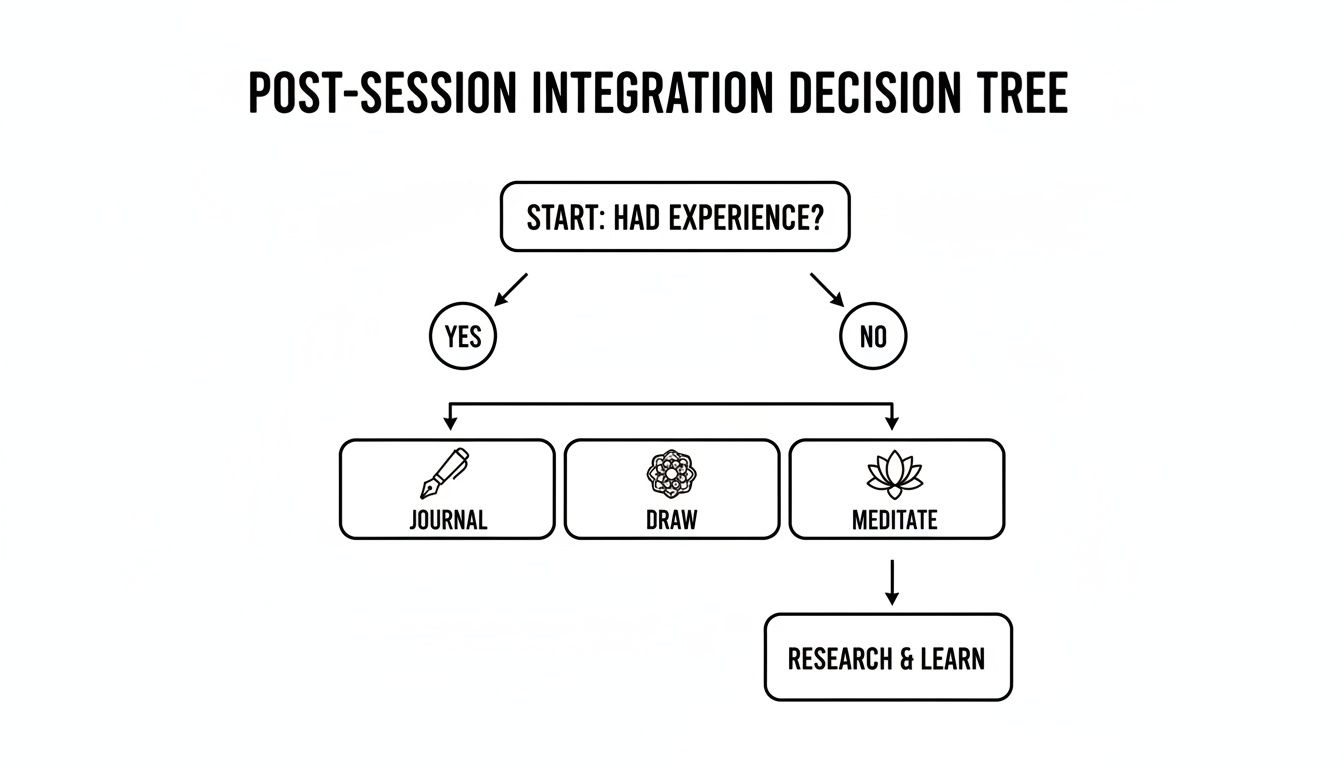
This visual guide shows that after a powerful experience, the next step is choosing a method—like journaling, drawing, or meditation—that helps you weave those insights back into your daily life. It highlights that there's no single "right" way to integrate; the best approach is the one that feels right to you, depending on whether your experience was more cognitive, emotional, or felt in the body.
Frequently Asked Questions About Holotropic Breathing
Let's finish up by tackling some of the most common questions people have about holotropic breathing. Getting clear on these practical points can help you feel more comfortable and confident if you decide to explore this powerful practice for yourself.
Is Holotropic Breathing Just Hyperventilation?
That's a very common question, but the answer is a firm no. While the breathing is faster and deeper than what you’re used to, it's a controlled process happening in a safe, intentional space.
Think of it this way: hyperventilation is usually an unconscious, anxiety-driven reaction. Holotropic breathing, on the other hand, is built on intention, a supportive setting, evocative music, and the guidance of a trained facilitator. These elements are what make it a therapeutic tool, not a panic response.
In fact, a 2023 study published in Cell Reports Medicine demonstrated that specific, intentional breathing patterns (like cyclic sighing) can significantly improve mood and reduce physiological arousal. This shows that conscious control over breathing activates neural circuits for emotional regulation, the very opposite of a panic state.
What Kind of Experiences Can I Expect?
This is where it gets really personal, as no two experiences are ever quite the same. The range is incredibly wide, from moments of pure bliss and profound insight to the release of deeply held, challenging emotions.
Many people find themselves revisiting significant memories, feeling a powerful sense of spiritual connection, or finally letting go of pent-up grief or anger. It's also very common to feel physical sensations like tingling, changes in body temperature, or muscle tightness as energy moves through the body.
The guiding principle here is to trust what the practice calls your "inner healer." The idea is that whatever surfaces during a session is precisely what you need to address for your own growth at that moment. The real work is simply allowing it all to unfold without trying to judge or control it.
How Long Do the Effects of a Session Last?
The most intense, immediate sensations will fade as your breathing returns to normal toward the end of the session. But the real takeaway—the insights, the emotional clarity—can stick with you for a long time.
Many people find the benefits continue to unfold over the following days and weeks. This often looks like a noticeable drop in anxiety, a brighter mood, and a much clearer sense of who they are.
A longitudinal study on breathwork participants published in the Journal of Transpersonal Psychology found that the positive effects, such as increased self-acceptance and purpose in life, were still present at a six-month follow-up. How long these benefits last often comes down to how well you integrate the experience into your daily life afterward.
Ready to see what breathwork can do for you? At 9D Breathwork, we bring together timeless techniques and modern technology to guide you on a powerful journey of mind and body.