If you’ve ever felt like a fraud at work, constantly waiting for someone to tap you on the shoulder and say, "We know you don't belong here," you're not alone. This isn't a personal flaw; it's imposter syndrome, and it's a deeply ingrained pattern of doubting your own accomplishments.
At its core, imposter syndrome is a profound disconnect between your external success and your internal reality. You see the promotions, the completed projects, and the praise, but you attribute it all to luck, timing, or fooling everyone around you. It's a persistent, nagging fear of being exposed as unqualified, despite all evidence to the contrary.
This isn't just a fleeting moment of self-doubt. It's a cycle of anxiety, over-preparation, and a constant feeling of inadequacy that can stifle your growth. The key isn't to eliminate self-doubt entirely—that's impossible—but to learn how to separate the feeling of being an imposter from the fact of your competence. A great first step is simply getting better at listening to your own internal dialogue. Building stronger self-awareness is the foundation for spotting these thoughts as they pop up.
You're in Good Company: The Reality of Professional Self-Doubt
Picture this: you're about to present in a big meeting. Your heart is pounding, not from excitement, but from the fear that every word you say will reveal you as a phony. That feeling is incredibly common.
A Hays survey of over 8,000 employees revealed that 64% have felt this exact professional insecurity. It cuts across every industry, role, and level of seniority.
The data paints a clear picture:
- It hits women particularly hard, with a staggering 70% reporting these feelings compared to 58% of men.
- The pressure is intense for those starting out, with 71% of workers aged 20-29 struggling with it.
- Even those at the very top aren't immune. A Korn Ferry survey found that 71% of U.S. CEOs admit to feeling like imposters.
These numbers aren't just statistics; they're a powerful reminder that what feels like a deeply personal and isolating struggle is, in fact, a shared human experience in the modern workplace.
The journey to quiet that inner critic starts with a simple, yet powerful, framework.
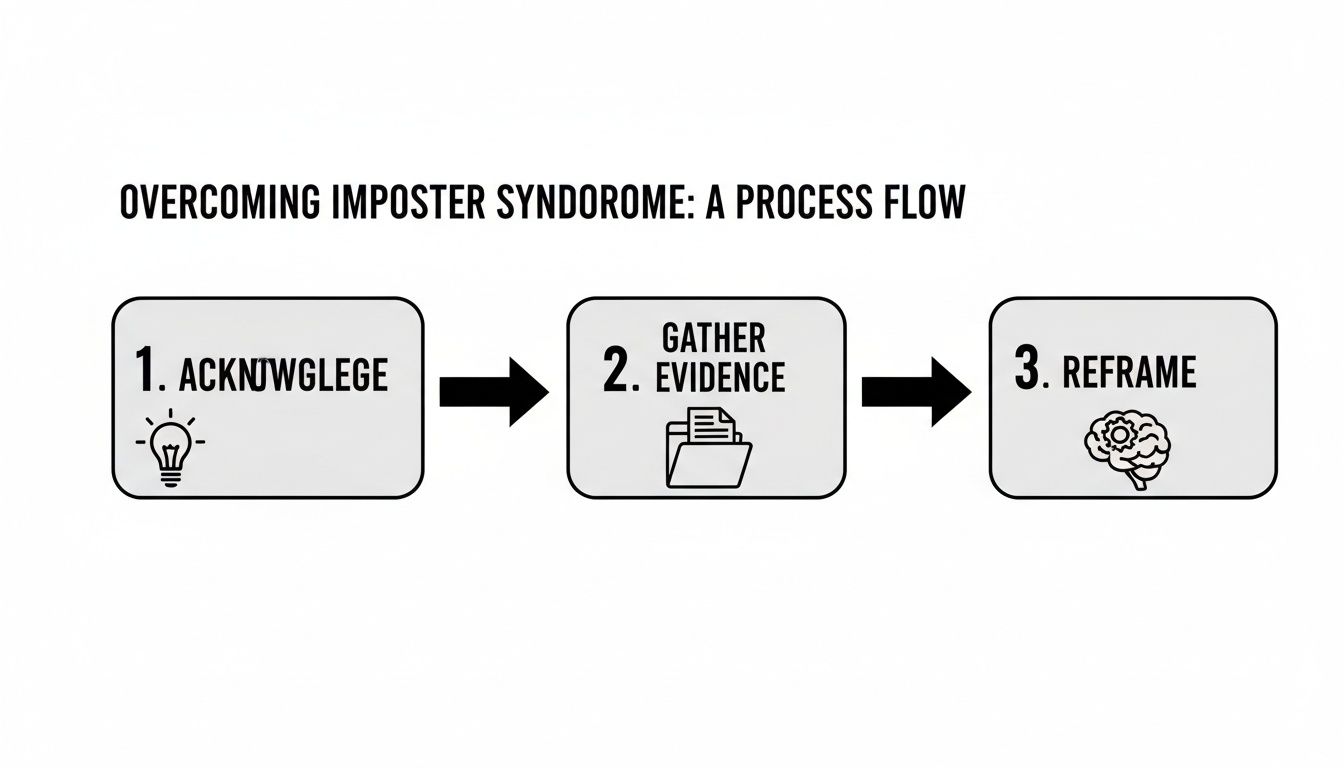
This process—Acknowledge, Gather Evidence, Reframe—is the bedrock of the practical strategies we'll explore. It’s about moving from a place of passive worry to one of active self-advocacy.
Are You Experiencing Imposter Syndrome? A Self-Diagnostic Checklist
Imposter syndrome isn't a one-size-fits-all experience. It shows up in different ways for different people. Dr. Valerie Young, a leading expert on the topic, identified five common "types." Understanding your dominant type can help you pinpoint your specific triggers and thought patterns.
Use this checklist to identify which behaviors and beliefs resonate most with you. You might see yourself in one or a mix of several.
| Symptom or Belief | The Perfectionist | The Superhuman | The Natural Genius | The Soloist | The Expert |
|---|---|---|---|---|---|
| "If I make one mistake, my incompetence will be exposed." | ✓ | ||||
| "I must work harder and longer than everyone else to prove my worth." | ✓ | ||||
| "If I don't get something right on the first try, I'm a failure." | ✓ | ||||
| "I have to figure this out on my own; asking for help is a sign of weakness." | ✓ | ||||
| "I feel like a fraud because I don't know everything about my field yet." | ✓ | ||||
| Tend to micromanage or have trouble delegating tasks. | ✓ | ||||
| Feel stressed when you're not working and often sacrifice hobbies for work. | ✓ | ||||
| Avoid challenges because of the fear of not being able to master them immediately. | ✓ | ||||
| Reject offers of assistance, even when you're overwhelmed. | ✓ | ||||
| Constantly seek new certifications or training before taking the next step. | ✓ |
Recognizing your patterns is the first step toward dismantling them. When you know how your imposter syndrome speaks to you, you can start to challenge its narrative with cold, hard facts about your actual abilities and accomplishments.
Build an Evidence Locker to Silence Self-Doubt
The voice of imposter syndrome is a master of vague accusations and dismissive self-talk. It almost never deals in cold, hard facts. This is its weakness. Your most powerful weapon, then, is tangible, undeniable proof of your competence and value. This is where building an "Evidence Locker" becomes a total game-changer.
This isn’t just a feel-good exercise. We're talking about building a data-backed case against your own inner critic. Research in the Journal of Vocational Behavior confirms that recognizing your own accomplishments and receiving positive feedback are critical for reducing imposter feelings. Your Evidence Locker is your private, irrefutable collection of this proof, ready whenever you need it.
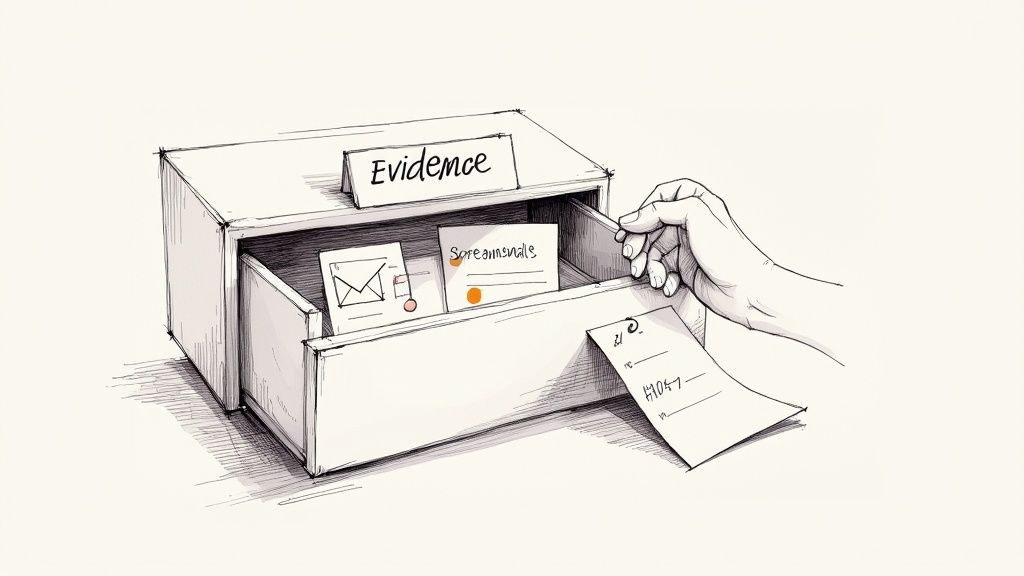
What Goes into Your Evidence Locker
Forget generic affirmations. Your locker needs specific, concrete evidence. You have to think like a prosecutor building a case—the more detailed and irrefutable the proof, the stronger your argument against that fraudulent feeling becomes.
Start a dedicated folder on your computer, a private Google Doc, or even a physical binder. The tool doesn't matter, but consistency does.
Here’s exactly what to start collecting today:
- Screenshots of Praise: Grab that Slack message where your manager publicly shouted you out. Screenshot the team chat where a colleague thanked you for saving the day on a tight deadline.
- Positive Client Feedback: Did a client email you saying your contribution was "invaluable"? Save it. Did a customer leave a glowing review mentioning you by name? Document it immediately.
- Hard Numbers and Metrics: This is crucial. Don't just write "improved a process." Get specific: "My new workflow reduced project delivery time by 10% in Q2." or "The sales script I drafted increased lead conversions by 5%." Numbers don't lie.
- Performance Review Highlights: Pull out the specific positive phrases and documented wins from your formal reviews. For this exercise, you have permission to completely ignore the "areas for improvement" and focus only on the proof of your strengths.
This collection becomes a powerful counter-narrative. We know from research in Personality and Individual Differences that while self-doubt can be linked to traits like neuroticism, external validation and self-affirmation are incredibly effective at pushing back. Your Evidence Locker is your own personal, on-demand source of that validation.
Make Collecting Evidence a Habit
An empty folder is useless in a moment of panic. The key is to make capturing these wins a regular, almost automatic, practice.
Actionable Step: Set a recurring reminder on your calendar for Friday afternoon labeled "Weekly Wins." Spend just five minutes scrolling through your week. Did you get a compliment? Finish a brutal task? Hit a goal? Add it to your locker right then and there. This simple act of regularly documenting your successes reinforces their validity in your own mind. It’s one of the most practical strategies to deny doubt because you are systematically replacing vague fears with solid facts.
When to Open Your Evidence Locker
This tool is most powerful when you use it both proactively and reactively.
Key Takeaway: Your Evidence Locker isn't a trophy case. It's an active tool for rewiring your thoughts. Use it to interrupt the cycle of self-doubt before it spins out of control.
A study in the Journal of Business and Psychology found that self-affirmation activities buffer us against threats to our sense of self—which is exactly what imposter syndrome is. Reviewing your locker is a potent, personalized form of that affirmation.
Pull out your evidence:
- Before a big meeting or presentation: Got a high-stakes event coming up? Spend 10 minutes beforehand reading through your wins. It grounds you in your competence when your nerves are telling you to run.
- Right after getting tough feedback: When constructive criticism stings and makes you feel like a fraud, go to your locker. It’s a powerful reminder that one critique doesn't erase a whole history of success.
- On days you feel stuck or overwhelmed: When you feel like you’re treading water, your locker gives you a bird's-eye view of your growth and proves you're more capable than you feel in that moment.
Building this repository helps you externalize your achievements, making them objective truths instead of lucky breaks. It’s a foundational step in overcoming limiting beliefs because it forces you to confront the reality of your own success.
Rewire Your Mindset in the Moment
We all know that feeling. The wave of panic crests, your heart starts pounding, and that insidious little voice whispers, "You're a fraud."
While your Evidence Locker is great for building a long-term case against that voice, you need something for right now. The goal is to interrupt the negative spiral before it hijacks your entire day. It’s not about pretending the feeling isn't there; it's about actively taking the wheel and shifting your mental and physiological state.
These are the quick, discreet tools you can pull out anywhere—at your desk, in a bathroom stall before a big meeting, or even while someone is talking during a stressful call.
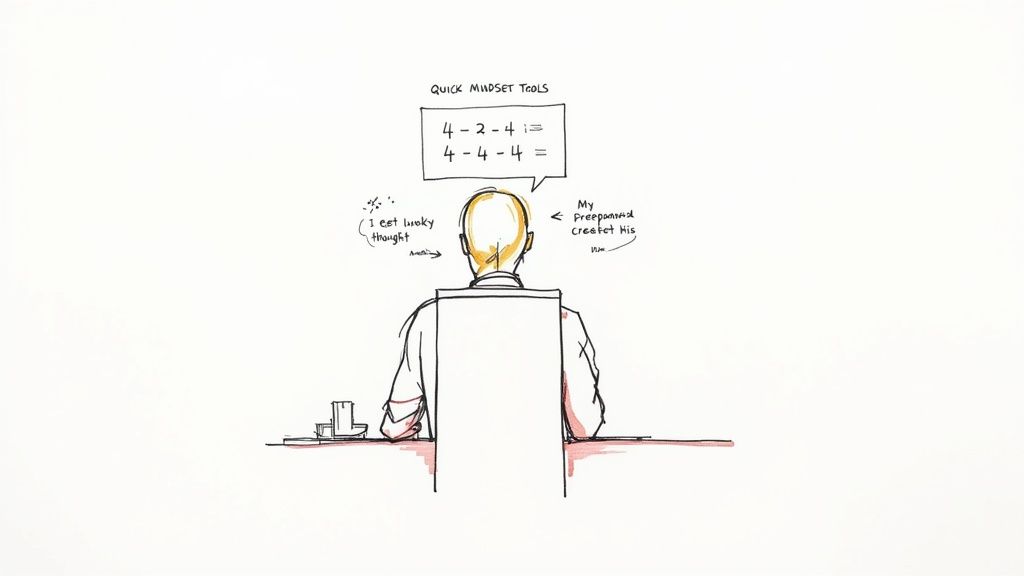
From "I Got Lucky" to "I Earned This"
Think of cognitive reframing as becoming a fact-checker for your own brain. Imposter syndrome loves to twist reality, and your job is to call it out on its nonsense with cold, hard facts.
Instead of letting those automatic negative thoughts have free rein, you step in and consciously challenge them with something more balanced and true.
Here’s how you can reframe some of the most common imposter thoughts:
-
The Thought: "I just got lucky with that project."
The Reframe: "My preparation and skills are what created this success. Luck might have been a small factor, but my hard work was the engine." -
The Thought: "Everyone else here knows exactly what they’re doing except me."
The Reframe: "I'm only seeing their professional highlight reel, not their private doubts. We all have different strengths and blind spots." -
The Thought: "Any minute now, they're going to find out I'm not qualified for this."
The Reframe: "I was hired for a reason, based on my track record. My role is to grow and learn, not to be perfect from day one."
Learning to reframe these thoughts is one of the most powerful healthy coping mechanisms for stress you can develop. It directly tackles the mental strain that self-doubt creates.
Instantly Calm Your Nervous System with Box Breathing
When anxiety hits, your "fight-or-flight" response kicks in, flooding your system with stress hormones. Breathwork is like a manual override for that system. It’s one of the fastest ways to tell your body it's safe to calm down.
Actionable Step: When you feel overwhelmed, stop what you are doing. Follow the 4-4-4-4 box breathing technique.
- Inhale slowly through your nose to a count of four.
- Hold your breath at the top for a count of four.
- Exhale slowly through your mouth for a count of four.
- Hold your breath at the bottom for a count of four.
Just repeat this for a minute or two. This simple, rhythmic pattern breaks the panic signal, clearing the mental fog and giving you the space to use your reframing techniques.
Anchor Yourself with Visualization
When you feel like you're spiraling, visualization can be the anchor that pulls you back to solid ground. The idea is to create a powerful mental and emotional blueprint of success that you can tap into on demand.
Take Action: Close your eyes and think of a specific moment at work when you felt completely competent and proud. Really immerse yourself in it. What did you see? What did you hear? Most importantly, what did that feeling of accomplishment feel like in your body? That’s your "confidence anchor."
Before a nerve-wracking presentation or a tough conversation, take just 30 seconds to recall this anchor. By deliberately bringing that feeling into the present, you can shift your entire emotional state from anxiety to centered confidence.
These in-the-moment tools are your first line of defense. But for real, lasting change, you have to go deeper. Practices like 9D Breathwork are designed to get to the root of these patterns, helping you access and release the core beliefs fueling your feelings of inadequacy. Combining these immediate tactics with deeper work is how you truly win the war against imposter syndrome.
Master Workplace Communication and Set Clear Boundaries
Overcoming imposter syndrome isn't just a battle fought in your head. It’s also won out in the open, through your actions and your words. The way you communicate at work can either feed that nagging feeling of being a fraud or start building a solid foundation of confidence.
Changing your communication habits is one of the most powerful, tangible ways to show your brain—and everyone you work with—that you belong.
It’s all about shifting from a defensive, apologetic posture to one of quiet self-assurance. This means unlearning the impulse to deflect a compliment, hide that you need a hand, or take on an impossible workload just to "prove" you’re worthy of your job title. These habits, especially common for the "Superhuman" or "Soloist" imposter types, are a direct pipeline to anxiety and burnout.
Script Your Way to Confidence
In a high-pressure moment, having a few go-to phrases ready can make all the difference. Instead of fumbling or defaulting to that self-deprecating language we all know too well, you can respond with calm and clarity.
Here are a few battle-tested scripts you can use for common workplace scenarios that tend to trigger imposter feelings:
-
When Someone Gives You a Compliment:
- The Old Way: "Oh, it was nothing," or "Anyone could have done it."
- The New Way: "Thank you, I’m really proud of how that project turned out." Another great one is, "Thanks, I appreciate you noticing the work I put into that." This simple switch lets you own your success without feeling arrogant.
-
When You Need to Ask for Help:
- The Old Way: Apologizing like you’ve committed a crime. "I'm so sorry to bother you, I know this is a stupid question, but…"
- The New Way: "I've started the analysis on X, but I'd value your perspective on Y before I go any further. Do you have 15 minutes to sync up?" This frames your request as smart collaboration, not a personal failure.
These small verbal tweaks have a huge impact. A study in the Journal of Personality and Social Psychology found that using confident, assertive language doesn't just change how others see you—it fundamentally changes how you see yourself.
Set Boundaries to Protect Your Focus (and Sanity)
If you identify with the "Superhuman" imposter type, you probably believe you have to say yes to everything to keep from being "found out." This is a fast track to burnout, and ironically, it ends up diminishing the quality of your work.
Setting boundaries isn't a sign of weakness. It's a mark of strategic professionalism.
Actionable Step: The next time you're asked to take on a new project when you're already at capacity, use this script: "I'm excited about this project. Right now, my main priorities are A and B to meet their deadlines. Can we talk about how this new task fits in? I want to make sure I can give it the focus it deserves without letting existing commitments slip."
This response is brilliant because it does three things at once:
- It shows you’re engaged and responsible.
- It gently reminds your manager of your current workload.
- It opens a collaborative dialogue about what truly matters most.
Turn Feedback into Fuel for Growth
For so many of us dealing with imposter syndrome, the idea of getting feedback is a source of pure dread. The fear of criticism can be paralyzing.
But what if you flipped the script? Proactively seeking feedback puts you back in the driver's seat. It reframes feedback as a tool for targeted growth, not a final judgment on your worth.
Key Insight: Don't wait for the dreaded annual review. Asking for specific, regular feedback shows you're committed to your professional development and completely dismantles the fear of the unknown. A study from the Journal of Occupational and Organizational Psychology confirmed that people who actively seek feedback perform better and have higher job satisfaction.
Here’s a simple script to get you started:
How to Ask Your Manager for Feedback:
"As I continue to settle into my role, I want to make sure I'm focusing my energy in the right places. Could we set aside 20 minutes next week to go over my performance on the recent [Project Name]? I'd especially love to get your thoughts on my [Specific Skill, e.g., presentation skills, data analysis]."
This approach is specific, forward-looking, and completely professional. You've just turned a source of fear into a structured, actionable conversation. If you're looking for more ways to strengthen these skills, you can explore more about improving communication in the workplace and see how it builds true professional resilience.
Turn Imposter Feelings into a Performance Advantage
Here’s a wild thought: what if that nagging voice in your head, the one telling you you're a fraud, could actually become your secret weapon? It sounds completely counterintuitive, I know. But you can learn to reframe those feelings of inadequacy from a source of dread into a powerful, if sometimes uncomfortable, motivator.
The goal isn't to start loving anxiety. It's about learning to catch that nervous energy and strategically point it in a productive direction.
This isn't just some feel-good platitude; there's real evidence to back it up. Even Albert Einstein reportedly felt like an "involuntary swindler," which goes to show these feelings can hit anyone, regardless of talent. What's fascinating is that research from MIT Sloan found that, under the right circumstances, imposter thoughts can actually boost performance by making people more interpersonally effective.
In their study, when people who frequently felt like imposters were in high-stakes situations, they tended to compensate by becoming more other-focused, which improved their performance in collaborative tasks. This shift is all about stripping the imposter syndrome of its power over you. Instead of a secret shame you have to hide, it becomes a predictable signal you can use to your advantage.
From Fear to Fuel
The trick is to use that "I don't know enough" feeling as a very specific cue to take action. When that familiar dread starts creeping in before a big meeting or project, don't let it paralyze you. Instead, learn to hear it as an internal alarm bell. It's a signal to prepare a little more thoroughly, to double-check your work with a finer-toothed comb, or to reach out to a colleague you trust for a quick sanity check.
Think of it this way: the imposter voice is just a slightly panicked risk manager, pointing out a potential gap in your preparation. Your new response is, "Thanks for the heads-up. Now I know exactly where to focus."
- Feeling unprepared for a big presentation? Use that feeling to motivate one more full run-through than you originally planned.
- Worried your final report isn't quite there? Channel that concern into meticulously checking your sources and giving it one last proofread.
- Doubting what you can contribute in a team meeting? Let that doubt push you to research the topic more deeply than anyone else, so you can walk in armed with data and insightful questions.
This simple reframing turns a vague, overwhelming anxiety into a clear, actionable to-do list. It's a vital skill when you're learning how to build mental resilience in a high-pressure workplace.
Audit Your "Superpower" Moments
To really make this stick, you need to prove to yourself that this has already worked for you in the past. Think back to a time you felt immense pressure—a time you were absolutely certain you were in over your head, but you still managed to deliver an exceptional result.
Those moments are pure gold.
Practical Action: For the next two weeks, keep a simple log on your phone. Write down instances where high pressure and self-doubt actually led to a high-quality outcome. Maybe you pulled off a last-minute project that wowed everyone, delivered a killer presentation on a tight deadline, or solved a complex problem you initially felt completely unqualified for. For each entry, jot down the specific imposter thought you had ("There's no way I can finish this on time") and the concrete action that fear prompted you to take ("I broke the project into tiny steps and focused on one at a time"). This creates your own personalized playbook for turning pressure into peak performance.
The same MIT study pointed out that this dynamic is often even stronger in fast-paced, sometimes chaotic work environments. When the stakes are high, that internal nudge can be exactly what drives you toward excellence.
Reframe Your Internal Dialogue
The final piece of the puzzle is actively rewriting your self-talk in the moment. It’s about catching that destructive thought as it appears and consciously swapping it for a productive directive.
The table below breaks down how to transform that negative chatter into something that actually helps you move forward.
Transforming Negative Self-Talk into Productive Action
A practical guide to reframing common imposter thoughts into actionable steps that enhance performance.
| Common Imposter Thought | Destructive Interpretation | Productive Reframe and Action |
|---|---|---|
| "I have no idea what I'm doing." | "I'm a fraud and I'm going to fail." | "This is a new challenge. What is the very first step I can take to understand it better?" |
| "Everyone else here is smarter than me." | "I don't belong here and shouldn't speak up." | "I can learn a lot from my colleagues. I'll listen carefully and ask one clarifying question to get started." |
| "I'm definitely going to get this wrong." | "I should avoid this task to prevent embarrassment." | "Mistakes are just part of the process. I'll create a rough draft and ask for some early feedback." |
By systematically turning these internal alarms into specific, positive actions, you begin to rewire your brain's response to imposter feelings. You don't get rid of the feeling entirely, but you fundamentally change its outcome. You become someone who uses that internal friction to polish your work to a higher standard, turning a perceived weakness into a genuine professional edge.
Your Questions About Imposter Syndrome, Answered
As you start putting these tools into practice, questions are going to pop up. That’s not just normal—it’s a great sign. It means you’re actively digging in and starting to change things. Think of this section as your go-to resource for the common hurdles and "what-ifs" that come up on the journey.
Let's get you the clarity you need to keep moving forward with confidence.
Is This Imposter Syndrome or Am I Just Being Humble?
This is such a crucial distinction, because on the surface, they can feel similar. But the truth is, they're worlds apart. The real difference comes down to how they make you feel and act: one is empowering, the other is paralyzing.
Humility is all about having an honest, grounded view of yourself. It's the quiet confidence to say, "I'm great at this, but I'm still learning over there." This kind of thinking opens you up to curiosity, learning, and collaboration. It's a strength.
Imposter syndrome, on the other hand, is a funhouse mirror. It takes your reality and twists it into a distorted view based on fear. It's that nagging voice that insists any success was a fluke and you're just one question away from being exposed. It fuels anxiety and makes you want to hide, no matter what your track record says.
The Litmus Test: Humility is knowing you don't have all the answers. Imposter syndrome is being convinced you have none of the answers and shouldn't even be in the room.
What if I Slip Back Into Old Self-Doubt Habits?
First things first: a relapse isn't failure. It's proof that you're human. The goal isn't to reach some mythical state of perfect, unwavering confidence. It's to get quicker at spotting the old thought patterns and knowing exactly how to pull yourself out of the spiral. A study in the Journal of Vocational Behavior found that while self-doubt is a common professional hurdle, having go-to coping strategies makes a massive difference in bouncing back.
When you feel those familiar thoughts creeping in, don't panic. Take action.
- Name It. Just acknowledge it without judgment: "Ah, there's that imposter story again. I see you." Simply calling it out takes away a huge chunk of its power.
- Open Your Evidence Locker. This is the moment you prepped for. Take five minutes and read through the hard proof of your skills and wins. Let the facts speak louder than the fear.
- Reset Your Body. Your mind is spinning, so calm your nervous system. Use the box breathing technique from earlier. A quick physiological reset gives your brain the space it needs to think clearly again.
- Ping an Ally. You don't have to do this alone. Send a quick text to a mentor or trusted colleague. Something as simple as, "Having a bit of a confidence wobble. Can I get a quick sanity check?" can pull you back to reality.
Think of it like building a muscle. Every time you catch yourself and navigate a moment of doubt, you're doing another rep. You're getting stronger.
How Do I Deal With This as a Remote Worker?
Working from home can be a breeding ground for imposter syndrome. You lose all the casual, in-person feedback loops—the quick thumbs-up, the overheard praise, the simple nod of agreement in a meeting. Research published in Cyberpsychology, Behavior, and Social Networking shows this lack of spontaneous validation can crank up feelings of inadequacy. When you're remote, you have to be much more intentional about proving your value—to yourself and others.
Here are a few actionable steps for remote workers:
- Make Your Work Visible. Don't wait to be asked for an update. Post regular, quick summaries of your progress in a public Slack channel. This isn't about bragging; it’s about creating the visibility that would happen naturally in an office.
- Create Your Own Feedback Loop. At the end of the week, send a short email to your manager with your top 3 wins and how they moved the needle. It closes the loop and keeps your contributions top-of-mind.
- Turn That Camera On. It can feel like a pain, but being on camera during calls builds real human connection. It reminds everyone (including yourself) that you're a present, engaged member of the team, not just a name on a screen.
- Ask for Feedback Directly. Don’t wait for a formal review. After you ship a project, message a coworker: "Hey, would love your quick take on how the X part of that went. Anything you saw that I could've done better?"
The key is to proactively build the connection and visibility that fight off the isolation where imposter syndrome thrives.
At 9D Breathwork, we know that true, lasting confidence comes from rewiring the patterns at their source. While these practical strategies are your essential toolkit for managing symptoms day-to-day, our immersive breathwork journeys are designed to get to the root of it all. We help you access and release the deep subconscious beliefs that have been running the show for years. By combining somatic breathwork with powerful audio guidance, we help you build unshakable confidence from the inside out.