To truly prevent employee burnout, we need a fundamental shift in thinking. Organizations have to move from simply reacting to burnout when it happens to building a proactive strategy that gets to its systemic roots—the culture, the workload, and the leadership.
This means going deeper than just offering surface-level wellness perks. It’s about tackling the core drivers: emotional exhaustion, cynicism, and a crushing sense of ineffectiveness.
Moving Beyond Burnout Myths
For far too long, the narrative around burnout has been all wrong. It’s often framed as a personal failing—a sign that someone just isn’t resilient or driven enough. This perspective isn’t just outdated; it’s actively harmful.
Burnout isn’t about being tired after a long week. It’s an occupational phenomenon, a direct result of chronic workplace stress that hasn’t been managed effectively. It’s a loud and clear signal that the work environment itself is broken and needs to change.
Ignoring this reality comes with a hefty price tag. When people are pushed to their limits, productivity plummets, turnover spikes, and innovation grinds to a halt. A seminal study in the Journal of Applied Psychology found a significant negative relationship between burnout and job performance, underscoring that exhausted employees are not effective employees. The real key to preventing employee burnout is to stop treating it as an individual’s problem and start owning it as a critical organizational issue. This requires a multi-layered solution that looks at everything from individual support and team dynamics all the way up to company-wide policies.
Understanding the Three Core Components of Burnout
Burnout isn’t a single event; it’s a slow burn that typically unfolds across three distinct dimensions. These components often build on each other, pulling employees into a downward spiral.
This flowchart breaks down that progression, showing how initial exhaustion can devolve into a deep-seated feeling of ineffectiveness if left unchecked.
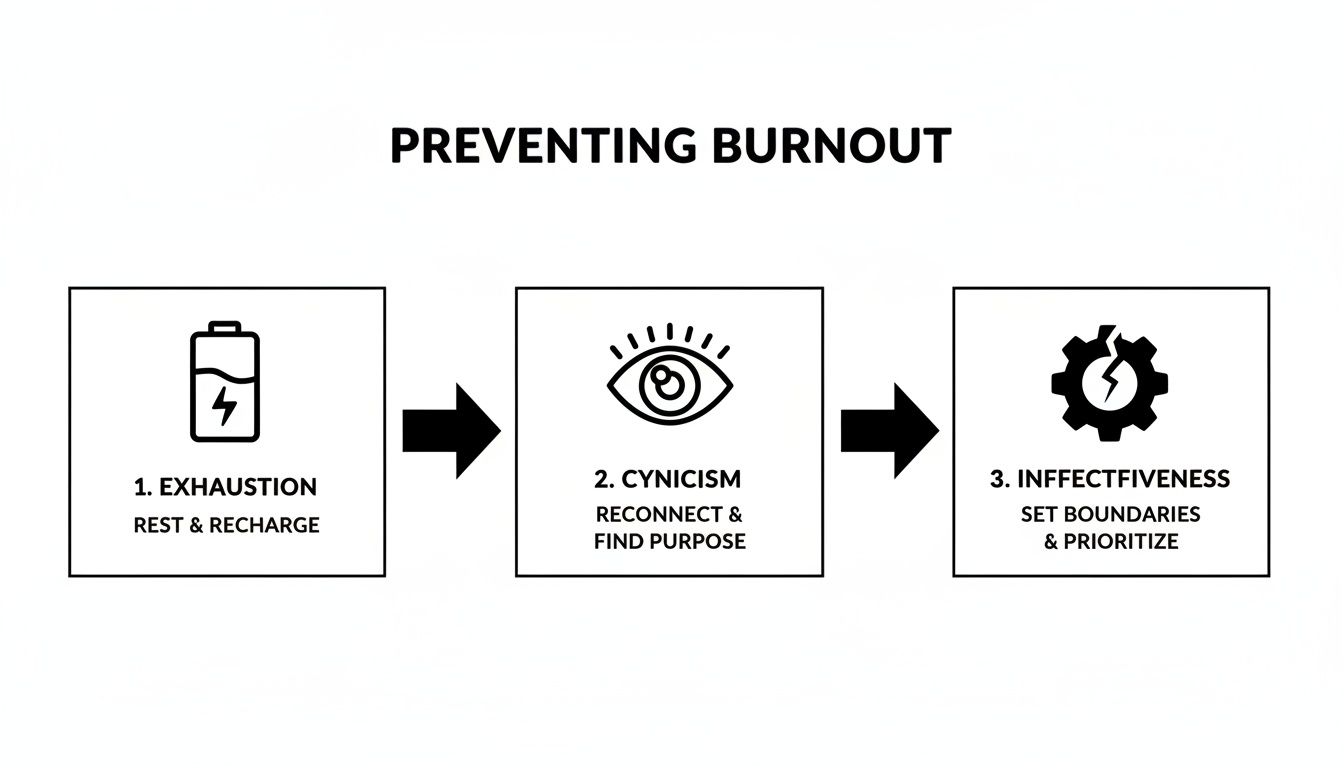
When leaders can spot these stages, they can step in before the damage becomes irreversible.
The symptoms are clear and dangerously interconnected:
- Emotional Exhaustion: This is that feeling of being completely drained, with nothing left to give. It’s when someone feels “used up” at the end of every day, a feeling shared by a staggering 51% of the U.S. workforce.
- Cynicism or Depersonalization: As the exhaustion deepens, people may start to feel detached and cynical about their jobs. It’s a protective mechanism—that “I don’t care” attitude is a shield against overwhelming demands.
- Reduced Professional Efficacy: Finally, employees begin to doubt their own competence. They question their ability to make a difference, and this feeling of ineffectiveness is often the final stage before they completely disengage.
The Widespread Impact of Unchecked Burnout
The scale of this problem is massive. Recent data projects that by early 2025, 28% of the U.S. workforce will be fully burnt out. On top of that, 44% report feeling emotionally drained from their work.
This crisis hits especially hard in fields like healthcare and education, and for roles like project managers, where unsustainable workloads and poor leadership are often the primary drivers. To dig deeper into practical solutions, this practical guide on how to avoid burnout at work is an excellent resource for implementing preventive measures.
Building Your Own Defense Against Burnout
While the company culture sets the stage, you’re not just a passive actor in your own well-being. Building personal resilience is your first and best line of defense, giving you the practical tools to handle workplace stress before it spirals into burnout. This isn’t about being tougher or just “powering through.” It’s about developing a smart, proactive skill set to protect your own energy and focus.
Think of it like a circuit breaker in your house. When the electrical load gets too high, the breaker trips to prevent a fire. The strategies here are your personal circuit breakers—things you can do right now to manage your internal energy, stay centered, and find your footing, even when things get demanding.
These aren’t just fluffy self-care platitudes. They are in-the-moment actions designed for the reality of a packed workday, helping you get a handle on your nervous system and feel back in control.
Putting Up Clear, Flexible Fences
One of the most powerful moves you can make is setting real boundaries. Without them, work has a sneaky way of creeping into every part of your life, leaving you with no space to recharge. Boundaries aren’t about being difficult; they’re about clearly communicating your limits so you can keep performing at a high level for the long haul.
It’s not just a feeling, either. A 2022 study published in the International Journal of Environmental Research and Public Health found that employees who could psychologically detach from work—essentially, switch off—reported significantly lower levels of emotional exhaustion. You can’t switch off if there’s no “off” switch to begin with.
Here’s how to start building those fences today:
- Block Off “Deep Work” Time: Treat your focus time like you would a meeting with your CEO. Seriously. Block out 90-minute chunks in your calendar for uninterrupted, heads-down work. If a meeting request comes in, protect that time by responding, “I’m in a deep work block then, but I’m free at [alternative time].”
- Set Your Communication Hours: Be upfront about when you’re available. A simple line in your email signature or Slack status can work wonders, like: “I check and respond to messages between 9 AM and 5 PM.” It manages expectations and eases that pressure to be constantly available.
- Get Comfortable Saying “No” (or “Not Now”): This can feel tough, but it’s a game-changer. Instead of an automatic “yes” to a new request, try a buffer. “Let me take a look at my current priorities and I’ll get back to you on how I can best support this.” This gives you space to assess your capacity realistically.
Finding the “Why” in Your Daily Grind
A key ingredient in the burnout recipe is cynicism, which often shows up when there’s a huge gap between what you do all day and what you actually care about. When your work feels pointless, motivation tanks and exhaustion sets in fast. The antidote is to find that connection, even in small ways.
First, figure out what drives you. Is it about helping people? Solving a really tricky puzzle? Creating something from scratch? Once you know your core motivators, you can start framing your daily to-do list through that lens.
Actionable Example: Take a project manager staring down the barrel of a stressful launch. They could see their job as just “hitting deadlines.” Or, they could reframe it as “clearing the path for my team to do their absolute best work.” Suddenly, the tasks are connected to a deeper value of mentorship and support, making the pressure feel more meaningful and manageable.
This mental shift is a cornerstone of resilience. If you want to dive deeper into this, our guide on how to build mental resilience is a great place to start.
Hitting the Reset Button on Your Nervous System
Chronic stress keeps your body stuck in high-alert mode, draining your battery day after day. Learning to consciously downshift your nervous system is one of the most practical skills you can develop. Simple, physical techniques can pull you out of a frantic, reactive state and into a calm, clear one in just a few minutes.
The most powerful tool you have is right under your nose: your breath. A 2023 study in Cell Reports Medicine showed that specific breathing exercises, like cyclic sighing, actually outperformed mindfulness meditation in improving mood and calming the body’s stress response.
Here’s a simple one you can do at your desk without anyone even noticing:
- The Physiological Sigh: Take a deep inhale through your nose.
- Take a Little More: Before you exhale, sneak in another short sip of air to completely fill your lungs.
- A Long, Slow Exhale: Now, let it all out slowly through your mouth. Make the exhale much longer than the inhales.
- Repeat: Just two or three rounds are enough to feel a shift when you feel stress creeping in.
This simple action helps your body dump excess carbon dioxide and flips on your parasympathetic nervous system—the “rest and digest” system. It’s a quick, discreet, and science-backed way to manage stress as it happens, stopping it from building up and pushing you toward burnout. These aren’t just coping strategies; they’re skills for thriving at work.
How Managers Can Create Burnout-Proof Teams
When it comes to an employee’s daily experience, no one has more impact than their direct manager. You’re on the front lines, with the power to either dial up the stress or create a psychologically safe space where your team can actually thrive. Building a burnout-proof team isn’t about some massive, one-off initiative; it’s about the small, consistent, and intentional things you do every single day to build trust and protect your people.
It starts with getting real about the most common drivers of burnout—things like unfair treatment, crushing workloads, murky communication, and a lack of autonomy. From there, you can build specific strategies to counteract them. When you shift your focus from just managing tasks to proactively managing your team’s energy and well-being, you create a powerful buffer against the exhaustion and cynicism that defines burnout.
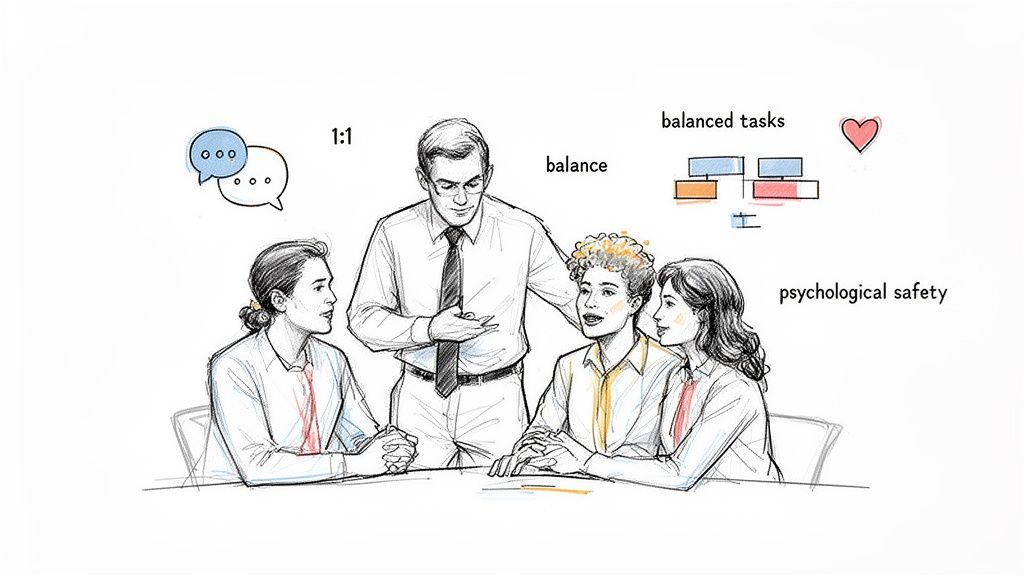
The stakes have never been higher. A recent study found that a staggering 59% of US workers are feeling the heat of burnout. Even more alarming for leaders, employees in high-burnout environments are 56% more likely to be actively looking for a new job. This makes preventing burnout less of a “nice-to-have” and more of a critical retention strategy.
Let’s look at how you, as a manager, can directly address these issues.
Below is a quick-reference table that connects the most frequent causes of burnout I see in the workplace with concrete actions you can take to get ahead of them.
Common Burnout Drivers And Manager-Led Solutions
| Common Burnout Driver | Manager’s Proactive Solution | Example Action |
|---|---|---|
| Overwhelming Workload | Proactively monitor and balance team capacity. | During one-on-ones, ask: “On a scale of 1-10, how is your workload feeling this week?” If it’s consistently high, work together to re-prioritize or delegate tasks. |
| Unclear Communication | Establish clear expectations for roles, responsibilities, and project goals. | Create a project brief for every new initiative that clearly outlines the “what,” “why,” and “who.” Review it as a team to ensure everyone is aligned. |
| Lack of Autonomy | Empower team members with ownership over their work. | Instead of dictating how a task should be done, define the desired outcome and let them determine the best path to get there. Offer support, but don’t micromanage. |
| Unfair Treatment | Distribute tasks and opportunities equitably. | Avoid defaulting to your usual “go-to” person. Actively look for opportunities to stretch the skills of other team members and ensure everyone gets a shot at high-visibility projects. |
| Lack of Support | Foster a culture of psychological safety where asking for help is encouraged. | Regularly and openly share your own challenges or mistakes. This normalizes vulnerability and signals to your team that it’s safe for them to do the same. |
This table is a starting point. The real magic happens when you integrate these solutions into your daily leadership rhythm.
Master the Art of the Compassionate Check-In
Let’s be honest, most one-on-one meetings are just glorified status updates. A truly effective check-in goes much deeper. It should be a dedicated space for employees to talk openly about their workload, their challenges, and their energy levels without fearing judgment. This is your primary listening post for the early warning signs of burnout.
Instead of just asking, “What are you working on?” try framing questions around their actual experience:
- “What part of your work is giving you the most energy right now?”
- “Are there any roadblocks that are causing frustration or slowing you down?”
- “How is your workload feeling this week on a scale of 1 to 10?”
- “Is there anything I can do to better support you?”
These questions shift the conversation from capability to capacity. Research consistently shows that employees who feel their manager genuinely has their back are far less likely to burn out. These conversations are a direct investment in that support system.
Distribute Work with Fairness and Clarity
Nothing tanks morale faster than a sense of unfairness. This isn’t always about blatant favoritism; it often creeps in through how work gets distributed. When one person consistently gets the exciting, high-profile projects while another is stuck with tedious, thankless tasks, it breeds resentment and eventual exhaustion.
Your goal should be equitable, not just equal, task distribution. This means you have to consider each person’s unique skills, their development goals, and—most importantly—their current capacity.
Actionable Example: An urgent, high-stakes project lands on your desk. Your first instinct might be to give it to your most reliable top performer. Pause. Before you do, ask yourself: “Who on the team would benefit most from this growth opportunity? Who actually has the bandwidth to take this on without being pushed over the edge?” That simple moment of reflection can prevent you from unintentionally burning out your best people.
Proactive workload management is a non-negotiable skill for modern leaders. If you’re looking to sharpen these abilities, our leadership development training programs are specifically designed to give managers the tools to build resilient, engaged, and high-performing teams.
Give Feedback That Builds Confidence, Not Anxiety
Feedback is the fuel for growth, but when it’s delivered poorly, it can shatter an employee’s sense of professional efficacy—a key psychological defense against burnout. The goal isn’t just to correct; it’s to guide while preserving, and even boosting, their confidence.
The trick is to be specific, timely, and focused on the behavior, not the person. Vague statements like “You need to be more proactive” are useless and demoralizing. Get concrete.
Instead of: “This report wasn’t your best work.”
Try: “In the next report, let’s focus on adding more specific data to back up the conclusions in section three. That will make the argument even stronger.”
See the difference? The second option provides a clear path for improvement and shows you’re invested in their success, not just pointing out flaws. It frames feedback as a partnership, which is fundamental to building the psychological safety that reduces performance anxiety. By making feedback a constructive and supportive ritual, you help your team members feel competent and valued—directly combating a major burnout trigger.
Designing a Company Culture That Fights Burnout
While individual resilience and great managers are fantastic lines of defense, they can’t hold back the tide of burnout forever. True, sustainable prevention has to be baked right into the DNA of your company culture and policies.
This is about moving beyond team-level fixes to tackle the systemic issues that make burnout feel almost inevitable. It’s where you consciously build an environment where well-being isn’t a perk, but a core part of how you operate. You’re not just putting out fires; you’re creating a workplace that is fundamentally more sustainable and engaging.
Shift from Hours Logged to Outcomes Achieved
One of the most profound changes any company can make is to stop confusing presence with productivity. A culture obsessed with hours logged is a perfect breeding ground for burnout. It encourages “presenteeism”—people sitting at their desks but completely checked out—and it actually punishes efficiency.
The alternative? A results-oriented work environment. This approach trusts people to manage their own time and energy to deliver on clear, agreed-upon goals. What matters is the quality of the work, not the time spent chained to a desk.
A 2021 study in the International Journal of Environmental Research and Public Health confirmed what many of us know instinctively: higher job autonomy is directly linked to lower emotional exhaustion. When people feel trusted and in control, that sense of agency is a powerful shield against stress.
This doesn’t have to be a radical overhaul. It could look like:
- Truly Flexible Work: Let teams set their own core hours or adopt a hybrid model that actually fits their workflow.
- Asynchronous-First Communication: Make it normal to use tools that don’t demand an instant reply, lifting the pressure to be “always on.”
- Crystal-Clear Goals: Use frameworks like OKRs (Objectives and Key Results) so everyone knows exactly what success looks like, freeing them up to figure out the best way to get there.
Build Clear Pathways for Growth and Purpose
Nothing kills motivation faster than a dead-end job. Your best people, especially, need to see a future for themselves at your company. When career paths are murky or seem based on who you know, it just makes the daily grind feel pointless.
A culture that genuinely fights burnout invests in its people’s growth. This means building transparent and fair systems for advancement. But it’s about more than just promotions. It’s about giving people constant opportunities to learn new skills, keeping their work challenging and meaningful. In fact, a study in the Journal of Occupational and Environmental Medicine showed that employees with high growth opportunities had significantly lower rates of burnout.
Connecting individual roles to the company’s bigger mission is a huge piece of this puzzle. Leaders must constantly reinforce how each person’s work matters. That sense of purpose is an incredible motivator that helps people navigate challenges without burning through their emotional reserves. You can explore more on the benefits of this approach in our guide on ways to improve company culture.
Champion and Destigmatize Mental Health Support
It’s one thing to offer mental health benefits. It’s another thing entirely to build a culture where people feel safe using them. Stigma is a massive barrier, often stopping people from getting help until they’re already in crisis. A truly supportive workplace normalizes conversations about mental health, starting from the very top.
This means your leaders have to walk the walk. When an executive openly talks about the importance of mental health or shares their own ways of managing stress, it sends a clear message: taking care of yourself is a priority here.
Here are a few actionable ideas:
- Integrate wellness into the workday itself. Offer things like guided breathwork sessions or encourage mindfulness breaks. This signals that the company values this time.
- Train your managers. Give them the tools to spot signs of distress and teach them how to have supportive, confidential conversations.
- Talk about your resources, constantly. Use different channels to remind employees what benefits are available and make it ridiculously easy for them to access support.
In 2023, a staggering 65% of employees reported experiencing burnout. Research consistently shows that companies that prioritize accessible mental health tools and champion work-life balance see those numbers drop. An organization that builds a supportive and flexible environment can slash burnout incidence by as much as 20-30%. You can discover more insights about these burnout statistics and how they hit the bottom line.
Ultimately, by making well-being a non-negotiable part of your company’s DNA, you create a system that protects your most valuable asset: your people.
Tracking Wellbeing to Drive Real Change
You can’t manage what you don’t measure. If you’re serious about shifting from a reactive, fire-fighting approach to a proactive strategy for preventing burnout, you first need a clear picture of your organization’s health. You have to know where the pain points are before you can even begin to address them.
This means establishing consistent and ethical ways to monitor employee sentiment. Without that data, your best efforts are just guesswork, and you risk missing critical warning signs until it’s far too late. The goal is to create a transparent feedback loop where employees see their input directly leads to meaningful change.
Go Beyond Generic Satisfaction Surveys
The annual satisfaction survey is a start, but it’s often too slow and broad to capture the real-time dynamics of burnout. To get a more accurate reading on the ground, you need to supplement it with more focused, frequent, and validated tools.
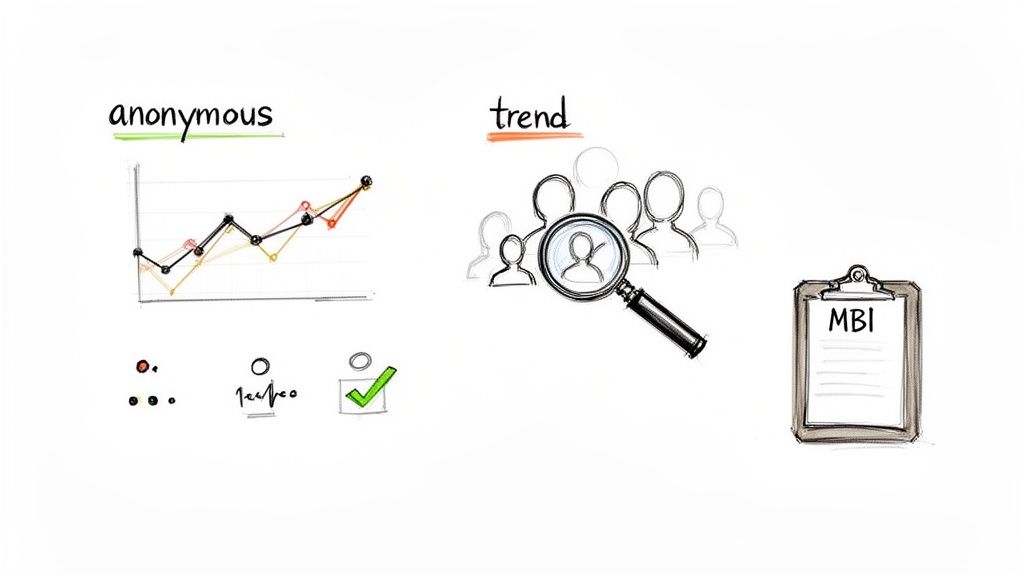
This is where instruments like the Maslach Burnout Inventory (MBI) come into play. The MBI is a well-regarded psychological assessment that measures burnout across its three core dimensions: emotional exhaustion, depersonalization (cynicism), and a diminished sense of personal accomplishment. Using a validated tool like this gives you a scientifically sound baseline to work from.
Combine this with regular, anonymous pulse surveys, and you can start tracking trends and spotting issues as they emerge. In fact, a study in the Journal of Occupational Health Psychology found that frequent, brief surveys were highly effective in tracking fluctuations in employee well-being and identifying stressors in near real-time.
Asking the Right Questions to Get Real Answers
The quality of your data depends entirely on the quality of your questions. Generic inquiries will get you generic, unhelpful answers. Your pulse surveys need to dig into the specific drivers of burnout. To gather crucial insights into your team’s current state, it’s worth considering the value of conducting staff satisfaction surveys designed with this in mind.
Here are a few examples of questions that probe key areas:
- Workload: “On a scale of 1-10, how manageable has your workload felt over the past two weeks?”
- Autonomy: “Do you feel you have the flexibility you need to get your work done effectively?”
- Psychological Safety: “How comfortable are you voicing a different opinion or raising a concern with your direct manager?”
- Recognition: “Do you feel that your contributions are seen and valued by your team and leadership?”
These questions move beyond simple “happiness” metrics and get to the heart of what truly impacts an employee’s daily experience at work.
Turning Data Into Decisive Action
Collecting data is completely pointless if you don’t do anything with it. This is the final, most crucial step—translating those survey results into tangible action. It’s where you close the feedback loop and build real trust. Research in the Journal of Applied Psychology showed that when employees see their organization genuinely acting on feedback, both engagement and job satisfaction increase significantly.
Actionable Example: Imagine your survey data reveals that the marketing team is reporting dangerously high workload scores. Instead of a generic company-wide email, the marketing director holds a team-specific session to review the data, acknowledge the problem, and collaboratively brainstorm solutions like pausing a low-priority project or bringing in temporary support. This targeted action shows you’re listening and serious about fixing the problem.
Once you have the data, your action plan needs to be multi-layered.
- Pinpoint At-Risk Teams: Look for patterns. Is burnout concentrated in a specific department or under a particular manager? This allows for targeted interventions instead of a one-size-fits-all approach that misses the mark.
- Refine Policies and Resources: Do the results point to a systemic issue, like a lack of flexibility or insufficient mental health support? Use this data to build a strong business case for policy changes or for implementing comprehensive workplace mental health programs.
- Upgrade Manager Training: If the data reveals a widespread lack of support from managers, it’s a clear signal that your leadership training needs an update. Equip managers with the practical skills to foster psychological safety and manage workloads for their teams.
By systematically tracking well-being and, most importantly, acting on what you learn, you demonstrate a genuine commitment to creating a sustainable, supportive work environment. This proactive approach is the cornerstone of any truly effective burnout prevention strategy.
Answering Your Questions About Burnout Prevention
Putting a burnout prevention strategy into practice always brings up a few questions. Let’s tackle some of the most common ones I hear from leaders trying to get this right.
What Are the Earliest Warning Signs of Employee Burnout?
Long before an employee hits a breaking point, the signs are there—they’re just subtle. Forget dramatic outbursts; the earliest red flags are usually quiet changes in behavior and attitude.
You need to watch for these small but telling shifts:
- Growing Cynicism: Is a once-enthusiastic team member suddenly making sarcastic remarks or dismissing new ideas? That’s a classic sign.
- A Drop in Proactivity: Think about the person who always brought fresh ideas to the table. If they’re now just going through the motions, something’s up.
- Unusual Mistakes: When a detail-oriented employee starts fumbling simple tasks or missing deadlines, it’s not a performance issue—it’s a warning sign.
These indicators often point to what’s known as “presenteeism.” The person is physically at their desk, but their mind and spirit have already checked out. A study in the American Journal of Preventive Medicine drives home just how costly this disengagement can be. The right move is to pull them aside for a supportive, private chat that’s about their well-being and workload, not just their output.
How Can Small Businesses Prevent Burnout with Limited Budgets?
Here’s the good news: preventing burnout is about building a better culture, not buying expensive perks. Small businesses can make a massive difference with smart, low-cost strategies that focus on communication and respect for people’s time.
For instance, actively protecting your team’s personal time costs nothing but sends a powerful message. You could implement a “no after-hours emails” policy or establish “focus Wednesdays” with no meetings. Gallup’s research has shown time and again that a lack of manager support is a primary driver of burnout. Investing a little time in training your managers to give regular, meaningful feedback is one of the highest-impact things you can do.
Actionable Example: A small startup can implement a “no-meeting Friday afternoon” rule. This costs zero dollars but gives every employee a dedicated block of time for deep work or to wrap up their week without interruption, directly addressing workload pressure and giving back a sense of control over their time.
How Should We Introduce a New Wellness Initiative?
The way you roll out a new wellness program determines whether your team sees it as a genuine benefit or just another corporate task. It’s all in the framing. Present it as a practical resource to help them manage stress and sharpen their focus—a tool to help them win the workday.
Getting your leadership on board is absolutely essential. The initiative should be kicked off by a senior leader who can explain why the company is investing in this and, even better, share how they plan to use it themselves. That’s what authentic buy-in looks like.
Finally, remove every possible barrier to entry.
- Schedule short, guided sessions during paid work hours.
- Make participation 100% voluntary and confidential.
- Position it as a way to boost both personal and professional effectiveness.
Research from the Journal of Occupational and Environmental Medicine confirms that when people feel their organization truly supports them, burnout rates plummet. Making wellness accessible and championed from the top is how you show that support in a real, tangible way.
Ready to build a more resilient, engaged, and burnout-proof team from the inside out? At 9D Breathwork, we provide powerful, science-backed experiences that disrupt stress patterns at their root. Discover how our corporate programs can rewire your team for well-being and peak performance at https://9dbreathwork.com.