Finding work that feels truly meaningful isn’t about chasing some mythical “perfect job.” It’s about forging a real, deliberate connection between what you do every day and who you are at your core.
The whole process starts with a simple but powerful idea: aligning your work with your core values, your natural strengths, and the kind of impact you want to make. When these three things click into place, you stop just working and start building a career that genuinely fulfills you.
So, What Does Meaningful Work Actually Mean to You?
Let’s be honest, the search for meaningful work can feel a bit vague and overwhelming. But it really boils down to something deeply personal. It’s not about some rare, unattainable dream job that only a lucky few find. It’s about building a career that reflects who you are and contributes to something you believe in.
A study published in the Review of General Psychology analyzed data from multiple studies and found that meaningfulness is a stronger predictor of life satisfaction than happiness. This means the deep sense of purpose you get from your work can have a more lasting impact on your overall well-being than a fleeting feeling of daily happiness.
This isn’t about reaching a final destination. It’s a journey of intentional alignment. Our goal here is to give you a realistic, empowering framework to guide that journey—one where fulfillment is something you can actively build, not just hope for.
The Key Pillars of Meaningful Work
Before we dive in, let’s get clear on the building blocks of a meaningful career. It goes way beyond just “being happy” at work. We’re talking about a much deeper sense of connection to what you’re doing and why it matters. Organizational psychologists have found that a sense of meaning is a far stronger motivator than salary or status will ever be.
This quick overview table breaks down the core components we’ll be exploring throughout this guide.
| Pillar | What It Means for You | Actionable Example |
|---|---|---|
| Values | These are your non-negotiables—the guiding principles that define who you are. When your work aligns with them, you feel authentic and grounded. | A person who values “Community” would find more meaning working in a collaborative team than in a siloed, remote role. |
| Strengths | These are your natural talents and the skills you’ve honed. Using them regularly creates a sense of competence, flow, and energy. | A graphic designer who is a natural “Storyteller” can craft a project to build a compelling visual narrative, not just make something look good. |
| Impact | This is the tangible difference you want to make. It’s about seeing how your effort contributes to a cause, a community, or a mission you care about. | A software engineer could find impact by working for a health-tech company that improves patient outcomes. |
Think of these pillars as your personal compass for navigating your career choices.
The diagram below shows how these three elements flow together. It’s a simple, actionable path to follow.
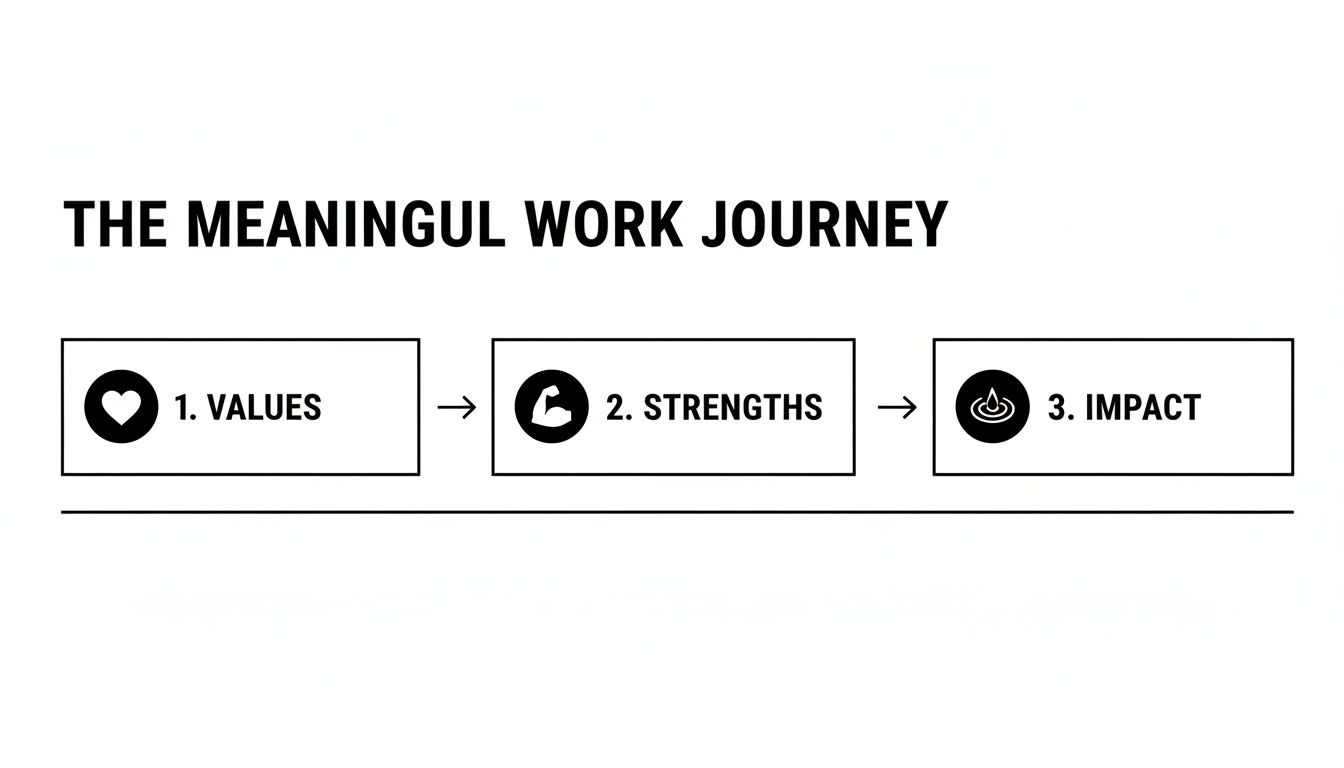
Your values point you in the right direction, your strengths are the tools you use to move forward, and the impact is the positive result you create along the way.
It’s important to remember you can find your work meaningful even if you aren’t perfectly satisfied with your job every single day. A global survey from ManpowerGroup revealed that while 82% of workers feel their work is meaningful, only 62% reported being satisfied with their jobs. This gap is telling. It shows that meaning and day-to-day happiness are two different things, and having a strong sense of purpose doesn’t automatically solve every career challenge.
Your work is ultimately an expression of yourself. When you align it with your core purpose, a job transforms into a calling. It becomes a vehicle for who you are becoming.
Taking the time for this kind of self-reflection is the most important step you can take. If you want to go even deeper on this topic, our guide on how to find purpose in life is a great place to start.
Building Your Personal Compass for Career Navigation
Before you can even think about charting a new career course, you need a compass. Not a physical one, but an internal one. The real search for meaningful work always starts with a deep, honest look inside—moving past just what you can do to figure out what truly drives you.
This isn’t some quick fix or a hunt for the “perfect” job that will solve everything overnight. It’s about building the kind of self-awareness that lets you make deliberate, powerful choices for yourself. This kind of reflection can feel a bit overwhelming, so it’s smart to have some simple grounding techniques in your back pocket to manage any stress that pops up.
Uncovering Your Core Values
Think of your values as the non-negotiable principles that quietly guide your life. When your work is out of sync with them, you feel it—that constant drain, that sense of being a square peg in a round hole. But when your work and values click? That’s when you feel authentic and energized, even on the tough days. It’s not just a feeling; research from the Journal of Vocational Behavior shows that when personal and workplace values line up, it’s a huge predictor of overall life satisfaction.
Actionable Step: Get out a pen and paper.
- Remember a peak moment: Think back to a time at work when you felt totally alive, proud, and in the zone. Maybe it was landing a huge client, solving a complex problem, or helping a teammate succeed. Write down exactly what you were doing.
- Dig into the “why”: Now, look at your story. Why did that moment feel so good? Was it the creative freedom? The teamwork and collaboration? The challenge of mastering a difficult skill? The feeling of making a difference for a client? Write down the “why” behind the what.
- Name your values: From your “why” list, pull out core themes. You might end up with words like Autonomy, Collaboration, Mastery, Creativity, or Service. Circle your top five. These are your non-negotiables.
This simple exercise gives you a real, evidence-based list of what you absolutely need to feel fulfilled in your work.
Pinpointing Your Unique Strengths
Meaningful work isn’t just about what you believe in; it’s about what you’re naturally good at. I’m not talking about the skills on your LinkedIn profile. I mean your innate talents—the things you do that feel easy, almost effortless, and leave you feeling energized, not drained.
A huge piece of finding meaning at work is feeling like you matter. That doesn’t just come from a pat on the back. It comes from knowing, deep down, that what you bring to the table makes a real difference.
Actionable Step: Send a quick email or text to five people you trust (colleagues, friends, former managers) and ask them: “When you think of me at my best, what do you see?” The patterns in their answers will reveal the strengths you might be taking for granted. These might be things like being an “empathetic listener,” a “systems thinker,” or a “natural motivator.” When people get to use their signature strengths every day, they’re six times more likely to be engaged at work. Getting clear on these unique gifts is a crucial part of building your compass. If you want to go deeper, you can explore techniques to increase self-awareness.
Once you have this foundational understanding of yourself, you can start looking at the practical side. A great next step is performing a skills gap analysis to see where you are now versus where you want to go. It’s the perfect bridge between self-discovery and a real, actionable plan.
Connecting Your Compass to the Real World
Okay, the self-discovery part is done. You’ve looked inward and have a much better handle on your values, your strengths, and the kind of impact you want to make. That’s a huge step, but it’s only half the journey. Now, we need to build a bridge from that internal clarity to the actual job market.
This is where we move past aimlessly scrolling through job boards. It’s about translating who you are into what you do.

The real trick is to connect your personal definition of meaning with real, tangible opportunities out there. This takes a bit of detective work, but it’s worth it to find those industries and roles where you’ll feel both fulfilled and valued.
Start with Industries, Not Job Titles
Forget about specific job titles for a moment. Instead, let’s look at entire sectors. Ask yourself, “Where is the world heading, and where do my values align with that direction?”
Practical Example: If your top value is “Environmental Stewardship,” your world isn’t just “environmental scientist.” It’s the entire green ecosystem. You could be a marketing manager for a solar panel company, a supply chain expert for a sustainable fashion brand, or a financial analyst for an ESG investment fund.
Thinking in terms of sectors opens your eyes to a whole universe of possibilities, not just a few siloed roles. This forward-looking approach is critical. A recent report on the future of work estimates that major economic shifts will create new jobs equivalent to 14% of today’s total employment by 2030. That’s a massive change. By focusing on sectors with strong growth and in-demand skills, you’re not just finding a job for now, you’re building a sustainable, meaningful career. You can dig into the specifics in the full Future of Jobs Report.
Use LinkedIn as Your Research Lab
Most people see LinkedIn as a place to park their resume. I see it as one of the most powerful career research databases on the planet. This is where you can see, in real-time, how people with backgrounds like yours have built fascinating careers.
Actionable Step:
- Find 5-10 people working in roles or companies in the sectors you identified. Use keywords like “sustainability manager” or “health tech product lead.” This isn’t about networking yet—it’s pure intelligence gathering.
- Become a career archaeologist. Go to their profile and look at their career path. What was their first job? What skills are listed in their “Skills” section? Did they make a major pivot from a totally different field? Take notes.
- Spot the patterns. After looking at a few profiles, you’ll start to see common threads—the specific software they know, the certifications they have, or the types of companies they worked for. This gives you a realistic, unofficial roadmap for how to get where they are.
This exercise demystifies the path forward. It helps you connect the dots between your current reality and a potential future, making it feel so much more achievable. It’s also the best way to identify the specific, in-demand skills you might need to pick up along the way.
You’re not looking at other people’s career paths to copy their journey. You’re collecting clues to write your own unique and meaningful professional story.
Learn to Decode Job Descriptions
Once you’ve zeroed in on a few target roles or industries, it’s time to start looking at actual job descriptions. But don’t just skim them—analyze them like a detective searching for hidden clues. Look past the bullet points and read the language.
- What are the action verbs? Are they using words like “build,” “create,” and “innovate”? Or is it more about “maintaining,” “supporting,” and “administering”? The verbs they choose tell you a lot about the day-to-day energy of the role.
- What’s the cultural vibe? Does the description talk a lot about collaboration, team projects, and cross-functional work? Or does it emphasize individual contribution and autonomy? The language is often a direct reflection of the company’s values. A healthy work environment is non-negotiable, and knowing how to improve company culture can help you recognize the green flags.
- Read between the lines of “Required” vs. “Preferred.” This section is a goldmine. It tells you what skills are absolute deal-breakers and which ones are nice-to-haves where you have some room to grow.
By mapping your internal compass to the realities of the market, you shift from wishful thinking to strategic action. You’re no longer just hoping to find something meaningful; you’re actively building a path where your contribution matters.
Trying Things On: How to Test Your New Career Path Without Quitting Your Job
It’s easy to get stuck in your head. You can map out your values, research companies, and read job descriptions for months, but all that thinking can lead to a classic case of analysis paralysis. At some point, you have to shift from theory to practice.
But making the leap doesn’t have to mean handing in your notice tomorrow. Think of it like a scientist running an experiment. You have a hypothesis: This new career path might be the one for me. The next step is to run a few small, low-stakes tests to see if your hypothesis holds up in the real world. This approach cuts through the uncertainty, builds confidence, and gives you actual data to work with.
Dip Your Toes in With a Freelance Project
One of the fastest ways to get a real feel for a new line of work is to take on a small, paid project. You can find these gigs everywhere, from platforms like Upwork to a simple post on LinkedIn asking your network for leads. It’s like test-driving a car before you buy it.
Actionable Step: If you’re a project manager curious about sustainable branding, search Upwork for “sustainability report” or “eco-friendly marketing plan.” Find a small, 5-10 hour project. This isn’t about the money; it’s about the hands-on experience. You’ll learn the language, see the real-world challenges, and get a genuine sense of the day-to-day work—things a job description will never tell you.
Volunteer Your Skills for a Cause You Love
If you’re pulled toward work that makes a difference, volunteering is an incredible way to explore that calling. It’s a direct path to seeing how your professional skills can create a real-world impact, especially if you’re eyeing the non-profit world.
Actionable Step: Use a site like VolunteerMatch or Catchafire. You can filter by cause (e.g., “Animal Welfare”) and by skill (e.g., “Marketing” or “Accounting”). Find an opportunity that requires 2-4 hours a week for a limited time.
Here are a few ways this could look:
- A marketer who cares about animal welfare could spend a few hours a week running the social media accounts for a local shelter.
- An accountant feeling bored at their corporate job could offer to help a small arts organization sort out their bookkeeping.
- A software developer passionate about education could volunteer to build a simple app for a local literacy program.
These experiments tell you so much, so quickly. You’ll find out if the work itself lights you up and if the environment truly resonates with your core values.
Meaningful work is often found where your skills meet a real need in the world. Low-risk experiments are how you find that sweet spot without veering completely off course.
Carve Out a “Stretch” Project at Your Current Job
Sometimes the best opportunities are hiding in plain sight. Taking on a “stretch” project at your current company lets you try on a new role in a familiar setting. It’s often the lowest-risk experiment you can run.
Actionable Step: Schedule a meeting with your manager. If you’re in customer support but are fascinated by UX design, pitch a small project: “I’d love to spend 10% of my time for the next month interviewing our top 10 customers about their experience with X feature and creating a short feedback report. It would help us improve the product and give me some valuable experience.” It’s a win-win: you show initiative and get concrete experience for your resume, while the company gets valuable insights.
Stepping into a new role, even temporarily, can be stressful. It’s a perfect opportunity to build your resilience. Learning how to handle that pressure is a skill in itself, and you can find powerful techniques for rewiring your brain for resilience and growth to help you along the way.
Finding More Meaning Right Where You Are

The search for meaningful work doesn’t always have to end with a dramatic exit and a brand-new career. In fact, one of the most powerful moves you can make is to find that meaning in the job you already have.
The secret is to stop viewing your job description as a rigid set of rules and start seeing it as a flexible framework you can actively shape.
This idea is called job crafting. It’s all about redesigning your role from the inside out so it aligns better with what you value, what you’re good at, and what truly interests you. By making small, deliberate tweaks, you can fundamentally change your relationship with your work—no resume update required.
Tweak Your Tasks
This first approach, known as task crafting, is about changing up your daily responsibilities. You can either take on new projects that excite you or simply find a new way to handle your current duties. The goal is to spend more of your time on the parts of the job that actually feel important to you.
Actionable Step:
- For one week, keep a log of your daily tasks.
- At the end of the week, highlight the tasks that felt energizing and meaningful in green. Highlight the tasks that felt draining in red.
- Brainstorm one small way you could increase your “green” time by 10% next week.
- An accountant who loves mentoring could offer to spend one hour a week helping a new hire.
- A retail manager could start a community partnership program with a local cause they support.
Research from the Journal of Vocational Behavior confirms this isn’t just a nice idea. It found that employees who actively craft their jobs report higher well-being, greater job satisfaction, and feel more engaged. Taking control, even in small ways, pays off.
Reshape Your Relationships
Next up is relational crafting, which is all about being intentional with your workplace connections. The quality of our professional relationships has a huge impact on how we feel about our jobs.
Actionable Step: This week, identify one person at work who inspires you and one person you could help. Schedule a 15-minute coffee chat with the person who inspires you to learn about their role. Then, offer 15 minutes of your time to the person you can help, maybe by reviewing a document or sharing a skill.
Reframe Your Perspective
The final piece is cognitive crafting—changing how you think about your work. This is the mental shift of connecting your day-to-day tasks to a bigger, more meaningful purpose. It’s an internal reframe, and it can be incredibly powerful.
Actionable Step: Write down your core job function (e.g., “I manage schedules”). Now, rewrite it to connect to the ultimate impact.
- A hospital administrator isn’t just “managing schedules.” They are “making sure patients get timely, life-saving care.”
- A janitor at a school isn’t “cleaning floors”; they’re “creating a safe and healthy environment for children to learn.”
Of course, making these changes is much easier in a healthy work environment. Knowing about things like reasonable adjustments for mental health at work can make a real difference in creating the psychological safety needed to craft your role. This shift in mindset, combined with a supportive culture, is a core part of finding meaningful work, no matter where you are.
Got Questions? Let’s Talk Through Them.
Even with the best roadmap, hitting a few bumps or having questions crop up is completely normal. It’s all part of the process. Let’s tackle some of the most common concerns I hear from people navigating this journey, so you can keep your momentum going.
“Okay, But How Long Is This Really Going to Take?”
This is the big one, isn’t it? The honest answer is: it’s a marathon, not a sprint. There’s no magic timeline because your path is uniquely yours. It really depends on where you’re starting from—your industry, your financial situation, and how much time you can realistically carve out for the deep work of reflection and exploration.
For some, it might be a matter of job crafting their current role, and they could feel more fulfilled in a few months. But for a full career change, it could be a year or more to allow for self-discovery, research, new skills, and networking.
One fascinating study on career transitions in the Academy of Management Journal revealed that people who actively engaged in “identity work”—like trying out new professional hats or connecting with people way outside their usual network—had far more success in making meaningful changes. This proves that you can’t wait for the answer to appear; you have to go out and find it.
My advice? Forget the giant leap. Focus on taking small, consistent steps. Actionable step: Schedule 30 minutes in your calendar each week labeled “Career Exploration.” Use that time for one specific action: updating your values list, researching one company, or sending one networking email. That’s what progress looks like.
“Meaningful Work Sounds Great, But I Can’t Afford a Pay Cut.”
This is a huge, practical concern. Let’s bust a myth right now: the idea that meaningful work automatically means less money is simply not true. The trick is to be strategic. Hunt for the sweet spot where your values and your market value overlap.
Here’s how you can start:
- Look at booming, purpose-driven industries: Think about fields like renewable energy, health tech, sustainable finance, or educational technology. These sectors are growing fast and are desperate for top talent.
- Bring your existing skills to a mission-focused company: A company dedicated to fighting climate change needs skilled software engineers and marketing directors just as much as a traditional tech firm does.
- Know and negotiate your worth: Never forget that your experience has real-world value.
Research in the Journal of Research in Personality backed this up, finding that while feeling a sense of purpose is critical for happiness at work, a fair salary still plays a huge role in overall job satisfaction. The goal is to find a role that ticks both boxes. Actionable step: Use a site like Tech Jobs for Good or B Work to browse well-paying jobs at mission-driven companies and see how your current salary expectations stack up.
“How Do I Actually Know if I’m on the Right Track?”
When you’re stepping into the unknown, a little uncertainty is guaranteed. The best way to gauge if you’re moving in the right direction is to tune into your own energy.
After you do one of your small experiments—say, a short volunteer project or an informational interview—how do you feel? Are you drained and just glad it’s over, or are you buzzing with energy and new ideas? That feeling is your internal compass pointing the way.
Another study, this one from the Journal of Career Assessment, showed something I’ve seen time and time again: clarity comes from action, not just from thinking. The more you get out there and test your ideas in the real world, the more confident you’ll become in your direction. Actionable step: Keep a “Career Experiments Journal.” After each action you take (a conversation, a short project, an online course), write down one sentence about how it made you feel. Review it monthly to see what energizes you. Trust the feedback you’re getting from your own experiences.
At 9D Breathwork, we know that profound, lasting change begins on the inside. Our guided breathwork journeys are specifically designed to help you dissolve limiting beliefs, get crystal clear on your purpose, and build the inner strength you need to create a career that genuinely lights you up. Ready to find your path? Explore our transformative experiences today.