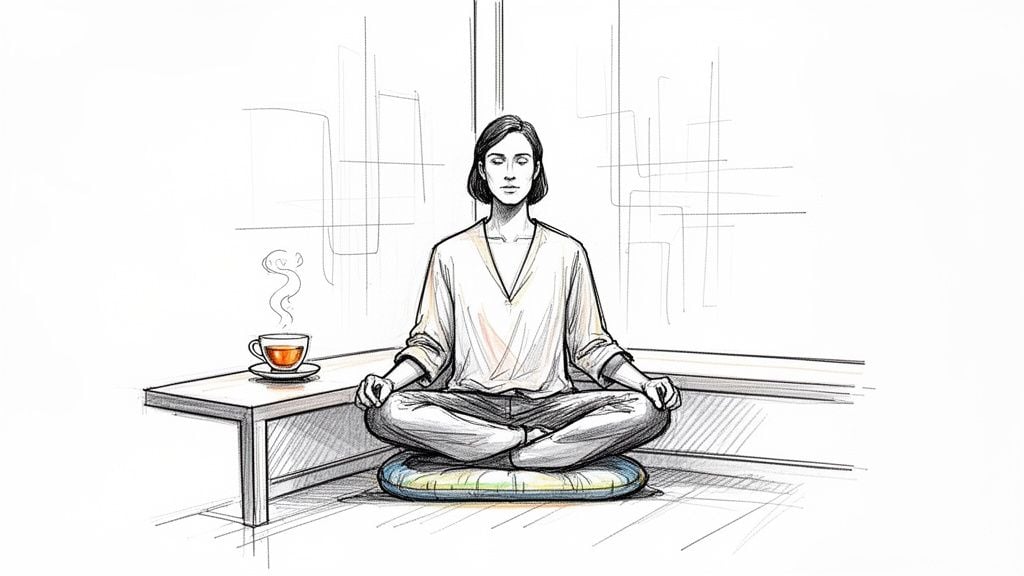
Learning to sit for meditation is about so much more than just crossing your legs and closing your eyes. It’s about setting up a physical foundation that allows your mind to settle. Getting your posture right—making it comfortable and aligned—is the first actionable step toward a practice that can genuinely clear your head and calm your nervous system.
The Foundation Of Mindful Practice

In a world that never seems to stop, the simple act of sitting in stillness can feel almost revolutionary. It’s an intentional choice to step away from the noise and reconnect with yourself. For busy professionals or anyone feeling the weight of stress, this isn’t some abstract concept; it’s a practical tool for getting back a sense of clarity.
Think of your physical posture as the gateway to your meditation. If you’re slouched, uncomfortable, or in pain, your body will constantly send distracting signals to your brain, pulling your attention away from your breath. A 2020 study backs this up, showing that mindful awareness practices—which all start with a stable, seated position—can significantly cut down on rumination and knee-jerk emotional reactions.
My goal here is to make this whole process feel approachable. I want to give you practical steps you can put into practice today, no matter how skeptical or busy you might be.
Linking Stillness And Breath
Physical stillness is key, but it’s just the beginning. A quiet body creates the perfect space for deeper inner work, especially when you bring intentional breathing into the mix. For instance, advanced techniques like those in 9D Breathwork build on this quiet foundation to explore the subconscious, helping to release old patterns and create new ways of thinking. We know this works—research from 2017 showed that slow, controlled breathing has a direct, calming effect on the brain’s emotional control centers.
The physical posture isn’t the goal of meditation; it is the vehicle. A supported spine and relaxed body allow your energy and attention to turn inward, preparing you for the journey ahead.
By mastering the fundamentals of how you sit, you’re also setting yourself up for real cognitive benefits. A study in Perspectives on Psychological Science found that meditation improves attention and working memory. This guide will walk you through finding a posture that feels both comfortable and sustainable, whether that’s on a cushion or right in your office chair.
This is where the journey begins—with the simple, powerful act of taking your seat. For a deeper dive, you can explore more guided meditation techniques in our detailed article.
Getting Ready to Sit: Preparing Your Space and Body
Setting the stage for meditation is about more than just finding a quiet corner. It’s an act of intention. You’re signaling to your mind and body that it’s time to shift from the chaos of the day into a state of quiet presence. This doesn’t require an elaborate setup; a few thoughtful adjustments are all it takes.
If you’re a professional trying to squeeze this into a busy workday, this might look like carving out a small sanctuary in your office. Maybe you place a small plant on your desk, silence all your notifications (seriously, all of them), and pop in some noise-canceling headphones. It’s a simple ritual, but it creates a powerful mental boundary between “work mode” and “practice mode.” In fact, a 2021 study found that creating these “micro-environments” can dramatically lower stress in busy open-plan offices.
Warming Up Your Body for Stillness
Just as you prepare your space, you need to prepare your body. Trying to go from sixty to zero by jumping from a high-stakes meeting directly into silent stillness is a recipe for frustration. Your body needs a moment to catch up.
A brief transition ritual can make all the difference.
- Move a little first. Try this 1-minute routine: Slowly roll your neck from side to side 3 times each way. Shrug your shoulders up to your ears, hold for a breath, then let them drop completely (repeat 3 times). Finish with a simple seated spinal twist, holding for 15 seconds on each side.
- Have a warm drink. A cup of herbal tea like chamomile or peppermint isn’t just comforting; it has a real physiological soothing effect. The warmth and aroma help anchor you in the present moment through your senses.
- Get comfortable. Your clothes shouldn’t be a distraction. If you’re at the office, just loosening a tie, kicking off your shoes, or removing a tight blazer can significantly boost your comfort and ability to relax.
Think of these small actions as a buffer zone between your day and your meditation. They smooth the transition, making it much easier to settle down.
Before you begin, take a moment to set an intention. This is your final step. Silently ask yourself what you hope to find in this session. Is it clarity? Calm? Or just a single moment of quiet? This gives your practice a gentle focus.
Fine-Tuning Your Environment
Last but not least, do a quick scan of your physical environment. A room that’s too hot or cold will constantly pull at your attention. You’re looking for a comfortable, neutral temperature where you won’t be distracted by a chill or feel stuffy and overheated.
Even a five-minute setup can radically improve your ability to drop into a mindful state. One 2018 study confirmed that even short meditations in a well-prepared space can improve emotional regulation and focus. The whole point is to minimize the external chatter so you can finally tune into your internal landscape. This preparation is a crucial first step for anyone learning how to master sitting for meditation.
Finding Your Ideal Meditation Posture
Let’s get one thing straight: your meditation posture isn’t about looking like a Zen master on the cover of a magazine. It’s about finding a position that feels stable and comfortable enough for you to stay put. The whole point is to find a sustainable posture that works for your body, not against it.
There’s actually science behind this. A solid, stable posture is directly linked to better focus. A 2019 study in Consciousness and Cognition found that sitting upright can boost your mood and alertness, which makes it much easier to keep your attention where you want it. Your goal is simply to find a position you can hold without constantly fidgeting or feeling strained.
Before you even think about posture, it’s wise to prepare your mind. This simple flowchart walks you through the mental prep that can make all the difference.

The big takeaway here is that your practice starts before you sit down. Acknowledging your mental state and setting a quick intention can completely shift the quality of your session.
Floor-Based Postures for a Grounded Sit
Sitting on the floor is the traditional approach, and for good reason—it provides a solid, grounded base. These postures are great if you have decent hip flexibility, but nearly everyone benefits from using a meditation cushion (often called a zafu) to lift their hips slightly above their knees. This simple trick takes a ton of pressure off your lower back.
Here are a few common options:
- Burmese Position: This is my go-to recommendation for beginners. Actionable step: Sit on the edge of a cushion, cross your shins, and place one foot on the floor in front of the other shin. Both of your feet should be resting on the floor. Check that your knees can drop lower than your hips.
- Half-Lotus (Ardha Padmasana): If your hips are more open, you can try placing one foot on the opposite thigh while the other foot is tucked under the opposite leg. This creates a very stable triangular base, but please, don’t force it. You can seriously strain your knee ligaments if you push your body into a position it’s not ready for.
- Seiza (Kneeling): This is a fantastic alternative. Simply kneel, place the tops of your feet flat on the floor, and sit back on your heels. Many people find this much more sustainable with a purpose-built seiza bench or even just a firm cushion tucked between the heels and buttocks.
No matter which one you choose, the fundamental principle is an upright spine that feels long but not stiff.
Key Alignment Cue: Imagine a string is gently pulling the crown of your head up toward the ceiling. Let that feeling create length in your spine, then allow your shoulders to relax down and back, away from your ears. Your hands can just rest gently on your thighs or in your lap.
Chair Meditation: The Accessible Alternative
You absolutely do not have to sit on the floor to meditate. For many of us, especially if we’re dealing with knee issues, limited mobility, or just trying to squeeze in a session at the office, a chair is the perfect tool.
The trick is to use the chair for support without sinking into it. Actionable step: Sit toward the front third of the chair. Plant both feet flat on the floor about hip-width apart. Your thighs should be parallel to the floor, creating a rough 90-degree angle at your knees. This forms a strong, stable foundation for an upright spine.
If your feet are dangling, don’t just let them hang! Slide a yoga block, a cushion, or a stack of sturdy books underneath them. The most important thing is to maintain the natural, gentle curve in your lower back. A 2018 study showed that a mindfulness program for older adults who used chairs helped improve their attention and even reduced feelings of loneliness.
So, how do you choose? The best posture is the one that works for your body today. Some days you might feel open and ready for the floor; other days, a chair will feel like a lifesaver. This table can help you weigh your options.
Comparing Meditation Postures for Your Body
Choosing the right position comes down to your body’s unique needs. This table breaks down the most common options to help you find your best fit based on flexibility, comfort, and the props you have available.
| Posture | Best For | Key Challenge | Props Needed |
|---|---|---|---|
| Cross-legged (Burmese) | Those with average hip flexibility; creating a stable, grounded base. | Can strain the lower back or knees if hips are tight. | Essential: Meditation cushion (zafu). Optional: blanket under knees. |
| Kneeling (Seiza) | People who find cross-legged positions uncomfortable; takes pressure off the hips. | Can be intense on the ankles and knees without support. | Recommended: Seiza bench or a firm cushion between the heels. |
| Chair | Anyone with limited mobility, knee/hip pain, or meditating in an office setting. | The temptation to slouch or lean back can be strong. | A firm chair. Optional: cushion for back support; block/books for feet. |
Ultimately, finding your go-to posture is a process of friendly experimentation. Listen to your body and honor what it’s telling you. If you start to feel a lot of tension creeping in during your sit, it might be a sign to switch things up. For extra help with that, you can explore some techniques on how to release tension in the body.
Using Props to Support Your Practice
Let’s be honest: it’s nearly impossible to find mental quiet when your body is screaming at you. Physical pain is one of the biggest reasons people give up on sitting meditation. This is where props come into play. Think of them not as crutches, but as smart tools to build a practice that’s both sustainable and enjoyable.
The whole point is to create a posture that feels supported, not strained. A study in Frontiers in Psychology confirmed that physical discomfort during meditation is directly linked to a wandering mind. So, by making yourself comfortable with props, you’re not cheating—you’re setting the stage for a more focused session.
The Foundation: A Meditation Cushion
The most basic and essential prop is a meditation cushion, often called a zafu. Placing one under your sit bones elevates your hips, which is the key to everything else falling into place.
This simple lift allows your pelvis to tilt forward naturally. This, in turn, helps your spine find its natural S-curve and lets your knees drop down below your hips, taking a huge amount of strain off your lower back and hip flexors.
- Zafu (Round Cushion): This is your best friend for most cross-legged positions. Actionable step: Sit on the front edge of the cushion, not flat in the middle. This is what helps your pelvis tilt forward correctly.
- Zabuton (Flat Mat): This is the larger, rectangular mat that goes underneath your zafu. It’s a lifesaver, providing crucial padding for your ankles and knees and preventing them from grinding into a hard floor.
Think of it like this: the zafu aligns your posture, and the zabuton comforts your limbs. Using them together is a total game-changer for sitting on the floor.
Solving Specific Pains with Blocks and Benches
Even with the perfect cushion setup, you might still run into specific aches. This is your chance to get creative and troubleshoot those sore spots directly.
Practical Tip: If you’re sitting cross-legged and your knees are floating high in the air, don’t just leave them hanging! That puts a ton of tension on your hip joints. Instead, slide a yoga block, a firm pillow, or even a folded blanket under each knee. You’ll feel an immediate and welcome sense of release.
A seiza bench is another fantastic tool, especially if sitting cross-legged just isn’t in the cards for you. This small, angled bench lets you kneel comfortably without putting any pressure on your ankles or knees. Your weight is supported by the bench, which keeps your spine effortlessly straight. Research from the Journal of Bodywork and Movement Therapies has even shown that using props like benches can significantly reduce musculoskeletal pain during meditative postures.
For those who find sitting in a chair is the best option, specialized equipment can make a world of difference. You might consider an all-in-one saddle stool designed for meditation, which is built to encourage an upright posture. A 2018 study found that using these kinds of ergonomic aids can improve core muscle activity and reduce the load on your spine.
And you don’t always need something fancy. Even a simple rolled-up towel or small blanket placed at your lower back can provide excellent lumbar support in almost any chair, helping you fight off that all-too-familiar slouch.
Bringing Your Breath into the Picture

Once you’ve settled into a posture that feels supportive and sustainable, your breath takes center stage. Think of your posture as the vessel; your breath is the anchor that keeps your mind from drifting out to sea. This isn’t just a poetic idea—it’s grounded in our biology.
When you deliberately slow down your breathing, you send a direct message to your brain to switch off its alarm system, the “fight-or-flight” response. Research has shown that mindful breathing fires up the parasympathetic nervous system, your body’s natural relaxation mechanism. Just by breathing consciously, you can lower your heart rate, ease your blood pressure, and invite a genuine sense of calm.
It’s no surprise that meditation has seen a massive surge in popularity. In the US alone, the number of adults who meditate jumped to 18.3% (that’s 60.53 million people) by 2022. The recent pandemic accelerated this trend, with one fitness company seeing a staggering 2,900% increase in meditation minutes logged globally since March 2020. You can dive into the full details of this worldwide shift in this comprehensive study.
Simple Breathing Techniques to Get You Started
You don’t need to be a yogi to get started. The first and most important step is simply to pay attention. As you sit, just notice your breath. Don’t try to force it or change it. Simply feel the air as it comes in through your nose and as it leaves your body.
A fantastic starting point is what’s known as diaphragmatic breathing, or more simply, “belly breathing.” It’s incredibly effective.
- Try this right now: Place one hand gently on your chest and the other on your lower belly.
- Breathe in slowly through your nose for a count of four. Your goal is to feel the hand on your belly rise, while the one on your chest remains mostly still.
- Then, as you exhale slowly for a count of six, feel your belly gently fall. Repeat this five times.
This method ensures you’re using your diaphragm to its full potential, which boosts oxygen flow and sends powerful relaxation signals. In fact, a study in Frontiers in Psychology found that this exact technique can significantly lower cortisol, our main stress hormone.
For anyone dealing with a high-stakes job, box breathing is a game-changer. It’s subtle enough to do right at your desk before a presentation. Simply inhale for a count of 4, hold for 4, exhale for 4, and hold again for 4. Repeat this a few times. The rhythm quickly calms the nerves and sharpens your focus.
Ready for the Next Step in Your Breathwork Journey?
Getting comfortable with these foundational breathing exercises is the perfect way to build a strong meditation practice. They ground you in the present and help regulate your nervous system. Once you feel you have a good handle on them, you can start exploring practices that go even deeper.
Advanced methods, like those we guide people through in 9D Breathwork, take this foundation and build on it. They use intentional breathing patterns, music, and vocal guidance to help you access and work with the subconscious mind. While belly breathing is excellent for calming the surface-level chatter, these deeper journeys offer a path to more profound personal insights. To learn more about the roots of breath control, have a look at our guide on what Pranayama breathing is.
Troubleshooting Common Meditation Challenges
Even when you’ve nailed the perfect posture, your mind will inevitably have its own plans. This is a huge sticking point for so many people. They sit down to meditate, and when their mind starts racing or they feel sleepy, they think they’re failing.
You’re not failing. These experiences are a totally normal, expected part of the process. In fact, learning how to work with these distractions is the practice.
A study in the journal Mindfulness highlighted that this very act—noticing you’re distracted and then returning to your breath—strengthens your emotional regulation. Think of it as a bicep curl for your focus.
Taming The Racing Mind
There’s a reason it’s called “monkey mind.” Your thoughts can feel like they’re chaotically swinging from one branch to the next. The trick isn’t to fight it.
Instead, try a simple labeling technique. Actionable step: When you realize you’re tangled up in a to-do list or a worry, just silently say to yourself, “thinking.” This tiny act of acknowledgment creates just enough space to shift your perspective. You go from being caught in the thought-storm to simply observing it. From there, gently guide your focus back to the physical feeling of your breath.
If you find yourself stuck in a loop of particularly negative thoughts, our guide on how to stop intrusive thoughts offers some more specific techniques you can try.
The goal isn’t an empty mind. The real goal is to notice when your mind has wandered and to gently, kindly, bring it back. Each time you return, that’s a small victory.
Navigating Sleepiness And Restlessness
Drowsiness is another frequent guest, especially if you’re not getting enough sleep. If you feel yourself starting to nod off, the first thing to check is your posture. A slumped spine is a fast track to sleepiness.
If straightening up doesn’t do the trick, try letting your eyes open just a tiny bit. Keep a soft, unfocused gaze on the floor about a few feet in front of you. Research published in PLOS ONE shows that even a subtle adjustment like this can directly impact the brain activity tied to staying alert.
On the flip side, you might feel an intense restlessness or impatience. When that overwhelming urge to just get up and do something hits, Actionable step: see if you can challenge yourself to stay for just one more breath. A Journal of Neuroscience study showed that mindfulness actually changes the parts of the brain linked to self-control. By choosing not to react immediately, you are literally rewiring your brain’s response to discomfort.
Got Questions About Sitting Meditation? We’ve Got Answers.
Even after you’ve got the basics down, a few questions always seem to surface. It’s completely normal. Let’s tackle some of the most common ones that come up when you’re just starting out.
What If I Can’t Stop Thinking About Work?
This is, without a doubt, the most frequent hurdle people face. When your mind starts running through your to-do list or replaying a meeting, the trick is not to fight it. Fighting a thought just gives it more energy.
Instead, try this: simply notice the thought, and in your mind, label it “work” or just “thinking.” That’s it. Then, gently guide your attention back to the physical feeling of your breath moving in and out. A 2019 study actually showed this simple act of acknowledgment helps regulate our emotional reactions, making it much easier to let go of those stressful thoughts.
Acknowledge the thought without judging it, then gently guide your focus back to your breath. Think of it as a gentle redirection, not a mental battle.
Where Do I Put My Hands?
You’ve probably seen photos of people holding their hands in specific, sometimes intricate positions (mudras). While those have their place, simplicity is your best friend when you’re starting.
Just let your hands rest in a way that feels natural and relaxed. A couple of easy options are:
- Rest them in your lap, one hand inside the other with your palms facing up.
- Place them on your thighs, either palms-down or palms-up.
The whole point is to minimize distraction. A 2018 study pointed out that a comfortable hand position reduces physical fidgeting, which directly helps you maintain your focus. Pick whatever feels most effortless for you.
Seriously, How Long Should I Meditate For?
Start small. Really small. Actionable step: Set a timer for just five minutes a day. So many people try to be a hero on day one, sitting for 30 minutes, only to get frustrated and quit. Consistency beats duration, every single time.
Building a daily habit of just five minutes creates the foundation and the confidence you need. A study in the Journal of Positive Psychology found that even 15 minutes of meditation can bring about major psychological benefits, but you have to build up to it. Once five minutes feels manageable and routine, try adding another two minutes, and slowly build from there.
At 9D Breathwork, we see a stable seated meditation practice as the perfect launchpad for much deeper inner work. When you feel ready to go beyond simple mindfulness and start working directly with subconscious patterns, our guided breathwork journeys are designed to help you create profound, lasting shifts.
Ready to explore what’s next? Find your path at 9dbreathwork.com.