Sharpening your decision-making skills isn’t about just “thinking harder.” It’s a two-pronged approach: first, you have to manage your internal state to find clarity, and second, you need to apply structured mental frameworks to look at your options without bias. This is how you move from being reactive to making sharp, confident choices.
Why Making Good Decisions Feels Impossible Under Pressure
Ever feel stuck, just staring at a problem with no clue what to do next? You’re not imagining it, and you’re certainly not alone. For a lot of us juggling a million things, hitting a state of “analysis paralysis” is practically a daily occurrence. This isn’t a personal failing; it’s a byproduct of modern work.

We’re drowning in information, constantly connected to our devices, and under immense pressure to get everything right, right now. All of this creates a state of chronic stress that quite literally hijacks the decision-making center of your brain.
The Brain on Stress
When you get overwhelmed, your brain’s amygdala—its threat detector—kicks into high gear. It floods your system with stress hormones like cortisol, which gums up the works in your prefrontal cortex. That’s the part of your brain you need for rational thought, planning ahead, and sound judgment.
In fact, a study published in Biological Psychiatry found that chronic stress can impair the prefrontal cortex, making it physically harder to think clearly and weigh your options. Your brain effectively switches from a thoughtful, analytical mode into a reactive, survival-focused one.
Key Takeaway: Bad decisions under pressure often aren’t a willpower problem—they’re a biological one. Your brain is wired to prioritize immediate survival over complex analysis when it senses a threat, even if that “threat” is just an overflowing inbox.
The Vicious Cycle of Overwhelm and Indecision
This biological reaction traps you in a nasty cycle. The more stressed you are, the harder it is to make a decision. That indecision leads to more piled-up tasks and mounting pressure, which, you guessed it, just ramps up your stress even more.
Breaking this cycle requires a different strategy. Improving your decision-making skills isn’t about gathering more data or making yet another pro-con list. It’s about learning to regulate your internal state first. Once you find that calm and clarity, you bring your prefrontal cortex back online.
This guide will walk you through a complete system that combines:
- Proven Mental Frameworks: Practical tools to give your thinking structure and cut through the noise.
- Powerful Somatic Practices: Techniques to manage your body’s stress response and create much-needed mental space.
If that feeling of being swamped is a constant battle for you, our guide on how to stop feeling overwhelmed offers even more strategies. By tackling both the mind and the body, you can finally regain control and start making choices with confidence.
Building Your Foundational Decision Making Toolkit
Improving how you make decisions isn’t some abstract goal. It’s about building a practical, reliable toolkit you can pull from when the pressure is on. Think of it like a craftsperson who has specific tools for specific jobs. Mental models are your tools for dismantling complex problems, allowing you to see your options with far greater clarity. They give your thinking much-needed structure, shifting you from reactive guessing to intentional, confident choosing.
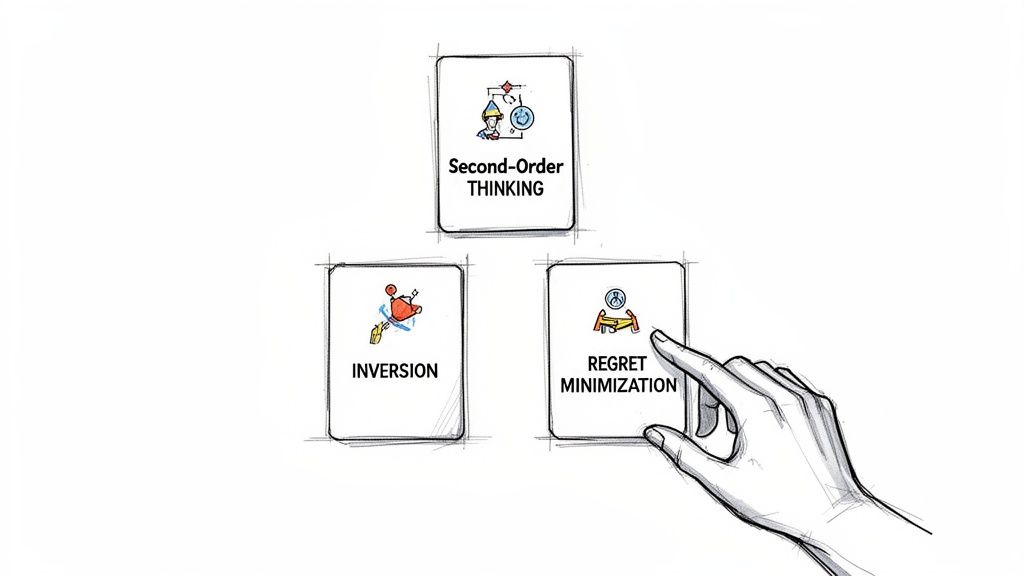
The sheer number of choices we face is mind-boggling. The average adult makes around 35,000 decisions every single day, from the trivial to the mission-critical. When our judgment falters on the big ones, the fallout can be massive. Poor choices cost businesses billions and create immense personal stress. For more on this, hsi.com offers some great tips for improving decision-making.
So, let’s stock your new toolkit with three powerful frameworks you can start using immediately.
To help you get started, here’s a quick overview of three incredibly practical mental models that you can apply in almost any professional scenario.
Three Actionable Decision Making Frameworks
| Framework | Core Principle | When to Use It |
|---|---|---|
| Second-Order Thinking | Asking “And then what?” to map out the long-term consequences of an immediate decision. | Best for strategic planning, policy changes, or any choice where the ripple effects are significant and not immediately obvious. |
| Inversion | Instead of aiming for success, you identify and systematically avoid all the paths that would lead to certain failure. | Ideal for project management, risk assessment, and de-risking a new initiative. It helps you build a robust plan by knowing what not to do. |
| Regret Minimization | Project yourself into the future and ask: “Which option will I regret the least?” | Use this for major career moves, personal life decisions, or when you feel paralyzed by short-term fear and external pressure. |
These frameworks aren’t just theories; they are practical guides to help you navigate complexity with confidence. Let’s dig into how to actually use them.
Master Second-Order Thinking
First-order thinking is our default mode—it’s quick, easy, and focuses only on the immediate result. “If I do this, that will happen.” Second-order thinking is where the real magic happens. It’s the disciplined process of asking, “And then what?” This simple question forces you to trace the chain of events that follows a decision, helping you spot unintended consequences before they become problems.
A study in the journal Thinking & Reasoning found that people who regularly engage in this deeper, consequential thinking show much better long-term planning and problem-solving skills. It’s the difference between a chess novice who only sees their next move and a grandmaster who sees the board five moves ahead.
Actionable Example: Imagine you’re a manager thinking about cutting the training budget to boost this quarter’s profits.
- First-Order Thought: “Cutting the budget will immediately increase our profit margin.” Simple, direct, and appealing.
- Second-Order Thought: “Okay, and then what? The team’s skills will stagnate, leading to lower quality work in six months. Top performers might leave for companies that invest in growth, increasing our hiring costs. Is a short-term profit bump worth the long-term talent drain?”
Your Action: Next time you face a significant choice, grab a piece of paper. Write down your decision in the center. Draw lines radiating out to the immediate consequences (first-order). Then, from each of those, draw more lines to the consequences of those consequences (second-order). This simple map makes the ripple effects tangible.
Use Inversion to Sidestep Failure
Sometimes, the surest path to success is simply avoiding all the ways you could fail. Inversion, a mental model made famous by investor Charlie Munger, is all about flipping a problem on its head. Instead of asking, “How do I achieve my goal?” you ask, “What would absolutely guarantee I fail?”
Once you’ve identified all the potential pitfalls, bad habits, and surefire ways to mess things up, you have a clear list of what to avoid. It reframes the problem entirely and often illuminates the right path forward by simple elimination.
Key Insight: Focusing on what not to do is often more powerful than chasing a perfect strategy. It’s about clearing the road of obstacles, not searching for a mythical shortcut.
Actionable Example: You’re launching a new marketing campaign.
- Standard Approach: “What do we need to do for a successful campaign?” This is a good start, but can lead to generic ideas.
- Inversion Approach: “What would guarantee this campaign is a complete disaster?”
- Our message is confusing and generic.
- We target the wrong audience.
- The website link in the ad is broken.
- We don’t track any metrics.
Your Action: Before starting your next big project, hold an “inversion meeting.” Spend the first 20 minutes brainstorming all the ways the project could fail spectacularly. Then, spend the rest of the meeting creating a specific plan to prevent each of those failure points. You’ve just engineered a path to success by systematically sidestepping failure. If you’re interested in the role emotions play in team dynamics, our guide on how to improve emotional intelligence is a great resource.
Make Decisions with the Regret Minimization Framework
This one, popularized by Jeff Bezos, is a game-changer for big life or career decisions. The concept is simple: project yourself forward in time—to age 80, for example—and look back on this moment. From that future perspective, which path will you regret less?
This mental exercise is incredibly effective because it disconnects you from short-term fears, social pressure, and immediate anxieties. It forces you to prioritize what aligns with your long-term values and who you want to become, rather than what feels safe or comfortable right now. Research published in Social Psychological and Personality Science confirms that decisions made with a long-term, future-self perspective consistently lead to greater life satisfaction and less regret.
Actionable Example: You’ve been offered a new job. It’s a riskier role at a startup, but it’s work you’re passionate about. Your current job is stable but uninspiring.
- Short-Term Fear: “What if the startup fails? I’ll be out of a job. The pay is slightly less right now.”
- Regret Minimization: “When I’m 80 and looking back, which will I regret more? Sticking with the safe, boring job, or taking a shot at something I truly loved, even if it didn’t work out?”
Your Action: For your next major decision, find a quiet space. Close your eyes and genuinely imagine yourself as an old person reflecting on your life. Ask that future version of you for advice on the choice you’re facing today. Write down what they say. This shifts your perspective from fear to legacy.
Using Data to Make Confident Choices
The phrase “data-driven” can conjure up images of overwhelming spreadsheets and analytics, but it doesn’t have to be that intimidating. At its heart, using data is just about gathering solid information to quiet your own biases and dial down the uncertainty. It’s a remarkably effective way to sharpen your decision-making, especially when stress is high and your gut feelings feel more like a gamble.
You don’t need a Ph.D. in statistics to get started. Think smaller, more practical.
Maybe you track your time for a week to discover your most productive windows. Or you sift through customer feedback to decide which product features to tackle next. Even just analyzing team performance metrics to delegate tasks better is a form of data-driven decision-making.
The point isn’t to replace your intuition. It’s to give it a factual foundation to stand on—an anchor of clarity when emotions, pressure, or office politics start to muddy the waters.
Start by Asking the Right Questions
The best way to get value from data is to start with a really good question. Before you even think about numbers, pinpoint exactly what you need to know. This simple act turns data collection from a daunting chore into a focused investigation.
Not sure where to begin? Try framing your challenges like this:
- Productivity: “Where is my team’s time actually going, and how does that square with our biggest priorities?”
- Customer Needs: “What’s the one single complaint we see most often in our support tickets and online reviews?”
- Project Management: “Which part of our project workflow consistently hits a bottleneck?”
Framing the problem as a specific question immediately tells you what information you’re looking for. It cuts through the paralysis that comes from staring at a mountain of information with no clear direction. A study in the Journal of Experimental Psychology actually found that people who frame problems with specific questions are far better at filtering out irrelevant noise and finding the best solution.
Gather Your Data Without the Overwhelm
Once your question is clear, getting the data is often simpler than you think. You’re probably already sitting on a goldmine of insights. It’s just a matter of knowing where to look.
Here are a few straightforward ways to collect useful data:
- Run Micro-Surveys: Use simple tools like Google Forms or a quick Slack poll to ask your team or customers a few targeted questions. A three-question survey is far more likely to get a response than a 20-minute questionnaire.
- Scan Existing Communications: Block out 30 minutes to read through customer service emails or comments in your project management system. Look for recurring words, themes, and frustrations.
- Track Your Own Time: For just one week, use a simple app or even a notebook to jot down your tasks and how long they take. The results can be shocking, revealing where your focus and energy are truly going.
The goal here isn’t to build a perfect, academic dataset. It’s about finding clear signals in the noise that can guide your next step. This is a huge challenge for overloaded leaders. A global Oracle study of over 14,000 executives found that 85% admit their decision-making struggles hurt their organizations, often because of data overload and a lack of clear tools.
Turn Raw Information into Confident Action
Collecting information is only half the job. The real magic happens when you turn those raw numbers and notes into a clear, confident decision. You have to connect the dots between what the data is telling you and what you need to do about it. For a deeper dive, mastering data-driven decision-making offers some fantastic strategies for objective evaluation that lead to clearer outcomes.
Actionable Tip: Don’t just report the numbers—tell a story with them. Instead of saying, “Customer complaints increased by 15%,” frame it as, “We’ve seen a 15% jump in complaints, specifically about shipping delays, ever since we switched carriers. That tells us we need to take a hard look at our new partner.”
This simple rephrasing adds context and points directly toward a solution.
A peer-reviewed study from Harvard Business School also highlights that diverse teams are better at interpreting data. Why? Because each person brings a unique lens, which helps uncover hidden assumptions and challenge unconscious biases.
So, bring your team into the sense-making process. Not only will you land on a better decision, but you’ll also get more buy-in for whatever you choose. When you ground your choices in evidence, you build confidence, slash the second-guessing, and lead with genuine clarity.
Rewiring Your Brain for Clarity with Somatic Techniques
What if you could physically calm your mind to make better decisions? We often focus on mental models and data to guide our choices, but if your body is running on high alert, none of that matters. Your physiological state is the foundation everything else is built on.
When you’re stressed, your body is in fight-or-flight mode. No amount of logical thinking can fully override that primal, biological response.

This is where somatic techniques come in—they use the body to influence the mind. Instead of trying to “think” your way out of stress, you use physical tools like your breath to send a direct signal to your nervous system. You’re telling it that it’s safe to power down the alarm bells.
This connection is fundamental to how to improve decision making skills, because a calm body leads directly to a clear mind.
The Science of Stress and Decision Making
When stress hits, your body floods with cortisol, the primary stress hormone. It’s fantastic for escaping a real threat but absolutely terrible for making a nuanced business decision. Cortisol actually impairs the function of your prefrontal cortex—the brain’s command center for rational thought and long-term planning.
Your brain physically reallocates resources away from complex thinking to focus on immediate survival. Suddenly, you’re left with a brain that’s optimized for pure reaction, not thoughtful reflection. It’s why even a simple choice can feel impossible when you’re overwhelmed.
Somatic techniques are the antidote. By consciously regulating your breath, you activate your parasympathetic nervous system (the “rest and digest” system). This simple act slows your heart rate, lowers blood pressure, and tells your brain the threat has passed, allowing your prefrontal cortex to come back online.
Regulate Your Nervous System with Box Breathing
One of the simplest yet most powerful tools in your pocket is Box Breathing. Navy SEALs, elite athletes, and top executives use this technique to maintain focus and calm under extreme pressure. It works by creating a predictable, rhythmic breathing pattern that puts you back in control of your nervous system.
This isn’t just about feeling calm; it’s about measurable physiological change. A study published in the journal Frontiers in Human Neuroscience demonstrated that controlled, slow breathing techniques enhance emotional control and cognitive functions like attention and focus. You are literally creating the optimal internal environment for clear thought.
Actionable Example: You’re about to enter a tense negotiation or a performance review with your boss. Your heart is pounding.
- Before You Go In: Find a quiet space for two minutes (even a bathroom stall works).
- Perform Box Breathing:
- Inhale slowly through your nose for a count of 4.
- Hold your breath for a count of 4.
- Exhale slowly through your mouth for a count of 4.
- Hold at the bottom of the breath for a count of 4.
- The Result: You walk into the meeting with a slower heart rate and a clearer head, able to listen and respond thoughtfully instead of reacting defensively.
Repeat this cycle for just two or three minutes before your next big meeting or anytime you feel stress creeping in. You’ll be surprised by the immediate shift. For more ideas, you can explore various mind-body connection exercises.
Integrating Somatic Awareness into Your Workflow
The key is to make this a regular practice. You can’t wait until you’re in a full-blown panic to try and find your calm. The goal is to build your capacity for self-regulation so you can stay centered before the pressure mounts.
Actionable Tip: Set a recurring calendar reminder three times a day for a “Somatic Check-in.” When it goes off, just pause. Take three conscious breaths and notice any tension you’re holding in your body—your shoulders, your jaw, your hands. This small habit builds powerful self-awareness over time.
This mind-body awareness is a critical skill, especially as data overload complicates our choices. Even top decision-makers struggle; a survey of over 14,000 leaders found that 85% see indecision as a major drag on their organizations, fueled by information overload.
Somatic work provides the clarity needed to cut through the noise. It helps you distinguish between true intuitive insight and a gut reaction driven purely by stress. By learning to manage your physiology first, you give yourself the mental space to apply logical frameworks and data effectively. If you’re curious about the deeper science, you can find out more about somatic therapy principles. https://9dbreathwork.com/what-is-somatic-therapy/
Ultimately, mastering your decision-making skills requires a holistic approach. You need sharp cognitive tools, absolutely. But you also need the grounded somatic awareness to use them well. By rewiring your brain-body connection, you aren’t just coping with stress—you’re building a resilient foundation for consistent, clear, and confident leadership.
Your Action Plan for Decisive Leadership
Alright, let’s move from theory to action. Knowing all the frameworks is one thing, but actually using them when you’re under the gun is where the real change happens. This is your practical roadmap for building powerful, sustainable habits that will completely change how you make choices under pressure.
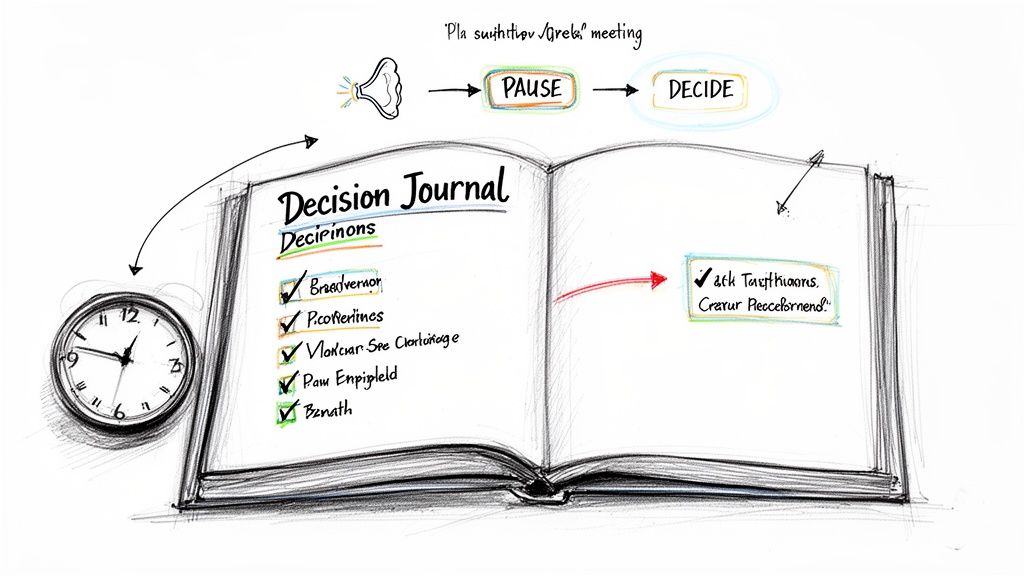
The goal here isn’t a massive, overnight overhaul of your entire workflow. That never sticks. Instead, we’re focusing on small, consistent actions that build on each other and create a huge impact over time.
Start with One Small Change This Week
Overwhelm is the enemy of progress. If you try to implement every strategy at once, you’ll likely burn out and give up. So, for the next seven days, I want you to pick just one thing to focus on. This makes it feel easy and helps you build momentum from a quick win.
Here are a few simple ideas to get you started:
- Pick a Framework: Choose one mental model—like Second-Order Thinking or Inversion—and deliberately apply it to a single, low-stakes decision you have to make this week.
- Track Your Time: For just one day, keep a rough log of where your time and energy actually go. Use that data to find one task you can either delegate or just stop doing.
- Practice Box Breathing: Commit to a two-minute Box Breathing exercise every morning before you even think about opening your inbox.
Starting small proves to yourself that change is manageable. In fact, a study in the European Journal of Social Psychology found that people who focus on small, consistent habits are significantly more likely to achieve their long-term goals because it lowers the mental barrier to getting started.
Launch Your Decision Journal
This is one of the most powerful tools I know for getting better at judgment. A Decision Journal isn’t a diary for your feelings; it’s a logbook for your choices. It helps you learn from both your wins and your misses with cold, hard clarity.
The real magic of a Decision Journal is that it creates a feedback loop for your thinking. By writing down your reasoning before the outcome is known, you can go back and analyze your thought process without being tricked by hindsight bias.
Here’s a simple template you can steal. Use it for any decision that feels even slightly important.
| Journal Entry Element | What to Write | Example |
|---|---|---|
| The Decision | What choice are you making? Be specific. | “Should we delay the Q3 product launch by two weeks to fix a non-critical bug?” |
| The Situation | What’s the context? What are the key variables? | “Dev team is exhausted. Marketing has a huge campaign queued up. Competitor X is launching something soon.” |
| Mental State | How are you feeling right now? (e.g., rushed, calm, stressed) | “Feeling rushed and pressured by the marketing deadline. A little anxious about the competitor.” |
| My Rationale | Walk through your thought process. What framework are you using? | “Using Inversion: What would guarantee failure? Launching a buggy product that gets ripped apart in reviews. The risk of delaying is losing some market momentum.” |
| Expected Outcome | What do you honestly predict will happen? | “We’ll delay. I expect marketing will be frustrated, but we’ll have a more stable product and better long-term customer satisfaction.” |
| Future Review Date | Put a date on your calendar to check the results. | “Review in 6 weeks.” |
Keeping this log forces you to see patterns. Maybe you realize you consistently underestimate how long projects take, or that you always make reactive choices when you’re stressed. That kind of self-awareness is the first real step toward improving.
Schedule Your Somatic Pauses
You can’t just wait until you’re overwhelmed to remember to breathe. It doesn’t work that way. To make these somatic techniques stick, you have to build them into your day by scheduling them like any other meeting.
Your Action: Open your calendar right now and schedule these three daily appointments for the rest of the week:
- 9:00 AM – Pre-Work Grounding: A 3-minute appointment for Box Breathing. Start the day with a regulated nervous system.
- 12:30 PM – Midday Reset: A 1-minute appointment for a somatic check-in. Where are you holding tension? Unclench your jaw. Drop your shoulders.
- 2:55 PM – Pre-Meeting Prep: A 2-minute appointment before your biggest meeting of the afternoon. Use it for a breathing exercise to clear your head.
Treat these little appointments as non-negotiable. They are your secret weapon for maintaining the physiological calm you need to think sharply. For those who want to go deeper in a structured way, exploring formal leadership development training programs can provide invaluable guidance.
This action plan gives you a tangible place to start. Pick one micro-habit, start your journal, and put those pauses on your calendar. These small, deliberate steps are what build the foundation for consistently clear and confident decision-making.
Got Questions? Let’s Talk Through Them
As you start weaving these new tools into your daily grind, you’re bound to have some questions. That’s a good thing. It means you’re engaged in the process. Improving how you make decisions isn’t a one-and-done deal; it’s a practice.
Let’s clear up some of the most common hurdles I see people encounter.
How Long Until I Actually See a Difference?
Everyone wants to know this, and it’s a fair question. You can feel a sense of calm and focus after just one breathwork session, which is great, but lasting change takes a little more time. It’s like going to the gym—one workout feels good, but real strength is built over weeks of showing up consistently.
Realistically, most people start to feel a significant shift in their confidence and the quality of their choices within 3 to 4 weeks. That’s with consistent practice, though—things like using your decision journal, doing daily check-ins with your body, and running at least one big decision a week through a mental model.
But What if I Still Make a Bad Decision?
You will. And that’s okay. The point of this whole process isn’t to become infallible; it’s about improving your batting average and, crucially, learning from the misses. Even top executives get it wrong. A McKinsey study found that 60% of leaders admitted their bad decisions were just as frequent as their good ones.
When a choice goes south, don’t beat yourself up. Your decision journal is your best friend here.
This is where you turn regret into a lesson. Go back to what you wrote down. Was the logic flawed from the start? Were you making an emotional call and telling yourself it was rational? Did a curveball come out of nowhere? This isn’t a failure; it’s valuable intel for next time.
How Do I Decide When My Team Is Completely Divided?
Ah, the classic leadership dilemma. This is where you have to reframe the goal. You’re not trying to get everyone to agree—you’re trying to find the best possible path forward. Research from Harvard Business School consistently shows that teams with different perspectives make smarter, more innovative decisions. The trick is channeling that disagreement productively.
Here’s a practical way to handle it:
- Get Clear on the Problem: First things first, make sure everyone agrees on the actual problem you’re solving. It’s easy to get lost arguing over solutions when you’re not even aiming at the same target.
- Hear Everyone Out: Don’t just tolerate dissenting opinions; actively seek them out. Use open-ended questions like, “Walk me through your thinking on that.” This shows you value their perspective, even if you don’t end up going with their idea.
- Use a Framework Together: This depersonalizes the conflict. Try using Inversion as a group. Ask, “What are all the ways we could absolutely guarantee this project fails?” It aligns everyone against a common enemy (failure) instead of each other.
- Make the Call, Then Commit: At the end of the day, someone has to make the decision. That’s you. Clearly explain why you’re choosing a certain path, acknowledge the other viewpoints, and then ask the entire team to commit to moving forward.
This approach turns messy disagreements from a roadblock into an asset. You get the benefit of the group’s collective brainpower without getting bogged down in an endless debate.
Ready to stop second-guessing and start leading with unshakable clarity? 9D Breathwork offers a direct path to rewiring your nervous system for calm, focused decision-making. Move beyond theory and experience the shift for yourself. Explore our transformative journeys today.