The days of office fruit bowls and pizza parties defining corporate wellness are over. Modern workplaces demand a more sophisticated, strategic approach to employee well-being, one that addresses the complex challenges of burnout, stress, and mental health head-on. A study in the Journal of Occupational and Environmental Medicine found that comprehensive wellness initiatives can lead to a 25% reduction in absenteeism and healthcare costs. This shift is not just about perks; it’s about creating a resilient, engaged, and productive workforce.
Truly strategic wellness extends beyond basic offerings to include fundamental support for employee well-being. For instance, companies can explore a comprehensive guide on implementing reasonable adjustments for mental health at work to build a genuinely inclusive culture. Investing in the best employee wellness programs is no longer a luxury but a core business imperative that directly impacts retention, performance, and your bottom line.
This guide cuts through the noise to help you find the right fit for your team. We’ve curated a list of top-tier platforms and services, from innovative breathwork to comprehensive mental health support. For each program, you’ll find a direct link, a clear breakdown of its pros and cons, target audience, and actionable implementation tips to help you make an informed decision. Let’s explore the solutions that will genuinely support your employees’ health and drive your organization forward.
1. 9D Breathwork
9D Breathwork emerges as a powerful and innovative contender in the landscape of the best employee wellness programs, offering a deeply transformative experience that goes far beyond conventional stress-management techniques. It integrates ancient breathing practices with a modern, multi-sensory technological approach, creating a full-spectrum journey designed to address the root causes of workplace stress, burnout, and dissatisfaction. A study in Frontiers in Psychology found that breathwork interventions can significantly reduce stress and improve mental health. This platform is uniquely positioned for organizations seeking to provide employees with a tool for profound and lasting change, rather than a superficial fix.
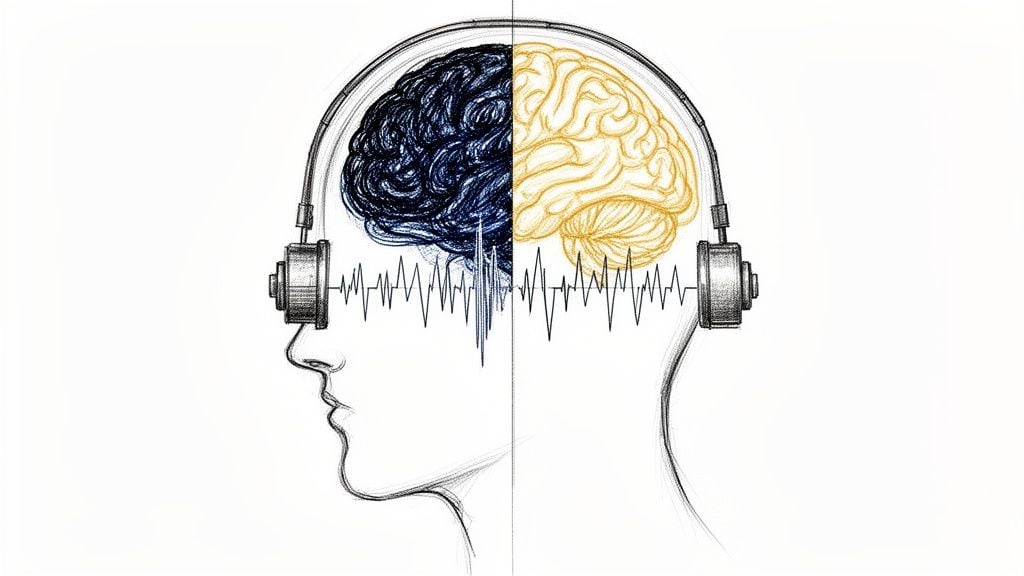
The core of the 9D Breathwork experience is its multi-layered methodology. Each session combines guided breathwork, binaural beats for brainwave entrainment, hypnotic suggestion, Neuro-Linguistic Programming (NLP), and subliminal messaging. This potent combination is engineered to bypass the conscious mind’s resistance and directly influence the subconscious, where limiting beliefs and stress patterns are stored. For corporate teams, this translates into a powerful tool for dismantling the deep-seated drivers of anxiety and overwhelm, fostering genuine resilience from the inside out.
Key Features and Strengths
- Multi-Modal Approach: By layering multiple therapeutic modalities, 9D Breathwork creates a synergistic effect that targets the body, mind, and subconscious simultaneously for deeper, more sustainable shifts in well-being.
- Corporate Suitability: The program is explicitly designed to address common workplace challenges like burnout, job dissatisfaction, and high-stress environments, making it a highly relevant corporate wellness solution.
- Scalable Delivery Model: 9D Breathwork offers a digital franchise model that empowers certified facilitators to deliver standardized, high-quality, tech-enabled sessions to corporate clients, ensuring consistency and scalability.
Implementation and Actionable Insights
To integrate 9D Breathwork effectively, introduce it as the cornerstone of a mental resilience initiative. Start with a pilot program for a specific department experiencing high stress, such as sales or project management.
Action Step: Schedule a 60-minute introductory “Stress Release & Reset” session for the pilot group, facilitated by a certified 9D practitioner. Frame it as an innovative experience-based workshop, not just another webinar. Collect pre- and post-session feedback using a simple 1-10 rating scale for stress, focus, and overwhelm to measure immediate impact. Based on the positive results, you can then develop a quarterly series of sessions focused on different themes like “Enhancing Focus” or “Overcoming Burnout.” Learn more about the foundations of breathwork therapy on 9dbreathwork.com to better understand its mechanisms.
What to Consider
While the approach is innovative, organizations should perform their own due diligence. Pricing, formal certifications, and specific corporate case studies are not publicly listed and should be requested directly. It’s also crucial to communicate that this is a powerful wellness tool, not a substitute for clinical mental health treatment. Employees with pre-existing medical conditions should be advised to consult a clinician before participating. Despite this, its unique, tech-forward approach makes 9D Breathwork a standout choice for companies ready to invest in a truly transformational wellness program.
Website: https://9dbreathwork.com
2. Personify Health
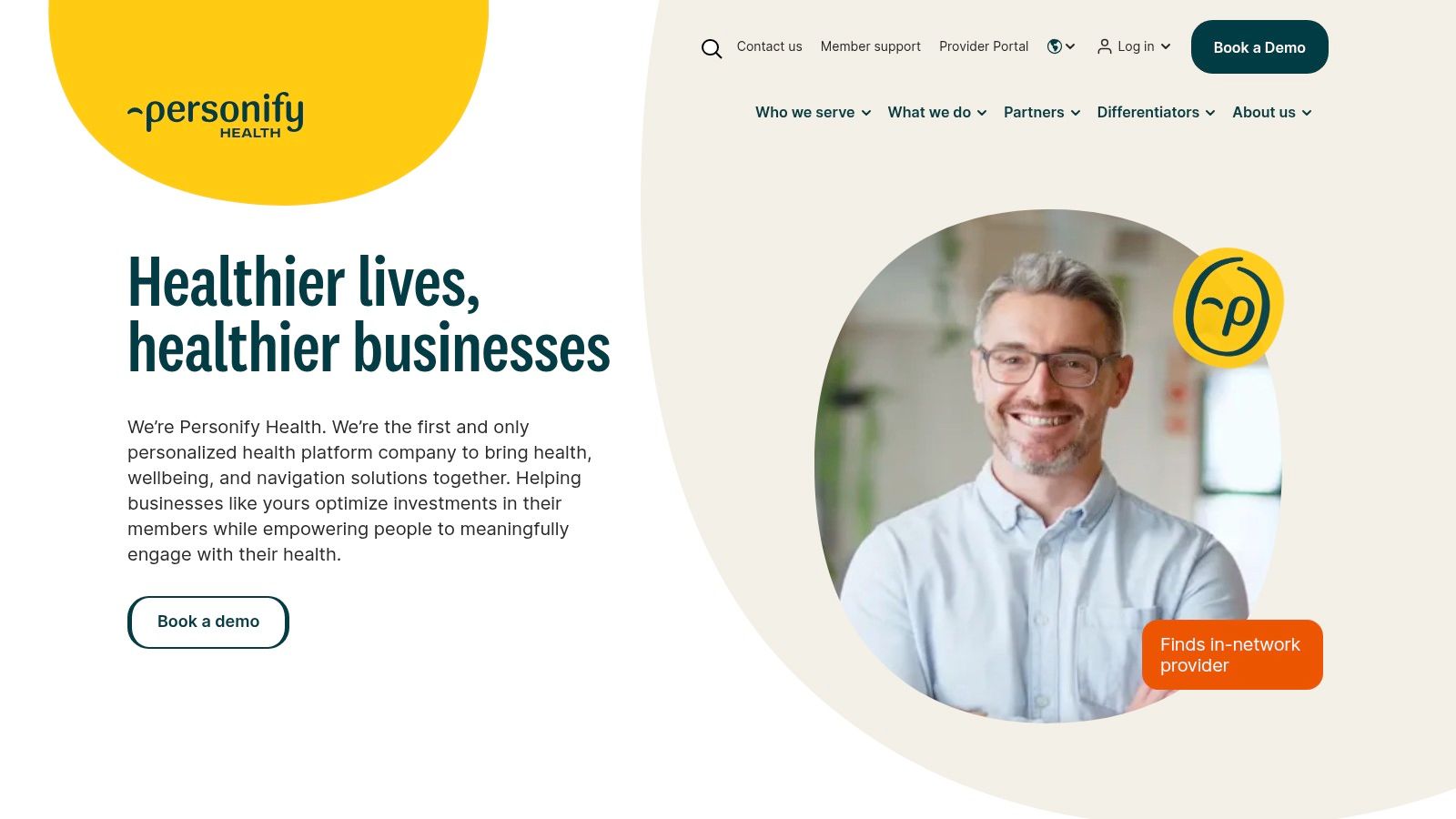
Personify Health (formerly Virgin Pulse) offers an enterprise-grade, unified wellbeing platform designed to be a single “front door” for all aspects of employee health. It excels at consolidating disparate benefits, care navigation, and wellness initiatives into one cohesive experience, making it one of the best employee wellness programs for large, complex organizations aiming to reduce vendor sprawl and simplify benefits for their workforce.
The platform integrates everything from mental health support and fitness challenges to chronic condition management and benefits navigation. This holistic approach is grounded in behavioral science, using nudges, gamification, and personalized content to drive sustained engagement and healthy habits.
Key Features & Benefits
Personify Health stands out by bundling comprehensive services, which can streamline administration and improve the employee experience.
- Holistic Platform: Combines wellbeing programs, care navigation, incentives, and even TPA services in one place.
- Behavior-Change Tools: Utilizes gamification, team challenges, and live coaching to motivate employees. A study in the Journal of Medical Internet Research found that such gamified interventions significantly increased physical activity among participants.
- Global Scalability: Trusted by Fortune 500 companies, the platform is built to support large, diverse, and geographically distributed employee populations.
- Advanced Analytics: Provides robust data to track engagement, measure health outcomes, and demonstrate ROI/VOI for leadership.
Implementation & Budget
- Pricing: Pricing is quote-based and typically structured as a Per Employee Per Month (PEPM), Per Participant Per Month (PPPM), or Per Employee Per Year (PEPY) fee. It is not publicly listed and requires a consultation.
- Best For: Mid-market to large enterprises (500+ employees) that need to manage a complex benefits ecosystem and are seeking a single, integrated solution.
- Actionable Tip: To maximize ROI, leverage Personify Health’s data to identify key health risks in your population. For example, if data shows low physical activity, use the platform’s challenge tools to launch a company-wide “Step Challenge” with teams competing for a prize, like an extra day of PTO.
Pros and Cons
| Pros | Cons |
|---|---|
| Enterprise Credibility: Strong track record with large, global organizations. | Opaque Pricing: Quote-based model makes it hard to compare costs without a formal sales process. |
| Reduces Vendor Sprawl: Consolidates multiple wellness and navigation vendors. | Potential Overkill: May be too complex or feature-rich for small businesses needing a single solution. |
| Broad Market Recognition: The rebrand from Virgin Pulse has maintained its visibility. | Implementation Time: Integrating a comprehensive platform can require significant internal resources. |
How it Complements 9D Breathwork: A platform like Personify Health provides the broad, foundational structure for daily wellbeing. You can integrate specialized, high-impact modalities like 9D Breathwork as a featured “event” or “challenge” within the Personify ecosystem to target specific needs like stress reduction and peak performance. Learn more about how to design a comprehensive program by exploring these workplace wellness program examples.
3. Wellhub
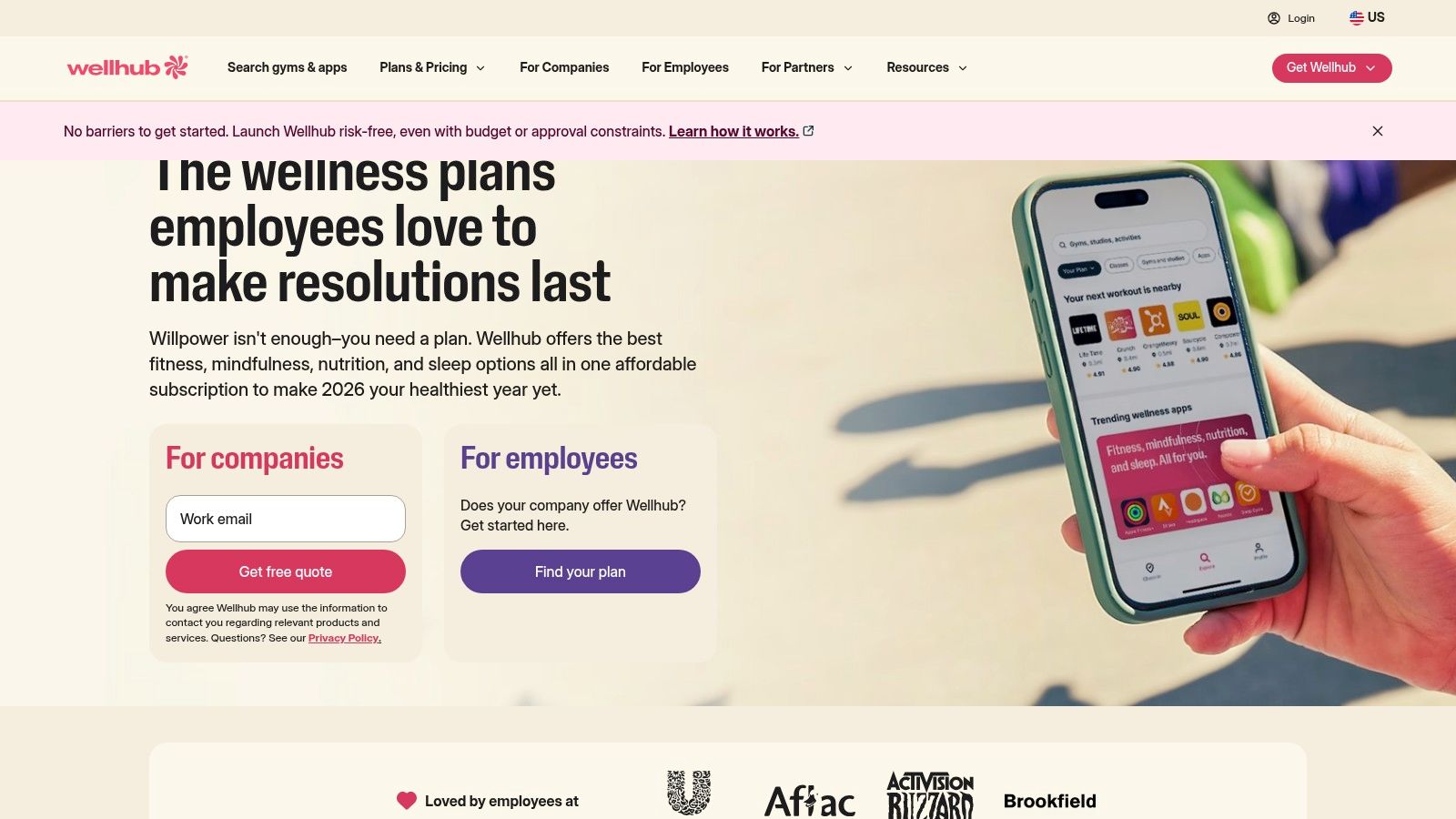
Wellhub (formerly Gympass) operates as a corporate wellness marketplace, offering employees subsidized access to a vast global network of gyms, fitness studios, virtual classes, and premium wellness apps. It stands out by providing unparalleled choice and flexibility, making it one of the best employee wellness programs for companies that want to empower their employees to pursue their own version of wellbeing, from physical fitness to mental health.
The platform provides a consumer-grade experience where employees can browse and book services through a simple app, using a single membership. This model aggregates thousands of wellness partners, removing the friction for employees to find activities they genuinely enjoy and for employers to manage countless individual vendor relationships.
Key Features & Benefits
Wellhub’s strength lies in its extensive partner network and flexible, employee-centric design, which promotes autonomy and variety.
- Vast Partner Network: Provides access to thousands of gyms, studios, and wellness apps (like Calm and Headspace) globally, catering to diverse interests.
- Tiered Membership Plans: Offers multiple plan levels (e.g., Digital to Diamond) with transparent employee-facing prices, allowing for choice based on budget and need.
- Holistic Offerings: Goes beyond just gyms to include mindfulness, nutrition, sleep apps, and therapy, supporting a comprehensive view of health. A study in the American Journal of Health Promotion found that multicomponent wellness programs that include both physical and mental health resources are more effective at improving employee health outcomes.
- Simplified Administration: Employers manage a single contract with Wellhub while giving employees access to a massive, aggregated network of providers.
Implementation & Budget
- Pricing: Employee-facing plan prices are publicly listed. The employer subsidy and overall cost structure, however, are quote-based and depend on company size and the level of contribution.
- Best For: Companies of all sizes (from startups to large enterprises) looking to offer a high-value, flexible fitness and wellness benefit that caters to individual employee preferences.
- Actionable Tip: Launch a “Wellness Exploration” campaign when you roll out Wellhub. For example, challenge employees to try one new activity weekly for a month—a local yoga class, a guided meditation on a partner app, or a session with a nutritionist—and post a photo in a company-wide chat channel. The most adventurous participant wins a wellness-related prize.
Pros and Cons
| Pros | Cons |
|---|---|
| Unmatched Employee Choice: Massive network of fitness and wellness partners. | Opaque Employer Pricing: The exact employer subsidy and total cost are not publicly available. |
| Transparent Employee Tiers: Easy for employees to understand plan costs. | Access Limitations: Premium studios or popular classes can have booking caps depending on the plan tier. |
| Global Scalability: Excellent for companies with a distributed workforce. | Dependent on Partner Network: The value is contingent on the quality and density of partners in each location. |
How it Complements 9D Breathwork: Wellhub is an ideal “everyday wellness” platform that gives employees ongoing access to gyms and apps. You can then introduce a specialized modality like 9D Breathwork as a premium, high-impact workshop to address specific corporate goals like stress resilience and leadership development. Learn more about how to design a comprehensive program by exploring these workplace wellness program examples.
4. Calm for Organizations (Calm Business / Calm Health)
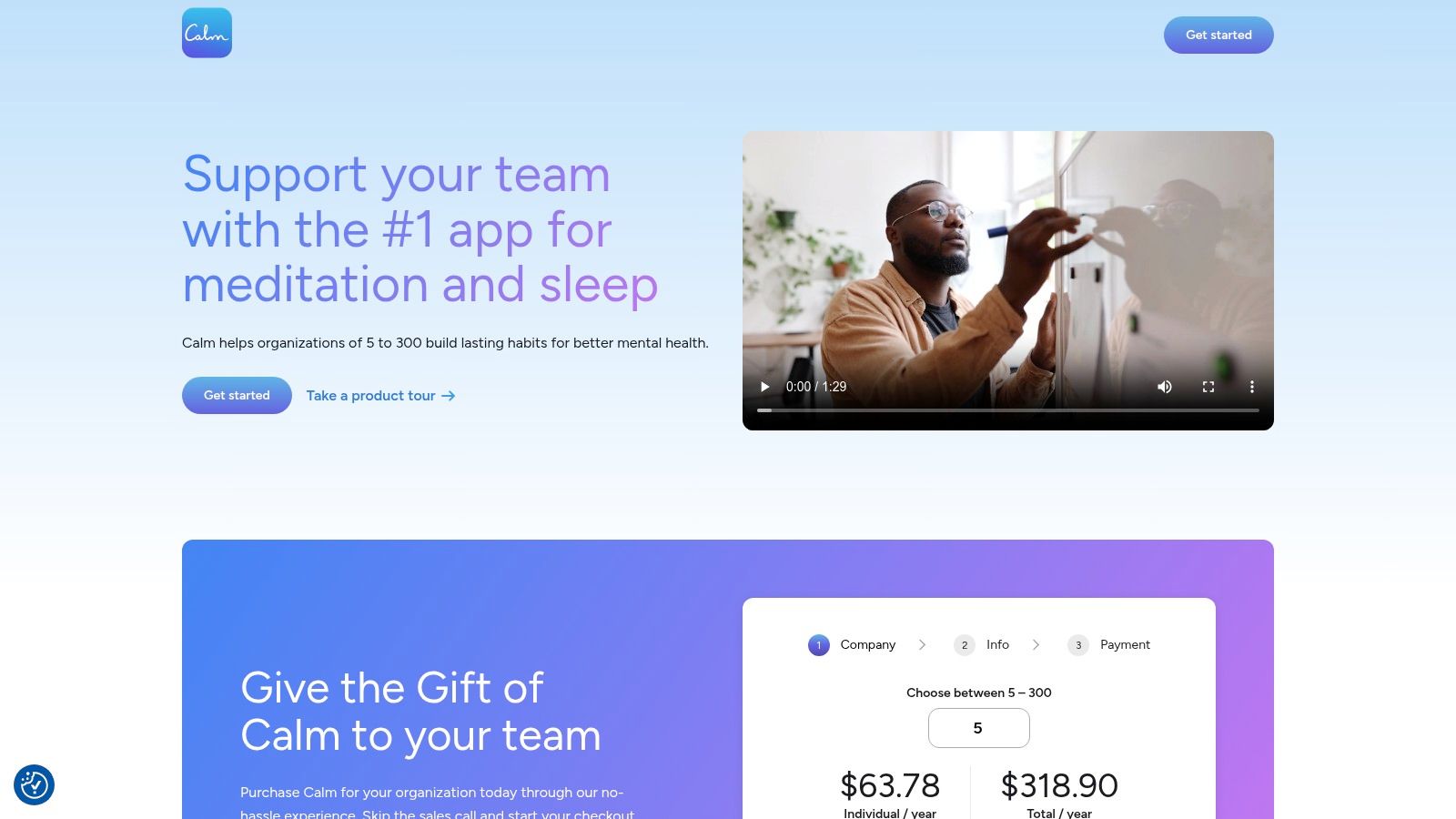
Calm for Organizations extends the popular consumer meditation and sleep app into the corporate world, offering a streamlined, content-first approach to employee mental wellbeing. It is one of the best employee wellness programs for companies seeking a fast, scalable, and highly accessible solution to address common stressors like anxiety and poor sleep. By providing a vast library of guided meditations, sleep stories, and mindfulness exercises, Calm makes mental wellness resources immediately available to employees.
The platform is designed for ease of use, both for administrators and employees. Its user-friendly interface and widely recognized brand name help drive adoption and engagement, making it a powerful tool for building a foundational layer of mental health support within an organization. A study published in the Journal of Affective Disorders found that regular use of a mindfulness app like Calm was effective in reducing self-reported depression symptoms.
Key Features & Benefits
Calm stands out with its speed to market and content that resonates with a broad audience, from meditation novices to experienced practitioners.
- Extensive Content Library: Offers thousands of hours of original audio content, including guided meditations, sleep stories, mindfulness exercises, and calming music.
- Rapid Deployment: Small to mid-sized teams (5-300 employees) can purchase and launch the program instantly online with a credit card, a unique feature among top-tier vendors.
- Admin Partner Portal: Provides HR and wellness leaders with real-time analytics on engagement, sign-ups, and content usage to measure program impact.
- Brand Recognition: The consumer app’s popularity significantly lowers the barrier to entry, as many employees are already familiar with and trust the Calm brand.
Implementation & Budget
- Pricing: For teams of 5-300, pricing is transparent and available for online purchase, starting around $58.99 per employee per year, with discounts for larger teams. Enterprise pricing for Calm Health is quote-based and requires a consultation.
- Best For: Small to large companies that want a low-friction, high-engagement mental wellness benefit that can be implemented almost immediately.
- Actionable Tip: Launch a company-wide “Mindful Month” challenge. For example, promote a different 10-minute “Daily Calm” meditation each week via internal comms. Use the Partner Portal to identify the most engaged department and reward them with a team lunch to boost friendly competition and participation.
Pros and Cons
| Pros | Cons |
|---|---|
| Fastest Implementation: Unmatched speed-to-launch for smaller teams. | Content-Focused: The standard plan lacks deep clinical support or one-on-one coaching. |
| High Brand Recognition: Leverages a well-loved consumer brand to drive adoption. | Opaque Enterprise Pricing: Costs for larger, more integrated Calm Health plans are not transparent. |
| Accessible for All Levels: Content is approachable for beginners and experts alike. | Passive Engagement Model: Relies on employees to self-initiate use of the app’s resources. |
How it Complements 9D Breathwork: Calm provides an excellent “always-on” resource for daily mindfulness and stress maintenance. You can then layer in 9D Breathwork as a powerful, instructor-led intervention for deeper transformation. Use Calm for daily practice and introduce a 9D Breathwork workshop as a peak experience in your wellness calendar to provide comprehensive stress management training for employees.
5. Headspace for Employers (Headspace Health)
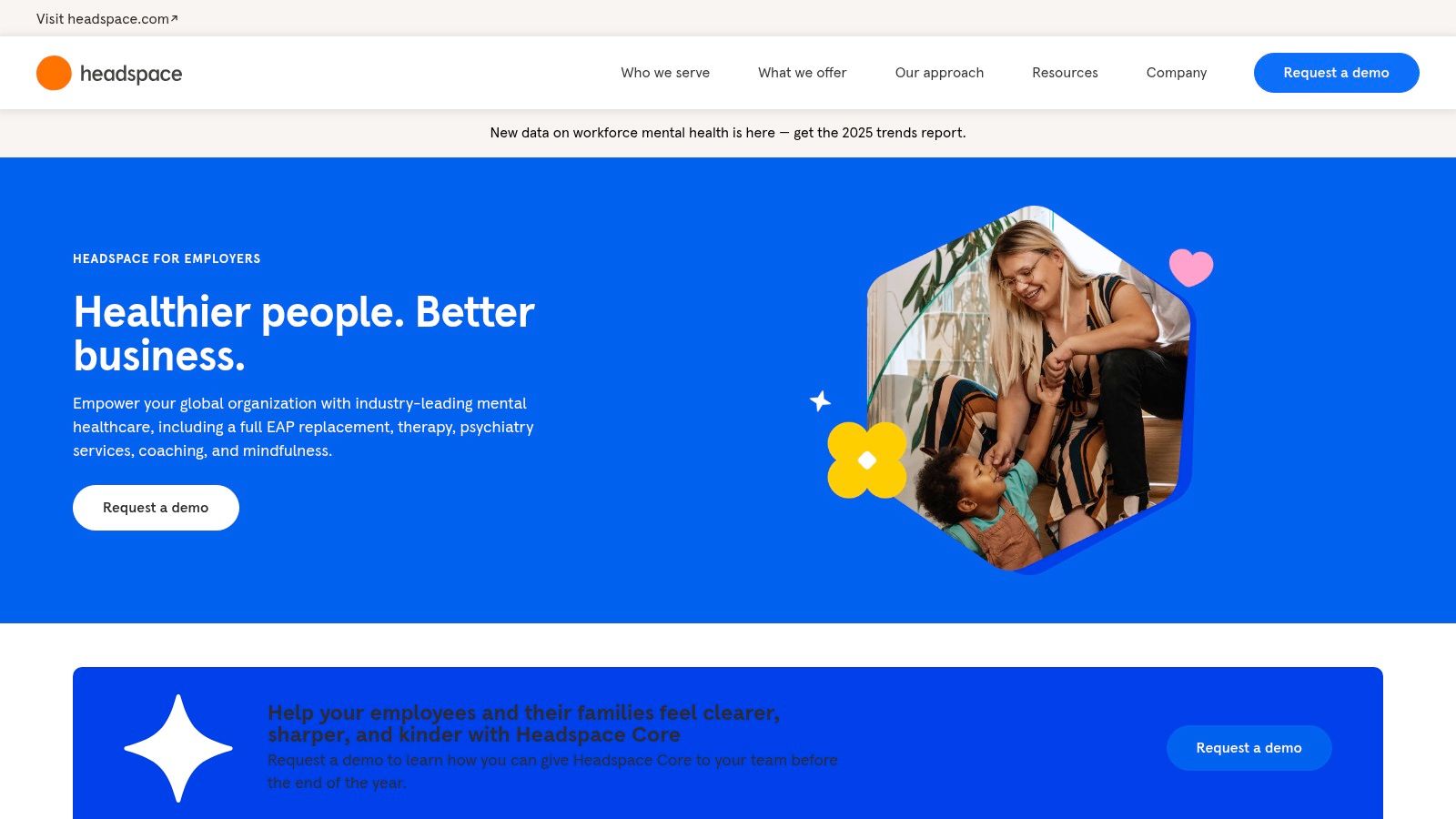
Headspace for Employers offers a powerful, integrated solution that combines preventive mental wellness with clinical mental health care. It merges the widely recognized Headspace mindfulness app with on-demand coaching, therapy, and psychiatry, making it a top contender among the best employee wellness programs for organizations prioritizing a comprehensive mental health strategy. This unified approach simplifies vendor management by providing a single resource for both proactive mindfulness and reactive clinical support.
The platform is designed to meet employees wherever they are on their mental health journey. It provides accessible, everyday tools for managing stress and improving focus through its app, while also offering a clear pathway to higher levels of care, including 24/7 coaching and access to licensed therapists.
Key Features & Benefits
Headspace stands out by bridging the gap between daily mindfulness and clinical intervention, all under a brand that employees already know and trust.
- Integrated Care Spectrum: Provides a full range of services from the Headspace app (meditation, sleep, focus) to on-demand coaching, therapy, and psychiatry, functioning as a complete EAP replacement.
- Strong Brand Recognition: The consumer popularity of Headspace drives higher initial adoption and engagement rates compared to lesser-known EAP providers.
- Evidence-Based Approach: The effectiveness of its mindfulness content is well-documented. A study in the Journal of Medical Internet Research found that just 10 days of Headspace use resulted in a 14% decrease in stress.
- Global & Crisis Support: Offers enterprise-level implementation, robust impact reporting, and critical incident support for a distributed, global workforce.
Implementation & Budget
- Pricing: Pricing is customized based on company size and selected services, typically following a Per Employee Per Month (PEPM) model. A consultation with their sales team is required for a quote.
- Best For: Companies of all sizes (from startups to large enterprises) looking for a dedicated, best-in-class mental health solution that covers both preventive care and clinical needs.
- Actionable Tip: Launch a “Mindful Mornings” initiative. For example, block 15 minutes in company-wide calendars every morning for one week for “Focus Time,” and encourage teams to use a guided meditation from the Headspace app during this period. Survey employees on perceived stress and focus levels before and after the week to demonstrate tangible impact to leadership.
Pros and Cons
| Pros | Cons |
|---|---|
| Unified Mindfulness & Clinical Care: A single vendor for the full spectrum of mental health. | Opaque Pricing: Requires direct sales engagement to understand costs and compare options. |
| High Employee Engagement: Well-known brand encourages voluntary adoption and use. | Broader Than Needed for Some: Small businesses wanting only a basic meditation app may find it too comprehensive. |
| Strong Clinical Governance: Backed by a team of clinical experts and scientific research. | Focus on Mental Health: Not an all-in-one wellness platform covering physical or financial wellbeing. |
How it Complements 9D Breathwork: Headspace provides an excellent “always-on” resource for daily mental hygiene and clinical support. You can introduce 9D Breathwork as a powerful, deep-dive workshop to address acute stress, burnout, or trauma that requires a more somatic and transformative experience than guided meditation alone can offer. Learn more about creating a multi-layered approach by reviewing these workplace wellness program examples.
6. Lyra Health
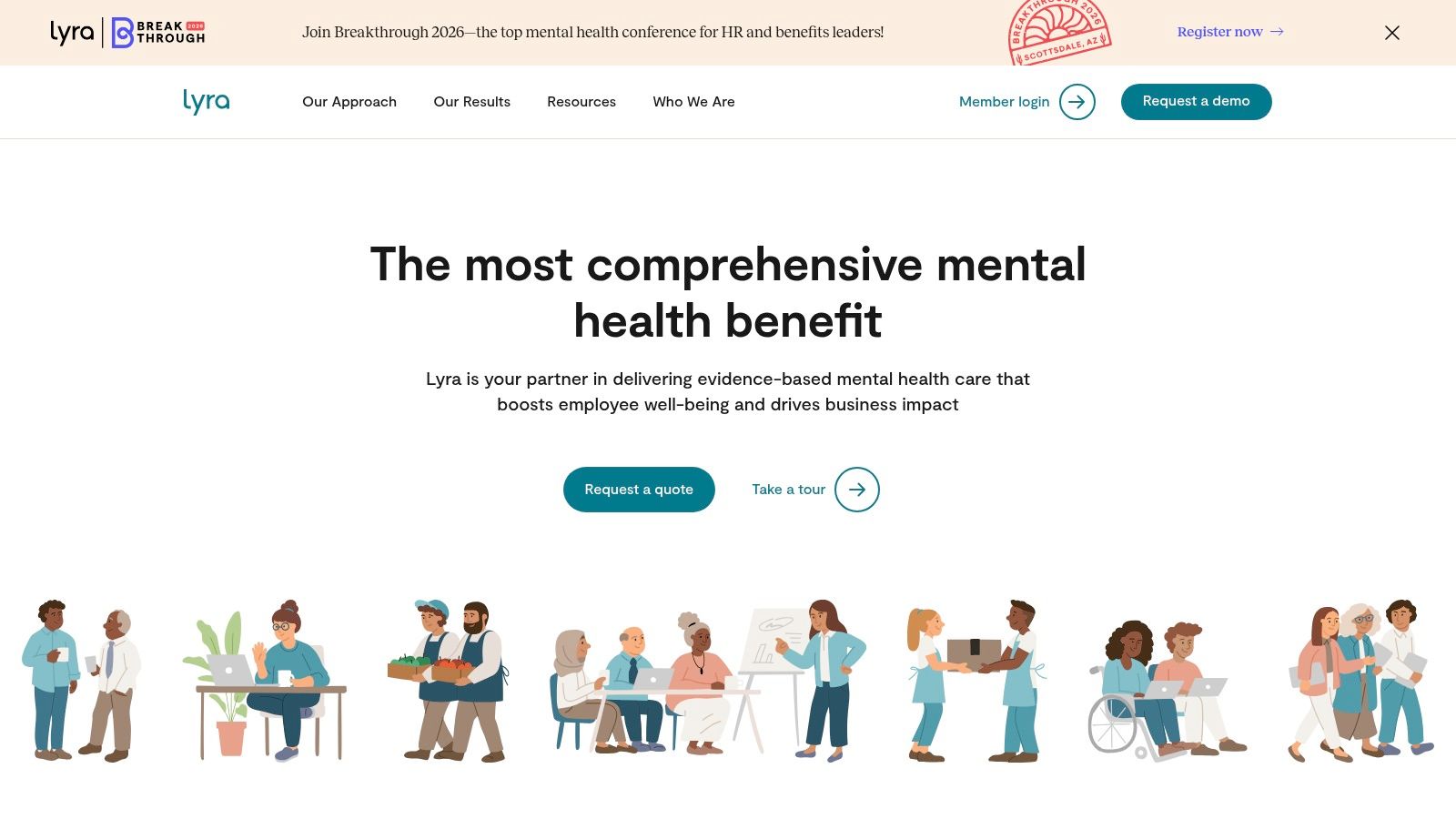
Lyra Health provides a high-touch, workforce mental health solution that is a clear leader among the best employee wellness programs focused on clinical quality and measurable outcomes. Instead of offering a broad, lifestyle-focused platform, Lyra zeroes in on providing evidence-based therapy, coaching, and medication management through a rigorously vetted and credentialed provider network. This makes it an ideal choice for employers prioritizing deep, impactful mental health support over general wellness perks.
The platform is engineered to remove barriers to care, offering fast access to providers and a personalized matching process to ensure a good fit. Its emphasis on data provides HR and finance leaders with the robust analytics needed to demonstrate the value and impact of their mental health investment, moving beyond simple engagement metrics to clinical outcomes.
Key Features & Benefits
Lyra’s strength lies in its clinical-first approach, ensuring employees receive effective, evidence-based care that drives real results.
- Evidence-Based Care: Connects employees with a large, high-quality network of therapists and coaches trained in proven methods like Cognitive Behavioral Therapy (CBT). A meta-analysis in Cognitive Therapy and Research confirmed CBT’s effectiveness in treating anxiety disorders, a common workplace issue.
- Blended Care Model: Integrates therapy, coaching, medication management, and digital self-care tools into personalized care plans for each employee.
- Robust Employer Analytics: The Lyra Connect dashboard offers powerful, aggregate insights into workforce mental health trends, utilization, and clinical improvement, enabling data-driven decisions.
- Seamless Integration: Lyra Link and other tools integrate with existing benefits platforms, simplifying access for employees and reducing administrative burdens for HR teams.
Implementation & Budget
- Pricing: Enterprise-focused pricing is quote-based, typically structured on a PEPM model. It is not publicly available and requires a consultation with their sales team.
- Best For: Mid-market to enterprise companies (500+ employees) that want a premium, clinically-focused mental health benefit with strong ROI reporting capabilities.
- Actionable Tip: Use Lyra’s aggregate data to identify the top mental health challenges in your organization (e.g., burnout, anxiety). For example, if burnout is high in the engineering department, partner with Lyra to launch a targeted email campaign to that group, promoting specific resources like Lyra’s coaching for stress management and time-management skills.
Pros and Cons
| Pros | Cons |
|---|---|
| Focus on Clinical Quality: Provider network is rigorously vetted for quality. | Niche Focus: Less emphasis on physical wellness, nutrition, or financial health. |
| CFO-Ready Reporting: Delivers measurable data on clinical outcomes and ROI. | Enterprise Pricing: Cost may be prohibitive for smaller companies or startups. |
| Reduces HR Burden: Strong integrations streamline benefits administration. | High-Touch Model: May be more than what’s needed for companies seeking a simple, self-serve tool. |
How it Complements 9D Breathwork: Lyra provides the essential clinical framework for addressing diagnosed mental health conditions. You can introduce 9D Breathwork as a powerful, non-clinical tool for proactive mental fitness, helping employees manage daily stress and build resilience before they require clinical intervention. Discover more about building a supportive ecosystem with these workplace mental health programs.
7. Spring Health
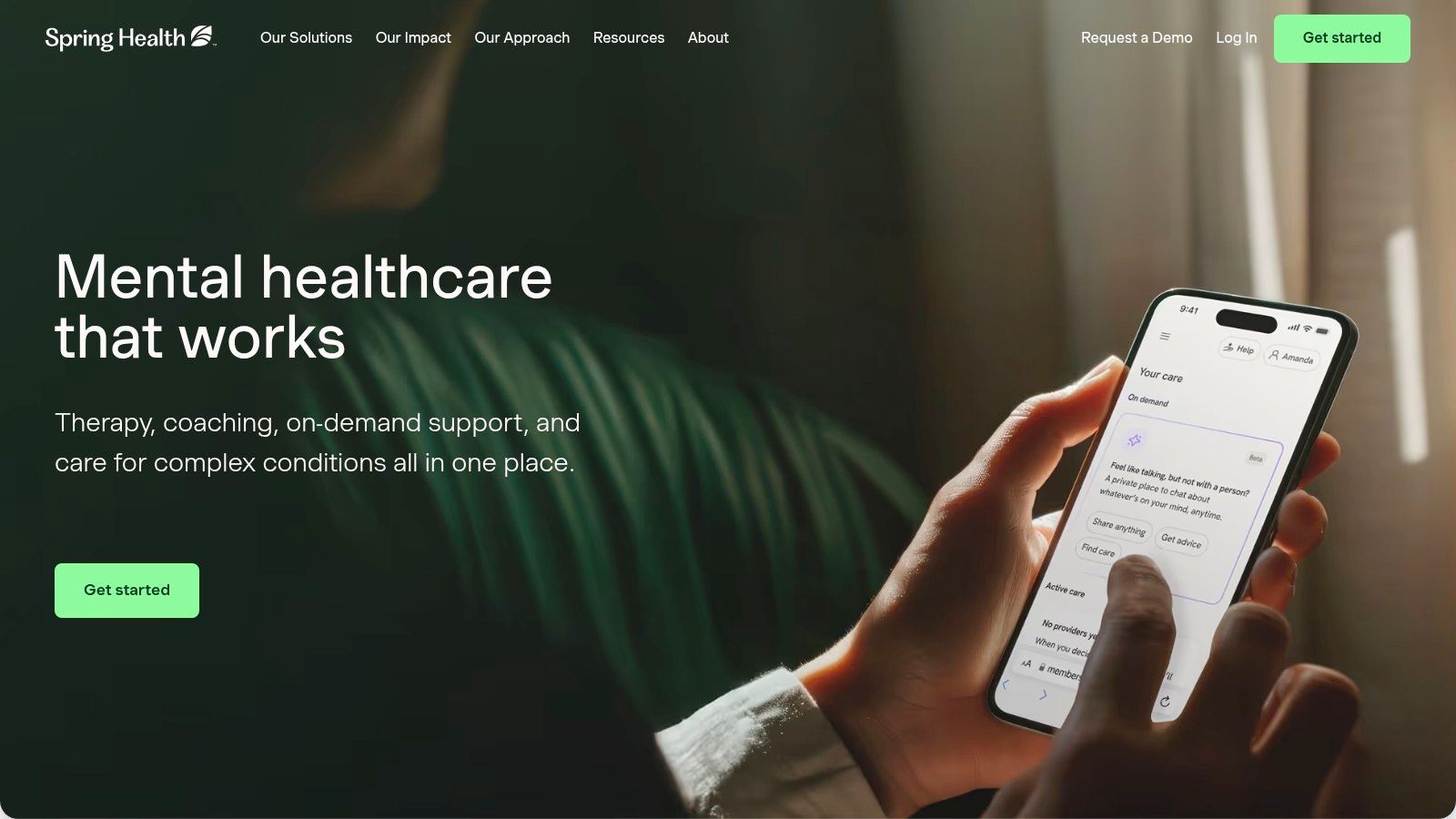
Spring Health is a comprehensive mental health solution that acts as a precise, data-driven front door for employee mental healthcare. It distinguishes itself by providing rapid access to care, personalized navigation, and robust analytics, making it one of the best employee wellness programs for organizations prioritizing measurable mental health outcomes and fast support for their workforce.
The platform uses a proprietary assessment to create a personalized care plan for each employee, guiding them to the right level of support, whether it’s coaching, therapy, or medication management. This clinical precision aims to reduce the trial-and-error process often associated with finding effective mental healthcare, ensuring employees connect with the right provider quickly.
Key Features & Benefits
Spring Health’s strength lies in its speed, personalization, and focus on demonstrating tangible results for both employees and employers.
- Precision Mental Healthcare: Each member completes a dynamic assessment that generates a personalized, evidence-based care plan, guiding them to the most effective treatment.
- Rapid Access to Care: The platform boasts an average time-to-care of less than two days, a critical factor when employees are in immediate need. Research in Psychiatric Services highlights that long wait times are a significant barrier to receiving mental health treatment.
- Dedicated Care Navigators: Every member is assigned a dedicated Care Navigator (a licensed clinician) to provide guidance, book appointments, and offer continuous support.
- Manager Training & Support: The “SpringsWorks” component provides leaders with playbooks, consultations, and crisis resources to help them support their teams’ mental wellbeing effectively.
Implementation & Budget
- Pricing: Pricing is quote-based and requires a consultation. It is typically structured on a Per Employee Per Month (PEPM) basis, covering access to the platform and a set number of therapy or coaching sessions.
- Best For: Companies of all sizes (from startups to large enterprises) that want to provide a high-touch, clinically-rigorous mental health benefit with a clear ROI.
- Actionable Tip: Utilize the SpringWorks manager training to equip your leaders. For example, host a mandatory “Mental Health First Aid” workshop for all people managers using Spring Health’s resources. Role-play scenarios where managers practice recognizing signs of distress and confidently guide an employee to the platform using compassionate, pre-approved language.
Pros and Cons
| Pros | Cons |
|---|---|
| Exceptional Speed-to-Care: Drastically reduces wait times for mental health support. | Quote-Based Pricing: Lack of transparent pricing makes initial budget planning difficult without a demo. |
| Data-Driven & ROI-Focused: Provides employers with clear analytics on engagement and outcomes. | Niche Focus: Primarily centered on mental health; requires other vendors for physical or financial wellness. |
| Personalized Care Navigation: High-touch support model reduces employee confusion and friction. | U.S. Centric: While expanding, its network and primary focus have historically been strongest in the U.S. |
How it Complements 9D Breathwork: Spring Health provides the clinical framework for mental health treatment (therapy, psychiatry), while 9D Breathwork offers a powerful, non-clinical modality for immediate stress reduction and nervous system regulation. You can position 9D Breathwork sessions as a proactive, preventative tool within your wellness calendar to help employees manage daily stress before it escalates to a clinical level requiring Spring Health’s services. Explore these workplace wellness program examples for more integration ideas.
Top 7 Employee Wellness Programs: Side-by-Side Comparison
| Item | Implementation complexity | Resource requirements | Expected outcomes | Ideal use cases | Key advantages |
|---|---|---|---|---|---|
| 9D Breathwork | Medium–High: trained facilitators + tech stack | Facilitator training, audio/entrainment tech, digital delivery/franchise support | Deep stress/anxiety reduction and substrate-level behavioral shifts (non‑clinical) | Corporate wellbeing experiences, experiential workshops, facilitator scaling | Multi‑modal layering (breath + entrainment + subconscious reprogramming); scalable franchise model |
| Personify Health | High: enterprise deployment and integrations | Platform configuration, admin teams, enterprise licensing and BI resources | Consolidated wellbeing management, engagement tracking, ROI/VOI reporting | Mid‑to‑large employers needing a single wellbeing “front door” | Unified platform with analytics; reduces vendor sprawl; enterprise credibility |
| Wellhub | Low–Medium: marketplace onboarding and plan setup | Employer subsidy budget, account admin, employee communications | Broader employee access to fitness/wellness options and higher utilization | Employers wanting flexible, tiered fitness/wellness networks | Large partner network and transparent employee pricing tiers |
| Calm for Organizations | Low: quick license provisioning; optional enterprise setup | User licenses, minimal admin setup; optional enterprise services | Rapid access to meditation/sleep/stress content and baseline engagement | Organizations wanting fast, content‑forward mental wellbeing at scale | Fastest path to launch; broad, approachable content library |
| Headspace for Employers | Medium: app + clinical service integration | Licenses, clinical service coordination, implementation support | Preventive mindfulness plus on‑demand clinical care and improved engagement | Employers seeking combined mindfulness and higher‑acuity mental health services | Single vendor for preventive and clinical care; strong brand recognition |
| Lyra Health | High: provider network management and integrations | Enterprise budget, benefits integrations, provider credentialing | Measurable clinical outcomes, high‑quality therapy/coaching access | Employers prioritizing clinical quality, measurable outcomes and CFO reporting | Credentialed provider network; emphasis on clinical quality and analytics |
| Spring Health | Medium–High: care navigation and rapid access workflows | Care navigators, integration with HR/benefits, implementation support | Very fast time‑to‑care, guided navigation, employer insights | Employers needing rapid access to care, guided navigation and manager support | Speed‑to‑care with dedicated navigators; strong outcome tracking |
Your Action Plan: Choosing and Integrating the Right Program for Your Team
Navigating the landscape of employee wellness programs can feel overwhelming, but this guide has armed you with the essential details on top-tier options like Personify Health, Wellhub, Calm, Headspace, Lyra Health, and Spring Health. We’ve explored how each platform tackles a different facet of well-being, from comprehensive health management and physical fitness to targeted mental health support and mindfulness. The central takeaway is clear: the most effective strategy isn’t about finding a single magic bullet, but about building a holistic, integrated ecosystem of support.
The research is undeniable. A 2022 study published in JAMA Network Open found that multicomponent wellness interventions significantly improved employee health outcomes and reduced healthcare costs. This highlights the importance of layering solutions to address the diverse needs of your workforce.
Synthesizing Your Strategy: From Selection to Success
Your journey from evaluation to implementation requires a strategic, people-first approach. The best employee wellness programs are those that align with your company’s unique culture, address your employees’ specific pain points, and deliver measurable results.
Key Takeaways to Guide Your Decision:
- Holistic is Non-Negotiable: Relying solely on a mental health app or a fitness subsidy is no longer sufficient. True well-being encompasses mental, emotional, and physical health. Your program should reflect this interconnectedness.
- Integration is Power: The most successful programs work in synergy. For instance, an EAP like Lyra Health can provide critical crisis support, while a platform like Calm offers daily preventative care. Adding a somatic modality like 9D Breathwork can then provide a powerful tool for processing stress and trauma that traditional talk therapy might not address.
- Customization Drives Engagement: One size does not fit all. Look for partners that allow you to tailor offerings to different employee demographics, job functions, and stress levels. As a study in the American Journal of Health Promotion noted, personalized wellness programs see higher participation rates and greater long-term success.
Your Immediate Next Steps
Transforming insight into action is the final, crucial step. Use this checklist to build momentum and make a confident, informed decision for your team.
- Survey Your Team (Again): Before you sign any contract, gather fresh, anonymous feedback. Action: Use a simple tool like Google Forms to ask, “What is the #1 thing impacting your well-being at work today?” and “If you had a $50 monthly wellness stipend, what would you spend it on?” This data provides immediate direction.
- Audit Your Current Offerings: What do you already have in place? An underutilized EAP? A basic health insurance plan? Identify the gaps that a new program needs to fill. Action: Create a simple two-column list: “What We Have” and “What We Need.” This visual gap analysis prevents overlap and ensures you’re investing where it matters most.
- Request Targeted Demos: Approach vendors with your specific needs. Instead of a generic overview, ask platforms like Spring Health or Personify Health to demonstrate exactly how they would address your top three employee challenges. Action: Provide your top challenge from the survey (e.g., burnout) to vendors beforehand and ask them to tailor their 30-minute demo to solving that specific problem.
- Pilot a Program: If possible, run a small-scale pilot with a specific department. For example, introduce a somatic tool like 9D Breathwork to a high-stress team, like your sales or customer support departments. Measure feedback and engagement before committing to a company-wide rollout. Research from the Journal of Occupational and Environmental Medicine confirms that pilot programs are effective for testing feasibility and ROI.
Ultimately, investing in employee wellness is one of the most powerful investments you can make in your organization’s future. It’s a commitment to building a resilient, engaged, and thriving workforce capable of navigating any challenge. By choosing thoughtfully and integrating strategically, you create a culture where every employee feels seen, supported, and empowered to do their best work.
Ready to add a powerful, science-backed somatic tool to your wellness ecosystem? 9D Breathwork offers transformative virtual and in-person experiences designed to release stress, process trauma, and unlock peak performance. Discover how our unique approach can complement your existing programs and provide a profound new level of support for your team at 9D Breathwork.