If you feel like you're fighting a losing battle for mental clarity, the path forward is simpler than you think. It starts with reducing your cognitive load, getting a handle on stress, and shoring up foundational habits like quality sleep and solid nutrition. These are the building blocks for a focused, sharp mind.
Why Mental Clarity Feels So Hard to Achieve Today

Feeling mentally scattered and overwhelmed isn't a personal failure—it’s a modern epidemic. We're swimming in a sea of digital pings, social pressures, and an endless firehose of information pulling our attention in a million different directions. It’s no wonder achieving genuine clarity feels like an uphill climb.
Mental clarity isn't about having a completely empty mind. It’s about being able to think clearly, focus without getting sidetracked, and stay grounded in the present. It’s the skill that fuels better decision-making, creative problem-solving, and a real sense of well-being. When your mind is clear, you're in the driver's seat, acting with intention instead of just reacting to whatever comes your way.
The Modern Obstacles to a Clear Mind
The thieves of your focus are often hiding in plain sight. Information overload is a massive one. Our brains simply weren't built to process the sheer volume of data we see every single day. A 2019 study in Nature Communications confirmed what we all feel: our collective attention spans are getting shorter because of it. This digital flood keeps us in a state of continuous partial attention, making deep, meaningful focus feel almost impossible.
On top of that, the lines between work and home life have all but disappeared, leaving many of us with a low-grade, chronic hum of stress. We’re not just talking about big, dramatic events. It’s the constant drip-drip-drip of small pressures that creates a persistent mental fog. A crucial first step is learning the difference between good stress and bad stress; you can dive deeper into the concepts of distress and eustress right here: https://9dbreathwork.com/distress-and-eustress/.
The constant demand to be ‘on’—answering emails at all hours, checking notifications, and juggling multiple tasks—robs our brains of the downtime needed to recharge and make sense of things. This creates a vicious cycle of mental exhaustion that directly sabotages clarity.
The Growing Awareness of Mental Well-being
The good news? The conversation around mental health is finally changing. A recent survey across 30 countries found that 45% of people now consider mental health their number one health concern—a huge jump from just 27% in 2020. This shift shows just how important it is to find real tools and strategies for improving mental clarity.
For some, the struggle for clarity can also be linked to underlying conditions that affect how the brain processes information. In these cases, it can be helpful to start understanding sensory processing disorder treatment options to see if that sheds some light.
This guide is designed to give you a practical roadmap. We’re moving beyond generic advice to offer actionable steps—from specific breathwork protocols to smart workplace strategies—to help you reclaim your focus and build a resilient, clear mind.
Your Quick-Start Mental Clarity Checklist
Ready to take the first step right now? This table breaks down the core pillars into simple, daily actions you can start immediately. Think of it as your cheat sheet for cutting through the noise.
| Pillar | Daily Action (5-10 Minutes) | Long-Term Benefit |
|---|---|---|
| Breathwork | Perform a 5-minute Box Breathing exercise (4s in, 4s hold, 4s out, 4s hold). | Calms the nervous system, reduces immediate stress, and improves focus. |
| Mindfulness | Sit quietly for 5 minutes, focusing only on the sensation of your breath. | Trains attention, reduces mind-wandering, and fosters present-moment awareness. |
| Movement | Take a brisk 10-minute walk outside, leaving your phone behind. | Boosts blood flow to the brain, elevates mood, and breaks up mental fatigue. |
| Nutrition | Drink a large glass of water first thing in the morning before coffee. | Fights dehydration-induced brain fog and kickstarts your metabolism. |
| Sleep | Set a "digital sunset" alarm 30 minutes before bed; no screens after it goes off. | Improves sleep quality, allowing your brain to properly consolidate memories and recharge. |
This isn't about a massive life overhaul. It's about small, consistent deposits into your mental well-being bank account. Pick one or two to start with this week and build from there.
Building Your Foundation for a Clearer Mind
Before we can even think about advanced cognitive techniques, we have to get the fundamentals right. I’m talking about the bedrock of mental clarity: your daily physical habits.
Now, I know what you might be thinking—sleep, nutrition, movement… heard it all before. But the secret isn't just knowing these things matter; it's in how you implement them. We're going to skip the generic advice and focus on practical, evidence-based routines that actually fit into a demanding schedule.
These three pillars work in tandem to regulate your hormones, manage your energy, and support the very brain structures responsible for clear thinking. A 2021 study in The Lancet Psychiatry didn't just suggest a link—it found that poor sleep is a direct causal factor for mental distress.
Trying to build mental clarity without this foundation is like building a house on sand. It just won't hold up.
The Brain-Off Wind-Down Routine for Restorative Sleep
Getting enough sleep isn’t just about the hours you log. It’s about the quality of those hours, and that starts with how you prepare your brain to power down for the night. Simply putting your phone away is a start, but a truly effective wind-down routine actively signals to your brain that the day is over.
Actionable Tip: Forget endless scrolling. Dedicate the last 20 minutes of your evening to a "brain dump" in a journal. This isn't deep, soul-searching stuff; think of it as a practical offloading process.
Here’s a simple way to structure it and quiet those racing thoughts:
- The "Worry List": Write down everything that's making you anxious, big or small. The act of getting it onto paper takes the burden off your brain to juggle it all night long.
- The "To-Do List": Pinpoint the top three most important tasks for tomorrow. This tells your brain a plan is in place, so it can relax instead of strategizing while you’re trying to sleep.
- The "Win of the Day": Acknowledge one small thing that went well. It's a simple act that helps shift your mind from a state of stress to one of gratitude, setting the stage for more peaceful rest.
Fueling Your Focus With Strategic Nutrition
What you eat has a direct and immediate impact on your cognitive function, mood, and energy. A complete diet overhaul can feel overwhelming, so let's focus on small, strategic additions and simple systems that make a real difference. The goal here is to make brain-healthy eating the path of least resistance.
A study in the journal Neurology showed that people with diets rich in flavonoids—compounds found in foods like blueberries and strawberries—reported less cognitive decline. The good news is, you don't need a complicated meal plan to get these benefits.
Practical Meal-Prep Hacks for Busy Professionals:
- Create "Focus Fuel" Snack Packs: On Sunday, portion out small bags of walnuts, almonds, and dark chocolate chips. Keep them at your desk or in your car so you have an easy alternative to the sugary, focus-draining snacks that call your name mid-afternoon.
- Embrace the Smoothie Bag: Pre-pack freezer bags with a handful of spinach, mixed berries, and a scoop of protein powder. In the morning, you just add water or milk and blend. It's a nutrient-dense breakfast that takes less than two minutes.
As you build these habits, you might also want to explore beverages known for their cognitive benefits. For example, look into the advantages of Sencha green tea for boosting focus.
Using Movement Snacks to Fight Mental Fatigue
Ever notice how brain fog creeps in after you've been sitting for a long time? That’s often due to stagnant blood flow. The fix isn't necessarily a grueling hour at the gym. Instead, think in terms of "movement snacks"—short, 5-minute bursts of activity you can sprinkle throughout your day.
These quick interludes dramatically increase blood flow and oxygen to the brain. In fact, research from the University of British Columbia shows that even short bouts of aerobic exercise can immediately boost the size of the hippocampus, the part of your brain involved in memory and learning. By learning how to rewire your brain with new micro-habits, you can make these small actions feel automatic.
Try a few of these simple movement snacks:
- The Desk-Side Squat: Every time you finish a task, stand up and do 10-15 bodyweight squats.
- The Brisk Walk Block: After a long meeting, take a five-minute brisk walk around the office or, even better, outside.
- The Stair Climb Challenge: Skip the elevator and take the stairs a few times a day to get your heart rate up.
These foundational habits aren't just items on a wellness checklist. They are the essential raw materials your brain needs to operate at its absolute best. By putting these practical routines in place, you create the biological environment necessary for sharp, sustained mental clarity.
Using Your Breath to Instantly Sharpen Focus

When your mind feels like a browser with way too many tabs open, the fastest way to get back in control isn’t your phone or another cup of coffee—it’s your lungs. Your breath is the most direct and potent tool you have for cutting through mental noise, because it acts like a remote control for your nervous system.
The connection is surprisingly simple. When you're stressed or distracted, your breathing becomes shallow and erratic. This signals your brain to enter "fight or flight" mode, flooding your system with cortisol and making focused thought feel almost impossible.
But by deliberately slowing and deepening your breath, you activate the parasympathetic nervous system—what’s often called the "rest and digest" system. This sends a powerful signal of safety to your brain, which in turn lowers your heart rate, reduces stress hormones, and allows the parts of your brain responsible for focus and decision-making to come back online. A 2017 study in Frontiers in Psychology showed that diaphragmatic breathing can significantly lower cortisol levels, giving a real physiological basis for that feeling of renewed clarity.
The 3-Minute Focus Reset for Immediate Clarity
Picture this: you're about to walk into a high-stakes presentation. Your mind is racing, your thoughts are all over the place, and you can’t seem to nail down your opening lines. This is the perfect time for a quick "Focus Reset."
The technique is called box breathing, and it's a simple, four-part pattern that can ground you in seconds.
Here’s exactly how to do it:
- Inhale Slowly: Breathe in through your nose for a steady count of four.
- Hold Gently: Hold your breath at the top for another count of four.
- Exhale Fully: Breathe out slowly through your mouth for a count of four.
- Hold Empty: Hold your breath at the bottom for a final four-count before starting over.
Just repeat this cycle for two to three minutes. You can do it at your desk, in the bathroom, or even in your car right before a big meeting. The rhythmic pattern forces your mind to concentrate on a single task, breaking the chaotic loop of anxious thoughts and clearing the way for sharp focus.
The 10-Minute De-Stress Protocol to Clear Your Mind
After a long, chaotic day, your mind is often still buzzing with leftover stress and mental clutter. A slightly longer breathing protocol can act as a mental "power wash," helping you shift from work mode to a state of rest and presence.
For this, find a quiet spot and get comfortable. Set a timer for 10 minutes and focus on one thing: making your exhale longer than your inhale. This is a powerful way to calm your nervous system.
- Breathe in through your nose for a count of four.
- Breathe out slowly through your mouth for a count of eight.
That’s it. By making your exhale twice as long, you powerfully activate your body's relaxation response. A study from the American Psychological Association found that this kind of slow breathing is highly effective at reducing anxiety and improving cognitive performance under stress.
By dedicating just 10 minutes to this at the end of your workday—maybe on your commute (if you're not driving) or as soon as you get home—you create a clear boundary that keeps the day's stress from spilling into your personal time.
Going Deeper with 9D Breathwork
While these quick protocols offer immediate relief, sometimes the root of chronic brain fog is deeper, tied to stored stress and old subconscious patterns. This is where a more immersive experience like 9D Breathwork can make a profound difference.
9D Breathwork goes far beyond simple breathing patterns. It combines specific breathing techniques with a rich, multi-sensory landscape of sound, including binaural beats and hypnotic guidance. This creates an environment designed to help you release deep-seated stress and rewire the underlying patterns contributing to mental fog.
If you're curious about integrating these powerful techniques, you might be interested in our guide on the differences between meditation and guided breathing. Think of these sessions as a way to proactively clear out the mental "sludge" that builds up over time, leading to a more sustained state of clarity and focus in your daily life.
Cognitive Exercises and Mindfulness to Train Your Brain
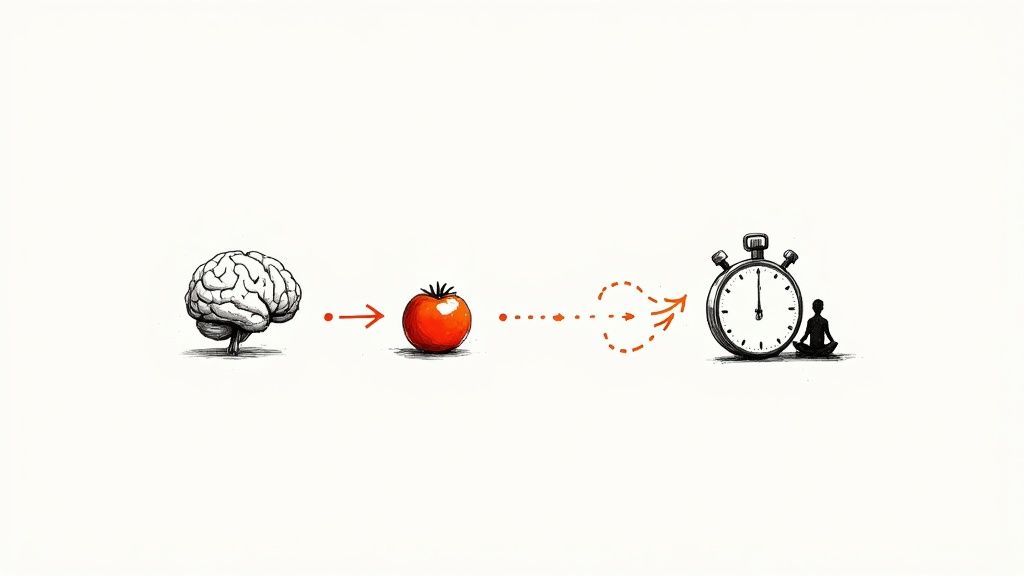
Just like you hit the gym to keep your body strong, your brain needs regular workouts to stay sharp and agile. Think of mental clarity not as something you either have or don't, but as a muscle you can actively train.
By consistently engaging in a few targeted exercises, you can build your capacity for deep focus, become more mentally flexible, and finally quiet that constant internal chatter that creates so much brain fog.
These aren't meant to be another item on your already overflowing to-do list. Instead, think of them as smart, efficient tools that help you get more out of the time you already have. They train your attention much like lifting weights trains a specific muscle group, making you stronger and more effective over time.
Build Deep Focus with the Pomodoro Technique
One of the best ways to fight back against constant distraction is to work with your brain's natural rhythms instead of against them. That’s where the Pomodoro Technique comes in. It’s a deceptively simple time management method that breaks your work into focused, manageable sprints.
Here’s how you put it into action:
- Pick one single task. Just one.
- Set a timer for 25 minutes. For that time, you are fully committed. No email, no phone, no "quick" checks on social media.
- Work until the timer dings. When it does, put a checkmark on a piece of paper.
- Take a real 5-minute break. Get up, stretch, grab some water—anything but the task.
- After four "Pomodoros," take a longer break of 15-30 minutes to properly reset.
This method trains your brain to sustain focus, which makes huge projects feel way less intimidating. In fact, a study in the Journal of Applied Psychology found that these kinds of frequent, short breaks are essential for keeping performance high and stopping cognitive fatigue from setting in.
Sharpen Your Mind with Attentional Switching Drills
Mental clarity isn’t just about laser focus on one thing; it's also about being able to shift your attention smoothly and intentionally. This skill, called attentional switching, is absolutely critical for navigating a busy, dynamic workday.
A fantastic way to train this is with the 5-4-3-2-1 Grounding Exercise. It's a mindfulness technique that forces you to deliberately move your attention between your senses, pulling you out of a racing mind and grounding you in the present moment.
Next time you feel scattered, try this:
- Acknowledge 5 things you can see around you. (Your monitor, a pen, a plant on the windowsill.)
- Acknowledge 4 things you can feel. (The texture of your desk, your feet flat on the floor.)
- Acknowledge 3 things you can hear. (The hum of the air conditioner, distant traffic.)
- Acknowledge 2 things you can smell. (The coffee on your desk, the air in the room.)
- Acknowledge 1 thing you can taste. (Maybe the mint from your gum or the last sip of tea.)
Practicing this little drill when you feel your mind wandering can dramatically improve your brain's ability to pivot its focus on command.
Reframe Your Thoughts with a Simple NLP Technique
Sometimes, the fog rolls in because we get stuck in a negative thought loop. A technique from Neuro-Linguistic Programming (NLP) called reframing is all about changing your perspective on a situation to change how you feel and react to it. It’s a mental judo move.
Instead of seeing a tough project as a threat ("I'm going to fail at this"), you can reframe it as an opportunity ("This is a great chance to learn something new"). This simple linguistic shift can instantly cut through mental clutter and dial down your stress.
The impact of these mental health tools goes far beyond just feeling better. Economic analyses show that mental health conditions lead to 290 million disability-adjusted life years lost globally each year. But scaling up cost-effective interventions could unlock a staggering $4.4 trillion in global GDP by helping people show up as their best, most productive selves. You can find more on this in an in-depth McKinsey report about investing in mental health.
Let's face it: the modern workplace can be a real minefield for your mental clarity. It's the never-ending stream of notifications, the wall-to-wall meetings, and that unspoken pressure to be "on" all the time that splinters our focus into a million tiny pieces. If you want to cut through that fog, you need some real-world, battle-tested strategies to carve out pockets of calm in the middle of all the chaos.
This isn't about grinding harder. It’s about working smarter by fiercely protecting your most valuable asset: your attention. This is especially true for younger generations navigating the professional world. The data is pretty stark—the Mental Health Quotient (MHQ) for younger adults took a nosedive during the pandemic and has barely recovered. This shows just how hard recent psychological stressors have hit them. You can dig into the specifics in the full Mental State of the World report.
What this all means is that getting a handle on your clarity at work isn't just a career hack anymore. It's a non-negotiable part of staying healthy.
Embrace Strategic Disengagement
The old-school idea of powering through an eight-hour day without a proper break? That’s just a fast-track ticket to burnout. The most productive and clear-headed professionals I know don't just push through; they intentionally step away. This is what I call strategic disengagement—scheduling short, deliberate breaks to give your brain a hard reset.
And no, scrolling through social media doesn't count. That’s often just trading one form of mental clutter for another. A real disengagement break means completely disconnecting from anything work-related.
Actionable Tip: Block out two 15-minute "clarity breaks" in your calendar every single day. Treat them like you would any important meeting. Use that time to step outside for a walk, listen to some instrumental music, or just sit quietly away from your desk.
It’s not just a nice idea; it's backed by research. A study in the Journal of Occupational Health Psychology found that these kinds of micro-breaks seriously improve well-being and engagement. Think of them as pit stops for your brain, letting it consolidate information and recharge before that dreaded afternoon slump even thinks about showing up.
Structure Your Day for Peak Focus
A clear mind loves structure. If you feel like your day is a chaotic mess, two of the most effective methods you can implement right away are task batching and creating deep work blocks. Both are designed to cut down on the cognitive cost of "context switching"—that sluggish, foggy feeling you get when you jump from your inbox to a spreadsheet to a team chat.
- Task Batching: This is simple but so effective. You just group similar, low-effort tasks together and knock them out in one go. Instead of checking your email every time a notification pops up, set aside two 30-minute windows a day (maybe at 11:00 AM and 4:00 PM) to clear your entire inbox.
- Deep Work Blocks: Pick the one or two most critical, high-impact tasks on your plate for the day. Then, block out a 90-minute, no-interruptions-allowed chunk of time on your calendar to focus solely on them. That means email is closed, your phone is on silent, and your team knows you're off-limits.
When you organize your day like this, you create a natural rhythm that allows your brain to sink into that highly productive state of deep concentration. If you want to explore more strategies for structuring your workday, our guide on how to improve focus at work is a great next step.
Set Clear Boundaries with Communication Scripts
Those constant pings and notifications are the sworn enemy of mental clarity. To truly protect your focus, you have to manage expectations and set firm boundaries with colleagues. The good news is, you don't have to be aggressive or awkward about it. A few simple, professional communication scripts can do all the heavy lifting for you.
Practical Scripts for Setting Boundaries:
| Situation | Your Go-To Script |
|---|---|
| Getting constant instant messages | "Thanks for reaching out. I'm in a deep work block until 2 PM but will get back to you then. If it's urgent, please let me know." |
| Being pulled into unplanned meetings | "I'd love to help. Could you send me a brief agenda so I can prepare? My next availability is at 3 PM." |
| Receiving after-hours emails | Use the "send later" function in your email to schedule your reply for the next morning. This subtly reinforces that you're not on call 24/7. |
Putting these scripts into practice helps "train" your colleagues on how you work best and reinforces that your focused time is valuable. It's a small change, but it can dramatically cut down on mental clutter and help you finally reclaim control over your day.
Making Your Newfound Clarity Last
Getting those moments of sharp, crystal-clear focus is a huge win. But let's be honest, the real game is making that feeling stick around. To do that, you need a dead-simple way to see what's working and what's not. Vague feelings are impossible to build on, but a little bit of real data? That gives you the power to make smart changes.
This isn't about piling another complicated task onto your already full plate. It’s about creating a simple feedback loop that keeps you on the right track. By keeping an eye on a few key things, you can turn an abstract goal like "be more focused" into something real you can actually measure. You get to see the small victories, which builds momentum for a clear mind that lasts.
In fact, a study in the Journal of Medical Internet Research found that this kind of simple self-monitoring—whether in a journal or an app—is directly linked to better well-being because it forces you to become more self-aware.
What to Actually Keep an Eye On
Start with just a few simple metrics. The goal here is consistency, not complexity.
- Daily Clarity Score (1-10): At the end of the day, just give yourself a gut-check rating. How clear did you feel? A 1 is total brain fog, and a 10 is perfectly sharp and on-point. This takes five seconds but gives you a powerful snapshot over time.
- Focused Work Hours: Forget just tracking "hours worked." How many truly focused, uninterrupted blocks of time did you get in this week? This measures real, high-quality output, not just time spent at your desk.
- Sleep Quality: Don't just log the hours. Note how you felt when you woke up. Was it rested and ready? Grogggy? Somewhere in the middle?
This is where you can start connecting the dots. Think about how you structure your day—batching the small admin tasks together, carving out time for deep work, and then properly disengaging.
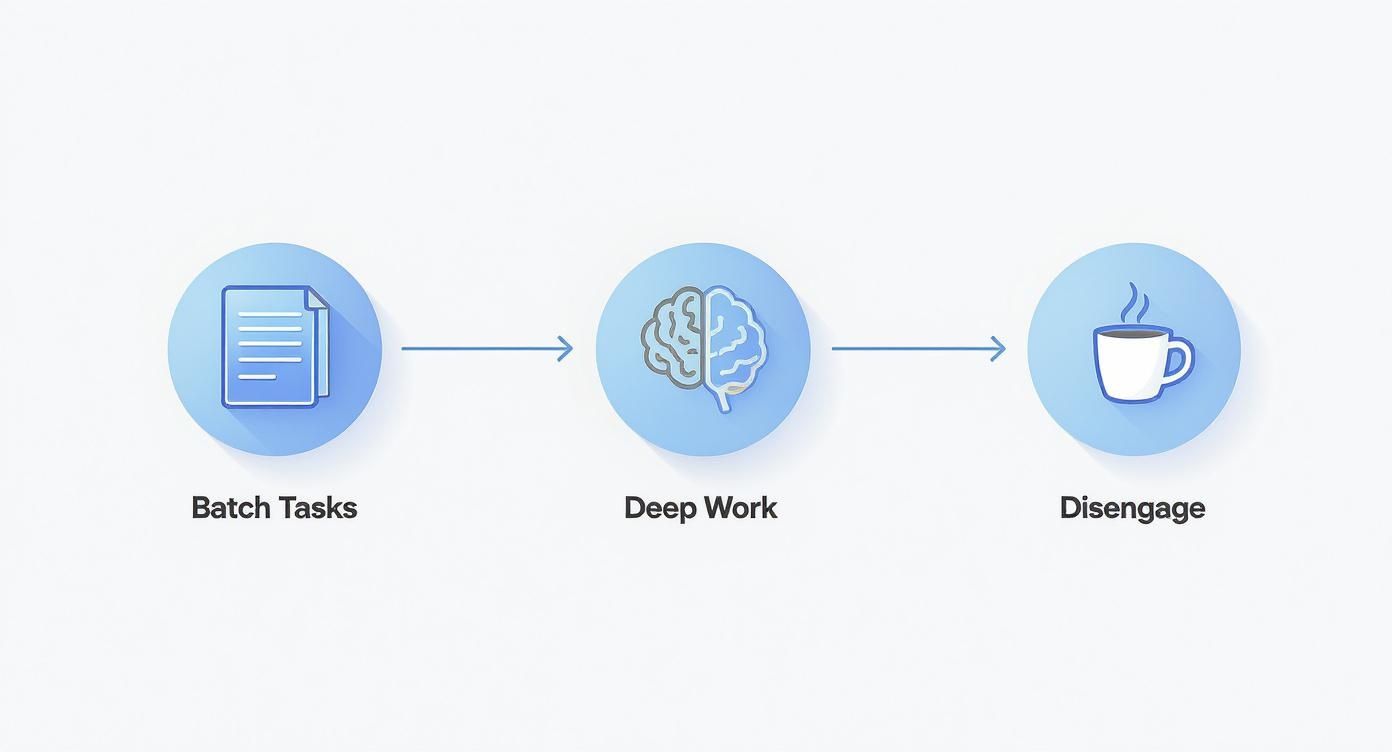
When you track these simple metrics, you can see how your daily actions directly impact your clarity score. You might notice your score tanks on days you have back-to-back meetings. That’s not a failure; that’s actionable data telling you to start protecting your calendar a little more fiercely.
A quick note on this: celebrate your progress. If your average Clarity Score goes from a 4 to a 6 over a couple of weeks, that's a massive improvement worth acknowledging. This kind of positive reinforcement is what makes new habits stick. Research has shown that celebrating these small wins literally activates the reward circuits in our brains, making us want to do it again.
Of course. Here is the rewritten section, designed to sound like it was written by an experienced human expert, following all your specific instructions.
Common Questions on the Path to Mental Clarity
Embarking on this journey to sharpen your mind naturally brings up a few questions. Let's tackle some of the most common hurdles people run into when they start building these new routines.
How Long Until I Actually Feel a Difference?
While there's no magic number, you can get an immediate payoff from simple techniques like box breathing—often within minutes. For the more foundational shifts, like better sleep and nutrition, most people start feeling a real difference in their energy and focus in about one to two weeks.
But the real secret is consistency. A study from the European Journal of Social Psychology found it takes, on average, 66 days for a new habit to feel automatic. So, be patient with yourself. The goal is small, daily progress, not some dramatic overnight transformation.
What Happens If I Miss a Day?
It’s going to happen. Life gets in the way. Missing a day isn’t a failure; it’s just part of the process of building a new habit. The trick is to sidestep that "all-or-nothing" thinking. If you skip your morning walk or forget to journal, just pick it back up the next day. No guilt, no drama.
A single missed day is just a blip. Two missed days in a row? That's the beginning of a new, less helpful habit. Just acknowledge it and get back on track. Progress is the goal, not perfection.
There’s So Much Here. Where Should I Start?
If you feel overwhelmed, just start with your breath. It’s the one tool you have with you at all times. Seriously, committing to just five minutes of focused breathing a day can dramatically lower your stress and bring an instant sense of calm.
Once you have that down, just pick one more thing that feels easy to tackle:
- For better sleep: Give the "digital sunset" rule a try tonight.
- For better focus: Use the Pomodoro Technique for a single task tomorrow.
When you score a small, manageable win, it creates momentum. That makes it so much easier to layer in other practices down the road.
At 9D Breathwork, we create powerful, multi-sensory experiences designed to cut through mental fog and release the deep-seated stress that’s holding you back. Find out how our unique blend of breathwork, sound, and hypnotic guidance can help you find lasting clarity by exploring our sessions at https://9dbreathwork.com.