It starts subtly. You might feel constantly drained, a little more detached from your work, or find it increasingly difficult to focus on tasks that once felt routine. Many professionals dismiss these feelings as ‘just a tough week’ or the normal ebb and flow of a demanding career. However, these seemingly minor issues can be the early warning signs of a more profound and pervasive condition: workplace burnout.
Burnout is not simply stress. It is a state of significant emotional, physical, and mental exhaustion caused by prolonged and excessive workplace pressure. A 2018 study published in the SAGE Open journal confirmed that burnout is directly linked to both emotional exhaustion and a cynical, detached attitude towards one’s job. While stress is often characterized by over-engagement and a sense of urgency, burnout represents the opposite: disengagement, emptiness, and a loss of motivation. Recognizing the difference is a critical first step toward addressing the root cause. Ignoring the signs of workplace burnout can dismantle your productivity, impact your physical health, and erode your passion for your career. A study in the International Journal of Environmental Research and Public Health found that prolonged burnout correlates with increased physical ailments and a higher likelihood of leaving one’s job.
This guide is designed to provide clarity. We will explore eight critical signs of workplace burnout, providing practical examples to help you identify the symptoms in your own life. Understanding these red flags is the most powerful action you can take to reclaim your well-being, restore your energy, and build sustainable resilience against chronic workplace stress. By moving from awareness to action, you can begin the journey toward recovery.
1. Chronic Fatigue and Physical Exhaustion
One of the most profound and pervasive signs of workplace burnout is a deep, persistent sense of physical exhaustion that rest alone cannot cure. This isn’t the familiar tiredness you feel after a long day; it’s a chronic state where sleep provides no genuine refreshment. Your body’s energy reserves are so depleted by prolonged stress that even a full night’s rest or a long weekend isn’t enough to recharge them.
This debilitating fatigue is a direct physiological response to the unmanaged, long-term stress that defines burnout. A 2017 study in Frontiers in Psychology highlighted that burnout is significantly associated with health complaints, with fatigue being among the most prominent. It manifests as a heavy, leaden feeling that makes even small tasks seem monumental.
Real-World Examples
- A healthcare professional works back-to-back 12-hour shifts during a public health crisis. After their scheduled four days off, they still feel as drained as they did on their last shift, dreading their return to work.
- A project manager at a tech startup sleeps for eight hours every night but consistently wakes up feeling groggy and unrefreshed, relying on multiple cups of coffee just to function through morning meetings.
- A teacher finds that even summer vacation isn’t enough to restore their energy, spending the first few weeks in a state of near-total exhaustion before feeling even a sliver of their usual vitality return.
Actionable Steps to Take
If this level of exhaustion feels familiar, it’s crucial to take proactive steps rather than trying to “push through” it.
- Audit Your Energy: For one week, use a simple journal to rate your energy on a scale of 1-10 at three key times: morning, midday, and evening. Note what you were doing right before each check-in. This will reveal clear patterns of what drains and what sustains you.
- Schedule Rest First: When planning your week, block out non-negotiable rest periods in your calendar before adding work tasks. This could be a 20-minute “tech-free” walk at lunch or 30 minutes of reading before bed. Treat these appointments with the same importance as a client meeting.
- Optimize Your Sleep Routine: Instead of just aiming for more hours, improve the quality. For the next three nights, turn off all screens 60 minutes before bed and try a calming activity like light stretching or listening to an audiobook.
- Rule Out Medical Conditions: Consult a healthcare provider to ensure an underlying medical issue, like anemia or a thyroid disorder, isn’t contributing to your fatigue.
Ultimately, this type of exhaustion is your body’s alarm system. To truly recover, you must address the source of the depletion. You can explore techniques like intentional breathwork to naturally boost your vitality and find out more about using your breath for renewed energy.
2. Emotional Detachment and Cynicism
A core psychological sign of workplace burnout is a growing sense of emotional detachment from your job and a cynical, negative outlook toward your colleagues and the organization. This isn’t just a bad mood; it’s a protective coping mechanism where you unconsciously distance yourself emotionally to manage overwhelming demands. This detachment, a key dimension in Christina Maslach’s seminal research on burnout, acts as a shield against further emotional depletion.
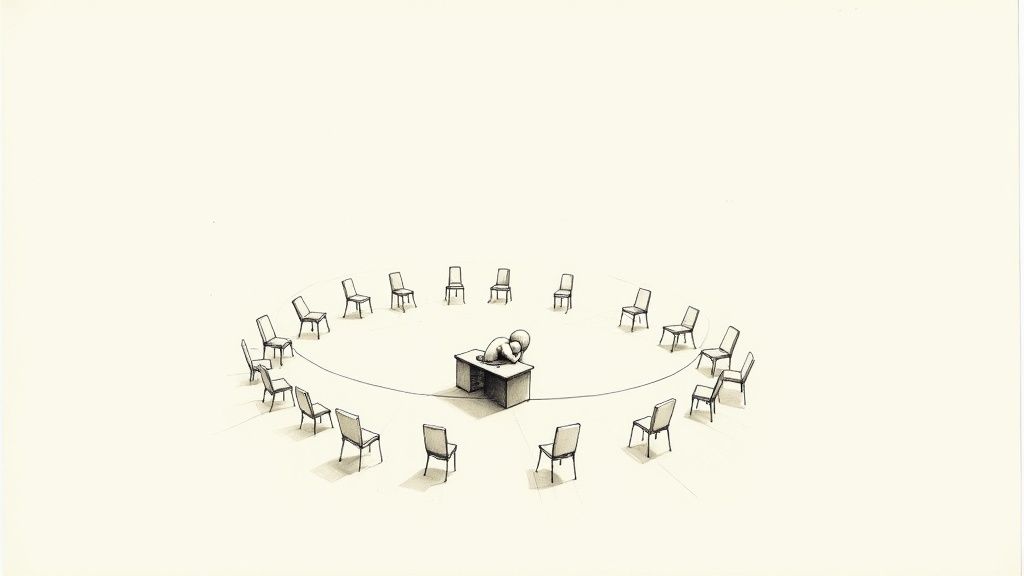
When you’re emotionally detached, your investment in your work plummets. Passion is replaced by pessimism, and empathy gives way to irritation. This cynicism is more than just sarcasm; it’s a deep-seated negativity that can poison your professional relationships and job satisfaction. Research published in the journal Work & Stress confirms that this depersonalization is a central component of burnout, strongly linked to job demands and a lack of resources.
Real-World Examples
- A customer service representative who once took pride in helping people now makes cynical jokes about clients and goes through the motions without any genuine engagement.
- A nonprofit worker, previously driven by their organization’s mission, becomes dismissive during team meetings and openly questions the impact of their work.
- A sales professional begins to view every client with suspicion and distrust, focusing on potential negatives rather than building rapport and finding solutions.
Actionable Steps to Take
If you recognize this growing distance in yourself, you can take steps to rebuild your emotional connection before it becomes completely severed.
- Reconnect with Your “Why”: Set aside 15 minutes to journal about why you chose your profession or current role initially. What aspects once excited you? Identify one small task you can do this week that connects directly to that original motivation.
- Practice Perspective-Taking: Before your next team meeting, choose one colleague and make it your goal to understand their perspective on a key issue, even if you disagree. This empathy exercise can help counteract the instinct to emotionally withdraw.
- Limit Negative Conversations: For the next week, make a conscious effort to either steer cynical conversations toward solutions or politely excuse yourself. Instead, seek out a 5-minute chat with a colleague who maintains a more constructive outlook.
- Log a Daily “Win”: At the end of each day, write down one specific thing you did that had a positive impact, however small. For example, “I helped a junior colleague find a file they were looking for.” This practice shifts focus from negativity to tangible contribution.
Ultimately, emotional detachment is a signal that your psychological resources are critically low. To rebuild your capacity for engagement, you need to address the emotional drain at its source. You can start by exploring effective emotional regulation strategies to regain control and foster a healthier professional mindset.
3. Decreased Job Performance and Productivity
A sharp, noticeable decline in your work quality and efficiency is one of the most visible signs of workplace burnout. This isn’t just about having an “off” week; it’s a sustained drop in performance where tasks that were once routine now feel overwhelming. You might find yourself missing deadlines, making uncharacteristic errors, or struggling to concentrate on complex problems. This performance slump is a direct result of cognitive and emotional resources being depleted by chronic stress.

This decline is not a reflection of your competence or work ethic, but rather a symptom of your brain’s diminished capacity to function under prolonged duress. Research published in the International Journal of Environmental Research and Public Health confirms that burnout significantly impairs cognitive functions like attention and executive control, which are essential for productivity. The combination of mental exhaustion and dwindling motivation creates a feedback loop where poor performance fuels feelings of inadequacy, worsening the burnout.
Real-World Examples
- A software developer, once known for clean, efficient code, starts submitting work with frequent bugs and logical errors, causing project delays.
- A financial analyst who typically produces insightful reports begins missing key deadlines and submitting analyses that are incomplete or lack depth.
- A project manager, previously on top of every deliverable, struggles to coordinate their team, leading to miscommunication and missed milestones.
Actionable Steps to Take
If you recognize this pattern in your own work, it’s a clear signal to intervene before your professional reputation and well-being suffer further.
- Deconstruct Your Main Project: Take your largest current project and break it down into a checklist of 5-10 smaller, concrete tasks (e.g., “Draft email to stakeholder X” instead of “Manage stakeholders”). This makes the work feel less overwhelming and more achievable.
- Use the Pomodoro Technique: Set a timer for 25 minutes and commit to working on one single task without distractions. When the timer goes off, take a mandatory 5-minute break away from your screen. Do this for your first two hours of the day to build momentum.
- Have a Solutions-Focused Conversation: Schedule a meeting with your manager. Instead of saying “I’m overwhelmed,” try: “To ensure I deliver high-quality work on Project Y, could we clarify the top three priorities for this week?” This frames the discussion around effectiveness, not inability.
- Identify Your “High-Energy” Window: Pinpoint the 2-3 hour block in your day when you feel most focused. Protect this time fiercely for your most mentally demanding tasks, and schedule meetings or administrative work during your lower-energy periods.
Ultimately, decreased performance is a cry for help from your cognitive and emotional systems. It indicates that your current way of working is unsustainable. Addressing the root cause is essential to restoring your effectiveness and job satisfaction.
4. Increased Irritability and Mood Swings
A hallmark sign of workplace burnout is a significant shift toward heightened emotional reactivity. When emotional reserves are depleted, small frustrations can trigger disproportionate responses, turning once-calm professionals into short-tempered and unpredictable colleagues. This isn’t just a “bad mood”; it’s a persistent state of irritability where patience wears thin, and emotional control becomes a daily struggle.
This emotional volatility is a direct consequence of a dysregulated nervous system under chronic stress. Research published in the International Journal of Environmental Research and Public Health confirms that emotional exhaustion, a core component of burnout, directly predicts irritability and anger at work. The mental and emotional energy required to manage reactions is simply no longer available, leaving you raw and exposed to daily triggers.
Real-World Examples
- A once-patient manager now snaps at their team during meetings over minor mistakes or delays, creating a tense and fearful environment.
- A collaborative graphic designer who used to welcome feedback becomes territorial and defensive, interpreting constructive criticism as a personal attack.
- An experienced mentor grows dismissive and impatient with junior employees’ questions, sighing audibly and giving curt, unhelpful answers.
Actionable Steps to Take
If you find your temper flaring up more easily, it’s a critical signal to regain emotional control before it damages your professional relationships.
- Adopt the “PAUSE” Method: Before reacting to a trigger, Pause, Acknowledge the feeling, Understand the trigger, Step back for a moment, and then Execute your response. This simple mental checklist creates a crucial buffer between stimulus and reaction.
- Use Tactical Breathing: Before entering a potentially stressful meeting, practice “box breathing”: Inhale for a count of four, hold for four, exhale for four, and hold for four. Repeat 3-5 times to physically calm your nervous system.
- Identify Your Triggers: For one week, keep a small notepad and make a tally mark every time you feel a surge of irritation. Note the specific situation (e.g., “last-minute request,” “interruptions”). This data will show you exactly what to address.
- Schedule “Proactive Decompression” Breaks: Don’t wait until you’re overwhelmed. Block two 10-minute slots in your calendar each day to step away from your work. Walk around, listen to a song, or simply look out a window to reset your emotional state.
Ultimately, this increased irritability is a clear indication that your coping mechanisms are overloaded. Addressing the root cause of this emotional depletion is essential for restoring your sense of balance and improving your interactions at work.
5. Social Withdrawal and Isolation
When the pressure of work becomes overwhelming, a common but counterproductive response is to pull away from others. This social withdrawal isn’t about introversion; it’s a defensive mechanism where you actively retreat from colleagues, friends, and family because social interaction feels like another draining task. This progressive isolation is a key sign of workplace burnout, as the very support systems that could offer relief become sources of perceived stress.
This emotional and social retreat is a way to conserve dwindling energy reserves. Instead of joining team lunches, you eat at your desk. You might stop contributing in meetings or decline after-work events you once enjoyed. Research published in the Journal of Occupational Health Psychology shows a strong correlation between burnout and disengagement, where employees emotionally detach not just from their work but from the social fabric of the workplace itself.
Real-World Examples
- An account manager, once the life of the office who organized team outings, now keeps their headphones on all day, eats lunch alone, and leaves the second the workday ends.
- A remote software developer who used to be active on team chat channels and virtual social events now communicates only when necessary, keeping their camera off during calls and ignoring non-essential messages.
- A marketing professional starts regularly declining invitations to industry networking events they used to frequent, citing tiredness and a lack of interest in connecting with peers.
Actionable Steps to Take
If you recognize this pattern of pulling away, it’s vital to intentionally reconnect, even when it feels difficult. Isolation will only deepen the feelings associated with burnout.
- Schedule One Micro-Connection: This week, schedule one 15-minute coffee chat (virtual or in-person) with a trusted colleague. The goal isn’t to solve problems but simply to connect as people. Put it in the calendar so it happens.
- Re-engage with a Specific Purpose: Instead of avoiding all meetings, choose one low-stakes meeting this week to actively participate in. Ask one clarifying question or offer one piece of constructive input. This is a small, controlled step back into engagement.
- Practice “Low-Stakes Vulnerability”: Choose one trusted friend or colleague and share a small, non-critical part of your struggle. Simply saying, “I’ve been feeling really drained by my workload lately,” can reopen a door for connection and support.
- Plan One Non-Work Social Activity: Intentionally schedule one enjoyable, low-energy social activity outside of work this month, like going to a movie or taking a walk in a park with a friend. This helps rebuild the association of social interaction with pleasure rather than obligation.
Ultimately, this withdrawal is a symptom of a deeper need for safety and energy conservation. Re-establishing social connections is a powerful step toward recovery, reminding you that you are not alone in your struggle.
6. Cynical Self-Talk and Reduced Self-Efficacy
Burnout doesn’t just exhaust your body; it hijacks your inner dialogue, replacing confidence with crippling self-doubt. This sign manifests as a relentless internal critic that questions your abilities, dismisses your accomplishments, and frames your efforts as futile. This erosion of professional self-esteem, known as reduced self-efficacy, is a core dimension of burnout, creating a vicious cycle where negative thoughts cripple your motivation and performance.
This internal negativity is one of the most insidious signs of workplace burnout because it feels deeply personal. It’s more than just a bad day; it’s a fundamental shift in how you perceive your own competence and value. Research published in the International Journal of Environmental Research and Public Health confirms that reduced personal accomplishment is a critical component of the burnout syndrome, directly impacting job satisfaction and mental health.
Real-World Examples
- An experienced software developer, despite a proven track record of successful projects, starts believing they are an imposter who will soon be “found out” and constantly second-guesses their code.
- A marketing manager looks at their team’s stable performance and positive results but internally concludes, “I’m not an effective leader; we’re just getting lucky.”
- An administrative assistant becomes convinced that their daily tasks are insignificant and make no real difference to the organization’s goals, no matter how efficiently they perform them.
Actionable Steps to Take
Reclaiming your sense of professional self-worth requires actively challenging this destructive internal narrative. Instead of letting self-criticism run unchecked, you must intervene with intention.
- Create a “Success Folder”: Create a digital folder or a physical document where you save every piece of positive feedback you receive—a thank you email from a client, praise from your manager, a compliment from a colleague. Review it once a week to counter your negative internal voice with hard evidence.
- Reframe Negative Thoughts: When you catch yourself thinking, “I can’t handle this,” actively reframe it to, “This is challenging, but I will handle it by focusing on the first step.” This small linguistic shift can move you from a state of overwhelm to a state of action.
- Set One Achievable Micro-Goal: Choose one small, tangible task you know you can complete today (e.g., “organize my desktop files” or “respond to three emails”). The act of successfully completing it provides a concrete victory that helps restore a sense of competence.
- Seek an External Perspective: Ask a trusted mentor or colleague for their honest feedback on a recent piece of work. Hearing their objective assessment can provide a much-needed reality check against your harsh internal criticism.
This internal battle is a definitive signal that burnout has taken root. To regain control, you must learn to identify and dismantle these harmful thought processes. You can find out more about how to break free from negative thought patterns and rebuild a healthier internal dialogue.
7. Loss of Boundaries Between Work and Personal Life
One of the clearest signs of workplace burnout is the gradual erosion of the line separating your professional duties from your personal time. This isn’t just about occasionally working late; it’s a chronic intrusion where work demands consistently bleed into evenings, weekends, and even vacations. The mental and physical space once reserved for rest and personal life becomes an extension of the office, preventing true psychological detachment and recovery.
This constant connectivity creates a state where you are never truly “off,” perpetuating the stress cycle that leads directly to burnout. A 2017 study published in the Journal of Business and Psychology found that the inability to detach from work during non-work hours is a significant predictor of emotional exhaustion. When the boundaries dissolve, your nervous system remains in a heightened state of alert, making it impossible to recharge.
Real-World Examples
- A remote tech worker leaves their laptop open on the kitchen table, responding to Slack messages at midnight and checking emails as soon as they wake up.
- An executive on a family vacation spends two hours every morning on conference calls, unable to disengage and be present with their loved ones.
- A consultant consistently takes client calls during family dinners, signaling that work priorities always come first, which strains personal relationships.
Actionable Steps to Take
If you find work constantly creeping into your personal time, it’s critical to proactively re-establish clear and firm boundaries.
- Define and Communicate Your Availability: Set your working hours on your shared calendar and communication apps (like Slack or Teams). Let your colleagues know, “I’ll be online from 9 AM to 5 PM and will respond to messages during that time.”
- Create “Digital Bookends” for Your Day: Start your day with a 15-minute non-work activity (like stretching) before checking any emails. End your day by creating a to-do list for tomorrow, then closing your laptop and putting it out of sight. This creates clear mental start and stop points.
- Use an Email Auto-Responder: After your designated work hours, turn on an auto-responder that says, “Thank you for your message. I am currently offline and will respond during my working hours (e.g., 9 AM – 5 PM, Mon-Fri).” This manages expectations and removes the pressure for an instant reply.
- Schedule Tech-Free Zones: Designate specific times or places as “no-work zones.” For example, make a rule that no phones or laptops are allowed at the dinner table or in the bedroom.
Reclaiming your personal time is non-negotiable for preventing and recovering from burnout. When work encroaches on personal time, it’s a clear red flag; exploring effective strategies for work-life balance is essential to prevent this destructive cycle.
8. Cynicism About Organizational Values and Purpose
One of the more corrosive signs of workplace burnout is a deep-seated cynicism toward the organization’s mission and values. This isn’t just dissatisfaction with your daily tasks; it’s a fundamental loss of belief in the “why” behind your work. Where you once saw purpose and integrity, you now see hypocrisy, profit-motives disguised as purpose, or a glaring disconnect between stated values and actual company behavior. This erosion of trust creates a crisis of meaning.
This sign is particularly potent because it attacks the motivational foundation that keeps employees engaged. A study published in the Journal of Vocational Behavior found that a perceived lack of organizational values was a significant predictor of emotional exhaustion, a core component of burnout. When your personal values no longer align with those of your employer, the psychological contract is broken, leading to detachment and skepticism.
Real-World Examples
- A nonprofit worker who joined to make a social impact now feels their organization is more focused on securing funding and positive PR than on genuinely helping the community it serves.
- A healthcare administrator becomes jaded, believing their hospital prioritizes patient turnover and billing efficiency over quality patient-centered care, directly contradicting its mission statement.
- An environmental scientist at a large corporation begins to see their department’s work as “greenwashing,” a marketing tactic rather than a sincere commitment to sustainability, making them question the value of their contributions.
- An educator feels their school district’s new policies focus on standardized testing metrics to the detriment of genuine student learning, a conflict with their core educational philosophy.
Actionable Steps to Take
If your belief in your organization’s purpose is fading, it’s vital to address this misalignment before it completely extinguishes your professional motivation.
- Reconnect with Your Direct Impact: For one week, focus on the human element of your role. If you’re in a customer-facing role, pay extra attention to positive interactions. If not, seek out a colleague whose work you directly support and ask them how your contribution helps them.
- Identify a “Value Ambassador”: Find one person or team within the organization who still seems to embody the values you believe in. Schedule a brief meeting with them to discuss their work, which can provide a pocket of inspiration and reaffirm that the mission isn’t entirely lost.
- Frame Concerns as a “Value Gap”: If you have a trusted manager, schedule a conversation. Instead of saying, “Our company is hypocritical,” try: “I’m passionate about our stated value of [e.g., customer focus]. I have some ideas on how our team could better align our daily actions with this mission. Could we discuss them?”
- Conduct a Personal Value Audit: Take 20 minutes to write down your top five personal and professional values. Then, rate how well your current role allows you to live out each one on a scale of 1-10. This data will clarify whether the gap is manageable or if a larger change is needed.
8 Workplace Burnout Signs Comparison
| Indicator | Implementation complexity | Resource requirements | Expected outcomes | Ideal use cases | Key advantages |
|---|---|---|---|---|---|
| Chronic Fatigue and Physical Exhaustion | Medium — combines medical evaluation with workplace adjustments | Medium–High — healthcare, schedule changes, rest policies | Restored energy, fewer sick days, better recovery when addressed | Persistent tiredness despite rest; frequent illness or sleep disturbance | Measurable early warning sign; motivates medical and organizational action |
| Emotional Detachment and Cynicism | Medium — psychological support and cultural change required | Medium — counseling/coaching, manager training | Increased engagement, restored empathy, reduced negativity | Sarcasm, depersonalization, withdrawal from team mission | Visible signal for intervention; can prompt timely support |
| Decreased Job Performance and Productivity | Low–Medium — process fixes and workload adjustments | Low–Medium — tools, training, manager time | Measurable performance gains, fewer errors, improved efficiency | Declining KPIs, missed deadlines, higher error rates | Easily measured; provides clear basis for support and feedback |
| Increased Irritability and Mood Swings | Low–Medium — emotion-regulation training and brief interventions | Low–Medium — stress-management resources, short-term therapy | Better team interactions, fewer conflicts, improved self-regulation | More frequent conflicts, overreactions in meetings | Noticeable to others; prompts quick, targeted interventions |
| Social Withdrawal and Isolation | Low–Medium — rebuild social supports and low-pressure engagement | Low — peer programs, optional social opportunities, buddy systems | Reconnected support networks, improved morale and collaboration | Avoiding social events, reduced meeting participation | Observable pattern; small steps can restore social support |
| Cynical Self-Talk and Reduced Self-Efficacy | Medium — requires therapeutic interventions and coaching | Medium–High — CBT, coaching, structured practice time | Increased confidence, restored motivation, reduced avoidance | Imposter feelings, persistent negative self-evaluation | Treatable with evidence-based therapy; improves long-term performance |
| Loss of Boundaries Between Work and Personal Life | Medium — policy, technology and cultural shifts needed | Medium — tech controls, leadership modeling, staffing adjustments | Better recovery, lower burnout risk, improved work–life balance | Constant after-hours work, inability to disconnect on leave | Policy changes can have wide impact; prevents chronic stress |
| Cynicism About Organizational Values and Purpose | High — systemic transparency and leadership change required | High — audits, leadership engagement, structural reforms | Restored trust, higher retention, renewed mission alignment | Widespread skepticism about leadership or mission | Addressing it yields meaningful cultural change; critical for mission-driven orgs |
From Recognition to Recovery: Your Actionable Path Forward
Navigating the landscape of modern work can feel like an endurance race with no finish line. Recognizing the signs of workplace burnout in yourself is not an admission of failure; it is the first, most courageous step toward reclaiming your well-being. Throughout this guide, we’ve explored the subtle and overt signals your mind and body send when they are running on empty, from chronic fatigue and emotional detachment to a creeping sense of cynicism and reduced professional efficacy.
The crucial takeaway is that burnout is not a personal deficit but a response to chronic, unmanaged stress. It’s a systemic issue that requires a strategic, multi-faceted response. Simply “powering through” is a counterproductive strategy that only deepens the exhaustion and detachment. Recovery begins with intentional, often small, actionable steps that create the psychological space needed for healing.
Your Immediate Action Plan: Moving from Insight to Impact
Acknowledging the signs is half the battle; the other half is implementing change. Don’t feel pressured to overhaul your entire life overnight. Instead, focus on initiating one or two manageable adjustments today. This approach builds momentum and restores a sense of agency, which burnout often erodes.
Here are concrete next steps you can take:
- Re-establish a Single Boundary: Choose one clear boundary to enforce this week. It could be as simple as not checking work emails after 7 p.m., taking a full hour for lunch away from your desk, or declining a non-essential meeting that conflicts with deep work time. This small act powerfully signals to your brain that your personal time is valuable and non-negotiable.
- Communicate Strategically: Open a dialogue with a trusted manager or HR representative. Frame the conversation not as a complaint, but as a proactive effort to sustain your performance and well-being. For example, say, “I’m committed to my role and want to ensure I can perform at my best long-term. Recently, I’ve noticed signs of exhaustion due to [specific reason, e.g., high project load]. Could we discuss potential adjustments to my workload or explore strategies to better prioritize tasks?” This constructive approach is supported by research from the Journal of Applied Psychology, which consistently finds that supportive leadership and open communication are critical buffers against burnout.
- Incorporate a Micro-Recovery Practice: Integrate a two-minute breathwork exercise into your daily routine. Before a stressful meeting or after a difficult task, simply practice a “box breathing” technique: inhale for four seconds, hold for four, exhale for four, and hold for four. This simple practice activates the parasympathetic nervous system, helping to regulate your physiological stress response in real-time.
For those looking for a comprehensive guide on next steps, exploring resources that offer structured advice can be incredibly helpful. You can find valuable strategies in these three tips for overcoming burnout in the workplace, which provide a clear framework for action.
The Power of a Dual-Pronged Approach
While individual strategies are vital, lasting change often requires a combination of personal and organizational efforts. A 2021 study in The Lancet highlighted the superior effectiveness of interventions that combine individual-focused strategies (like mindfulness and stress management) with organizational changes (like workload reduction and increased autonomy). This underscores the importance of both self-advocacy and systemic improvements.
Furthermore, a comprehensive meta-analysis published in JAMA Internal Medicine confirmed this, finding that interventions targeting both the individual and the organization were most effective at reducing burnout symptoms. This means your personal coping strategies are most powerful when paired with a work environment that actively supports employee well-being.
Remember, addressing the signs of workplace burnout is not a luxury; it is a fundamental aspect of career sustainability and personal health. It is an act of profound self-respect and a necessary investment in a future where you can be both productive and fulfilled. By taking these informed, deliberate steps, you are not just surviving your job, you are redesigning your relationship with work to be one that energizes, rather than depletes you.
Ready to move beyond managing symptoms and address the root of burnout? Discover how 9D Breathwork uses a powerful fusion of breath mechanics, sound, and somatic guidance to release stored stress from the nervous system and build profound resilience. Take the first step toward lasting recovery by exploring the transformative potential of a 9D Breathwork journey today.