If you’ve ever found yourself stuck in a mental spin cycle, you know how draining the connection between anxiety and overthinking can be. The first real step toward breaking free is simply recognizing you’re in that loop. It’s about creating that tiny bit of space between you and your thoughts, which is just enough breathing room to start taking back control with some practical techniques.
Understanding the Anxiety and Overthinking Loop
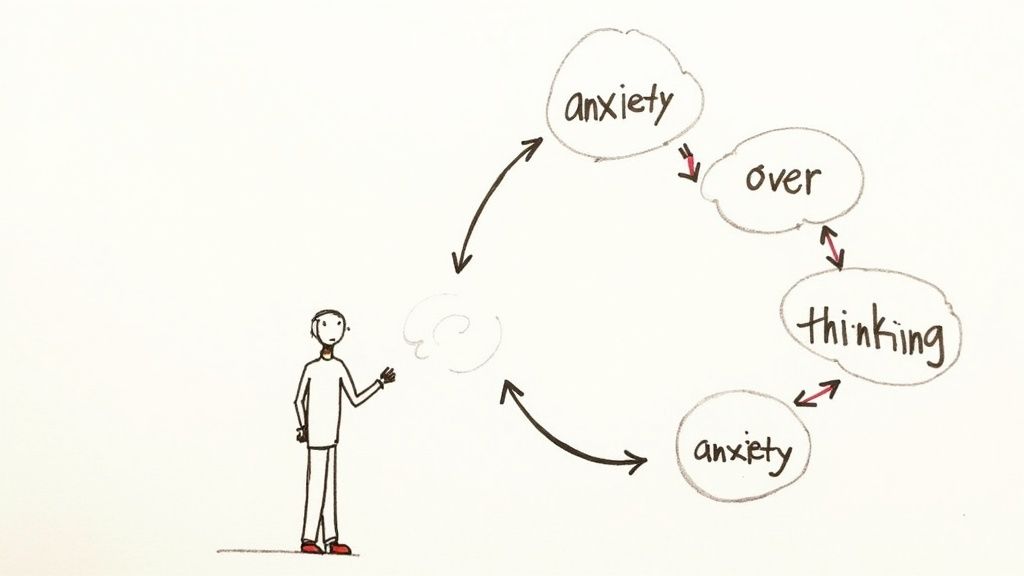
It almost always starts with a single, small spark of worry. Maybe you’re thinking about an upcoming presentation at work. An anxious thought pops into your head: “What if I totally forget what I’m supposed to say?” Before you can even catch your breath, that one little question has ignited a full-blown wildfire of worst-case scenarios.
This is the frustrating dance between anxiety and overthinking. It’s a self-feeding cycle where your initial anxious feeling fuels obsessive “what-if” thinking, and that relentless thinking just pumps more fuel into your anxiety. The more you analyze, the more you seem to find to worry about.
How the Cycle Plays Out in Real Life
Let’s get specific. Imagine you send an important email to your boss and don’t get a reply right away. That first twinge of anxiety is just a slight nervousness. But then, overthinking kicks in and starts writing a story: “Did I say something wrong? They must be mad. This is definitely going to affect my performance review.”
This internal monologue doesn’t solve a thing; it just pours gasoline on your original anxiety. Now your heart is pounding, and you can’t focus on anything else. Your mind is stuck replaying a situation that probably has a perfectly logical explanation, like your boss just being in a meeting. This mental spiral is absolutely exhausting and pulls you out of the present moment.
At its core, overthinking comes from feeling vulnerable about the future. We desperately try to solve problems in our heads to get a sense of control, but we often end up trapping ourselves in a loop of worry that never leads to a solution.
Seeing this pattern for what it is—a common mental habit, not a personal failing—is the first step toward freedom. And you’re not alone in this. Anxiety is one of the most common mental health challenges out there, affecting an estimated 19.1% of U.S. adults every year. If you’re curious, you can learn more about the widespread impact of anxiety from South Denver Therapy.
Once you understand that this is just a predictable loop and not a reflection of who you are, you can start to separate yourself from the thoughts. You gain the power to see the cycle in action and use the right strategies to step out of it.
Ground Yourself When Anxious Thoughts Take Over
When you’re caught in an overthinking spiral, your mind isn’t in the present. It’s racing ahead, tangled up in a web of “what-if” scenarios that haven’t even happened yet. The trick to stopping that momentum is to yank your awareness right back into your body and your immediate surroundings.
This is called grounding. It’s not about ignoring the anxiety; it’s about interrupting the feedback loop by giving your brain something tangible to focus on. Instead of battling the thoughts, you simply shift your attention to what’s real, right here and now.
Try the 5-4-3-2-1 Sensory Method
This is a powerful, subtle technique you can do absolutely anywhere—in a tense meeting, in the middle of a crowded store, or when you’re wide awake at 3 AM. It works by systematically walking your brain through your senses, pulling it out of the abstract world of worry.
Action Step: The next time you feel your thoughts starting to race, stop and do this right away:
- See 5 things: Look around you and silently name five objects. Notice specific details. For example: “I see the grain on my wooden desk, the red light on the power strip, the smudge on my monitor, the chipped paint on the wall, and the gold lettering on that book.”
- Feel 4 things: Tune into the physical sensations on your body. Bring your focus to the rough texture of your sweater against your skin, the solid pressure of your feet on the floor, the cool metal of your watch, or the soft fabric of your chair.
- Hear 3 things: Listen intently and pick out three distinct sounds. It could be the low hum of your refrigerator, a car driving by outside, or the sound of your own quiet breathing.
- Smell 2 things: Take a gentle breath in. What do you smell? Perhaps it’s the faint scent of old coffee, the soap on your hands, or the clean air coming through a window.
- Taste 1 thing: Focus on a single taste. You can take a sip of water, pop a mint, or just notice the natural taste inside your mouth.
This simple exercise forces your mind to stop its frantic future-tripping and reconnect with the sensory world. It’s like hitting the emergency brake on an anxiety spiral.
Use Physical Anchors for Instant Relief
Sometimes, the fastest way back to the present moment is through a strong physical sensation—something so immediate that your anxious mind has no choice but to pay attention.
When anxious thoughts take over, quick and effective techniques are crucial. For immediate relief, you can explore these 7 tips to calm anxiety fast.
Action Step: Try one of these physical anchors the next time you feel overwhelmed:
- Press your feet firmly into the floor. Wiggle your toes. Feel the solid ground beneath you.
- Hold a piece of ice in your hand. The intense cold is impossible to ignore and shocks your system back to the here and now.
- Splash cold water on your face. This triggers the mammalian dive reflex, which naturally slows your heart rate.
These are more than just tricks; they are tools. By practicing them, you’re building a reliable toolkit for managing those overwhelming moments. For a deeper dive into calming strategies, our guide on how to calm anxiety naturally offers even more valuable insights.
Challenge and Reframe Anxious Thinking Patterns
Grounding techniques are brilliant for stopping an anxiety spiral in its tracks, but what’s next? You have to dismantle the very thoughts that started the fire in the first place. This is where you shift from being a passive victim of your internal dialogue to an active participant. By learning to challenge and reframe your anxious thoughts, you can fundamentally change your relationship with anxiety itself.
This whole process is a cornerstone of Cognitive Behavioral Therapy (CBT), one of the most effective and well-researched methods for managing anxiety. With over 1 billion people worldwide living with mental health conditions, structured approaches like CBT offer a clear roadmap by teaching you how to systematically change these unhelpful patterns.
First, Catch the Anxious Thought
The most important skill to develop is simply noticing when an anxious thought pops up. This sounds easy, but it’s not. These thoughts are often automatic, lightning-fast, and feel like undeniable truths, which makes them incredibly sneaky. Your first job is to practice catching them in the act.
Action Step: For the next day, keep a small notebook or use the notes app on your phone. Every time you feel a spike of anxiety, write down the exact thought that preceded it. Don’t judge it, just capture it. This practice makes you a detective of your own mind.
Anxious thoughts often fall into predictable traps known as cognitive distortions. These are just flawed thinking patterns your brain defaults to when it senses a threat.
Keep an eye out for these common culprits:
- Catastrophizing: Your mind jumps straight to the worst-case scenario. For example, “This one little mistake is definitely going to get me fired.”
- All-or-Nothing Thinking: You see things in pure black and white. “If this presentation isn’t absolutely perfect, it means I’m a complete failure.”
- Mind Reading: You assume you know exactly what others are thinking—and it’s always negative. “I know everyone in that meeting thought my idea was stupid.”
Just naming the thought is a massive first step toward taking its power away.
Next, Question the Evidence
Okay, so you’ve caught the thought. Now, it’s time to put it on trial. Anxious thoughts almost never hold up under a little cross-examination. The goal isn’t to bully yourself or pretend the thought isn’t there, but to gently and curiously question its validity.
Action Step: Take one of the thoughts you wrote down. Now, answer these questions about it:
Let’s use the thought: “I’m going to completely ruin this project.”
- What’s the actual evidence for this thought? “Well, I feel really nervous, and I made a small error earlier today.”
- And what’s the evidence against it? “I’ve successfully managed dozens of projects. I’m skilled, I’m prepared, and my team is here to help.”
- So, what’s a more realistic, likely outcome? “The project will probably have some bumps along the way, but a ‘complete ruin’ is extremely unlikely. We’ll solve problems as they come up, just like we always do.”
By questioning your thoughts, you create distance. You shift from blindly believing the anxiety to observing it with curiosity, which drains it of its power.
Finally, Create a Balanced Reframe
The last step is to consciously replace the distorted, anxious thought with one that’s more balanced and realistic. This isn’t about slapping on a coat of fake positivity. It’s about finding a perspective that is more accurate, helpful, and true.
To get better at managing these intense moments, exploring a variety of practical strategies like these 21 fast ways to disarm an anxiety anytime it hits can give you more tools for your toolkit.
Action Step: Write your new, reframed thought down.
- From: “I’m going to ruin this project.”
- To: “I’m feeling nervous about this project, and that’s a normal feeling when something is important to me. I am well-prepared, and I have the skills to handle any unexpected challenges that come up.”
See the difference? The new thought acknowledges the anxiety without accepting the catastrophic prediction as fact. It’s empowering because it focuses on your actual capabilities and a much more probable reality.
Practicing this simple three-step process—Catch, Question, and Reframe—is how you start to untangle yourself from overthinking and begin rewriting your internal story for good.
Cognitive Reframing In Action
To make this even more practical, let’s look at how this works with some common anxious thoughts. This table breaks down how to challenge those automatic negative assumptions and build a more balanced viewpoint.
| Anxious Thought (Cognitive Distortion) | Challenge Question | Balanced Reframe (New Perspective) |
|---|---|---|
| “Everyone noticed I was nervous during my presentation. I looked like an idiot.” (Mind Reading) | “Is there any real proof that everyone was focused on my nervousness? What else could they have been thinking?” | “I felt nervous, but it’s unlikely anyone noticed as much as I did. They were probably focused on the content, and feeling nervous is a normal human reaction.” |
| “I missed one deadline. Now my boss thinks I’m unreliable and my career is over.” (Catastrophizing) | “What has happened in the past when I’ve missed a deadline? Is my entire career really defined by this one event?” | “I missed a deadline, and I need to address it. However, my track record is strong, and this is a single event, not a reflection of my entire work ethic.” |
| “If I don’t get this promotion, I am a complete failure.” (All-or-Nothing Thinking) | “Is this promotion the only measure of my success? What other achievements and qualities am I proud of?” | “Getting this promotion would be great, but my value isn’t tied to this one outcome. I have many other skills and accomplishments that define my success.” |
Working through examples like these helps build the mental muscle needed to reframe your thoughts on the fly. The more you practice, the more natural it becomes to see situations from a more helpful and realistic perspective.
Use Deliberate Breathwork to Calm Your Nervous System
When your mind starts spiraling, your breath is the most powerful tool you have to tell your body it’s safe. Forget the generic advice to “just take a deep breath.” To really stop overthinking fueled by anxiety, you need structured, deliberate breathing exercises that can physically slam the brakes on your body’s fight-or-flight response.
By consciously slowing down your breath, you activate the parasympathetic nervous system—your body’s built-in “rest and digest” mode. This isn’t just a mental trick; it physically counteracts the symptoms of anxiety like a racing heart and clenched muscles. When your body calms down, your mind finally has the space it needs to follow suit.
This infographic lays out the process of reframing anxious thoughts, a cognitive skill that becomes so much easier to use once your nervous system is no longer in panic mode.
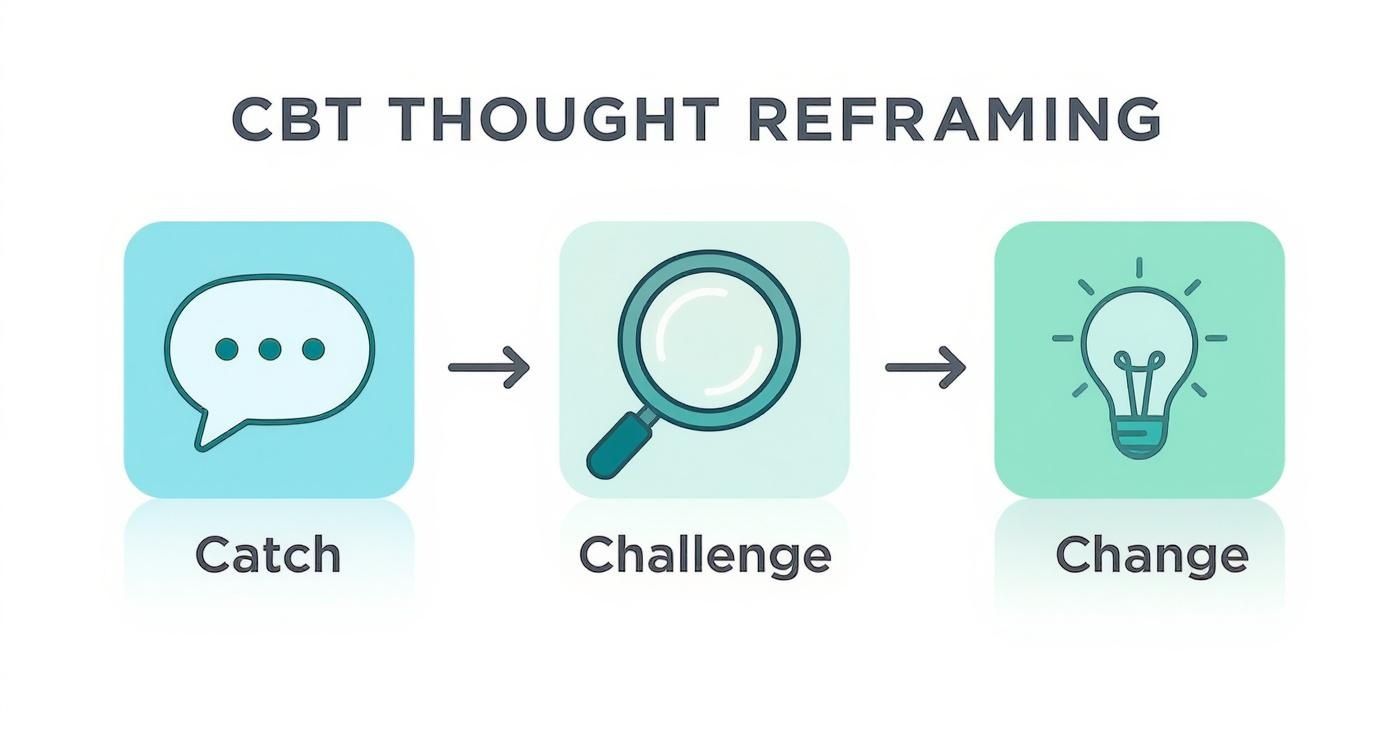
The flow is simple: catch the thought, challenge it, and then change it. This whole process is supercharged when you start with a calm body, and breathwork is the fastest way to get there.
A Simple Guided Routine: Box Breathing
One of the most effective techniques I’ve ever taught is Box Breathing. There’s a reason everyone from Navy SEALs to ER nurses uses it—it works, and it’s incredibly simple to remember, even when you’re stressed. The 4-4-4-4 count gives your mind a simple, rhythmic anchor.
Action Step: Try one minute of Box Breathing right now. Find a comfortable seat.
- Gently exhale all the air from your lungs. Get it all out.
- Now, slowly inhale through your nose to a count of 4. (1… 2… 3… 4…)
- Hold your breath at the top for another 4-count. (1… 2… 3… 4…)
- Slowly exhale through your mouth for a count of 4. (1… 2… 3… 4…)
- Hold at the bottom, lungs empty, for a final 4-count. (1… 2… 3… 4…)
Repeat this cycle for at least four rounds. You’ll feel an immediate shift. Your mind has something to focus on besides the worry, and your body gets the clear message that the threat has passed.
What makes Box Breathing so powerful is the pause it creates. In that small window of stillness, you sever the link between an anxious thought and the physical panic that usually follows. It’s your moment to regain control.
Beyond the Basics: The Power of Advanced Practices
While simple techniques like Box Breathing are fantastic for in-the-moment relief, more advanced practices can create much deeper, more lasting changes. Modalities like 9D Breathwork, for instance, use specific, dynamic breathing patterns paired with sound and guided focus. The goal isn’t just to calm down, but to release the stored somatic tension—that physical residue of stress and trauma we all hold in our bodies.
These sessions are less about managing anxiety and more about actively processing and releasing the root energy that fuels it. By working with the breath in this more intensive way, you can start to rewire your nervous system for greater resilience over the long haul. There are many potent and specific breathing exercises to lower heart rate that you can build into your daily routine.
Just adding a simple, 5-minute breathwork practice to your day builds the mental and physiological muscle you need to catch anxious thoughts before they ever have a chance to spiral.
Build Lasting Resilience to Overthinking
While having tools to pull you out of an anxiety spiral is essential, the real win is building a mind that doesn’t get stuck there in the first place. This is about creating sustainable habits that act as a buffer against stress and worry. The aim is to shift your default state from high alert to calm. When you proactively manage your mental environment, you’ll find those overthinking loops happen a lot less often.
It really starts with acknowledging the deep connection between your mind and body. You can’t separate them. Getting consistent, high-quality sleep and moving your body regularly aren’t just “healthy habits”—they’re fundamental for regulating your brain’s entire anxiety response. A well-rested mind simply has less fuel for catastrophic thinking.
Schedule Dedicated Worry Time
Here’s a strategy that sounds completely backward but works wonders: give your anxiety an appointment. I know, it sounds strange. But scheduling a specific, limited time to worry—say, 15 minutes every day at 4:30 PM—can be incredibly liberating.
Action Step: Set a recurring alarm on your phone for “Worry Time” for the next week. When an anxious thought pops up during the day, tell yourself, “Not now. I’ll think about that at my scheduled time.” This simple act lets you reclaim your focus, knowing there’s a designated time to handle that concern.
This technique is all about taking back control. Instead of anxious thoughts hijacking your day whenever they please, you’re the one setting the terms. You contain the worry to a specific block of time where you can actually deal with it constructively.
During that “worry window,” you can get it all out. Write down your concerns, brainstorm solutions, or just let yourself feel the anxiety without judgment. You’ll often find that when you revisit the worries later, they’ve lost a lot of their power and seem much more manageable.
Develop Micro-Habits for a Resilient Mind
If you’re a busy professional, the idea of adding more “self-care” to your plate can feel overwhelming. The secret isn’t finding more time; it’s weaving tiny, resilience-building habits into the routine you already have. These “micro-habits” don’t demand a big commitment but their cumulative effect is huge.
Action Step: Pick just one of these habits and commit to doing it for the next three days.
- Two-Minute Mindfulness Check-in: In that tiny gap between back-to-back meetings, just close your eyes and focus only on your breath for two minutes. Feel the air coming in and going out. That’s it. This simple practice is a powerful reset button for your nervous system.
- Mindful Commute: Ditch the stressful news podcast for a day. Instead, use your commute to just notice what’s around you. If you’re walking, feel the sensation of your feet hitting the pavement. If you’re driving, pay attention to the different colors of the cars you see. It pulls you out of your head and into the present.
- Single-Task Focus: Pick one small task each day—like writing a single email—and commit to only doing that one thing. Phone goes on silent, extra browser tabs get closed. You give that one task your full, undivided attention. This is how you train your brain to resist the constant pull of distraction and rumination.
These small, consistent actions do more than just feel good in the moment; they help regulate your body’s stress response over the long haul. Building these habits is one of the most effective ways to discover how to reduce cortisol levels naturally and create a lifestyle that keeps you out of the anxiety spiral by default.
Answering Your Questions About Overthinking and Anxiety
As you start using these new tools, some very real questions are bound to surface. That’s a good thing—it means you’re engaged in the process. Let’s walk through some of the most common sticking points people run into when they’re learning to quiet an anxious mind.
Think of this as your practical field guide. The goal here is to give you the confidence to keep moving forward, especially on the days when it feels tough.
“What If a Technique Doesn’t Work for Me?”
First off, this is completely normal. It’s easy to get frustrated and think, “See? I can’t even get this right,” which, ironically, is just more overthinking. Don’t fall into that trap.
If a technique doesn’t click right away, approach it with curiosity, not judgment. Maybe the 5-4-3-2-1 grounding method feels like too much to remember when your heart is racing. No problem. Try something purely physical instead, like splashing cold water on your face or holding an ice cube.
Maybe Box Breathing actually makes you feel more anxious (it happens!). In that case, forget the structure and just focus on a long, slow exhale. Breathe in normally, then breathe out for twice as long. The whole point is to find what calms your nervous system, and that almost always takes a bit of trial and error.
“So often people confuse overthinking with problem-solving. But what ends up happening is we just sort of go in a loop. We’re not really solving a problem.”
– Helen Odessky, Psy.D.
This is exactly why you shouldn’t get hung up on one specific tool. If something isn’t working, just pivot to another one in your toolkit. Consistency with any method that brings you relief is what truly matters.
“How Do I Know If I’m Problem-Solving or Just Overthinking?”
This is a brilliant question because the line can feel incredibly blurry in the moment. The real difference isn’t in the topic of your thoughts, but in their direction. Productive thinking moves you forward. Overthinking keeps you spinning in place.
Here’s a simple test you can run. Ask yourself: “Is this thought pattern leading me to a tangible next step I can actually take?”
Let’s look at a real-world example:
- Problem-solving sounds like: “I’m worried about this client presentation. Okay, what’s one small thing I can do right now to feel more prepared? I’ll spend 15 minutes reviewing my first three slides.” That’s a concrete action.
- Overthinking sounds like: “What if I freeze up? What if they hate my ideas? Everyone will think I’m a fraud. This is going to be a disaster.” Notice how it’s just a downward spiral of “what-ifs” with no plan.
When you catch your thoughts just replaying fears instead of generating solutions, that’s your signal. It’s time to interrupt the loop with a grounding technique and gently guide your focus elsewhere.
“When Should I Consider Professional Help?”
While the strategies in this guide are powerful, they aren’t meant to be a substitute for professional support. Recognizing when you need a bit more help is a sign of incredible strength, not weakness.
It might be time to reach out to a professional if:
- Anxiety and overthinking are consistently getting in the way of your work, relationships, or just your ability to enjoy daily life.
- You feel overwhelmed most days, and the self-help tools just aren’t cutting it.
- You’re dealing with frequent physical symptoms like panic attacks, chronic stomach issues, or dizziness.
- You notice you’re starting to avoid people or situations that trigger your anxiety.
A good therapist or a mental health coach can offer personalized strategies tailored to you. They can help you get to the root of what’s driving the anxiety and provide structured support through methods like Cognitive Behavioral Therapy (CBT). You absolutely don’t have to figure all this out on your own.
At 9D Breathwork, we believe in getting to the core of the issue, not just managing the symptoms on the surface. Our guided breathwork journeys are built to help you release the stored stress and emotional patterns that fuel the overthinking cycle. We help you rewire your nervous system for a deeper, more lasting sense of calm. Find out how you can go deeper at the official 9D Breathwork website.