If you’re mapping out a career change, it really boils down to three key phases: getting your mindset right, building a realistic roadmap, and then taking deliberate action. Think of it as moving from that familiar state of confusion and overwhelm to a place where you feel confident and ready for what’s next. It all starts with the internal work—getting crystal clear on what you actually want.
The Great Career Reshuffle Is Here—Are You Ready?
Feeling stuck, unfulfilled, or just plain burnt out? You’re definitely not alone. That nagging feeling that there has to be something better out there isn’t a personal failing; it’s a reflection of a huge cultural shift in how we think about work. Professionals everywhere are ditching the traditional career ladder in search of more meaning, better flexibility, and a life that isn’t all about the job.
This massive wave of change has been dubbed the Great Reshuffle, an ongoing movement of people actively redesigning their careers on their own terms. At its peak, the U.S. Bureau of Labor Statistics reported a staggering 4.3 million people quit their jobs in August 2021 alone. This wasn’t just a blip. Census data shows that these pandemic-era job changes have permanently altered entire industries. As you can read more about the ongoing impact of the Great Reshuffling on census.gov, this trend is still very much alive.
A New Map for Your Career Journey
The old-school idea of a straight, linear climb up the corporate ladder is pretty much obsolete. What’s replaced it is something many of us are now calling a ‘squiggly career path.’
It’s no longer about a direct route from A to B. Instead, modern professionals often pivot multiple times, collecting a unique portfolio of skills and experiences that reflect their personal evolution. A study in the Journal of Vocational Behavior found that individuals who embrace a “protean career” attitude—one that is self-directed and driven by personal values—report higher levels of career satisfaction and success. This new reality celebrates the fact that you’re allowed to change your mind as you grow.
This journey is what we’re here to navigate. It follows a clear, logical progression.
As you can see, a successful pivot depends on moving from internal clarity (Mindset) to strategic planning (Roadmap) and finally to execution (Action). This guide is built to walk you through each of these phases, giving you practical, actionable tools to manage your own transition with real confidence.
To give you a bird’s-eye view of where we’re headed, here’s a quick summary of the five core phases we’ll be breaking down together.
Your 5-Phase Career Change Roadmap
This table lays out the high-level steps we’ll cover in this guide, giving you a clear preview of the journey ahead.
| Phase | Core Activity | Key Outcome |
|---|---|---|
| Phase 1: Clarity & Mindset | Deep self-reflection, identifying values and non-negotiables. | A clear vision for what you want (and don’t want) in your next career. |
| Phase 2: Skills & Gap Analysis | Mapping your existing skills and identifying what’s missing for your target roles. | A concrete plan for upskilling or reskilling. |
| Phase 3: Retraining & Branding | Acquiring new skills and updating your professional narrative (resume, LinkedIn). | You’re now a credible candidate in your new field. |
| Phase 4: Financial & Exit Plan | Creating a financial buffer and a strategic plan to leave your current role. | A low-stress transition without financial panic. |
| Phase 5: Action & Transition | Networking, applying for jobs, and managing the emotional side of the change. | You’ve successfully landed and started your new role. |
Each of these phases builds on the last, creating a structured yet flexible framework to guide you from where you are to where you want to be.
The most crucial step in any career change isn’t updating your resume—it’s updating your mindset. Lasting, meaningful change begins from the inside out, by aligning your professional life with your core values and purpose.
The road to a new career can feel like a huge undertaking, but when you break it down into these manageable stages, it becomes entirely doable. We’ll cover everything from self-reflection and skills analysis to networking and financial planning.
Your next chapter starts right now.
First, Master Your Inner Game Before Making an Outer Move
Before you even touch your resume or start scrolling through LinkedIn, the most crucial work of any successful career change happens inside your own head. A new job title is just a band-aid if you haven’t addressed the deeper sense of misalignment that’s making you want to leave in the first place.
Real, lasting clarity comes from tuning out the external noise—all those expectations from your boss, your family, and even yourself—so you can finally hear what you truly want.
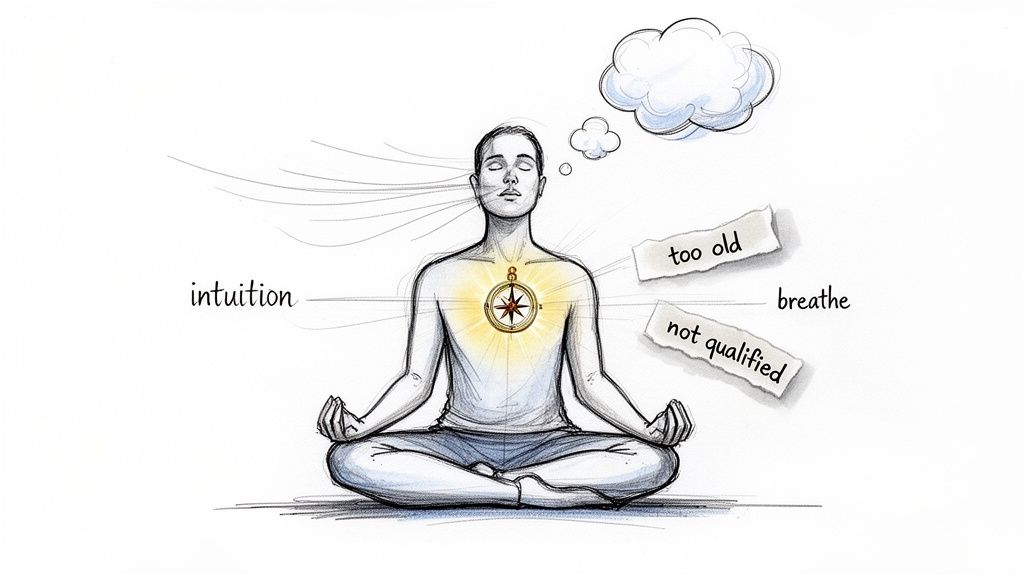
The goal here is to shift from a state of anxious uncertainty to one of grounded confidence. I know how impossible self-reflection feels when you’re buried under the constant pressure of a demanding job. But it’s the only way to make sure your next step is a step forward, not just a sideways jump into a different kind of unhappiness.
This isn’t about wishful thinking. It’s about using practical, science-backed techniques to quiet your nervous system and tap into your intuition. When you’re less reactive, you can make choices from a place of clarity instead of fear.
Confront Your Limiting Beliefs
Often, the biggest obstacle standing in your way is the story you’re telling yourself. These narratives, or limiting beliefs, are the invisible walls that keep you stuck.
They whisper things like:
- “I’m too old to start over.”
- “I don’t have the right skills.”
- “What if I fail and look like an idiot?”
These thoughts feel like undeniable facts, but they’re really just old, outdated protection mechanisms. To move forward, you have to call them out. If you’re ready to dig in, our guide on overcoming limiting beliefs has some powerful exercises that can help you get started.
Actionable Step: The “Cost of Belief” Exercise
Grab a pen and paper. Write down one belief holding you back (e.g., “It’s too risky to leave my stable job”). Now, answer these questions:
- What does this belief cost me? (e.g., My mental health, my creativity, time with my family).
- What benefit do I get from holding it? (e.g., A feeling of safety, avoiding the unknown).
- What’s a more empowering belief I can choose instead? (e.g., “My experience makes me a valuable candidate for a career that also offers stability and fulfillment.”)
That one small shift in perspective can change everything. It’s the first step to reclaiming your power and moving from a place of fear to a place of possibility.
Your career isn’t a fixed destination decided by your past choices. It’s a dynamic journey you can redirect at any moment, simply by changing the story you tell yourself about what’s possible.
Use Breathwork to Find Your Inner Compass
When you’re constantly stressed, your brain’s prefrontal cortex—the part responsible for logic and clear decision-making—partially shuts down. It’s a survival mechanism. This is why it feels nearly impossible to think clearly about your future when you’re stuck in a state of chronic anxiety.
Breathwork is one of the fastest ways to counteract this.
Controlled breathing sends a direct signal to your brain to calm down, activating your parasympathetic nervous system (the “rest and digest” state). Studies in Frontiers in Psychology confirm that just a few minutes of deep, diaphragmatic breathing can lower cortisol levels and improve cognitive function. This creates the mental space you desperately need for genuine self-reflection.
Give it a try right now. This is called the 4-7-8 breath, and it takes less than two minutes.
- Find a quiet place to sit or lie down.
- Exhale completely through your mouth with a whoosh sound.
- Close your mouth and inhale quietly through your nose for a count of four.
- Hold your breath for a count of seven.
- Exhale completely through your mouth, making that whoosh sound again for a count of eight.
Do that cycle three more times. Notice the immediate shift. By making this a regular practice, you’re training yourself to access a calm, clear state on demand—an invaluable tool for navigating the uncertainty of a major life change. This inner work is the foundation for everything that comes next.
Mapping Your Future by Identifying Skills and Opportunities
Once you’ve done some of that crucial inner work, it’s time to turn your attention outward. This is where you start translating all that newfound clarity into a concrete, real-world plan. The idea is to build a solid bridge from what you want to do to the actual opportunities that are out there.
This isn’t about just scrolling through job boards and hoping something catches your eye. It’s a much more deliberate process of looking at what you bring to the table and what the job market is actually looking for. You have to start seeing your career history not as a rigid, linear path but as a toolbox full of valuable skills you can repackage for something new and genuinely exciting.
Conduct a Comprehensive Skills Audit
Before you can figure out where you’re going, you need a brutally honest look at where you are right now. A skills audit is basically a deep dive into your professional toolbox, and its main job is to uncover strengths you probably take for granted. The trick is to think way beyond your official job description.
Actionable Step: Create a Skills Inventory
Open a document and create three columns:
- Transferable Skills: These are the portable skills you’ve picked up that are valuable pretty much anywhere. Think communication, managing a project from start to finish, leading a team, solving tricky problems, and having a high degree of emotional intelligence. Example: “Led a team of 5 to increase Q3 sales by 15%.”
- Technical Skills: These are your more specific, measurable abilities. This could be anything from knowing your way around Salesforce or the Adobe Creative Suite to coding languages, data analysis, or financial modeling. Example: “Proficient in Python for data analysis.”
- Passion-Based Skills: Don’t forget the skills you’ve built outside of work—the things you do because you love them. Are you the one who meticulously plans every group vacation (hello, event planning)? Did you set up a small shop on Etsy (e-commerce and digital marketing skills right there)? Example: “Managed an Etsy store with 100+ sales, handling marketing and customer service.”
Seriously, don’t dismiss anything. Your uncanny ability to mediate family arguments is a form of conflict resolution. The detailed budget you created for your kitchen renovation? That’s financial planning in action.
The most powerful assets for a career change are often the skills you undervalue the most. Your unique combination of experience is your competitive advantage—your job is to learn how to articulate it.
Identify and Research High-Growth Industries
Okay, now let’s turn our gaze to the market. You want to aim for industries that have momentum, not ones that are shrinking. It just makes sense—you’ll have a much better shot at finding good opportunities and building long-term security. The job market is always in flux; recent data showed a wild 59% of U.S. professionals were looking to make a move.
The Bureau of Labor Statistics is forecasting a huge addition of 6.7 million U.S. jobs between 2023 and 2033. Just the healthcare and social assistance sector is set to add 2.3 million of those. Right now, some of the hottest fields for people changing careers are IT (15%), information research (15%), and business consulting (14%). You can dig into more career change statistics on High5Test to get a feel for where the growth is.
As you research, try to connect what you find with the personal values you identified earlier. For example:
- If sustainability is your driving force, you might explore roles in green energy, sustainable agriculture, or corporate social responsibility.
- If you’re after more creativity and autonomy, look at the creator economy, digital marketing, or user experience (UX) design.
- If you feel a pull toward helping others, maybe health tech, non-profit management, or corporate training is your zone.
You’re looking for that sweet spot where what the world needs intersects with what makes you feel alive. If you’re struggling to pinpoint that, our guide on how to discover your passion has some great exercises to help you connect with your real motivators. And as you get yourself ready, checking out a guide on How to Change Careers Successfully can help make sure your mindset and your actions are perfectly aligned.
Perform a Career Gap Analysis
This is the final piece of the mapping puzzle. A gap analysis is where you lay out your skills audit (what you have) side-by-side with the requirements of your target roles (what you need). It’s a simple but incredibly powerful exercise that turns a fuzzy goal into a clear, step-by-step plan.
Let’s walk through a real-life example to see how it works.
Scenario: The Retail Manager Eyeing a Move to Logistics
- Current Role: Store Manager for a big retail chain.
- Target Role: Logistics Coordinator for an e-commerce company.
She sits down and makes two lists:
- Skills Audit (What she has):
- Transferable: Team leadership, conflict resolution, customer service, budget management.
- Technical: Experience with inventory management software, sales forecasting, employee scheduling systems.
- Target Role Research (What she needs):
- Hands-on experience with a warehouse management system (WMS).
- A solid understanding of supply chain principles.
- Proficiency in data analysis tools like Excel or even Tableau.
Suddenly, it’s crystal clear. The manager sees her “gap.” She’s a rockstar with people and inventory, but she needs to build her technical skills in supply chain software and data analysis. Her next step isn’t just to blindly apply for jobs; it’s to find an online certification in supply chain management or take a course on advanced Excel for logistics.
This is how you do it. This targeted approach is how you build a solid bridge to your new career, one plank at a time.
Building Your Bridge with New Skills and Real Connections
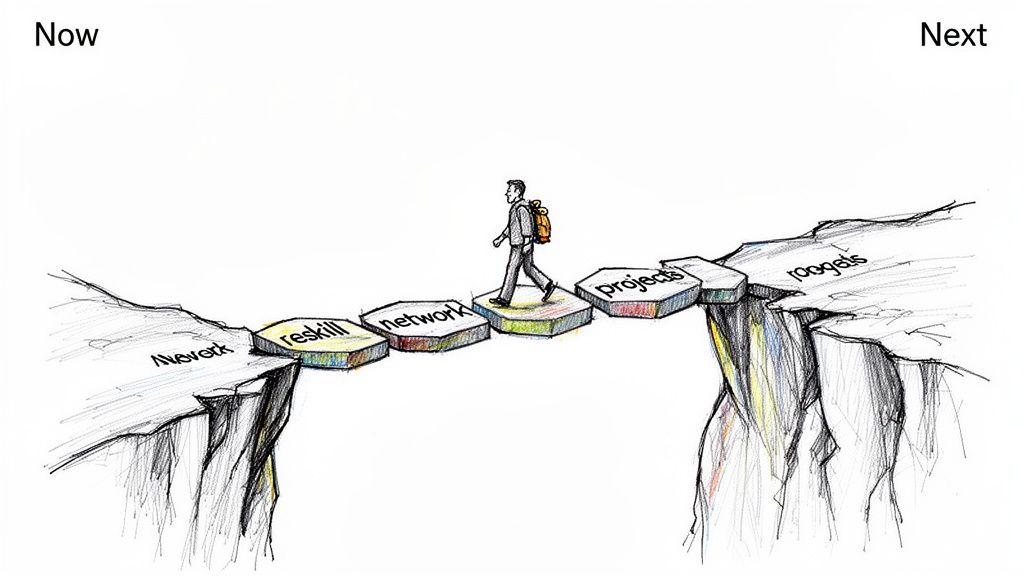
You’ve done the deep work to figure out what you want. Now comes the exciting part: building the bridge to get you there. This is where you roll up your sleeves and take deliberate, strategic action. It’s all about methodically closing your skill gaps and making the human connections that will open doors.
This isn’t about just taking a random online course or awkwardly showing up at a networking event. It’s a focused process of earning the right credentials and building genuine relationships that will support you long after you’ve landed the new role.
Find the Right Way to Reskill
The options for learning new skills are endless, which can feel overwhelming. The trick is to pick a path that directly fills the gaps you identified earlier and actually fits your budget, timeline, and how you learn best.
A recent Randstad report found that 41% of people would quit a job that didn’t offer them a chance to grow, which shows just how much we all value learning. Right now, the most in-demand skills for people changing careers are AI skills (23%), IT literacy (11%), and leadership/management (7%). You can find more eye-opening career change statistics from CareerShifters.org.
So, what’s the best route for you? Here are a few common ones I see people take:
- Targeted Online Certifications: Platforms like Coursera, edX, and LinkedIn Learning are fantastic for adding a specific, marketable skill to your resume. Think Google Analytics, project management (PMP), or a specific software.
- Immersive Bootcamps: If you’re making a big leap—say, from accounting to data science—a bootcamp can be a game-changer. They’re intense, but you’ll come out with a comprehensive education and a portfolio of projects in just a few months.
- Community College Courses: Don’t sleep on your local colleges. They often have affordable, practical courses in things like graphic design, bookkeeping, or digital marketing that are taught by people who actually work in the field.
- Self-Directed Projects: Sometimes, you just have to learn by doing. Want to get into web development? Find a local non-profit and offer to build them a new website. Aspiring content creator? Start a blog or podcast about something you’re passionate about.
Practical Example: A former teacher wants to pivot into instructional design. Instead of going back for a full degree, they could take a 3-month online certification in Articulate Storyline (a key industry software), create a portfolio of 2-3 sample e-learning modules, and be ready to apply for junior roles.
Think “Relationship Building,” Not “Networking”
The word “networking” makes most of us cringe. It conjures images of forced small talk and exchanging business cards that end up in the trash. Let’s ditch that idea.
True networking is about building genuine, mutually beneficial relationships. Your “social capital”—the opportunities and support found within your network—is one of your most powerful assets in a career change. Your goal isn’t to ask for a job; it’s to learn from people’s experiences and build real rapport.
One of the best ways to do this is through informational interviews. These are just short, casual conversations where you get to hear someone’s story.
The secret to effective networking is to stop trying to get something and start trying to give something—your genuine curiosity, your full attention, and your gratitude. People are far more willing to help someone who has taken a real interest in them.
Master the Art of the Informational Interview
Reaching out to a complete stranger can be scary, I get it. But a thoughtful, personalized approach changes everything. For this, LinkedIn is your best friend.
Actionable Step: Your LinkedIn Outreach Script
Find someone in a role you admire and send them a connection request with a short, personalized note. Here’s a template you can make your own:
- “Hi [Name], I’m [Your Name], an accountant looking to transition into data science. I was really impressed by the [Project Name] you shared from [Company Name]. If you have 15-20 minutes in the coming weeks, I’d be so grateful for the chance to hear a bit about your journey into the field and learn from your experience.”
Once they agree, come prepared with questions that go deeper than what you could find on Google. You’re there to understand their story.
Questions That Build Real Rapport:
- “What does a typical day or week in your role really look like?”
- “What’s been the most unexpected or surprising part of working in this field?”
- “Looking back, what’s one thing you wish you had known before you started this career path?”
- “What skills do you see as being essential for success in this role over the next few years?”
Always, always send a thank-you note after the call, mentioning something specific you learned. It’s a simple act of respect that leaves a lasting impression and keeps the door open. And for those looking to build deep skills in facilitation and connection, exploring something like the 9D Breathwork facilitator training can offer profound insights into human dynamics.
By combining targeted learning with authentic relationship-building, you’re not just hoping for a change—you’re actively building the bridge that will carry you to your new career.
5. Map Out Your Financial Runway and Exit Plan
Let’s talk about the elephant in the room: money. It’s the single biggest fear that paralyzes most career changes before they even begin. But getting a handle on your finances isn’t about restriction—it’s about liberation.
A solid financial plan builds you a runway, giving you the freedom to make a calm, calculated transition instead of a desperate, panicked leap. The goal here is to move from a place of anxiety to one of empowerment and control. You’re not just saving money; you’re buying yourself time and options.
What’s Your Freedom Number?
First things first, you need to calculate your “freedom number.” Think of this as the magic number in your savings account that lets you breathe easy while you retrain, network, and hunt for that new role.
Actionable Step: Calculate Your Runway
Get brutally honest with your non-negotiable monthly expenses. Pull up your bank statements and track everything.
- Housing: Rent or mortgage
- Utilities: Power, water, internet, etc.
- Food: Groceries and basic household supplies
- Transportation: Car payments, insurance, gas, or public transit passes
- Debt: Student loans, credit card minimums, any personal loans
- Insurance: Health, life, or other essential policies
Once you’ve got that total monthly cost, multiply it by the number of months you realistically think your transition will take. The standard advice is a six-month runway, but that’s just a starting point. If you’re breaking into a tough industry or need a year-long certification, you might want to aim for nine or even twelve months of expenses saved up.
A Real-World Example:
Sarah, an account manager, figured out her essential monthly bills came to $4,000. She wanted a comfortable 9-month runway to complete a data analytics bootcamp and find the right job without feeling the pressure.Her freedom number became $4,000 x 9 = $36,000. Suddenly, that big, scary unknown had a name and a number. It became a clear, tangible savings target she could work toward.
Building Your Financial Bridge
With your target number in sight, the next step is to actually build a “financial bridge” to get you from your current job to the next one. This usually comes down to two things: cutting costs and boosting income.
Take a hard look at your discretionary spending. We’re not talking about total deprivation, but conscious choices. Can you pause that one streaming service you never watch? Can you cut back on restaurant meals for a few months? Every dollar you redirect is another plank in your bridge.
At the same time, look for ways to bring in extra cash. This can dramatically shorten your timeline. The easiest place to start is often by freelancing with the skills you already have. An HR professional could offer resume reviews on Fiverr, or a marketing specialist could pick up small social media projects through Upwork.
And if your new path involves working for yourself, start learning the financial ropes now. It’s a completely different world, and knowing how to unlock self-employed tax benefits in Canada, for example, can make a huge difference.

To keep all this straight, a simple budget planner is your best friend. It helps you see where your money is going now and where you can make changes to fund your future.
Sample Career Transition Budget Planner
A template to help you calculate your financial runway and plan for transition-related expenses.
| Expense Category | Current Monthly Cost | Transition Monthly Cost | Savings Strategy |
|---|---|---|---|
| Rent/Mortgage | $1,800 | $1,800 | N/A (Fixed Cost) |
| Dining Out | $400 | $100 | Cook more meals at home; pack lunch. |
| Subscriptions | $75 | $15 | Cancel unused services (gym, streaming). |
| Groceries | $500 | $450 | Meal plan; buy generic brands. |
| Transportation | $350 | $300 | Carpool or use public transit more often. |
| Freelance Income | $0 | +$500 | Secure one small monthly client. |
| Monthly Savings | $500 | $1,460 | ($360 cut + $600 new income) |
This simple exercise shows exactly how small, deliberate changes can more than double your monthly savings, getting you to your goal much faster.
Your Timeline: Turning Goals into a Plan
Finally, you need to get this all down on paper. A vague idea to “save more” won’t get you there. You need a project plan for this new chapter of your life, broken down into manageable chunks.
Think in terms of quarters and months.
- Quarter 1:
- Finalize my skills gap analysis from Step 3.
- Enroll in that online UX design certification course.
- Open a new high-yield savings account just for my “freedom fund.”
- Set up an automatic monthly transfer of $1,500.
- Quarter 2:
- Keep up with the certification coursework.
- Start networking: schedule two informational interviews per month.
- Land one small freelance writing client to boost savings to $1,800/month.
- Quarter 3:
- Finish the certification!
- Overhaul my resume and LinkedIn profile with new skills.
- Start actively applying for my target roles.
When you structure it like this, a huge, overwhelming goal transforms into a series of small, achievable wins. It builds momentum and keeps you in the driver’s seat every step of the way.
Answering Your Toughest Career Change Questions
Even with the best-laid plans, changing careers can feel like navigating a maze in the dark. Doubts creep in. Questions pop up at 3 AM. It’s completely normal, and you’re not alone. Let’s walk through some of the biggest concerns that come up and give you some real-world ways to handle them.
“So, Why the Big Change?” Answering the Interview Question
This question is guaranteed to come up, and how you answer it is crucial. Recruiters aren’t looking for a confession; they’re looking for a confident story that connects the dots. Your old career wasn’t a mistake—it was the foundation for what comes next.
In fact, research from the American Psychological Association shows that people who can tell a coherent “career story” have higher job satisfaction and adapt better to change. Your pivot is a strength, not a weakness.
Here’s a simple framework I call the “pivot story” to help you nail it:
- Start with Your Wins: Kick off by highlighting a core skill you mastered in your last role.
- “In my decade as a project manager, I got really good at leading complex, cross-functional teams and bringing projects in on time and under budget.”
- Share Your “Aha!” Moment: Explain what sparked the desire for a new direction. This is the heart of your story.
- “While I loved the strategy, I realized the part that truly energized me was digging into the data to figure out why we were setting certain goals. That curiosity led me to get a certification in data analytics.”
- Connect it to This Job: Tie it all together by explaining why your unique background makes you perfect for the role you’re interviewing for.
- “That’s exactly why I was so drawn to this Data Analyst position. It feels like the perfect way to blend my proven project leadership with the technical data skills I’ve built, so I can deliver insights that really move the needle for your team.”
Is It Too Late for Me to Make a Switch?
Let’s get one thing straight: the idea that you get one shot at a career is a myth. Age isn’t a barrier; it’s an asset. You bring wisdom, resilience, and a whole host of transferable skills that someone fresh out of college simply can’t compete with.
Think about it. Research published in Work, Aging and Retirement shows that mature professionals often have far superior problem-solving skills and emotional intelligence, which are highly valued by employers.
Your years of experience aren’t a liability. They are your single greatest advantage. The only trick is learning how to package that experience as a must-have asset for your new field.
Practical Example: A former lawyer has an almost unfair advantage in a corporate compliance role because of their built-in attention to detail and negotiation prowess. A retired teacher? They’re a natural fit for a corporate training position, bringing masterful communication and mentoring skills to the table.
What if I Choose Wrong?
This is the big one, isn’t it? The fear of making a mistake can be paralyzing, often leading to the worst choice of all: making no choice at all.
Here’s a mental shift that can change everything: Stop thinking of it as a final verdict and start seeing it as an experiment. There is no single “perfect” career path just waiting for you. Every role you take is just an opportunity to gather more data on what you love, what you’re good at, and what you want to do next. If a move doesn’t pan out, it’s not a failure—it’s just feedback.
A fascinating study on decision-making found that people who frame their choices as experiments report way less anxiety and much higher satisfaction. You can build this muscle and learn to trust your gut. A great first step is to actively work on sharpening your decision-making skills, which will help you move forward with a lot more confidence.
A career change is more than just a new job; it’s a journey of rediscovery. At 9D Breathwork, we create powerful experiences designed to help you quiet the outside noise, tap into your own inner guidance, and find the clarity you need to make your next move. Visit 9dbreathwork.com to see how you can start your journey from the inside out.