It often feels like anger is a runaway train, an unstoppable force that hijacks your body and mind. One minute you're fine, and the next, your heart is pounding, your jaw is clenched, and rational thought feels miles away.
This isn't just in your head—it's a very real, very powerful physiological reaction.
How Breathing Directly Controls Your Anger Response
When you perceive a threat, an injustice, or even just a major frustration, your body flips a switch on its "fight or flight" response. This ancient survival system floods you with stress hormones like adrenaline and cortisol, prepping your body for immediate, physical action.
This hormonal surge creates a cascade of physical changes you know all too well:
- Accelerated Heart Rate: Your heart hammers in your chest to pump blood to your muscles.
- Shallow Breathing: Your breath becomes quick and shallow, trying to suck in more oxygen, fast.
- Muscle Tension: Your shoulders, jaw, and fists tighten, ready for a confrontation.
- Narrowed Focus: Your brain locks onto the threat, making it nearly impossible to see the bigger picture.
While this system is great for escaping a predator, it’s not so helpful when the "threat" is a critical email from your boss or someone cutting you off in traffic. This is where intentional breathing becomes your most powerful tool for taking back control.
Activating Your Body's Natural Braking System
Here’s the secret: you can't consciously tell your heart to stop racing, but you can consciously control your breath. And that’s the key that unlocks the whole system.
By deliberately slowing down and deepening your breath, you send a direct signal to your brain that the danger has passed. This simple action activates your parasympathetic nervous system (PNS), which you can think of as the "rest and digest" or "calm and connect" system. It’s the physiological opposite of fight or flight.
When the PNS takes over, it counteracts the flood of stress hormones. You can literally feel your heart rate begin to slow, your muscles start to unclench, and your mind begin to clear. To see just how powerful this is, you can explore other Polyvagal Theory exercises that are designed specifically to target this calming response.
This shift from a purely reactive state to a responsive one is everything. It creates that crucial pause between the trigger and your reaction, giving you the mental space to choose how to proceed instead of being driven by raw instinct.
Science fully backs this up. A 2018 study published in Frontiers in Psychology found that slow, deep breathing techniques significantly reduced physiological markers of stress, including lowering cortisol levels. In a practical sense, this means that taking a few deep breaths directly combats the stress hormones fueling your anger. Participants who engaged in diaphragmatic breathing showed a measurable decrease in these hormones, proving the direct link between conscious breathing and calming your body's anger response.
3 Breathing Techniques for Immediate Relief
When you feel that familiar heat of anger rising, you don’t have time for complex theories. You need simple, actionable tools that can pull you back from the edge right now. These breathing exercises are designed for that exact moment of intervention, acting as a direct line to your nervous system to restore calm.
This is what it looks like in practice—using a conscious breath to interrupt the anger response before it takes over.
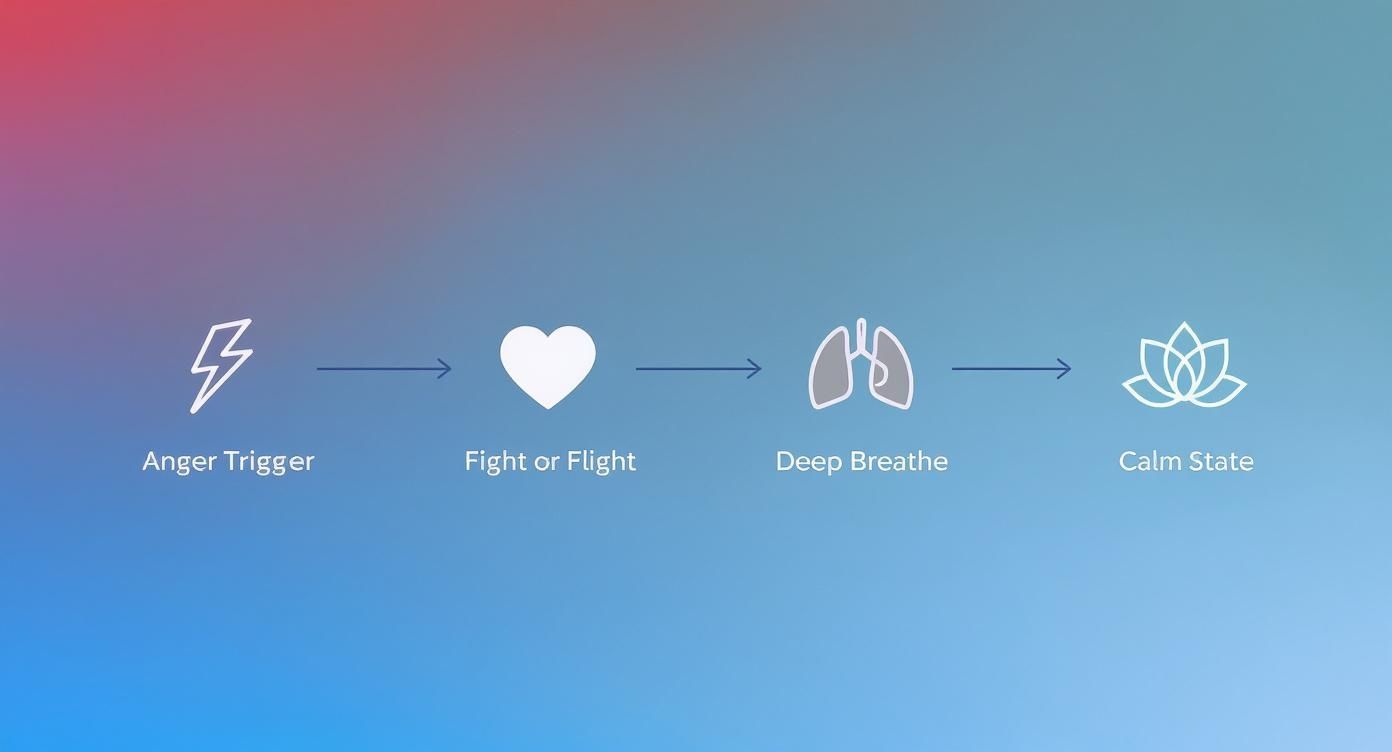
As you can see, a single, conscious deep breath acts as a crucial intervention. It's the pivot point that shifts your body's reaction from an automatic "fight or flight" state toward a more controlled, calm one.
Tame a Racing Mind with Box Breathing
When anger hits, your thoughts can feel like a chaotic storm, replaying the frustrating event on an endless loop. Box breathing, sometimes called the 4-4-4-4 breath, imposes order on this mental chaos. It gives your brain a simple, rhythmic pattern to latch onto.
The real benefit? It's incredibly discreet. You can do this in a tense work meeting or standing in a long line, and no one will know.
Actionable Example: Imagine you just received a passive-aggressive email. Before you type a reply, push your chair back slightly. Look away from the screen.
- Inhale through your nose: Silently count to four. Feel the air fill your lungs.
- Hold: Hold your breath for a count of four. Just pause; try not to tense your shoulders.
- Exhale through your mouth: Gently exhale for a count of four.
- Hold: Hold your breath again, with lungs empty, for a final count of four.
Repeat this cycle 4-6 times. You'll feel your racing thoughts begin to settle as your mind grabs onto this predictable anchor, breaking you free from the angry feedback loop.
Release Physical Tension with Diaphragmatic Breathing
Anger often gets trapped in the body. It's that tight chest, clenched jaw, and knotted stomach you feel. Diaphragmatic breathing, or "belly breathing," directly targets this physical tension. It activates the diaphragm, a large muscle at the base of your lungs, which in turn stimulates the vagus nerve.
This nerve sends calming signals throughout your body, making it one of the most effective breathing exercises to lower your heart rate.
Actionable Example: You've just ended a frustrating phone call. Your shoulders are creeping up toward your ears, and your stomach is in knots.
- Find a comfortable posture, sitting or standing.
- Place one hand on your chest and the other on your stomach, just above your belly button.
- Breathe in slowly through your nose, focusing on making your stomach rise. The hand on your stomach should move outward, while the hand on your chest stays relatively still.
- Exhale slowly through your mouth, feeling your stomach gently fall as you engage your abs slightly.
A pro tip here is to make the exhale slightly longer than the inhale. For instance, inhale for a count of four and exhale for a count of six. That extended exhale is a powerful signal to your nervous system that it's safe to relax.
Hit the Emergency Brake with the Physiological Sigh
What about those sudden, intense flashes of rage? The kind you feel when someone cuts you off in traffic or you receive a shocking email. For those moments, you need an emergency brake.
The physiological sigh is a rapid and potent tool for dumping stress from your system almost instantly. It works by reinflating the tiny air sacs in your lungs (alveoli), which tend to collapse when we're stressed. This allows for a much more efficient offload of carbon dioxide.
A 2023 study from Stanford University published in Cell Reports Medicine found that just five minutes of daily "Cyclic Sighing" improved mood and reduced physiological arousal more effectively than mindfulness meditation.
Actionable Example: A car suddenly swerves in front of you. Your body jolts with adrenaline and anger. In that immediate moment:
- Take a full, deep inhale through your nose.
- Without exhaling, take a second, sharper inhale to pack in just a little more air.
- Then, let it all go with a long, slow, complete exhale through your mouth.
Repeat this one to three times. Think of this double inhale and extended exhale as a powerful reset button. It provides immediate relief when you feel completely overwhelmed by anger.
Building Resilience: The Six-Breaths-Per-Minute Protocol
While the techniques for putting out an immediate fire are essential, the real goal is to become less flammable in the first place. This is where we shift from merely managing anger to actively building emotional resilience. Think of it as strength training for your nervous system, making you less susceptible to the daily triggers and stressors that used to set you off.
The cornerstone of this training is a specific breathing rhythm known as paced breathing, or sometimes coherent breathing. It’s all about intentionally slowing your breath down to a steady cadence of about six breaths per minute.
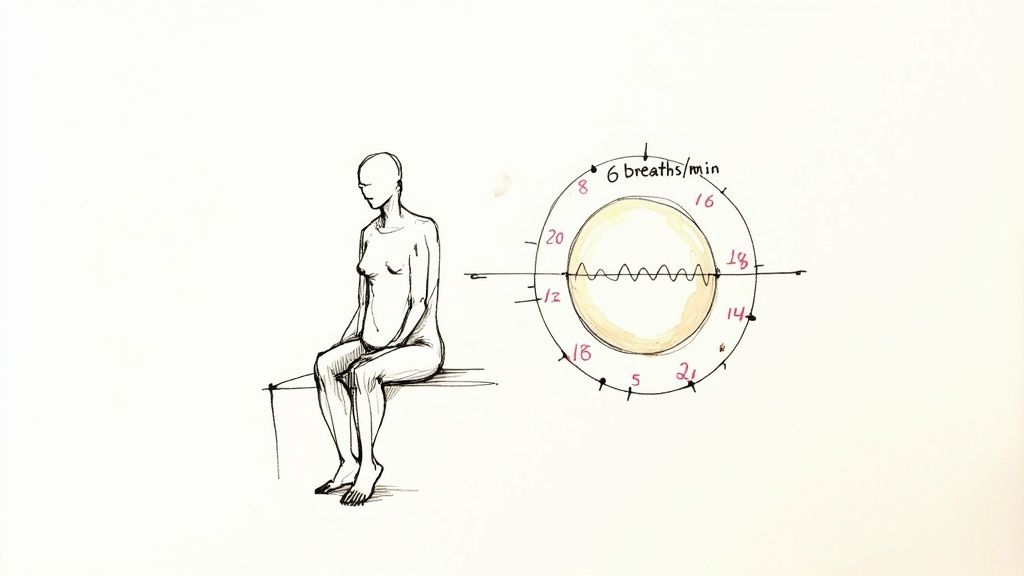
This particular rhythm isn't just a random number. It’s the sweet spot where your breath, heart rate, and blood pressure naturally fall into sync, creating a state of deep physiological balance. Consistently practicing this improves your heart rate variability (HRV), which is one of the best biological markers we have for a healthy, adaptable nervous system.
Why This Rhythm Is So Powerful
When your HRV is high, your nervous system can move gracefully between states of alertness and calm. But when it's low, you’re much more likely to get stuck in that rigid, stressed-out, fight-or-flight mode—the very state where anger thrives.
Practicing the six-breaths-per-minute cadence is like taking your body to the gym. You're training it to return to a balanced state more efficiently and conditioning your physiological response to stress before it happens. This is the foundation for building a truly calm nervous system over the long haul.
This isn't just theory. A systematic review in the Journal of Clinical Medicine (2021) examined multiple studies on slow-paced breathing. The findings consistently showed that this practice not only increased HRV but also led to significant reductions in self-reported anger and hostility. The direct, measurable link between the practice and better emotional regulation is clear: breathing at this pace trains your body to be less reactive.
How to Practice Six Breaths Per Minute
This isn't an emergency tool; it's preventative maintenance for your emotional health. The real magic happens when you do it daily, even if it's just for five minutes.
Your 5-Minute Daily Practice:
- Find the Rhythm: The goal is a 10-second breath cycle. A balanced 5-second inhale followed by a 5-second exhale is the perfect place to start.
- Use a Guide: When you’re new to this, it’s incredibly helpful to use a guide. Find a breath pacer app, a YouTube video with a visual guide, or just use a stopwatch to keep you on track.
- Sit Comfortably: Find a relaxed but upright posture. You can be in a chair with your feet flat on the floor or sitting on a cushion—whatever works for you.
- Breathe Gently: Inhale smoothly through your nose for five seconds, then exhale slowly (through your nose or mouth) for five seconds. The key is to keep it effortless. Don't force it.
- Stay Consistent: Try to carve out one 5-minute session each day.
Actionable Tip: Set a recurring daily alarm on your phone labeled "5-Min Breath Practice." Link it to the time you have your morning coffee or right after you brush your teeth to build the habit.
This daily practice is what supercharges your in-the-moment techniques. By raising your baseline level of calm, you build a buffer against life's frustrations. It makes it far less likely that a small spark will ignite into a full-blown fire.
Your Four-Week Plan for Emotional Control
Knowing a few breathing exercises is one thing. Actually using them when your blood is boiling is another thing entirely. The real goal is to make these techniques so ingrained that they become your automatic response to stress, not an afterthought.
This four-week plan is designed to do just that. It's not about perfection; it’s about consistency. We're going to build this skill methodically, so it’s there for you when you need it most.
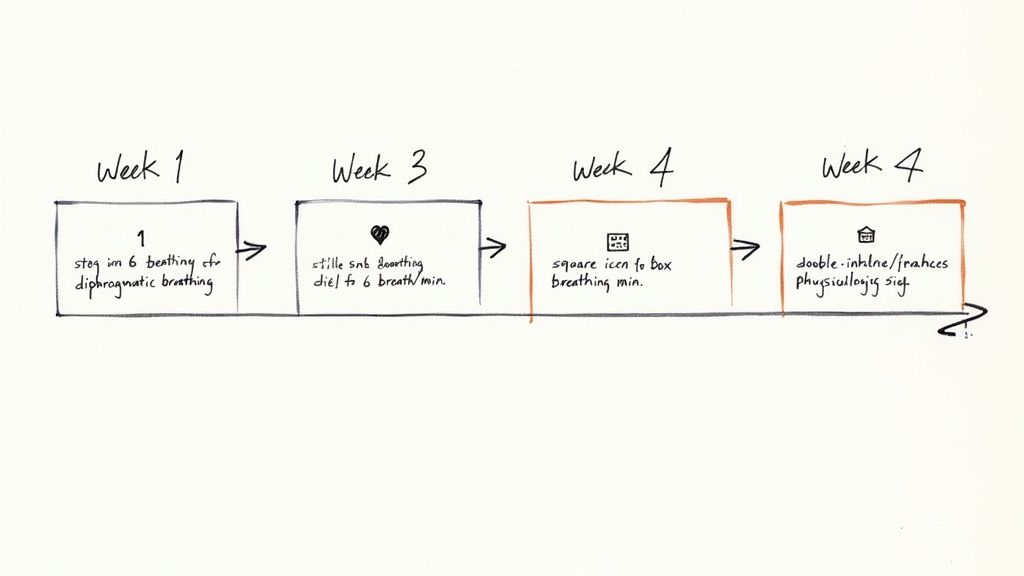
We’ll break it down week by week to keep it manageable. Think of it as building emotional muscle—you start with the fundamentals and gradually add more weight.
Week One: Master the Foundation
Your first week is all about one thing: Diaphragmatic Breathing. Before you can expect to calm yourself in a heated moment, your body needs to re-learn what a truly deep, grounding breath feels like.
- Daily Practice: Set aside just five minutes a day to practice belly breathing. The best time is when you're already calm, like first thing in the morning or just before you go to sleep.
- Action Step: When you feel a minor frustration—like hitting every red light—your only job is to take three intentional belly breaths. Don't just notice your breath; actively change it.
Week Two: Build Your Resilience
Now it's time to introduce the six-breaths-per-minute protocol. This isn't for acute anger; this is your preventative maintenance. Practicing this rhythm tones your nervous system, making you more resilient to stress before it ever boils over.
- Daily Practice: Keep up your five minutes of belly breathing, but now add a second five-minute session focused on the six-breaths-per-minute cadence.
- Action Step: When you feel that familiar irritation creeping in, your goal is to consciously try to slow down your exhale, even just a little. Make it last a count of 5 or 6.
Week Three: Handle Daily Irritations
You’ve built a solid foundation. Now let’s add Box Breathing. This will be your go-to tool for managing the mental chatter and frustration that come with daily life, like a snarky email from a coworker or a difficult conversation.
- Action Step: Intentionally use Box Breathing at least once a day when you face a real, but low-stakes, trigger. The key is to feel how it creates a small gap between the trigger and your reaction, giving you a crucial moment of clarity. For example, before responding to that annoying email, do four rounds of Box Breathing.
Week Four: Integrate Your Emergency Brake
In this final week, we bring in the heavy hitter: the Physiological Sigh. Think of this as your emergency brake for when you feel a sudden, intense surge of anger or panic.
Because it's an emergency tool, you need to practice it when you're calm so the movement becomes second nature. Do it a few times throughout the day, just so your body knows the pattern.
By the end of this month, you won't just know these techniques—you'll have started hardwiring them into your nervous system. These breathing exercises are powerful, and they become even more so when combined with other effective behavioral intervention strategies that support lasting change.
Here’s a simple table to help you keep track of your practice.
4-Week Breathing Practice Schedule
This structured weekly plan is designed to help you build a consistent breathing practice for anger management.
| Week | Daily Practice (5-10 mins) | In-the-Moment Focus | Goal |
|---|---|---|---|
| 1 | 5 mins of Diaphragmatic Breathing. | Use 3 belly breaths during minor frustrations. | Re-establish a natural, deep breathing pattern. |
| 2 | 5 mins Diaphragmatic + 5 mins 6 Breaths/Min. | When irritated, gently try to lengthen your exhale. | Strengthen your nervous system’s resilience to stress. |
| 3 | Continue daily practice. | Use Box Breathing for moderate daily stressors (work, traffic). | Manage mental chaos and create a pause before reacting. |
| 4 | Continue daily practice. Practice Physiological Sigh 2-3x. | Use the Physiological Sigh for sudden, intense anger spikes. | Have an "emergency brake" for moments of high emotional intensity. |
Following this simple schedule will help you turn these exercises from a chore into a reliable, life-changing skill.
What If It Doesn't Go Smoothly? Troubleshooting Your Breathwork Practice
Starting a new routine, even something as natural as breathing, can have its own little bumps in the road. It's totally normal. The goal isn't to be perfect from day one, but to know how to navigate the challenges when they pop up.
One of the most common—and frankly, weirdest—things that can happen is feeling more anxious when you first start paying attention to your breath. If this is you, I promise you’re not broken. It's often just a sign that your system is so accustomed to being on high alert that the sudden downshift feels foreign and almost threatening.
What to Do If Focusing on Your Breath Makes You Anxious
If you feel that spike of panic, don't try to power through it. The whole point is to work with your body, not against it. The simplest fix is to shift your focus from an internal sensation (your breath) to an external one.
- Look around you: Find five blue things in the room. Name them silently.
- Tune in to sounds: What are three things you can actually hear right now? The hum of the fridge? Distant traffic?
- Feel the ground: Push your feet into the floor. Wiggle your toes. Notice how solid the ground feels holding you up.
This is a classic grounding technique that pulls your brain out of its spiral and reminds your nervous system that you're physically safe. By engaging your prefrontal cortex—the logical part of your brain—you’re telling the primal, reactive part to stand down.
How to Use These Breathing Exercises Without Anyone Noticing
Worried about looking strange while taking deep breaths in a stressful meeting? I get it. The good news is that most of these techniques can be completely invisible. Diaphragmatic breathing and box breathing are your secret weapons for public situations.
The trick is to breathe quietly through your nose. Keep the movements subtle. No one can see your diaphragm moving, and a slow, gentle inhale looks just like normal breathing to everyone else. It's a private tool you can use anytime, anywhere.
Remembering to Actually Breathe When You’re Seeing Red
So what happens when you get blindsided by anger and your mind goes completely blank? This is exactly why you practice when you're calm.
Think of it as building "emotional muscle memory." Firefighters don't learn how to handle a hose during a five-alarm fire; they run drills over and over. Every five-minute practice session you do while feeling good strengthens the connection in your brain between the trigger (stress) and the solution (a calming breath).
Don't beat yourself up if you forget. If you get through a whole angry episode and only remember to take one deep breath at the very end, count it as a win. Seriously. This is a practice of progress, not perfection.
Got Questions About Breathing and Anger? Let's Clear Things Up.
You're not alone if you have questions about how a simple breath can really make a dent in a powerful emotion like anger. Let's tackle some of the most common ones I hear.
How Fast Does This Actually Work?
Some techniques, like the Physiological Sigh, can bring you down from a heightened state in less than one minute. It's incredibly fast and effective for hitting the brakes when you feel yourself escalating.
But that’s for the in-the-moment rescue. The bigger goal—reducing your overall reactivity and what psychologists call "trait anger"—takes time. Real, lasting change in your emotional baseline is something you build over several weeks of consistent, daily practice.
Can I Really Do These Exercises Anywhere?
Absolutely. That's the whole point.
These breathing techniques are designed for the real world. You can easily do Diaphragmatic Breathing during a tense meeting or a few rounds of Box Breathing while staring at your computer screen after a frustrating email.
No one around you will have a clue you're actively calming your nervous system. This subtlety is what makes it such a reliable tool when you need it most.
What If My Mind Wanders When I'm Trying to Breathe?
First off, welcome to the club. This is completely normal and expected, especially when you're already feeling agitated.
Trying to force an "empty mind" is a recipe for more frustration. The real work isn't about blocking thoughts; it's about gently noticing when your mind has drifted and guiding your focus back to your breath.
Each time you catch your mind wandering and bring it back, you're doing a rep for your brain. You are literally strengthening the neural pathways responsible for focus and emotional control. It’s this gentle redirection, not perfection, that builds mental muscle.
While these breathing exercises are a powerful, direct tool, they work best as part of a bigger picture. Integrating them with other general health and well-being practices that support your nervous system creates a powerful synergy. The calmer your baseline state, the more effective these techniques will be when a trigger hits.
At 9D Breathwork, we guide you through multi-sensory breathwork journeys that fuse ancient wisdom with modern science to rewire your nervous system for resilience and calm. Discover how our unique approach can help you move beyond simply managing anger to fundamentally transforming your emotional landscape. Explore our immersive experiences at 9dbreathwork.com.